Poetry Shelf toasts Te Marama Puoro o Aotearoa | NZ Music Month 2026
Music streams in the ink of so many poets I love, whether on the page or in the ear/air. Think rhythm, rhyme, chords, key, hooks, harmonies, disharmonies, pitch, bridges. And of course the lyrics.
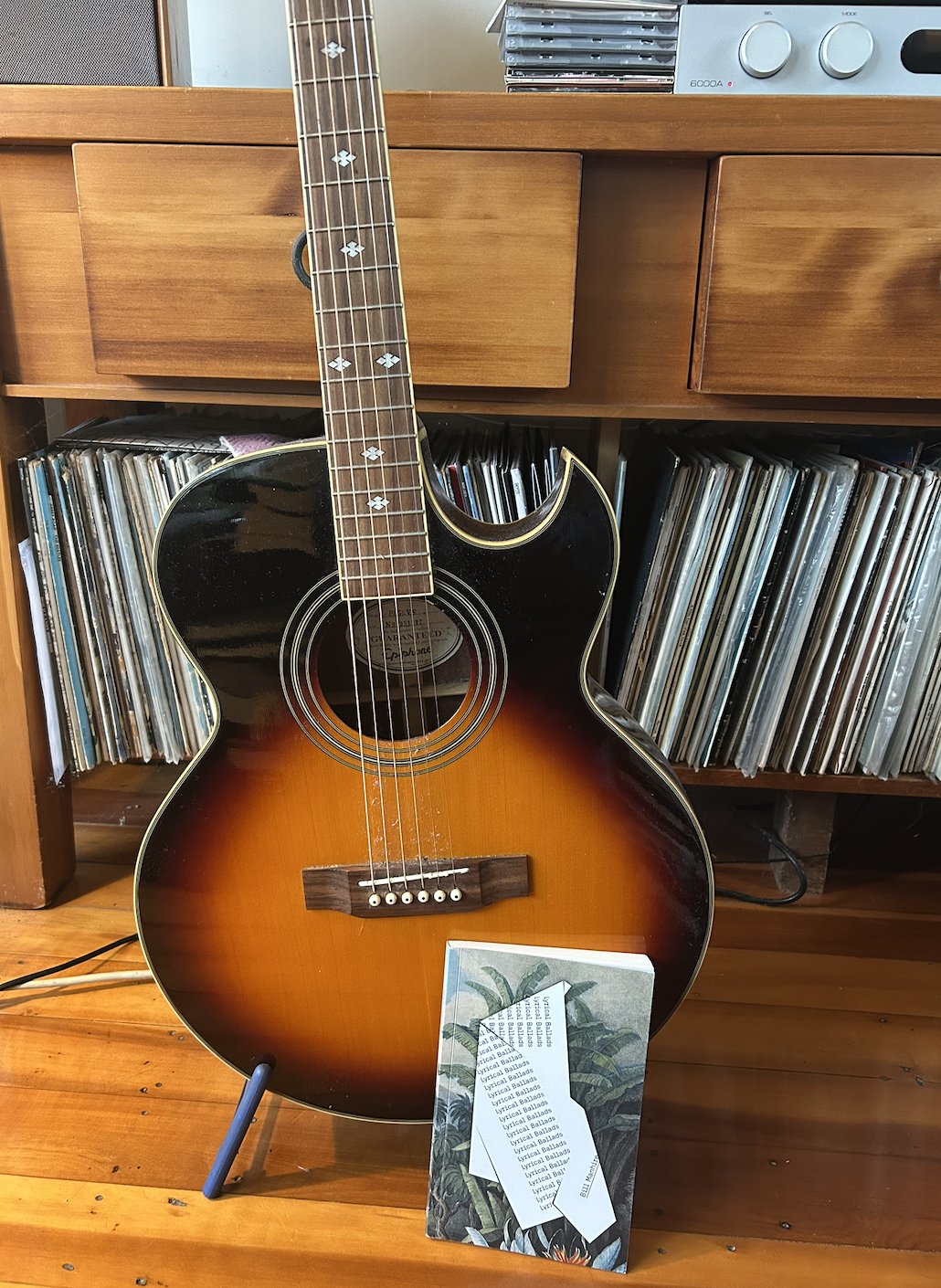
One of my favourite poetry books of 2026 to date, is Bill Manhire’s Lyrical Ballads (THWUP): “And of course there is the ink steeped in music, with rhyme and repetitions, loops, the exquisite lyricism that audio-marks each ballad. My dream is to sit in the Titirangi hall again and listen to Bill read us the whole book as we sit spell bound, before moving to the side room to the spread the locals have put on, to return with plates of food balancing on our knees, and to talk poetry and life until our voices are hoarse.” My review
Yesterday I finished reading Khadro Mohamed’s sublime novel Before the Winter Ends, and it is probably my favourite novel from 2025. Khadro writes with her poetic ear attuned to the musicality of words. I just adore it. I will be posting some thoughts on the book in the next week or so. In fact I seem to be binging on novels with sentences that achieve such musical cadence I am bursting with the pleasure of reading – and daydreaming upon how the ear of the reader is as important as the eye, the heart, the musing mind.
Music is such a connecting activity – listening to music gets us through tough patches, gets our bodies moving, our hearts moving. And how vital live gigs are, having our socks blown away by the utter joy and pleasure of live performances.
I have never invited open submissions to Poetry Shelf, but on the spur of a midnight moment, invited poets to contribute to a poetry / music month celebration. I made the brief open: “YES the poems will offer links to NZ music. Maybe subtle links, maybe a clear spotlight on performances, albums, past or present experiences, music anecdotes, memorable occasions, but the poems may also connect with music as part of our daily lives.”
I got an astonishing arrival of poems, and while it was super hard choosing only a handful, I think I will do a quick-fire submission invite again. Maybe in a few months. Maybe sooner.
Thank you everyone who sent poems. This was an absolute pleasure.
23 poems
Mata singing in the supermarket
It is the first sound I encounter, Mata singing,
a humming hovering over the ripe oranges, tomatoes,
the perfect newly washed potatoes, curling around
persimmons in season, the sultry scent of feijoas
Mata singing, a hibiscus flower tucked behind her ear
Her voice follows me past the morning newspaper,
beyond a magazine with Audrey Hepburn’s face
on the cover, oh those were the beautiful days,
it’s passing the wine bottles, the beer, the lo-alcohol
cans, our sober days are here, it riffs across the scent
of soap and laundry powder, and the eggs,
bread and cheese that sustain us, Mata singing
to children whose mother is buying a happy
birthday cake and lollies; so long as I remember
Mata has been here, her voice crooning
tunes amongst the herbs and spices,
her hair greying. One day she’s not there
but a young woman from Samoa
is at the checkout counter, her voice
soaring. But where is Mata today? I ask.
She will be back, it’s just her day off, the song
must go on, Mata will come back, Mata singing.
Fiona Kidman
When the band played the chords
of their opening song
the crowd surged forward.
Not wanting to be crushed,
he slipped under the stage
like a moray eel
and became immersed
in a reverberating
ocean of sound.
Richard von Sturmer
from a new poetry sequence
White duck
On the way to the gig
I stopped by the sea
the tide was in and slow.
I stood on grey and mellow
stones, marked time, looked out
to the horizon.
A white duck meandered
by, and as I tried (crimped
hands, cramped knees) to revive
the swing, the feel of lines
it parked me beside me:
white feathers, round stones.
There were drumbeats and
triplets and words I could not
remember, though I stared
hard at the sea, the way
the duck did, for verse, bridge
chorus to reappear
which they didn’t, despite
the tight paradiddles
of my heart and quavers
in my knees, so I watched
the duck and the duck watched
the sea until I had to leave,
and I think I played pretty tight,
that night at the Royal Albert.
Jillian Sullivan
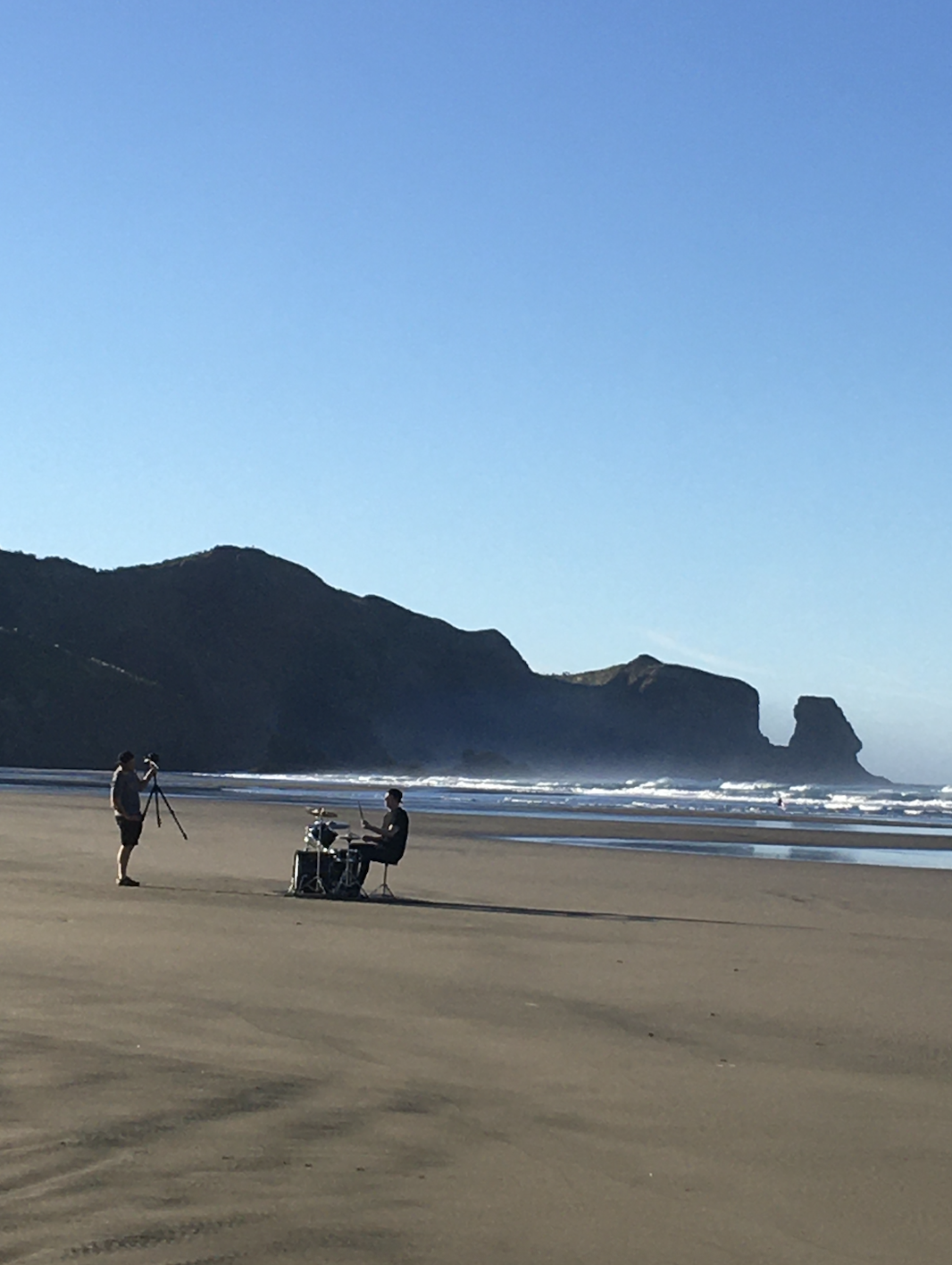
“A poem, published in JAAM, from when I was a drummer (in the all- female band Red Dress, and full of nerves before a gig.”
Amy Winehouse on St Clair Esplanade
A breezy day on the Esplanade,
where nothing escapes the view,
a kid high on a can of Red Bull,
guys in hoodies puffy as cobras.
Drifting from their wound-down window,
the sob-sister on a squawk box,
— make me go to rehab, but I said no, no, no!
Backflips through an ocean’s backyard,
with dipsticks, dropkicks, surf wipe-outs,
salt haze drifting like a filmy drape,
floaty over barren rocks, eroded sand dunes,
flowers yellow as a lick of butter,
yellow as sunshine,
— make me go to rehab, but I said, no, no, no!
I buy a chocolate ice-cream cone for you.
Smiley faces and stuck-out tongues,
there’s e-scooters, shiny shells of cars,
and peeled from a seal-black wetsuit,
the pipe-band drum-major’s leg tattoo,
— make me go to rehab, but I said no, no, no!
Your pointy leather boots clack on concrete,
while hunch-backed scolds of gulls
are moving red-webbed feet to a ska beat,
they’re crying out like Amy Winehouse,
— ska, ska, ska! — no, no, no!
The evening sky vamps like a lava lamp
of tie-dye kaftan mauves and yellows,
but now there’s no scamp Amy Winehouse
to echo along with the seagulls,
— ska, ska, ska! — no, no, no!
David Eggleton
published in Otago Daily Times in 2024
Organology
I dropped my new earrings in the sink
and fished them out again. Only a small dark
fingerprint of tarnish gave any indication
of their drainward descent. I wore them out
to the orchestra, where we stared up the legs
of the cellists, in the cheapest of cheap seats.
Sitting there with a new friend I wondered how
it all turned out like this — libraried afternoons, waiting
nights, hurried mornings — all these violins oiled
by the fingers of guys who would have worn wigs
and white powder and all the rest of it. My friend told me
he cried, and I chose to believe him. He has eyes
like I’ve seen in photographs from 1912. The evolution
of cornets mimics the evolution observed in fossils.
Ammonites curled in spirals as if sleeping. I almost
bought one the other month with my cousin, at that
incensey place on Willis Street; a tiny crystalline
thumbnail of a thing. A lover, somewhere, reaches
for a nightstand. I didn’t see any tears fall.
I saw the wood, worn and singing, and fiddled with my rings.
Cadence Chung
Quantum Decoherence at a Bailter Space Gig, 1989
20 July was my seventeenth birthday
and I went to Sammy’s on a Thursday night.
Cold and rain, a winter standard for Dunedin.
My one clear memory is standing alone
on a fairly empty dance floor,
spotlit by a stream of sodium blue light
while feeling my neural networks
being reformatted by a subsonic phase shift
on top of which an avalanche of white noise
glued loosely together with a standing wave
of human friendly harmonic frequencies
pulsed from side to side of the hall
while bodies swayed like reeds in a gale.
When I left some time after midnight
life had changed permanently,
and my inner ears were filled
with a softly anesthetic snowfall.
Victor Billot
from The Sets, Otago University Press, 2021
The Smith the Grocer girl
wipes tables, ferries plates
and bowls and cups and jugs
back and forth to the counter
After the rush
tray-laden in the light-filled well of the old lift shaft
she looks up
and pitches a melody
rung by perfect rung
to the sky
and you know she’ll climb it
It’s for her the cutlery
has stopped clacking, and in their pre-porcelain
clay, their porous places, the saucers,
it’s for her they listen and thirst
Sue Wootton
from By Birdlight, Steele Roberts, 2011.
Phoenix Foundation
(for Will)
“En-tnt”: that was what you used to call
an elephant. You’d say “I carry
you” when you wanted to be picked up.
Each time we read that page in Peter
and Jane where the farmer is getting
ready for work, you’d shout out “Boots on!”
because on walks you wore your red boots.
You had long yellow curls like Little
Lord Fauntleroy, a Leicester accent
thick and ruddy like the local cheese.
Once in the grocer’s in Stoneygate,
an old lady bent down, stroked your hair,
murmured: “What a very pretty boy.”
“Fook off!” you said, staring at your boots.
She jerked her hand away as though stung.
Years after, I see you running round
and round a room, arms flapping wildly.
You stop. “I can’t fly,” you say, surprised.
But here tonight you’re standing stage right
behind your barricade of drums. Shaved
head, black singlet, sticks raised, you might be
the sorcerer’s latest apprentice.
The guitars kicks in, the blue light spins,
your hands begin to fly.
Harry Ricketts
from Just Then, Victoria University Press, 2012
Martin Phillipps’ eyes
From photos, Martin Phillipps’ eyes
look out; looking for all the world like eyes forever looking out.
The music is all we have of him now.
On walks down the street where he lived
close by our street, I ask myself: Is that the house he lived in?
Not knowing for sure, I can only guess.
For some of us, all that’s left of him is the music, the songs and any memory.
Like the one I have of seeing him, once, in the late nineties,
alone on a stage, playing keyboard
and singing, Submarine Bells. The second time, over twenty years later,
in Ian Chapman’s house at the launch of his book, OK Boomer,
where he was just a man standing at the window
looking out at the harbour, my husband beside him
both of them remarking about the weather rolling in and the yachts,
my husband not realising who the man was until he asked him his name.
Martin, the man said. Of course, my husband thought. Martin Phillipps.
Knowing then why he’d looked familiar.
And they both just stood there a moment longer, looking out.
Kay McKenzie Cooke
“I thought immediately of this poem I wrote after the death of Martin Phillipps of the Dunedin Sound band The Chills. It is a poem that will be in my new collection, My Favourite Set of Lights, due out in November this year with The Cuba Press. Co-incidentally, a new LP by the late Martin Phillipps arrived in my email yesterday to be downloaded through Bandcamp, and today I’ve been listening to songs of his I’d never heard.”
Recipe for a Mother’s Mana
for Helen
It must be possible
to conclude a home concert
without food, without cheesecake,
chocolate cheesecake that is,
but I wouldn’t risk my motherly mana
to find out.
The day before a concert
while I listen to Maestro practise
Brahms and Gershwin on the piano
down in the lounge,
I adapt my sister’s recipe,
my hands knowing what to do.
I crush a packet of biscuits,
mix with two tablespoons of sugar
three of cocoa
and four ounces of melted butter,
then cover the bottom and up the sides
of a lined large round cake tin
with a push up bottom.
Next, as I think through To-Do lists
I beat two tubs of cream cheese
and one of cottage,
a cup of brown sugar
two tablespoons of flour
half a teaspoon of instant coffee
three quarters of a cup of cream
and three eggs.
If you’re a Luddite like me
and beat by hand, it takes time
and grunt till it’s harmoniously blended
but when it is, quickly stir in
300 g of melted dark chocolate,
pour into the crust
and when no-one’s watching
lick the bowl.
It cooks over the next hour
or a bit more in a slow oven,
the smell of melted chocolate
sweetly seeping down the hall
to Maestro at the piano
now with Helen on the viola
practising Schubert and Glazunov.
The next day, after the first course
of the post-concert dinner,
Maestro is back on the piano
jamming with Helen on viola,
violin, cello, flute, guitars
singing.
In the quiet of the dining room
I put out the expected cheesecake
and ambrosia, food of the gods ~
ambrosia ~ how I love that word,
berry yoghurt, whipped cream
tinned boysenberries
chopped marshmallows.
In the end it is simple,
make music
have concert
eat cheesecake.
Tui Bevan
Backyard Blues Revival
This sucks. Among the
reverb thinking I was
tapu then. Not now.
My axe rings
in circles
swinging back
through
the firewood
in my skin
cutting a shard
in scrap tōtara
from the old farm house,
Shick! / Thunk! It cracks
open. Careful now.
Not to
take my fingers,
pare the shard back
down until I
am vinyl and
ten again lost
in a picture of an
old man playing
a Kōauau
and seeing the soul
of my poverty.
i toko
rattling the tauranga jazz fest hum
you came from some crevice
in the city’s noise
from the cafe across the road
from its canopy of
dark-skinned grapes.
the singing blade of you
arrived and rattled the
whispering stars
you stood there
all jaunty in
your tattered coat
and I wanted to
unravel you
thread by pretty thread.
on stage
we inverted chords
swapped surfaces
knelt in snow so deep
it could thaw a summer’s grief
oh how we harmonised,
improvised, be-bob sha-bammed
and all of that jazz
now, pasted down far apart
we hum those old songs
crazy with superheros and
and bright lights
there’s a strange high note
playing in the skies
as icarus and angels fall
and our veins run
feverish with loss.
Lyndsey Knight
The Thistle
Climb the stairs, and tight to the right. Up into the old tea merchants.
There was no lingering smell of potted empire when I reached the top.
Rather the punk cologne of dak, scrumpy, sweat and leather.
Wander in past the array of anarchist books, the dangerous tools of revolution.
Now a google search would be a lot quicker.
And ‘the man’ can keep his tabs remotely.
And the revolution is remoter still.
The PA is old and clad in carpet.
The amps are shared, the drum kit communal.
The masses form up; the sound system rumbles.
The old, the young, and the great unwashed, we are all in this mess together.
We are all a mess, in this mess , together.
Then two sets in, the inevitable disruption.
In flow the police, with shields and truncheons.
And down the stairs we flow, barrelling to the left with a scent of bourbon.
And out into the night of yellow and black, so full of nineteen nineties energy.
So full of pregnant possibility.
Kieran Haslet-Moore
Thistle Hall is a community hall which played a key role in Wellington’s punk/alternative/underground music scene through the 70’s, 80’s, 90’s and 00’s.
Shihad
Unite against
the apathy.
The name on our
backs is your name —
one shared with the
faithful rendered
malleable
in the forge where
crowd surfers’ boots
smash noses of
Medusa boys
with ringing ears,
loose spines whip wild
heads, and masses
roar ’til they turn
to stone. Yet, still,
you would know us,
struck mute, because
the name on our
backs is your name.
Bee Trudgeon
and somehow his silence
from the second row we see stagelights gleam on Jon Toogood’s forehead the bassist’s mouth clenching and unclenching the guy from The Phoenix Fountain mouthing Heart of Gold from stage left
the man next to me has spilled out under the armrest and as the drums pulse through the seats I feel his side belly tremble against my arm
when the song ends he doesn’t clap just turns to his phone some bannered news website something about Trump
and I turn my head just enough to see his grey hair black pants plaid shirt and I’m suddenly conscious of my movements my nodding and tapping along my denim jacket my calling out into the applause
and somehow his silence has sucked something out of the night and I’m searching for it in the bags under the guitarist’s eyes the greasy fall of his hair the grip of his hand on the fretboard grey haze of the smoke machine flicker of lights to blue as the band shifts into the wings
and there’s one guy left on the keyboard Lawrence Arabia I think his name is ginger moustache black jeans brown boots and as he starts to sing I lean into these details knit them together stitch a curtain between me and the guy beside me velvet and dense
his belly quivers against my arm again but there’s no drummer now no bass and in my peripheral vision I see movement a plaid arm rising
and I turn my head just enough to see his thumb and finger spread into a fleshy triangle each one pressed to an eyelid the gleam of blue light in the wetness of his cheek skin
and Lawrence Arabia’s voice seems to fill the space between major and minor the smell of dust and steam the bite of IPA at the front of my mouth the question and the answer when will I see you again
when will I see you again
Rebecca Ball
Lessons
Sunday morning and the light is grey
inside this house. I embrace the heavy silence like a flood
embraces gravity
seeping down beneath buildings and soil and rocks and roots
of living things. Systemic
is in the very name of this disease
and so it takes a long while—everything
takes a long, long while. I learn to measure
distance by how it feels
to walk
to the bakery, the park, the classroom
where I teach teenagers the meaning of words like circulatory and interconnectedness. They are learning
about the human body
the way our organs
work: the heart, the lungs
like singing, I say
the poetry in science
these things that keep us
alive. My flatmate
is sympathetic
says the roads to our house are all uphill
but that is not the story. I am learning
to step outside
this new set of imposed boundaries
the things we normalise
as we gather ways
to place our selves
in the landscape of our grief.
Sometimes it feels like I’ve
misplaced my self
and if I just look hard
enough
I might see my centre
pulsing
behind a mesh of muscle and bone
deep within my stomach with the rest
of my voice. Pacifism is not the same
as passiveness. My other students
are learning to breathe
like they did when they were babies
the diaphragmatic ebb and pull
before we grow
into the panting, holding
tightness
of everyday. But it’s difficult.
We relax and focus at once. Try to recall
the measured freedom
of youth
the evenness, the newness
the burst of life and noise
because babies come out
crying
ready to sing
Lola Elvy
Voyager
this tiny machine
this analog toy
this little adventurer
a glorious toddler
exploring the unimaginable
vastness
of its boundaries
speaks greetings
from Akkadian to Wu
and the walking tribes
that dream their dreams
of the rainbow serpent
sing Johnny B. Goode
and play Mozart
Bach and Stravinsky
at 16 and 2/3 rpm if the finder
has a decent record player
tethered to us by hope
and grit
and dreams
and yesterday’s genius
and dial up speeds
of imagery and sound
and the cacophany of
creatio
go looking for God
beyond grasp of the sun
beyond its anger
its rage
its wrath
the war within itself
that will destroy it
one day
one day
one
day
Ben Brown
Oh my
I was born a devil, he tells me
licking salt off my skin
holy smoke rising from his hot
wings
invites me to feast on gravel and wine,
drive the black sheep over the edge
of this world.
Everybody’s doing it, he says,
smudging the clear dome of my cornea
and I know we’re doomed to die
regardless of what’s written in the water.
Drunk on air, he tastes licorice and tar
notes of sulphur
black sand scorching, scorching.
Mikaela Nyman
“A tribute to Gin Wigmore’s ‘Written in the Water Die Regardless'”
Community Choir
It’s November
& next month, December
we’ll sing at the Rest Home, Silent Night
Pam, alto, says I keep slipping into lead
Pat, bass, says I want to move on ‘dawn’
Jay, tenor, says You leave Dawn alone
Everyone laughs
The dog licks Diane’s – soprano – toes
I’ve been in the garden, she says & everyone laughs again
& Pat learns not to move on dawn
& Pam learns not to sing the lead
& Jay puts his right foot in & his right foot out
Jay shakes it all about & everyone laughs once more Oh Jay!
& Diane’s toes are clean now
That’s better, she says
Sam Duckor Jones
Hugh playing the Moonlight
Hugh is playing the Moonlight
to the valley.
In swannie, shorts and Tuesday’s
socks he takes the stage before
kānuka and jostling miro.
He begins to play.
The kahikātea on the balcony
adjusts the stars upon her
shoulders.
Tawai on the high terrace
bend to pay attention and
kōwhai huddle close where
they can sway in their yellow
ear rings.
Lizard, spider, bird and fish,
rock and lichen, creek and
tussock hold their breath.
Hugh’s fingers find notes
like seeds sown on a stave.
He plants them in the dark
and the music sets leaf. It
grows into a supple vine,
looping tree to tree.
There is nothing more
beautiful in nature than
a man in a swannie,
playing the Moonlight.
Fiona Farrell
Nouns, Verbs etc: Selected poems, OUP, 2020
Be the rising human
Ava and Jasmine wanted to marry you
All the girls wanted to marry you
and you were not even four years old
When you slithered into this world
you opened your eloquent eyes
and cradled silence
From your ancestors, harmony impregnated all pores
Those eyes saw distances beyond the now
observed here from afar and afar from near
A small cough like a chipmunk scattering leaves
and words flow into poems into songs
You are thrumming. Music another name
A tiger-swallowtail alights on bee balm
vacated by hummingbirds and the knock
knock of a pileated woodpecker high in hemlock
tells us you are in this hemisphere, panting for cool air
It’s coming and the cold cold winter too
but autumn gifts us your embrace
Those genes are not ordinary DNA, those genes
Are pure love (made in Australia like your kuia)
Pushed out in Aotearoa now rising in Londontown
Be the leaf, be the branch, be the trunk, be the root
Be the river, be the air, be the soil, be the garden
Be the rising human in this world, beloved
Reihana Robinson
from Be the rising human, Off the Common Press, 2024
Prelude
A mother practices a prelude
agile fingers working
Florence Price’s minor thirds,
woven memory loss survival
A daughter scores sounds
from a tired world
corals and crickets new phrasings
for better listening
A woman watches the moon
round and full
rising over earth’s shoulders
hunched around a harbour
Harmonies dissonances blended experience
recollection rippling
crooked lines in a poem’s spaces imagining
what comes next
Michelle Elvy
from in the poetry / art exhibit ‘The Wild Edge’, Arataki Visitor Centre, Jan-Mar 2026.
Moonlight spell
We reach the point
the mind forgets the mind.
Across our great divide
and down to moon-soaked
spots on the floor. I want
to be so consumed by something,
to think that there is no way out.
Turn off the headlights. Tap the stream.
If poetry could make you love me,
it would, I think. Close the windows.
Lock the door. Show me things.
Show me more.
Jackson McCarthy
“These poems were first published in Starling‘s Issue 14, then set to music by my dear friend Cadence Chung.”