Tag Archives: Poetry Shelf Breathing Room

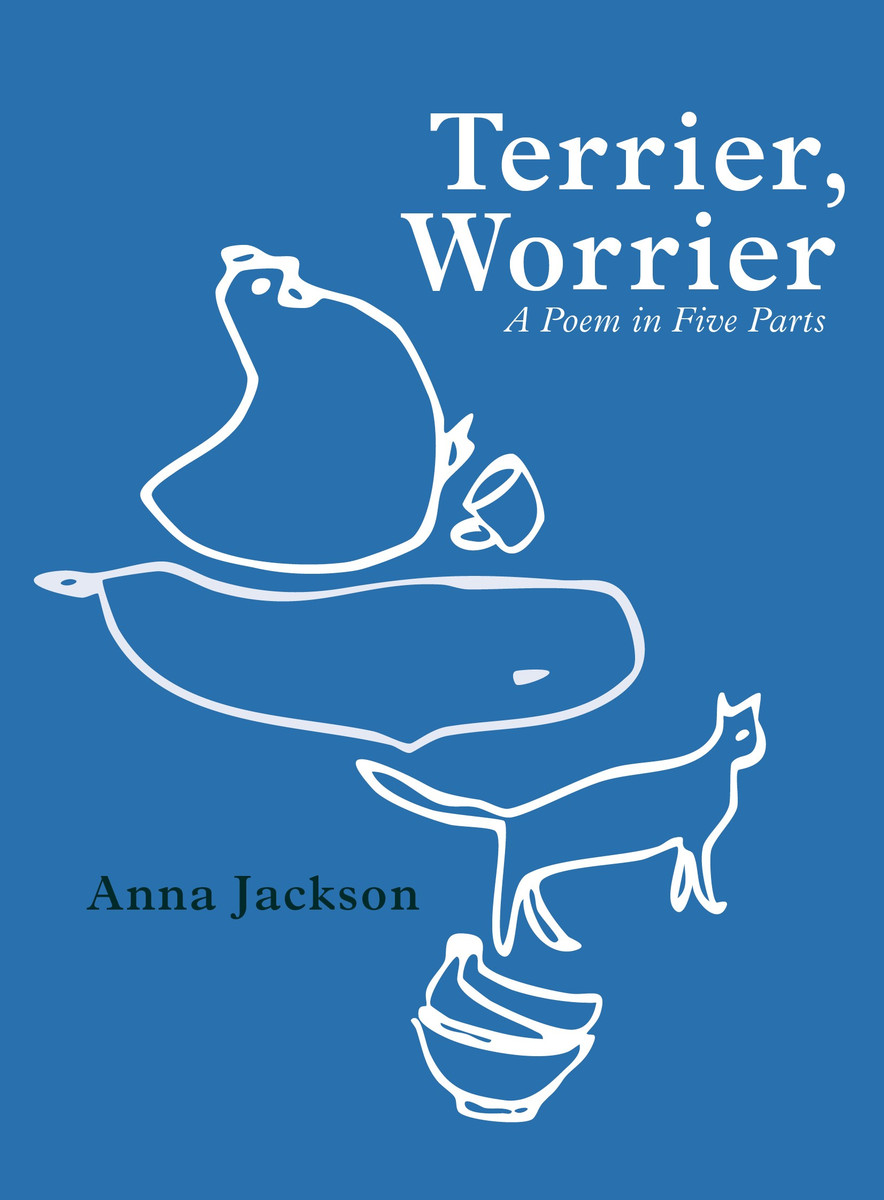
Poetry Shelf Breathing Room: Terrier, Worrier by Anna jackson

I hear birds and thought that although I am only hearing them,
and I am not having a thought, it still feels like a thought, almost
like a thought of my own, or a conversation I am having, or
perhaps it is more like reading a poem, where the words, or the
movement of the thought, the song of the thought, is given to
you rather than coming from you, but still moves through you.

from ‘Summer: Terrier, worrier’

I thought, it tells us something about poetry that when we
need to talk to ourselves about something we don’t know
we know, we tell it to ourselves when we are asleep, in images
we struggle to remember when we are awake, and often take
more than one reading to fully understand.

from ‘Summer: Terrier, worrier’

I wondered if anyone wrote a diary anymore. For writers like
Virginia Woolf this was a daily necessity, a form of expression
so compulsive that a day without writing in the diary felt for
Woolf like ‘a tap left running’, with it being not the writing
she imagined as a running tap but the day itself, as if writing
somehow stemmed from the flow of time. Could the diary really have
become so important to so many writers just because the paper was
cheap, and ready-made exercise books were sold in stationery
shops? Did the diary not answer a need for secret self-reflection
but create the need?

from ‘Autumn: Lounge scale’

I thought, even if the mind is a construction of activity of the
brain it makes no more real sense to think of thoughts as being
located in the head than it does to think of them as located in
the heart. They aren’t material things that can be there behind
the eyes, and why behind the eyes except that I look at the
world through the eyes and so can locate myself there?

from ‘Autumn: Lounge scale’

She came upstairs looking more like a cloud than a silver lining.

from ‘Winter: Hilbert spaces’

I thought, perhaps it isn’t that people high on mushrooms are
accessing some transcendent truth through the unlocking of
their own minds, perhaps it is that they are experiencing life the
way fungi experience it, with a consciousness without individual
identity, dispersed and without borders.

from ‘Winter: Hilbert spaces’

Agnes asked if meaning drains out of life as you get older, and
almost everyone said no, except for me. I answered emotionally,
not logically, and even as I was answering yes I was thinking,
but is a novel drained of meaning in its last few chapters? is a
sonnet drained of meaning after the volta?

from ‘Spring: Matchbox beetles’

I thought, we take it as axiomatic that happiness is the
highest good, but for the Romans it was justice, for the Greek
philosophers it was knowledge. For me, I think is beauty.

from ‘Spring: Matchbox beetles’

Lying on the carpet in our living room, Simon cooking in the
other room, I had the most profound sense of contentment.
I realised I was in the position I spent much of my childhood
in, lying on a carpet, able to play the most complicated
imaginary games in front of everyone, with whatever props
were to hand, knowing that even with the outer workings of
my inner life on display I was completely private because no
one was remotely interested.

from ‘Summer: Memory palace’

Anna Jackson
from Terrier, Worrier, Auckland University Press, 2025

Terrier Worriers is a long poetic sequence divided into five parts, into five season loop: summer autumn winter spring summer. These nine pieces are lifted from the extended sequence.

Inspired by The New York Times invitation to take ten minutes and slowly absorb the artwork they post each Monday, I created an ongoing series, the Poetry Shelf Breathing Room. Here, I invite you to breathe in a poem slowly for ten minutes. I love choosing the poem, I love slowing down to a restorative snail’s pace, to see what is experienced when we unfold a poem slowly.

As I move Poetry Shelf slowly and gently back online, I have spent this week lingering in the Breathing Room. On Tuesday, I was set to pick a poem from Bill Manhire’s Lyrical Ballads (THWUP, 2026) but stayed with the whole collection for several glorious hours. Yesterday it was a painting from Michael Hight’s exhibition, and wrote a poem in response. Today I spent several hours reading Anna Jackson’s glorious Terrier, Worrier again. I am curious to see what happens when I return to books I have loved so much, and to write down my engagements, as I also did with Bill’s new book. On both occasions, the books shifted to reveal new delights and wonders.

Anna’s book is an extraordinary sailing ship, a deep simmer-pot of thinking and exploration: porous moving full of song, with questions puzzles ideas worries that tremble and quiver and navigate as they set sail upon the page. There’s Anna’s recurring dream terrier pulling us into digging up and over and under things, the lyrical lines that carry us with wit and agility. It feels like I am are drawn into the waiting room, a poetry room that’s maybe cerebral physical recalled experienced imagined. An utterly intimate space of poetic and self exploration, where beloved hens cats Simon son and daughter mother and father are seated or standing close, where writing becomes thinking and thinking becomes writing, and everything is steeped in a slow braise of feeling and being and tenterhooks and life, yes above all life. To read this precious book, in my three-day Breathing-Room retreat is utterly precious.

Anna Jackson is a poet and Professor of English literature at Te Herenga Waka/Victoria University of Wellington, whose latest book Terrier, Worrier came out with Auckland University Press in 2025. She is the author of seven collections of poetry as well as Diary Poetics: Form and Style in Writers’ Diaries 1915–1962 (Routledge, 2010) and Actions & Travels: How Poetry Works (Auckland University Press, 2022).

Auckland University Press page

Poetry Shelf Breathing Room: Kyeburn by Michael Hight

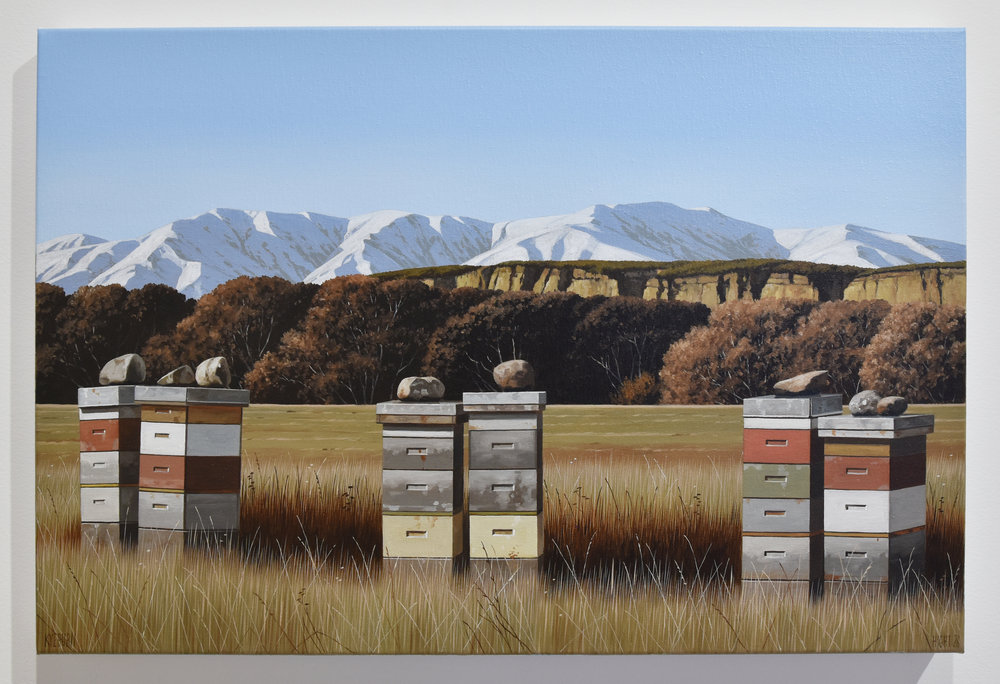
‘Kyeburn’ by Michael Hight
from The Seasons, Gow Langsford Gallery, 2026

Kyeburn

Light rises, an ocean swell across the mountains
Heartbeat rhythm of the snowcapped range
Light licking the shivering grass
There’s music of honey bees and autumn willows
There’s light stoking the blue sky beauty
Rhythm of the hives and a person pausing
The light swashes and laps, and we’re on the Maniototo Plains

Paula Green

Inspired by The New York Times invitation to take ten minutes and slowly absorb the artwork they post each Monday, I created an ongoing series, the Poetry Shelf Breathing Room. Here, I invite you to breathe in a poem slowly for ten minutes. I love choosing the poem, I love slowing down to a restorative snail’s pace, to see what is experienced when we unfold a poem slowly.

For the first time I am posting both an art work and a poem, extra special as the artist is my partner Michael Hight. When I most need it, I walk up the hill to his studio, sit on the couch and absorb the beauty, stillness and extraordinary light of a beehive painting. Unfold a painting slowly. Last week I stood in his latest Gow Langsford show for ten minutes, breathed in the beauty, and felt body and heart recharge. My wee poem is simply a tentative bridge to the ripples his work lit in me. This gift. This incredible gift.

Michael Hight is best known for his hyper-real paintings of beehives in the New Zealand landscape, which frequently depict locations in Central Otago and Canterbury. Hight’s more recent works include dark, surreal dreamscapes that weave in imagery of objects that have a personal significance to the artist. Toys, musical instruments, books, rusted corrugated iron and other such items are set in striking juxtaposition to rustic landscapes, often with dark skies above.Hight has an exhibition history of more than 30 years. He continues to exhibit regularly in New Zealand and Australia. Highlights include inclusion in exhibitions at City Gallery, Wellington (2001 and 2007)—and his work is held in numerous public and private collections in New Zealand, and private collections in the UK, Germany, Italy, USA, Hong Kong and Australia. In 2014 Gow Langsford Gallery published his first monograph Michael Hight: Crossing the Line.

Gow Langsford Gallery has represented Michael Hight since 1987.

The Seasons page

Poetry Shelf Breathing Room: Three poems by Bill Manhire

The Distant Road

Some days I try to stare past
the distant road
at all the roads beyond it

nothing there yet

then the noise of desperate engines
comes on the wind
the sound of waves too and

look!

a child runs into the safe small waves
pauses a moment then
sits down on his well padded

autobiography

Poetry Updates

Yes, there will be sadness.
There will be metaphors and music.
There will be music and the lovely names.

There will be the beating of hearts,
the happiness of trees beside water,
plus death with its aches and gratitude.

And more on this throughout the day
as fresh information comes to hand.

The World About Us

There was a weatherboard church
but no settlement to speak of

just a few houses
some bewildered passers-by

I remember wild bells ringing underwater
a line of torn macrocarpas

also the sound of children coughing
someone had made this whole thing happen

Bill Manhire
from Lyrical Ballads, Te Herenga Waka University Press, 2026

Inspired by The New York Times invitation to take time out and slowly absorb the artwork they post each Monday, I created an ongoing series, the Poetry Shelf Breathing Room. Here, I invite you to breathe in a poem slowly for ten minutes. I love choosing the poem, I love slowing down to a restorative snail’s pace, to see what is experienced when we unfold a poem slowly.

This morning, I wanted to choose a poem from a book I have loved so much, Bill Manhire’s Lyrical Ballads, and found myself absorbed for several hours. The whole book became my Breathing Room, not just one poem. Again I experienced surprise and delight and nourishment. Lyricism. Prismatic tracks and electric undercurrents. An infectious love of writing. New things sung in mind: ideas, images, feelings. And yes, for many of us, poetry is the perfect uplift destination when the road is spiky (along with a bowl of green goddess soup!). Bill gave me kind permission to share three poems – do track down a copy of the book! It is a Breathing Room gem.

Bill Manhire’s latest poetry collection is Lyrical Ballads, THWUP, 2026. He has won the New Zealand Book Award for Poetry five times, and was New Zealand’s inaugural poet laureate. He founded and directed the International Institute of Modern Letters at Te Herenga Waka—Victoria University of Wellington. He has edited major anthologies of New Zealand literature, including, with Marion McLeod, the now classic Some Other Country: New Zealand’s Best Short Stories (1984). In 2018 Bill was awarded an Icon Award Whakamana Hiranga from the Arts Foundation.

Poetry Shelf Breathing Room: White horses by Gail Zing

White horses
at the Christchurch Symphony Orchestra 

The percussion rolls in / and
out / in and
out the swell / a perfect swell / an ocean growl
so deep / and she is fine
on the edge of her folding seat 
next to her friend / and the girl in the story next
to her friend / the pilot who invited her
on this gig / the symphony thickening / with opening
courage / and PTSD in the hooves
of the ocean drums / and the flying girl / and the
ocean rising to the sky flute / when the girl /
returned from world war one / turns / between notes 
to pick up her handbag / it seems / but
lifts the handle on the exit / door to the airstream 
over Cook Strait / the rush of cellos
she leaps out / into the horn of the sky

the air is not the ocean / it is a piccolo 
she is rushing / through blue air and tinkling
but the air is the air is the air
until it is

a long flatline so hard / a body can fall through

how long it lasts / how small a suspension
my friend’s arm against mine / 
in the clang / the pilot must drop /
to look for his friend / in the ocean /
and there are only / white horses

the complexity of a galloping drum / he circles again 
and again / and everything is lost
the heads of crowds / the marvellous conductor
until there’s only a stampede / the
swell / of all those beating hearts 
on the edge of their folding seats.

Gail Zing

This one is FOR the CSO for telling this NZ story in music, about a nurse (Viva Farmar) who survived WWI and came home to jump out of her friend’s aeroplane over the Cook Strait a while later. The friend, the pilot, described that all he could see was the white horses or wave-tips in the sea, she was completely gone. I was so moved by the music that captured this tragic story I wrote this poem – art inspiring art, connections on connections across time.

Gail Zing is a Te Waipounamu author of three collections of poetry, including Some Bird, selected for Best Poetry Books 2024 by The NZ Listener. Winner of both Caselberg and NZPS International Poetry Competitions and placed in many others including the 2025 Fish Poetry Prize and Hungry Hill Political Poetry prize, her work appears in Poetry Aotearoa, Cordite Poetry Review, Poems for the Planet, Stone Circle ReviewCatalyst, Landfall, The Spinoff and others. She is a freelance editor, including previously for a fine lineFlash Frontier and takahē, and she teaches at Write On School for Young Writers and Hagley Writers Institute. In 2025 received a residency at Robert Lord House in DunedinSee more here

Poetry Shelf Breathing Room: Empty Coat Hangers by Joy Sharp

Empty Coat Hangers

They hang there
heads drooping
naked skeletons

I gave away your shirts
The jeans I ordered for you
from England
fit my brother

You’re gone

But last night
I heard you
in the wardrobe

Empty coat hangers
swinging around 10 pm
doing your dance

Did you notice
I left some
of your favourites

The one that reads
Last Clean Shirt
and your most
comfortable shoes

Disturbed from dreaming
I woke excited
thinking you had returned

But what were you doing
shaking your booty
at 10 pm rattling
the empty coat hangers

This morning on GeoNet
3.9 south west of French Pass
shaking at 9.55 pm

I thought it was you
doing your dance
coming back to me

It was only
a silly earthquake

Joy Sharp

Joy Sharp was born in Hamilton and now lives in Nelson where she spent seven blissfully happy years with her husband Iain, before his death early this year from blood cancer. She has an MA (hons) University of Auckland where she was a graduate of the Creative Writing programme. Her chapter on Meg and Alistair Campbell in Between the Lives: Partners in Art arose from her Masters thesis on Meg’s poetry, and she wrote the introduction to the Campbells’ last published collection: It’s Love Isn’t It? The Love Poems. Joy is a past winner of the Whitireia Pietry Competition, the Sunday Star Times Short Story Contest, and the Lilian Ida Smith Award. She was also highly commended in the BNZ Katherine Mansfield Short Story Competition.

Poetry Shelf Breathing Room: Puanga by Airini Beautrais

Puanga

The children are making the river.
They have sand and pumice. They have ferns.

A teacher unrolls masking tape,
presses a map to the wall.

There are birds that sing when squeezed.
Wild-eyed, a girl clings to a tūī.

There are little whare, into which
the birds can be inserted.

A boy carries the kōkako
around all morning.

*

Over the radio, silence.
Then the swish of piupiu,

tread of feet,
pat of plastic poi.

Stillness. Silence moves
across the airwaves.

A drum, a guitar strum
breaks it. Girls open their throats.

The sound of lungs filling.
The loosing of tongues.

*

This is Puanga, or Rigel.
The laser pointer circles the gleam.

Children’s heads silhouetted
by the projector,
continually in movement.

This is Matariki, or the Pleiades,
or Subaru.

But in Whanganui,
Puanga is the star
we look for in the new year.

*

The children have made star biscuits.
They have harakeke. They are weaving stars.

Milo in the star-cave,
telescopes searching cloud.

They have playdough the colour
of night sky, filled with glitter.

Dressing gowns, gumboots, woolly hats.
A brazier in the sandpit.

The smell of damp air.
The smell of burning sugar.

*

It is a time for planting.
A child chooses a pine

with blue-grey needles.
It will bear nuts in forty years.

A time for gathering.
Pink yam fingers poke from the soil.

A time to prepare new ground.
Bared black of loam.

Where can we plant this tree?
Where will it cast its shadow?

*

From here, Puanga.
From here, Rigel.

In the sky a hunter stands
on his hands,
both feet upwards.

In a tank a real eel.
The silver of īnanga.

The stones are lined up,
the birds are positioned.
The children are making the river.

Airini Beautrais
from Flow: Whanganui River Poems, THWUP (VUP), 2017

 Airini Beautrais lives in Whanganui. She is the author of four poetry collections, a book of short stories, and an essay collection. Her new poetry collection, Salt Quilt, is forthcoming from Te Herenga Waka University Press in July 2026.

The Poetry Shelf Breathing Room: A place to enter and pause and take a long slow breath and then another, as you absorb the beauty movement joy stillness wonder movement of a poem.

Poetry Shelf weekend reading

Poetry Shelf offers a five links for you over the long weekend.

First up Michelle Elvy’s Monday poem: ‘Memory is a feather’

Secondly Manjit Grewal’s poem in Poetry Shelf Speaking Out To For With. Food inequality is ia key thread: ‘Saturday Morning at St Peter’s

Thirdly Nina Mingya Piowles Katherine Mansfield poem in The Breathing Room: ‘Katherine Mansfield Park

Fourthly, Elizabeth Smither and I in conversation to celebrate her new collection, The Interview Rose (AUP).

Fifthly, and quite wonderfully, Poetry Shelf toasts Te Marama Puoro o Aotearoa | NZ Music Month 2026 with 23 poems. My first ever open invitation to submit a poem. And I loved doing it so much I might very well do another one!

Please note our post shop is closing so I am in the process of getting a new post box at a different venue.

Do send me poetry news.

Your support of poetry this week has been extraordinary. Let’s continue to connect, challenge, console, delight in the uplift and sidetracks and over bridges and fertile clearings of what poetry can do and be.

Thank you.

new parcel opened

Poetry Shelf Breathing Room: Nina Mingya Powles

Katherine Mansfield Park

After we moved away, I often thought about the park. I thought of how I
used to practice rolling sideways down the hill. I thought of grass stains
on my elbows and dirt beneath my fingernails. I thought of sitting on the
seesaw licking the pink icing off hundreds-and thousands biscuits.

This must be the place where I first saw her name. It was printed in yellow
letters on a signpost next to the slide.

If I could, I would tell her I like the park best at dusk in summer,
looking up at the green hills looming above. I would ask her if she
remembers this—the moon rising and shapes collapsing inside their own
shadows, birds flinging themselves out of the bush, calling out to each
other in the dark.

Nina Mingya Powles
from the chapbook, ‘Sunflowers’ in Luminescent, Seraph Press, 2017

Nina Mingya Powles is a writer from Aotearoa based in the UK. She is the author of several poetry collections and pamphlets, most recently In the Hollow of the Wave (2025), Magnolia 木蘭 (2020) and two books of creative nonfiction, Tiny Moons: A Year of Eating in Shanghai (2020) and Small Bodies of Water (2021). She is part of fieldnotes collective, an experimental nature writing project in collaboration with Alycia Pirmohamed, Jessica J. Lee and Pratyusha. She writes a monthly substack on food and memory called Crispy Noodles.

The Poetry Shelf Breathing Room: A place to enter and pause and take a long slow breath and then another, as you absorb the beauty movement joy stillness wonder movement of a poem.

Poetry Shelf Playing Favourites: Anna Jackson chooses Amy Marguerite

drives and drops

we were hitting the shuttlecock 

and it started to rain and you 

started singing and all of a sudden 

i knew what i had to do to be good 

at this game and the girl sat 

beside the net complaining about 

her body and the tide came 

closer and sleep seemed further 

away and the book i was supposed 

to have finished was still on the couch 

and i love the way you put your arm 

around me there and i want you 

to do it again and we are so wet now

it is time to get undressed and the 

clothes stay on and the girl puts on 

an accent and the net falls onto 

the grass and this is so convincing 

i might never read again and the boy 

brings us beer and badminton is easier 

when you’re drunk and i am getting 

so good at this and i am never 

good at anything and everything 

smells like the dinner we forgot 

to take out of the oven and the ocean 

that is so close i am already 

swimming and let’s just drop our 

racquets

Amy Marguerite
from over under fed, AUP, 2025

drives and drops

I have been thinking about voice in poetry, and a student, Erina French, pointed me to Alice Notley’s observation that “a good poetic voice must have … something like vividness, actual presence of the live poet in the dead words on the page—the poem is very little without that.”  I don’t know if words on a page are ever dead to me, but I do know that any writing I have ever read by Amy Marguerite is somehow more vividly, urgently alive than almost any other writing I can think of, including even those writers Amy Marguerite loves for their aliveness, Grace Paley and Eileen Myles (I love them too).  “To make that transference is a mysterious thing to do,” Notley says, but this poem, “drives and drops,” being, as it is, about finding a way to live with the vividness and presence of a good poem, tells us something about how this transference might come into being.  It is a poem about playing badminton with such abandon that everything becomes part of the game, and the game becomes part of everything around it – the book left unread is part of the game of badminton, the girl complaining about her body, the dinner forgotten in the oven, the tide coming in… Of course everything and everyone is going to get wet!  In a poem like this, you are already swimming before you have even dropped your racquets.  Are we in love?  The desire coursing through the poem, out of which pours forth the poem’s dizzying trajectory, somehow languorously slow and heart-stoppingly fast at the same time, in a very badminton-like way, cannot possibly not be felt by any reader of the poem who knows how to love.  Who, reading this poem, could help but love the poet, the players, the game itself and everything the game encompasses, which is nothing less than the whole world?

Anna Jackson

Amy Marguerite (she/her) is a poet, essayist, and peer support worker living in Pukekohe. In 2022, she completed an MA in Creative Writing at the International Institute of Modern Letters. Amy’s debut collection over under fed was published by Auckland University Press in March 2025. Her essay on the new generation of Aotearoa poets features in Te Whāriki: Reading Ten New Poets from Aotearoa, published by Auckland University Press in October 2025.

Anna Jackson is a poet and Professor of English literature at Te Herenga Waka/Victoria University of Wellington, whose latest book Terrier, Worrier came out with Auckland University Press in 2025. 

Poetry Shelf Breathing Room: Majella Cullinane

Feather

If only every day was as simple as listening to birds, their small voices
plucking the grey-blue morning, emboldened on this first day of spring.
We too might dare to hope that what has long been desired is not so far away.
Let’s suppose it is here already, as real as this room’s radiator
switching itself on and off; the thermostat of our longing unhindered
by a dial of hours. Rather it exists in a kind of elsewhere,
or takes form in the wanderer who crosses bridges and borders
without restraint. Better to loosen the tangle of our rough wishes,
of the could-have-beens and might-have-beens and know we had it all,
just for a moment. Beneath the clamour of sounds –
logging trucks rattle to and fro from the port, a dog barks at the passersby.
A friend writes a message, subvoce – imagine, imagine,
and the bird that sheds a feather without knowing,
is the one we might chance upon, pick up and carry home.

Majella Cullinane
from Whisper of a Crow’s Wing, Otago University Press, 2018

Majella Cullinane writes essays, fiction and poetry and has lived in Aotearoa since 2008. She has published three poetry collections with Salmon Poetry Ireland and Otago University Press. Her most recent, Meantime (Otago University Press 2024) was chosen as The New Zealand Listener’s Top Poetry Books Of 2024. In 2020 she graduated with a PhD in Creative Practice from the University of Otago. Her short story collection Islands Ever After (Quentin Wilson Publishing) will be published in June this year. She lives with her family in Kōpūtai, Port Chalmers.

The Poetry Shelf Breathing Room: A place to enter and pause and take a long slow breath and then another, as you absorb the beauty movement joy stillness wonder movement of a poem.