Tag Archives: Poetry Shelf audio

Poetry Shelf Conversations and Readings: Amber Esau

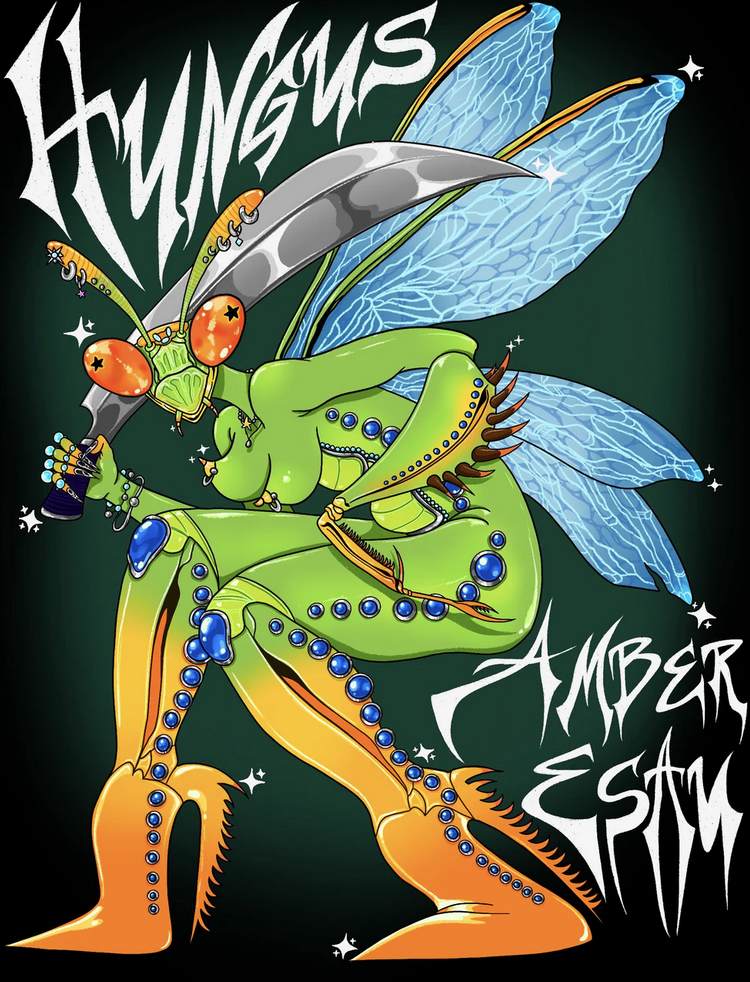
Hungus, Amber Esau
Te Herenga Waka University Press, 2026

To celebrate Amber Esau’s terrific new collection, Hungus, Amber reads some poems and answers six questions. The conversation is like a surrogate review as I enthuse whole-heartedly on why and how I love the book so much.

a conversation

Paula: I love reading your collection so much. For all kinds of reasons. The rhythm of reading for a start. At times it’s like a lightning storm with my heart pumping, at times like that beauty moment when I stall and star gaze. Slow, fast, utterly inspiring. What was the rhythm of writing like for you?

Amber: A lot of the shorter poems and the foundations for the longer poems were written during my MA year but they really started crystallising once I had distance from the work. I had started editing it pretty soon after finishing my course but it was still very undercooked. I spent over a year not looking at the manuscript, reading and editing other poets’ works, before I could finally see mine better. The first draft of poems were a lot more slippery and while I love that uncertainty I was better able to accept where too much elusiveness was limiting my writing. The varying rhythms between the poems are likely in part due to these different concentrations of time. It’s also very Geminian of me to love a switch up like I do!! At my core, though, I am a turtle writer; slow on land, quick in the water.

Paula: Another love for me is your agility with words. Every line is sheer music delight, with sonic shifts and dances. Sweet sharp savoury. There’s hip jargon, urban slang, words that smash together or elide, words that jam in harmony, disharmony, similes that stick and surprise. I just want to hear you read the whole friggin book. Out loud. Honestly your use of words is inventive, life-rich, like a K-Rd dairy-on-the-corner milky hills mosh pit symphony. Do things sing differently as you move between page and performance?

Amber: Wooooah I really appreciate that, thank you. I never used to read my poems aloud until I finished writing them which often surprises people about my process. We all have our own internalised sense of rhythm and I have secretly always wanted to be a rapper. I think that kinda gets injected into the writing. If I say a poem aloud too early though, it starts trying to rhyme too much and I have to reset myself. This process creates a mean tension between the sounds of things and the meanings of them. I also grew up in a predominantly Samoan speaking household but I only spoke English. I understand Samoan better than I speak it and I think there’s something in there about learning a language only through the ears in relation to learning a language through the verbal and written word. The former is more mutable. Sometimes, I still have to say Samoan words aloud to know what I’m reading on the page and tbh, “fobbing” up my English is where I feel most at home. I think this might be a common experience within a lot of immigrant households.

Paula: The title, ‘Hungus’, magnetised me, with its connotations of both enormousness and hunger. And The Mantis, the equally mesmerising prankster figure on the cover who appears larger than life in poems, electrifies your writing ink. Did your relationship with The Mantis change over the course of writing the collection?

Amber: The Mantis is comical and menacing and laced in a sort of cartoonish violence that feels so familiar to me. I used to view it steeped only in its “badness” which was both alluring and repellent. Originally, the Mantis was very archetypal in my imagining and slowly I started wondering what the flipside to this figure would be… kinda in the way that Hinetītama becomes Hine-nui-te-pō. That’s where the Manaia comes out of. We all hold many contradictions and there are many factors that transform us – for better or worse, eh. Mostly though, I started to consider the Mantis’ capacity for change and how bloody annoying that is and how maybe that means it’s still possible.  

Paula: Your collection has tendrils and roots in sky and land. It feels personal and it feels imagined. It feels political and it feels mythological. It feels like poetry of now and then and might be. Yep, as the blurb says ‘a work of world-building’. I love that. Was there an ignition point for the collection? Experiences, world, possibilities, real or imagined, that you wanted to ‘visit’ as you wrote.

Amber: Oh that’s mean as! Thank you! Originally, I planned to explore addiction/the addict in a way that echoes the different representations of Maui across the pacific. It wasn’t until the Mantis started bubbling to the surface that I had something to craft around. Warping Maui into the Mantis felt like an interesting entrance into the intersections of urban indigeneity and moana diaspora. It took a few versions of the work as a whole to realise that a big part of Hungus is about the idea of empire and ways we maintain certain legacies; of expanding so as not to be swallowed; of establishing hierarchies within a language; of projecting hurts as a form of self-preservation; of resisting meaningful change. In my experience, these also rhyme with the ways that power dynamics and inherited traumas are expressed within the home.

Paula: For me writing is a secret private intimate activity and also a public one, whether through Poetry Shelf poet connections or as a published author. Your moving acknowledgements page underlines how important other writers are to you, how important writing communities are. Do you need a secret private writing space alongside your nourishing community space/presence?

Amber: Definitely. I’ve gotten into a pretty consistent journaling practice which has helped me figure out what I’m actually saying, how I feel about my daily life, responses to current events, lots of dissecting my traumas lol, small notes for projects, and what I’m reading. Too many tokes back in the day means my memory is kinda shoddy though, so it’s been really useful writing about the books I read to help my recall.

Paula: In this upheaval world, a world that is straining and testing the foundations of humanity, what matters to you? As a writer yes, as a new voice yes, and as daughter, sister, friend, human being?

Amber: It’s hard not to be somewhat cynical about where humanity is heading, but publishing a poetry collection feels like an act of hope and faith. The other day, my brother, who doesn’t read poetry at all, texted me he’s been really enjoying the book, slowly reading through it, and cracking up that some poems have been sparking unexpected insights within him. It’s important to me that my brother, someone who has always felt a lil excluded from literary spaces, has found a place to dock in my poetry. This doesn’t mean that I’m anti-intellectualism – I’m just suss about the hierarchy of languages and knowledge systems lol. My idealistic ass still thinks that language fuckery is one of the many ways we might shift the collective psyche towards learning how to sit with uncertainty and make space for each other on our terms.  

reading

Amber reads from Hungus

Amber Esau is a SāMāoRish (Ngāpuhi / Manase) writer from Tāmaki Makaurau. She is a poet, storyteller, and professional bots. Always vibing at a languid pace, her work has been published both in print and online. In 2023, she co-edited the queer poetry anthology Spoiled Fruit. She is a past recipient of the emerging Pasifika writer’s residency from the Michael King Writers Centre and the Ideas In Residence residency from the Basement Theatre. Hungus is her debut collection. 

Te Herenga Waka University Press page

Poetry Shelf celebrates new books: Chris Tse reads from Super Model Minority

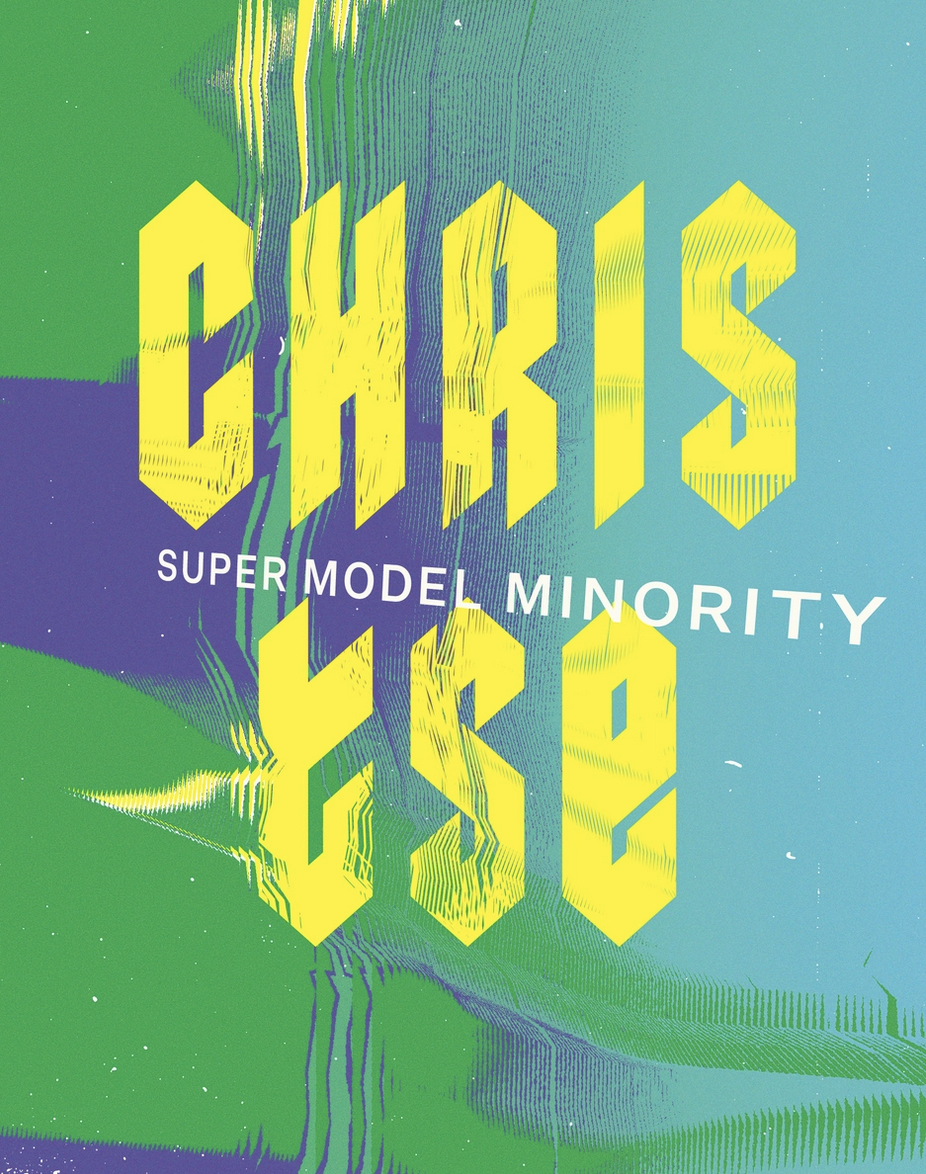
Super Model Minority, Chris Tse, Auckland University Press, 2022

Chris reads ‘Tomorrow, and tomorrow, and tomorrow’

Chris reads ‘BOY OH BOY OH BOY OH BOY’

Chris Tse is the author of three poetry collections published by Auckland University Press: How to be Dead in a Year of Snakes (winner of Best First Book of Poetry at the 2016 Ockham New Zealand Book Awards), HE’S SO MASC and Super Model Minority. He and Emma Barnes are the co-editors of Out Here: An anthology of Takatāpui and LGBTQIA+ writers from Aotearoa.

Poetry Shelf celebrates new books with an audio: Amber Esau and Sam Duckor-Jones read from Skinny Dip – Poems

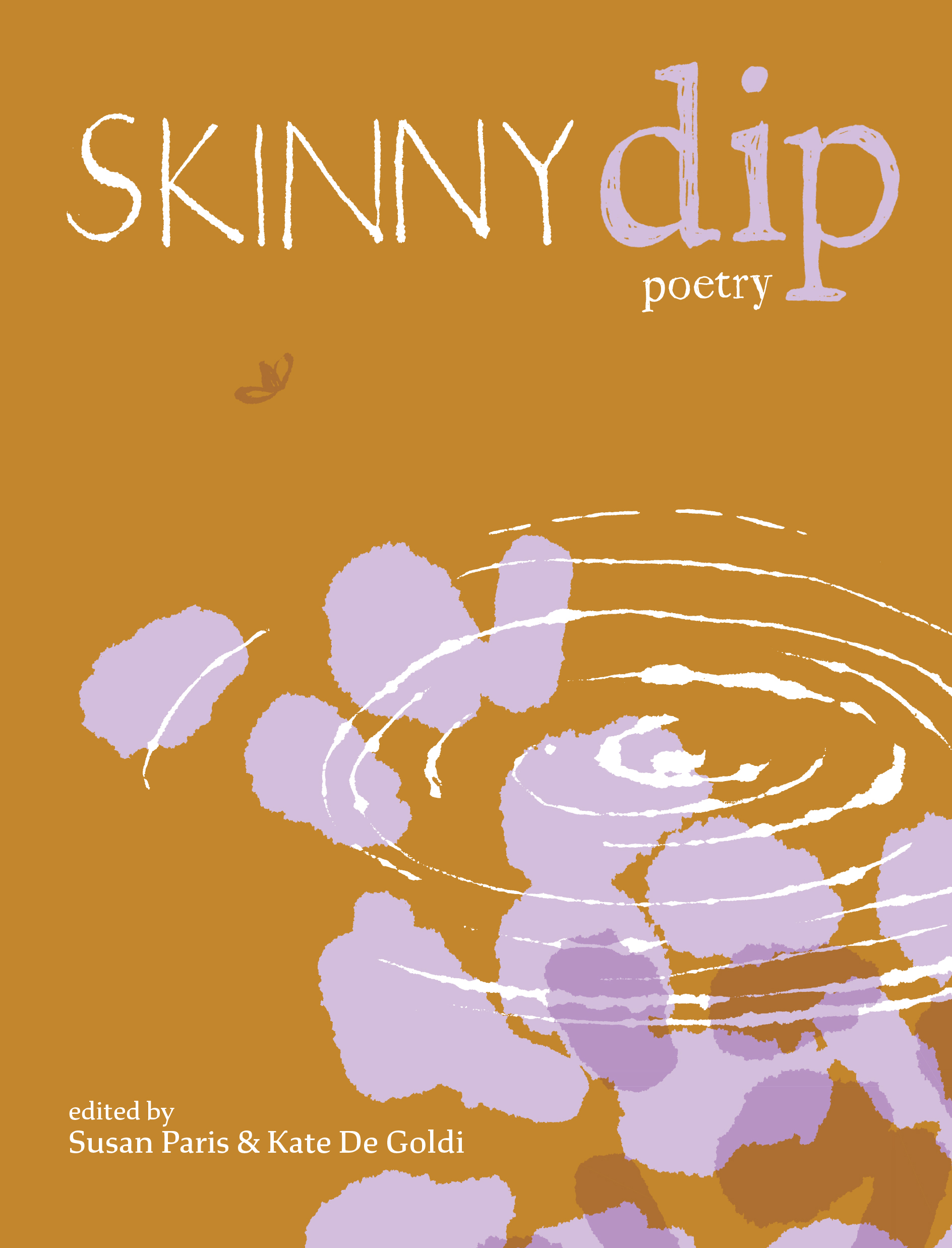
Skinny Dip: Poems, eds Susan Paris & Kate De Goldi, illustrations by Amy van Luijk, Massey University Press (Annual Ink), 2021

Kate De Goldi and Susan Paris, editors of the popular and best-selling Annuals, have edited a lively, much-needed, and altogether stunning anthology of poems for middle and older readers. Kate and Susan commissioned ‘original, and sometimes rowdy poetry’ from a selection of well-known Aotearoa poets. The poems are pitched at Y7 to Y10 readers, but will catch the attention of a range of readers. The collection is shaped like a school year, with four terms, and with the poets both recalling and imagining school days. The subjects shift and spark. The moods and tones never stay still. Some of the poems are free verse (no rules) and some are written according to the rules of specific poetic forms. There is a useful glossary detailing some of the forms at the back of the book (rondel, tanka, haiku, ode, cinquain, rondel, sestina, villanelle, acrostic, pantoum). There are also found, prose, strike-out and dialogue poems. A genius idea for a book that shows how you can follow poetry rules, break poetry rules, play with poetry rules.

The editors invited poems from a glorious group of Aotearoa poets: Sam Duckor-Jones, essa may ranapiri, Bill Manhire, Anahera Gildea, Amy McDaid, Kōtuku Nuttall, Ben Brown, Ashleigh Young, Rata Gordon, Dinah Hawken, Oscar Upperton, James Brown, Victor Rodger, Tim Upperton, Lynley Edmeades, Freya Daly Sadgrove, Nina Mingya Powles, Renee Liang and Nick Ascroft.

Through doing my poetry blogs, schools visits and author tours over decades, I have witnessed poetry simmering and bubbling, somersaulting and sizzling, the length and breadth of Aotearoa. Poetry in my experience can excite the reluctant writer, advance the sophisticated wordsmith, and captivate all those writers in between, both in primary and secondary schools. Poetic forms are fun, and can stretch the imagination, electrify moods and music. Send your writing pen in refreshing and surprising directions.

Poem anthologies for younger and middle readers are as rare as hen’s teeth in Aotearoa, so it is a special day when a new one hits our library and bookshop shelves. Kate and Susan have curated a selection of poems that will fit ranging moods, and perhaps inspire you to write a poem of your own, however old you are!

I have celebrated Skinny Dip on Poetry Box with four readings (Ben Brown, James Brown, Lynley Edmeades and Ashleigh Young). My November challenge on Poetry Box is inspired by Skinny Dip (for Y1 – Y8), so do invite keen young poetry fans to give it a go. For Poetry Shelf, I am featuring two glorious readings by Amber Asau and Sam Duckor-Jones, and including a challenge for secondary students.

I decided Skinny Dip is so good it deserves a feast of celebrations! Let me raise my glass to a fabulous project.

A popUP poetry challenge for secondary school students in Year 9 and 10:

Choose one of the poetry forms mentioned above and write a poem. You can stick to the rules or you can play with the rules. Send to paulajoygreen@gmail.com by November 14th. Include your name, age, year and name of school. Deadline: November 11th. I will post some on Poetry Shelf on November 16th. Write Skinny Dip in subject line so I don’t miss your email. I will have a copy of the book to give away.

two readings

Amber Esau reads ‘Street Fighter’

Sam Duckor-Jones reads ‘Please excuse my strange behaviour’

Amber Esau is a Sā-māo-rish writer (Ngāpuhi / Manase) born and raised in Tāmaki Makaurau. She is a poet, storyteller, and amateur astrologer. Her work has been published both in print and online.  

Sam Duckor-Jones lives in Wellington. He has published two collections of poems: People from the Pit Stand Up and Party Legend (VUP).

Massey University Press (Annual Ink) page
Kate De Goldi & Susan Paris talk to Kim Hill
Read an extract at the The Spinoff
ReadNZ Q & A with Kate & Susan


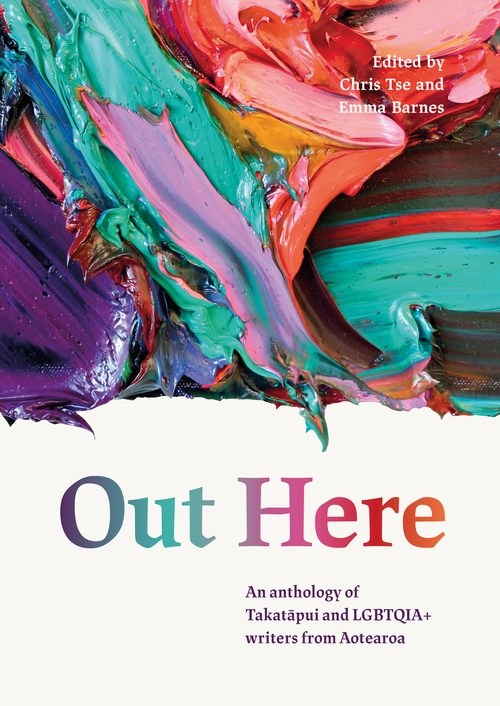
Poetry Shelf celebrates new books: Nine poets read from Out Here: An anthology of Takatāpui and LGBTQIA+ writers from Aotearoa

Out Here: An anthology of Takatāpui and LGBTQIA+ writers from Aotearoa, eds Emma Barnes and Chris Tse, Auckland University Press, 2021

We chose words that delighted us, surprised us, confronted us and engaged us. We chose political pieces and pieces that dreamed futures as yet only yet imagined. We chose coming out stories and stories of home. We followed our noses. What our reading revealed to us is that our queer writers are writing beyond the expectations of what queer writing can be, and doing it in a way that often pushes against the trends of mainstream literature.

Emma Barnes and Chris Tse

The arrival of Out Here is significant. Editors Emma Barnes and Chris Tse have gathered voices from the wider reach of our rainbow communities. Queer texts, rainbow texts. Fiction, poetry, comic strips. I am delighted to present a selection of audio readings in celebration.

The readings

Stacey Teague

Stacey Teague reads ‘Angelhood’

Jiaqiao Liu

Jiaqiao Liu reads ‘as my friends consider children’

essa may ranapiri

essa may ranapiri reads an extract from ‘knot-boy ii’

Emer Lyons

Emer Lyons reads ‘poppers’

Oscar Upperton

Oscar Upperton reads ‘New transgender blockbusters’

Hannah Mettner

Hannah Mettner reads ‘Obscured by clouds’

Natasha Dennerstein

Natasha Dennerstein reads ‘O, Positive, 1993’

Gus Goldsack

Gus Goldsack reads ‘It’s a body’

Ruby Porter

Ruby Porter reads ‘A list of dreams’

The poets

Natasha Dennerstein was born in Melbourne, Australia. She has an MFA from San Francisco State University. Natasha has had poetry published in many journals internationally. Her collections Anatomize (2015), Triptych Caliform (2016) and her novella-in-verse About a Girl (2017) were published by Norfolk Press in San Francisco. Her trans chapbook Seahorse (2017) was published by Nomadic Press in Oakland. She lives in Oakland, California, where she is an editor at Nomadic Press and works at St James Infirmary, a clinic for sex-workers in San Francisco. She was a 2018 Fellow of the Lambda Literary Writer’s Retreat.

Gus Goldsack is a poet, cat dad and black-sand-beach enthusiast. He grew up in Te Whanganui-a-Tara / Wellington and Tāmaki Makaurau / Auckland, and lives in Brooklyn, New York. His work has appeared in The Spinoff and Out Here: An Anthology of Takatāpui and LGBTQIA+ Writers From Aotearoa (Auckland University Press, 2021).

Jiaqiao Liu is a poet from Shandong, China, who grew up in Tāmaki-makau-rau. They are finishing up their MA in Creative Writing at Vic, working on a collection about love and distance, relationships to the self and the body, and Chinese mythology and robots.

Emer Lyons is a lesbian writer from West Cork living in New Zealand. She has a creative/critical PhD in lesbian poetry and shame from the University of Otago where she is the postdoctoral fellow in Irish Studies at the Centre for Irish and Scotish Studies. Most recently, her writing can be found at The Pantograph Punch, Newsroom, Queer Love: An Anthology of Irish Fiction, Landfall, and The Stinging Fly

Hannah Mettner (she/her) is a Wellington writer who still calls Tairāwhiti home. Her first collection of poetry, Fully Clothed and So Forgetful, was published by Victoria University Press in 2017, and won the Jessie Mackay Award for best first book of poetry at the 2018 Ockham New Zealand Book Awards. She is one of the founding editors of the online journal Sweet Mammalian, with Sugar Magnolia Wilson and Morgan Bach.Hannah Mettner

Ruby Porter is a writer, artist and PhD candidate. She tutors creative writing at the University of Auckland, and in high schools. Ruby was the winner of the Wallace Foundation Short Fiction Award in 2017, and the inaugural winner of the Michael Gifkins Prize in 2018, with her debut novel Attraction. Attraction was written during her Masters of Creative Writing at the University of Auckland under supervisor Paula Morris, and published in 2019 by Melbourne-based Text Publishing. It is distributed throughout Australia, New Zealand and North America.

essa may ranapiri (Ngāti Wehi Wehi, Ngāti Raukawa, Na Guinnich, Highgate) is a takatāpui poet living on the lands of Ngāti Wairere. They are super excited about Out Here being in the world even in these weird times. Their first book of poems ransack (VUP) was published 2019. They are currently working on their second book ECHIDNA. They will write until they’re dead.

Stacey Teague (Ngāti Maniapoto/Ngāpuhi) is a queer writer and editor. She is the poetry editor for Awa Wahine, editor for We Are Babies Press, and has her Masters in Creative Writing from the IIML.

Oscar Upperton‘s first poetry collection, New Transgender Blockbusters, was published by Victoria University Press in 2020. His second collection, The Surgeon’s Brain, is scheduled for publication in February 2022. It follows the life of Dr James Barry, nineteenth century surgeon, dueller and reformer whose gender has been the subject of much debate.

Auckland University Press page

Poetry Shelf celebrates new books: AUP New Poets 8

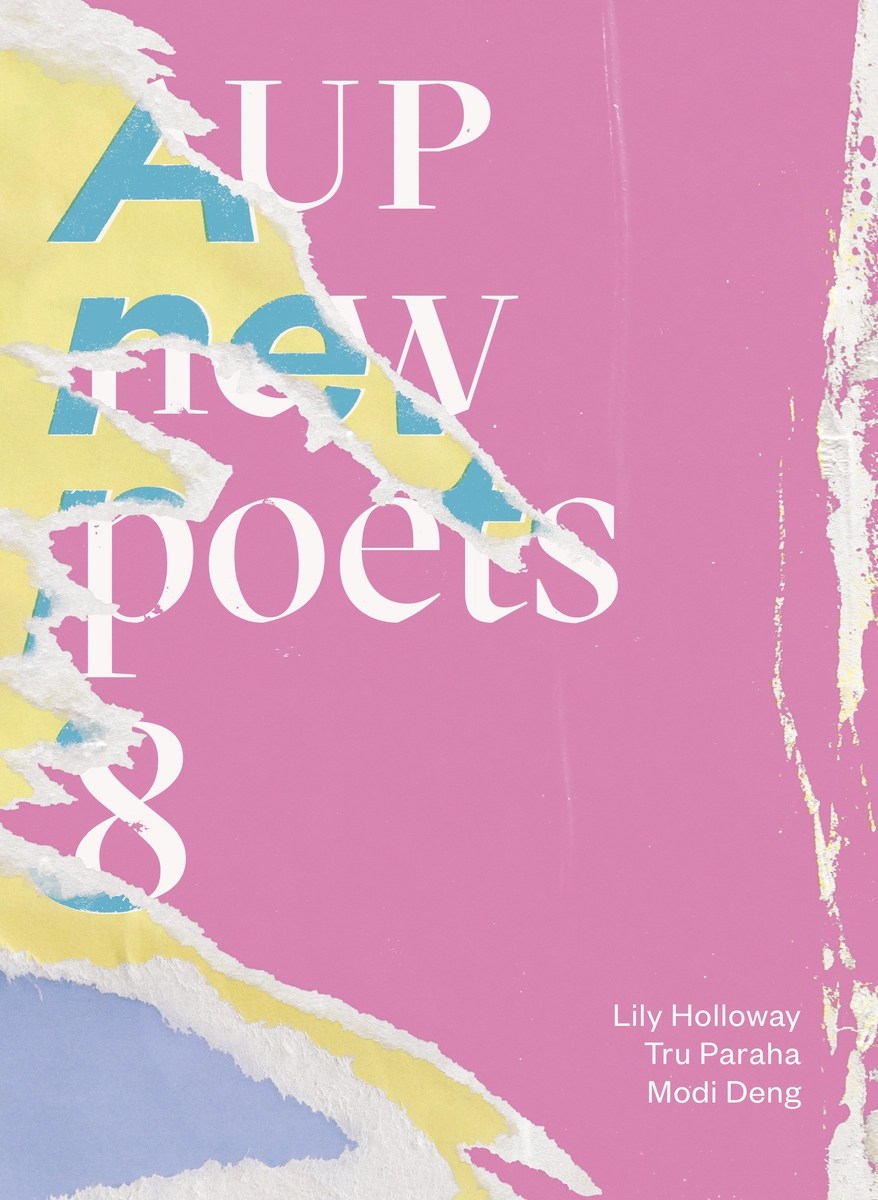
AUP New Poets 8: Lily Holloway, Tru Paraha, Modi Deng, Auckland University Press, 2021

I am loving the AUP New Poets series under the astute editorship of Anna Jackson. Each volume draws new voices into compelling view, each volume sparks essential poetry conversations. How we write. Why we write. What we write. How we write ourselves and how we write the imagined.

This on AUP New Poets 8, from my Kete Books review appearing shortly: ‘Editor Anna Jackson has selected three distinctive poets for AUP New Poets 8 and has placed them in the perfect tonal order. The title of Lily Holloway’s suite, ‘a child in that alcove’, reminds me of poetry’s alcove-like features. Poems can be miniature shelters, places of refuge, an interplay of dark and light, secret, mysterious, challenging, bulging with nooks and crannies. Reading the work is to read across myriad directions, to peer into captivating cubbyholes and, as Anna writes in her terrific foreword, to read distance and depth.’

This is an arrival to celebrate – and how better than with a suite of readings – not as good as book launch for sure – but online readings offer a lounge of returns. Make a coffee, a cup of tea, pour a glass of wine, you choose, find a sweet spot and have a listen. I raise my glass to Anna, Lily, Tru, Modi and AUP. This is essential listening (and reading!).

The readings

Lily Holloway

Photo credit: Angela Zhang

Lily Holloway reads ‘Reverb or Aftermath’

Lily Holloway reads ‘return again’

Tru Paraha

Tru Paraha reads ‘Paradox’

Tru Paraha reads ‘Postcard from Israel’

Modi Deng

Photo credit: Mikayla Bollen

Modi Deng reads ‘field notes on Lewis Hyde’s ‘The Gift’’

Modi Deng reads ‘unrest • an wei’

Modi Deng reads ‘now and then things come in tandem’

The poets

Lily Holloway (born in 1998, she / they) is a queer writer and postgraduate English student. While she mostly writes poetry, she has also tried her hand at non-fiction, fiction and playwriting. You can find her work in places like Starling, Midway Journal, Scum, The Pantograph Punch and The Spinoff amongst various other literary nooks and crannies. In 2020 she was honoured to receive the Shimon Weinroth Prize in Poetry, the Kendrick Smithyman Scholarship in Poetry and second place in the Charles Brasch Young Writers’ Essay Competition. In her spare time she enjoys op-shopping, letter writing, visiting small towns and collecting vintage Teletubbies paraphernalia. She is passionate about survivor advocacy and taking up space. You can find a list of her writing at lilyholloway.co.nz.

Tru Paraha resides in Tāmaki Makaurau in the suburb of Tukituki Muka (aka Herne Bay). She works as a choreographer and director, having enjoyed an extensive career in experimental dance, theatre and audio-visual arts. She is currently in the final year of a postdoctoral research fellowship in the English and Drama department at the University of Auckland. Moving between choreography, philosophy and creative writing, Tru produces live performances, artists’ pages and poems drawing on materials from deep space. She is a member of the International Dark-Sky Association and advocate for the preservation of the night sky as a world cultural heritage.

Modi Deng is a pianist based in London, currently pursuing postgraduate performance studies on a scholarship at the Royal Academy of Music. Her Chinese name 默笛 means ‘silent flute’, which her father drew from a poem by Tagore. Performances with her ensemble, the Korimako Trio, have taken her throughout the UK and her concerts have been broadcast on BBC Radio 3 and RNZ Concert. After growing up in Dunedin, she went on to complete a Master of Music with First Class Honours on a Marsden research scholarship, while completing a Bachelor of English at the University of Auckland. Modi cares deeply about literature (diaspora and poetry), music, psychology and her family.

Auckland University Press page

Poetry Shelf audio: Shari Kocher reads from Foxstruck and Other Collisions

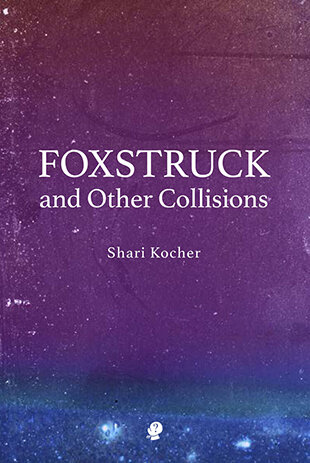
Foxstruck and Other Collisions, Shari Kocher, Puncher & Wattmann, 2021

Shari Kocher reads five poems from Foxstruck and Other Collisions

‘All the Silver Ships You Carry’

‘As We Spiral Pine Tree Mountain’

‘Not the Horses’

‘Goats Cheese with Honey and Rosemary on Toast on Sunday Morning’

‘Peak-to-Peak Amplitude is also the sound of the wind on the tundra, singing’

The poems in Foxstruck and Other Collisions cross many registers and seek to intervene in the ‘death drive’ at work in the over-culture at every level. At the same time, art as a measure of resistance is also riddled with colonisations of every kind. Though it’s hard for this poet to speak about her own work in any comprehensive way, the poems in this collection tackle the labour of love and the work of eros not as modes in which to answer historical and contemporary atrocities, but as provisional structures in which to witness and invoke the kinesis of a tangible ‘life-force’ larger than the self, inherently more mysterious, unknowable, and ecological than the scholarship this poet has undertaken will ever grasp. In this arbitrary selection of five poems, a vision of diverse artistries and bold scholarship is explicitly referenced, from the astronomy of Rebecca Elson, the encaustic paintings of New Zealand artist Amy Melchior, fellow New Zealand artist Kate Van der Drift, one of whose river works adorns the cover of this book, writings by Clarice Lispector and Carson McCullers, the philosophy of Gaston Bachelard, to diffuse and implicit connections with the influential work of Kerry Reed-Gilbert, Deborah Bird Rose and Constanza Ceruti, among others. If poetry is to be a shelter of any kind, then the biosphere that breathes it must be porous and open to the sacred, however that term is both contested and defined.

Shari Kocher, July 2021

Shari Kocher is the author of Foxstruck and Other Collisions (Puncher & Wattmann, 2021) and The Non-Sequitur of Snow (Puncher & Wattmann 2015). Sonqoqui: a Threnody is currently in translation under the auspices of The Peter Steele Poetry Prize (2020). She holds MA and Doctorate degrees from Melbourne University, where she sometimes works in the creative writing program. She also works in a freelance and remedial capacity, but during lockdown, finds herself working primarily on a collection of short stories and new poetry, while shadow-boxing a monograph on Dorothy Porter and Anne Carson. Website

Puncher and Wattman page

Poetry Shelf review

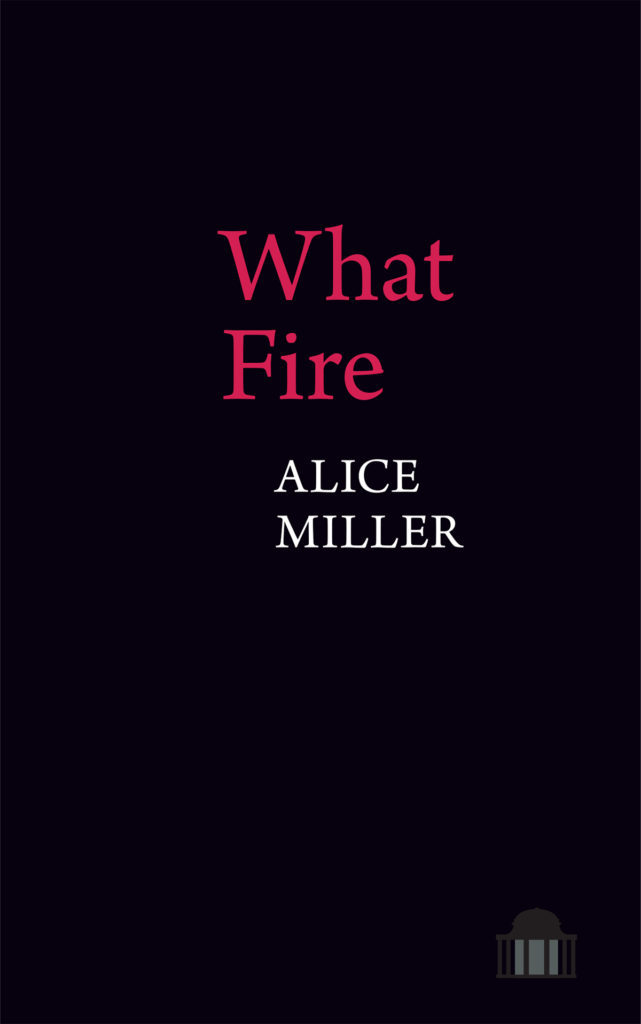
Poetry Shelf celebrates new books: Alice Miller reads from What Fire

What Fire, Alice Miller, Pavillion, 2021

Alice reads ‘After The Internet’

Alice reads ‘New Wings’

Alice reads ‘Seams’

Alice Miller is from Māhina Bay and currently lives in Berlin. Her third poetry collection, What Fire, has just been published by Pavilion in the UK. Her first novel, More Miracle than Bird (Tin House, 2020) was on the New York Times summer reading list. 

Friday Poem at The Spinoff: ‘The Twin Peaks’

Pavilion Poets at Liverpool University Press page (Alice Miller)

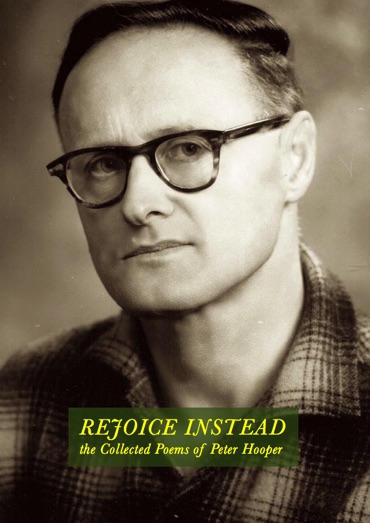
Poetry Shelf celebrates new books: Editor Pat White reads from Rejoice Instead: the Collected Poems of Peter Hooper

Rejoice Instead: the Collected Poems of Peter Hooper, ed and introd by Pat White,

Cold Hub Press, 2021

Pat White reads from Rejoice Instead (Part One)

Pat White reads from Rejoice Instead (Part Two)

Peter Hooper (1919–1991): was a West Coast poet, novelist, teacher, bookseller and conservationist. In a writing career that spanned the decades following World War II until his death in 1991, his reputation as a poet has tended to depend on poems published in slim volumes no longer easily accessible. The exception was Earth Marriage (Fragments III, 1972), a selection of previously published and new work with photographs of the West Coast, which sold two thousand copies within a year. A rather meagre Selected Poems was published by John McIndoe in 1977. Between 1977 and his death in 1991 Hooper published a trilogy of novels: A Song in the Forest (1979); People of the Long Water (1985); and Time and the Forest (1986) which won the New Zealand Book Award for fiction. A collection of short stories, The Goat Paddock and other stories appeared in 1981. Hooper also wrote and published extensively on conservation and environmental subjects.

Pat White is a writer and artist living near Fairlie. He has an MFA from Massey University, and an MA in Creative Writing from IIML Victoria University. In August 2018 Roger Hickin’s Cold Hub Press published Watching for the Wingbeat; new & selected poems. In 2017 Notes from the margins, his biography/memoir of the teacher, author, environmentalist, the West Coast’s Peter Hooper, was published. An exhibition, Gallipoli in search of family story, has been shown in museums and art galleries a number of times in recent years.

Cold Hub Press page

Pat White discusses Rejoice Instead: Collected Poems: Peter Hooper with Lynn Freeman on RNZ National

Poetry Shelf celebrates new books: Bryan Walpert reads from Brass Band to Follow

Brass Band to Follow, Bryan Walpert, Otago University Press, 2021

Bryan reads ‘In the lull’

Bryan reads ‘Brass Band to Follow’

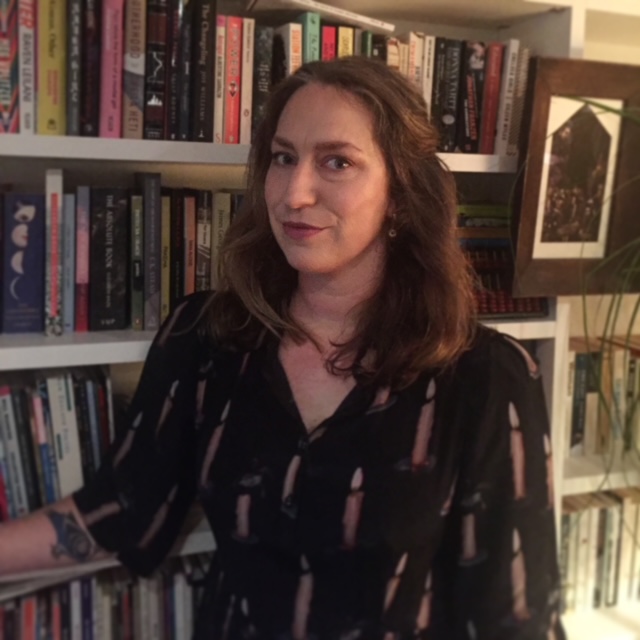
Bryan Walpert is the author of four collections of poetry—Etymology, A History of Glass, Native Bird and most recently Brass Band to Follow (Otago UP). He is also the author of a novella, Late Sonata, winner of the Viva La Novella prize (Australia); a collection of short fiction, Ephraim’s Eyes; and two scholarly books: Poetry and Mindfulness: Interruption to a Journey and Resistance to Science in Contemporary American Poetry. A novel, Entanglement, is forthcoming with Mākaro Press in October. His work has appeared in New Zealand, Australia, UK, U.S., and Canada and has been recognized by, among others, the Montreal International Poetry Award, the New Zealand International Poetry Competition, the Royal Society of NZ Manhire Award Creative Science Writing Award (fiction), The Rattle Poetry Prize (US), and the James Wright Poetry Award (U.S). He is a Professor in Creative Writing at Massey University, Auckland. More on Bryan can be found at bryanwalpert.com.

Otago University Press page
Bryan Walpert website

Bryan in conversation with Lynn Freeman Radio NZ National

Poetry Shelf celebrates new books: Liz Breslin reads from in bed with the feminists

Liz Breslin reads ‘In bed with history: by lamplight’

In bed with the feminists is Liz Breslin’s second poem collection, part of which won the 2020 Kathleen Grattan Prize for a Sequence of Poems. Her first collection, Alzheimer’s and a spoon, was listed as one in the NZ Listener’s Top 100 Books of 2017. Liz was a virtual resident at the National Centre for Writing, UK, in February 2021, where she documented life through the peregrine webcam on Norwich Cathedral in a collection called Nothing to see here. In April 2020 she co-created The Possibilities Project with Dunedin UNESCO City of Literature.

Liz’s website

Deadbird Books page