Tag Archives: Amber Esau

Poetry Shelf Conversations and Readings: Amber Esau

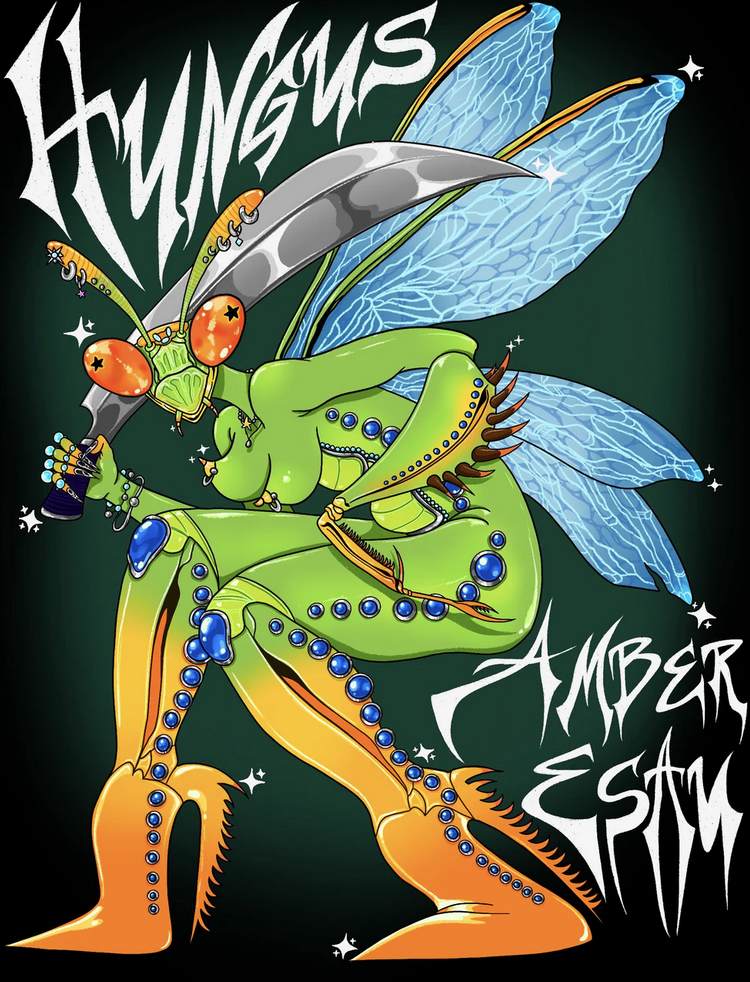
Hungus, Amber Esau
Te Herenga Waka University Press, 2026

To celebrate Amber Esau’s terrific new collection, Hungus, Amber reads some poems and answers six questions. The conversation is like a surrogate review as I enthuse whole-heartedly on why and how I love the book so much.

a conversation

Paula: I love reading your collection so much. For all kinds of reasons. The rhythm of reading for a start. At times it’s like a lightning storm with my heart pumping, at times like that beauty moment when I stall and star gaze. Slow, fast, utterly inspiring. What was the rhythm of writing like for you?

Amber: A lot of the shorter poems and the foundations for the longer poems were written during my MA year but they really started crystallising once I had distance from the work. I had started editing it pretty soon after finishing my course but it was still very undercooked. I spent over a year not looking at the manuscript, reading and editing other poets’ works, before I could finally see mine better. The first draft of poems were a lot more slippery and while I love that uncertainty I was better able to accept where too much elusiveness was limiting my writing. The varying rhythms between the poems are likely in part due to these different concentrations of time. It’s also very Geminian of me to love a switch up like I do!! At my core, though, I am a turtle writer; slow on land, quick in the water.

Paula: Another love for me is your agility with words. Every line is sheer music delight, with sonic shifts and dances. Sweet sharp savoury. There’s hip jargon, urban slang, words that smash together or elide, words that jam in harmony, disharmony, similes that stick and surprise. I just want to hear you read the whole friggin book. Out loud. Honestly your use of words is inventive, life-rich, like a K-Rd dairy-on-the-corner milky hills mosh pit symphony. Do things sing differently as you move between page and performance?

Amber: Wooooah I really appreciate that, thank you. I never used to read my poems aloud until I finished writing them which often surprises people about my process. We all have our own internalised sense of rhythm and I have secretly always wanted to be a rapper. I think that kinda gets injected into the writing. If I say a poem aloud too early though, it starts trying to rhyme too much and I have to reset myself. This process creates a mean tension between the sounds of things and the meanings of them. I also grew up in a predominantly Samoan speaking household but I only spoke English. I understand Samoan better than I speak it and I think there’s something in there about learning a language only through the ears in relation to learning a language through the verbal and written word. The former is more mutable. Sometimes, I still have to say Samoan words aloud to know what I’m reading on the page and tbh, “fobbing” up my English is where I feel most at home. I think this might be a common experience within a lot of immigrant households.

Paula: The title, ‘Hungus’, magnetised me, with its connotations of both enormousness and hunger. And The Mantis, the equally mesmerising prankster figure on the cover who appears larger than life in poems, electrifies your writing ink. Did your relationship with The Mantis change over the course of writing the collection?

Amber: The Mantis is comical and menacing and laced in a sort of cartoonish violence that feels so familiar to me. I used to view it steeped only in its “badness” which was both alluring and repellent. Originally, the Mantis was very archetypal in my imagining and slowly I started wondering what the flipside to this figure would be… kinda in the way that Hinetītama becomes Hine-nui-te-pō. That’s where the Manaia comes out of. We all hold many contradictions and there are many factors that transform us – for better or worse, eh. Mostly though, I started to consider the Mantis’ capacity for change and how bloody annoying that is and how maybe that means it’s still possible.  

Paula: Your collection has tendrils and roots in sky and land. It feels personal and it feels imagined. It feels political and it feels mythological. It feels like poetry of now and then and might be. Yep, as the blurb says ‘a work of world-building’. I love that. Was there an ignition point for the collection? Experiences, world, possibilities, real or imagined, that you wanted to ‘visit’ as you wrote.

Amber: Oh that’s mean as! Thank you! Originally, I planned to explore addiction/the addict in a way that echoes the different representations of Maui across the pacific. It wasn’t until the Mantis started bubbling to the surface that I had something to craft around. Warping Maui into the Mantis felt like an interesting entrance into the intersections of urban indigeneity and moana diaspora. It took a few versions of the work as a whole to realise that a big part of Hungus is about the idea of empire and ways we maintain certain legacies; of expanding so as not to be swallowed; of establishing hierarchies within a language; of projecting hurts as a form of self-preservation; of resisting meaningful change. In my experience, these also rhyme with the ways that power dynamics and inherited traumas are expressed within the home.

Paula: For me writing is a secret private intimate activity and also a public one, whether through Poetry Shelf poet connections or as a published author. Your moving acknowledgements page underlines how important other writers are to you, how important writing communities are. Do you need a secret private writing space alongside your nourishing community space/presence?

Amber: Definitely. I’ve gotten into a pretty consistent journaling practice which has helped me figure out what I’m actually saying, how I feel about my daily life, responses to current events, lots of dissecting my traumas lol, small notes for projects, and what I’m reading. Too many tokes back in the day means my memory is kinda shoddy though, so it’s been really useful writing about the books I read to help my recall.

Paula: In this upheaval world, a world that is straining and testing the foundations of humanity, what matters to you? As a writer yes, as a new voice yes, and as daughter, sister, friend, human being?

Amber: It’s hard not to be somewhat cynical about where humanity is heading, but publishing a poetry collection feels like an act of hope and faith. The other day, my brother, who doesn’t read poetry at all, texted me he’s been really enjoying the book, slowly reading through it, and cracking up that some poems have been sparking unexpected insights within him. It’s important to me that my brother, someone who has always felt a lil excluded from literary spaces, has found a place to dock in my poetry. This doesn’t mean that I’m anti-intellectualism – I’m just suss about the hierarchy of languages and knowledge systems lol. My idealistic ass still thinks that language fuckery is one of the many ways we might shift the collective psyche towards learning how to sit with uncertainty and make space for each other on our terms.  

reading
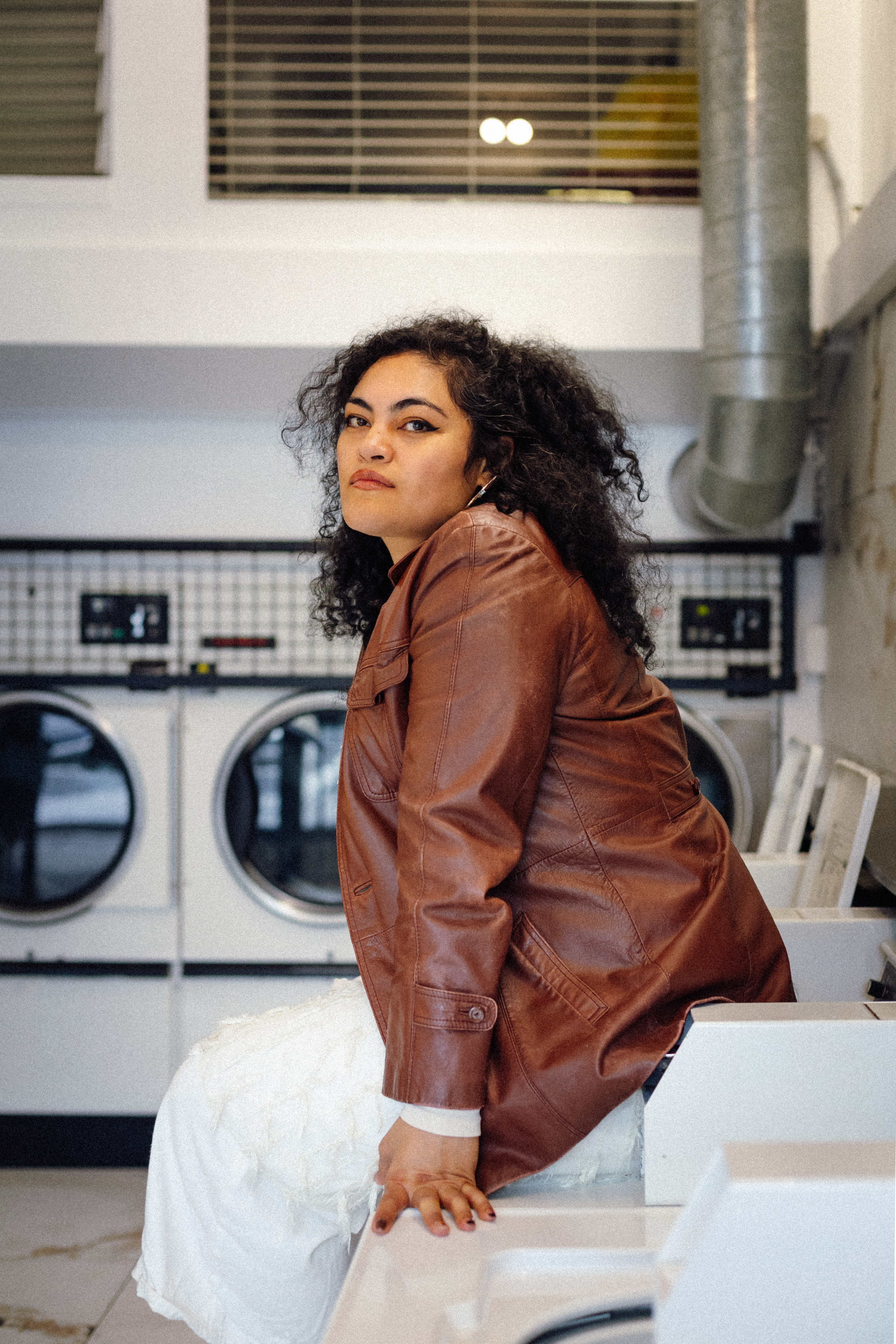
Amber reads from Hungus

Amber Esau is a SāMāoRish (Ngāpuhi / Manase) writer from Tāmaki Makaurau. She is a poet, storyteller, and professional bots. Always vibing at a languid pace, her work has been published both in print and online. In 2023, she co-edited the queer poetry anthology Spoiled Fruit. She is a past recipient of the emerging Pasifika writer’s residency from the Michael King Writers Centre and the Ideas In Residence residency from the Basement Theatre. Hungus is her debut collection. 

Te Herenga Waka University Press page
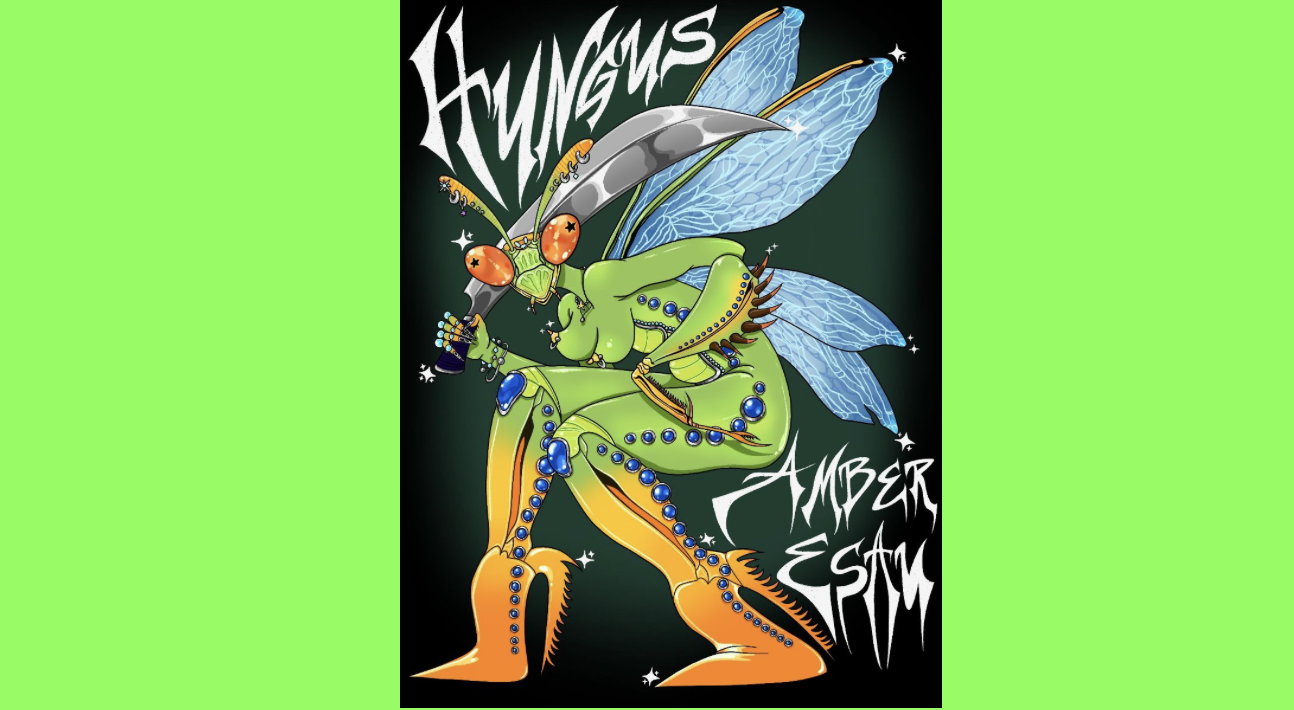
Poetry Shelf noticeboard: Amber Esau poetry launch

Join us next week to celebrate a dazzling new voice in New Zealand poetry!

 Thursday 26 March, 6pm
Rocketman bar, 8 Roukai Lane, Auckland Central
 Free entry – all welcome!


The book will be launched by Courtney Sina Meredith and we’ll have three amazing artists – @dam_dandan@make.aotearoa.native.again, and the book’s cover artist Katrina Steak – in the house with us for mini makeki styles. Books will be for sale thanks to Unity Auckland.

Poetry Shelf Monday Poem: Amber Esau’s ‘Liminal’

Liminal

Parted down the middle, his sharpened cuerpo
struts out of a waspish cave in the dark

harakeke, strands bowing under a nosey Tūī
eyeing the red beaned flower that’s claw-like

in lazy light. We lock eyes in glass. Feathers
and flax. He stares from corners acting coy

but this is k’rd, bruh, a Queen will call you
out for not looking long enough. I ruffle

the curls searching silences in the glare
knowing? Not quite slow moving but watchful

the manu drops a beak at onyx arrowhead
eyes forgetting forward. Down the vague grey

he walks the tui across the winking glass
into a powdery afternoon, kicking up silent

dust behind them on the street. They swoop to the top
of St. Kevin’s perched for a second before flying off

into the blue thin as the moon of pulotu
dragging nails across the fog and Paz.

Amber Esau

Amber Esau is a Sā-māo-rish writer (Ngāpuhi / Manase) born and raised in Tāmaki Makaurau. She is a poet, storyteller, and amateur astrologer. Her work has been published both in print and online. 

Hear Amber read


Poetry Shelf celebrates new books with an audio: Amber Esau and Sam Duckor-Jones read from Skinny Dip – Poems

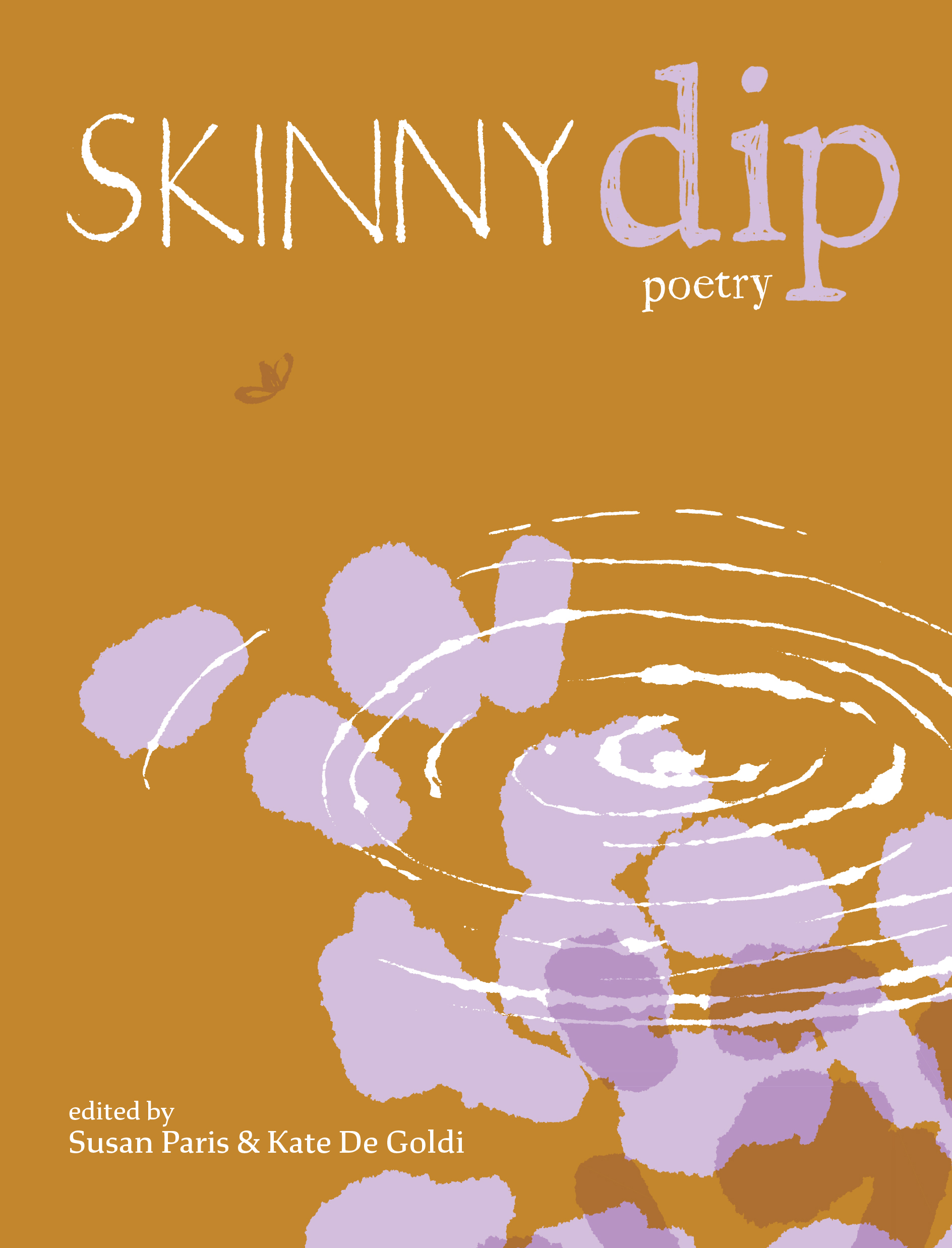
Skinny Dip: Poems, eds Susan Paris & Kate De Goldi, illustrations by Amy van Luijk, Massey University Press (Annual Ink), 2021

Kate De Goldi and Susan Paris, editors of the popular and best-selling Annuals, have edited a lively, much-needed, and altogether stunning anthology of poems for middle and older readers. Kate and Susan commissioned ‘original, and sometimes rowdy poetry’ from a selection of well-known Aotearoa poets. The poems are pitched at Y7 to Y10 readers, but will catch the attention of a range of readers. The collection is shaped like a school year, with four terms, and with the poets both recalling and imagining school days. The subjects shift and spark. The moods and tones never stay still. Some of the poems are free verse (no rules) and some are written according to the rules of specific poetic forms. There is a useful glossary detailing some of the forms at the back of the book (rondel, tanka, haiku, ode, cinquain, rondel, sestina, villanelle, acrostic, pantoum). There are also found, prose, strike-out and dialogue poems. A genius idea for a book that shows how you can follow poetry rules, break poetry rules, play with poetry rules.

The editors invited poems from a glorious group of Aotearoa poets: Sam Duckor-Jones, essa may ranapiri, Bill Manhire, Anahera Gildea, Amy McDaid, Kōtuku Nuttall, Ben Brown, Ashleigh Young, Rata Gordon, Dinah Hawken, Oscar Upperton, James Brown, Victor Rodger, Tim Upperton, Lynley Edmeades, Freya Daly Sadgrove, Nina Mingya Powles, Renee Liang and Nick Ascroft.

Through doing my poetry blogs, schools visits and author tours over decades, I have witnessed poetry simmering and bubbling, somersaulting and sizzling, the length and breadth of Aotearoa. Poetry in my experience can excite the reluctant writer, advance the sophisticated wordsmith, and captivate all those writers in between, both in primary and secondary schools. Poetic forms are fun, and can stretch the imagination, electrify moods and music. Send your writing pen in refreshing and surprising directions.

Poem anthologies for younger and middle readers are as rare as hen’s teeth in Aotearoa, so it is a special day when a new one hits our library and bookshop shelves. Kate and Susan have curated a selection of poems that will fit ranging moods, and perhaps inspire you to write a poem of your own, however old you are!

I have celebrated Skinny Dip on Poetry Box with four readings (Ben Brown, James Brown, Lynley Edmeades and Ashleigh Young). My November challenge on Poetry Box is inspired by Skinny Dip (for Y1 – Y8), so do invite keen young poetry fans to give it a go. For Poetry Shelf, I am featuring two glorious readings by Amber Asau and Sam Duckor-Jones, and including a challenge for secondary students.

I decided Skinny Dip is so good it deserves a feast of celebrations! Let me raise my glass to a fabulous project.

A popUP poetry challenge for secondary school students in Year 9 and 10:

Choose one of the poetry forms mentioned above and write a poem. You can stick to the rules or you can play with the rules. Send to paulajoygreen@gmail.com by November 14th. Include your name, age, year and name of school. Deadline: November 11th. I will post some on Poetry Shelf on November 16th. Write Skinny Dip in subject line so I don’t miss your email. I will have a copy of the book to give away.

two readings

Amber Esau reads ‘Street Fighter’

Sam Duckor-Jones reads ‘Please excuse my strange behaviour’

Amber Esau is a Sā-māo-rish writer (Ngāpuhi / Manase) born and raised in Tāmaki Makaurau. She is a poet, storyteller, and amateur astrologer. Her work has been published both in print and online.  

Sam Duckor-Jones lives in Wellington. He has published two collections of poems: People from the Pit Stand Up and Party Legend (VUP).

Massey University Press (Annual Ink) page
Kate De Goldi & Susan Paris talk to Kim Hill
Read an extract at the The Spinoff
ReadNZ Q & A with Kate & Susan


Poetry Shelf review: Ora Nui 4: Māori Literary Journal (New Zealand and Taiwan Special Edition)

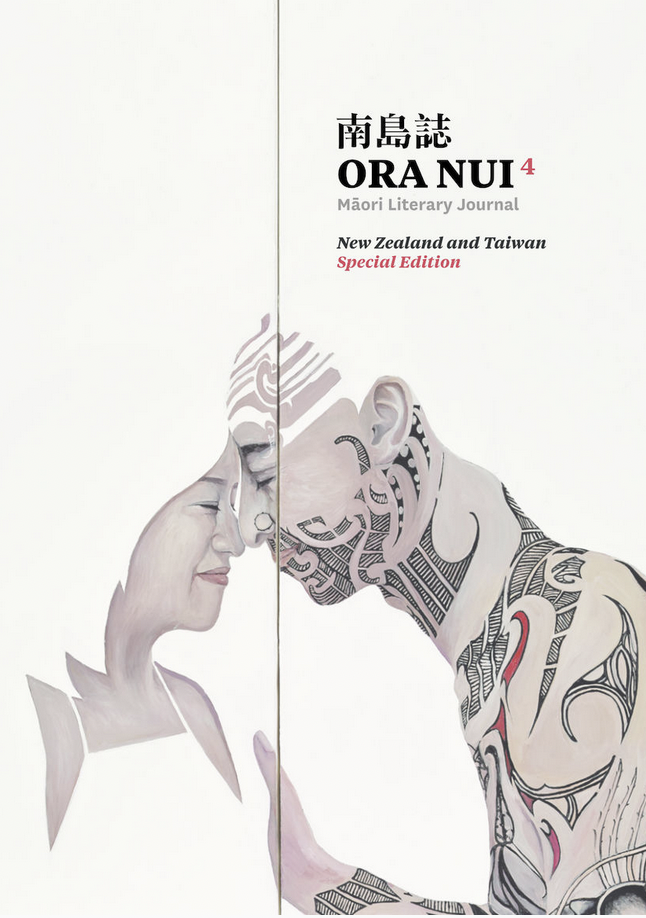
Ora Nui 4: Māori Literary Journal (New Zealand and Taiwan Special Edition), published by Anton Blank, edited by Kiri Piahana-Wong and Shin Su. Cover image: Hongi 2012, Idas Losin, oil on canvas, Kaohsiung Museum of Fine Arts Collection.

How to construct a piupiu for your Waitangi day celebrations

First the karakia to gather the family; the strength
of your fibre depends on them.
Next, measure the pattern and score with clear, even cuts—
if you don’t do this yourself, your enemy will do it for you
with year after year after year of protest.
Expose the muka, the soft threads that will be so pale, so raw,
that they will take on any colour they mix with.
Pliability and adaptability are a gift. Don’t let them use it against you.
Instead brace yourself, if your thighs can take it, and roll towards the knee.
Boil these family strands until buttery smooth
right down to the vein; the skin of nature.
Sit close to that pain. It can sing.
Then, by the threads of these taonga tuku iho,
hang them where they are visible, until dry.
They will curl in on themselves, shiny side hidden
and become hollow chambers in a flaxen silencer.
Finally, cold plunge them into dye.
Constant interaction may result in uneven colouring,
ignore this—do not cry for them here—
their warpaint will be revealed, their pattern set.
Those hardened tubes will have become whistle darts
capable of long distance warning
ki te ao whānui.
Let their percussion begin.
Let them whisper in the ears of your children.

Anahera Gildea

Anton Blank begins his introduction: ‘This issue of Ora Nui is a jewel; light dances across the words and images sparking joy and wonder. It is filled with contributions from my favourite Māori and Taiwanese writers and artists.’

Ora Nui 4 is indeed a vital gathering of poetry, fiction, creative nonfiction, essays and artwork, lovingly assembled by editors Kiri Piahana-Wong and Shin Su. When you bring together a range of voices in a literary journal – with distinctive melodies, admissions, experience, challenges, silences – conversations ensue. Electric and eclectic connections spark and inspire, both within the individual written and visual contributions, and across the volume as a whole. How much more heightened the connective tissues become when contributions are also drawn from Taiwan.

We are in a time when to slow down and listen, to linger and absorb, is the most satisfying advantage. This is, as Anton says, joy. Reading and viewing Ora Nui is to move between here and there, between love and longing, amidst myriad ideas, feelings, melodies. As Kiri underlines, Ora Nui is ‘all the richer for creative pieces spanning an incredible range of topics’. Shin astutely suggests that ‘when finished with this edition of Ora Nui, you the reader will be in possession of an empathetic understanding of the lives and histories of a great many people’.

Familiar names leap out at me: Aziembry Aolani, Marino Blank, Jacqueline Carter, Gina Cole, Amber Esau, Anahera Gildea, Arihia Latham, Kiri Piahana-Wong, Vaughan Rapatahana, Reihana Robinson, Apirana Taylor, Anne-Marie Te Whiu, Iona Winter, Briar Wood. And then – one of the reasons I am attracted to literary journals – the unfamiliar Aotearoa poets become the gold nuggets of my reading: Gerry Te Kapa Coates, Kirsty Dunn, Teoti Jardine, Hinemoana Jones, Michelle Rahurahu Scott, Jean Riki, kani te manukura. Add in the Taiwan voices, the fiction and the nonfiction, and this is a sumptuous reading experience. I am especially drawn to the mesmerising movement and harmonies in Etan Pavavalung’s artworks and poetry, that are internal as much as they are physical.

I travel from the spare and haunting heart of Jacqueline Carter’s ‘Picton to Wellington’ to the aural and visual richness of Amber Esau’s ‘Manaakitanga’. I want to hear them both read aloud, to be in a room with the voices of these poets, in fact all the poets, filling the air with spike and soothe and light. Anahera Gildea’s poems reach me in a ripple effect of sound and song, contemplation, challenge and sublime heart. Reading the collection, I draw in phrases, images and chords that boost a need to write and read and converse. To connect.

For example, this extract from Stacey Teague’s exquisite grandmother poem:

Every Christmas
She would knit me dolls
with yellow dresses,
bright like egg yolks.

She had budgies, chickens, a cat called Mopsy.

She liked the TV show, Pingu.

On her headstone, it says:
‘Ko tōna reo waiata tōna tohū whakamaharatanga’.

My Narn sang waiata with her guitar
until her voice stopped.
Traded her guitar for
a dialysis machine.

from ‘Kewpie’


The artwork is stunning. Take time out from daily routine and challenges, and sink into a double-page spread of art. I keep greturning to Nigel Borell’s Pirirakau: bush beautiful (2006) series. The artworks are an alluring and intricate mix of acrylic, beading and cotton in bush greens on canvas. Or his Hawaiki Hue (2010), an equally glorious mix of acrylic, dye and silk on paper.

This is an anthology to treasure.

Read NZ Q & A with Anton Blank here

Oranui Publisher page

from Manukau Institute, Amber Esau’s striking essay is live at Horoeka Reading- panic, the inbetween

‘On Having My Card Decline at Countdown’ by Amber Esau

  • The checkout girl dropped the Nashi pears in with the dried goods and they’ll probably bruise. Do the job properly mate. I think she’s in the sixth form but you can never really tell these days even though I haven’t been out of high school long enough to get away with thinking that. A man in line at the next counter over holds his baby against his shoulder so that she’s facing me. Her milky spit dribbles down her dad’s back in time with the beeping of the wiry haired checkout girl. Louise, as her name tag reads, calls the total and I fumble around in my bag for my wallet. My least favourite part is finding it. My boyfriend says that I buy too much food for us but he’s never seen how my family has to shop. I pull my card out, swipe and punch in the pin. The blue digital daggers of shame strike up on the screen and I start sweat-shaking. I often panic, like a lot of people, about being too broke for everyone.

    Growing up in a house with no walls, sharing is expected and enforced by the way the air gels everything in place. The TV, the bodies, the sun slicing in through only the kitchen window at half past one; each finds themselves stretched amongst many hands. Everything is defined by relation. As the Samoan poet and novelist Albert Wendt writes: “We can only be ourselves linked to everyone and everything else in the Va, the Unity-that-is-All and Now.”

    This is a fabulous read. A timely read. Rest of essay at Horoeka Reading here 

Poem Friday: Amber Esau’s ‘Analogue’ —

Amber_Esau

Photo credit: Christina Pataialii

Analogue

gravel
; shells

crunch kiss
and leave behind
the echo
in canon.

Road works
pinch at the waist

and I’ve noticed
orange peels
that pray like cracked tar rising.

No one came for me tonight
so I run to them

cigarette chopped between
fingers

smoking moonhair
even if it’s only in streetlight.

I can hear the ocean
in my mouth

as I walk to New(York-Lynn)
in the dark

swishing with va’a jaw
waiting on the rise.
Author’s note: The main road near my street is in a constant state of road works and I became interested in the rubble on a lot of the sidewalks. To me it sounded like walking on shells and in a way it became a sort of suburban sea. The word Va’a means canoe in Samoan and I feel like having a Va’a jaw is about movements between locating and dislocating yourself within your own sense of language as an almost reactionary element of physical location (in New Zealand and the wider world.)

Author’s Bio: Amber is a Samoan/Maori/Irish poet and aspiring novelist doing her final year of the Creative Writing degree at Manukau Institute of Technology. She has been published in the journals Ora Nui, Blackmailpress, ika, Hawaii Review and Landfall and will appear in the Maori poetry anthology Puna Wai Kōrero to be published later this year by Auckland University Press.

Paula’s note: Sound is what first hits you as you read this poem: the pitch, the chords, the beat. There is the way words shimmy together (‘crunch kiss’) and the way words shimmy apart (‘pinch’). A semicolon is carried over like a protagonist in the ambulatory beat — punctuation no longer invisible stitching. This poem brings every lucid detail to walking down the road yet walking down the road is not smooth sailing. I was reminded of Gertrude Stein as I read this and the way she breaks up language and puts it back together in ways that can be disconcerting, disconnecting, reconnecting, reasserting. This is that kind of walk. Amber’s line, ‘echo/ in canon’ resonates in my ear as echoing canon. There is the jarring step from New Lynn to New York. Similes lift and surprise (‘orange peels/ that pray like cracked tar rising’). This a walking poem that startles and cracks and never stops moving. I love it!

Māori poets celebrate Matariki

kiripiahana_160x170  apirana_taylor   robertsullivan_160x151

An exciting group of Māori poets – several of the country’s leading poets and some emerging writers – will come together to celebrate Matariki with readings and korero at a free event on Saturday June 28.

Māori Poets Celebrate Matariki features Ben Brown from Lyttelton, Apirana Taylor from Kapiti, with Auckland’s own Robert Sullivan, and social historian, novelist and poet, Kelly Ana Morey, from Mangawhai. It also features writer Te Awhina Arahanga, publisher and poet Kiri Piahana-Wong, and an emerging young poet Amber Esau.

This is a rare opportunity to hear some of the leading Māori poets in Aotearoa today, together with the next generation of talented young writers. It is a free event, part of the 2014 Matariki Festival, supported by Auckland Council and the Michael King Writers’ Centre.

Where:  Depot Artspace, 28 Clarence St, Devonport, Auckland
When:   Saturday, June 28, 2014, 4 pm
Free