
My Bourgeois Apocalypse, Helen Rickerby
Auckland University Press, 2026
Helen Rickerby
from My Bourgeoise Apocalypse
The New York Times offers a weekly newsletter challenge to look at an art work for ten minutes uninterrupted. A bit like what I do with Poetry Shelf’s Breathing Room. A bit like how I react to poetry books I love. I want to linger over them uninterrupted and slowly absorb what they reveal to me, over weeks and days and thirty-minute patches.
Helen Rickerby’s new collection, My Bourgeoise Apocalypse, is a meeting place for memoir, poetry, essay. A succulent and sumptuous poetic collage that offers eclectic life, rich, strange. A collection both unsettling and resettling my reading tracks. Like Anna Jackson, I too am “hooked by the text’s strange rhythms, narrative threads and depths of passionate feeling” (the blurb).
To celebrate the book’s arrival, I embarked upon an email conversation with Helen as I read, and it was a perfect choice. I wanted the reading to last a year! The conversation even longer.
I love how philosophy brushes against poetry and poetry brushes against memory. How doubt fingertaps confession, epiphany touches grief, and grief nudges joy. I just loved this book, the little startles and surprises and recognitions I carried as I stalled and absorbed and felt utterly boosted by what words can do.
Thank you so much Helen for this precious snail-pace conversation.
a conversation
Paula: I have been musing a lot lately on how I write, but also on how I review and read poetry books. And to some degree they all set off into the unknown with no predetermined itinerary. I decided I would love to try reading your new poetry collection and embark on an unfolding email conversation with you as I read. And you agreed! Wonderful. Before I even open the book, or muse on the cover or the title, I wondered if you had a prompt, a seed that fell in to your mind and took root, a startle point that set you writing this poetry project?
Helen: When I started this, I didn’t intend to be writing a book. Well, actually I was writing another book – which I am in fact still writing – but this one jumped the queue. I can see now how a lot of ideas and influences converged in the creation of this book, but it started with just one poem, which was an experiment. For a while I had been playing with randomness and chance in my writing – opening a page of a book I was reading or my journals, sticking my finger down on the page and then using whatever word or phrase it landed on as the starting point for some writing. I liked how it led to surprising myself. I had also recently seen a film about Brian Eno and I was struck by his ideas about art – his Oblique Strategies cards make an appearance. For a long time I’ve been interested in how our brains make meaning out of random things, and how in poetry we are particularly open to leaping over gaps, making connections. And I had just finished reading Motherhood by Sheila Heti, which makes use of coin tosses for philosophical purposes, and I had listened to a podcast where she talked about her newest book, Alphabetical Diaries (which I have not yet read because I didn’t want to copy it, but I’m looking forward to reading it soon), in which she creates a book out of alphabetised sentences from her diaries. I wondered what I would get if I randomly selected sentences from my journals (I’ve been keeping a journal since my teens, but the ones I used in this project were more recent) and arranged them into a poem. I really liked the result – it sounded a lot like poems I write anyway (I do often use text from my journals in my poems, and all my creative writing starts its life in my journals) – and I liked how it was able to express some things that had been hard to write about. Though, because everything was out of context, there was space for new meanings and stories and surprise.
After that first one I thought I’d try a few more, and then it wasn’t very long before I thought perhaps I could make a whole book.
Do you usually know when you’re starting a book that it’s going to be a book?
Paula: I love this, this writing matrix of surprise and wonder. I think it is key, too, for me as a reader. It is strange, I have a number of writing projects evolving in my head and in my notebooks, and I think of them as ‘books’, but they are all more concerned with writing as travel rather than writing as destination. Like writing becomes a ticket to feeling thinking imagining surprising myself.
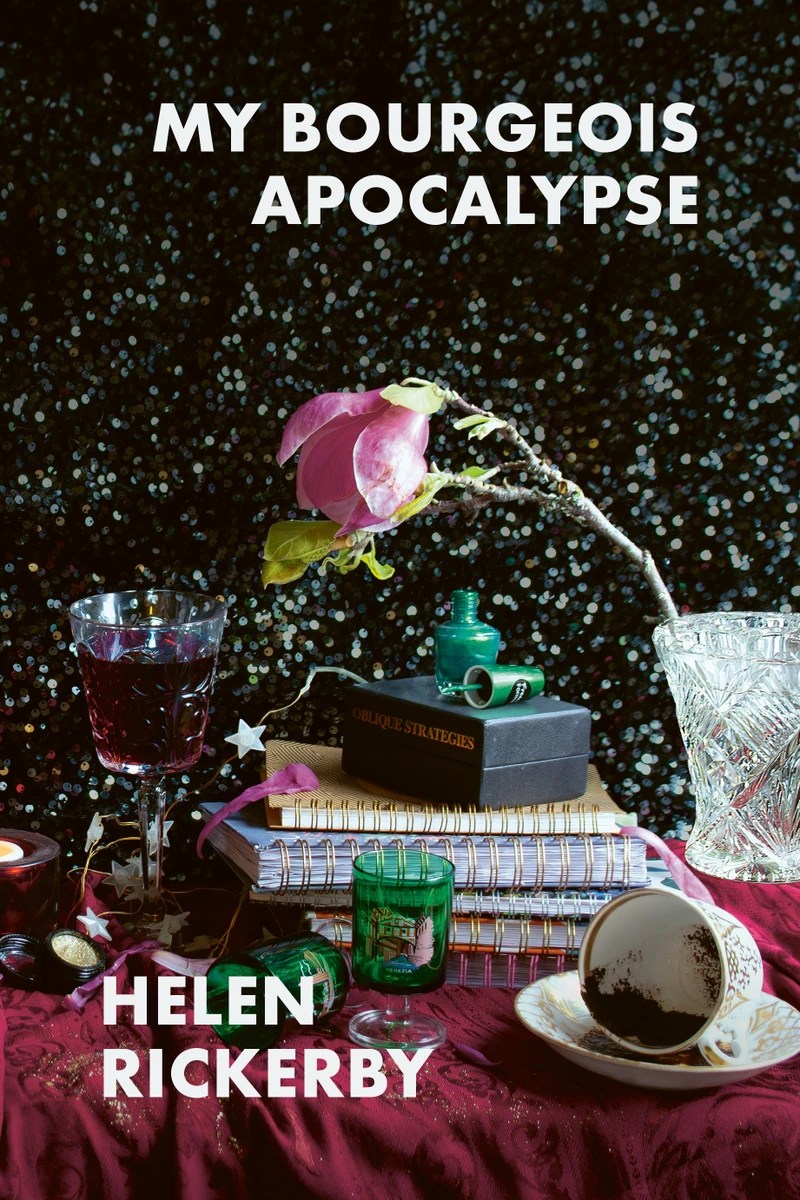
I have now started reading your new collection, My Bourgeois Apocalypse and feel like I am carrying the strangeness and surprise of the title as the cover images reverberate in a tableau of fascination. Extraordinary. The dregs in the teacup. The stack of spiral bound notebooks. The ambiguous galaxy background. I am reminded of the paintings of Laura Williams.
I am reading and it’s goosebumps on my arm as words become more than the building blocks of sentences, but shimmer as talisman as I move from the word azzurro to the word doubt, still holding the word connection from the previous page.
You collage the title ‘[A] POEM IS A THINKING THING’ from Brian Blanchfield. It got me musing on your poetic collage-essay-memoir and how ranging and organic it is. My reading is already thinking feeling puzzling connecting. This feels like an impossible question but did you develop a sense of what you wanted this writing to be and do for you as writer, and then for the reader?
Helen: First of all, I hadn’t heard of Laura Williams, so of course I had to look her up and I can see a parallel in her artworks with what I was doing in My Bourgeois Apocalypse – a bit of this from here, a bit of this from there, something from somewhere else, something big, something whimsical.
The cover photo is the realisation of an idea I had to use various objects mentioned in the poems to create a kind of modern vanitas painting – vanitas paintings were still life paintings that were to remind you of mortality. They often had skulls in them, so the head of the Roboraptor (which is on the back cover) kind of stands in for a skull. My friend Sasha Francis brought her good camera up and we did a photo shoot, and the designer, Kalee Jackson managed to make it work as a cover. The stack of notebooks should really be much higher – those are just a small selection of the journals I was using as source material for the book – it was actually around 20!
I love what you said about being concerned with writing as travel rather than writing as destination. And, like you, I do think of my writing generally as a thing I’m doing to work something out for myself. And this was definitely a journey of discovery for me.
My journals are where I’m not thinking about readers at all – that writing, in that context, is very much for myself – though almost all my writing does begin within my journals. To be for other people it needs to be transformed into a different medium.
I was thinking about readers while I was working on the poems in My Bourgeois Apocalypse, and while I didn’t alter anything in that first draft, I was kind of wondering whether it would make much sense to anyone else. I sent some of the early ones to a few friends, and I did get a positive response, which was encouraging. I also recognised that it was akin to poetry I have written before, and other poetry that I have read and loved (notably My Life by Lyn Hejinian) – poetry that isn’t entirely straightforward to follow, which makes use of parataxis, that you just have to kind of ‘go with’. But, unusually for me, I didn’t show any of the poems to my partner, Sean (aka S), until I had finished the whole first draft – I suspected that if he didn’t like it, it would throw me, and I really wanted to finish it. And once I’d finished it, I still wasn’t sure if it had worked, but I really liked it.
In some ways I wanted it partly to fox readers, as well as connect with them, but in the revising I did keep the reader in mind. The titles were something that I wrote at that point, which readers who have seen earlier drafts have told me helped very much with navigating the book, and also I hope introduced a playful tone.
Paula, do you keep journals, or are your various poetry projects in place of a journals, or a kind of distillation of what could/would be in your journals? Your latest book, The Venetian Blind Poems, feels to me like a distilled journal (journals and diaries can sometimes be quite rambling!), or little extracts from one. I also know from that book, and also from The Track, that you sometimes compose your poetry in your head. How on earth can you remember them? How can you hold the words in your mind? (I forget things almost immediately if I don’t write them down!)
Paula: I have rooms in my head where I compose things. And then sometimes put the things into dedicated notebooks, writing with a pencil. And then when it feels right I transcribe the things in my head onto my laptop. I haven’t kept journals since my twenties!
This morning I woke at 4 am and decided to read a few more pages of My Bourgeois Apocalypse but I kept reading until it was light and I had reached the end. Wonderful! I imagined we were sitting in a café and I’d keep looking up and reading bits I loved to you, bits that resonated with me. Like how I never want to explain poetry. I like to communicate the effects poetry has on me, muse upon the roads and side paths it sends me down, the windows a poem opens, the music it generates, the questions it raises, and of course the wonder. At one point you write: “Poems come out of wonder, not knowing.”
I like how you say: “Writing made me feel like I was rebuilding my internal furniture.” And I was thinking this can also happen as reader.
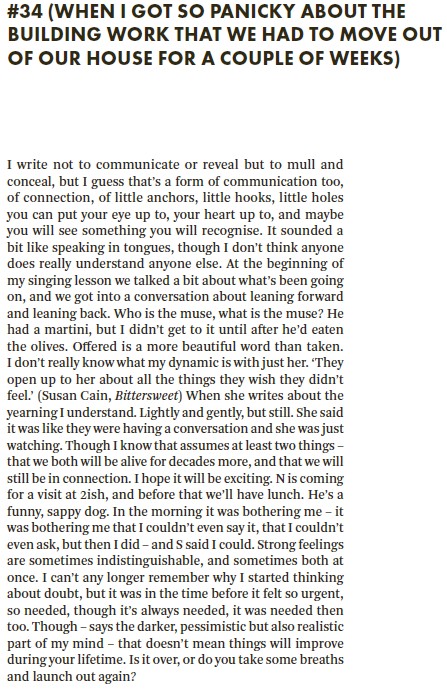
Or how you suggest writing might be “a form of connection, of little anchors, little hooks, little holes you can put your eye up to, your heart up to, and maybe you will see something you will recognise.”
What strikes me is the way your poetic collage essay memoir builds different rhythms, how metonymy is both significant and fertile, how a sentence might nestle and rub and sparkle against the next. Surprisingly. Often in poetry the space is a key player, but I was mesmerised by bridges, and by how these took me into deep currents of thinking and feeling, whether on writing, living, loving, grieving, wondering.
The collection has had a number of lives, in journals, in a first draft and then in a final draft. Now that the book is out in the world, what words have you carried with you, individual words that signal what writing and indeed this book mean to you?
Helen: You say “I never want to explain poetry.” That resonates with me – I love to talk about poetry, to explore a poem, but there’s something about ‘explaining’ it that seems to reductive. In one of my favourite poems in my book (‘#38’) I say “To explain a poem is to take it apart like it’s an equation that can be solved, or a puzzle where the pieces fit, but I do not think poetry is like that.” I remember writing that and I was thinking partly of when a friend who used to be a secondary-school English teacher told me about how he hated the way they were supposed to teach poetry to students – like it was a riddle with one correct answer. I don’t think there is a black-and-white answer to almost anything, and I don’t want that for poetry either. With this book there’s a lot of ambiguity and evasion – I wanted the sentences to free themselves from their original contexts and be able to be whatever they might be for the reader, whatever meaning or story the reader finds in them.
I’m also really taken by what you say about bridges as compared to space. Last year Anna Jackson and I organised a conference about hybrid sorts of writing that have been called ‘lyric diary’. Many of them are made up of pieces/fragments, and I started a list of all the different terms we could use for them, one of which was ‘islands’. I was thinking about how the spaces in between are spaces for connection as well as gaps – in the same way as the water can be a medium of travel as well as a barrier.
Once I finished the poems and read them over, I did notice many recurring words, themes, ideas – I guess because they are my obsessions. Connection is a big one. And doubt. And love, grief, friendship, music, dancing, happiness, sadness, the nature of poetry, and figuring out what’s going on in my own head – which are also I guess what writing is for me too.
Paula: I was really affected by the way the collection often has its roots in the soil and terrain of COVID. How this strange and tilting time affected us so much, how we lived, and for some of us, how we wrote. You mention that although politics don’t make their way into your writing, you do talk politics with friends and loved ones. Does today’s world teetering upon extraordinary ruinous brinks affect your writing pen?
Helen: The lockdowns and the pandemic generally were a massive thing in the last decade, and has really had massive effects on us as individuals and as a society. I spent a lot of time writing during the lockdowns – mostly in my journal, recording the details of each day, but also in a collaborative project I was doing with some friends. Some people I know really enjoyed it, but, while it certainly wasn’t terrible for me because I was in a very good and privileged situation (a couple of nice people to live with, in a nice house, with work I could do from home and enough money) I did not like it. I discovered I was more of an extrovert than I realised, and missed face-to-face connection with other people. But I was at the beginning very hopeful that our society was united in caring for each other. The socialist utopia I was hoping for did not eventuate, sadly, and while I was joking then about it being an apocalypse, I think it was only the beginning. I studied history when I was younger, and had a kind of arrogant idea that people wouldn’t let such terrible things happen again, but now I think I understand better how terrible things are allowed to happen.
The project I have been thinking about and working on, on and off, since I finished How to Live in 2019, is an exploration of doubt. I’d been writing fragments and notes, but it wasn’t coming together and then I veered off into writing My Bourgeois Apocalypse, but since finishing that I’m back on doubt, and I can see what I’m doing more clearly. Part of the reason is that it seems more and more relevant every day, in this crazy, ‘post-truth’ world. I think we have both too much and not enough doubt. I wouldn’t say I’m a ‘political’ writer, but I’m a person who is engaged with politics, who sees that the personal is political, and I guess also that everything is complicated and multi-faceted. I’m interested in ambiguity, but I also believe in the importance of facts and truth. I think I also believe in hope. All of this stuff gets into my conversations more than my writing, but my doubt project is getting more and more political as time goes on.
Something that resonated with me in The Venetian Blind Poems is the way that we are aware of the horrors of the world, and are horrified by them, at the same time as continuing to go about our own lives. And there’s a strange dissonance to that, but it’s also what we have to do. We keep living. Do you feel like that too?
Paula: Absolutely. Now when my new normal is a rugged personal road coupled with the rugged unsettling terrain of the wider world, to hold and nourish what gives joy, what offers moments of peace and stillness, is so very precious.
I love the idea of a book of doubt. I want to read this already. And I reckon slow simmer writing is as satisfying as slow simmer reading. Then again flash fiction reading (can we say flash poetry sudden poetry) is also a gut heart mind pleasure.
I have to mention the appearance of Italian. A shift in musical key. Things change for me when I move into parlando Italiano, divento una donna diversa, e la mia vita sembra piena di luci diversi e altra musica. How is it for you?
Helen: I’ve been learning Italian for almost a decade now, but slowly, and I am still not very fluent. But it is also part of my daily life. Sean and I say simple things to each other in Italian, and I have friends I communicate with in a mixture of English and Italian. On one hand, being a wordsy and generally eloquent person, I find it a real challenge to communicate in a language in which I have only a toddler’s level of ability. For the anthology Te Moana o Reo | Ocean of Languages I wrote a poem that was partly in English and partly in Italian, which was a fascinating experience. It is mostly about that difficulty of communicating complex things in a language in which you have the ability of an infant.
But on the other hand, Italian is also a kind of heart language for me, one I feel right inside me. And it is such a beautiful language, and musical. I’ve also been learning to sing in recent years – maybe it’s a connected impulse. That said, most of the Italian in the book is from notes I write in my journal when I’m at my Italian class, rather than super-deep things!
I’m really interested that you feel like you become a different woman in Italiano. I have heard people say that they sometimes have different personalities in different languages. For myself, I probably become a bit shyer because I’m less eloquent!
Paula: I once encountered a family at Te Henga Bethells and could tell they were from Italy. We spoke books and life and being here and elsewhere and the language lifted and sang in the café dunes and it was glorious.
A bit like your book, it has lifted and sang in me, knowing writing poetry can be and do so many things. There’s strangeness and humour, heart wrench and skin tingle. I love the piece that I open our conversation with so much because it mirrors my experience. It feels like I have put my eye to the holes, held the anchors in my palm, stalled upon fascinating hooks as I read. Little shatters. Little tremors. Little links. And then . . . and then most especially then, the way your book reminds me of my big loves.
Thank you so much for the conversation. Can you choose a poem the reader can stall upon uninterrupted (with a nod to my New York Times ten-minute art challenge reference in my introduction) to discover their own bridges and holes, hooks and anchors.
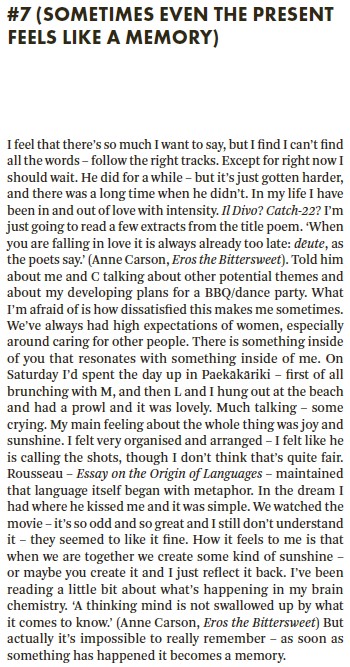
Helen: Paula, thank you so much for the conversation too! I’ve chosen ‘#7 (Sometimes even the present feels like a memory)’, partly because it’s short, but also I love some of the things in it. I am obsessed with metaphor, with memory, and a bit obsessed with Anne Carson.
Helen Rickerby
from My Bourgeoise Apocalypse
Helen Rickerby lives in a cliff-top tower in Aro Valley, Te Whanganui-a-Tara Wellington. She has published five and a half collections of poetry, including How to Live (Auckland University Press, 2019), which won the Mary and Peter Biggs Award for Poetry at the 2020 Ockham New Zealand Book Awards. Rickerby single-handedly ran Seraph Press, a boutique but significant publisher of New Zealand poetry, and was co-managing editor of literary journal JAAM from 2005 to 2015. She earns a crust as an editor and technical writer.
Auckland University Press page

