Tag Archives: Auckland University Press

Poetry Shelf conversation: Helen Rickerby

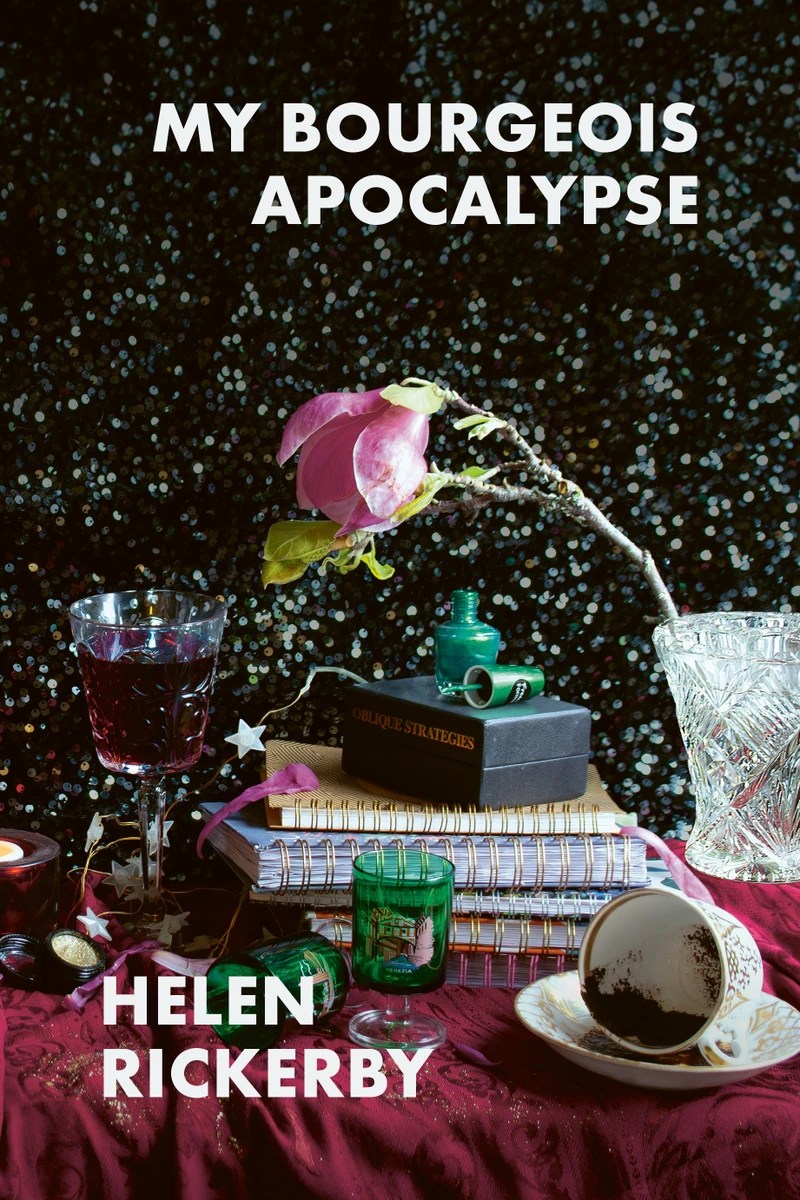
My Bourgeois Apocalypse, Helen Rickerby
Auckland University Press, 2026

Helen Rickerby
from My Bourgeoise Apocalypse

The New York Times offers a weekly newsletter challenge to look at an art work for ten minutes uninterrupted. A bit like what I do with Poetry Shelf’s Breathing Room. A bit like how I react to poetry books I love. I want to linger over them uninterrupted and slowly absorb what they reveal to me, over weeks and days and thirty-minute patches.

Helen Rickerby’s new collection, My Bourgeoise Apocalypse, is a meeting place for memoir, poetry, essay. A succulent and sumptuous poetic collage that offers eclectic life, rich, strange. A collection both unsettling and resettling my reading tracks. Like Anna Jackson, I too am “hooked by the text’s strange rhythms, narrative threads and depths of passionate feeling” (the blurb).  

To celebrate the book’s arrival, I embarked upon an email conversation with Helen as I read, and it was a perfect choice. I wanted the reading to last a year! The conversation even longer.

I love how philosophy brushes against poetry and poetry brushes against memory. How doubt fingertaps confession, epiphany touches grief, and grief nudges joy. I just loved this book, the little startles and surprises and recognitions I carried as I stalled and absorbed and felt utterly boosted by what words can do.

Thank you so much Helen for this precious snail-pace conversation.

a conversation

Paula: I have been musing a lot lately on how I write, but also on how I review and read poetry books. And to some degree they all set off into the unknown with no predetermined itinerary. I decided I would love to try reading your new poetry collection and embark on an unfolding email conversation with you as I read. And you agreed! Wonderful. Before I even open the book, or muse on the cover or the title, I wondered if you had a prompt, a seed that fell in to your mind and took root, a startle point that set you writing this poetry project?

Helen: When I started this, I didn’t intend to be writing a book. Well, actually I was writing another book – which I am in fact still writing – but this one jumped the queue. I can see now how a lot of ideas and influences converged in the creation of this book, but it started with just one poem, which was an experiment. For a while I had been playing with randomness and chance in my writing – opening a page of a book I was reading or my journals, sticking my finger down on the page and then using whatever word or phrase it landed on as the starting point for some writing. I liked how it led to surprising myself. I had also recently seen a film about Brian Eno and I was struck by his ideas about art – his Oblique Strategies cards make an appearance. For a long time I’ve been interested in how our brains make meaning out of random things, and how in poetry we are particularly open to leaping over gaps, making connections. And I had just finished reading Motherhood by Sheila Heti, which makes use of coin tosses for philosophical purposes, and I had listened to a podcast where she talked about her newest book, Alphabetical Diaries (which I have not yet read because I didn’t want to copy it, but I’m looking forward to reading it soon), in which she creates a book out of alphabetised sentences from her diaries. I wondered what I would get if I randomly selected sentences from my journals (I’ve been keeping a journal since my teens, but the ones I used in this project were more recent) and arranged them into a poem. I really liked the result – it sounded a lot like poems I write anyway (I do often use text from my journals in my poems, and all my creative writing starts its life in my journals) – and I liked how it was able to express some things that had been hard to write about. Though, because everything was out of context, there was space for new meanings and stories and surprise.

After that first one I thought I’d try a few more, and then it wasn’t very long before I thought perhaps I could make a whole book. 

Do you usually know when you’re starting a book that it’s going to be a book?

Paula: I love this, this writing matrix of surprise and wonder. I think it is key, too, for me as a reader. It is strange, I have a number of writing projects evolving in my head and in my notebooks, and I think of them as ‘books’, but they are all more concerned with writing as travel rather than writing as destination. Like writing becomes a ticket to feeling thinking imagining surprising myself.

I have now started reading your new collection, My Bourgeois Apocalypse and feel like I am carrying the strangeness and surprise of the title as the cover images reverberate in a tableau of fascination. Extraordinary. The dregs in the teacup. The stack of spiral bound notebooks. The ambiguous galaxy background. I am reminded of the paintings of Laura Williams.

I am reading and it’s goosebumps on my arm as words become more than the building blocks of sentences, but shimmer as talisman as I move from the word azzurro to the word doubt, still holding the word connection from the previous page.

You collage the title ‘[A] POEM IS A THINKING THING’ from Brian Blanchfield. It got me musing on your poetic collage-essay-memoir and how ranging and organic it is. My reading is already thinking feeling puzzling connecting. This feels like an impossible question but did you develop a sense of what you wanted this writing to be and do for you as writer, and then for the reader?

Helen: First of all, I hadn’t heard of Laura Williams, so of course I had to look her up and I can see a parallel in her artworks with what I was doing in My Bourgeois Apocalypse – a bit of this from here, a bit of this from there, something from somewhere else, something big, something whimsical.

The cover photo is the realisation of an idea I had to use various objects mentioned in the poems to create a kind of modern vanitas painting – vanitas paintings were still life paintings that were to remind you of mortality. They often had skulls in them, so the head of the Roboraptor (which is on the back cover) kind of stands in for a skull. My friend Sasha Francis brought her good camera up and we did a photo shoot, and the designer, Kalee Jackson managed to make it work as a cover. The stack of notebooks should really be much higher – those are just a small selection of the journals I was using as source material for the book – it was actually around 20!

I love what you said about being concerned with writing as travel rather than writing as destination. And, like you, I do think of my writing generally as a thing I’m doing to work something out for myself. And this was definitely a journey of discovery for me.

My journals are where I’m not thinking about readers at all – that writing, in that context, is very much for myself – though almost all my writing does begin within my journals. To be for other people it needs to be transformed into a different medium.

I was thinking about readers while I was working on the poems in My Bourgeois Apocalypse, and while I didn’t alter anything in that first draft, I was kind of wondering whether it would make much sense to anyone else. I sent some of the early ones to a few friends, and I did get a positive response, which was encouraging. I also recognised that it was akin to poetry I have written before, and other poetry that I have read and loved (notably My Life by Lyn Hejinian) – poetry that isn’t entirely straightforward to follow, which makes use of parataxis, that you just have to kind of ‘go with’. But, unusually for me, I didn’t show any of the poems to my partner, Sean (aka S), until I had finished the whole first draft – I suspected that if he didn’t like it, it would throw me, and I really wanted to finish it. And once I’d finished it, I still wasn’t sure if it had worked, but I really liked it.

In some ways I wanted it partly to fox readers, as well as connect with them, but in the revising I did keep the reader in mind. The titles were something that I wrote at that point, which readers who have seen earlier drafts have told me helped very much with navigating the book, and also I hope introduced a playful tone.

Paula, do you keep journals, or are your various poetry projects in place of a journals, or a kind of distillation of what could/would be in your journals? Your latest book, The Venetian Blind Poems, feels to me like a distilled journal (journals and diaries can sometimes be quite rambling!), or little extracts from one. I also know from that book, and also from The Track, that you sometimes compose your poetry in your head. How on earth can you remember them? How can you hold the words in your mind? (I forget things almost immediately if I don’t write them down!)

Paula: I have rooms in my head where I compose things. And then sometimes put the things into dedicated notebooks, writing with a pencil. And then when it feels right I transcribe the things in my head onto my laptop. I haven’t kept journals since my twenties!

This morning I woke at 4 am and decided to read a few more pages of My Bourgeois Apocalypse but I kept reading until it was light and I had reached the end. Wonderful! I imagined we were sitting in a café and I’d keep looking up and reading bits I loved to you, bits that resonated with me. Like how I never want to explain poetry. I like to communicate the effects poetry has on me, muse upon the roads and side paths it sends me down, the windows a poem opens, the music it generates, the questions it raises, and of course the wonder. At one point you write: “Poems come out of wonder, not knowing.”

I like how you say: “Writing made me feel like I was rebuilding my internal furniture.” And I was thinking this can also happen as reader.

Or how you suggest writing might be “a form of connection, of little anchors, little hooks, little holes you can put your eye up to, your heart up to, and maybe you will see something you will recognise.”

What strikes me is the way your poetic collage essay memoir builds different rhythms, how metonymy is both significant and fertile, how a sentence might nestle and rub and sparkle against the next. Surprisingly. Often in poetry the space is a key player, but I was mesmerised by bridges, and by how these took me into deep currents of thinking and feeling, whether on writing, living, loving, grieving, wondering.

The collection has had a number of lives, in journals, in a first draft and then in a final draft. Now that the book is out in the world, what words have you carried with you, individual words that signal what writing and indeed this book mean to you?

Helen: You say “I never want to explain poetry.” That resonates with me – I love to talk about poetry, to explore a poem, but there’s something about ‘explaining’ it that seems to reductive. In one of my favourite poems in my book (‘#38’) I say “To explain a poem is to take it apart like it’s an equation that can be solved, or a puzzle where the pieces fit, but I do not think poetry is like that.” I remember writing that and I was thinking partly of when a friend who used to be a secondary-school English teacher told me about how he hated the way they were supposed to teach poetry to students – like it was a riddle with one correct answer. I don’t think there is a black-and-white answer to almost anything, and I don’t want that for poetry either. With this book there’s a lot of ambiguity and evasion – I wanted the sentences to free themselves from their original contexts and be able to be whatever they might be for the reader, whatever meaning or story the reader finds in them.

I’m also really taken by what you say about bridges as compared to space. Last year Anna Jackson and I organised a conference about hybrid sorts of writing that have been called ‘lyric diary’. Many of them are made up of pieces/fragments, and I started a list of all the different terms we could use for them, one of which was ‘islands’. I was thinking about how the spaces in between are spaces for connection as well as gaps – in the same way as the water can be a medium of travel as well as a barrier.

Once I finished the poems and read them over, I did notice many recurring words, themes, ideas – I guess because they are my obsessions. Connection is a big one. And doubt. And love, grief, friendship, music, dancing, happiness, sadness, the nature of poetry, and figuring out what’s going on in my own head – which are also I guess what writing is for me too.

Paula: I was really affected by the way the collection often has its roots in the soil and terrain of COVID. How this strange and tilting time affected us so much, how we lived, and for some of us, how we wrote. You mention that although politics don’t make their way into your writing, you do talk politics with friends and loved ones. Does today’s world teetering upon extraordinary ruinous brinks affect your writing pen?

Helen: The lockdowns and the pandemic generally were a massive thing in the last decade, and has really had massive effects on us as individuals and as a society. I spent a lot of time writing during the lockdowns – mostly in my journal, recording the details of each day, but also in a collaborative project I was doing with some friends. Some people I know really enjoyed it, but, while it certainly wasn’t terrible for me because I was in a very good and privileged situation (a couple of nice people to live with, in a nice house, with work I could do from home and enough money) I did not like it. I discovered I was more of an extrovert than I realised, and missed face-to-face connection with other people. But I was at the beginning very hopeful that our society was united in caring for each other. The socialist utopia I was hoping for did not eventuate, sadly, and while I was joking then about it being an apocalypse, I think it was only the beginning. I studied history when I was younger, and had a kind of arrogant idea that people wouldn’t let such terrible things happen again, but now I think I understand better how terrible things are allowed to happen.

The project I have been thinking about and working on, on and off, since I finished How to Live in 2019, is an exploration of doubt. I’d been writing fragments and notes, but it wasn’t coming together and then I veered off into writing My Bourgeois Apocalypse, but since finishing that I’m back on doubt, and I can see what I’m doing more clearly. Part of the reason is that it seems more and more relevant every day, in this crazy, ‘post-truth’ world. I think we have both too much and not enough doubt. I wouldn’t say I’m a ‘political’ writer, but I’m a person who is engaged with politics, who sees that the personal is political, and I guess also that everything is complicated and multi-faceted. I’m interested in ambiguity, but I also believe in the importance of facts and truth. I think I also believe in hope. All of this stuff gets into my conversations more than my writing, but my doubt project is getting more and more political as time goes on.

Something that resonated with me in The Venetian Blind Poems is the way that we are aware of the horrors of the world, and are horrified by them, at the same time as continuing to go about our own lives. And there’s a strange dissonance to that, but it’s also what we have to do. We keep living. Do you feel like that too?

Paula: Absolutely. Now when my new normal is a rugged personal road coupled with the rugged unsettling terrain of the wider world, to hold and nourish what gives joy, what offers moments of peace and stillness, is so very precious.

I love the idea of a book of doubt. I want to read this already. And I reckon slow simmer writing is as satisfying as slow simmer reading. Then again flash fiction reading (can we say flash poetry sudden poetry) is also a gut heart mind pleasure.

I have to mention the appearance of Italian. A shift in musical key. Things change for me when I move into parlando Italiano, divento una donna diversa, e la mia vita sembra piena di luci diversi e altra musica. How is it for you?

Helen: I’ve been learning Italian for almost a decade now, but slowly, and I am still not very fluent. But it is also part of my daily life. Sean and I say simple things to each other in Italian, and I have friends I communicate with in a mixture of English and Italian. On one hand, being a wordsy and generally eloquent person, I find it a real challenge to communicate in a language in which I have only a toddler’s level of ability. For the anthology Te Moana o Reo | Ocean of Languages I wrote a poem that was partly in English and partly in Italian, which was a fascinating experience. It is mostly about that difficulty of communicating complex things in a language in which you have the ability of an infant.

But on the other hand, Italian is also a kind of heart language for me, one I feel right inside me. And it is such a beautiful language, and musical. I’ve also been learning to sing in recent years – maybe it’s a connected impulse. That said, most of the Italian in the book is from notes I write in my journal when I’m at my Italian class, rather than super-deep things!

I’m really interested that you feel like you become a different woman in Italiano. I have heard people say that they sometimes have different personalities in different languages. For myself, I probably become a bit shyer because I’m less eloquent!

Paula: I once encountered a family at Te Henga Bethells and could tell they were from Italy. We spoke books and life and being here and elsewhere and the language lifted and sang in the café dunes and it was glorious.

A bit like your book, it has lifted and sang in me, knowing writing poetry can be and do so many things. There’s strangeness and humour, heart wrench and skin tingle. I love the piece that I open our conversation with so much because it mirrors my experience. It feels like I have put my eye to the holes, held the anchors in my palm, stalled upon fascinating hooks as I read. Little shatters. Little tremors. Little links. And then . . . and then most especially then, the way your book reminds me of my big loves.

Thank you so much for the conversation. Can you choose a poem the reader can stall upon uninterrupted (with a nod to my New York Times ten-minute art challenge reference in my introduction) to discover their own bridges and holes, hooks and anchors.

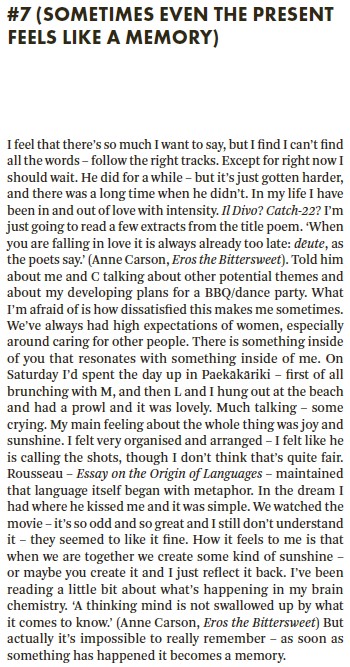
Helen: Paula, thank you so much for the conversation too! I’ve chosen ‘#7 (Sometimes even the present feels like a memory)’, partly because it’s short, but also I love some of the things in it. I am obsessed with metaphor, with memory, and a bit obsessed with Anne Carson.

Helen Rickerby
from My Bourgeoise Apocalypse

Helen Rickerby lives in a cliff-top tower in Aro Valley, Te Whanganui-a-Tara Wellington. She has published five and a half collections of poetry, including How to Live (Auckland University Press, 2019), which won the Mary and Peter Biggs Award for Poetry at the 2020 Ockham New Zealand Book Awards. Rickerby single-handedly ran Seraph Press, a boutique but significant publisher of New Zealand poetry, and was co-managing editor of literary journal JAAM from 2005 to 2015. She earns a crust as an editor and technical writer.

Auckland University Press page

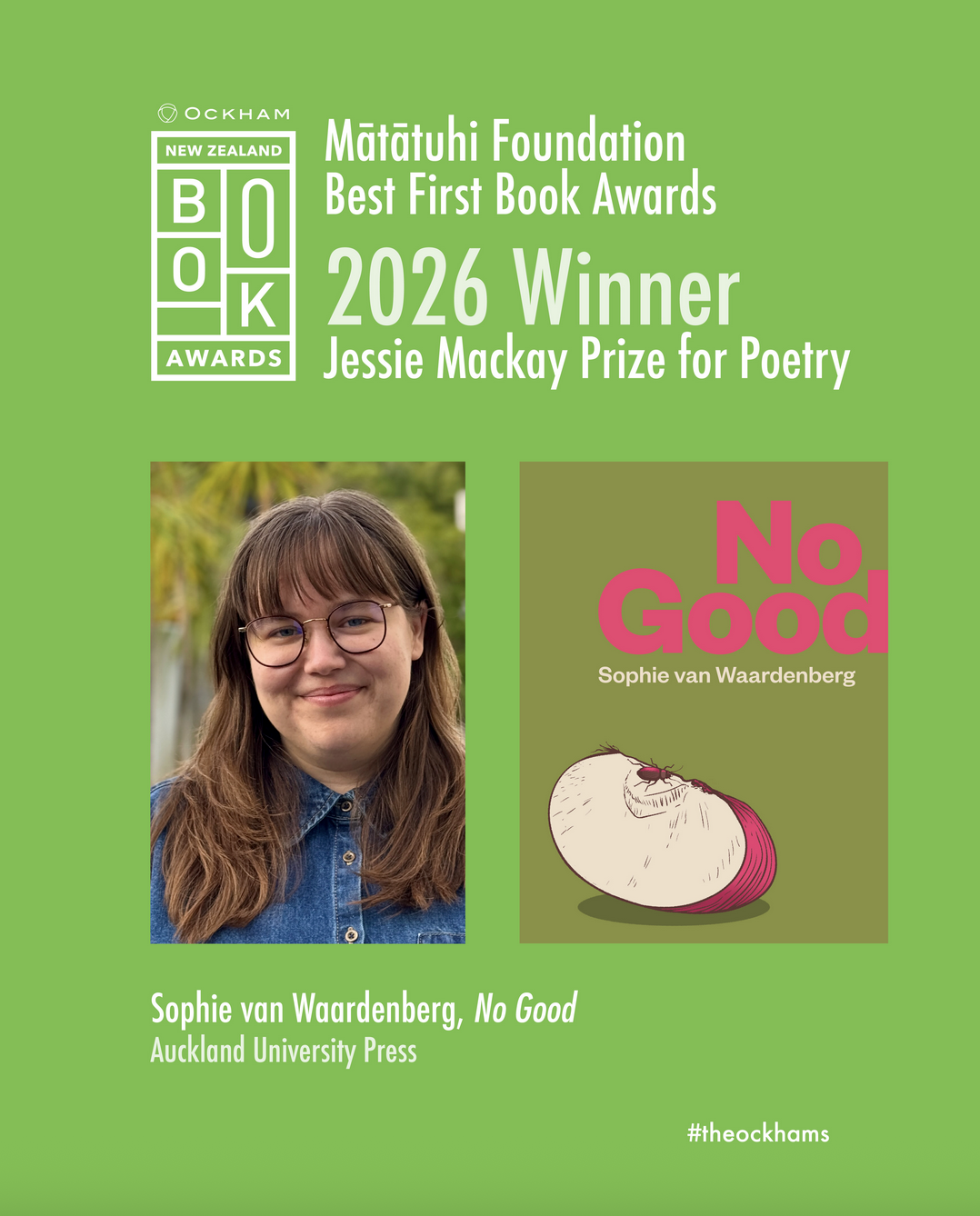
Poetry Shelf celebrates the Ockham NZ Book Awards poetry shortlist: Sophie van Waardenberg

No Good, Sophie van Waardenberg
Auckland University Press, 2025

The word I write in my notebook in my latest reading is bridge, the way poems become a bridge, establish vital bridges. Think sweet and sour crossings, fluid and awkward, here and there, good and not good. Not as a restrictive dichotomy but as a series of movements, like music, like the way personal experience resists pigeon holes. Traversing the myriad bridges in Sophie’s sublime collection makes me both think and feel the world. Yes I am thinking and feeling a version of her world, but also a version of my world. And this moves me.

Paula Green, from Poetry Shelf review

To celebrate placement on The Ockham NZ Book Awards poetry shortlist, I invited the four poets to choose some favourite things. Fourthly, Sophie van Waardenberg.

Sophie van Waardenberg
chooses favourites

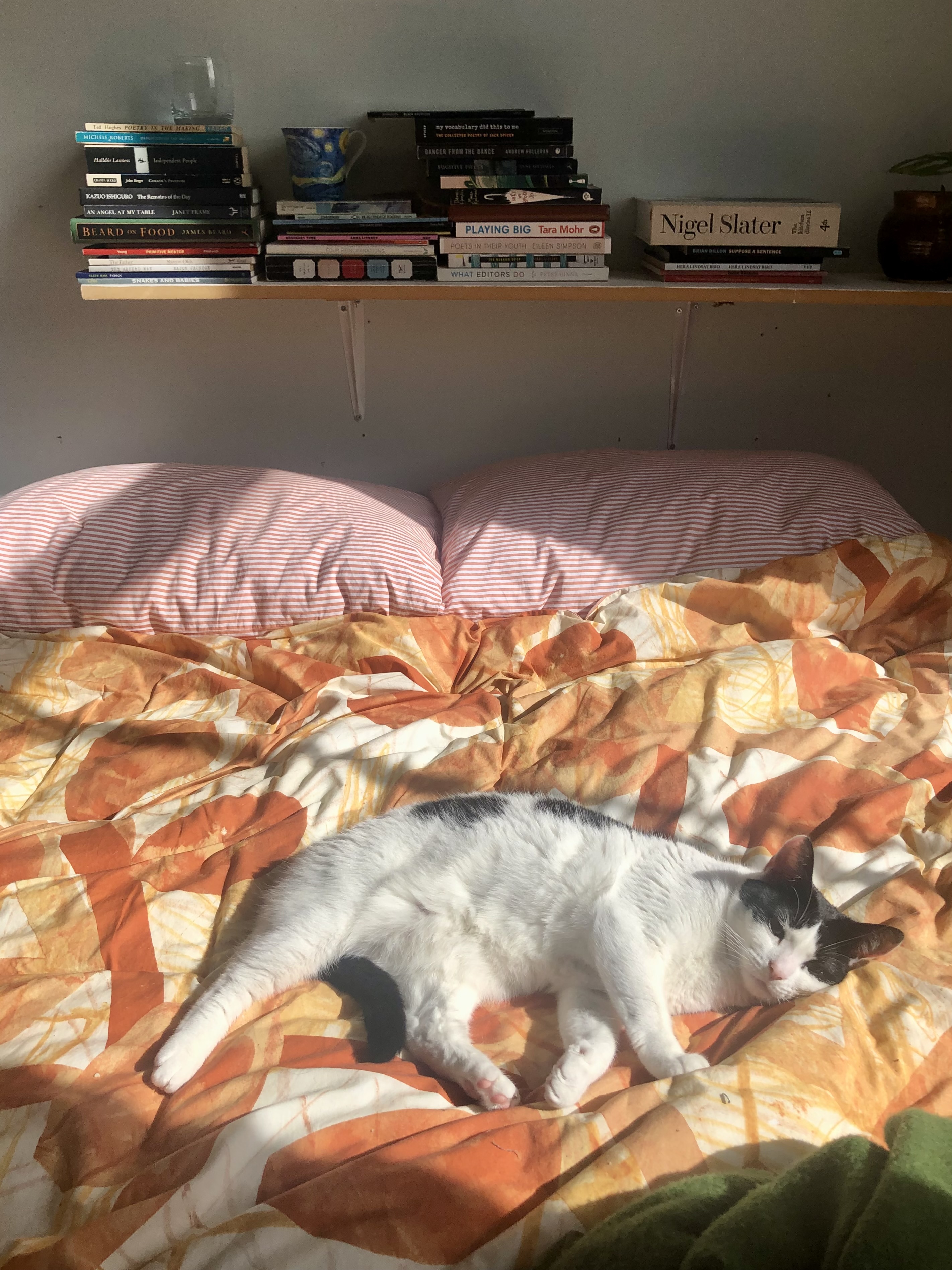
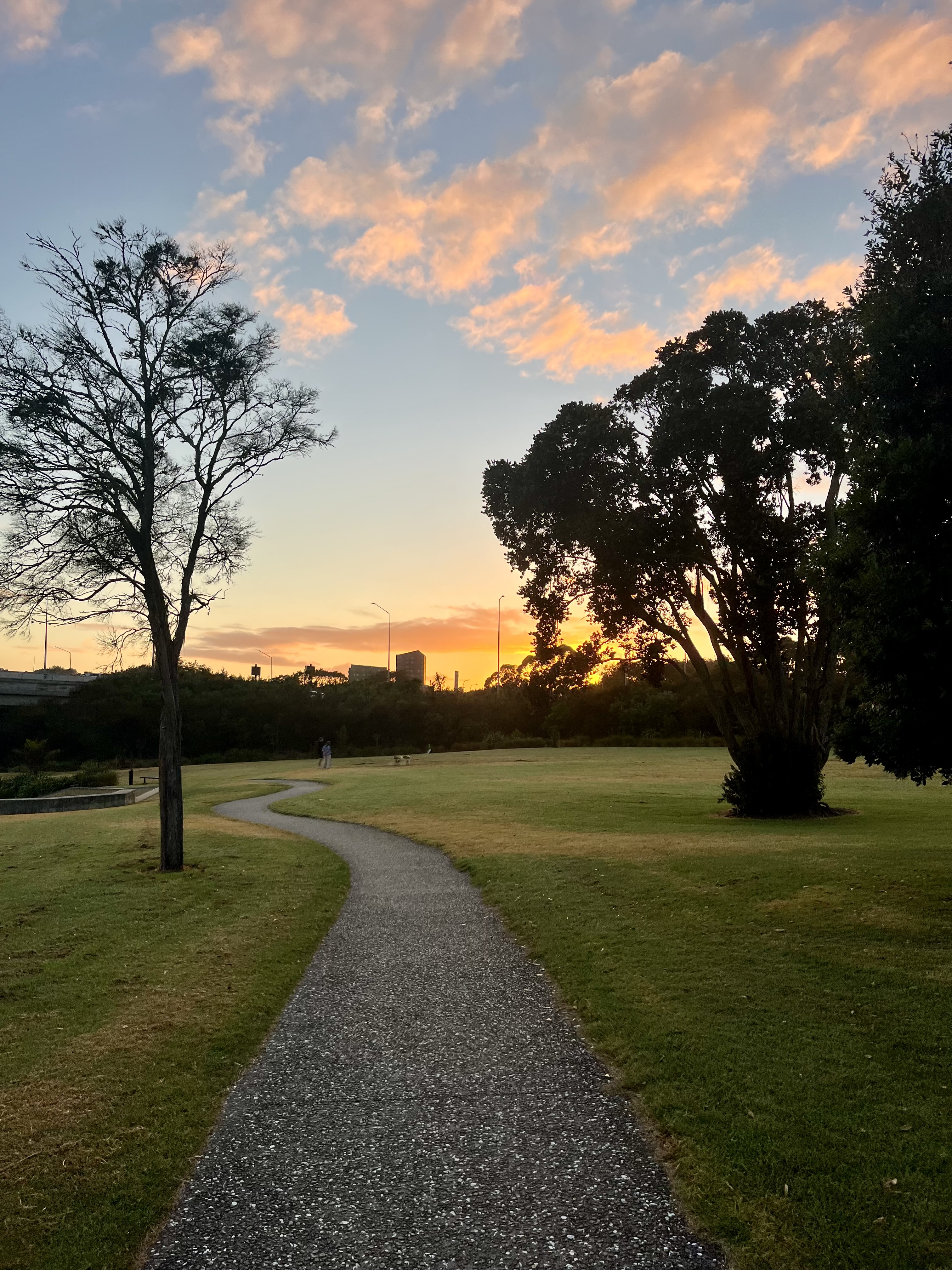
Four photos
(a favourite object, place, poetry book, album)

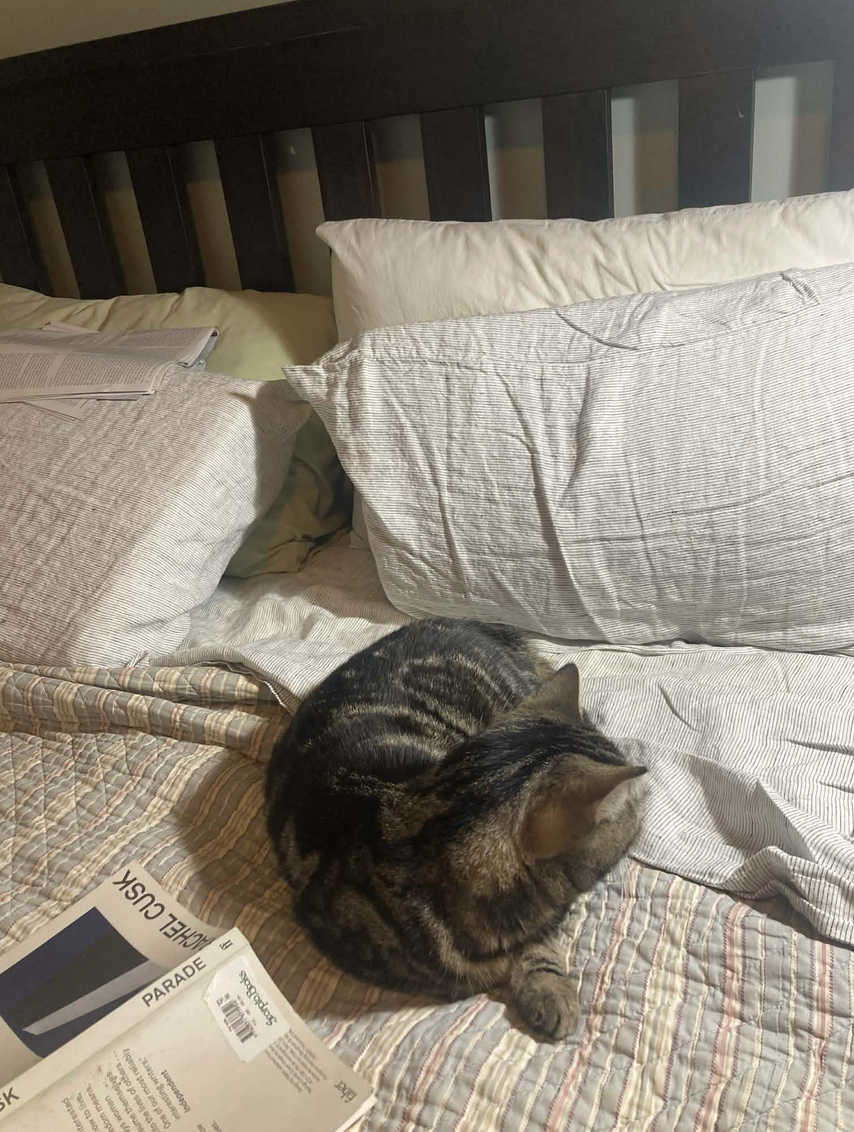
my bed! ideally with a cat on it and a pile of books nearby

the park near my house where I do my boring walks at sunrise & sunset

Three sets of three

Three favourite words in your poetry toolkit
You, I, whatever.

Three things that matter to you when you read and write poems
A question being asked; a rhythm; the alive and weird and particular voice of a human being.

Three poets who have inspired you
Frank O’Hara, Mary Ruefle, Emily Berry.

One question

Why or how does your poetry book matter to you?

I only really have selfish reasons: because it’s my first book, it’s proof for myself that I can draw a line under something and call it finished despite its imperfections. It’s also a relief that it exists, because it means I never have to write my first book again.

One poem

Sticky

A girl can have a piece of everything
as a treat. A girl can call her mother
to ask for love. A girl will superglue
her medicine together. A girl shovels
strawberries into her mouth for juice.
The sugar is enough to fill the hour.
A girl would like to ask for other fruit.
The other fruit falls thickly from the clouds.
A girl is filth and bright. A girl is born
out of comparison. A girl can sing or can’t.
A girl is held inside a duck’s bill, weighed
against a slice of bread for softness.
What flour is a girl made of? Wheat or corn?
How can a girl get clean again?

Sophie van Waardenberg

Sophie van Waardenberg is a writer from Tāmaki Makaurau. She holds an MFA from Syracuse University where she was editor-in-chief of Salt Hill Journal. Her first chapbook, ‘does a potato have a heart?’, was published in AUP New Poets 5 (2019). Her poems about eating carbohydrates and kissing girls can be found in Cordite, Sweet Mammalian, The Spinoff and Best New Zealand Poems.

Listen to Sophie read two poems on Poetry Shelf: ‘Self-Portrait as Adolescent Covered in Flour’, ‘Hymn to the Insomniac in Fool’s Spring’

Sophie chooses a poem

Auckland University Press page

Poetry Shelf celebrates the Ockham NZ Book Awards Poetry Shortlist: Some favourite things with Anna Jackson

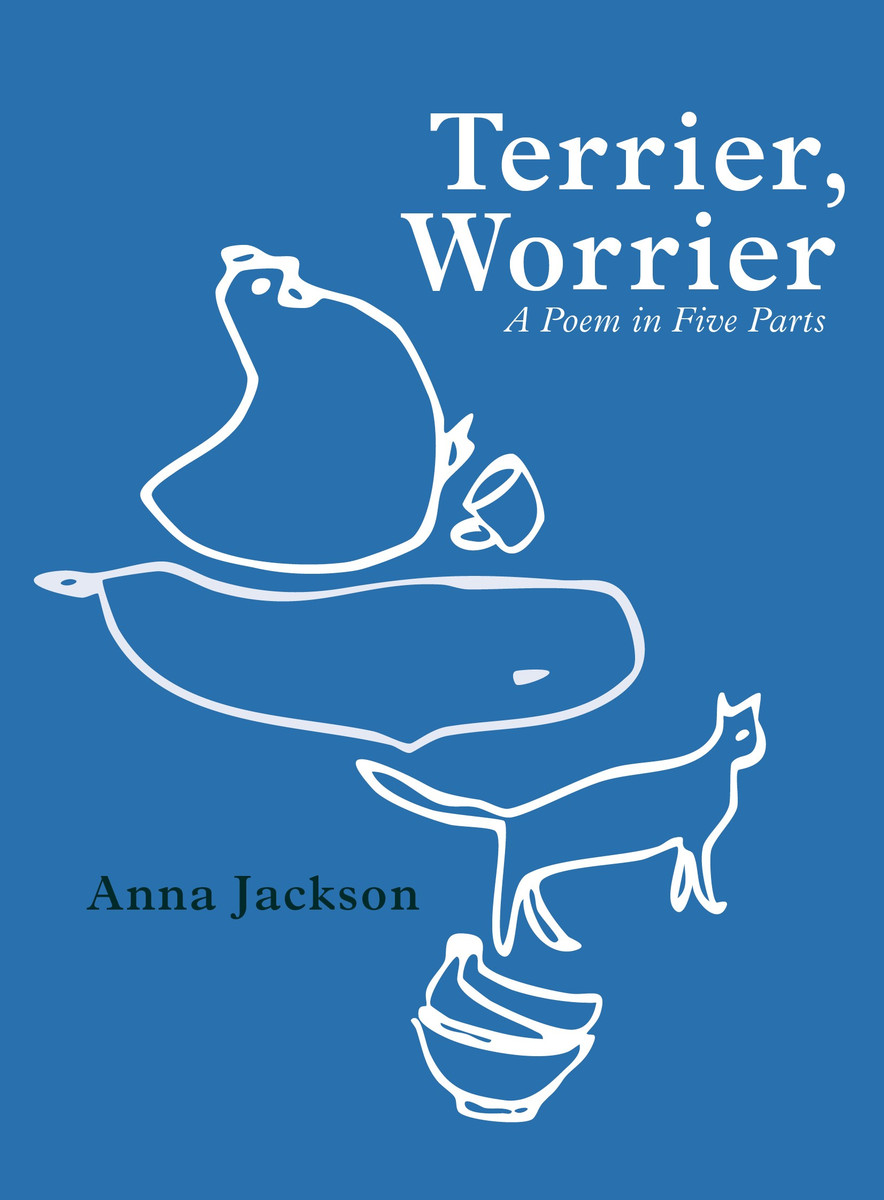
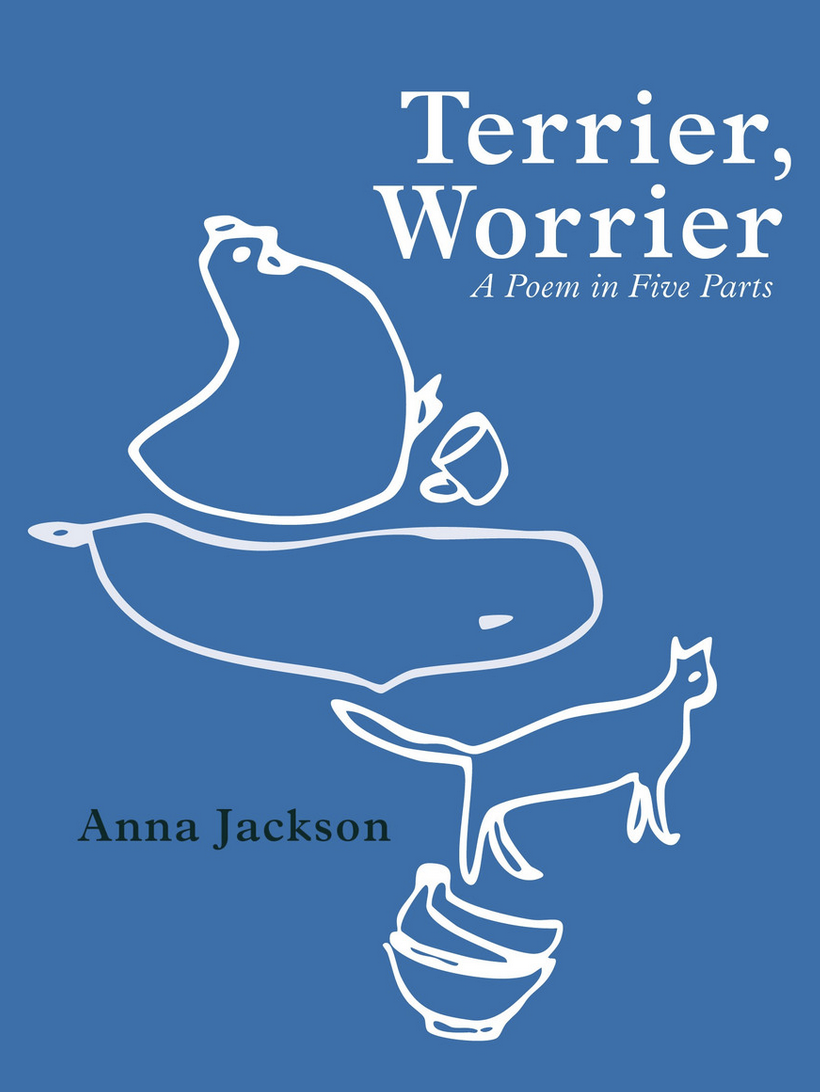
Terrier, Worrier A Poem in Five Parts, Anna Jackson
Auckland University Press, 2025

“Anna Jackson’s glorious new collection, Terrier, Worrier A Poem in Five Parts, gets sunlight slipping through the loops of my thinking, reading, dreaming. The collection is offered as a seasonal loop as we move through summer, autumn, winter, spring, summer, and in this temporal movement, the loop regenerates, absorbing and delivering rhythms of living . . . mind and body . . . rhythms of writing . . . nouns, verbs, conjunctions . . . rhythms of thinking . . . and little by little . . . the compounding ideas, the feelings. It’s poetry as looptrack: overloop, underloop, throughloop.”

Paula Green, Poetry Shelf

To celebrate placement on The Ockham NZ Book Awards poetry shortlist, I invited the four poets to choose some favourite things. First up Anna Jackson.

Four photos
(a favourite object, place, book cover, album)

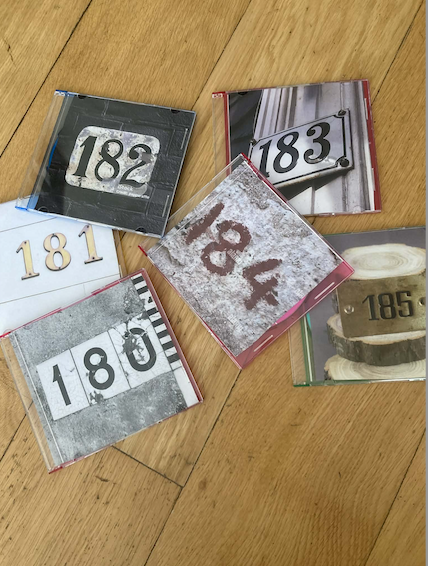
my mix-tape cd collection is a favourite thing!

my favourite place would be, in bed, with the cat

Thee sets of three

3 things that matter to me in poetry: I like surprise, a twist that goes somewhere unexpected but not random. I like repetition, the way it builds memory into a poem.  And voice, I love it when I hear emotion in the way something is said.

3 poets who have inspired me: Catullus, obviously, but not counting Catullus, Frank O’Hara, Wislawa Symborska, Helen Rickerby. 

One question

Why does Terrier, Worrier matter to me? 

Terrier, Worrier is made up of thoughts I was thinking during the Covid lockdowns and at the time I felt some urgency to write them down and not forget them, which was a very temporary impulse.  I don’t write down thoughts any more. But then I had what felt like raw material, that I wanted to work with the way you might want to work with clay or with fabric samples you’d collected.  I felt like using them up.  And I like what I made out of them. 

An extract from Terrier, Worrier

I remember sitting in the car after work, not wanting to turn on the windshield wipers because I felt like I needed the rain on the windshield to do the work of crying for me. 

I thought, every body is a memory palace. 

I dreamed I was in conversation with a photographer who had been photographing a series of traumatic scenes, a series of photographs both terrible and beautiful.  But, before he could exhibit them, before he could even print them, he exposed all the film, and all the images were lost.  Now, he wondered, did he have to go through everything again, re-enact the scenes, in order to recreate the images?

I thought, I don’t know why I translate Catullus over and over again, but it happens and I feel it, I feel like I am split in two. 

I thought, when I am Catullus, writing as Sappho, as Ariadne, as Attis, as Procne, am I bird or birdsong?  The journey, or the backwards glance?

I sat in the car with my daughter, tears running down our faces.  Then I laughed, and turned the windscreen wipers off.

Anna Jackson
from Terrrier, Worrier 

Anna Jackson is the author of seven collections of poetry as well as Diary Poetics: Form and Style in Writers’ Diaries 1915–1962 (Routledge, 2010) and Actions & Travels: How Poetry Works (Auckland University Press, 2022). She lives in Island Bay, Te Whanganui-a-Tara, and is professor in English literature at Te Herenga Waka  Victoria University of Wellington.

Anna Jackson’s website
Auckland University Press page
Poetry Shelf review
Anna and Paula in conversation on Poetry Shelf
Anna chooses an extract from Terrier, Worrier (longlist feature)

Poetry Shelf celebrates Ockham NZ Book Awards poetry longlist: a review and Emma Barnes picks a poem

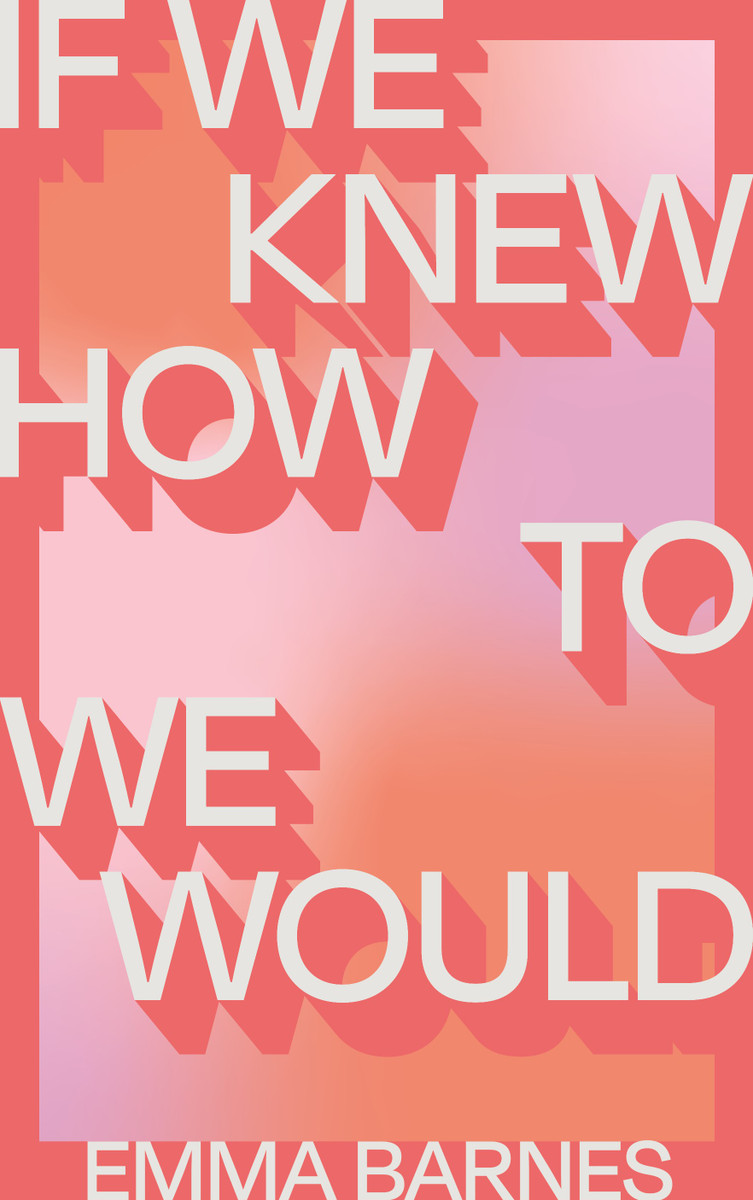
If We Knew How to We Would, Emma Barnes
Auckland University Press, 2025

Poetry Shelf review

Emma Barnes’ new collection comes with an advisory note as some parts deal with suicide, depression and grief. I utterly loved Emma’s debut collection,I Am in Bed with You (AUP, 2021), but in my patchwork year of light and dark, in 2025 I could not enter the pathways of If We Knew How We Could. Making choices like this is an important part of self care, yet this week, having steadily grown into my new normal, I felt ready to read it. And I absolutely love it.

I near the end of my madcap plan to celebrate every poetry book on the Ockham NZ Book Awards poetry longlist (within an uncharacteristic short space of time) and I know what an extraordinary set of books the judges have selected. And here is Emma’s book, one of the few collections I had not already read and reviewed, and it touches me so profoundly. It did not trigger the dark, it opened up a kaleidoscope of light on existence, on non-existence, on self love as much as self loathing.

The book is dedicated to “all the ad hoc mental health support teams who are out there doing their best in an underfunded, seemingly unloving world.’ How this resonates when our health system is rusting up and out, when our doctors and nurses are working against all our odds to heal and care.

Emma’s collection is divided into three sections, each prefaced with epigrams from authors who, as Emma writes in their endnote, are their “literary ancestors”: “As a writer I am descended from every author I’ve read and loved”. Again so resonant. I am reminded how I carry mantras in my heart and pockets, lines from poems that flicker and fertilise throughout each day. Try this for size:

“Love doesn’t just sit there, like a stone,
it has to be made, like bread;
remade all the time, made new.”

Ursula K. Le Guin, The Lathe of Heaven

I have filled a notebook with epigrams from If We Knew How We Could. Yet every prose poem is like an opening fan of epigrams, each line intricately woven into the “tilt” and “truth” of how we read the ones either side. This for example from ‘To knit is to code is to code is to knit’:

I am aware of the gaps within myself. I leave a little bit of openness for a
future though I knit around you, I knit around us. I knit into a future world
where thread and gap combine to wrap our history neatly of lopsided. The
gaps that made us then are not the gaps that make us now.

As much as the collection faces, negotiates, and indeed travels, with grief, it faces, negotiates and travels with life. I see the book as a form of embrace. Think self, think life, and also think form. The first and third sections are the warm arms around the middle section’s aching jagged heartwrenching core. In the opening section, the poems, both organic and mesmerising, at times erotic draw us close to a together and breaking “we”, to bodies that yearn and crave and desire, smudging and crossing borders between we and you and I. Of words, beyond words. Of self, beyond self. The middle section faces a suicide (the word too unbearable to be used by the poet) of someone close, with the pain of the what-if alternate paths and alleys, the toughness of the “unknown” and the “unknowable”, especially to self, even to self. The third section returns to the homeself, to the body, to the self as a solar system of possibilities, truths, recognitions. And yes, pain and desire and fragilities. Read this sample from one of my favourite poems, ‘I Am’:

I am an unmade bed. I am a single thing made up of many other things. I am a reason, a raising, a roof to be raised. I am a song you sing in your sleep. I am a collection of dots. I am a need you buried in the back garden. I am a literal spray of light across a wooden floor in a house where the sun has only just returned. I am a musical phrase. I am a lead light. I am a host. I am seven different names. I am all the fat in my body. I am the sky when it is early spring and I can’t believe I exist in this colour range. I am so blue.

What do I pull close from this extraordinary book, words to carry in my pockets and heart? I could point you to the way we are organic and multi-hued, maybe even multi-hulled. The way both world and self are full of gaps, how there is the known and the unknown, the knowable and the unknowable, recognition and misrecognition. I utterly love the unfolding slowness of the narrating voice, the rhythm intensifying thoughtfulness, the weave of “truth” and “tilt”, the complicated “knit” of how to live and co-exist, how to be, despite edges and wounds. I love the physical objects that feed into the self-narrative-knit: the Wi-Fi restarting, the egg cracked, the empty street, the tree roots and leaves, the pattern of feet, tender wall, soft bridge.

Extraordinary, this is my heart book of 2025, this book of human stutters and connections.

Emma Barnes (Pākehā, they/them) studied at the University of Canterbury and lives in Aro Valley, Te Whanganui-a-Tara, Wellington. Their poetry has been published in journals including LandfallTurbine | KapohauCordite and Best New Zealand Poems (2008, 2010, 2021). They performed in Show Ponies in 2022 and 2023. They are the author of the poetry collection I Am in Bed with You (AUP, 2021) and co-editor with Chris Tse of Out Here: An Anthology of Takatāpui and LGBTQIA+ Writers from Aotearoa (AUP, 2021). They work in tech and spend a lot of time picking up heavy things and putting them back down again.

Auckland University Press page

Poetry Shelf Celebrates Okham Book Awards poetry long list: Gregory Kan picks a poem

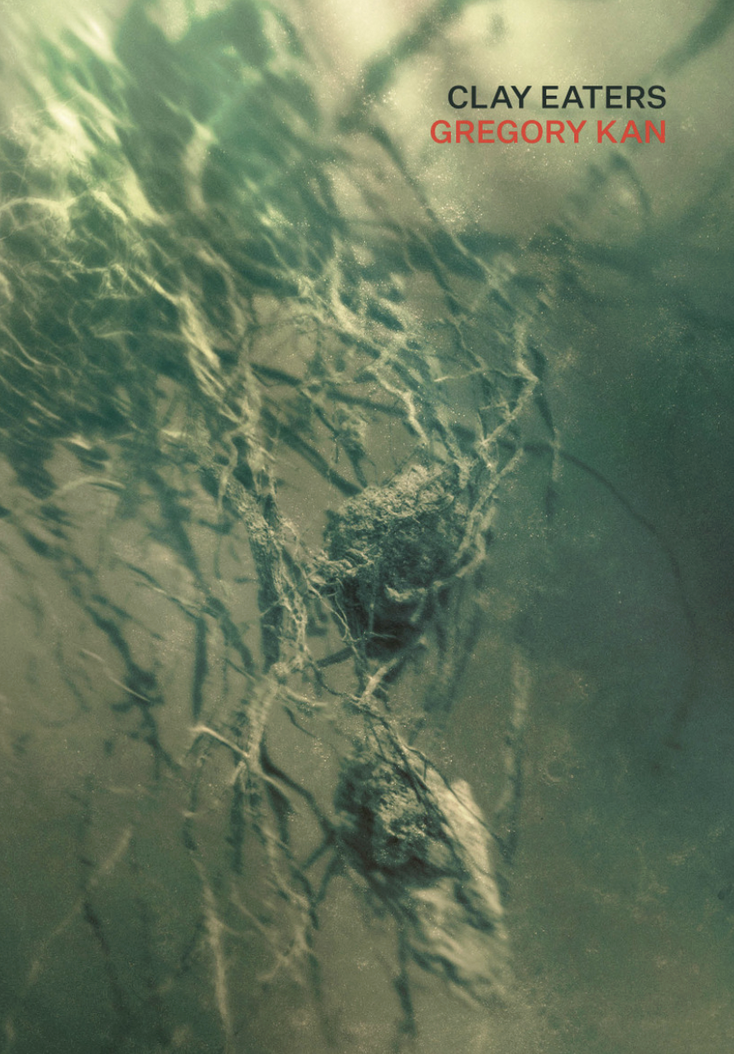
Clay Eaters, Gregory Kan
Auckland University Press, 2025

Not wanting to be bent

Over each and every loss

Divided my mind into multiple plots

Of land, with fences

Growing around each of them

Pretended

That there was nowhere else to go

That where I was

Was all that was left

And years went by

Like on television

Gregory Kan
from Clay Eaters

“I feel like I’ve written this poem many times, differently.” Gregory

From Paula Green’s review on Poetry Shelf:

I have just finished reading Gregory Kan’s Clay Eaters and I am caught in an eddy of multiple hauntings. How to translate this transcendental state of reading? How to share this poetry nourishment? I will begin with the notion that the collection resembles a landscape of braided rivers: a polyphonic source, the tributaries, the gentle currents and the torrents, the obstacle boulders and the jagged edges, the ripples and the calm. The beauty. The fierceness. The shifting waters. The place to stand and ponder. The place to stand and be. Poetry as braided river. Poetry as wonder.

Poetry that is personal and invented and incredibly moving.

Who were you, really

Outside of us, outside of me

Outside of all my

Useless bargaining

There are autobiographical braids. The family who moves from Singapore to Aotearoa. The poet who returns to Singapore six years later to do compulsory military service on Pulau Tekong. A father who suffers a stroke. A partner and a beloved cat who dies. Siblings and their offspring.

Poetry that is slowly unfolding as we traverse the braided currents. The visual layout offers shifting movement as we move amidst silence, the double spacing, the single spacing, the space to ponder, the spare and the dense, the jungle and the family room, the familiar and the unfamiliar.

Poetry as mapping. Maps are a recurring motif on an island that has a chequered history of cartography and naming, where orienteering is a key lesson for the military trainees. Yet I find myself viewing this as more than jungle mapping, because these poetic braids are a way of mapping self, of heart. There are the slippery currents of losing and finding one’s way in both past and present, the porous areas between here and there. There is no translation for a dish, kueh: ‘Neither cake nor jelly / Neither dumpling nor pudding / But somewhere between them all’. For me that signalled the inhabited space. Nothing set in concrete. Nothing static. The forever changed. Like the braided river flowing, the same but different.

This is poetry that navigates a tough experience, the poet’s military cadet years, those jungle ghosts, where spirits may dwell in trees: ‘The island didn’t seem like a place for people’. Where it’s the ‘Endless trees running deep into the red clay earth’. And it’s the weight of packs and mysterious stories and escape longings. The hammering weapons. Heart wrenching. This ache.

And then.

This is poetry that draws forward the father, there in his invalid wheelchair or his study, notebooks piling, books on shelves. The difficulty and ease of being with him, then and now. And the family, the mother, the siblings and the offspring, coming into view. And a scene, this together family scene, after the ‘archetypal family feast’, that is a catch in my throat, as the dreams accrue and connect.

Gregory Kan is a writer and developer based in Pōneke/Wellington. His first collection of poetry, This Paper Boat, was shortlisted for the Ockham New Zealand Book Awards for poetry in 2017. Under Glass, his second collection, was longlisted for the award in 2020. He was the 2017 Grimshaw Sargeson Fellow.

Auckland University Press page

Listen to Gregory read here

Poetry Shelf celebrates the Ockham NZ Book Awards poetry long list: Sophie van Waardenberg chooses a poem

No Good, Sophie van Waardenberg
Auckland University Press, 2025

Cremation Sonnet

When you come back your eyes are huge and bursting.
You come back with clean long hair.
You come back normal but you’re swelling
in the middle like a bird. Your skin luminous.
Or your skin something else. Last night—
did you know—you came back caved in, beaten,
and tomorrow you’ll be perfect, wading nowhere
through a football field of loose complacent light.
You come back: you do not know me. Or if you do,
you do not love me. Or if you do, it’s not enough.
Still you come back, forty-eight and starving,
twenty-two and blushing from a pantomime.
Dead dead traveller, what song is it,
when you come back, that you sing?

Sophie van Waardenberg
from No Good

This is the first of a bunch of ‘Cremation Sonnets’ that make up the middle chunk of No Good. There were a lot more of those sonnets that didn’t make it into the book, and I almost feel like I could write just as many if I tried to again now, but I don’t think I’ll try to again. Grief gets boring. (And I think some of the poems are about that, about how boring it is.)

This one, though, comes from the dreams I had — still have, sometimes — of my dad being alive again. He died when I was thirteen, and for a long while there was nothing I wanted more than to have him back. But it is never comforting to have a dead person come back in a dream, at least not for me, because they are not themselves and have nothing new to say to you. They are what your sleeping brain makes from scraps: some kind of ghoul or stupid caricature. If I wanted to achieve anything in particular with this poem, it was probably to at least gesture at that weird cavernous space between longing and horror. How can you bear that desire for something you can never have again? How can someone be gone? I think grief is more like confusion than sadness.

The thing is, these sonnets weren’t actually horrific to write. They were sometimes quite fun. I remember being in a bit of a frenzy, writing one or two of them a day — most of them unpromising. I had a pretty on-again off-again relationship with metre, obviously, and I made no attempt to rhyme. Still, there are plenty of iambs lolloping around in here. ‘A football field of loose complacent light’ is definitely a result of working in metre; I love how that constraint can force me into a less predictable line. The most fun I have when I’m writing is when I surprise myself, and I did that a lot when I wrote these poems.

Sophie van Waardenberg

Poetry Shelf review extract:

What initially hooks us into a poem? For me, there is no singular response. Indeed if there were, it might limit what poetry can be and do. When I first started reading Sophie van Waardenberg’s new collection, No Good, I jotted down two words in my notebook: rhythm and voice. I was hooked. I was drawn into the musical cadence of a speaker speaking, drawn into the under and over currents of spiky, thistle, bloom. And as I read the collection, on a number of occasions over the past few months, crucial questions arrived. I was especially musing on the way a poem might become both self and other.

The title is the perfect welcome mat into the collection, particularly coupled with the cover illustration, where ‘good’ wavers, and I gaze at the beetle on the apple that is both good and not good. Pausing on the welcome mat, a cascade of (centuries) of good girl propaganda spins in my mind, and I am peering into the no good to see the next apple in the bowl, a portal of good in the pillowcase of no good.

Full review here

Sophie van Waardenberg is a writer from Tāmaki Makaurau. She holds an MFA from Syracuse University where she was editor-in-chief of Salt Hill Journal. Her first chapbook, ‘does a potato have a heart?’, was published in AUP New Poets 5 (2019). Her poems about eating carbohydrates and kissing girls can be found in Cordite, Sweet Mammalian, The Spinoff and Best New Zealand Poems.

Listen to Sophie read two poems on Poetry Shelf: ‘Self-Portrait as Adolescent Covered in Flour’, ‘Hymn to the Insomniac in Fool’s Spring’

Auckland University Press page

Poetry Shelf celebrates the Ockham NZ Book Award poetry longlist: Anna Jackson chooses an extract


Poetry Shelf has invited poets to choose a poem from their longlisted collections and to write a few comments on the poem and poetry. Today Anna Jackson:

Terrier, Worrier A Poem in Five Parts, Anna Jackson
Auckland University Press, 2025


Terrier, Worrier is one long poem so instead of choosing a poem from it for Poetry Shelf I have selected an extract.  This should be easy because every paragraph is almost a self-contained little poem, but to me what makes Terrier, Worrier a poem are both the gaps between the paragraphs and the repetitions, returns and resonances across the collection as a whole.  Thought doesn’t lead straight on to another thought but is present under the surface of the forward movement of the prose and emerges transformed elsewhere in relation to a new idea.  I don’t know if this is really poetry or just how the mind works.  In Terrier, Worrier thoughts are prompted by conversations, funerals, the behaviour of my hens, questions posed by philosophers, massages, memories and dreams. 

This extract includes the dream that gives the collection its title, and, with that sentence in the middle, connects narratives about my hens and worries about motherhood and daughterhood that run through the collection.  

This summer, I kept dreaming about a terrier. It was not a recurring dream but a recurring terrier that appeared in dream after dream, often needing to be released from somewhere it was trapped.  It did seem as if my unconscious was hard at work trying to tell me something I was repeatedly failing to grasp.  I thought, a terrier is a good symbol for the work of digging up something underground but still alive. 

Wilma had not been interested in me as a person when she was still part of a flock but now she looked in the eye which is not something she had ever done when the other hens were still alive.  I thought she was looking at me person to person now, whereas before she had only looked at me as an object.  I thought, there is a difference between being tame, and being a friend. 

There is a difference between being a tame, and being a daughter.

I wondered whether I could hear terrier as a version of the word worrier, a worrier being not someone who makes you worry but someone who themselves worries, who worries away at things like a terrier might worry away at a sock.  A terrier would be someone who allows themselves actually to indulge in the feeling of terror.  I tell myself “I am not okay, but I will be okay,” but maybe I need to stop saying that and release the terror, or maybe the terrier is not myself but represents someone else’s terror which needs to be heard. 

I thought, it tells us something about poetry that when we need to talk to ourselves about something we don’t know we know, we tell it to ourselves when we are asleep, in images we struggle to remember when we awake, and often take more than one reading to fully understand.

Anna Jackson

From Paula Green’s Poetry Shelf review (a review in nine loops):

There’s a long black cloud streaking from the west coast to the backyard bush sprinkling salt and pepper rain. Terrier, Worrier is generally written in the past tense, with many stanzas beginning with ‘I thought’, yet for me, curiously, wonderfully, it carries the charismatic freight of the present tense, the sweet fluidity of the gerund, the present participle . . . where be-here-now fluency prevails regardless of gaps, rest-stops, hesitancy. Reading is to be embedded in the moment of the past as reader, so that what happened, and what was thought, becomes acutely present. Dive into the poetry currents in the collection, and along with the writer, you will might find yourself filtering, evaluating, experiencing, valuing, photographing, documenting, thinking. Savouring a moment.

My full review here

Anna Jackson is the author of seven collections of poetry as well as Diary Poetics: Form and Style in Writers’ Diaries 1915–1962 (Routledge, 2010) and Actions & Travels: How Poetry Works (Auckland University Press, 2022). She lives in Island Bay, Te Whanganui-a-Tara, and is associate professor in English literature at Te Herenga Waka  Victoria University of Wellington.

Anna Jackson’s website
Auckland University Press page


Poetry Shelf noticeboard: Helen Rickerby Poetry Launch

Event by Auckland University Press

Southern Cross Garden Bar Restaurant

Join us to celebrate the launch of My Bourgeois Apocalypse, a new poetry collection by Helen Rickerby.

Friday 13 March
7pm

The Guest Room, out the back of the Southern Cross Garden Bar Restaurant
39 Abel Smith Street
Te Aro, Wellington

The book will be launched by Anna Jackson, with a reading by Helen.

In the spirit of the collection’s hybrid collage-essay-memoir form, this is a launch-cum-dance party, with music featured in the book playing throughout the night (mostly from the 80s). So bring your dancing shoes!

Books will be available for purchase on the night thanks to Unity Wellington.

About the book: https://aucklanduniversitypress.co.nz/my-bourgeois…/

Poetry Shelf review: In the Hollow of the Wave by Nina Mingya Powles

In the Hollow of the Wave, Nina Mingya Powles
Auckland University Press, 2025
first published, Nine Arches Press, UK, 2025

handiwork


People asked me where I learned
and I said I taught myself the slow work of making.

But memory is a house with scraped white walls.
I step inside and choose what to take, what to leave behind.

My hands feel their way through
the gathering, the careful pulling apart.

The work of particular poets can strike you so deeply, so resonantly. Poets who produce collections that satisfy your hunger to read so keenly, with books that take up residency in both your mental and physical poetry rooms. Nina Mingya Powles has been that kind of poet for me, from her terrific debut collection Magnolia 木蘭, through her various other published offerings. Her new collection, In the Hollow of the Wave, is one of the most gorgeous poetry books I have held this year – a sweet combination of heavenly paper stock, generous size, lovingly-tended internal design and vital breathing room. Nina has also created textile works that add to the visual beauty and allure of the book.

Textile is a key word. I experience the book as multiple loomwork: a weaving of memory, experience, language, cottons and fabric. Weaving as a way of observing the world, feeling the world, observing the object, feeling the object, observing the past, feeling the past. It might be the sewing machine upon which her grandfather stitched quilts from garments belonging to her siblings, mother and grandmother. It might be a gown, a pleat, or a sheet of white paper or fabric.

And now, with In the Hollow of the Wave, the granddaughter is herself stitching quilts; inside the stitched poem the stitched cloth, and inside the stitched cloth the stitched poem. I experience contemplation pockets tucked with memory pleats, and inside memory pleats, I threads of slow contemplation: andante, largo, adagio.

The book title is borrowed from a line in Virginia Woolf’s To the Lighthouse. It gains its own life as Nina ponders Virginia’s use of orientalism and Kitsushika Hokusai’s woodblock print, ‘The Great Wave off Kanagawa’. The poem haunts, the hollow in the wave haunts, the recurrent pulse of existence and non-existence haunt. The poem is skin-prickling reading:

beyond the frame I saw a distant city / a place I used to know / where rain
falls in the foreground / all day and all night / I took out my sketchbook /
sharpened my pencil / drew a line across the sea / asked the mountain /
what does it mean to see and be unseen / it did not answer

So many echoes across the collection. So many threads to follow and pause on(slip stitch, ladder stitch, cross stitch). There is the scent of plants and plantings, herbal remedies, the reminder of the women in poverty who stitched the garments we wear, the reflection of self in a stirred pan on the stove, the way dreaming seeps into making, the way the language, chores, hopes and the lives of women still matter. The way poetry can be a way of asking questions.

Inside the hollow of a wave is a poem. And inside that poem is a book. A book such as this one. Stitched with aroha and luminous threads. I want you to read it for yourself and get absorbed in its beauty and craft. It has already found spots in my poetry rooms.

Nina Mingya Powles is a poet and writer from Aotearoa New Zealand, currently based in London. Her debut poetry collection, Magnolia 木蘭, was published in New Zealand, the UK and the US, and was a finalist in the Felix Dennis Prize for Best First Collection and the Ockham New Zealand Book Awards. Powles won the inaugural Women Poets’ Prize in 2018 and the inaugural Nan Shepherd Prize for under-represented nature writers in 2019. Her resulting book of essays Small Bodies of Water was published in 2021 by Canongate. She has also published a short food memoir, Tiny Moons: A Year of Eating in Shanghai (The Emma Press, 2020).]

Auckland University Press page

Poetry Shelf celebrates National Poet Laureate Chris Tse

photo credit: Celeste Fontein

Today Chris Tse is stepping down from his role as National Poet Laureate, and it felt extremely fitting to acknowledge his vital contribution to poetry in Aotearoa and overseas. He has staged a range of poetry events around the country, drawing in voices, inspiring younger writers, contributing to inspiring poetry conversations in various settings.

Having always been a big fan of Chris’s poetry — from his debut in AUP New Poets 4 (AUP 2011) to Super Model Minority (AUP, 2022) — I decided I would pick one poem from each of his books as a celebration of his tenure. Chris kindly answered a couple of questions from me and contributed a recent poem. To reread my way through his collections was utterly moving: from How to be Dead in a Year of Snakes (2014, AUP), a collection that returns to the tragedy of murdered goldminer, Joe Kum Yung, to his next two, he’s so MASC (AUP, 2018) and Super Model Minority (AUP, 2022). His books navigate sexuality and race, sky and mountain peaks, revolution and imagining, speech and peace. Ah, take the time and spend a long weekend absorbing his extraordinary poetic ink.

Thank you, Chris thank you.

five poems

Dig
     after Seamus Heaney

Our first back yard hugged
the prickled slopes
of Kelson.

I watched my father dig and
tear his way       through bush and clay
to find that richer soil.

That spicy scent of gorse, the path
                he zigzagged.

And beyond him, decades
              and oceans away,
his father stooping to dig
gathering ginger and spring onion;
               dreams of richer days.

                  •

Between my finger and my thumb
the sticks rest.

                  •

Below the surface lies
a history of chopsticks.
                                          In the days
of new sight we clung to comfort
as a sign of success.

Eight treasure soups,
the finest teas
            ivory and bone over
            wood and plastic.

                 •

I’ll dig
           with them.

from Sing Joe, in AUP New Poets 4, Auckland University Press, 2011

They peer through me as if I were dead.
My hands are tired now, fading to mist.

•••

I’ve held out for luck
and fortune like a stony fool,

•••

but sometimes the heart must
gracefully accept defeat.

•••

These days it feels like I am digging
my own grave.

from How to be Dead in a Year of Snakes, AUP, 2014

Heavy Lifting

Once, I climbed a tree
too tall for climbing
and threw my voice out
into the world. I screamed.
I hollered. I snapped
innocent branches. I took the view
as a vivid but painful truth gifted
to me, but did not think to lay down
my own sight in recompense.
All I wanted was someone to say
they could hear me, but he tree said
that in order to be heard I must
first let silence do the heavy lifting
and clear my mind of any
questions and anxieties
such as contemplating whether
I am the favourite son. If I am not,
I am open to being a favourite uncle
or an ex-lover whose hands still cover
the former half’s eyes. I’ll probably never
have children of my own to disappoint
so I’ll settle for being famous instead
with my mouth forced open on TV like
a Venus fly-trap lip-synching for its life.
The first and last of everything
are always connected by
the dotted line of choice.
If there is an order to such things,
then surely I should resist it.

from he’s so MASC, AUP 2018

Wish list—Permadeath

I wish I didn’t feel compelled to write about racism, but there it is
patrolling my everyday thoughts like a mall cop drunk with power.

I wish people didn’t ask me how to solve a problem like racism, as if
it is a cloud they cannot pin down. I am not an expert spokesman

holding an elusive truth. I wish I could predict when racism
would exit stage right to wherever bad things go to die rusty

non-biodegradable deaths, but I can’t predict the death of something
with a robust business continuity plan that involves moving from

host body to host body. I am not an exorcist—I am a sympathetic
vomiter. Is it predictable for me to write this poem? I suppose so.

What I really want to write about are things with promise, to offer up
whiskers on kittens when the outlook is for Nazis on Nazis. I wish

I could sing my way out of this while the man I love applauds from
the front row, our adorable Jack Russell terrier Rocket sat by his feet.

I wish I could start a love poem with a line like ‘He thumbs me
like the Oxford Dictionary‘ and consider it a job well done. I wish

I didn’t always feel this way—always tired of explaining why
I am tired and why writing this poem is more need that want.

I never felt the need to be the gunshot during a knife fight until they
told me there was no such thing as ‘let’s finish this once and for all’

from Super Model Minority, AUP, 2022

How to edit a poem

  1. Let the poem approach you first. Don’t point; don’t scare it.
  2. Encircle the poem with broken lines and half-hearted rhymes to reverse any spell that may cause the reader sorrow.
  3. Ask yourself: is the poem merely camouflage for the poet’s desires?
  4. All persons, real or imagined, are questions and aphorisms double-crossing each other in pursuit of a revelation.
  5. Inside this poem there are two poets: one is literal and the other is metaphorical.
  6. Ask yourself: is the poet a secret carried in a whale’s mouth?
  7. Capitalise every word that reminds you of your childhood.
  8. Strike out every verb that will make the reader feel guilty for not living a wholesome and virtuous life.
  9. Inside this poem there are two poets: one tells the truth and theother got away with it.
  10. Ask yourself: when did you last trust a poem?  
  11. Interrogate each line as if it were a co-ordinate plucked from a map.
  12. A crooked staircase halfway to the moon. A wolf cries in the dark.
  13. The margins seesaw as you pull yourself into the poem for a better view, to take it all in.
  14. (There is no way out.)
  15. Use the poem as a mirror.
  16. Use the mirror as a sucker punch.
  17. Attack the mirror with a mallet.
  18. Hide the broken shards in the feathers of birds and instruct them to land on rooftops when the night is at its softest.
  19. The townsfolk’s sleep is disturbed by the crackle of crystal rain.
  20. Record their reactions.
  21. Respond, respond, respond.

from Everything I Know About Books: An insider look at publishing in Aotearoa, edited by Odessa Owens and Theresa Crewdson (Whitireia Publishing, 2023)

three questions

What draws you into a poem, whether as writer or reader?

As a reader, I want to get a sense that the poet is writing from a place of curiosity and isn’t afraid to let the reader get a glimpse behind the curtain as they work through their thinking or daydreaming. I don’t necessarily need anything to be resolved – an open end is just as good as any. I try to apply this to my own work as well because a big part of my writing process is to seek understanding about myself or the world. The poem is the result of that exploration.

Have you discovered any poets new to you in the course of your physical or reading travels over past couple of years?

So many! Editing Ōrongohau | Best New Zealand Poems 2023 was a voyage of discovery of new-to-me poets, like John Allison, Isla Huia, Geena Slow and Marjorie Woodfield. This week I’ve been dipping in and out of the 2025 edition of Aotearoa Poetry Yearbook and there are lots of unfamiliar names, so I can’t wait to get to know these poets’ work. I’ve also had the good fortune of working or performing with poets from other countries, either online or in person. Some of the poets whose work I’ve really enjoyed are Hasib Hourani and Panda Wong from Australia, Péter Závada from Hungary, and Amanda Chong from Singapore.

Can you share a couple of highlights from your tenure as Poet Laureate?

For National Poetry Day 2023, I invited students from Te Whanganui a Tara for a day of poetry workshops and activities at the National Library. The poems that the students wrote that day were great and demonstrated how fearless and creative young minds can be. Another highlight was the Poetry International Festival in Rotterdam, where I appeared in an event with Poets Laureates from around the world. It was a really special performance bringing poetry and dance together. I was very proud to be able to represent Aotearoa on stage that night alongside some poetry legends.

National Poet Laureate page
Auckland University Press page