
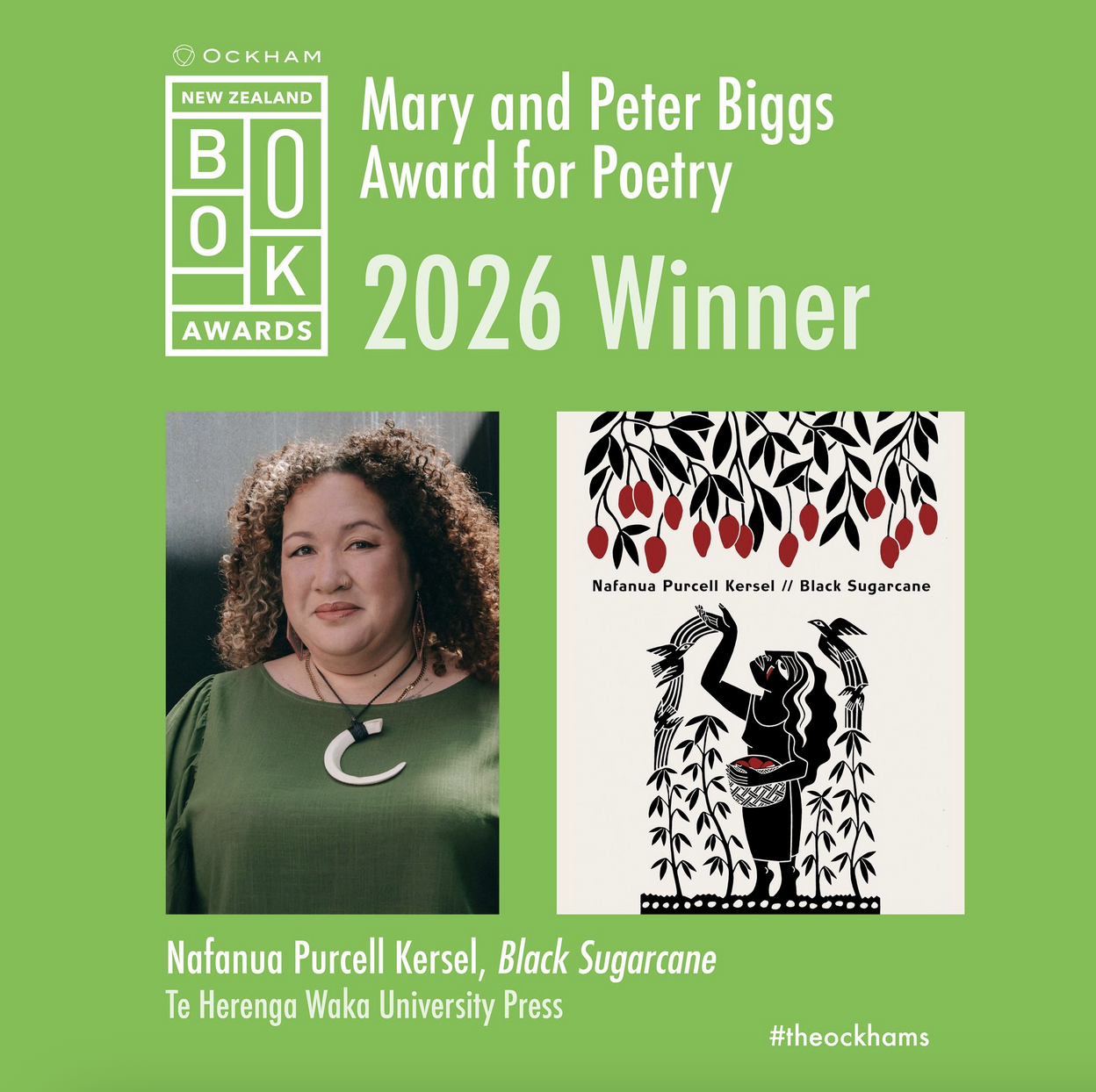
Warm congratulations to Nafanua Purcell Kersel for her awarding poetry collection, Black Sugarcane (THWUP).
Moana Pōetics
We build a safe around our birth stones.
Craft it with a dream, a gourd, a drum-made
chant.
Pile it high with frigate bird bones,
song bones, bones of
cherished names.
We rub sinnet along our thighs and lash
our cache. Our stories kept sound, where words
and names and songs are not forgotten.
One day before, now, or beyond, something
with a heart drops a hank of its flesh
before us. It sounds like a drum and we know
it’s time
to undo the rope, iron-rock and bone-sand.
The stories, they tell us
that if we are the dark blue seas then we are
also the pillowed nights and days, soft with
clouds, spread half-open.
We are a tidal collection, hind-waters of the
forever we rally on, to break the staple
metaphors from the fringes.
Safe.
We sound together on a dance or
bark an intricate rhyme.
We, are the filaments of a devoted rope. We,
who contain a continuance and
call it poetry.
Nafanua Purcell Kersel
Let me say this. There is no shortage of poetry books published in Aotearoa this year to love, to be enthralled and astonished by. We need this. We need these reading pathways. Sometimes I love a poetry book so much I transcend the everyday scene of reading (yes those bush tūī singing and the kererū fast-swooping) to a zone where I am beyond words. It is when reading is both nourishment and restoration, miracle and epiphany . . . and that is what I get with this book.
Begin with the physicality of a scene, a place, an island, a home. The scent of food being prepared and eaten will ignite your taste buds. Pies filled and savoured, luscious quince, the trickster fruit slowly simmered, a menu that is as much a set of meals as a pattern of life. Move into the warm embrace of whanau, the cousins, aunties, uncles, parents, grandparents, offspring. And especially, most especially, the grandmother and her lessons: ‘”If you want to learn by heart, / be still and watch my hands” (from ‘Grandma lessons (kitchen)’).
Find yourself in the rub of politics: the way you are never just a place name and that where you come from is a rich catalogue of markers, not a single word. The question itself so often misguided and racist. Enter the ripple effect of the dawn raids, or the Christchurch terrorist attack, or poverty, or climate change, crippling hierarchies. And find yourself in the expanding space of the personal; where things are sometimes explored and confessed, and sometimes hinted at. I am thinking pain. I am thinking therapist.
Find yourself in shifting poetic forms, akin to the shifting rhythms of life and living: a pantoum, a found poem, an erasure poem, long lines short lines, drifting lines. Find yourself in the company of other poets, direct and indirect lines to the nourishment Nafanua experiences as a writer: for example, Lyn Hejinian, Kaveh Akbar, Karlo Mila, Tusiata Avia, Selina Tusitala Marsh, Serie Barford, Konai Helu Thaman, Dan Taulapapa McMullin. So often I am reminded we don’t write within vacuums. We write towards, from and because of poetry that feeds us.
Bob Marley makes an appearance so I put his album, Exodus, on repeat as I write this. It makes me feel the poetry even more deeply. This coming together, this ‘One Love,’ this getting together and feeling alright, as we are still fighting, still uniting to make things better in a thousand and one ways.
I give thanks for this book.
From Nafanua picks some favourite things:
One question: Why or how does your poetry book matter to you?
“It mattered to me to have something to pass on to my children, something they could hold with our family names and stories in it.”
Nafanua Purcell Kersel (Satupa‘itea, Faleālupo, Aleipata, Tuaefu) is a writer, poet and performer who was born in Sāmoa and raised in Te-Whanganui-a-Tara, Aotearoa. Her poetry has been widely published. She has an MA from the IIML at Te Herenga Waka—Victoria University of Wellington and won the 2022 Biggs Family Prize in Poetry for Black Sugarcane, her first book. She lives in Te Matau-a-Māui Hawke’s Bay.
Te Herenga Waka University Press page
Listen to Nafanua read here

