Tag Archives: Seraph Press

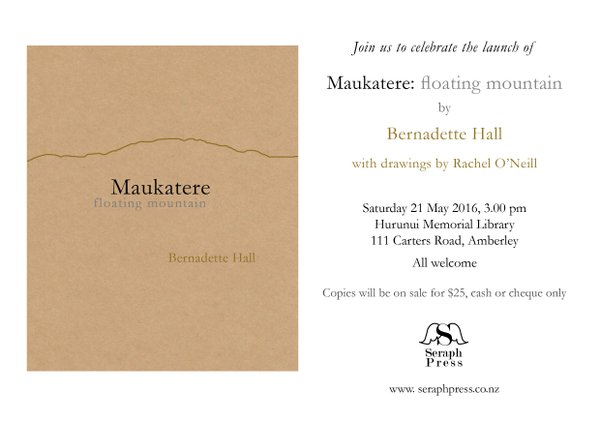
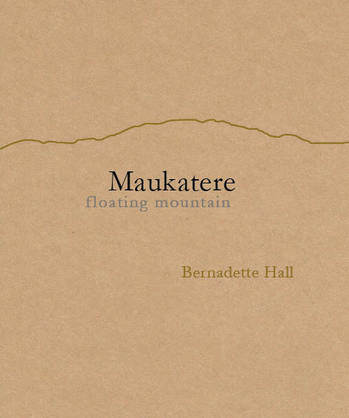
Poetry Shelf review – Bernadette Hall’s Maukatere: floating mountain – little dandelion kisses that hit the page and hook you

6860812.jpg


There are gauzy bandages of mist all down the East Cast as far as Bluff

Having to face our own despairs, we moved out onto the promontory

The ship was an illusion, a golden ship and a galleon,so high in the water

He may not be such a beautiful man when he is older, when the bones take over

I’m so glad we went to meet you, little darling, walking towards us through the tussock


Bernadette Hall has published numerous poetry collections with Victoria University Press – books that resonate so beautifully for both ear and heart. Her poems are like intricate lacework. Just gorgeous.

With her latest project, Bernadette was drawn to work with two younger women on a chapbook that drew inspiration from her local mountain, from the stories that have bedded down in the area and in her mind. Helen Rickerby from Seraph Press published the book and poet Rachel O’Neill did the illustrations. Three women walking round a mountain, as Bernadette says.

The poem is like a long poem (around 14 pages) made of drifting pieces, like little dandelion kisses that hit the page and hook you. Settler stories, as Bernadette says. There is the Tangler drifting in at out; an Irish figure, both loner and trickster, who acted as a buyer-seller go-between at the fairs. The poems are the fidgety intermediary between light and dark; the glint of the present and the shadows of history.

‘and she repeats it/ like the blade of light/ that repeats itself’

Reading this is like entering the metaphorical woods, where you get whiffs of story and elsewhere and skimming voices. Mountain as woods. Standing alongside a mountain, walking around that mountain, can be a portal to voice. This is a collection of voice; think of the way you stand somewhere old and it is like you can hear the past.

And in that mysterious pull of voice, you get the hit of physical detail, earthy and grounding.

‘A day of patchy rain – another chink in things’

‘What joy in the new experimental poets – up early throwing stones into the lake’

‘There are gauzy bandages of mist all down the East Coast as far as Bluff’

‘the wounds in the marshland fill slowly with fresh water’


Reading this is magical. The woods are knotty. The mountain is. You can take so many paths, both illuminated and dark.

Helen Rickerby has produced a beautiful hand-bound book  with thick paper and an elegant design. The book is a labour of love; picture a sewing circle with stories shared. The limited, hand-numbered edition has virtually sold out but a second print run is in the pipeline.

Rachel O’Neill has produced the most exquisite sequence of drawings that carry their own narrative. Little cross-hatched beauties. Enigmatic. Labour intensive. The hooded-lamp figure connects us to the poems where the little glows are like a unifying thread. The lantern head pulses with meaning. The figure is defined and dependent upon both light and dark in order to exist, in order to comprehend. Again there is the subtle and beautiful link to the poems where the light references rebound. It is as though certain things, whether recalled or invented, are caught in the beam of poet.

This is a very special book.


Bernadette co-founded Hagley Writers’ Institute In Christchurch. She lives at Amberley Beach in the Hurinui in North Canterbury. Bernadette was awarded The Prime Minister’s Award for Poetry in 2015.

Rachel’s debut collection was One Human in Height (Hue & Cry Press). She is a filmmaker, writer and artist.

Seraph Press page
Poetry Shelf Postcard: Anahera Gildea’s Poroporoaki

6688514.jpg

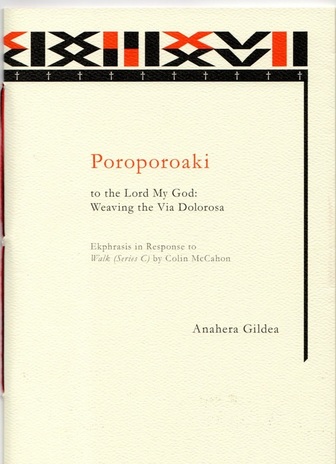
Poroporoaki to the Lord My God: Weaving the Via Dolorosa: Ekphrasis in Response to Walk (Series C) by Colin McCahon 

Anahera Gildea, Seraph Press, 2016

Designed and produced by Helen Rickerby of Seraph Press, this is the most exquisite chapbook imaginable. Add the gorgeous paper stock to the extra heavenly endpapers, the hand stitching and an internal design that is elegant and minimalist and you have a rare poetry treat. It is a work of beauty and all poets will be dreaming of their very own chap book. I for one!


XIV

Sometimes it is enough

to sit and look out.

Other times you have to walk

across bone, stone and shell.


Anahera Gildea’s poem is written in response to ‘Walk (Series C)‘ by Colin McCahon and is as much for James K Baxter as it is a response to the painting. It is an example of poetry as gift/taonga. Each line carefully stitched like the stitching in the kahu-kuri she makes for Baxter. This poet knows you don’t need many lines on the page to entice a reader to linger. You are walking alongside McCahon’s painting, you are walking along the wild and dark threat and wonder at Muriwai Beach, you are walking the Stations of the Cross and you are walking the poem. It is, for me, a very moving sequence.


Anahera (Ngāti Raukawa-ki-Te-Tonga, Kāi Tahu, Te Āti Awa, Ngāti Toa, Ngāi Te Rangi) is a Wellington-based writer who has had her poems and short stories published in a variety of journals. She recently completed the Masters of Creative Writing at Victoria University of Wellington and is currently finishing her first novel.
Seraph Press page

Book launch for Anahera Gildea

We hope you can make it to the launch of Poroporoaki to the Lord My God: Weaving the Via Dolorosa:  Ekphrasis in Response to Walk (Series C) by Colin McCahon by Anahera Gildea,  published by Seraph Press.


Screen Shot 2016-04-04 at 12.46.06 PM.png

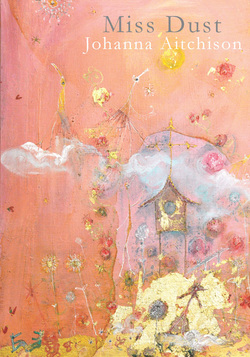
Poetry Shelf review: Johanna Aitchison’s Miss Dust – Simple, everyday cores of truth that have as much to do with how you feel the world as how you see the world

8507862    johanna-aitchison-for-web


Johanna is a poet who was living in Palmerston North (quite a hub of poetry activity!) but currently in Iowa. I haven’t read her debut chapbook from Pemmican Press, Oh My God I’m Flying (1991), but I really loved her second collection, Long Girl Ago (Victoria Press, 2007). The poems felt fresh, playful, finely crafted, and surprising in the little revelations, particularly in the poems that placed little frames on Japan. The book was shortlisted for best book of poetry the following year. Johanna’s new collection, Miss Dust, was recently released by Seraph Press. It is a collection in two parts with many bridges between, and the freshness, the economy and the diligent craft remain a vital feature.

What catches me with these new poems is the heightened degree of surprise. This is poetry tilted on its axis. The first section is devoted to a sequence that gives life to Miss Dust. When read together, the section forms a long narrative poem, or perhaps you could say, a long character poem in pieces. In trying to liken the startling effect of reading this life, I came up with a hybrid analogy: it is like an Eleanor Rigby portrait meets a Salvador Dali painting meets a dislocating dream state meets a short film by Alison Maclean meets Edward Lear meets a veiled memoir.

The idea of dust is ephemeral — it leaves traces and smears, it veils and it clouds. Perfect word for a character that hides behind tropes, white space and poetic jump cuts. The tropes are borderline surreal (‘The curtains of her house are ash’). At dinner with her online date, he ‘ordered for her the dark.’ Yet even though things are strange, it is the effect of the bridges and the gaps that augment the mood, the portrait, the arc of a life. Take ‘Miss Dust and the Affair.’ The little leaps from one thing to the next, from one action to the next, miss the gritty details that might pepper confession, exchanged story. The poem is mysterious and haunting, but if you lift out the stepping stones (that occur on other occasions throughout the book) you get a terrific story of love lost: affair kiss lips lines waves rocks cheeks. That story is the undercurrent of the poem, hiding in the dust. Miss Dust, herself, would sum up the undercurrent with two words (‘black heart’), words that crop up in a number of the poems.

The movement between things is also surprising or disconcerting in the poems and feeds into the crucial threads of loss and love and life. In ‘Miss Dust makes a promise to her black heart,’ every line seems to offer a new twist —  the way the dreaming mind takes the ordinary and then skews it to show a deep-seated feeling pulsing through.


Here is the cure: sitting

on someone else’s carpet,


she makes herself a promise,

with the help of a chisel


and a block of A4 refill.

She chips out a beach scene


three streets away, hammers in

stones that warm or cool


You can’t just read this poem and walk away. It holds you tight as Miss Dust walks into the beach scene and ‘lowers the plunger/ onto one more set of grounds.’ There is that jarring kink between the scene carved (hope, therapy, cure) that catapults the black heart to elsewhere and the chore of making coffee. For me, the word ‘grounds’ flicks and shifts. Yes, the coffee is ground (the daily chore/grind) but also, like the beach scene, ground is another place to lay down roots. To tend damaged roots. Soil, black like the black heart. A single word, and you can set up camp for hours.

I don’t know of a sequence in New Zealand poetry quite like this (maybe I got whiffs of the early surrealness of Gregory O’Brien). Reading and lingering in the half light of Miss Dust, is utterly moving as you fall between the gaps of her life.


The second half of the book is not Miss Dust but there is a similar degree of surprise, little echoes that seem familiar (the half house), the dislocating and then relocating pieces, the way nouns and verbs startle (‘I’m starting to skin your loneliness Miss Shoulder’). There is a stunning Japanese poem, ‘Jun,’ that pulls you back to the previous collection with its final, breathtaking stanza.


one of the saddest things i did in japan was to teach to jun’s photo

on his empty desk i asked the students to count the students

in the class the students said do we count jun


Johanna has delivered a new collection that never lets the dust settle (excuse the pun). Each poem reproduces a glorious jittery, shimmery movement between things, between actions and between things and actions. At the core of that movement: feeling. Yes, you enter a world that is, at times, a little like the bewildering jumps and turns of a dreamscape, but just as with the dream, you fall upon cores of truth. Simple, everyday cores of truth that have as much to do with how you feel the world as how you see the world. I loved this collection.


Seraph Press page

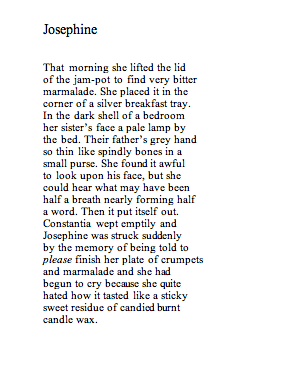
Poem Friday: Nina Powles’ ‘Josephine’ — This is a poem of curvature and overlap


Nina


Screen shot 2015-02-27 at 11.44.48 AM


Author bio:  Nina Powles studied English literature and Chinese at Victoria University, where she is now studying towards her MA in Creative Writing at the International Institute of Modern Letters. Her poetry and non-fiction has appeared in Salient, Turbine and Sweet Mammalian. Girls of the Drift (Seraph Press 2014) is her debut poetry collection. She will spend the upcoming year working on a new collection of biographical poems.


Author note: ‘Josephine’ is one of a pair of poems that I wrote in response to my favourite short story by Katherine Mansfield, ‘The Daughters of the Late Colonel’. The two sisters, Josephine and Constantia, have only ever known a life of duty and obedience to their father, until he dies, and then the world begins to open itself up to them in a series of small moments of colour and brightness. In my reading and writing, I always find myself thinking about people and places stuck in the in-between, caught in phases of transition. So I think I wanted this poem to sit on the verge of brightness. I wanted to crawl into the dark bedroom where Josephine feels trapped—and maybe start to show her the way out.


Note by Paula: I read this poem out of context, without linking it to Katherine Mansfield’s story, and I was struck by the luminous detail that sets the poem in marvellous shifting lights. The adjectives pulsate (‘the dark shell’).  I love the jarring counterpoint of expectation and discovery in the opening lines. I love the way the beginning and end take hold of each other in that sticky, candied link. This is a poem of curvature and overlap. Time folds in on itself as it does like rock striking rock to produce a spark of elsewhere. So the marmalade leads you to the core of the poem and core of memory with its emotional kick. And the image of the hand (‘thin like spindly bones in a/ small purse’) with its little potent bite,  again leads to small child and old father. Poems can reach you in small, perfectly formed packages such as this, and the joy is in the alluring rustle of tissue paper. This detail shining through here, that discovery shining through there. I use the word, ‘rustle,’ as this is a poem of sweetly composed music; there is the rustle of vowels and consonants that lifts beyond meaning, beyond feeling and then adds to each. I read Nina’s note after I wrote this and smiled at the notion of ‘small moments of brightness.’


Seraph Press page here


Nina Powles’ Girls of the Drift – I love the way lines turn a corner and surprise you


Girls-of-the-Drift-cover-web   Nina

Nina Powles, Girls of the Drift Seraph Press 2014

Nina Powles was the Books Editor for Salient last year, has an Hons Degree in English Literature and Chinese from Victoria University and is about to commence an MA in Creative Writing at the International Institute of Modern Letters.

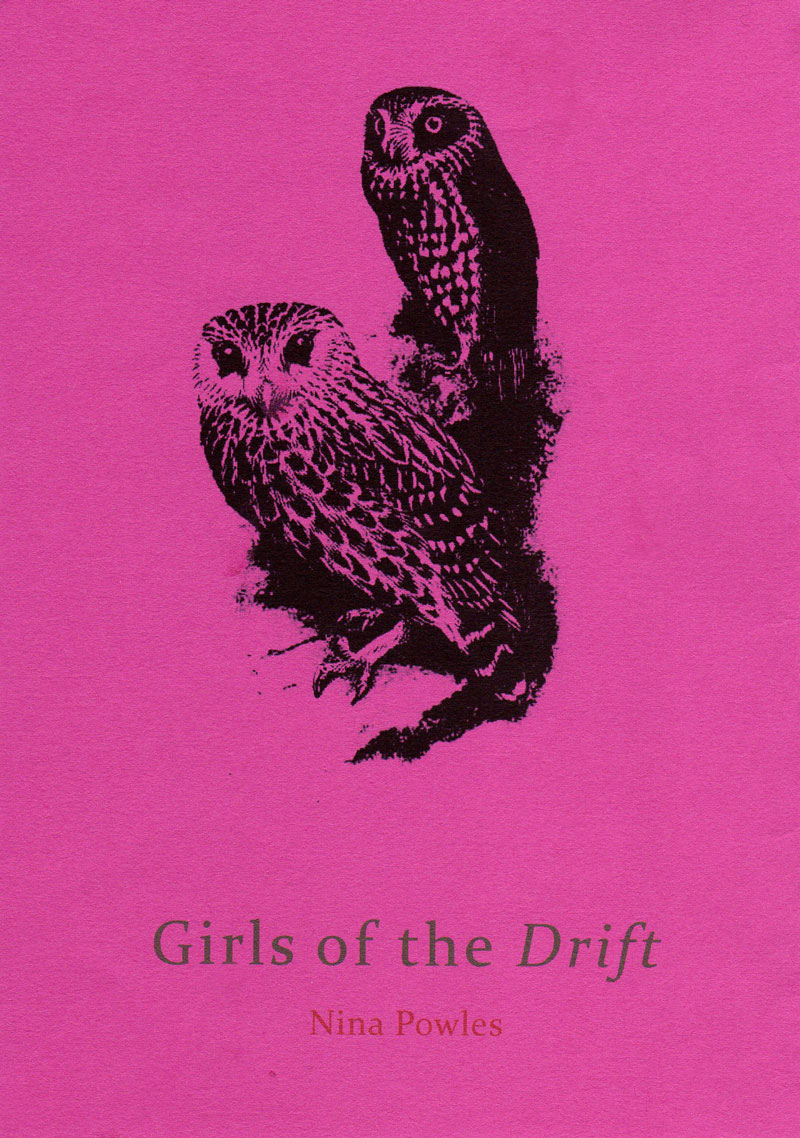
Nina’s debut chapbook is handbound and in striking pink with owls peering off the cover. Eye-catching. Exquisite. Borrowed from a poem in the book, the title, too, is eye-catching. It takes its name from a pamphlet Jessie Mackay wrote and published in 1928 on the social and moral responsibilities of young women (Girl of the Drift). Nina’s endnote discusses the passion that Jesse and fellow poet Blanche Baughan felt for social justice. Nina’s poems also seem to be sparked by a passion for writing, living and navigating the world beyond the doorstep, that is paradoxically the doorstep itself.

This is a collection of poems that engages with the lives of women, fictional or otherwise. Holding this book, I am reassured we write out of the women (and men for different reasons) who paved the way for us, not just in the pioneering poems and stories they wrote, but in the lives lived that stepped out of the norm (the first female lighthouse keeper for example). Nina also acknowledges her ENGL422 Modern Poetry class of 2014 run by Anna Jackson and the Alexander Turnbull Library with its storehouse of letters and documents. While the poems feel light and refined on the page, you also get a sense of the wider world — a world of books, thinking, discussions. A bit like what Blanche and Jessie engaged in.

I love the richness of context of the poems (Katherine Mansfield and her characters, a ghost at an old school, real things and invented things, a history of the poet’s reading), but I also love the way lines turn a corner and surprise you.


from Pencarrow Lighthouse

The wind spins dead things in circles.

Collect up the wintertime, won’t you,

crack it on a rock,

drop it from a height.


The glint of detail is so mouthwatering, it is as though the poems become miniature packages  of story — of this place and that woman, of this weather and that ocean. The detail, so good at animating poetry, augments the life of the poem, visually, aurally, emotionally.


from Volcanology

[ … ] I keep

pieces of the volcano on my

windowsill, next to the honey

jars, so they don’t forget.


Nina’s collection stretches with the agility of a wordsmith who knows just where to break a line, shift a point of view or the pitch of a phrase. The poems take flight from the reading and research that a university offers, and the experience and insight you bring to that reading. I loved this collection and to celebrate its arrival I am posting a poem from it, with notes by both Nina and me, as my first Poem Friday of 2015 on February 27th.


Seraph Press page


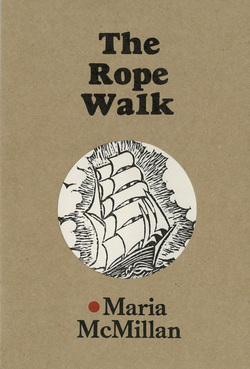
A Rope Walk for

Thanks to Seraph Press I have selected a follower of Poetry Shelf (out of the hat) for the giveaway copy.

Maria McMillan’s The Rope Walk goes to Emma Neale.

3665135