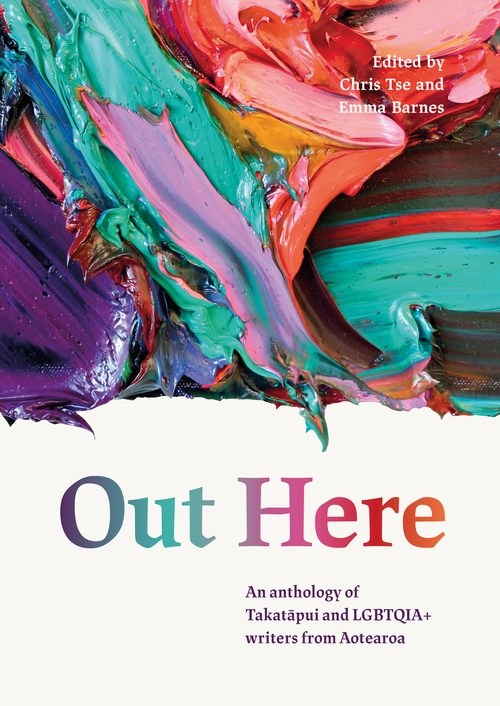
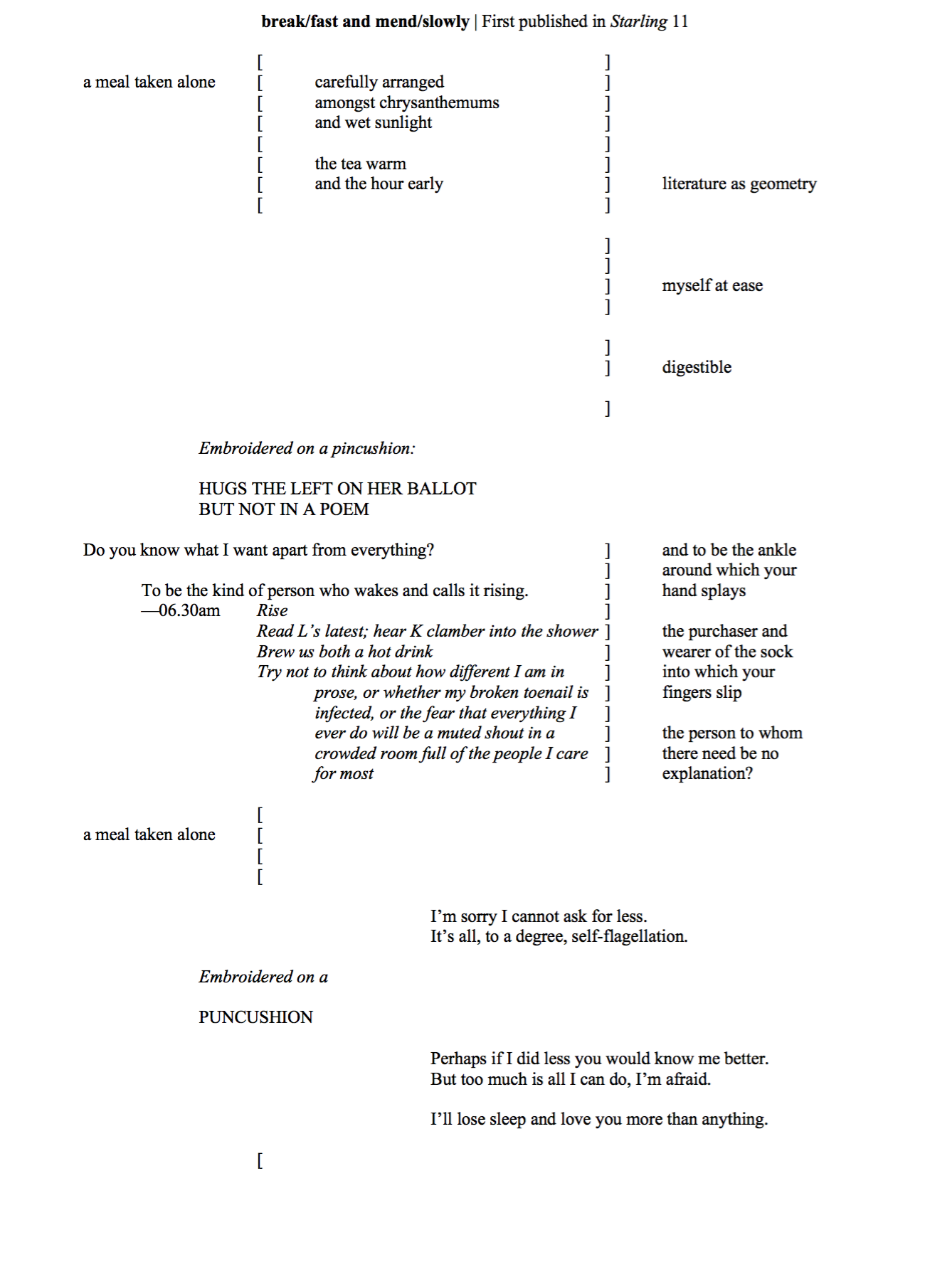
Out Here: An anthology of Takatāpui and LGBTQIA+ writers from Aotearoa, eds Chris Tse and Emma Barnes, Auckland University Press, 2021
Gender buttons
An object on a shelf; a self with words inside that never came out. Your finger down my spine; fine singing in my bones. Umbrella avoiding the rain: the celebrating hat you wear. Tell me a little more about myself.
The food you forgot; what you got for biting at my breasts. The coloured loss of uneaten toast on the bench and your tongue of loving pepper. Hunger heavy in my mouth.
This room we bed down in, be wed down in. White roses growing on the ceiling. You want in a variety of colours, but a rose is a rose is a rose a bunch of them placate the air much better than one. We couldn’t grow anywhere else.
The teasing is tender and trying and thoughtful. Melting without mending you undo my gender buttons till all of me is myself.
Hannah Mettner
Out Here is a significant arrival in Aotearoa, both for the sake of Takatāpui and LGBTQIA+ writers and readers, and for the sake of poetry. The sumptuous and wide ranging anthology feeds heart mind skin lungs ears eyes. It is alive with shifting fluencies and frequencies, and I want to sing its praises from the rooftops, from the moon, from street corners.
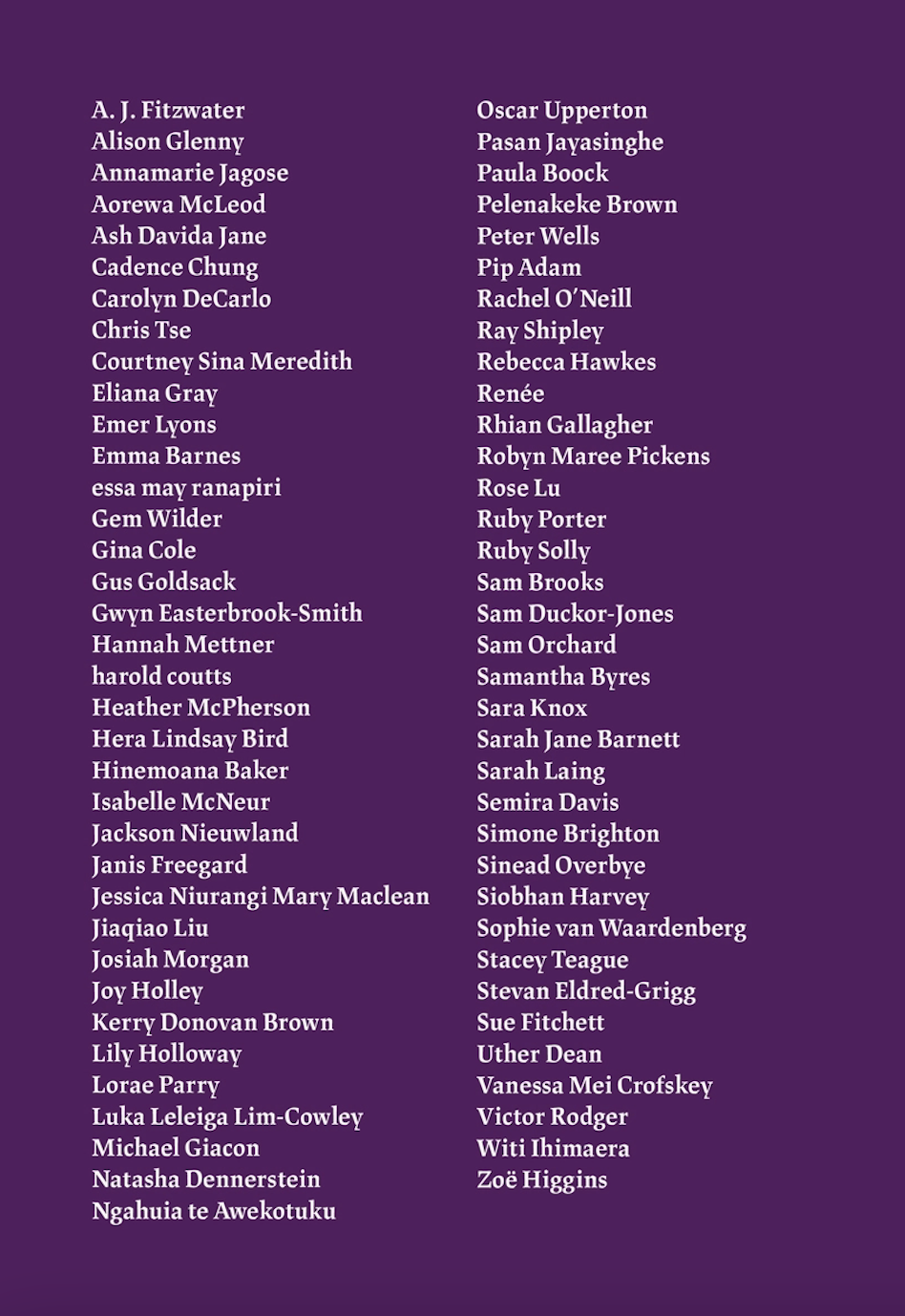
Chris Tse and Emma Barnes have responded to the erasure of queer identities in a national literature that was traditionally dominated and controlled by white heterosexual men. Chris and Emma opted to use ‘Takatāpui’ and ‘LGBTQIA+’ in the title to signal Aotearoa’s rainbow communities within the broadest possible reach. They have used the word queer in their introduction and underline that that must make room for as many ‘labels and identities’ as necessary. I am using the word queer with similar intentions.
Having spent a number of years on a book that responded to the erasure of women in literature across centuries, I understand what a mammoth task it is to shine a light across invisible voices and to reclaim and celebrate. To refresh the reading page in vital ways. Out Here draws together prose and poetry, from a range of voices, across time, but it never claims to cover everything. We are offered a crucial and comprehensive starting point. After finding 110 writers, Emma and Chris sent out an open call, and the response was overwhelming.
We chose words that delighted us, surprised us, confronted us and engaged us. We chose political pieces and pieces that dreamed futures as yet only yet imagined. We chose coming out stories and stories of home. We followed our noses. What our reading revealed to us is that our queer writers are writing beyond the expectations of what queer writing can be, and doing it in a way that often pushes against the trends of mainstream literature.
Emma Barnes and Chris Tse
I am reading the poetry first. I am reading poetry that reactivates what poems can do whether in terms of style, voice, theme, motifs. Some poems are navigating sexuality, gender issues, sex, love, identity. Other poems explore the body, oceans, discomfort, the end of the world, mothers, fathers, violence, tenderness, place, the dirt under fingernails. Expect humour and expect seriousness, the personal and the imagined. Expect to be moved and to be heartened. Some of the poems are familiar to me, others not, and it is as though I have parked up in a cool cafe for a legendary poetry reading (if only!). The physicality is skin-pricking, the aural choices symphonic, the intimate moments divine.
Take the three poems of Ash Davida Jane for example. I am reminded of the feminist catchphrase the personal is political but I am upending it to become the political is personal. ‘Good people’ resembles an ode to the soy milk carton. The poem considers how to be in the world, to make good choices, and be a good person when the world is drowning in plastics. It blows my head off. Ash’s second poem, ‘water levels’, celebrates the tenderness of being in the bath with someone who is shampooing your hair. The poem slows to such an intimate degree I get goosebumps. A poem that looks like a paragraph, ‘In my memory it is always daytime’, pivots on the waywardness of memory, its omission coupled with its power to transmit. I keep stalling on this glorious suite of poems rereading, revelling in the ability of poetry to deepen my engagement with the world, language, my own obsessions, weakenesses.
I stall too on Carolyn DeCarlo’s poems like I have struck a turning bay in the anthology. Rereading revelling. Reading revelling. And then Jackson Nieuwland’s astonishing ‘I am a version of you from the future’ where they stand in the shifting shoes and choices of a past self and it is tender and it is moving and it is tough. Or Ruby Solly’s ‘Lessons I don’t want to teach my daughter’, which is also tender and moving and tough. The ending in both English and Te Teo Māori restorative.
Imagine me standing on my rooftop singing out the names of the poets in the anthology and how they all offer poems as turning bays because you cannot read once and move on, you simply must read again, and it is measured and slow, and the effects upon you gloriously multiple. Chris and Emma have lovingly collated an anthology that plays its part in the final sentence of their introduction:
The final sentence resonates on so many levels. No longer will we tolerate literature that is limited in its reach. Poetry resists paradigms set in concrete, fenced off manifestos, rules and regulations, identity straitjackets. I welcome every journal and event, website and publishing house, that opens its arms wide to who and how we are as writers and readers. Out Here makes it clear: we are many and we track multiple roads, we are familied and we are connected. We are loved and we are at risk. We are floundering and we are anchored. This is a book to toast with a dance on the beach entitled POETRY JOY. I am dancing with joy to have this book in the world. To celebrate its arrival, I invited nine contributors to record a poem or two. Listenhere.
Thank you Emma, Chris and Auckland University Press; this book is a gift. 💜 🙏
I would like to gift a copy of this book to one reader. Let me know if you’d like to go in my draw.
The editors
Chris Tse (he/him) was born and raised in Lower Hutt. He studied English literature and film at Victoria University of Wellington, where he also completed an MA in creative writing at the International Institute of Modern Letters (IIML). Tse was one of three poets featured in AUP New Poets 4 (2011). His first collection How to be Dead in a Year of Snakes (2014) won the Jessie Mackay Award for Best First Book of Poetry and his second book He’s So MASC was published to critical acclaim in 2018.
Emma Barnes (Ngāti Pākehā, they/them) studied at the University of Canterbury and lives in Aro Valley, Wellington. Their poetry has been widely published for more than a decade in journals including Landfall, Turbine | Kapohau, Cordite and Best New Zealand Poems. They are the author of the poetry collection I Am in Bed with You (2021).
Out Here: An anthology of Takatāpui and LGBTQIA+ writers from Aotearoa, eds Emma Barnes and Chris Tse, Auckland University Press, 2021
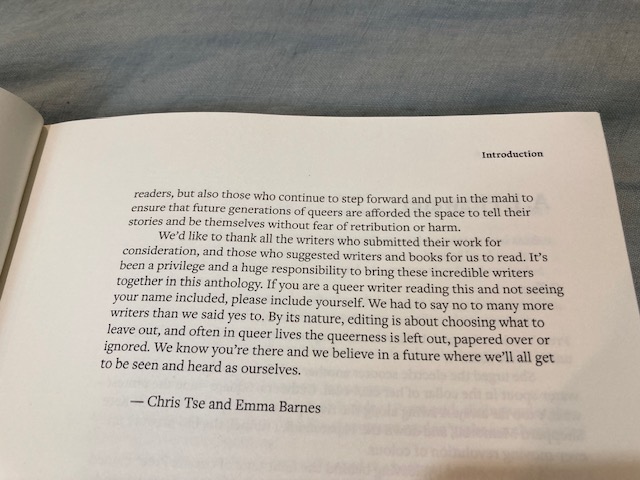
We chose words that delighted us, surprised us, confronted us and engaged us. We chose political pieces and pieces that dreamed futures as yet only yet imagined. We chose coming out stories and stories of home. We followed our noses. What our reading revealed to us is that our queer writers are writing beyond the expectations of what queer writing can be, and doing it in a way that often pushes against the trends of mainstream literature.
Emma Barnes and Chris Tse
The arrival of Out Here is significant. Editors Emma Barnes and Chris Tse have gathered voices from the wider reach of our rainbow communities. Queer texts, rainbow texts. Fiction, poetry, comic strips. I am delighted to present a selection of audio readings in celebration.
The readings
Stacey Teague
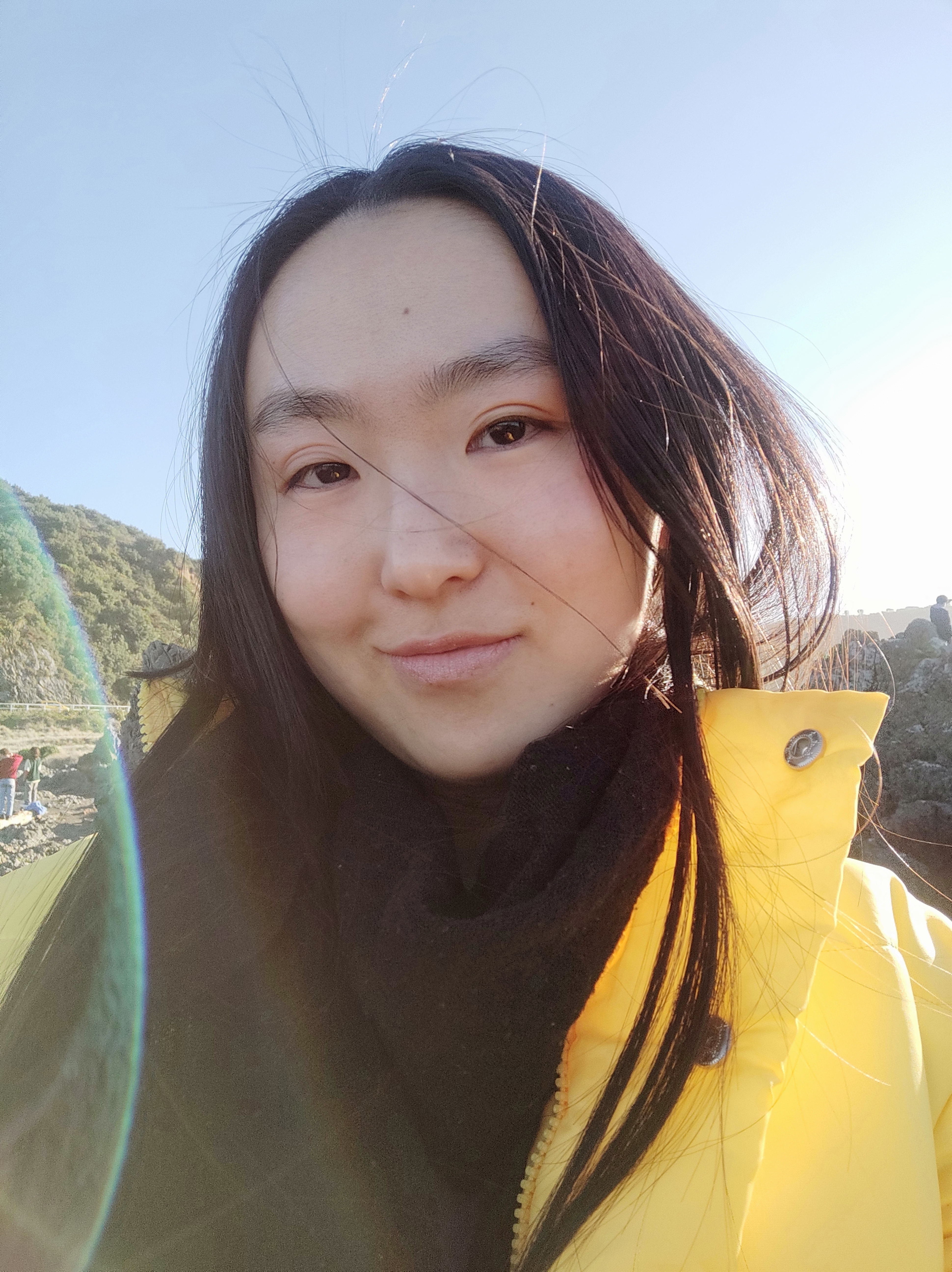
Stacey Teague reads ‘Angelhood’
Jiaqiao Liu
Jiaqiao Liu reads ‘as my friends consider children’
essa may ranapiri
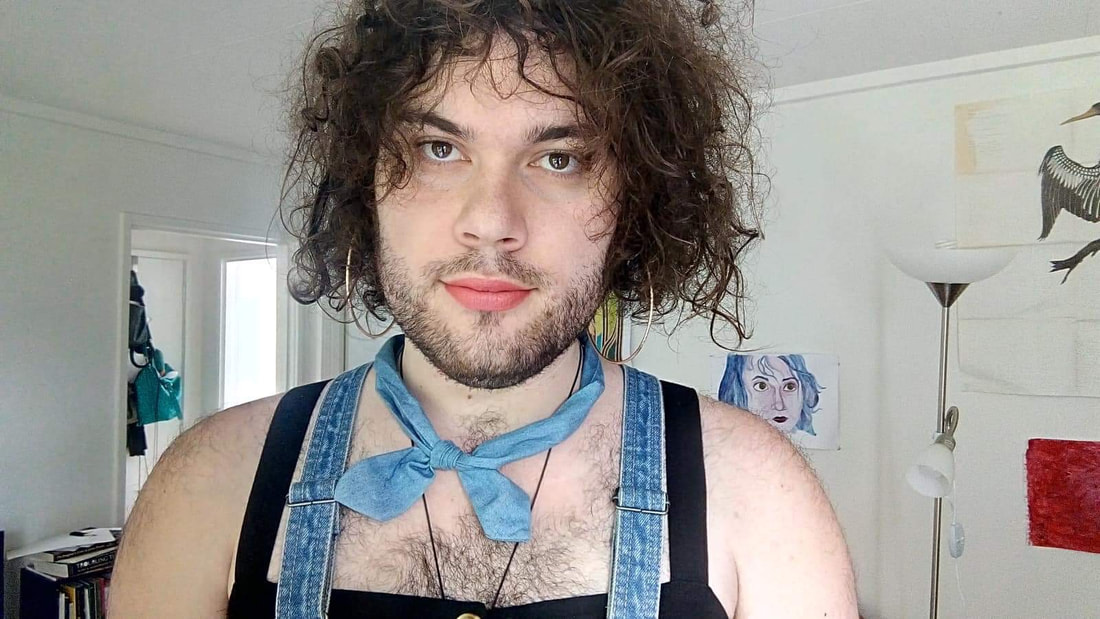
essa may ranapiri reads an extract from ‘knot-boy ii’
Emer Lyons
Emer Lyons reads ‘poppers’
Oscar Upperton
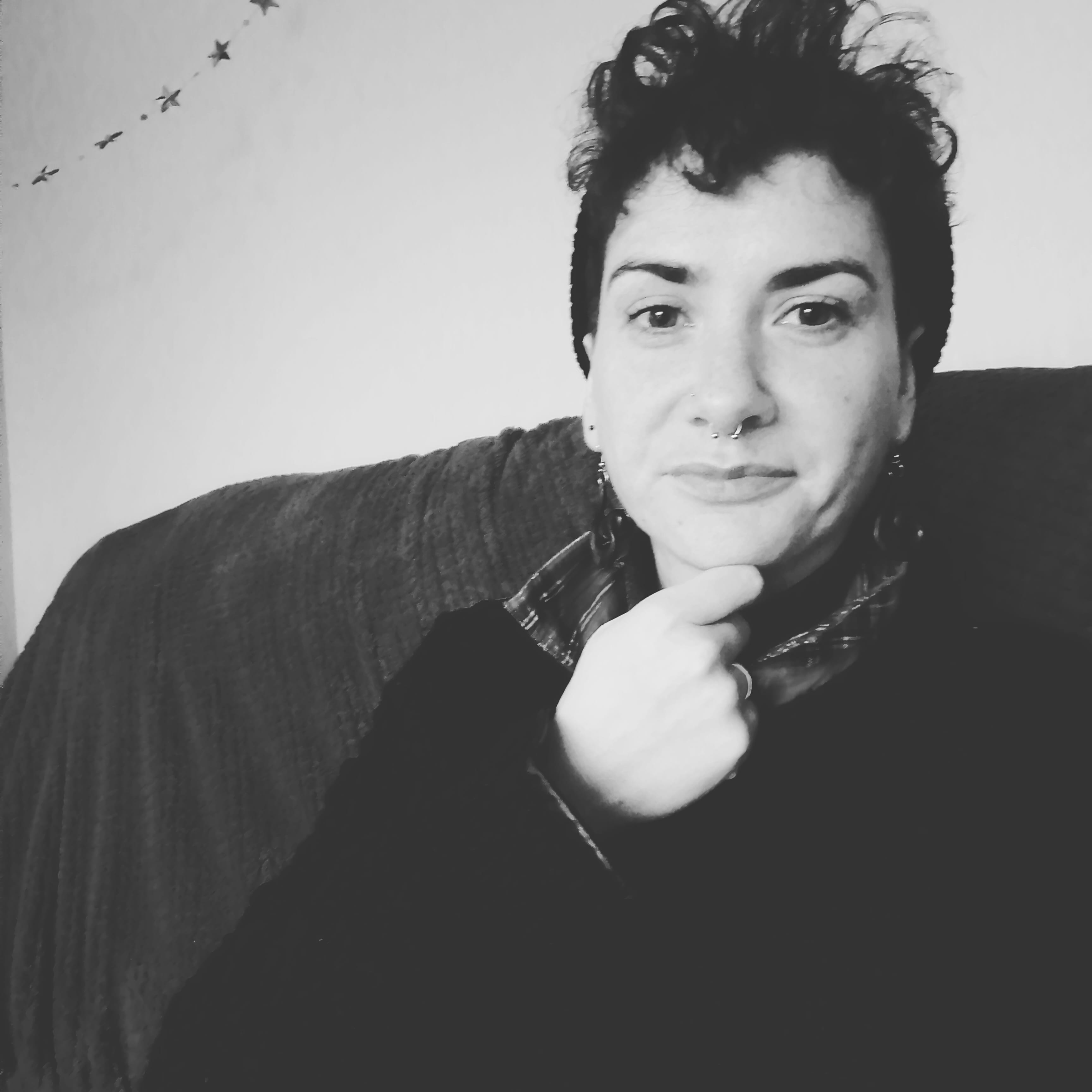
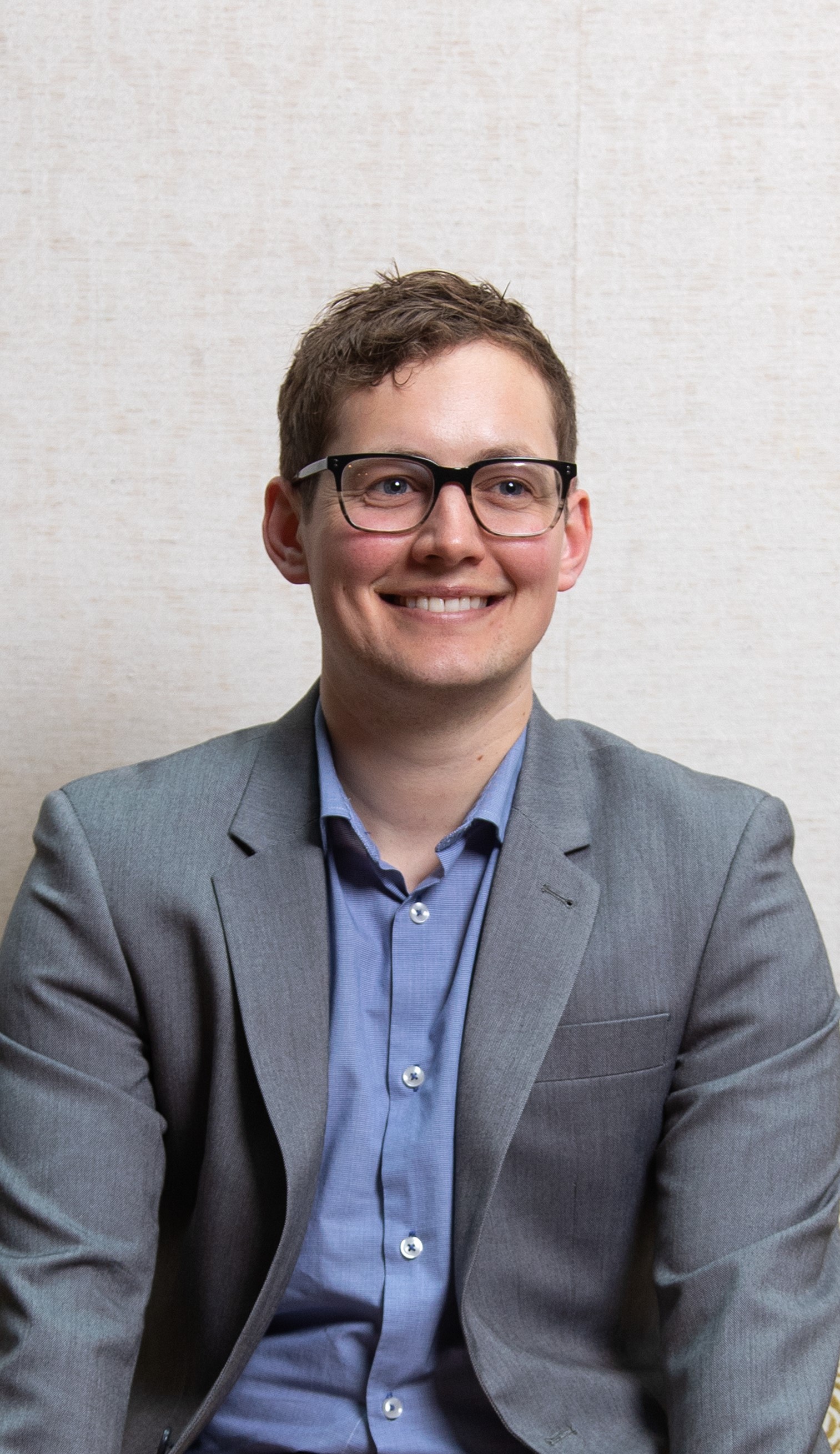
Oscar Upperton reads ‘New transgender blockbusters’
Hannah Mettner
Hannah Mettner reads ‘Obscured by clouds’
Natasha Dennerstein
Natasha Dennerstein reads ‘O, Positive, 1993’
Gus Goldsack
Gus Goldsack reads ‘It’s a body’
Ruby Porter
Ruby Porter reads ‘A list of dreams’
The poets
Natasha Dennerstein was born in Melbourne, Australia. She has an MFA from San Francisco State University. Natasha has had poetry published in many journals internationally. Her collections Anatomize (2015), Triptych Caliform (2016) and her novella-in-verse About a Girl (2017) were published by Norfolk Press in San Francisco. Her trans chapbook Seahorse (2017) was published by Nomadic Press in Oakland. She lives in Oakland, California, where she is an editor at Nomadic Press and works at St James Infirmary, a clinic for sex-workers in San Francisco. She was a 2018 Fellow of the Lambda Literary Writer’s Retreat.
Gus Goldsack is a poet, cat dad and black-sand-beach enthusiast. He grew up in Te Whanganui-a-Tara / Wellington and Tāmaki Makaurau / Auckland, and lives in Brooklyn, New York. His work has appeared in The Spinoff and Out Here: An Anthology of Takatāpui and LGBTQIA+ Writers From Aotearoa (Auckland University Press, 2021).
Jiaqiao Liu is a poet from Shandong, China, who grew up in Tāmaki-makau-rau. They are finishing up their MA in Creative Writing at Vic, working on a collection about love and distance, relationships to the self and the body, and Chinese mythology and robots.
Emer Lyons is a lesbian writer from West Cork living in New Zealand. She has a creative/critical PhD in lesbian poetry and shame from the University of Otago where she is the postdoctoral fellow in Irish Studies at the Centre for Irish and Scotish Studies. Most recently, her writing can be found at The Pantograph Punch, Newsroom, Queer Love: An Anthology of Irish Fiction, Landfall, and The Stinging Fly.
Hannah Mettner (she/her) is a Wellington writer who still calls Tairāwhiti home. Her first collection of poetry, Fully Clothed and So Forgetful, was published by Victoria University Press in 2017, and won the Jessie Mackay Award for best first book of poetry at the 2018 Ockham New Zealand Book Awards. She is one of the founding editors of the online journal Sweet Mammalian, with Sugar Magnolia Wilson and Morgan Bach.Hannah Mettner
Ruby Porter is a writer, artist and PhD candidate. She tutors creative writing at the University of Auckland, and in high schools. Ruby was the winner of the Wallace Foundation Short Fiction Award in 2017, and the inaugural winner of the Michael Gifkins Prize in 2018, with her debut novel Attraction. Attraction was written during her Masters of Creative Writing at the University of Auckland under supervisor Paula Morris, and published in 2019 by Melbourne-based Text Publishing. It is distributed throughout Australia, New Zealand and North America.
essa may ranapiri (Ngāti Wehi Wehi, Ngāti Raukawa, Na Guinnich, Highgate) is a takatāpui poet living on the lands of Ngāti Wairere. They are super excited about Out Here being in the world even in these weird times. Their first book of poems ransack (VUP) was published 2019. They are currently working on their second book ECHIDNA. They will write until they’re dead.
Stacey Teague (Ngāti Maniapoto/Ngāpuhi) is a queer writer and editor. She is the poetry editor for Awa Wahine, editor for We Are Babies Press, and has her Masters in Creative Writing from the IIML.
Oscar Upperton‘s first poetry collection, New Transgender Blockbusters, was published by Victoria University Press in 2020. His second collection, The Surgeon’s Brain, is scheduled for publication in February 2022. It follows the life of Dr James Barry, nineteenth century surgeon, dueller and reformer whose gender has been the subject of much debate.
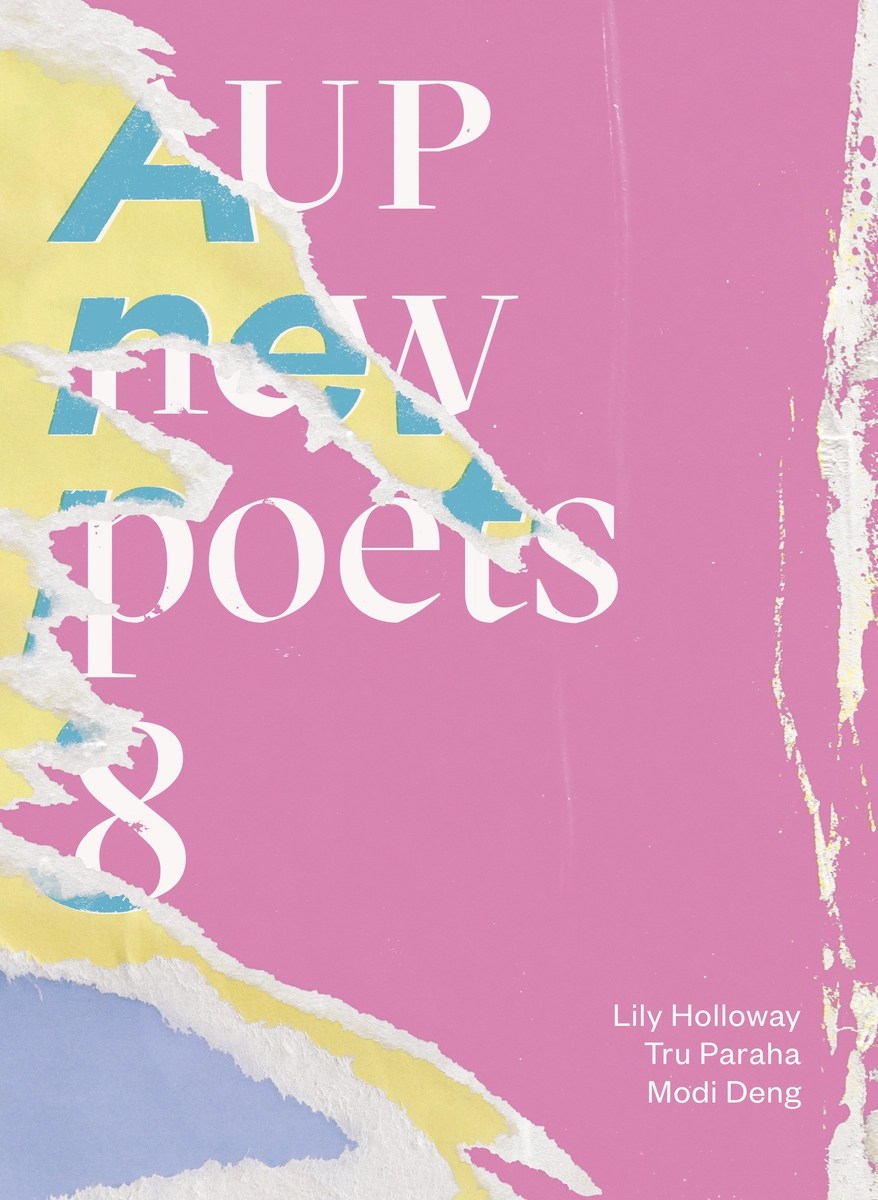
AUP New Poets 8: Lily Holloway, Tru Paraha, Modi Deng, Auckland University Press, 2021
Review extract:
Editor Anna Jackson has selected three distinctive poets for AUP New Poets 8 and has placed them in the perfect tonal order.
The title of Lily Holloway’s suite, a child in the alcove, reminds me of poetry’s alcove-like features. Poems can be miniature shelters, places of refuge, an interplay of dark and light, secret, mysterious, challenging, bulging with nooks and crannies. Reading the work is to read across myriad directions, to peer into captivating cubbyholes and, as Jackson writes in her terrific foreword, to read distance and depth.
Holloway is an award-winning writer and postgraduate student who has been published in numerous journals. I have long admired her poetry: her aural and linguistic deftness, the sweet measure of surprise, the variegated forms, the connecting undercurrents, the honey, the bitterness. Her poems run on the rewarding premise that poems don’t need the full explanation, that tactile detail and deft juxtapositions can unmask love, desire, razor edges, self-exposure. Pocket narratives are equally sublime.
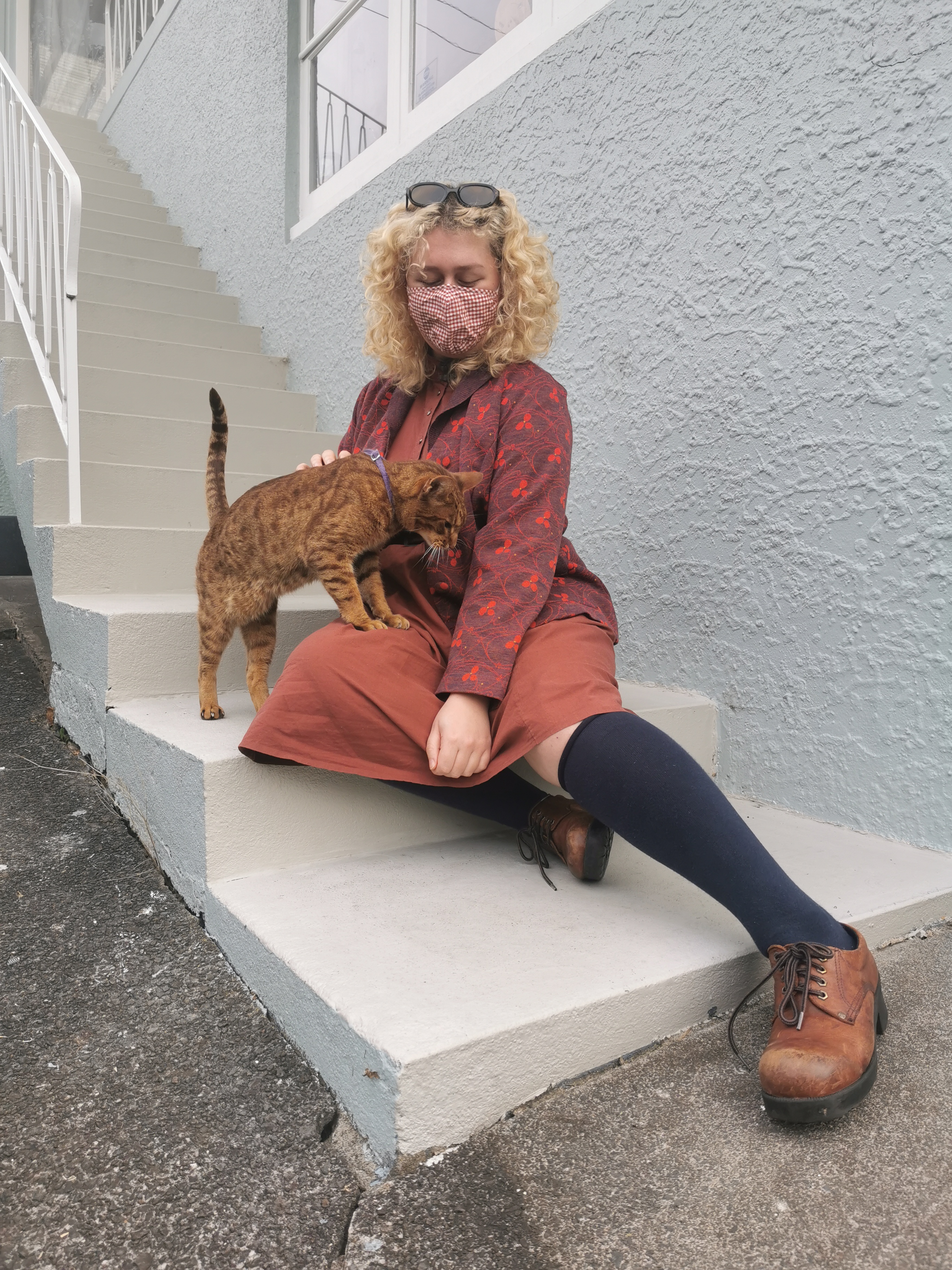
Lily Holloway(born in 1998, she / they) is a queer writer and postgraduate English student. While she mostly writes poetry, she has also tried her hand at non-fiction, fiction and playwriting. You can find her work in places like Starling, Midway Journal, Scum, The Pantograph Punch and The Spinoff amongst various other literary nooks and crannies. In 2020 she was honoured to receive the Shimon Weinroth Prize in Poetry, the Kendrick Smithyman Scholarship in Poetry and second place in the Charles Brasch Young Writers’ Essay Competition. In her spare time she enjoys op-shopping, letter writing, visiting small towns and collecting vintage Teletubbies paraphernalia. She is passionate about survivor advocacy and taking up space. You can find a list of her writing at lilyholloway.co.nz.
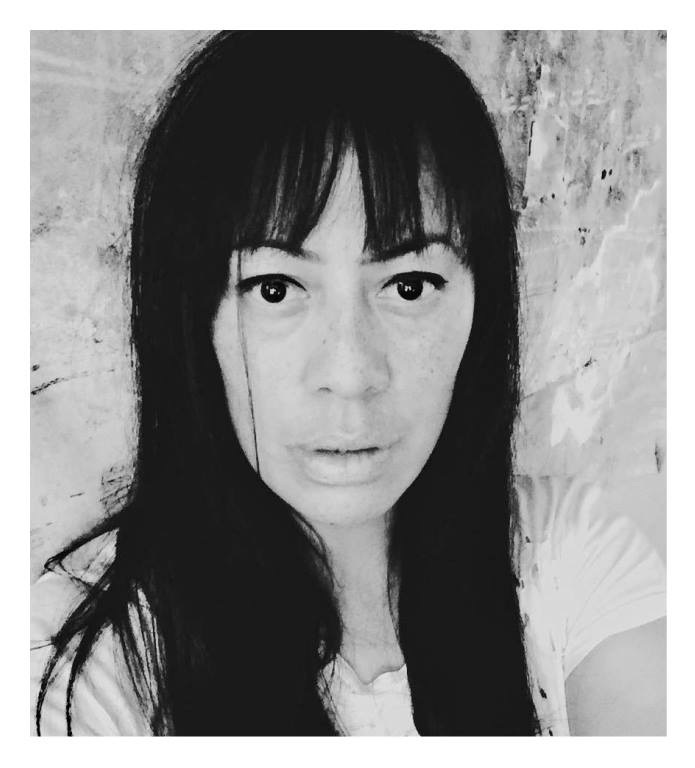
Tru Paraha resides in Tāmaki Makaurau in the suburb of Tukituki Muka (aka Herne Bay). She works as a choreographer and director, having enjoyed an extensive career in experimental dance, theatre and audio-visual arts. She is currently in the final year of a postdoctoral research fellowship in the English and Drama department at the University of Auckland. Moving between choreography, philosophy and creative writing, Tru produces live performances, artists’ pages and poems drawing on materials from deep space. She is a member of the International Dark-Sky Association and advocate for the preservation of the night sky as a world cultural heritage.
Modi Deng is a pianist based in London, currently pursuing postgraduate performance studies on a scholarship at the Royal Academy of Music. Her Chinese name 默笛 means ‘silent flute’, which her father drew from a poem by Tagore. Performances with her ensemble, the Korimako Trio, have taken her throughout the UK and her concerts have been broadcast on BBC Radio 3 and RNZ Concert. After growing up in Dunedin, she went on to complete a Master of Music with First Class Honours on a Marsden research scholarship, while completing a Bachelor of English at the University of Auckland. Modi cares deeply about literature (diaspora and poetry), music, psychology and her family.
AUP New Poets 8: Lily Holloway, Tru Paraha, Modi Deng, Auckland University Press, 2021
I am loving the AUP New Poets series under the astute editorship of Anna Jackson. Each volume draws new voices into compelling view, each volume sparks essential poetry conversations. How we write. Why we write. What we write. How we write ourselves and how we write the imagined.
This on AUP New Poets 8, from my Kete Books review appearing shortly: ‘Editor Anna Jackson has selected three distinctive poets for AUP New Poets 8 and has placed them in the perfect tonal order. The title of Lily Holloway’s suite, ‘a child in that alcove’, reminds me of poetry’s alcove-like features. Poems can be miniature shelters, places of refuge, an interplay of dark and light, secret, mysterious, challenging, bulging with nooks and crannies. Reading the work is to read across myriad directions, to peer into captivating cubbyholes and, as Anna writes in her terrific foreword, to read distance and depth.’
This is an arrival to celebrate – and how better than with a suite of readings – not as good as book launch for sure – but online readings offer a lounge of returns. Make a coffee, a cup of tea, pour a glass of wine, you choose, find a sweet spot and have a listen. I raise my glass to Anna, Lily, Tru, Modi and AUP. This is essential listening (and reading!).
The readings
Lily Holloway
Photo credit: Angela Zhang
Lily Holloway reads ‘Reverb or Aftermath’
Lily Holloway reads ‘return again’
Tru Paraha
Tru Paraha reads ‘Paradox’
Tru Paraha reads ‘Postcard from Israel’
Modi Deng
Photo credit: Mikayla Bollen
Modi Deng reads ‘field notes on Lewis Hyde’s ‘The Gift’’
Modi Deng reads ‘unrest • an wei’
Modi Deng reads ‘now and then things come in tandem’
The poets
Lily Holloway(born in 1998, she / they) is a queer writer and postgraduate English student. While she mostly writes poetry, she has also tried her hand at non-fiction, fiction and playwriting. You can find her work in places like Starling, Midway Journal, Scum, The Pantograph Punch and The Spinoff amongst various other literary nooks and crannies. In 2020 she was honoured to receive the Shimon Weinroth Prize in Poetry, the Kendrick Smithyman Scholarship in Poetry and second place in the Charles Brasch Young Writers’ Essay Competition. In her spare time she enjoys op-shopping, letter writing, visiting small towns and collecting vintage Teletubbies paraphernalia. She is passionate about survivor advocacy and taking up space. You can find a list of her writing at lilyholloway.co.nz.
Tru Paraha resides in Tāmaki Makaurau in the suburb of Tukituki Muka (aka Herne Bay). She works as a choreographer and director, having enjoyed an extensive career in experimental dance, theatre and audio-visual arts. She is currently in the final year of a postdoctoral research fellowship in the English and Drama department at the University of Auckland. Moving between choreography, philosophy and creative writing, Tru produces live performances, artists’ pages and poems drawing on materials from deep space. She is a member of the International Dark-Sky Association and advocate for the preservation of the night sky as a world cultural heritage.
Modi Deng is a pianist based in London, currently pursuing postgraduate performance studies on a scholarship at the Royal Academy of Music. Her Chinese name 默笛 means ‘silent flute’, which her father drew from a poem by Tagore. Performances with her ensemble, the Korimako Trio, have taken her throughout the UK and her concerts have been broadcast on BBC Radio 3 and RNZ Concert. After growing up in Dunedin, she went on to complete a Master of Music with First Class Honours on a Marsden research scholarship, while completing a Bachelor of English at the University of Auckland. Modi cares deeply about literature (diaspora and poetry), music, psychology and her family.
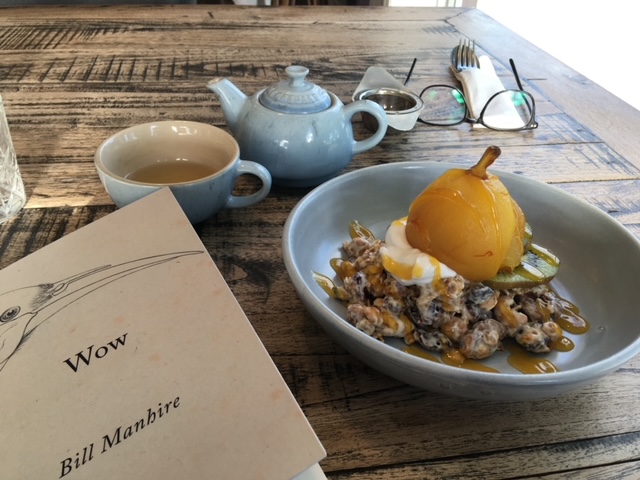
Breakfast is a lifelong ritual for me: the fruit, the cereal, the toast, the slowly-brewed tea, the short black. It is the reading, it is the silence, it is the companionship. It is finding the best breakfast when you are away at festivals or on tour, on holiday. This photograph was taken last year at Little Poms in Christchurch when I was at WORD. One of my favourite breakfast destinations. Breakfast is my gateway into the day ahead, it is food but it is more than food. It is the ideas simmering, the map unfolding, the poem making itself felt.
The poems I have selected are not so much about breakfast but have a breakfast presence that leads in multiple directions. Once again I am grateful to publishers and poets who are supporting my season of themes.
Unspoken, at breakfast
I dreamed last night that you were not you
but much younger, as young as our daughter
tuning out your instructions, her eyes not
looking at a thing around her, a fragrance
surrounding her probably from her
freshly washed hair, though
I like to think it is her dreams
still surrounding her
from her sleep. In my sleep last night
I dreamed you were much younger,
and I was younger too and had all the power –
I could say anything but needed to say
nothing, and you, lovely like our daughter,
worried you might be talking too much
about yourself. I stopped you
in my arms, pressed my face
up close to yours, whispered into
your ear, your curls
around my mouth, that you were
my favourite topic. That
was my dream, and that is still
my dream, that you were my favourite topic –
but in my dream you were
much younger, and you were not you.
Anna Jackson
from Pasture and Flock: New & Selected Poems, Auckland University Press, 2018
By Sunday
You refused the grapefruit
I carefully prepared
Serrated knife is best
less tearing, less waste
To sever the flesh from the sinew
the chambers where God grew this fruit
the home of the sun, that is
A delicate shimmer of sugar
and perfect grapefruit sized bowl
and you said, no, God, no
I deflated a little
and was surprised by that
What do we do when we serve?
Offer little things
as stand-ins for ourselves
All of us here
women standing to attention
knives and love in our hands
Therese Lloyd
From The Facts, Victoria University Press, 2018
How time walks
I woke up and smelled the sun mummy
my son
a pattern of paradise
casting shadows before breakfast
he’s fascinated by mini beasts
how black widows transport time
a red hourglass
under their bellies
how centipedes and worms
curl at prodding fingers
he’s ice fair
almost translucent
sometimes when he sleeps
I lock the windows
to secure him in this world
Serie Barford
from Entangled islands, Anahera Press, 2015
Woman at Breakfast
June 5, 2015
This yellow orange egg full of goodness and instructions.
Round end of the knife against the yolk, the joy which can only be known
as a kind of relief for disappointed hopes and poached eggs go hand in hand.
Clouds puff past the window it takes a while to realise they’re home made
our house is powered by steam like the ferry that waits by the rain-soaked wharf
I think I see the young Katherine Mansfield boarding with her grandmother with her duck-handled umbrella.
I am surprised to find I am someone who cares for the bygone days of the harbour.
The very best bread is mostly holes networks, archways and chambers
as most of us is empty space around which our elements move in their microscopic orbits.
Accepting all the sacrifices of the meal the unmade feathers and the wild yeast I think of you. Happy birthday.
Kate Camp
from The Internet of Things, Victoria University Press, 2017
How to live through this
We will make sure we get a good night’s sleep. We will eat a decent breakfast, probably involving eggs and bacon. We will make sure we drink enough water. We will go for a walk, preferably in the sunshine. We will gently inhale lungsful of air. We will try to not gulp in the lungsful of air. We will go to the sea. We will watch the waves. We will phone our mothers. We will phone our fathers. We will phone our friends. We will sit on the couch with our friends. We will hold hands with our friends while sitting on the couch. We will cry on the couch with our friends. We will watch movies without tension – comedies or concert movies – on the couch with our friends while holding hands and crying. We will think about running away and hiding. We will think about fighting, both metaphorically and actually. We will consider bricks. We will buy a sturdy padlock. We will lock the gate with the sturdy padlock, even though the gate isn’t really high enough. We will lock our doors. We will screen our calls. We will unlist our phone numbers. We will wait. We will make appointments with our doctors. We will make sure to eat our vegetables. We will read comforting books before bedtime. We will make sure our sheets are clean. We will make sure our room is aired. We will make plans. We will talk around it and talk through it and talk it out. We will try to be grateful. We will be grateful. We will make sure we get a good night’s sleep.
Helen Rickerby
from How to Live, Auckland University Press, 2019
Morning song
Your high bed held you like royalty.
I reached up and stroked your hair, you looked at me blearily,
forgetting for a moment to be angry.
By breakfast you’d remembered how we were all cruel
and the starry jacket I brought you was wrong.
Every room is painted the spectacular colour of your yelling.
I try and think of you as a puzzle
whose fat wooden pieces are every morning changed
and you must build again the irreproachable sun,
the sky, the glittering route of your day. How tired you are
and magnanimous. You tell me yes
you’d like new curtains because the old ones make you feel glim.
And those people can’t have been joking, because they seemed very solemn.
And what if I forget to sign you up for bike club.
The ways you’d break. The dizzy worlds wheeling on without you.
Maria McMillan
from The Ski Flier, Victoria University Press, 2017
14 August 2016
The day begins early, fast broken with paracetamol ibuprofen, oxycodone, a jug of iced water too heavy to lift. I want the toast and tea a friend was given, but it doesn’t come, so resort to Apricot Delights intended to sustain me during yesterday’s labour. Naked with a wad of something wet between my legs, a token gown draped across my stomach and our son on my chest, I admire him foraging for sustenance and share his brilliant hunger. Kicking strong frog legs, snuffling, maw wide and blunt, nose swiping from side to side, he senses the right place to anchor himself and drives forward with all the power a minutes-old neck can possess, as if the nipple and aureole were prey about to escape, he catches his first meal; the trap of his mouth closes, sucks and we are both sated.
just some huge rude dinner plate you left unwashed
now ascendant
brilliant with bioluminescent mould
how dare you rhapsodize my loneliness into orbit
I laughed
enraged
to the thought of us
halfway across the planet staring up
at some self-same moon & pining for each other
but now I long for a fixed point between us
because from here
even the moon is different
a broken bowl
unlatched from its usual arc & butchered
by grievous rainbows
celestial ceramic irreparably splintered
as though thrown there
and all you have left me with is
this gift of white phosphorous
dissolving the body I knew you in
beyond apology
to lunar dust
Rebecca Hawkes
in New Poets 5, Auckland University Press, 2019, picked by Aimee-Jane Anderson-O’Connor
everything changing
I never meant to want you.
But somewhere
between
the laughter and the toast
the talking and the muffins
somewhere in our Tuesday mornings
together
I started falling for you.
Now I can’t go back
and I’m not sure if I want to.
Paula Harris
from woman, phenomenally
Breakfast in Shanghai
for a morning of coldest smog
A cup of black pǔ’ěr tea in my bedroom & two bāozi from the
lady at the bāozi shop who has red cheeks. I take off my gloves,
unpeel the square of thin paper from the bun’s round bottom.
I burn my fingers in the steam and breathe in.
for the morning after a downpour
Layers of silken tofu float in the shape of a lotus slowly
opening under swirls of soy sauce. Each mouthful of doufu
huā, literally tofu flower, slips down in one swallow. The
texture reminds me of last night’s rain: how it came down
fast and washed the city clean.
for homesickness
On the table, matching tiny blue ceramic pots of chilli oil,
vinegar and soy sauce. In front of me, the only thing that
warms: a plate of shuǐjiǎo filled with ginger, pork and cabbage.
I dip once in vinegar, twice in soy sauce and eat while the
woman rolls pieces of dough into small white moons that fit
inside her palm.
for a pink morning in late spring
I pierce skin with my knife and pull, splitting the fruit open.
I am addicted to the soft ripping sound of pink pomelo flesh
pulling away from its skin. I sit by the window and suck on the
rinds, then I cut into a fresh zongzi with scissors, opening the
lotus leaves to get at the sticky rice inside. Bright skins and leaves
sucked clean, my hands smelling tea-sweet. Something inside
me uncurling. A hunger that won’t go away.
NIna Mingya Powles
from Magnolia 木蘭, Seraph Press, 20020
Serie Barford was born in Aotearoa to a German-Samoan mother and a Palagi father. She was the recipient of a 2018 Pasifika Residency at the Michael King Writers’ Centre. Serie promoted her collections Tapa Talk and Entangled Islands at the 2019 International Arsenal Book Festival in Kiev. She collaborated with filmmaker Anna Marbrook to produce a short film, Te Ara Kanohi, for Going West 2021. Her latest poetry collection, Sleeping With Stones, will be launched during Matariki 2021.
Amy Brown is a writer and teacher from Hawkes Bay. She has taught Creative Writing at the University of Melbourne (where she gained her PhD), and Literature and Philosophy at the Mac.Robertson Girls’ High School. She has also published a series of four children’s novels, and three poetry collections. Her latest book, Neon Daze, a verse journal of early motherhood, was included in The Saturday Paper‘s Best Books of 2019. She is currently taking leave from teaching to write a novel.
Kate Camp’s most recent book is How to Be Happy Though Human: New and Selected Poems published by VUP in New Zealand, and House of Anansi Press in Canada.
Tate Fountain is a writer, performer, and academic based in Tāmaki Makaurau. She has recently been published in Stuff, Starling, and the Agenda, and her short fiction was highly commended in the Sunday Star-Times Short Story Competition (2020).
Paula Harris lives in Palmerston North, where she writes and sleeps in a lot, because that’s what depression makes you do. She won the 2018 Janet B. McCabe Poetry Prize and the 2017 Lilian Ida Smith Award. Her writing has been published in various journals, including The Sun, Hobart, Passages North, New Ohio Review and Aotearotica. She is extremely fond of dark chocolate, shoes and hoarding fabric. website: http://www.paulaharris.co.nz | Twitter: @paulaoffkilter | Instagram: @paulaharris_poet | Facebook: @paulaharrispoet
Rebecca Hawkes works, writes, and walks around in Wellington. This poem features some breakfast but mostly her wife (the moon), and was inspired by Alex Garland’s film adaptation of Jeff Vandermeer’s novel Annihilation. You can find it, among others, in her chapbook-length collection Softcore coldsores in AUP New Poets 5. Rebecca is a co-editor for Sweet Mammalian and a forthcoming collection of poetry on climate change, prances about with the Show Ponies, and otherwise maintains a vanity shrine at rebeccahawkesart.com
Anna Jackson lectures at Te Herenga Waka/Victoria University of Wellington, lives in Island Bay, edits AUP New Poets and has published seven collections of poetry, most recently Pasture and Flock: New and Selected Poems (AUP 2018).
Therese Lloyd is the author of two full-length poetry collections, Other Animals (VUP, 2013) and The Facts (VUP, 2018). In 2017 she completed a doctorate at Victoria University focusing on ekphrasis – poetry about or inspired by visual art. In 2018 she was the University of Waikato Writer in Residence and more recently she has been working (slowly) on an anthology of ekphrastic poetry in Aotearoa New Zealand, with funding by CNZ.
Maria McMillan is a poet who lives on the Kāpit Coast, originally from Ōtautahi, with mostly Scottish and English ancestors who settled in and around Ōtepoti and Murihiku. Her books are The Rope Walk (Seraph Press), Tree Space and The Ski Flier (both VUP) ‘Morning song‘ takes its title from Plath.
Nina Mingya Powles is a poet and zinemaker from Wellington, currently living in London. She is the author of Magnolia 木蘭, a finalist in the Ockham Book Awards, a food memoir, Tiny Moons: A Year of Eating in Shanghai, and several poetry chapbooks and zines. Her debut essay collection, Small Bodies of Water, will be published in September 2021.
Helen Rickerby lives in a cliff-top tower in Aro Valley. She’s the author of four collections of poetry, most recently How to Live (Auckland University Press, 2019), which won the Mary and Peter Biggs Award for Poetry at the 2020 Ockham Book Awards. Since 2004 she has single-handedly run boutique publishing company Seraph Press, which mostly publishes poetry.
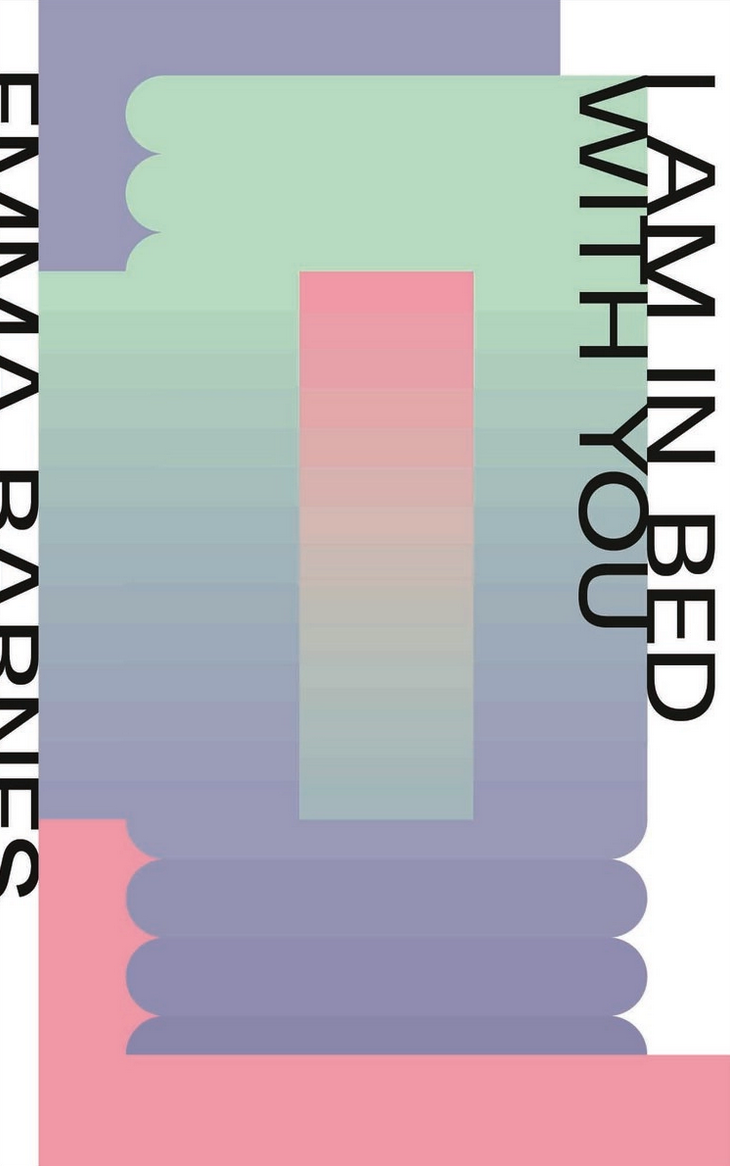
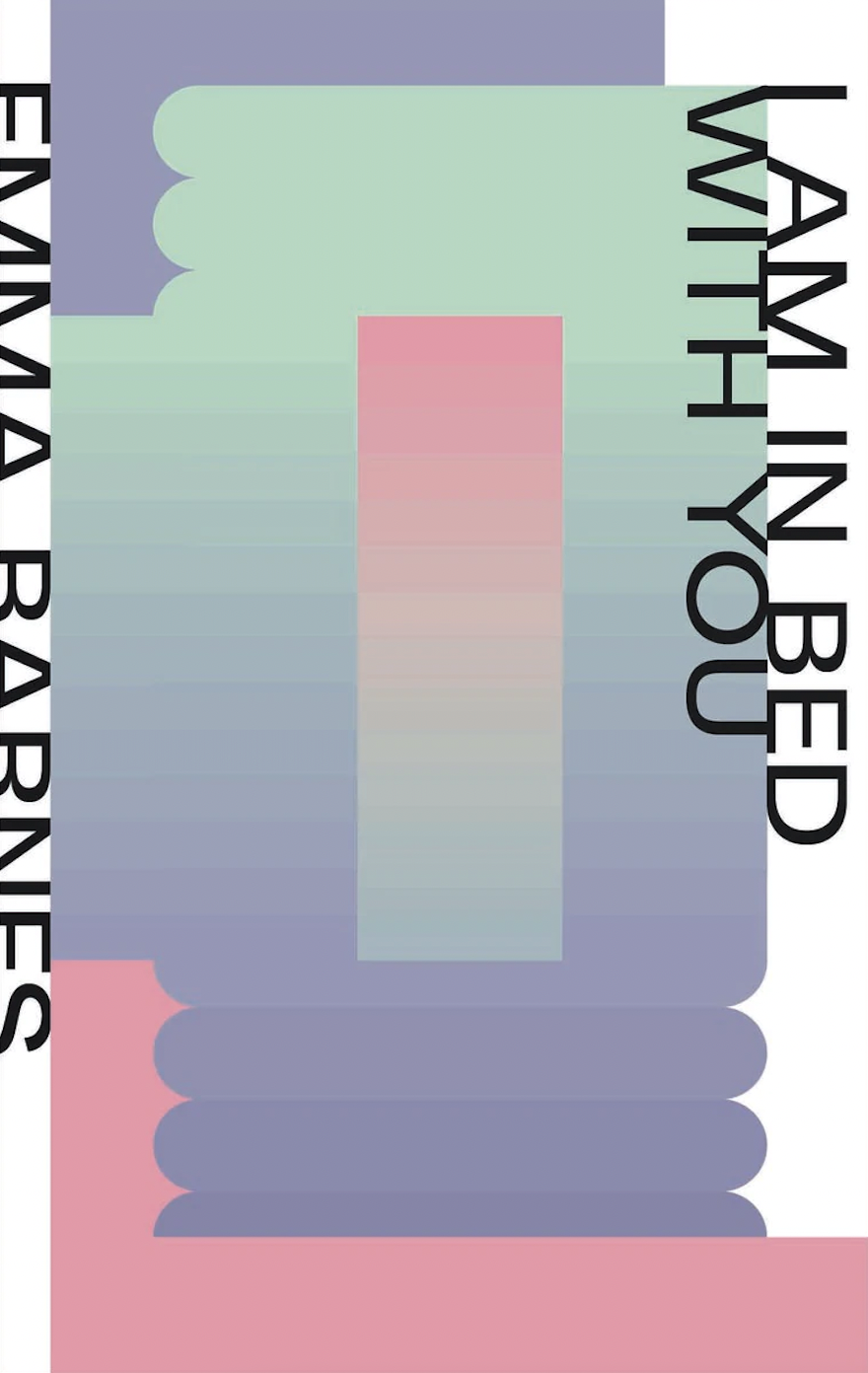
I Am in Bed with You, Emma Barnes, Auckland University Press, 2021
I am in bed with you. The room varies. But I’m always on the
left. I am pulling the pieces of myself into myself. In the winter
I left myself behind in the 90s. I’m coming back now. You
can see the light touching me. I can see layers of tissue finally
making a body. And once I have a body I have a head. And in
my head are these thoughts. I can’t tell you what it is like with
words. You can hold my hand and feel my pulse, but I was in
1994. I didn’t like
it there. When I am getting through days I don’t even know I
am making it. I am the legume in that story about royalty. And
then on the other side I open up like a lake into a river. I can
survey the lean fields of my insides as if I am owner of all
those glistening blades. In 1994 I was fourteen. I buried some-
thing back there. I buried it alive in a biscuit tin. This winter
makes choices I’d have made differently. Your mother cooked
a roast chicken every
Saturday unless a larger animal had died. (…)
from ‘I am in bed with you’
Emma Barnes’s debut collection I Am in Bed with You is a sublime read. Their poems hit such pitch-perfect notes any attempt to share my reading engagements will fall short. It’s like when someone asks why you like this painting or this song or this poem and all you can say I love it. Get the book. Find your own engagements.
And yet.
And yet this book haunts me to the degree I want to talk about it with you. There are three sections: ‘This is a creation myth’, ‘Sigourney Weaver in your dreams’ and ‘The Run-Around’.
There is a moving acknowledgements page. I love this page. In fact I am loving this choice in a number of recent publications – tributes paid to the communities and individuals that a book is in debt to. Emma begins by saying: ‘The most important thank you for any Pākehā writer is to mihi the mana whenua of Aotearoa for their generosity in the face of continued acts non-consent and disrespect by us, their Treaty partners. I am truly privileged to be a treaty partner, to have this place to stand and to receive repeated gifts and offerings of manaakitanga.’
Emma thanks a high-school teacher and her publisher Sam Elworthy (Auckland University Press) who prompted her ‘to transform reluctance into curiosity’. I love this too. A publisher who is nurturing all manner of vital poetry collections and connections into the world (think A Clear Dawn, AUP New Poets 8). And of course friends and family. Taking time to offer such a heartfelt mihi matters.
Emma’s collection refreshes a joy in sentences. This is a book where sentences are the exquisite building blocks of poetry. Crafted with an ear attuned to sound, rhythm and chords, and an eye for movement that may startle, dazzle, draw you in closer.
The opening poem in the opening section is akin to a creation myth; an original origin story: inventive funny fabulous. The poems that follow resemble creation episodes; the speaker is vulnerable and bold in their self exposures, in the creating and making of self, dismissed body, gendered self, self expectation. The mother is missing, longed for or discounted. Being woman being man being another is faced. The sentences are off-real surreal cloaked hyper-real skating and free-sliding from feeling to nothing to question to admission to nothing to strange detail to wounding edge to invisibility to laugh out loud. To being unbearably moved.
Sigourney Weaver tells me that desire has a hard edge. The end. The
limit it enforces by virtue of its own inevitability. She’s been reading
the internet again. Sigourney Weaver says that our bodies are wishes
made from DNA and that time and time again we defeat ourselves with
our limited thinking. Always imagining edges. The edge of desire
is only there because we out it there. And we put it there because we
can’t make sense of a world where we could desire and act in equal
measure. Trust Sigourney Weaver to get me tied up in knots without any
rope. Not even the tiniest string around my finger. I like a boundary,
Sigourney Weaver. I like clear statements. I like small words. (…)
from ‘Sigourney Weaver confronts the limits of desire’
The middle section of poems stars Sigourney Weaver. If you want to hang out with a famous film star you can do it in a sequence of poems and then you get to choose how things will pan out. The speaker is hanging out with Sigourney in Aro Valley. They rent movies, kiss, take ecstasy, kiss, have an android baby. It is wickedly funny, so so funny, with a twist of weird and strange and creepy. Sigourney buys a place, a van, becomes a citizen, and in all the curious surreal twists – exhilarating, hilarious, uplifting – your heart is consistently tugged. Look to the weird and you find the ordinary: house-moving cartons, dresses and pigtails, ballgowns, mint-flavoured life savers. This sweetly crafted sequence also finds sustenance in the joy of the sentence.
The final section’s refrain is love. Love poems that are like prismatic love songs with shifting chords and rhythms, the ‘you’ elusive and on the move. In the other sections poems are given breathing-space as they break apart into stanzas. Here the poems appear as dense paragraphs – framed by the white space of breath yes – but catching love’s intensity, love as unfathomable, physical, intimate, complicated, hard to say. Again there is a glorious sway between the weird and the surreal and a familiar heart-grasp of relationships, aloneness, closeness. You can’t breathe as you read, as you feel.
Emma has produced a collection unlike any other I know with its unifying addiction to the sentence, and motifs that go deeper than surface beacons: think age, body expectations, gender, the making of self, the lasting effects of childhood, experiences that bite, disappearing acts, love, desire, more love, more desire. You will meet dreams and demons and epiphanies. Writing is musing, reflecting back, side-drifting, inventing, confessing. You will revel in the joy (and pain) of writing, and yes writing becomes, and yes writing is a form of becoming. Extraordinary.
Emma Barnes studied at the University of Canterbury and lives in Aro Valley, Wellington. Their poetry has been widely published for more than a decade in journals including Landfall, Turbine | Kapohau, Cordite and Best New Zealand Poems. They are currently co-editing with Chris Tse an anthology of LGBTQIA+ and takatāpui writing from Aotearoa New Zealand for Auckland University Press.
Emma Barnes reads four poems from I Am in Bed with You, Auckland University Press, 2021
‘Maiden Mother Crone’
‘Ohio’
‘Low boughs’
‘Completely dry riverbed’
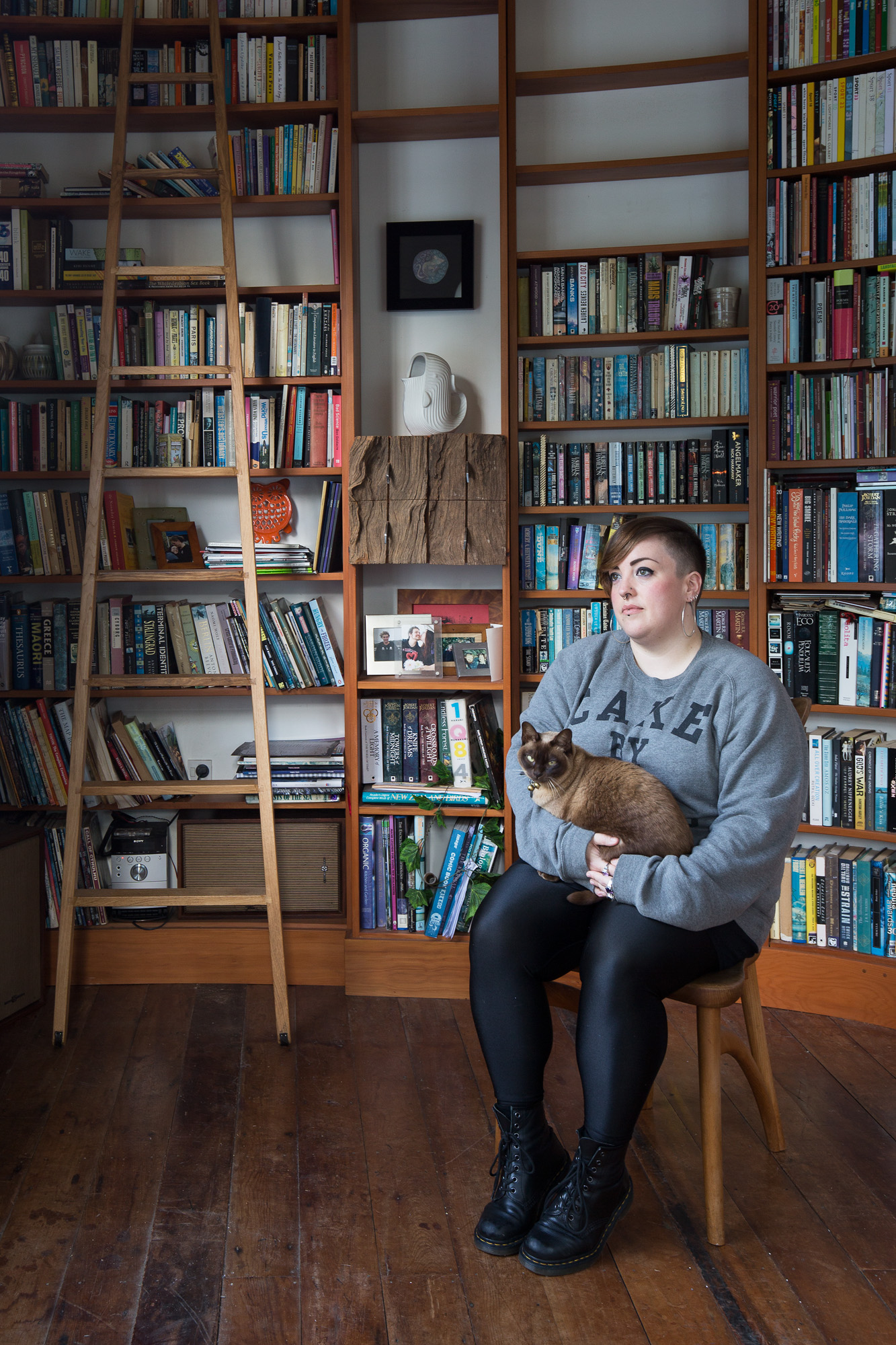
Emma Barnes lives and writes in Pōneke / Wellington. They have just released their first book I Am In Bed With You. For the last two years they’ve been working with Chris Tse on an anthology of LGBTQIA+ and Takatāpui writing to be released this year by Auckland University Press. They work in Tech and spend a lot of time picking heavy things up and putting them back down again.
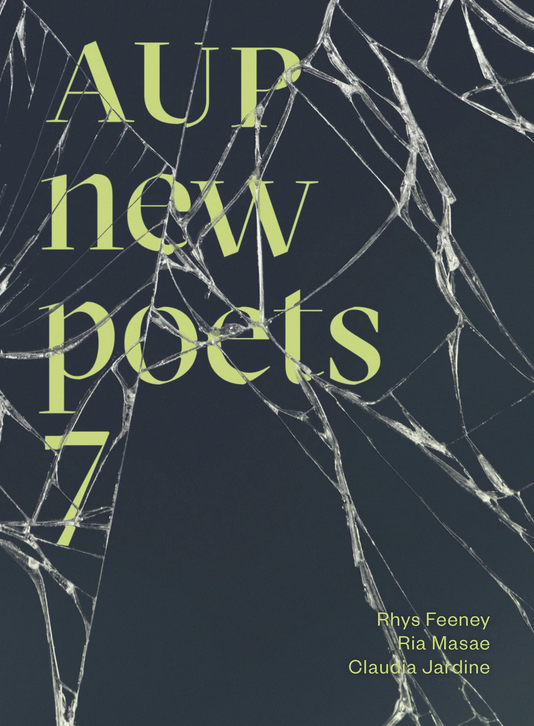
AUP New Poets 7 features the work of Rhys Feeney, Ria Masae and Claudia Jardine. The series is edited by Anna Jackson.
Editor Anna Jackson suggests the collection ‘presents three poets whose work is alert to contemporary anxieties, writing at a time when poetry is taking on an increasingly urgent as well as consolatory role role as it is shared on social media, read to friends and followers, and returned to again in print form’.
I agree. Poetry is an open house for us at the moment, a meeting ground, a comfort, a gift, an embrace. But poetry also holds fast to its ability to challenge, to provoke, to unsettle. In the past months I have read the spikiest of poems and have still found poetry solace.
AUP New Poets 7 came out in lockdown last year and missed out on a physical launch. To make up for that loss I posted a set of readings from the featured poets. One advantage with a virtual celebration is a poetry launch becomes a national gathering. I still find enormous pleasure in online readings – getting to hear terrific new voices along with old favourites.
Herein lies one of the joys of the AUP New Poets series: the discovery of new voices that so often have gone onto poetry brilliance (think Anna Jackson and Chris Tse).
Rhys Feeney is a high school teacher and voluntary health worker in Te Whanganui-a-Tara with a BA (Hons) in English Literature and a MTchLrn (Secondary). Ria Masae is an Auckland-based poet, writer and spoken-word artist. In 2018 she was the Going West Poetry Slam champion. Claudia Jardine is a Pākehā/ Maltese poet and musician with a BA in Classics with First Class Honours. The three poets have work in various print and online journals.
Rhys Feeney
I am thinking poetry is a way of holding the tracks of life as I read Rhys’s sequence of poems, ‘soy boy’. He is writing at the edge of living, of mental well being. There is the punch-gut effect of climate change and capitalism. There are crucial signals on how to keep moving, how to be.
The poems are written as though on one breath, like a train of thought that picks up a thousand curiosities along the way. As an audio track the poetry is exhilarating in its sheer honeyed fluency. Poems such as ‘the world is at least fifty percent terrible’ pulls in daily routine, chores, political barbs. The combination matters because the state of the world is always implicated in the personal and vice versa. The combination matters in how we choose to live our lives and how we choose to care for ourselves along with our planet.
waking up from a dream abt owning a house
for a moment i think i’m in utopia
or maybe australia
but then i see the little patches of mould on the ceiling
i roll over to check my phone
but i forgot to put it on charge last night bc i was too tired
why am i am so fucking tired all the time
i should find some better alternative to sugar
i should find some better alternative to lying there in the morning thinking
Artificial Intelligence is a Fundamental Risk to Human Civilisation
or what i am going to have for breakfast
how can i reduce my environmental footprint
but increase the impact of my handshake
from ‘the world is at least fifty percent terrible’
I love the way Rhys plays with form, never settling on one shape or layout; the poems are restless, catching the performer’s breath, the daily hiccups, the unexpected syncopation. Words are abbreviated, lines broken, capitals abandoned as though the hegemony of grammar and self and state (power) must be wobbled. Yet I still see this as breath poetry. Survival poetry.
I am especially drawn to ‘overshoot’; a poem that lists things to do that get you through the day, get you living. The list is more than a set of bullet points though because you get poignant flashes into a shadow portrait, whether self or invented or borrowed.
5) give yourself time to yourself
light fresh linen candles
& cry in the bath
call it self-care
6) eat a whole loaf of bread in the dark
7) start working again
the topsoil of your tolerance is gone
you break in two days
this is called a feedback loop
your coping strategies don’t work
in this new atmosphere
Rhys’s affecting gathering of poems matches rawness with humour, anxiety about the world with anxiety about self. Yet in the bleakest moments humour cuts through, gloriously, like sweet respite, and then sweesh we are right back in the thick of global worry. How big is our footprint? What will we choose to put in our toasters? Have we ever truly experienced wilderness other than on a screen? This is an energetic and thought-provoking debut.
Ria Masae
What She Sees from Atop the Mauga opens with a wonderful grandmother poem: ‘Native Rivalry’. The poem exposes the undercurrents of living with two motherlands, Samoa and Aotearoa, of here and there, different roots and stars and languages, a sea that separates and a sea that connects. There is such an intense and intimate connection in this poem that goes beyond difference, and I am wondering if I am imagining this. It feels like I am eavesdropping on something infinitely precious.
i tilted my face up to the stars
that were more familiar to me
than the ones on Samoan thighs.
without turning to her, i answered
‘Leai fa‘afetai, Nana.’
i felt her stare at me for a long pause
before puffing on her rolled tobacco.
we sat there silently looking at the night sky
until we were tired and went to sleep
side by side on a falalili‘i in her fale.
from ‘Saipipi, Savai‘i, Samoa’ in ‘Native Rivalry’
Perhaps the lines that really strike are: ‘Mum was fa’a pālagi, out of necessity / i was pālagified by consequence / so, was i much different?’
I am so affected reading these poems on the page but I long to hear them sounding in the air because the harmonics are sweet sweet sweet. ‘Intersection’ is an urban poem and it is tough and cutting and despairing, but it is also stretching out across the Pacific Ocean and it is as though you can hear the lip lip lap of the sea along with the throb throb throb of urban heart.
She sits at her window
staring down at the city lights.
Her scared, her scarred, her marred wrists
hugging her carpet-burnt knees.
The waves in her hair
no longer carry the scent of her Pacific Ocean
but burn with the stink of
roll-your-own cigarettes.
Ah, enter these poems and you are standing alongside the lost, the dispossessed, the in-despair, you are pulled between a so often inhumane, concrete wilderness and the uplift and magnetic pull of a Pacific Island. I find these poems necessary reading because it makes me feel but it also makes me see things afresh. I know from decades with another language (Italian) some things do not have a corresponding word (for all kinds of reasons). ‘There is No Translation for Post-Natal Depression in the Samoan Language’ is illuminating. There is no word because of the Samoan way: ‘be back home that same evening / to multiple outstretched brown hands / welcoming the newborn baby into the extended alofa.‘ How many other English words are redundant in a Samoan setting, where ‘isolation’ and ‘individualism’ are alien concepts?
At this moment, in a time I am so grateful for poetry that changes my relationship with the world, with human experience, on the level of music and connections and heart. This is exactly what Ria’s collection does.
Claudia Jardine
Claudia Jardine’s studies in Ancient Greece and Rome, with a particular interest in women, have influenced her sequence, The Temple of Your Girl. I was reading the first poem, ‘A Gift to Their Daughters: A Poetic Essay on Loom Weights in Ancient Greece’, in a cafe and was so floored by the title I shut the book and wrote a poem.
The sequence opens and closes with the poems inspired by Ancient Greece and Rome, with a cluster of contemporary poems in the middle. Yet the contemporary settings and anecdotes, the current concerns, permeate. There is sway and slip between the contemporary and the ancient in the classical poems. History isn’t left jettisoned in the past – there are step bridges so you move to and fro, space for the reader to muse upon the then and the now. The opening poem, ‘A Gift to their Daughters’, focuses on the weaving girls/women of ancient Greece, and the threads (please excuse the delicious pun) carry you with startle and wit and barb. I am musing on the visibility of the work and art women have produced over time, in fact women’s lives, and the troublesome dismissal of craft and the domestic. Here is a sample from the poem which showcases the sublime slippage:
Weaving provided women with a means to socialise and help one
another, strengthening their own emotional associations to the oikos and
to textile manufacturer itself.
The school is filled with Berninas, Singers, Vikings and Behringers.
Our mums are making cat-convict costumes for the school musical,
a mash-up of plagerised Lloyd Webber and local gossip.
I already hate CATS – The Musical.
from ‘The Importance of Textile Manufacture for the relationship of Women’ in ‘A Gift to their Daughters’
These lines reverberate: ‘My dad is furious when I decide to take a textiles class in Year 10. My mother has a needle in her mouth during this conversation.’ The characters may be fictional or the poet’s parents but the contemporary kick hits its mark. How many of us know how to sew? How many of us were frowned upon for selecting domestic subjects at secondary school? So many threads. The speaker / poet muses on ‘all the queens on Drag Race who do not how to sew’.
At times the movement between then and now borders on laugh-out-loud surprise, but then you read the lines again, and absorb the more serious prods. I adore ‘Catullus Drops the Tab’. Here is the first of two verses (sorry to leave you hanging):
there were no bugs
crawling under his skin
where that Clodia
had dug her nails in
rather
The middle section gets personal (or fictional in a personal way) as the poems weave gardening and beaching and family. Having read these, I find they then move between the lines of the classical poems, a contemporary undercurrent that contextualises a contemporary woman scholar and poet with pen in hand. I particularly love ‘My Father Dreams of His Father’ with its various loops and lyricisms.
My father dreams of his father
walking in the garden of the old family homestead at Kawakawa Point
I have not been back since he passed away
As decrepit dogs wander off under trees
to sniff out their final resting places,
elderly men wait in the wings
rehearsing exit lines.
Claudia’s sequence hit a chord with me, and I am keen to see a whole book of her weavings and weft.
Anna Jackson’s lucid introduction ( I read after I had written down my own thoughts) opens up further pathways through the three sequences. I love the fit of the three poets together. They are distinctive in voice, form and subject matter, but there are vital connections. All three poets navigate light and dark, self exposures, political opinions, personal experience. They write at the edge, taking risks but never losing touch with what matters enormously to them, to humanity. I think that is why I have loved AUP New Poets 7 so much. This is poetry that matters. We are reading three poets who write from their own significant starting points and venture into the unknown, into the joys (and pains) of writing. Glorious.
Poetry Shelf launch feature: Claudia, Rhys and Ria talk and read poetry
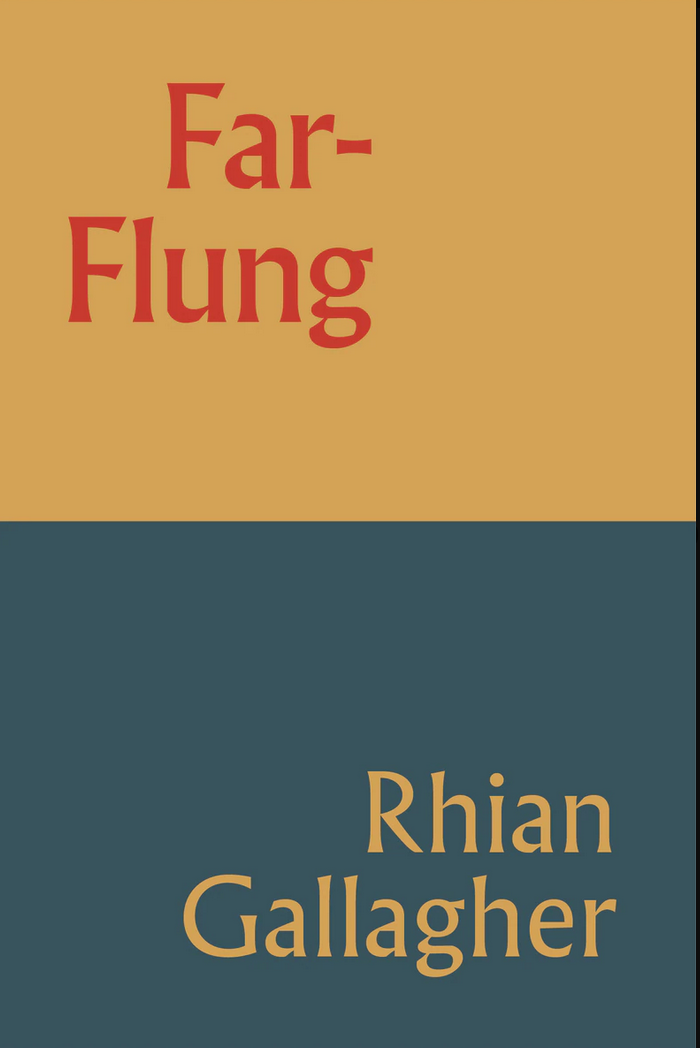
Rhian Gallagher reads from Far-Flung (Auckland University Press, 2020)
Rhian Gallagher‘s first poetry book Salt Water Creek (Enitharmon Press, 2003) was shortlisted for the Forward Prize for First Collection. In 2007 Gallagher won a Canterbury History Foundation Award, which led to the publication of her book Feeling for Daylight: The Photographs of Jack Adamson (South Canterbury Museum, 2010). She also received the 2008 Janet Frame Literary Trust Award. Gallagher’s Shift (AUP, 2011) won the 2012 New Zealand Post Book Award for Poetry. In 2018, she held the University of Otago Robert Burns Fellowship.
For end-of-year Poetry Shelf wraps, I have usually invited a swag of writers to pick books they have loved. It has always turned into a mammoth reading celebration, mostly of poetry, but with a little of everything else. This year I decided to invite a handful of poets, whose new books I have loved in 2020, to make a few poetry picks.
My review and interview output has been compromised this year. I still have perhaps 20 poetry books published in Aotearoa I have not yet reviewed, and I do hope to write about some of these over summer.
The 8 Poets
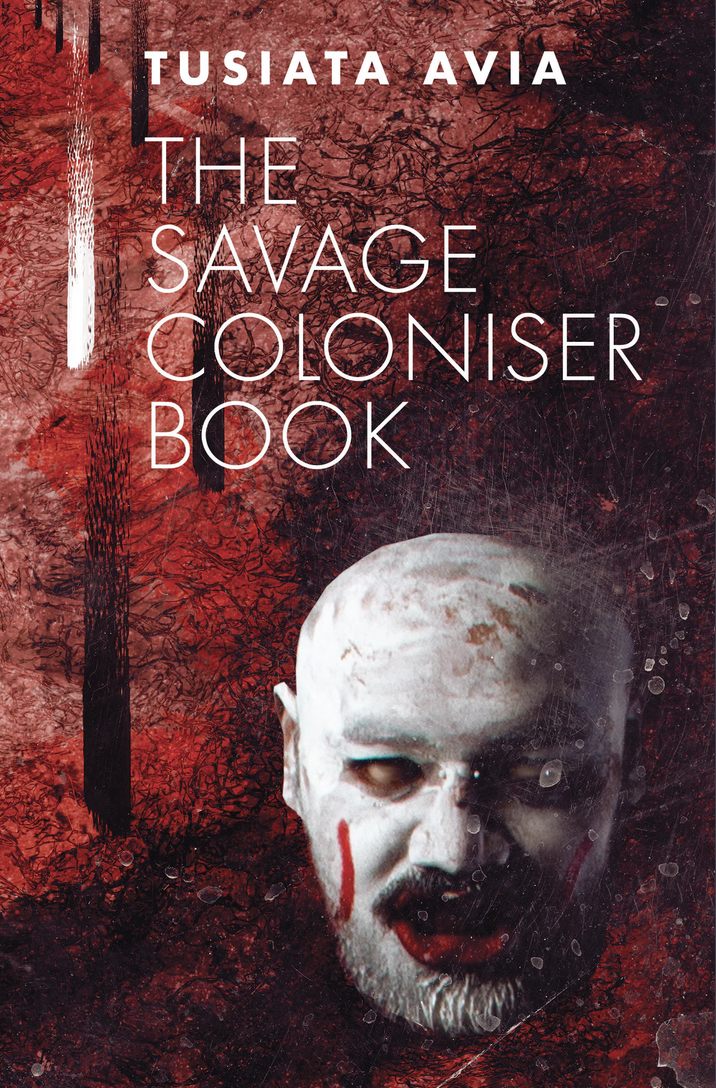
Among a number of other terrific poetry reads (Oscar Upperton’s New Transgender Blockbusters for example), here are eight books that struck me deep this year (with my review links). Tusiata Avia’s The Savager Coloniser (VUP) is the kind of book that tears you apart and you feel so utterly glad to have read it. Tusiata has put herself, her rage, experience, memories, loves, prayers, dreads into poems that face racism, terrorism, Covid, inequity, colonialism, being a mother and a daughter, being human. An extraordinary book. Rhian Gallagher’s Far-Flung (AUP) is a sumptuous arrival, a book of exquisite returns that slowly unfold across months. Her poetic craft includes the lyrical, the political, the personal and the contemplative in poems that reflect upon the land, experiences, relationships.
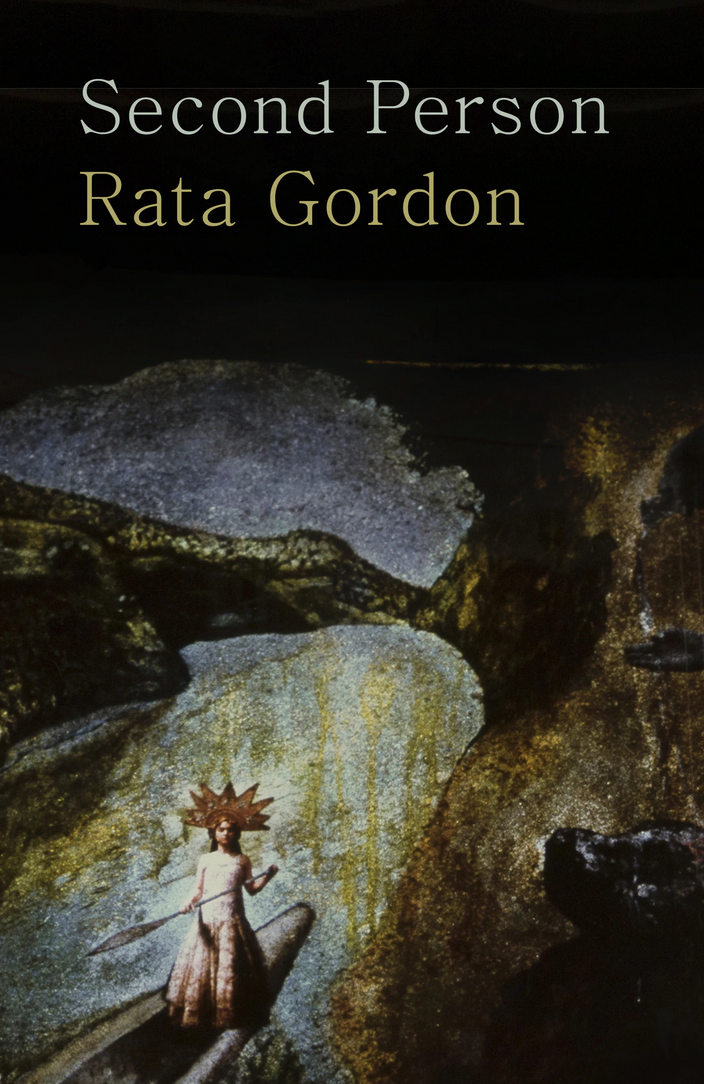
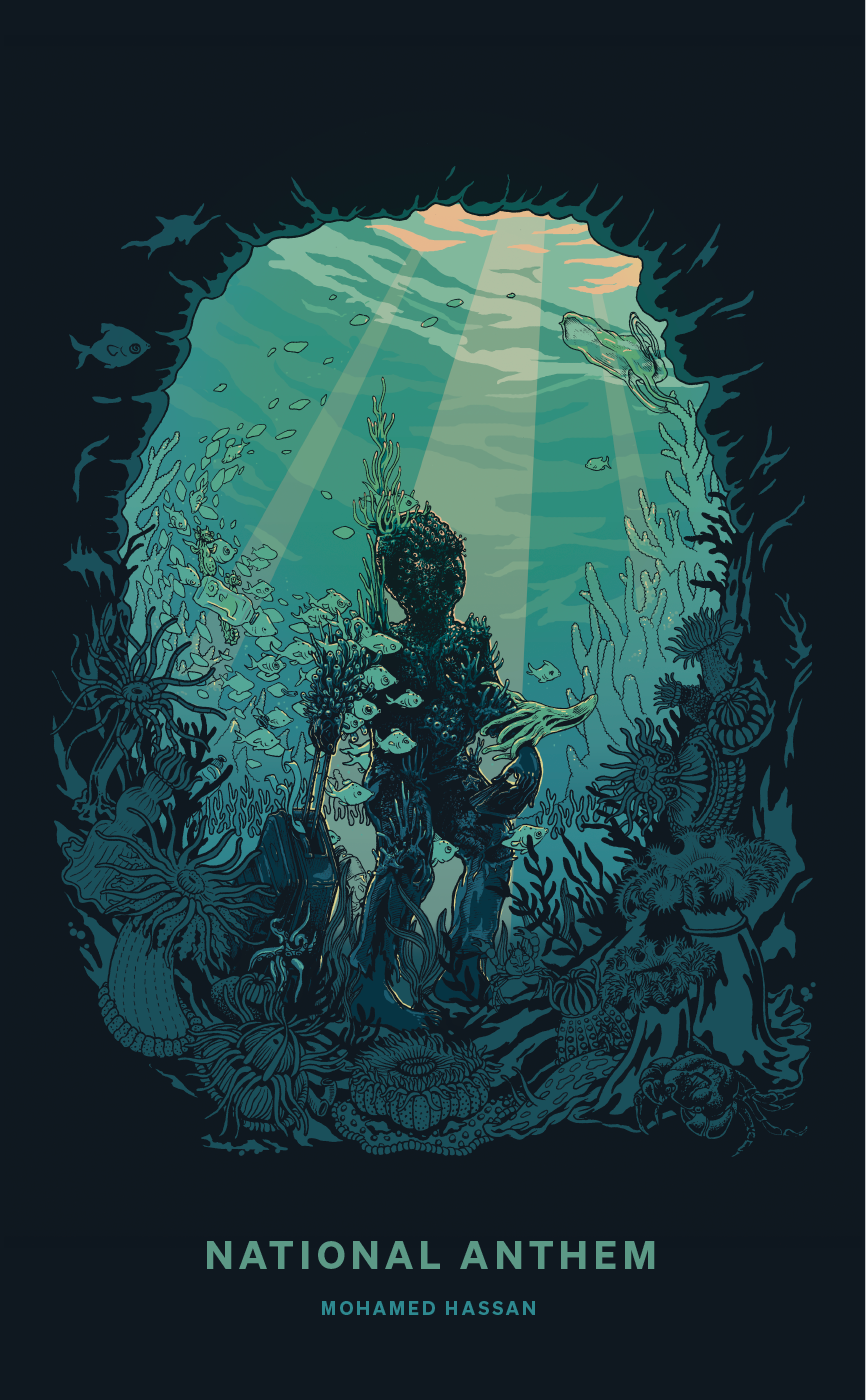
Rata Gordon‘s Second Person (VUP) is fresh, layered and utterly captivating. This is a book of birth, babies, death, the universe, love, motherhood, water, sky, wildlife. It is a book that celebrates the present tense, the way we can inhabit the now of being. Reading Mohamed Hassan’s new collection, National Anthem (Dead Bird Books), opens up what poetry can do. It widens your heart. It makes you feel. It makes you think. It gets you listening. It makes you think about things that matter. Humanity. Family. Soil. Ahh!
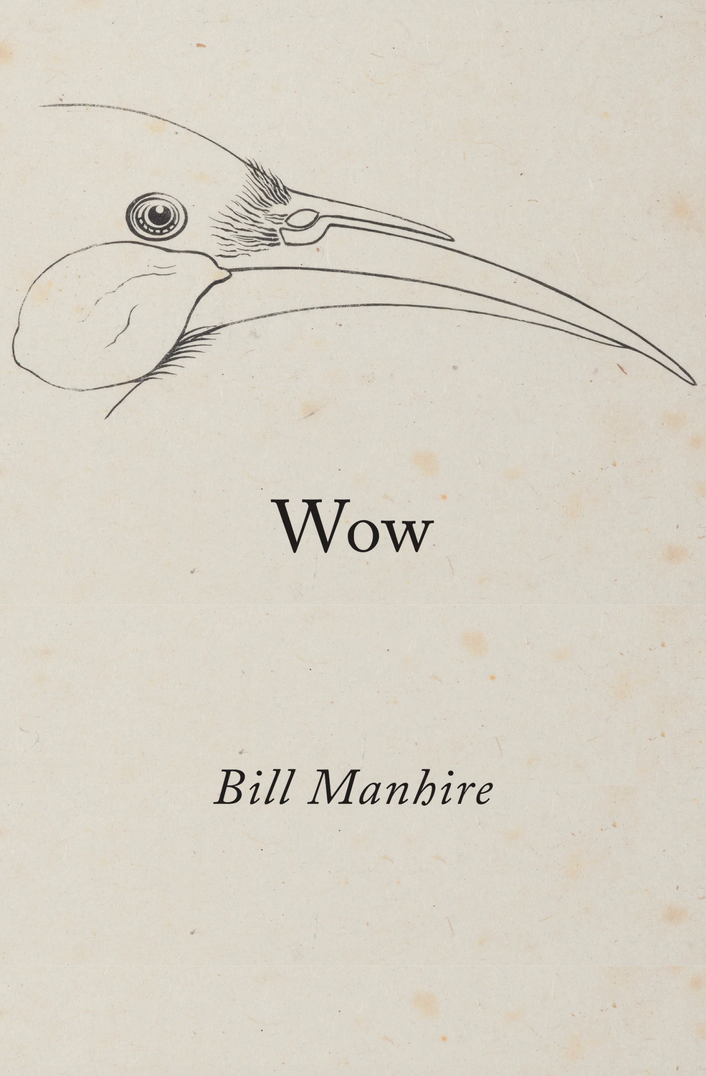
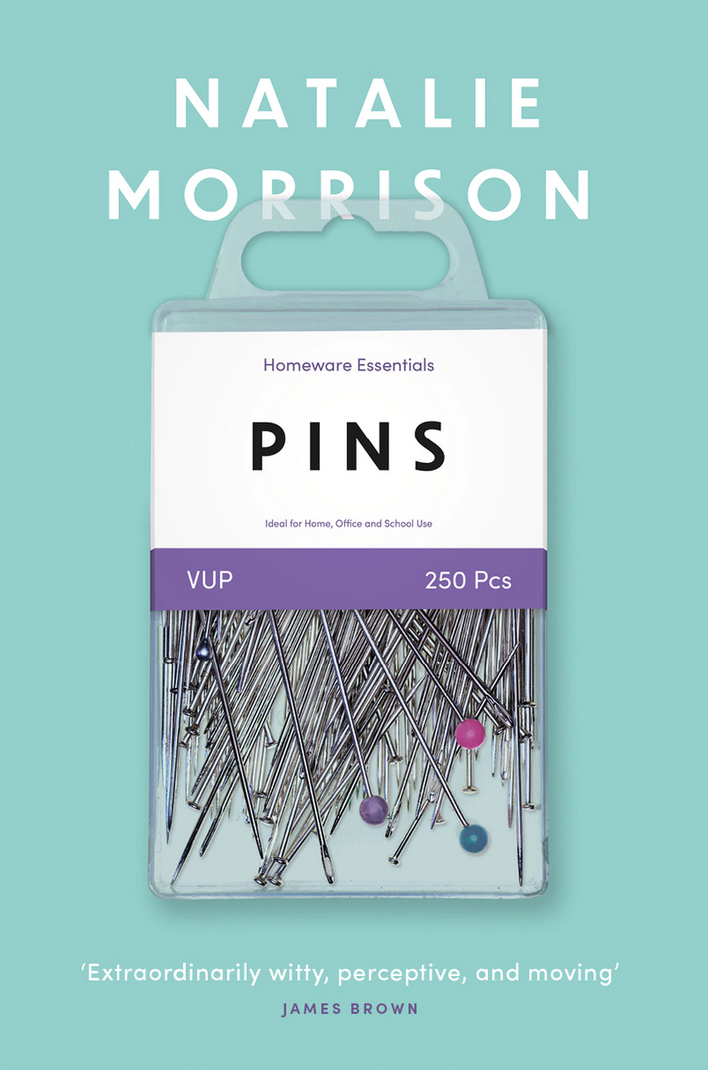
Bill Manhire‘s Wow (VUP) will haunt you – so many of these poems have joined my list of memorable poetry encounters. The baby in the title poem says ‘wow’ while the big brother says ‘also’. This new collection sparks both the ‘wow’ moments and the ‘also’ moments. Get lost in its glorious thickets and then find your way out to take stock of the ordinary (and out-of-the-ordinary) world about you. Like Rhian’s collection this is a book of poetry astonishments. Natalie Morrison‘s (VUP) debut collection Pins is exquisite, both melodious and tactile, economical and rich. There is both a quirkiness and a crafted musicality, resonant white space, yet perhaps a key link is that of narrative. I filled with joy as I read this book.
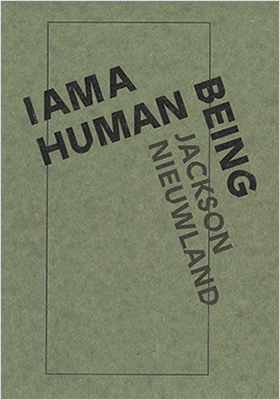
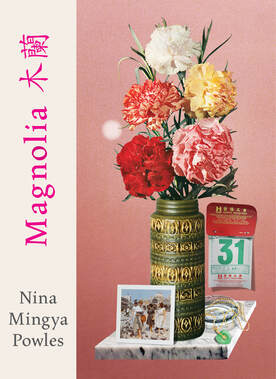
Jackson Nieuwland‘s I am a Human Being (Compound Press), so long in the making, lovingly crafted with the loving support of friends, with both doubt and with grace (think poise, fluency, adroitness), this book, in its lists and its expansions, moves beyond the need for a single self-defining word. I knew within a page or two, this book was a slow-speed read to savour with joy. Nina Powles‘s Magnolia (Seraph Press) is the book I am currently reading. I have long been a fan, from Girls of the Drift to the glorious Luminscent). Nina’s new book is so immensely satisfying as it navigates home and not-home, identity, history, myth, the lives of women – with characteristic nimbleness, heavenly phrasing, open-heart revelations, the senses on alert, the presence of food, multiple languages. Reading bliss!
The poets and their picks
Tusiata Avia
I’m a terrible book buyer. I tend to read books given to me (because I’m cheap like that) and the shopping-bag full of books my cousin, playwright, Victor Rodger, lends to me on the regular. He has the best taste! I should probably be a better reader of New Zealand poetry in particular, but I reckon I’ve got enough things to feel guilty about.
The top three on my list of books I have read this year and love:
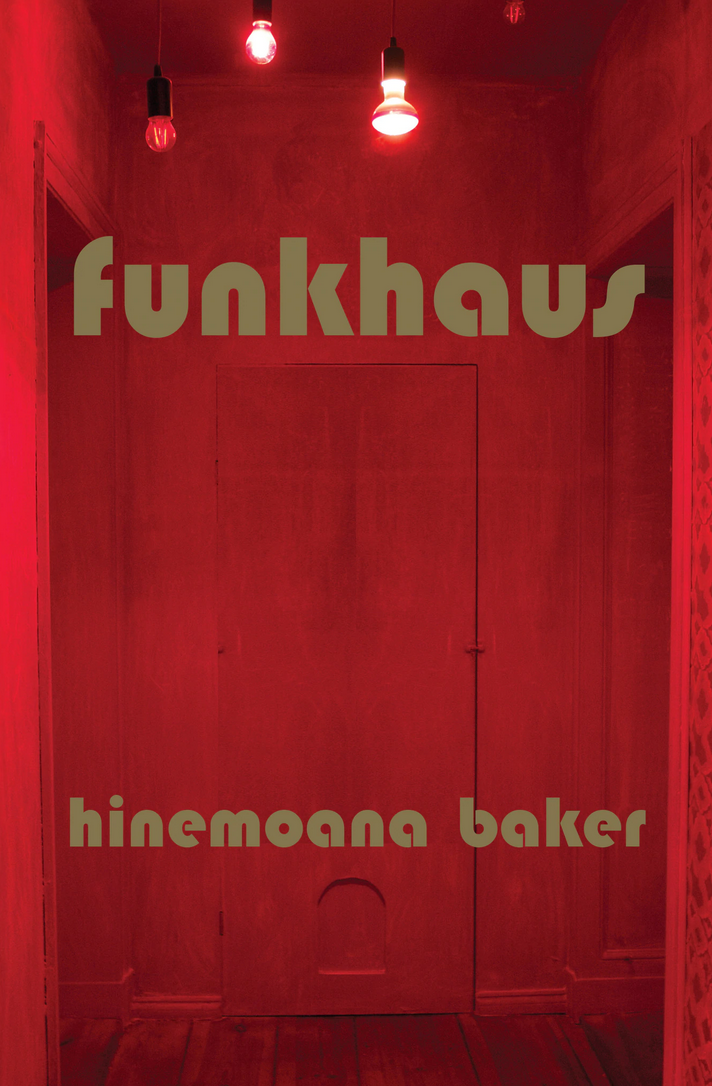
Funkhaus by Hinemoana Baker (Victoria University Press)
I love the way Hinemoana uses language to make the ethereal and the mysterious. I’m happy to not immediately be able to pin down meaning; her language allows me to be suspended between what it does to me and what it means. Poems like the incantatory Aunties and Mother – which I think of as more ‘rooted’ – make me want to sit down immediately and write a poem. In fact that is exactly what I did do when I read this book. I love a book that makes me write.
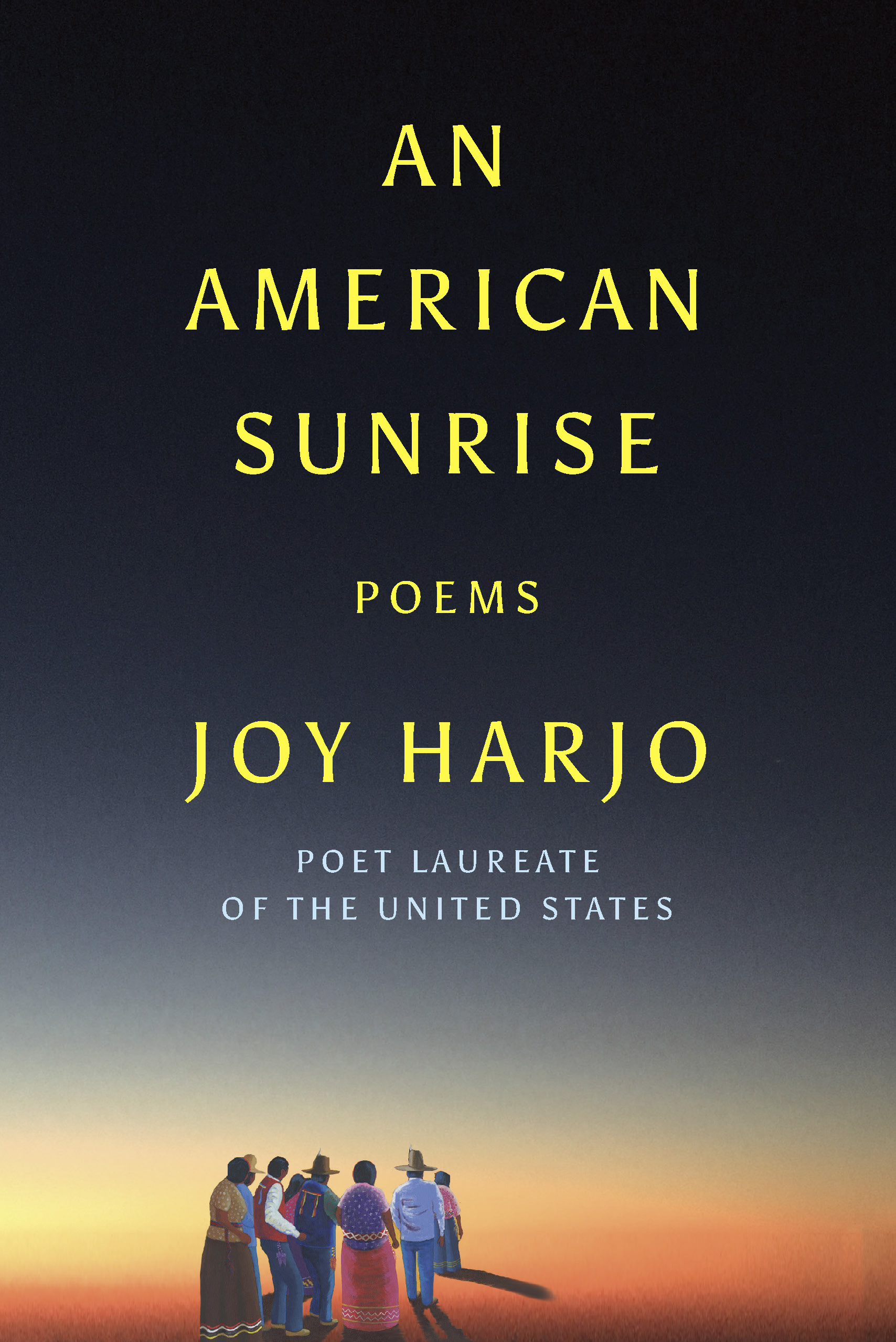
An American Sunrise Joy Harjo (WW Norton & Co)
An American Sunrise is Joy Harjo’s most recent book of poetry. Joy is Poet Laureate of the United States. I love everything Joy Harjo has written. And I mean everything. She Had Some Horses (from an early book of the same name) is one of favourite poems of all time. Elise Paschen says of her, “ Joy Harjo is visionary and a truth sayer, and her expansive imagination sweeps time, interpolating history into the present.”. I would add to that she is taulaaitu, mouth-piece for the ancestors, gods and spirits. While you’re reading Joy Harjo’s poetry, read Crazy Brave, her wonderful autobiography. It will stay with you forever.
National Anthem by Mohamed Hassan (Dead Bird Books)
When I was looking for favourite lines in this book, I couldn’t decide, sooo many – like small poems in themselves. Mohamed speaks with an iron fist in a velvet glove. His poetry is elegant and beautiful and it tells the damn truth. Someone needs to tell the damn truth – about March 15, about being Muslim in New Zealand (and in the entire western world), about the things that happen so close to us – and inside us – that are easy (and more comfy) to avert our eyes from.
Some favourite lines from White Supremacy is a song we all know the words to but never sing out loud: ‘Please come and talk on our show tomorrow/ no don’t bring that up/…
‘This isn’t about race/ this is a time for mourning/ this is about us/ isn’t she amazing/ aren’t we all’…
‘Let us hold you and cry/ our grief into your hijabs’…
Who can tell these stories in this way but a good poet with fire in his fingers, love and pain in equal measure in his heart and feet on the battleground?
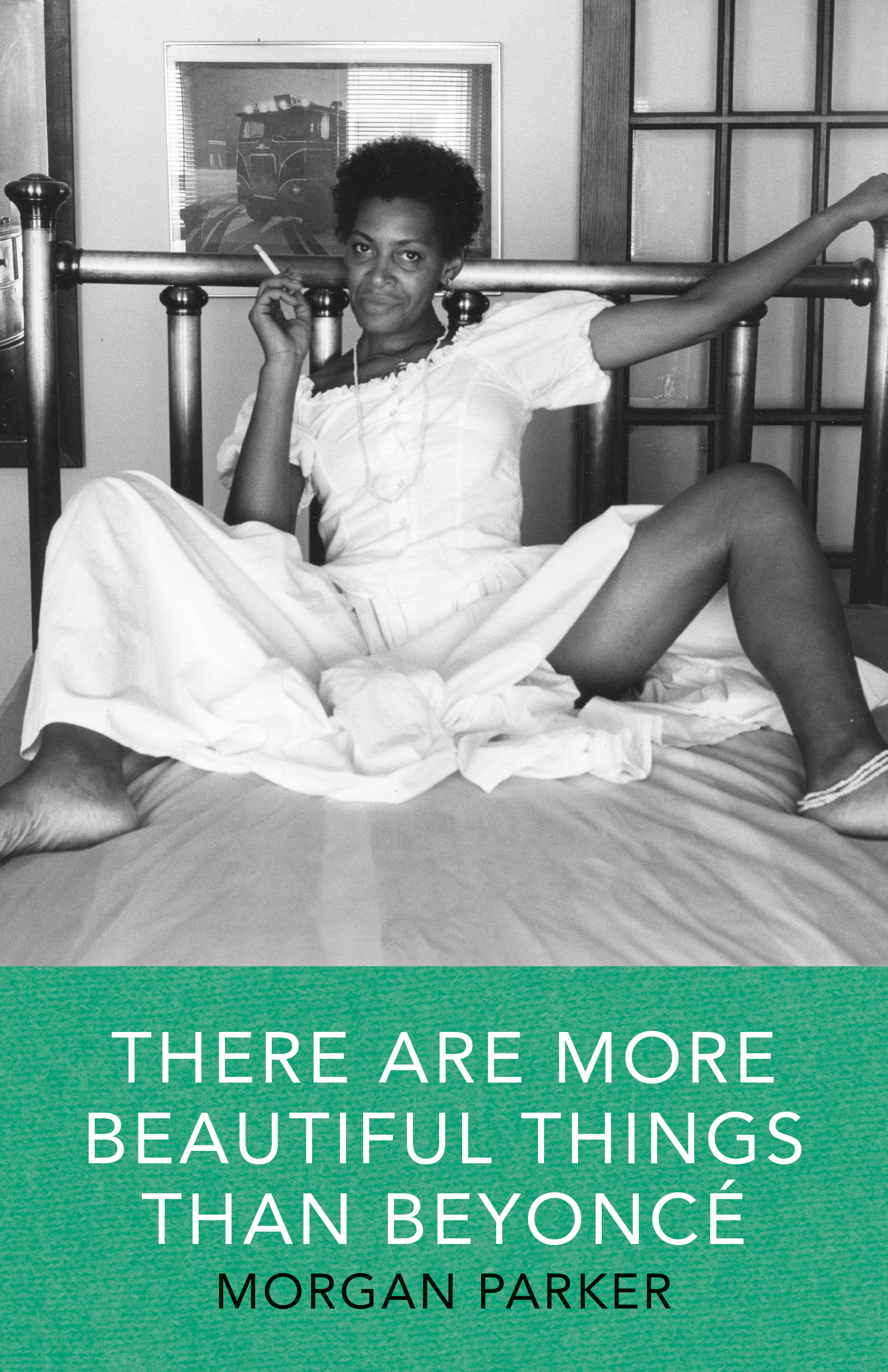
There are More Beautiful Things Than Beyonce Morgan Parker (Tin House)
I have to add, There are More Beautiful Things Than Beyonce by Morgan Parker to every list I write forever. In my opinion, no reader of poetry should miss this. If it doesn’t grab you by the shoulders, the heart, the brain, the belly – you might be dead. From the epigraph: ‘The president is black/ she black’ (Kendrick Lamar). Morgan Parker is PRESIDENT.
Rhian Gallagher
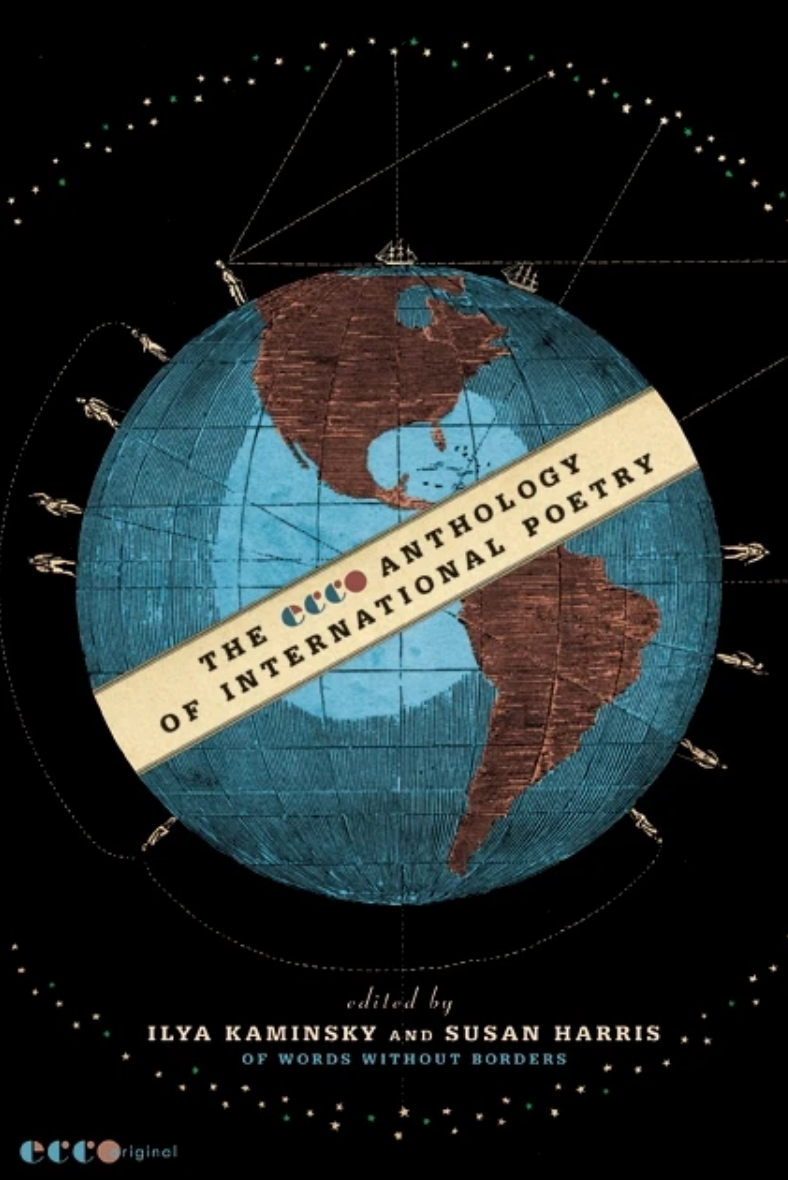
The Ecco Anthology of International Poetry (HarperCollins) edited by Ilya Kaminsky and Susan Harris features translations of 20th century poets from around the world and is packed with surprises.
Amidst all the books I have enjoyed during 2020, this is the one that I have read and re-read and continue to come back to. It was first published in 2010. I have been slow in coming to the book.
When a poem in another language is re-cast into English, through the empathy and skill of a translator, it seems to unsettle notions of line, rhythmn, word choice and form. Translation pushes and tugs at the boundaries of the ‘rules’ and introduces a kind of strangeness. This strangeness I experience as an opening; a feeling of potential, slippery as a an eel to articulate. It recalibrates predetermined notions and generates excitement about what a poem can do or be.
There are well-known names here: Cavafy, Lorca, Akhmatova, Ritsos, Milosz, Symborska among others. There are also many poets previously unknown to me, and many whose work is either out of print or difficult to source. It’s a diverse, inspiring array of poetic voices and, as Kaminsky says in the introduction, puts us ‘in conversation with a global poetic tradition’.
Making discoveries is one of the great pleasures of anthologies. I now have a brand new ‘to read’ list.
Rata Gordon
When I’m reading something that inspires me, I have the urge to inhabit it somehow. I find that entering into a creative process by writing with, and around, another’s words helps me to absorb them into my internal landscape. This poem was created with snippets of some of the poetry I have met recently.
Soon, we are night sailing (Hunter, p. 71)
This is the closest you can get to it:
the void, the nothing,
the black lapping mouth of the sea
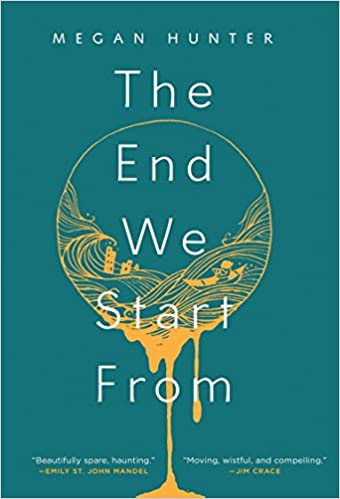
and the black arching back of the sky. (Hunter, p. 71)
One still maintains a little glimmer of hope
Deep down inside
A tiny light
About the size of a speck
Like a distant star
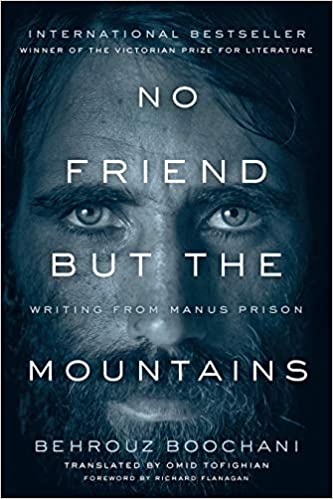
Is spotted on the horizon this dark night (Boochani, p. 26)
Swish swish swish
as quiet as a fish. (Ranger, p. 13)
… holy women
await you
on the shore –
long having practiced the art
of replacing hearts
with God
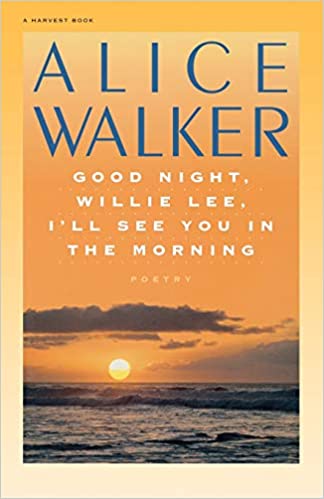
and song (Walker, p. 7)
Today you are tumbling towards her like the ocean.
… you are becoming nearer and nearer to someone other
than yourself. (Hawken, p. 49)
I have … imagined my life ending,
or simply evaporating,
by being subsumed into a tribe of blue people. (Nelson, p. 54)
The End We Start From by Megan Hunter (2017, Picador). (Not strictly poetry, but the book feels so much like a long poem to me). Line breaks added by me.
No Friend but the Mountains by Behrouz Boochani (2020, Picador).
‘Autumn Leaves’ by Laura Ranger. In A Treasury of NZ Poems for Children edited by Paula Green (2014, Random House).
Good Night, Willie Lee, I’ll See You in the Morning by Alice Walker (1975, The Women’s Press).
Small Stories of Devotion by Dinah Hawken (1991, Victoria University Press).
Bluets by Maggie Nelson (2009, Jonathan Cape). Line breaks added by me.
Mohamed Hassan
Tusiata Avia’s The Savage Coloniser Book (Victoria University Press)
A few weeks ago, I sat in the audience at a WORD Christchurch event and watched our former poet laureate Selina Tusitala Marsh read a poem from Tusiata Avia’s new collection. It began as such:
Hey James,
yeah, you
in the white wig
in that big Endeavour
sailing the blue, blue water
like a big arsehole
FUCK YOU, BITCH.
The hall fell pin silent and a heavy fog of discomfort descended from the ceiling, and I sat in the corner brimming with mischievous glee. It was a perfect moment, watching two of the country’s most celebrated poets jointly trash the country’s so-called ‘founder’ in the most spiteful way imaginable. The audience squirmed and squirmed and I grinned and grinned.
This is how Avia’s book begins, and it never lets up. As the title subtly implies with a hammer, Avia has things she wants to say, and doesn’t care how people feel about them. She delights in the spiteful, burrows down into the uncomfortable and the impolite and pulls out nuggets of painful truths with her bare hands. They are all truths that must be said bluntly and Avia drills them home.
In Massacre, Avia reflects on her youth fighting the demons of Christchurch, and asks us if our ‘this is not us’ mantra is divorced from the history carried in the land, haunted instead by the white spirits that rose to claim lives on March 15.
The book crescendos with How to be in a room full of white people, a dizzying poem that traps us in a single moment in time and forces us to witness and squirm and eventually, hopefully, understand what it is like to be the only brown body in a foreign space, in all its literal and metaphorical significance.
This has been my most cherished book this year, bringing together Tusiata Avia’s firecracker wit and her uncanny gift of conjuring worlds that feel vivid in their weight and poignancy. Abandoning all diplomacies, this is a blazing manifesto for honest and confrontational poetry that speaks with an urgency that puts me as a writer to shame, and demands more of me at once.
Bill Manhire
Jenny Lewis, Gilgamesh Retold, (Carcanet)
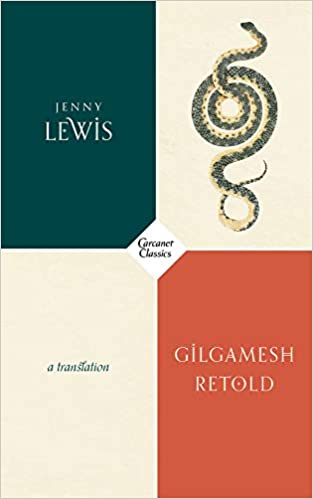
I love the way poetry re-visions the past, especially the deep past. I’m thinking of books like Matthew Francis’s reworking of the Welsh epic The Mabinogi and Alice Oswald’s Memorial, a book that abandons the main storyline of Homer’s Iliad in favour of narrating the death scenes of minor characters, accompanied by extra helpings of extended simile. I’d always known about the Epic of Gilgamesh, which I have owned for about 40 years in a yellow 1960 Penguin paperback. I’ve hardly opened it, but it’s one of some nine translations of the poem that Jenny Lewis has consulted for Gilgamesh Retold, published by Carcanet some four thousand years after the stories first circulated in oral form. (Her publisher at Carcanet, Michael Schmidt, has himself written a much admired book about the poem’s origins and afterlife)
Locally Dinah Hawken has worked with this ancient material, particularly writing about Inanna, the goddess of beauty and fertility and, sometimes, war, who is one of the major figures in the Gilgamesh cycle. Dinah’s feminist sense of the ancient stories accords with Jenny Lewis’s decision, as the blurb says, to relocate the poem “to its earlier oral roots in a Sumerian society where men and women were more equal, … [where] only women were allowed to brew beer and keep taverns, and women had their own language – emesal.”
It’s as well Inanna has such a significant role in Gilgamesh, for otherwise it would be a tale about male adventuring and bonding (Gilgamesh and Enkidu) and the discovery that even the greatest heroes can never overcome death. The world of Gilgamesh also gives us a Flood, which matches and in some ways outdoes the Old Testament. I love the way Jenny Lewis has retold these stories. She doesn’t try to pad them out to produce the sorts of coherence and pacing that contemporary readers and movie-goers find comfortable, while her phrasings have an unreductive clarity and a genuinely lyrical grace. The most audacious thing she has done, and has carried off brilliantly, is to use different metrical forms to reflect the ways in which a range of different custodians/retellers have voiced and revoiced the story. You admire the 21st-century poet’s craft even as she inducts you into a baffling and unfamiliar world. All stories, Gilgamesh Retold tells us, are made by many voices, and the best of them will journey on through many more.
And now I must try and summon up the courage to give the latest version of Beowulf a go!
Natalie Morrison
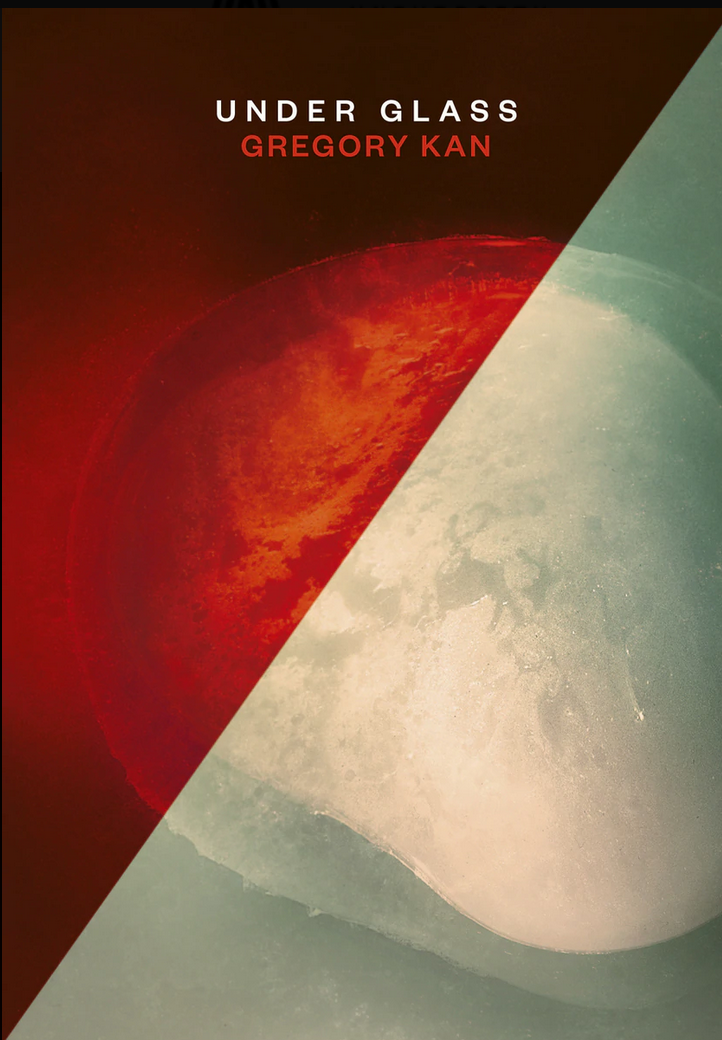
Gregory Kan, Under Glass(Auckland University Press)
My esteemed colleague, with one hand around his Friday swill-bottle: ‘I hate poetry – no one cares, no one reads it anymore.’
Gregory Kan, with two suns infiltrating the long ride on the train to Paekākāriki, illustrates otherwise: Under Glass lulls like a really disquieting guided meditation.
After lockdown, it is the first book I read outside our ‘bubble’. Threading through an internal landscape, somehow a place I recognise. ‘Here, there are two suns. The ordinary sun is in the sky overhead. The other sun is eating its way out from inside me.’
Certain lines, with their mystical insistence, snag on me and come back again from time to time: ‘Everything that surrounds the second sun is not part of it but nonetheless makes it what it is.’ It’s as if some lines have been dreaming of themselves. The book invites a gentle inspection. A glass bead held right up against the eye. A shutter flipped open over a stark interior.
‘When you move a look moves inside me and eats there what I eat.’
Once, a kind individual in Paekākāriki, their hands busy with a teapot, told me: ‘Those who know what it is, fall on it like starving people.’
When Litcrawl comes, we make our way to some of the events. The room has sucked a crowd in. Spells for 2020, with Rebecca Hawkes, Rata Gordon, Stacey Teague, Arihia Latham, Rachel McAlpine and Miriama Gemmell (thank you for your entrancing words), reminds me of how poetry is still something people might come in search of. Visitations of bees, airline heights and morphing walls. There is a sense of relief.
A crowd still feels like a dream, and a dream still feels like the sea. Gregory writes that ‘the sea is a house made of anything. The sea is a story about anything, told by someone unfit for storytelling. More than what I can know, and much more than I can understand.’
Under Glass, which wasn’t exactly written for this year (no ordinary year), seems to slot into it.
My steamed colleague, with one hand steadying the banister: ‘I guess Bob Dylan is okay, though.’
Note: I asked my colleague’s permission for quoting him. He said he was fine with it, as long as a mob of angry poets didn’t come knocking.
Jackson Nieuwland
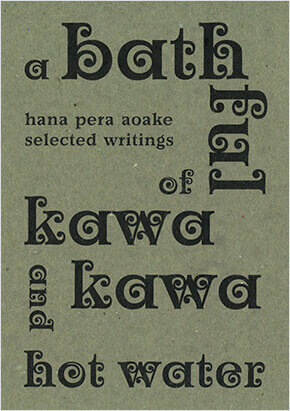
2020 was the year we finally got a book from Hana Pera Aoake (A bathful of kawakawa and hot water Compound Press). I had been waiting for this for so so long. It’s a taonga that I am incredibly grateful for. Ever since I first read Hana’s work they have been one of my favourite writers. Their writing is both clever and wise, of the moment and timeless, pop culture and fine art, Aotearoa and international.
This is a book I will be returning to over and over again for inspiration, electrification, nourishment, and comfort. I would recommend it to anyone.
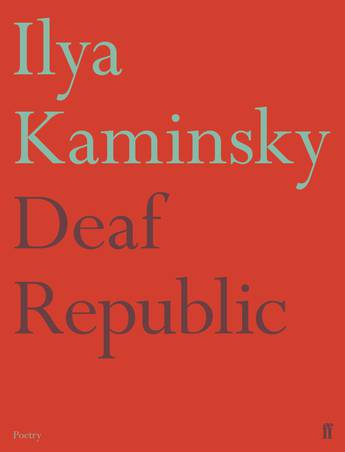
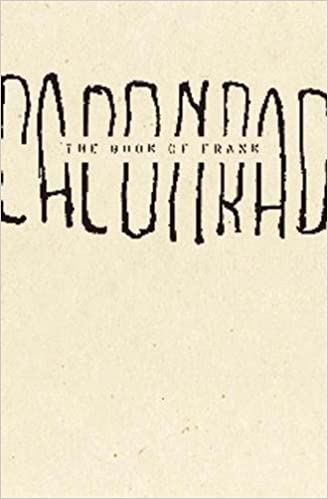
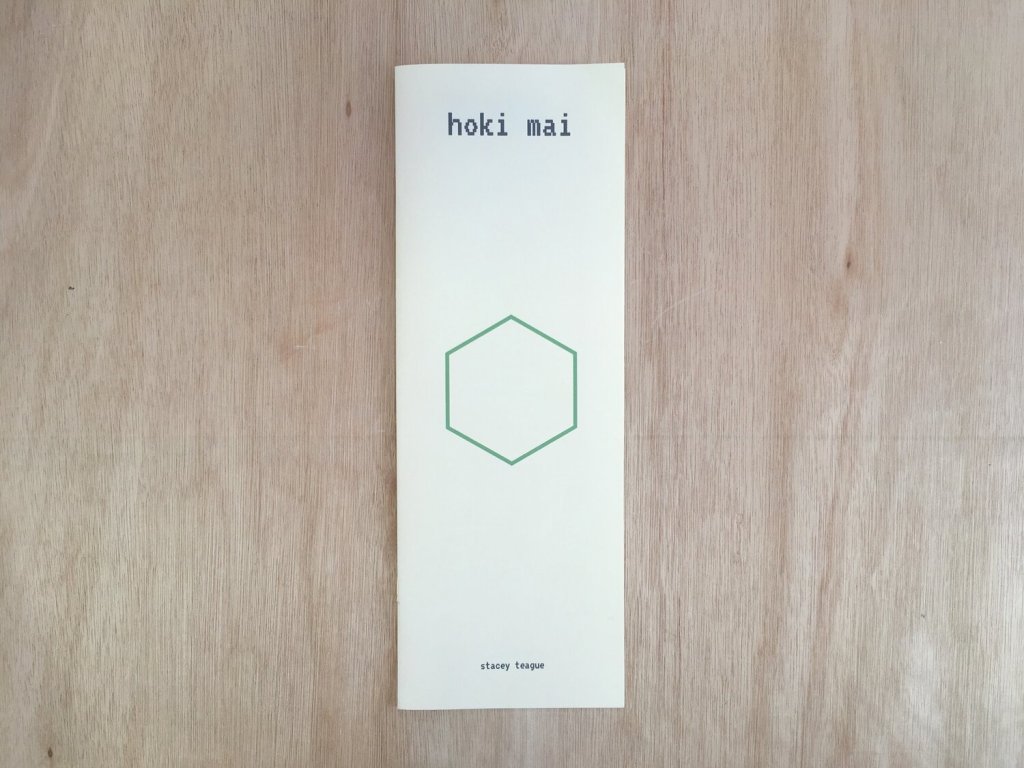
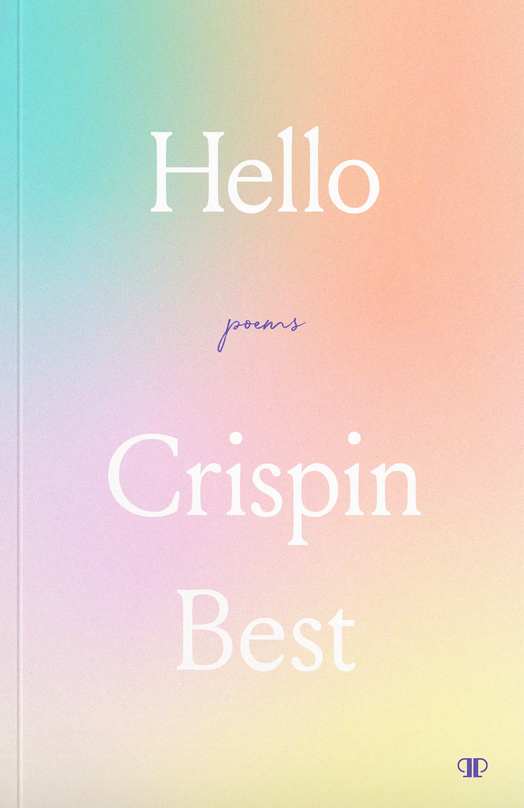
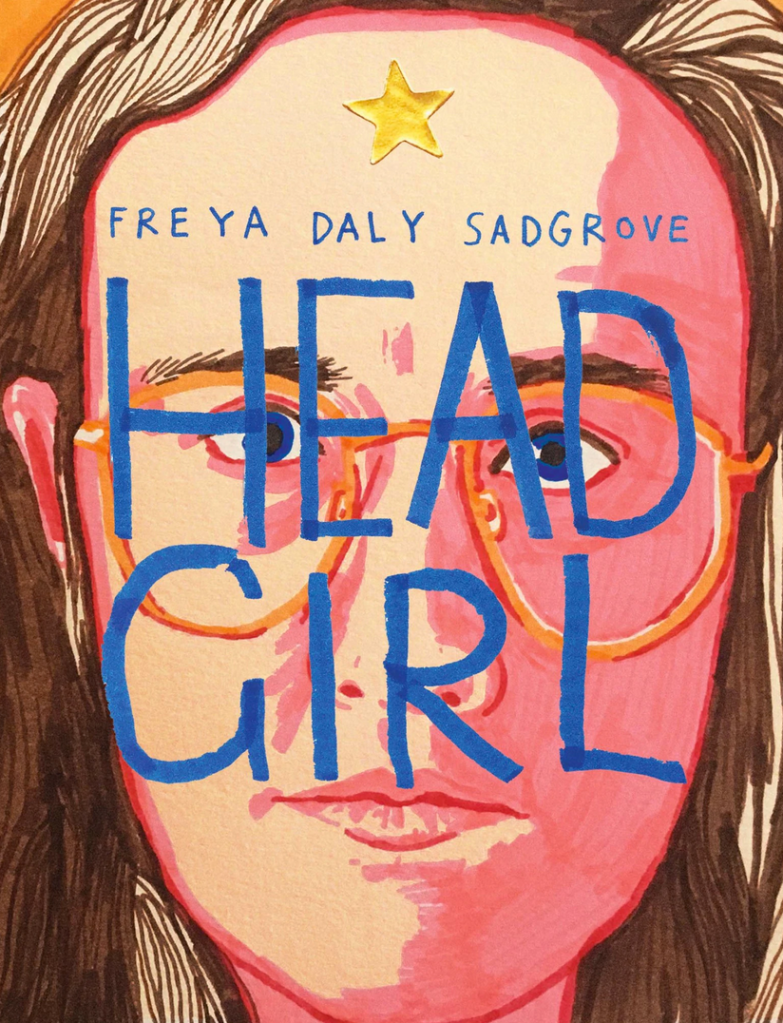
Other poetry books I read and loved this year: Deaf Republic by Ilya Kaminsky, The Book of Frank by CA Conrad, hoki mai by Stacey Teague, Hello by Crispin Best, and Head Girl by Freya Daly Sadgrove.
Nina Mingya Powles
For most of this year I could only read things in fragments. I could only hold on to small parts of poems, essays, short stories in my head before they floated away. This year I sought out poetry by Indigenous writers. Of these two books, the first I read slowly, dipping in and out like testing the surface of cool water. The other I read hungrily all at once.
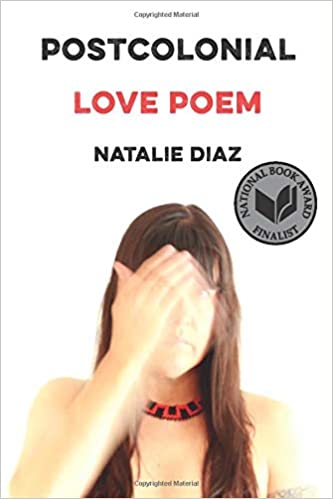
Postcolonial Love Poem by Natalie Diaz (Graywold Press) reminded me why I write poetry, at a time when writing anything at all felt impossible. Diaz’s heavy, melodic love poems circled around my head for days: “My lover comes to me like darkfall – long, / and through my open window.” But it is her writing about water and the body that changed me. In this book, water is always in motion, a current that passes through time, memory and history. Her long poem “The First Water of the Body” is a history of the Colorado River, a sacred river: “I mean river as a verb. A happening. It is moving with me right now.”
A bathful of kawakawa and hot water by Hana Pera Aoake (Compound Press) came to me when I needed it most, nourishing me and warming me. I haven’t yet held a copy of the book, but I read it on my laptop over two days and have carried parts of it around in my body ever since: “I speak broken French and Português into the broken yellow gloaming.” A bathful of kawakawa and hot water is a searing, lyrical work of poetry, memoir, and political and cultural commentary. Like the title suggests, it was a balm for me, but also a reminder of the ongoing fight for our collective dream of a better world, and most importantly, that “racism is not just a product of psychological malice, but a product of capitalism.”





 NZ Poetry Shelf