Public Event
· Hosted by Grace Taylor / Mama G


Public Event
From Seraph Press:
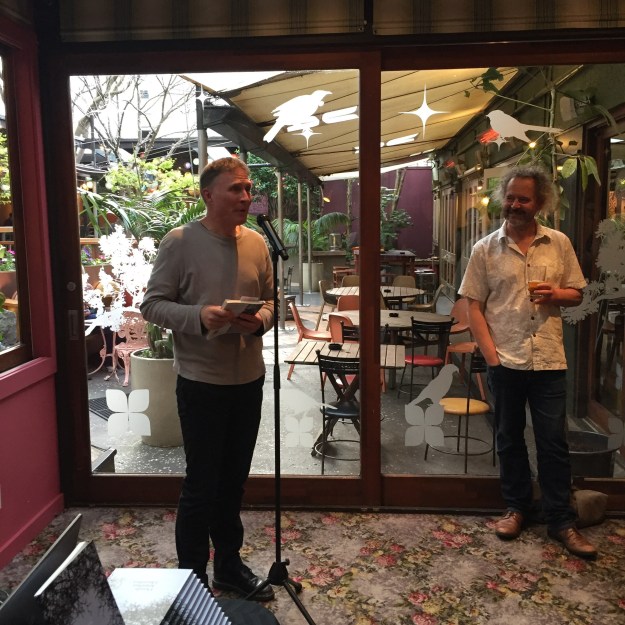
We hope you can join us to celebrate the launch of these two exciting new chapbooks with a French connection, both of which grew out of Anna Jackson’s time as Katherine Mansfield Fellow in 2016.
When: Thursday 26 October 2017, 5.30 pm
Where: Vic Books, Easterfield Building, Kelburn Parade, Wellington
All welcome.
About the books:
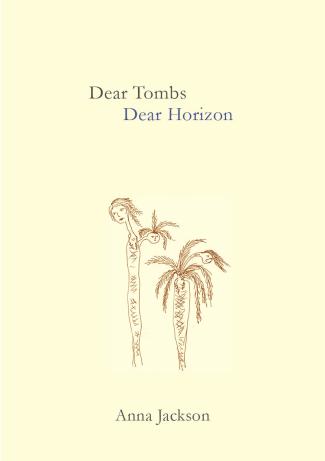
Dear Tombs, Dear Horizon
by Anna Jackson
In 2016, while the Katherine Mansfield Fellow in Menton, France, Anna Jackson began recording some of her thoughts and impressions in a notebook. Over the three months of her tenure this grew into a lively and charming poetic essay, which weaves her own experiences with her engagement with other writers and texts, including her predecessor Katherine Mansfield.

Last Stop Before Insomnia / Dernier Arrêt Avant l’Insomnie
by Marlene Tissot, translated by translated by Anna Jackson and Geneviève Chevallier
Seraph Press Translation Series No. 3
This bi-lingual taster of deliciously playful poetry by French poet Marlene Tissot takes you on a wild ride through the existential, the sensual and the sleep-deprived.
To find out more about the books, or to buy them online, visit here. seraphpress.co.nz.
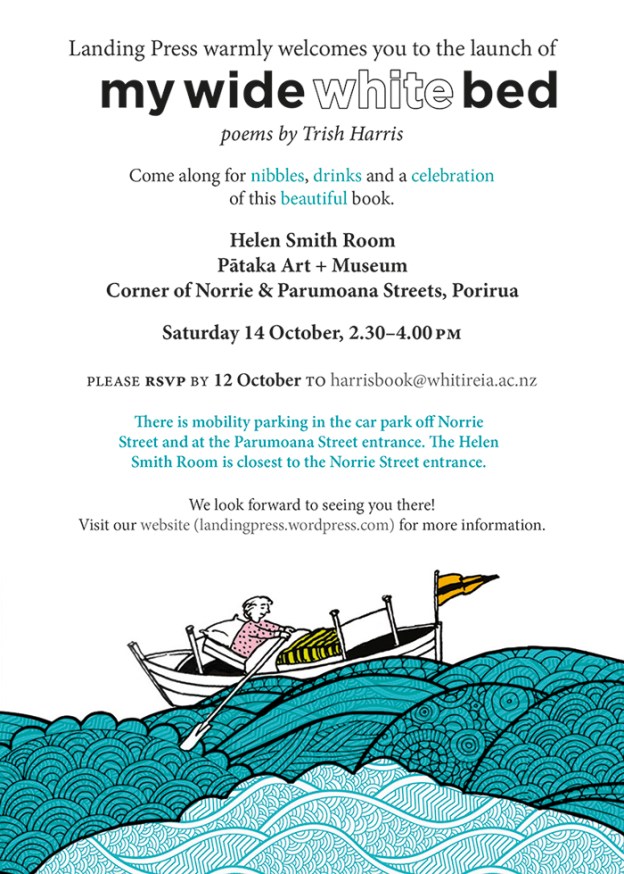
Next Saturday, Landing Press will be launching their newest collection of poetry – My wide white bed by Trish Harris.
My wide white bed, Trish’s first collection of poetry, is inspired by her long stay in an orthopaedic ward. Navigating daily hospital life and the path to recovery, the poems capture a unique view of hospital life from a patient’s point of view and demonstrates, as Glenn Colquhoun puts it in his endorsement of the book, ‘how crucial imagination is to being well’.
At a time when health care is a much talked-about issue, this book contributes to the conversation in an insightful way with measure and hopefulness.
The launch will be held at Pātaka Art + Museum in Porirua, Wellington from 2.30pm.
Here is a clip of Trish reading a poem from the book.
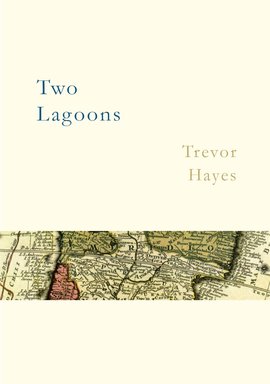
Two Lagoons, Trevor Hayes, Seraph Press, 2017
‘I have invented
myself this morning.
These lines
I have not imagined.’
from ‘Ash Song’
Trevor Haye’s Two Lagoons offers various resonant pools to sink into—forgive the pun, I rather like the idea of a poem as lagoon—and then establishes myriad links between. There is a here to there shimmer; from the South Island’s West Coast to South America; from a lived world, physically detailed and sensually lifted, to abstract movements, imaginings, sidesteps. The poems – there are 12 – are like surprise pockets: luminous with fizzing alchemy, grace, agility and rich layerings. The placement of this next to that, of the 19 letters in the mailbox alongside the milkman’s history, of the ‘trickery of phrasal verbs’ next to ‘the benefits of good manners’ is akin to sparks on the line. It’s a delight to read and I look forward to the next book.
I pack my suitcase lightly.
I have a toothbrush and floss,
as even nowhere is better
with healthy gums. I have some
reading material: a guide
to the extinct flora and fauna
and a book that translates silence.
I intend to visit the empty museums
and the vacant parking lots.
I’ll be able to take photos of nothing
but the wind. It seems unlikely
I will meet anybody there, as recent
political developments and negative
coverage by news media have discouraged
the travelling public.
©Trevor Hayes from Two Lagoons


Postmodernism Explained
You’re dreaming. In the
dream you fall asleep and dream
you’re writing. If to
write is to reflect
what you’ve already read, and
thus to reread, to
read is also to
rewrite. What are you saying?
Wake up, you tell me.
©James Brown 2017
And for an extra sample you can read the magnificent ‘Janet and John Go to the Book Launch’ here
The launch speech:
James Brown comes from Palmerston North
There are numerous questions that arise, like a lowland mist, from this collection, as from all of James Brown’s books: For a start, why did he ever leave his home-town of Palmerston North, to which he is so manifestly linked. Or maybe he did never leave? Or when is he due back there?
Taking this, Brown’s sixth poetry collection, as a kind of provocation, two Fridays ago I drove north to Palmerston North and checked in for the night at the Hotel Coachman, a neo-Tudor confection on Fitzherbert Avenue. Not far from ground zero—the address where Brown spent his formative years—I had decided to read this new collection on its home turf—on the south side of ‘the bustling go-ahead city at the heart of the Manawatu Plains’ as Brown once memorably wrote.
According to the Palmerston North Creative Giants website:
‘Of all Palmerston North’s Creative Giants, poet and short fiction writer James Brown stands out…’ Expectations of the new book were, accordingly, running very high in Room 102 of the Hotel Coachman. In the company of an increasing platoon of sopping tea-bags and an intermittently boiling kettle, I lay down and made my way across the flat, bicycle-friendly territory of Floods Another Chamber. . .
Despite the fact she appears in Brown’s new collection a much-remarked-upon four times, Jenny Bornholdt had earlier in the day declined the invitation to accompany me northwards on this hyper-literary excursion. . . Alone, I was consigned to my carpark-facing double room—$160 the night, which included breakfast in a rowdy dining area filled with travelling salesmen and at least one sports team. While the scrambled eggs resembled a Manawatu wetland and the spread, generally, was lacklustre, I was up to my ears in Brown’s book by breakfast time, which made it all not so bad. In fact it was as if James Brown had scripted the whole thing.
Later I drove past the Palmerston North Public Hospital, where the poet was born at 12.40am on April the 1st, 1966; a moment’s respectful silence, also, near the birthplace of Sarah Laing and the childhood home of Karl Maughan—and on Broadway Avenue where painter Pat Hanly, aged 15, was an apprentice hairdresser at Bert Pratt Limited.
The early things in life determine how we evolve. In Brown’s villanelles and quatrains, I can detect the orderly grid of the Palmerston North street plan, and the inspirational, idiot wind that crosses it. This is the place where, as Brown writes in ‘Childhood’, the days ‘inched by… Glue, glitter, galaxies. Things shone. Broke. You laughed / until you cried. There was no escape.’
While James Brown delights in poetic constraints, and is dazzling within them, he can also blast away and, like the late night motorists on Fitzherbert St, has been known to throw beer-cans and drop donuts, or their literary equivalent. . . On the subject of provincial psychology, ‘Erotic Snowdome’, from the new book, contains possibly the best, rudest line in all of New Zealand verse—or first-equal with Hera Lindsay Bird. (You’ll have to read the poem to discover this for yourselves.)
Brown is the New Zealand poet laureate of torpor, resignation and exhaustion (or maybe loss of interest), with intermittent bouts of fanatical bicycle riding. The miracle is that he can make it all so interesting and darkly humorous and weirdly moving. The poems are characterised by a process of subtle inversion whereby the personal is rendered impersonal and the impersonal becomes personal. The end result is a poetry that is simultaneously lop-sided and true. At times, it’s like L=A=N=G=U=A=G=E poetry, but definitely, to use a word from Brown’s book, funner. . .
Like the hometown, the poetry gains a certain intensity through its sprawl, pragmatism, volubility and absence of long term planning. . . Just as Palmerston North has its New Zealand Rugby Museum, Brown embraces the sacred paddock and has written the odd rugby poem (most recently ‘True Blood’ in Warm Auditorium). For such a flat place, Palmerston North casts a long shadow. Echoing the city’s single Beds R Us outlet—at 133 Rangitikei St—Floods Another Chamber includes a similarly stocked poem titled ‘Beds R Us’. . . With its conference centre, in-house training and local dialect, the Museum of New Zealand Te Papa Tongarewa—Brown’s recent long-term place of employment—configures in much of his poetry as a kind of rehash of Palmerston North, but on three or four levels.
Not surprisingly, perhaps, there are a great many poems in Floods Another Chamber about the other place, Wellington, but as any true son or daughter of Palmerston North will tell you, Wellington is only the southernmost suburb of Palmy—a feeder city or satellite. All roads, as indeed all bike lanes, lead to the one true Square.
After giving a talk at the Palmerston North art gallery—which was the other reason for my trip north two weeks ago—I fell into a conversation with a member of the audience, a district planner. When I put it to him that Palmerston North was just a theme park based on James Brown’s poetry, he appeared not to hear me and proceeded to outline, in some detail, the myriad cycle lanes that the council was now investing in—riverside bike trails, designated lanes, scenic diversions. . . According to my new friend, the place would soon be like Copenhagen—although with Fonterra and DB in the ’hood, and the Manawatu River rolling through and occasionally flooding everything. Having just read James Brown’s new book, it was crystal clear to me that the city was preparing itself for the imminent return of its most illustrious son, its cyclist-poet laureate.
Floods Another Chamber is our latest, biggest chance to bask in the life and work of a genuine Creative Giant of Palmerston North and of everywhere in the world that does not call itself Palmerston North. The overnight trip to Palmy is an optional extra. In some very fundamental ways, this indispensable collection will take you there anyway.
Gregory O’Brien October 2017
James Brown’s previous poetry collections include Go Round Power Please (1995), which won the Jessie Mackay Best First Book Award, Lemon (1999), Favourite Monsters (2002), The Year of the Bicycle (2006), and Warm Auditorium (2012), as well as the useful nonfiction booklet Instructions for Poetry Readings (2005). He edited The Nature of Things: Poems from the New Zealand Landscape (Craig Potton Publishing, 2005), the literary magazine Sport from 1993 to 2000, and the online anthology Best New Zealand Poems 2008. James teaches the Poetry Workshop at Victoria University’s International Institute of Modern Letters.
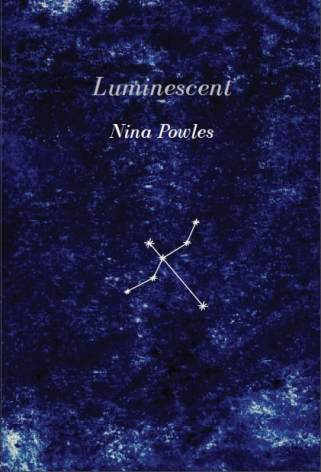
Luminescent, Nina Powles, Seraph Press, 2017
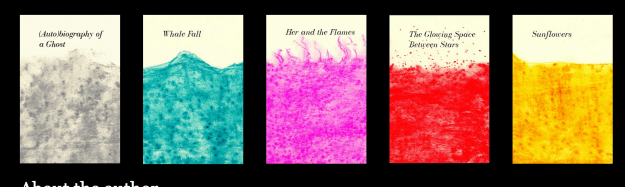
Nina Powles’s debut poetry collection, Luminescent, is a set of five slender chapbooks in a night-sky sleeve. Each book is like a constellation, with a particular woman, its luminosity. (Auto)biography of Ghost catches a ghost who was said to haunted Queen Margaret College’s bell tower where she fell to her death; Sunflowers becomes a conversation and an homage to Katherine Mansfield; Whale Fall imagines the world of Betty Guard, perhaps the first Pākehā woman to have lived in the South Island; Her and the Flames draws upon Phyllis Porter who died at 19 when her costume caught alight in a theatrical performance; The Glowing Space Between the Stars turns to Beatrice Tinsley, a New Zealand cosmologist. There are notes in the back of each booklet that background each woman.
I love the way the poems talk to each other within each booklet and between booklets.
The poetry extends itself in imaginings, yet grounds itself in the light of an autobiographical presence and research. Motifs such as dust, moths, ghosts and dreams are like connecting lacework that render a sense of ethereal wholeness to the set. The poems accumulate exquisitely textured voice; confident and idiosyncratic, searching and still, melodic and spare, intricate and warm. Every poem is a jewel of a thing.
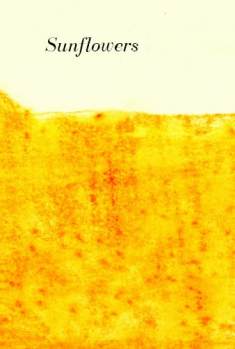
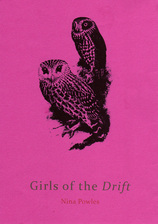
Sunflowers takes several Mansfield experiences as starting points for poems: she burnt all her letters and journals when she was in her early turbulent twenties; she wrote about a writing epiphany after seeing a Van Gogh painting for the first time; she recorded a dream after her brother’s death. In an early chapbook, Girls of the Drift, Nina put New Zealand poets, Jessie Mackay and Blanch Baughan together in poetry. The poems offered surprising pathways into our first women poets in print alongside a young contemporary poet forging her own poetic trails. With the Mansfield poems, I feel like I am sitting in a room in the South of France, and each poem resembles an aperture in the wall that pulls me into a Mansfield dreaming.
‘Fever dream’ is without punctuation, a slim short-lined poem that sizzles with ‘s’ alliterations that cut into the feverish night. In the midst of the hissing heat (stinging scorching nerves skin simmers inside struck bones sky she rising), two words cut into the fevered skin (teeth cracking). The poem is visually alert with its storm inflected sky. What stamps the poem indelibly is the final image:
bones cracking under
a New Zealand sky
and she is the wave
rising to meet it
‘She’ is Mansfield, and in that wave of fevered self, I am hooked into Mansfield musings.
The poems tap nostalgia, calling upon the senses to electrify the page. ‘Silver dream’ is set in a London garden in 1915, where Katherine bites into the pear her brother hands her:
It tastes like jam sandwiches
and sunshine on her mother’s hair.
After physical details that light the scene, the poem shifts to dream again, to the ghost-like vein that runs through all the poems, and it’s a surprising nudge. The pear leads us to ‘where everything is silver/ and he is alive again’, and the idyllic setting shifts. We are also lead to the collection’s title, as the whole poem glows with ache and loss in subtle overlaps:
Later she plants a pear tree
in one of her stories,
makes it glow in the window,
makes it touch the moon.
Several booklets feature erasure poems, where blocks of ghostly grey enable certain words to shine out as a poem. That we can see the journal entry in ‘Lucid dream’, through the grey veil, adds to the dream-like state of shiver and float. I pictured the whole journal translated into grey-veil poems. The lines that lift up feel so apt: ‘Time/ was shaken/ out of me.’ The final word, ‘violet’, pulls back to sweet-scented earth, to that nostalgic hunt for elsewhere places and elsewhere memories.
I love this set of poetry booklets, because we still need light shining on the shadows to recover the women who did extraordinary things, or everyday things, so they form a constellation, a suite of coordinates that might shift our contemporary means of navigation.
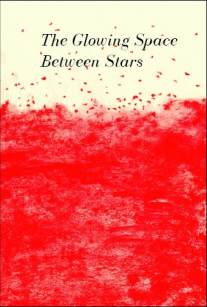
The Glowing Space Between Stars again links to the collection’s title, and underlines the idea that poetry can light up things, experiences, relations, ideas, feelings, memory. Beatrice, the cosmologist, shows how the space between things is the domain of curiosity. And for me, that feeds back into the way poetry is also curious about the gaps between. When you enter the poem gap, you enter a luminous field that so often surprises or delights or upturns.
Nina lists things in Beatrice’s childhood room; out of these things grew the adult curiosity (did anyone do this for Einstein or Newton?). She imagines the girl at 16:
then rushing home immediately
to write down what she’s seen,
noting especially
the glowing space between stars,
how it seems to have changed
since the night before.
Nina is making poems and she is making biographies, the one coming out of the other, and it is as though she is not tied to the rules of one or the rules of the other but can imagine and detour and intrude. In ‘Minutes’, the poet moves behind the galaxy facts, and the ongoing discoveries, to reveal the hiding narratives, the domestic underlay:
The light emitted by distant galaxies
takes billions of years to reach us.
It comes from a far younger universe,
somewhere where no one ever worried
about ironing their husband’s shirts
or arranging after-school childcare
because there were no ironing boards
and no children and no husbands
Five glowing booklets of poems that shine beyond the individual poems to gather a necessary and inventive, a lyrical and seismic, view of five very different women. I love this collection with its feminist energy, its poetic agility and its warm heart.
This, too, was the perfect time
to measure things in infinities.
from ‘Red (ii)’
Nina Powles, half Malasian-Chinese and half Pākehā, is from Wellington where she graduated with an MA in Creative Writing from Victoria University. There, she won the 2015 Biggs Family Prize for Poetry for Luminescent’s first draft. She writes poetry, non-fiction and makes poetry zines. Her chapbook, Girls of the Drift, was published by Seraph Press in 2014.
Seraph Press page
Nina Powles web page
Bad Things, Louise Wallace, Victoria University Press, 2017
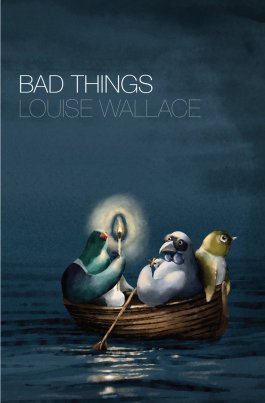
Some poetry collections depend upon a thread of similarity; connective subject matter, recurring motifs, a cohesion of form, tone and voice. Other collections resemble mosaics made of infinitely varied pieces that come together in surprising and satisfying ways. Louise Wallace’s new book, Bad Taste, exemplifies the latter. Turn the page and you have no idea what to expect – yet everything fits in the same animated package. There is a freshness and a daring at work here, because the poetry seems beholden only to its own choreography. I love that. I can’t think of another book quite like it. The cover, with the little patch of flame in the dark, and the boat waiting with its strange mix of birds, is the perfect entry into the poems.
Sometimes the poems relate little stories; condensed in prose paragraphs or strung with slashes to read in a single outbreath. Certain poems stop you in your tracks when you get to the last line and then tip you off the tracks of reading. ‘The hunt’ begins with a woman needing silence, yet it’s impossible to find when her voice rings out ‘like bells in the library’. She needs ‘to go church to pray’, but the poem does the twist and tilt and the ending becomes uneasy:
and without the silence she can’t pray / and if she doesn’t pray she will starve
Images also keep you on your reading toes: they might be strange, brightly-lit, smudged. There is, for example, a depiction of terrible things, ‘bad things’, that might fill a head:
They grow there—
a forest of tiny umbrellas.
They flourish—
a crown of terrible heads.
from ‘Bad things’
Or the sight and sound of a woman in a dump shop; ‘I’m amazed, she says’ over and over (‘Trash Palace’).
Or the sight and sound of a woman packing her husband and various assorted characters, including ‘the owner of the local chip shop’, into a row boat:
though it was extremely cramped
and they rowed
out to the open ocean
and sat quiet
and waited.
from ‘The body began to balance itself’
One poem may be densely packed and prose-like, while the next might offer short snappy lines that extend a poetic spine down the page:
resting shoulder
touching elbow
fingers to forehead
hand to cheek
from ‘Arrivals’
Strange poems, that may be hyper-real or surreal, hook with the element of surprise crouching somewhere:
7. You cannot take off the backpack.
8. You cannot just take off either.
9. You try to escape your own skin.
from ‘Right of return’
Sometimes it is a matter of taking three or four things (a man in a bus, the downhill, the light and the safety) and seeing what happens:
the light bounces
off the hill blindingly
bright and he’s saying
to himself
safety first
safety first
and he’s right, and all
through the bus
there is light.
from ‘Safety first’
Politics hue the mosaic pieces and slip in different directions, whether gender or ecological. Famous people glint the surface because their very presence is out-of-the-ordinary in the day-to-day ordinariness of what goes on. I especially like Meryl Streep, (but you also get Robert Redford and Reese Witherspoon): ‘Meryl Streep went nuts at me in the breakfast room, because I’d taken her table by mistake.’ I also like the arrival of Reeese, in ‘There are lots of ladies who have survived the desert’. The protagonist is walking in the desert, parched and desperate, when she hears wailing: ‘Reese Witherspoon emerges from behind a shrub, holding a plastic bowl full of oats and water.’ She cannot get her primus to work. Again Louise delivers the twist and tilt at the end of the poem, as though a shadow voice whispers to us to find perspective when we read of her neighbour: ‘Janet’s husband came home drunk one night and smashed a chair across her back.’
To understand the ability of the collection to travel and arc and shuffle, you need to juxtapose the offbeat with the achingly real. ‘Helping my father remember’ is the white hot searing heart of the collection. Communication is impaired: ‘Except something’s/ gone wrong with the wiring/ and he didn’t teach me/ how to fix it.’ The poem delivers such an emotional hit because of the way it lays little details alongside each other; the fact that the daughter is most like her father and his mother, and that sound might reactivate memory or that she is following him ‘through/ tall grasses, as high/ as my head.’ This time the ending is not a strange tilt but a poignant dive deeper below the poem’s surface:
We’re heading
to the river.
You find Nana,
and I’ll find you.
We won’t be lost
if we’re together.
If Louise’s new collection pulls you into a mosaic of dream, confession, anecdote or troublesome issues, it does so with a deft and darting accumulation of line. The overall effect works upon your ear, eye, heart and mind. There is stillness and movement, gaps and prickling images. I couldn’t ask for more – it’s a terrific read.
Louise Wallace is a poet and the founder and editor of The Starling, a literary journal for young NZ writers. She has published two previous collections: Since June (2009) and Enough(2013) . She was the 2015 Robert Burns Literary Fellow at Otago University.
Victoria University page
‘Reminders for December’ plus author note posted on Poetry Shelf
Louise in conversation with Pip Adam on Bad Things at Better Off Read
The Starling an online literary journal for young NZ writers
Airini Beautrais and Maria McMillan have written up their poetry road trip. I am so hoping this becomes a thing – two poet friends on tour with new books.

both Victoria University Press, 2017
We’ve known each other since the early 2000s, and both of us have been writing poetry for even longer than that. Some common threads in our work include feminism, social justice, environmentalism, and an interest in the possibilities of form. Over a cup of tea one afternoon in Maria’s lounge we agreed that as we both had books coming out this year, we should go on tour. Maria had been working hard in non-poetry related paid gigs, Airini was battling some difficult personal circumstances, and some time on the road reading with other women poets seemed like just what the doctor (of creative writing) ordered.
Somehow the tour got planned amidst the mad mess of everyday life. Sarah Laing kindly agreed to let us use her drawings for promotional purposes. Airini made a DIY poster with the help of scissors, glue, wallpaper and blu-tack. The word went out. The car got packed.
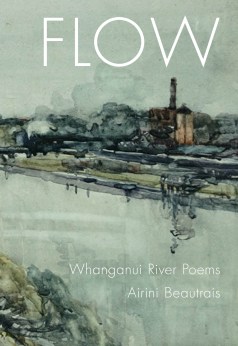
On Friday 14 July Airini held a book launch for Flow: Whanganui River Poems, at the Whanganui regional museum. Maria was the main support act on the night, reading from her recently-released The Ski Flier (Airini had also read at Maria’s launch a month earlier). Jenny Bornholdt read a poem by Joanna Margaret Paul. Other local booklovers read some favourite Whanganui-linked poems. VUP publicist and talented novelist Kirsten McDougall gave a fantastic launch speech.
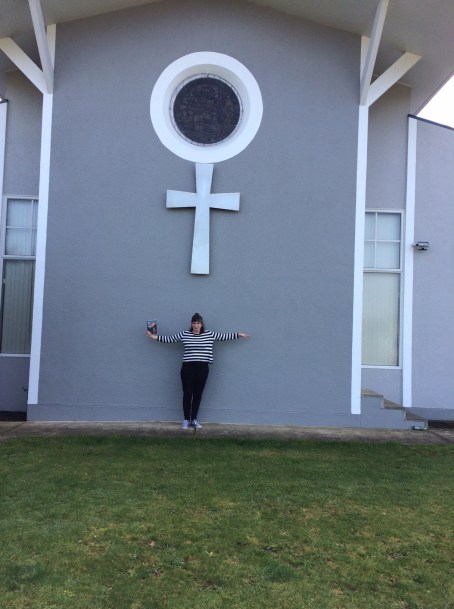
Accidental ankh, Dannevirke
In the morning it was coffee, porridge and a quick trip to Whanganui’s famous SaveMart ‘The Mill’. Then onto the back roads of the Manawatu with a battered road atlas and smartphones which were largely ignored. We made it over the Pohangina Saddle, and lunched on launch leftovers in Dannevirke, where we discovered a church with a possibly accidental (we think maybe not) ankh – a perfect opportunity for posing with our books. On to Napier where it appeared we had entered a time warp. Airini’s dirty old Honda suddenly looked new alongside the vintage cars sweeping around the waterfront, driven by flappers and dapper gentlemen. The thought occurred to us that it was Deco weekend.
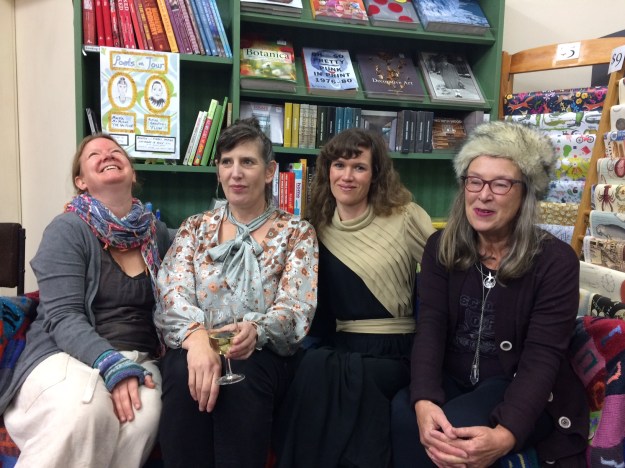
Beattie and Forbes Booksellers with Marty and Emily
Beattie and Forbes Booksellers is a must-visit independent bookstore near the sea in Napier. They opened up on a Saturday evening so we could read, with Marty Smith and Emily Dobson. Old friends and new turned up, along with members of local poetry groups. It seems that anywhere you go in New Zealand, there’ll be a poetry group of some sort, and a reading will draw at least some of them out of the woodwork. A highlight of the evening was Emily reading a poem owing a debt to her young daughter, called ‘Thea’s ‘gina song,’ which ended ‘It’s a ba-ba-ba-ba-ba-ba-BAGINA!’ Both Marty and Emily are accomplished poets and readers and it was a privilege to read alongside them.
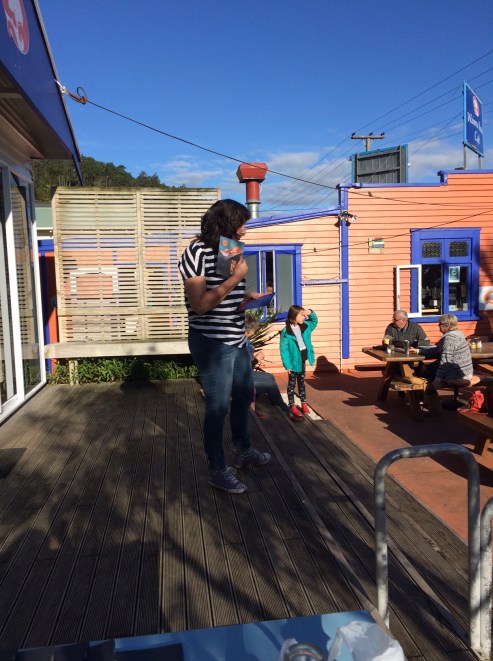
Maria at Waiomu Cafe
Sunday 16th we set off from Marty’s picturesque country house, on our big drive through to Thames. The roads had opened, but were still lined with snow. We made it to our reading at Waiomu Beach Café with five minutes to spare. The café is in a beautiful spot and draws in regulars driving around the Coromandel coastal road. It’s run by Maria’s cousin Julie, who was an amazing host. Airini also met some extended family members at the reading. More FM were there, and interviewed us. We read in the outdoor courtyard, adjusting our volume according to the passing traffic. Over the road, a cop issued speeding tickets. A kereru landed in a tree alongside. We posed for more book photos under the pohutukawa, took Julie’s dog for a walk, and enjoyed the scenery.
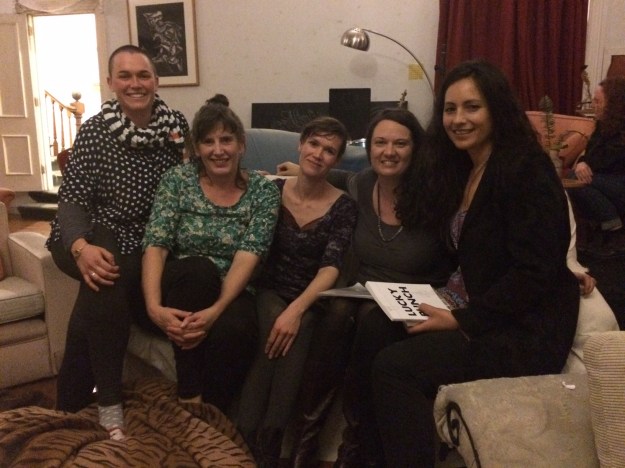
The Big House, Parnell with Tulia and Emma
Thames seems like the kind of place one could stay in forever, but on Monday morning we carried on to Auckland. We parked the car and went to hear a reading at the Auckland Art Gallery with Steve Toussaint, Simone Kaho, Elizabeth Morton, Johanna Emeney and Michael Morrissey. Everyone read well, but a disgruntled audience member booed, hissed and heckled during question time at the end. Chair Siobhan Harvey did an excellent job of shouting him down. We looked at each other and wondered if this was how poetry readings always went in Auckland. But our reading that evening at the Big House in Parnell, with Simone Kaho and Tulia Thompson, was a very warm and homely affair. Many of the house’s 25 occupants joined us by the fire to listen and talk, and housemate Emma also read some of her poems with us.
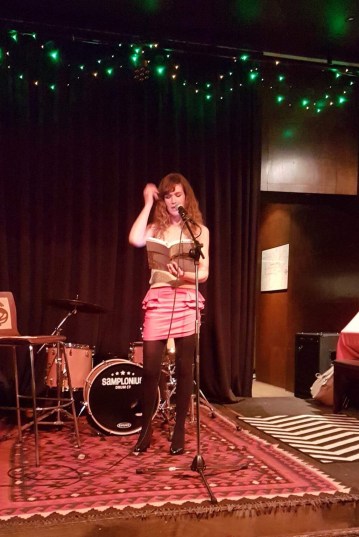
Airini at Poetry Live, Auckland
Tuesday night’s gig was Poetry Live, at the Thirsty Dog on K Road. Like the Big House, Poetry Live is an institution that’s been going for decades. We were lucky to be there for the farewell to regular MC Kiri Piahana-Wong. There was a great turnout and the venue and audience were friendly and welcoming. We read by turns in our guest poet slot, feeling like proper rockstars against the backdrop of a drum kit and stage lighting.
By Wednesday we were tired, and ready to head home. We stopped for tea and toasted sandwiches in the Pink Cadillac diner in Turangi. We parted ways at the Desert Road, after which Maria had some variable hitchhiking experiences, and Airini zig-zagged back and forth around the mountains navigating road closures. We’d had a great time and were looking forward to the second leg.
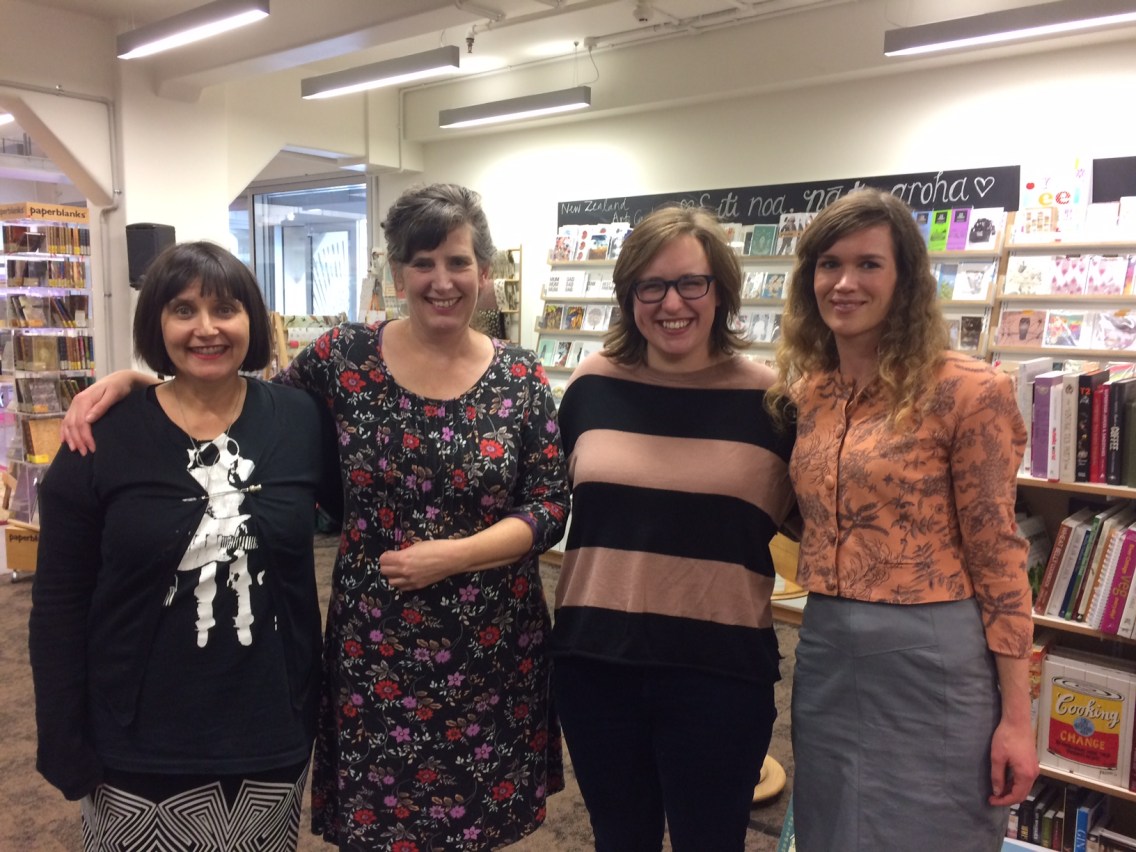
Vic Books in Wellington with Pip and Freya
The next leg kicked off on Friday 28 July with a lunchtime reading at Vic Books. We were joined by superstars Pip Adam, reading from her brand spanking new The New Animals, and Freya Daly Sadgrove, whose poetry is performative and highly entertaining. Maria read her poem, inspired by Pip, ‘In which I attain unimaginable greatness,’ in which the narrator attains superhero powers, achieves amazing feats, and at the end declares ‘This is how I begin. This is my first day.’
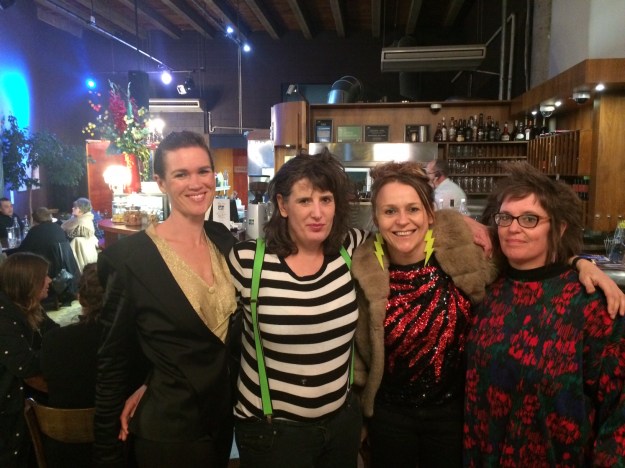
Palmerston North with Helen and Jo
Palmerston North City Library on Saturday evening was possibly the highlight of the tour. The library is a great place to read, hosting numerous literary events throughout the year. The big windows feature poems by local Leonel Alvarado, and pedestrians have a way of peering in through the letters, wondering what’s going on in there. We’d decided on a dress up theme of ‘80s trash with our fabulous co-readers Helen Lehndorf and Jo Aitchison, which got us some funny looks in New World, but definitely improved our performances. Helen’s hair was particularly spectacular. We had a small crowd but a great vibe. A kebab and whisky party kept us awake until the wee small hours.
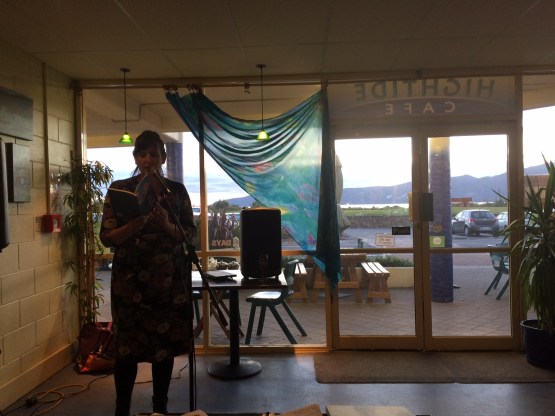
Maria at Hightide Cafe
Helen’s chickens laid us our breakfast, and we revived ourselves with bottomless pots of tea. Maria’s superpowers became evident when she managed to drive us safely to our last gig, Poets to the People at Hightide Café in Paraparaumu. The sun was setting over Kāpiti as we drank coffee and listened to the open mike. Again, this is an event that’s been running for years, and there’s a sense the regulars know and love one another. We went home to a beautiful roast cooked by Maria’s partner Joe. The tour was over, but the fight continues! We had some great conversations in the car over those two weeks, and some good catch-ups with family and friends along the way. There was a lot of fighting talk, a lot of laughter and also a few tears. A big part of the tour was affirming ourselves as poets, mothers and radical women, and by the end of it, our unimaginable greatness was hard to deny.
Airini Beautrais and Maria McMillan, September 2017
my conversation with Airini
my review of The Ski Flier
VUP page for Airini
VUP page for Maria

Victoria University Press warmly invites you to the launch of
James Brown’s brand new poetry collection
Floods Another Chamber
on Wednesday 4 October, 6pm–7.30pm
at The Guest Room, Southern Cross Garden Bar,
39 Abel Smith St, Te Aro.
Greg O’Brien will launch Floods Another Chamber
Books will be for sale courtesy of Unity Books.
p/b, $25
About Floods Another Chamber
Going West is a festival that devotes itself 100 per cent to showcasing an eclectic range of New Zealand writers: local, ultra-local (Westies), from out of Auckland. It draws upon fiction, poetry and nonficton and never fails to delight.
Due to the fire in the roof of Titirangi hall the festival moved into the beautiful ex Waitakere council chambers – better parking, not so far to drive for me, excellent green room, cosy space for sessions but I missed the hall and the bush and the village. As a temporary last minute venue – which must have been such stress on the team – it worked just fine.
As usual the food and shared conversations were excellent. Usually I go the whole weekend – but this year, just the Friday night and Saturday was possible. It means I sadly miss out on a suite of sessions today.
On Friday night we got to see our new Poet Laureate, Selina Tusitala Marsh in performance and, just as she sparks the poetic hearts of students in South Auckland (and elsewhere), she sparked the poetic hearts of festival goers. She delivered her Laureate ‘thank you’ speech again, a speech which acknowledges the people that have supported her, in the form of a list poem. She read her poem for the Queen with generous anecdotes to accompany it along with the revenge poem (he who shall not be named did not shake her hand), and the poem on three Queens, the last being Alice Walker.
The tokotoko was passed round for everyone to touch and imbue the stick with individual mana. Skin prickling for so many of us.
Every New Zealand Poet Laureate has gifted something to poetry fans. Selina, one of our beloved poetry icons, with the charisma of Sam Hunt, Hone Tuwhare and Glenn Colquhoun, is one of the most important Laureate choices to date. Those of us lucky enough to hear her on Friday night, will know just what treasures we have in store. It matters, as she says, that she is a brown face. It matters to every brown poet, every fledgling brown poet, and every student white and brown, who has yet to discover the liberating power of poetry.
It matters because Selina’s poetry shows how words can make music in the air, build vital connections to heart and mind, and challenge how we view the world.
If you get a chance to see her over the next few years – take it!
In a perfect and unplanned arc, Bill Manhire, our first Poet Laureate, and another beloved poetry icon, was part of the final session of the night. With jazz musician Norman Meehan, vocalist Hannah Griffin and Blair Latham on sax, we got to hear tracks from their new collaboration: Small Holes in the Silence. I have heard them before but the magic intensifies if anything on a subsequent hearing. The alchemy of word, musical score and manuka-honey voice is simply exquisite. It is absolutely breathtaking.
The next day, in our session, I described how listening to their new album/book, Tell Me My Name, is like a flotation aid. You listen and you lift above domestic routine, chores, head clutter. So yes, I floated home, adrift still in the after-effects.
Saturday was a long day, a good day. I had only managed a few hours sleep for various reasons so felt like I was in between here and there, wwhich is the theme of the festival. On the way I passed so many ALTERNAT ROUTE signs I wondered if I would find my way home through all the detours that might then be in place. I felt like I was entering a found-poem trap and I would get stuck in it.
Sitting on stage with Bill and Norman for our session was a bit like sitting in a cafe – I wanted Norman to hit the keyboard and play melodies here and there. I loved the idea of him playing something while we listened to see what word score unfolded in our heads. The inverse of Norman taking Bill’s poem and seeing what melody surfaces. It was fun to talk – people just happened to be listening!
Sadly I missed Diana Witchel and Steve Braunias – but I am going to make up for that and read the book: Driving to Treblinka. The audience loved this session.
I did hear Dame Anne Salmond in conversation with Moana Maniapoto and it was for many of us, an extraordinary thing. The conversation just flowed – it felt unafraid of anything: wisdom, human warmth, tough stuff, vulnerabilities, empathy.
In 1960 Anne met Māori and asked herself: ‘How come I’ve grown up in this country and know nothing about these people and this world?’
Eruera Stirling advised her: ‘If you are really interested in Māori Studies then the marae is the university for you.’
Anne: ‘I am a scholar but there’s a lot of stuff you can’t learn with your mind – you have to learn through your skin.’
Anne: doesn’t necessarily agree with the idea of one world with different views but prefers perhaps the idea of a ‘mulitverse with different realities.’
Anne: ‘You can’t be an expert on the Treaty if you can’t speak Māori.’ She said it would be like someone who couldn’t speak French acting as an expert on the French constitution.
Anne: ‘If the river is dying I am too.’
This is why I am both a reader and writer and a festival attendee. Because someone like Anne in conversation with someone like Moana can blast apart my thinking and feeling.
I have a copy of Tears of Rangi by my bed to read.
I got to hear Sarah Laing and Johanna Emeney read and talk. I have to say I love both the books (Mansfield and Me and Family History) and have written about both. I love the way they showed that poetry/memoir does not need to stick to facts (Airini Beautrais said the same thing in her interview with me). The gold of this session was hearing the multi-talented Sarah read an extract with an enviable array of accents. Wow!
Loved hearing tastes of Pip Adams and Kirsten McDougall’s new novels – and the way the unreal can unravel the real in such innovative ways. They worked double hard not to spoil the reading experience, for those of us who still have the treat in store, by giving too much away. Just little tempting clues.
Loved hearing the very articulate Linda Cassells talk about the genesis of the Allen Curnow biography she edited after the death of her husband, Terry Sturm, and the way Bill Manhire stepped into the gap, with CK Stead ill, read us a few poems, and shared a few anecdotes.
Thanks Going West. This was one very good festival – I was delighted to participate as both reader and writer.
 NZ Poetry Shelf