Category Archives: NZ poetry

Poetry Shelf review: Courtney Sina Meredith’s Burst Kisses on the Actual Wind

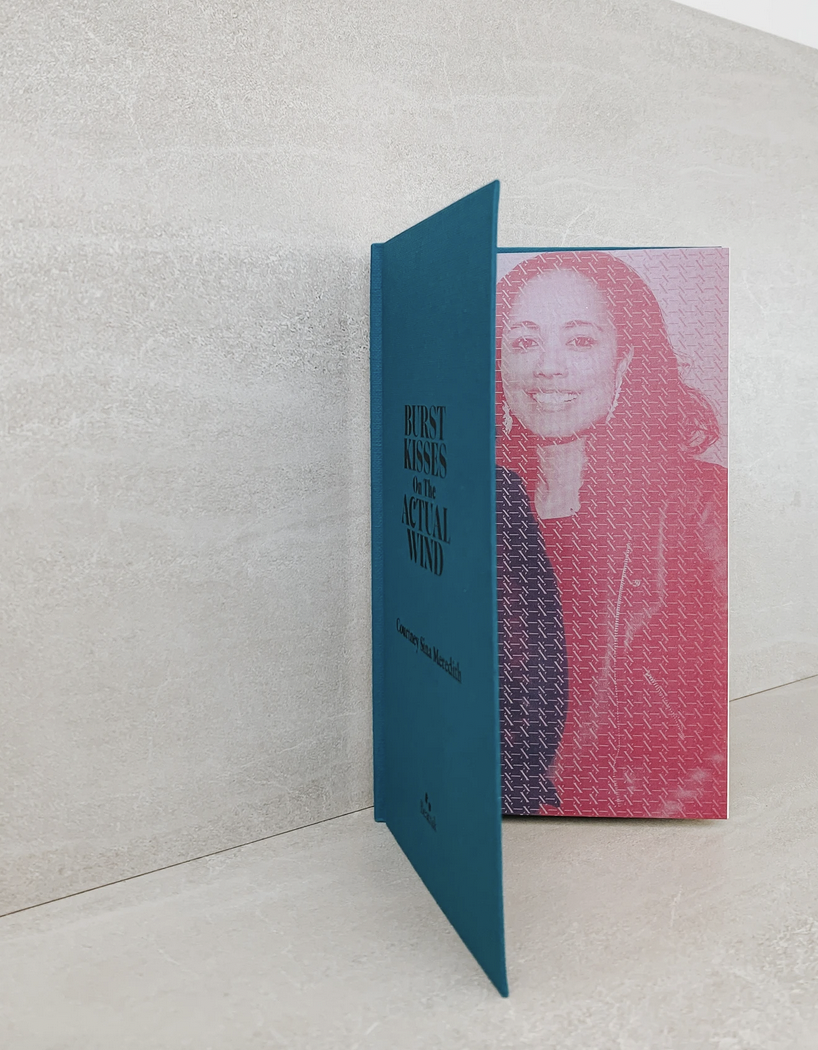
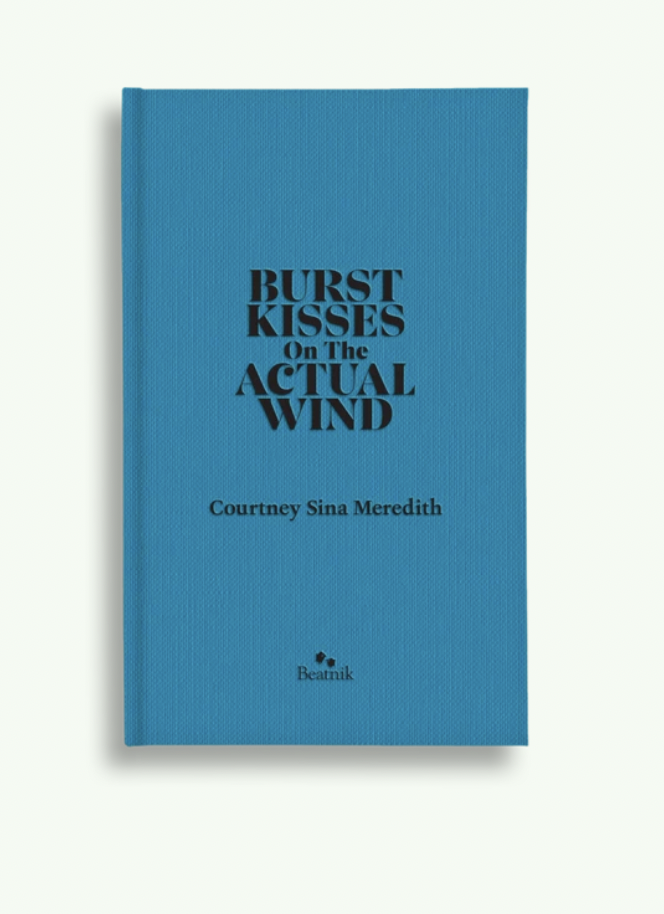
Burst Kisses on the Actual Wind, Courtney Sina Meredith, Beatnik Books, 2021

Courtney Sina Meredith’s mother, poet Kim Meredith, has edited Courtney’s new collection and has written a moving introduction. I love this. And I love the gratitude list at the back, where thanks is offered to her editor, publisher, true love, village and children. It infuses the book with love.

This is a book of love.

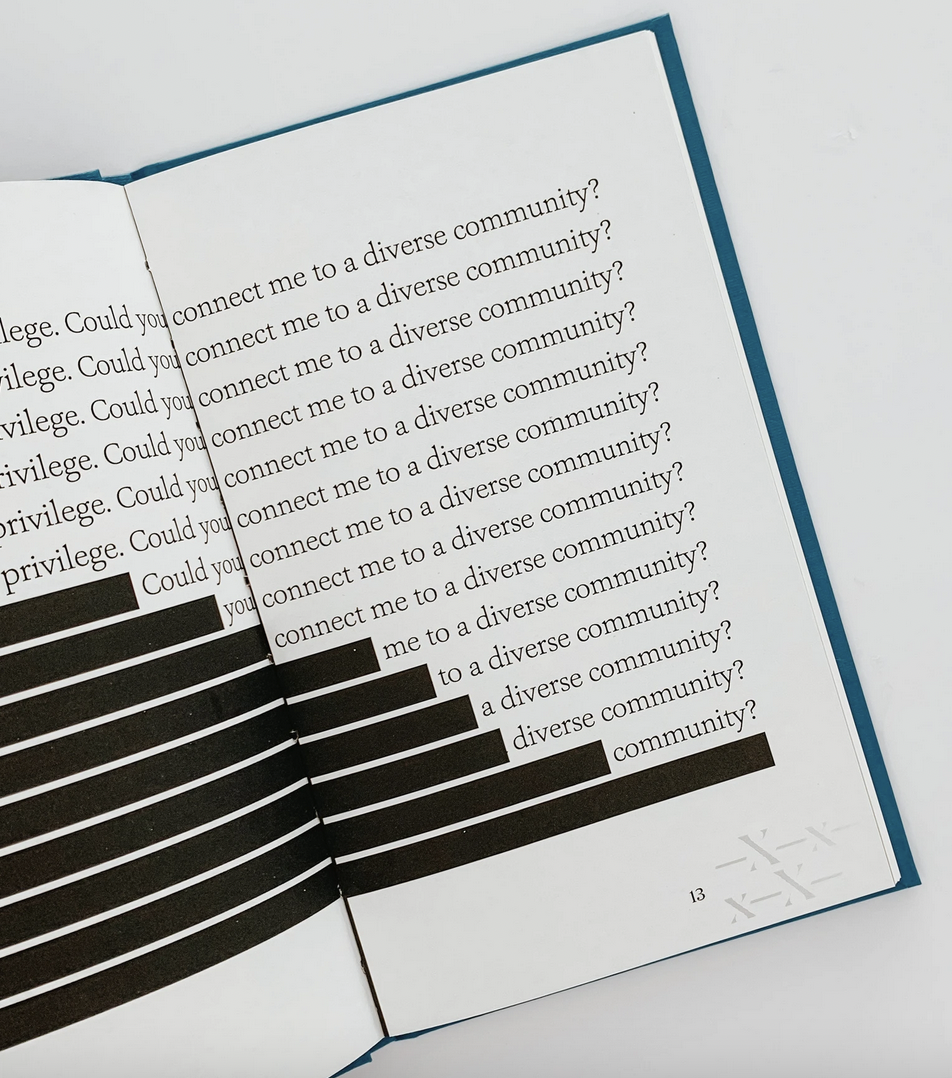
The opening poem is like a staircase, with the opening line (‘I am aware of my privilege. Could you connect me to my community?’) dropping a word, one by one, to become ‘community’. For me this collection is the incandescent, life-affirming bridge between ‘I’ and ‘community’.

And if the collection is a poem bridge, it is built with diverse material, every time you shift your eye it shifts form, becomes visually distinct. The love and themes that hold the collection together are a constant; think love, travel, dailiness, mother, daughter, lover. Self and community. I adore this fluctuation between constancy and a mobility of form. The mind and heart go flying. The mind and heart are grounded.

This is a book of self.

One poem resembles a vessel, a mouth, a self container. The opening and closing lines (‘How about being a woman?’) move, one extra word at a time, to the fullness of the middle line (‘How about being a young brown queer single educated professional creative woman?’). It is a song, a chant, a plea, a mantra. It resonates thorough the connection as a whole.

A second poem, ‘eye’, removes the letter ‘i’, and enacts missing self, elusiveness, restless, regret, arrival, departure. The peppery gaps are signposting the vagabond ‘I’, so full of possibilities.

This is a book of travel.

Foreign cities, physical travel away from home, charting the distractions and attractions of elsewhere (New York, London, Mexico City, Iowa, maybe Chicago). Yet the travel is also internal, inscribing the pathways home, to an interior home. Coming home to self. Poetry is most definitely a sublime means of travel.

This is a book of the matter of fact and this is a book of the intensely moving.

I made a big curry for all of my friends.
One of them gave me Twenty Love Poems and a Song of
Despair.

My cousin went to see another friend at a bar. A guy
asked them for a threesome. They said no.

I read about Nelson when everybody left.


from ‘Aso fanau’

I have stolen away into the secret room

mothers build inside their daughters

I am feeding on a dowry centuries old

the bones sucked dry

a feast of bright quiet.


My mother’s dreams are here

beside the red gold river

born of shame and laughter

the shifting bank won’t hold.


from ‘I have stolen away into the secret room’


Courtney’s poetry is so lovingly crafted, the silence as potent as the kinetic line, the evocation of the physical, the need to feel the word and the day and the vital connections. In Burst Kisses on the Actual Wind, the poems open out, gloriously, and as readers we are invited to step in. My only misgiving is the smaller font is a challenge for the visually impaired. But this is a joy to read. A beautiful object thanks to Beatnik. In the final poem, ‘Avondale Heights’, the poet is home, and in the final line, ‘The horizon is vast’, the possibilities of life stretch wide. And that includes poetry. Sublime.

Courtney Sina Meredith is a distinguished poet, playwright, fiction writer, performer, children’s author and essayist, with her works being translated and published around the world. A leading figure in the New Zealand arts sector, Courtney is the Director of Tautai Contemporary Pacific Arts Trust, an organisation committed to championing Oceanic arts and artists. Courtney’s award-winning works include her play Rushing Dolls, poetry Brown Girls in Bright Red Lipstick, short stories Tail of the Taniwha and children’s book The Adventures of Tupaia. Burst Kisses On The Actual Wind is Courtney’s new collection of poetry, the book was released in 2021 by Beatnik Books. 

Beatnik Books page

Courtney reads from Burnt Kisses on the Wind

Poetry Shelf Monday poem: Tony Beyer’s ‘Gardening Shoes’

Gardening shoes

since I gave up on black leather boots

years ago the best I’ve had

are a retired pair of New Balance trainers

already split sideways at the toes

for maximum comfort or drainage

my aim is that they will see me out

if not of terrestrial being

at least out of gardening

with which I’ve endured a lifelong

ambivalent relationship

I like digging turning planting

though repetitious weeding

thinning watering too easily bore me

but then as I’m often reminded

I also like eating

in the meantime (make it

a long time) this familiar disorderly

footwear sorts with my

amateur endeavours as the spade

fits my hand and my hand the spade

Tony Beyer

Tony Beyer is working on new poems in Taranaki. His print titles include Anchor Stone (2017) and Friday Prayers (2019), both from Cold Hub Press. 

Poetry Shelf Theme Season: Eighteen poems about love

Ah. Love is my final theme. My seventeenth gathering. I chose love because love is the ink in my pen, it drives the pencil filling my notebooks. It’s the reason I keep two blogs running when, at times, it seems impossible. There is the love of reading and writing stretching back to childhood. Love poetry can embrace many subjects, moods, objects, experiences, relationships. So many poetry books in Aotearoa are steeped in love. In what is written and, just as importantly, in the infectious love poets feel for the power of words. For the possibility of the line, silence, music, physical detail. As readers, writers, publishers, reviewers, booksellers of poetry, we are connected through a shared and invigorating love of poetry. Ah.

To celebrate the end of my theme season I have ten copies of Wild Honey: Reading New Zealand Women’s Poetry to give away. I will sign one for you or for a friend. You can leave a comment on the blog, on FB or Twitter: Which theme resonated for you? What theme do you suggest if I should ever do this again? Or just email me if you have my address.

Grateful thanks and aroha to all the poets, publishers and readers who have supported my season of themes. I so loved doing this!

The poems

Poem

So far
it has worked
by imagining you
in all the places I would
like you to be

*

this is the one I love.
he is not here
but the air is still warm
from where he
might have been

*

we have spent hours
circling each other
with words-thinly
vowelled embraces

*

how to translate these
words into silences
or the silences
into words

*

when I cannot fix you
behind my eyes
I carry your absence
like stars
on the blue roof

Jenny Bornholdt

from Selected Poems, Victoria University Press, 2016

Catch

Two sitting at a table
two at a table sitting
two and two
a table in the grass
in the grass a table
and on the table
empty almost with a little
a little empty almost but
with a little water
there sits a jar for love
on the table a jar for love
not a fresh jar every day
fresh every day
nothing in the jar that lasts
always fresh they are sitting
sitting at the table
looking they are looking
at the jar at the table
at each other they are
sitting looking sitting
at the table at the jar
looking looking sitting
now is nearly the day
the day is nearly now now
go to sleep go to love
go to jar go to look
look looking look
sit sitting catch that catch
two sitting at a table
two at table sitting
two and two and two
a table in the grass

Murray Edmond

from Fool Moon, Auckland University Press, 2004

Because of you

(for Darae)

My Son,

in you I see the shape of the heart
all poets try to explain

you, the greatest poem
I could never pen

how blessed I am
to mother a son
to exercise hope and love
when everything else is absent

Son,
your are a gift to men
because of you
I pray for men
still love men
hold hope for me,
for you.


Grace Iwashita-Taylor

from Full Broken Bloom, Ala Press, 2017

The wind has shaken everything out of the quince tree.
Behold the bony gullets of fledglings
as yellow as the towers of rock that arise in Wyoming.
‘Stop blocking the gangway,’ the old woman
used to say, cutting away long roils
of yellow clay with her spade, hell bent on re-configuring
a brand new version of genetically modified
melancholy. ‘Never forget how the old ones
arrived from Dubh Linn, the Place of the Dark Pool,
formed from the union of the River Liffey
and the River Poddle. Never forget
that we are arisen from a line of proud people.’
And here I am, holding onto my end of the string
and I know, my love, that you are holding onto the other.     

Bernadette Hall

Aroha Mai

Aroha mai
I was trying to get to you
but the wind kept changing direction

Aroha atu
she hates it when institutions use Te Reo in their signatures
she hates it when my wet hair drips all over the bedsheets

Aroha mai
I couldn’t see you this time
I was down a rabbit hole
along the coast beside the point

Aroha atu
love given love received
there isn’t enough room in this house to house our love
the brick square flat beneath a rectangle sky

Aroha mai
your baby finally came
the angels found your address submerged in yesterday’s current
and she’s clapping in every photo

Aroha atu
my feet don’t touch the ground these days
take the stairs to stay fit
I keep my car full of gas
it is easy to recycle the past 

Aroha mai
my ghost is in town
and I don’t know if I should email her back

Aroha atu
already the skeleton wings of this year are casting long shadows
we don’t know what’s for dinner but next door’s
Tui keeps singing all the buried bones to life

and you’re opening every can of beans in the cupboard
to feed the tired warrior in my arms 

Courtney Sina Meredith

from Burnt Kisses on the Actual Wind, Beatnik Publishing, 2021

Helping my father remember

My father
is in the business
of transmissions.
A radio technician,
the basic premise being
that a message is sent out,
then received. Except something’s
gone wrong with the wiring,
and he didn’t teach me
how to fix it. I see him, standing
at the kitchen bench,
his hand hovering
over an orange and paring knife;
trying to think
what he had planned.

*

There is evidence that sound
helps restore memory:
the sound
of a cricket ball colliding
with tin fence; lemonade
meeting beer
in a shandy;
sticks smouldering
in the air, when pulled
from a camp fire.
The doctor says
depression, my sister says
stress, my father says
stop being
so bloody dramatic.

*

They say
I am the most like you,
and that we
are like your mother.
I am following you through
tall grasses, as high
as my head. You’re in
your angling gear.
It’s summer, I can hear
the cicadas.
There’s a wind up,
but its warm.
We’re heading
to the river.
You find Nana,
and I’ll find you.
We won’t be lost
if we’re together.

Louise Wallace

from Bad Things, Victoria University Press, 2017

The love poem

I haven’t read a single
new book since I’ve been
with you. I’ve been so busy
peering into your eyes
where I can see dark
passages & feinting
canaries & gold &
mine
mine
mine
mine

Plus I’ve been preoccupied
with the joy of sex
the science of living
the interpretation of dreams
& my undiscovered self.

So today I read
a love poem.

But when I looked
at it, it just said
your name.

It was very repetitive.
It just kept skipping
over itself. Skipping
to the important bits.
Slipping into something
more comfortable.

I looked away for a second
& when I looked back the
love poem had filled the
whole room. It was thrusting
against the ceiling & had
burst through the open window
pushing the vase of sunflowers
right out.

I tried to call to you to come
& look but the love poem
was so big that it caught
in my throat. There were fainting
canaries everywhere like the
fallen petals of sunflowers
gasping
yours
yours
yours
yours

Hannah Mettner

from Fully Clothed and So Forgetful, Victoria University Press, 2017

Strummer Summer

All that summer we kissed outside 
because we had nowhere inside 
to be alone. We had matching Clash t-shirts
and black outlooks. After my shifts 
at Seafood Sam’s I would pick you up 
in my Dad’s ute and we’d drive to the river

so I could swim off the chip grease. I’d 
light a fire while you showed me the riffs
you’d learned that day on your unplugged
Fender. /I’ve been beat up, I’ve been thrown out,/
/But I’m not down, No I’m not down./
 I requested 
Blondie but you said it was chick-music. 

Poking the fire with a stick, the tinny twang 
of your dead strings. We thought we had it 
pretty bad. Your Dad didn’t like me because
I was “the wrong flavour”. I craved city life. 
Packed my army bag and left home, but not before 
I withdrew half my chip money and bought you an amp.

Helen Lehndorf

from The Comforter, Seraph Press, 2011

The library


The library is full of people looking for love. At the
sound of footsteps approaching, a boy turns around with
a meaningful glance, and casually slips a pencil behind his
ear. Girls pause on the landings, clutching armfuls of books
to their breasts. Sometimes, you feel sorry for these people.
You wish this wasn’t happening. All you want is a book,
and all the shelves are filled with eyes of longing.

Airini Beautrais

from Secret Heart, Victoria University Press, 2006

Always on Waking

Always, on waking, I look out into treetops:
I lie beside you in the shimmering room
Where, whether summer morning, shell of dawn
Or dazed moonlight patterns leaves on walls
I wake to wide sky and the movement of treetops.

As the leaves flicker (thin scimitars of opaque
Dull green the eucalyptus bundles over her bark strips)
They become lucent; leaves lined with sunlight
With moonlight are no longer drab
But seem scimitars shining, are not now opaque.


While you are there I am nested among leaves;
As sparrows come each morning for breadcrumbs
So I look for your still face beside me;
Without your calm in the face of what wild storm
I am no longer nested, but desolate among these leaves.

Ruth France

from No Traveller Returns: The poems of Ruth France, Cold Hub Press, 2020

Honey

It was manuka honey, the best kind,
in a big, white plastic bucket, given to you
by someone with bees, because you’d been helpful,
so much honey, it looked like it might last a lifetime
and you being you, and maybe why I love you,
you spooned it out into carefully washed jars
and gave it to your uncle, your mother, your brothers,
our friend with the little boy, your mother’s neighbour
who had the birthday, so much honey, and after
all that you gave away, there was still so much left for us.

Janis Freegard

from Meowing Part 1 (the Meow Gurrrls zine).

Is It Hard to Follow Your Heart When You Have Three?

(on the story of the giant octopus from Aelian’s De Natura Animalium)

is it hard to follow your heart when you have three?

one for circulation
two for breathing

i am the stone jar of pickled fish
you are the giant octopus

i wait in the dark for you
you crawl up the sewer for me

we cast our votes
two are for breathing

Claudia Jardine

from The Starling 9

Toikupu aroha 1

I waited all night for you to come home
to plant kihikihi into your cupped palms

now as you sleep I glide my fingers
memorising the tracks that led me here

to this chest – arms – manawa
with such vastness and proximity

I lean down taking in the entirety
of your pulse and there my hā quickens

above lifelines grooved
with spacious and honest certainty.

Iona Winter

from Gaps in the Light, Ad Hoc Fiction, 2021

For Baukis

There are four extant poems written by the ancient Greek poet Erinna. Three of these concern the death of her childhood friend, Baukis.

you lost her, didn’t you?
the one that made it worthwhile
to be underneath the sun and breathing

you remembered her, didn’t you?
the days you played 
chasing the tortoise topsy turvy,
falling from all the white horses

you missed her, didn’t you?
when marriage came like a thief
and snatched her away 
the ribbon of your world

you mourned her, didn’t you?
when the ribbon was torn
the bright eyes empty,
the breath stilled

you cried for her, didn’t you?
raw, with it heaving out 
the wet thick language 
of snot and tears

you loved her, didn’t you?
even more than a friend, 
the closest companion 
the only one

you wrote for her, didn’t you?
wove her memory through hexameters 
to stave off oblivion 

and, now, 
for her
we read.

Hebe Kearney

When the Person You Love Leaves You in the Night


When the person you love leaves you in the night, it is only natural to get out of bed and follow them. It is also only natural for your pyjamas to be all crumpled and your hair sticking up at the back. It is only natural to feel confused, and alone.

Nine times out of ten, a light will be on and you will walk into the living room, squinting. The person you love will probably be making human body parts out of plasticine, or playing video games. They will look up and say ‘Hello’ and smile at you like you’re some kind of lost baby animal. You will feel a little bit found.

If there is no light on in the house, it is important that you check the garden. If there is no garden, check the balcony. The person you love will be out there, staring at the moon and not crying. You are the one who cries. Except that one time… and the other. Don’t ask them if they’re okay because they will just say ‘Yeah’. Besides, you are the one who was left alone in the night.

Just look at them in the moonlight, and let them look at you. Stay very still. Then take their hand in slow motion and walk to the kitchen. The person you love will follow you, and so will the moon. Pour some milk into a pan and simmer gently. You will see a quivering white circle. The moon will be in there somewhere. Slice cheese onto bread and turn on the grill.

When you have two pieces of cheese-on-toast, put them on a plate. Pour half the milk into the mug with Peter Rabbit on it and half into the souvenir mug from Sweden. There will be sugar on the floor and it will stick to your feet. Swing yourself up onto the kitchen bench. You and the person you love will sit with your feet dangling side by side. The sugar will fall without a sound. You will drink your milk. The person you love will eat their grilled cheese, with sips of milk in-between. Peter Rabbit will eat his radishes.

Congratulate yourselves for drinking calcium. Sit at opposite ends of the couch with your legs tossed over their legs. Talk until you wake up the birds.

It is important that at some point during the night the person you love reminds you that you are the person they love. It is also important that they thank you for the grilled cheese. If they don’t, give them a pen and a piece of cardboard. Drop them on the side of the road. Tell them, ‘You can hitchhike from here.’

Joy Holley

from Starling 4

Love Poem with Seagull

I wish I’d seen it from your side of the table
when the horrid gull attacked my fish and chips,
the springy baton of haddock in my hand
a signal for the post-saurian psycho
to swoop at my talon-less fingers as they moved toward my mouth
in their classically dithering mammalian way,
because if I’d had the privilege to see
the stress-warped, flexuous face behind
my bat-like ultrasonic shrieks of shock
as I fought off the bird unsuccessfully
then I’d have some idea of what it means
for you to love me, the sort of person who manages
to always look like this or feel like this
regardless of how much easier being normal is.

Erik Kennedy

from There’s No Place Like the Internet in Springtime, Victoria University Press, 2018

Found Again

our love is a tracking device
more sure than any global
positioning system

just carve us into wooden tablets
then imprint us on opposite corners
of a mighty length of siapo
and watch tusili’i spring forth

making bridges to connect us
over rock-bound starfish
scampering centipedes and
the footprints of bemused birds

we have many stories of
losing and finding each orther

of getting lost
and losing others

but today all is well

I lie beneath the old mango tree
smothered with coconut oil
embellished with wild flowers
and droplets of your sweat

your aging shoulders
still fling back proud

and I still arch towards you
like a young sweetheart

you have whispered in my hair

found again

and we both know
this is our final harbour

Serie Barford

from Tapa Talk, Huia Press, 2007

Everything

This morning when I looked out my window
they were the first thing I noticed.
I saw them flocking outside my house.
I like to look at them from my window.
I get the sun there. I’ll go out and stroke them.
I wonder what they think of me.
Some people don’t have anything much
but if you put a hen on their knee they start looking.
I’m not fast on my feet. I have bother with my eyes.
I’ve got friends that can’t get out.
Everything goes downhill.
I would go back to when I was younger.
I love the first things.
When you’re young you’ve only a future.
I’ve made no plans for dying. I haven’t paid for anything.
I’d be terrified if they made a mistake.
I do love everything about living though.
I love being able to see.
I like to look out my windows and see the leaves
like a blanket on the ground. I love the autumn.
I love the hens in the autumn.
They’re beautiful.
I couldn’t imagine my life without them.
They’re everything to me.

Ashleigh Young

from How I get Ready, Victoria University Press, 2019

The poets

Serie Barford was born in Aotearoa to a German-Samoan mother and a Palagi father. She was the recipient of a 2018 Pasifika Residency at the Michael King Writers’ Centre. Serie promoted her collections Tapa Talk and Entangled Islands at the 2019 International Arsenal Book Festival in Kiev.  She collaborated with filmmaker Anna Marbrook to produce a short film, Te Ara Kanohi, for Going West 2021. Her latest poetry collection, Sleeping With Stones, will be launched during Matariki 2021.

Airini Beautrais lives in Whanganui and is the author of four poetry collections and a collection of short fiction. Her most recent poetry collection is Flow: Whanganui River Poems (VUP 2017). Bug Week and Other Stories recently won the Ockham NZ Book Fiction Award 2021.

Jenny Bornholdt is the author of many celebrated collections of poems, including The Rocky Shore (Montana New Zealand Book Award for Poetry, 2009) and Selected Poems (2016), and editor of several notable anthologies, including Short Poems of New Zealand (2018). In 2005 she became the fifth Te Mata Estate Poet Laureate, during which time she wrote Mrs Winter’s Jump (2007). In 2010 she was the Creative New Zealand Victoria University Writer in Residence. In 2013 she was appointed a Member of the New Zealand Order of Merit for services to literature. In 2016 she edited the online anthology Ōrongohau | Best New Zealand Poems. Jenny’s most recent collection is Lost and Somewhere Else (2019). 

Murray Edmond, b. Kirikiriroa 1949, lives in Glen Eden. 14 books of poetry (Shaggy Magpie Songs, 2015, and Back Before You Know, 2019 most recent); book of novellas (Strait Men and Other Tales, 2015); Then It Was Now Again: Selected Critical Writing (2014); editor, Ka Mate Ka Ora (http://www.nzepc.auckland.ac.nz/kmko/);  dramaturge for Indian Ink Theatre. Forthcoming: Time to Make a Song and Dance: Cultural Revolt in Auckland in the 1960s, from Atuanui Press in May, 2021.

Ruth France (1913–68) published two novels: The Race (1958), which won the New Zealand Literary Fund’s Award for Achievement, and Ice Cold River (1961); and two volumes of poetry: Unwilling Pilgrim (1955) and The Halting Place (1961), under the pseudonym Paul Henderson. Poems from a third collection, which remained in manuscript at the time of her death, are published as No Traveller Returns: The Selected poems of Ruth France (Cold Hub Press, 2020).

Janis Freegard is the author of several poetry collections, most recently Reading the Signs (The Cuba Press), and a novel, The Year of Falling. She lives in Wellington. website 

Bernadette Hall lives in the Hurunui, North Canterbury. She retired from high-school teaching in 2005 in order to embrace a writing life. Fancy Dancing is her eleventh collection of poetry (VUP, 2020). In 2015 she was awarded the Prime Minister’s Award for literary achievement in poetry and in 2017 she was made a Member of the New Zealand Order of Merit for services to literature in Aotearoa New Zealand.

Joy Holley lives in Wellington and has recently completed her Masters in fiction at the International Institute of Modern Letters. Her writing has been published in Starling, Sport, Stasis and other journals.

Claudia Jardine (she/her) is a poet and musician based in Ōtautahi/Christchurch. In 2020 she published her first chapbook, The Temple of Your Girl, with Auckland University Press in AUP New Poets 7 alongside Rhys Feeney and Ria Masae. For the winter of 2021 Jardine will be one of the Arts Four Creative Residents in The Arts Centre Te Matatiki Toi Ora, where she will be working on a collection of poems.

Hebe Kearney is a queer poet who lives in Tāmaki Makaurau. Their work has appeared in The Three Lamps, Starling, Oscen, Forest and Bird, a fine line, and Poetry New Zealand Yearbook 2021.

Erik Kennedy is the author of There’s No Place Like the Internet in Springtime (Victoria University Press, 2018), and he is co-editing a book of climate change poetry from Aotearoa New Zealand and the Pacific forthcoming from Auckland University Press later in 2021. His second book of poems is due out in 2022. His poems, stories, and criticism have been published in places like FENCEHobartMaudlin HousePoetryPoetry Ireland Review, the TLS, and Western Humanities Review. Originally from New Jersey, he lives in Christchurch, New Zealand.

Helen Lehndorf’s book, The Comforter, made the New Zealand Listener’s ‘Best 100 Books of 2012′ list. Her second book, Write to the Centre, is a nonfiction book about the practice of keeping a journal. She writes poetry and non-fiction, and has been published in Sport, Landfall, JAAM, and many other publications and anthologies. Recently, she co-created an performance piece The 4410 to the 4412 for the Papaoiea Festival of the Arts with fellow Manawatū writers Maroly Krasner and Charlie Pearson. A conversation between the artists and Pip Adam can be heard on the Better Off Read podcast here

Courtney Sina Meredith is a distinguished poet, playwright, fiction writer, performer, children’s author and essayist, with her works being translated and published around the world. A leading figure in the New Zealand arts sector, Courtney is the Director of Tautai Contemporary Pacific Arts Trust, an organisation committed to championing Oceanic arts and artists. Courtney’s award-winning works include her play Rushing Dolls, poetry Brown Girls in Bright Red Lipstick, short stories Tail of the Taniwha and children’s book The Adventures of Tupaia. Burst Kisses On The Actual Wind is Courtney’s new collection of poetry, the book was released just this month. 

Hannah Mettner (she/her) is a Wellington writer who still calls Tairāwhiti home. Her first collection of poetry, Fully Clothed and So Forgetful, was published by Victoria University Press in 2017, and won the Jessie Mackay Award for best first book of poetry at the 2018 Ockham New Zealand Book Awards. She is one of the founding editors of the online journal Sweet Mammalian, with Sugar Magnolia Wilson and Morgan Bach.

Grace Iwashita-Taylor, breathing bloodlines of Samoa, England and Japan. An artist of upu/words led her to the world of performing arts. Dedicated to carving, elevating and holding spaces for storytellers of Te Moana nui a Kiwa. Recipient of the CNZ Emerging Pacific Artist 2014 and the Auckland Mayoral Writers Grant 2016. Highlights include holding the visiting international writer in residence at the University of Hawaii 2018, Co-Founder of the first youth poetry slam in Aoteroa, Rising Voices (2011 – 2016) and the South Auckland Poets Collective and published collections Afakasi Speaks (2013) & Full Broken Bloom (2017) with ala press. Writer of MY OWN DARLING commissioned by Auckland Theatre Company (2015, 2017, 2019) and Curator of UPU (Auckland Arts Festival 2020 & Kia Mau Festival 2021). Currently working on next body of work WATER MEMORIES.

Louise Wallace is the author of three collections of poetry published by Victoria University Press, most recently Bad Things. She is the founder and editor of Starling, and is currently working on a PhD in Creative Writing at the University of Otago.

Iona Winter (Waitaha/Kāi Tahu) lives in Ōtepoti Dunedin. Her hybrid work is widely published and anthologised in literary journals internationally. Iona creates work to be performed, relishing cross-modality collaboration, and holds a Master of Creative Writing. She has authored three collections, Gaps in the Light (2021), Te Hau Kāika (2019), and then the wind came (2018). Skilled at giving voice to difficult topics, she often draws on her deep connection to land, place and whenua.

Ashleigh Young is the author of Magnificent Moon, Can You Tolerate This?, and How I Get Ready (Victoria University Press). She works as an editor at VUP.

Ten poems about clouds

Twelve poems about ice

Ten poems about dreaming

Eleven poems about the moon

Twelve poems about knitting

Ten poems about water

Twelve poems about faraway

Fourteen poems about walking

Twelve poems about food

Thirteen poems about home

Ten poems about edge

Eleven poems about breakfast

Twelve poems about kindness

Thirteen poems about light

Thirteen poems about song

Sixteen poems of the land

Poetry Shelf review: Sam Duckor-Jones’s Party Legend

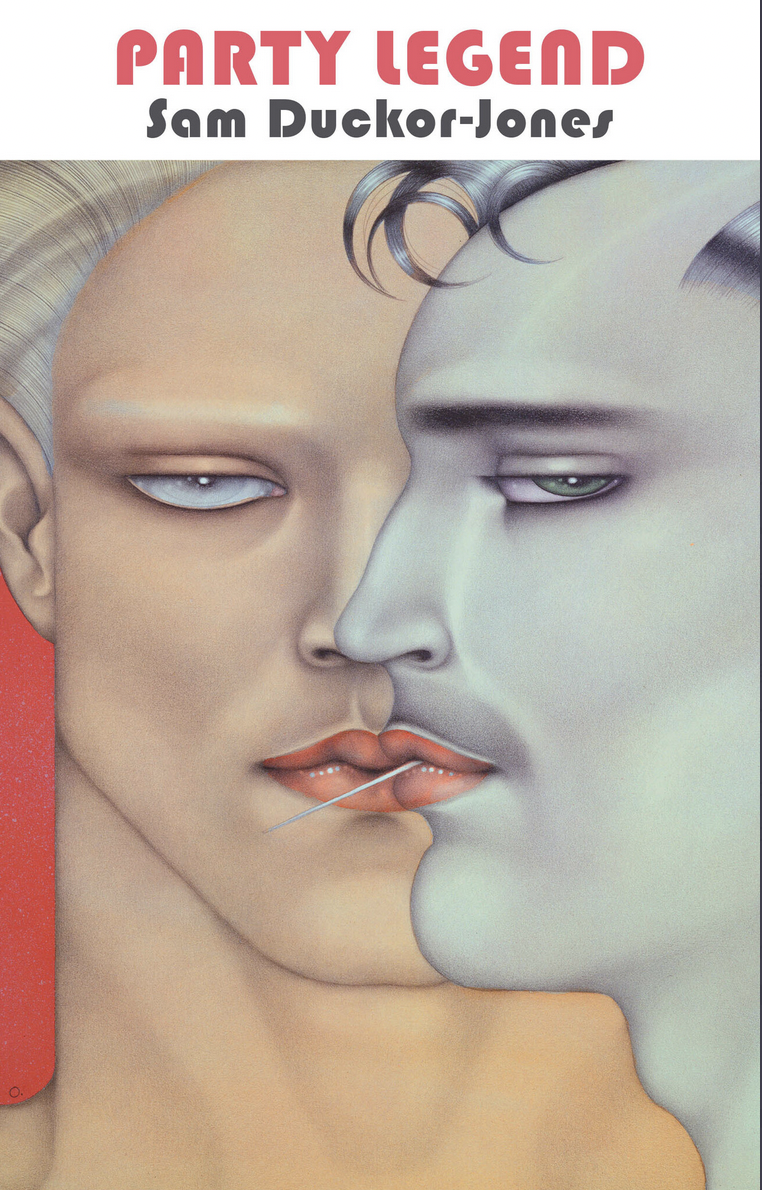
Party Legend, Sam Duckor-Jones, Victoria University Press, 2021

Dedications


To Anita: complete with scissors and buttons
For Donovan: a lesson
To Christopher: humming a little tune
For Neil: we tried
To Jack: a pasture of hens
For my grandfather: the standard question
For Amy: empty nutshells
To Janet: harder than quartz


Sam Duckor-Jones


Some poetry books offer a sweet flowing current, other books twist and spin with connections, disconnections, changing hues. I love both. I love a fluency of voice, and I love it when voice cracks and reforms afresh. Sam Duckor-Jones’s second collection, Party Legend, is utterly inventive as it redirects the current, swaps over form, upholds fluency, surprises you at each turn of the page.

First love: the sequence of fascinating epigraphs that hold the collection together. I am reminded of a leaf skeleton. Look though the weathered mesh and you enter the realm of existence. This is an epigraph fest: Dorian Corey, Ken Bolton, Charles Darwin, Bernadette Bassenger, Karen Kamensek, Sophie Zawistowski, Dr Ruth-Anne Tibbets.

And then the beating heart of the book, a long sequence, ‘The Embryo Repeats’, a sequence to luxuriate in, a God alphabet of making and breaking and coveting, and a what-the-heck God, and God is everywhere, think anecdotes and silence and chuckles. An alphabet of arrivals. Desire dissatisfaction curiosity.

Switch currents, and the ‘Allemande’ poems transpose Bach’s lettered notes in the same order of his Cello Suites. Well yes. The lexicon is lush and elbowed. Expect fêtes and golden fools and dick. Genius.

Take time out for Sam’s refreshment of the found poem. Has to be the best salt-and-pepper cluster of found poems I have encountered in a long time. There is the ha! moment when you discover the poem is found language. The ha! moment at the revelation of source. The way you go back to the poem and it spins like enriched dough in your head and the poem rises and lifts, and is more than our immunity to the language we encounter daily. It is a trapdoor into reverie. Musing on existence. Little thoughts. Big thoughts. Sam borrows from the dedications and final lines in a book he found in a BnB (poem above), from emails about Talmund with his mother, an overheard conversation in a bookshop, RNZ reportage of the Kaikoura earthquake. And!! a complete list of Israeli prime ministers mashed up with Mary Holmes interviews on RNZ National. Genius, again, genius.

The poetry of Sam Duckor-Jones is a refreshing gust in my head. It’s audacious and funny and real. It’s mind-roaming, and heart-attaching, and blisteringly good.

Sam Duckor-Jones is a sculptor and poet. In 2017 he won the Biggs Poetry Prize from the International Institute of Modern Letters at Victoria University of Wellington. His first book was People from the Pit Stand Up (VUP, 2018).

Victoria University Press author page

Review, Faith Wilson on RNZ, Nine to Noon

Review, Greg Fleming at Kete Books

‘Party Legend’ at The Spin off

‘The Embryo, Repeated’ on Poetry Shelf

Sam reads two poems for Poetry Shelf

Poetry Shelf Theme Season: Sixteen poems of land

the land. the contested land, the stolen land, the cherished land. the land with its regenerating bush. with a view out to the tail end of the Waitākere ranges. the feel the look the idea. the beauty. the unwavering beauty that holds you as you totter. as you stand. the kūmura to be harvested. the lettuces and herbs. the land as essential pulse in your veins. the sublime land. the broken land. the wounded land. the beloved land. we cycle the length and walk the breadth. we climb the heights and we join hands to protect. we will never stop singing the land. in poetry

The poems

Our tūpuna remain

Nothing like a lone-standing nīkau
in the middle of some paddock
owned by some Pākehā
to make you feel mamae

Surrounded by maunga
who serve to remind you
once that whole paddock
had that same sense of tapu

It’s a bit like that urupā
in the middle of that reserve
which used to be a papakāinga
till some Pākehā had it burned

So

consider yourselves warned:

It’ll take more than

a change of name
a chopping down of trees
a burning down of whare

to make us forget

our tūpuna remain

Jacq Carter

from Puna Wai Kōrero: An Anthology of Māori Poetry in English, Auckland University Press, 2014

Hone Said

chris abani
said
hone said
the only land I am
is that between my toes
but anne read
that hone said
the only land I have
is that between my toes
then michele said
selwyn said
hone had said

which is why
chris had written

it’s the difference between
being
and owning
surging
and standing
living
and landing
she said
she’d read
he said
have
not am

I keep
the am
anyway

then ken said
ron mason said
it first

Selina Tusitala Marsh

from Fast Talkin PI, Auckland University Press, 2009

Parihaka

we never knew
about Parihaka
it was never
taught anywhere
except maybe
around the fires
of Parihaka
itself at night
when stories
are told
of the soldiers
who came
with guns
to haul us up
by the roots
like trees
from our land
though the prophets
called peace peace
it was never
taught at school
it was all hushed up
how we listened
to the prophets
Tohu, Te Whiti
who called peace ‘Rire rire
Paimarire’
but the only
peace the soldiers
knew
spoke through
the barrels
of their guns
threatening
our women children
it was never
taught or spoken
how we
were shackled
led away to the caves
and imprisoned
for ploughing our land

Apirana Taylor

from A Canoe in Midstream: Poems new and old, Canterbury University Press, 2009 (2019)

Kauarapaoa

The road climbs up abruptly, here
beneath the cliff the water dark blue glass.
A peacock dives into the grass –
oh where oh where oh where oh where oh where?
Wet tang of sheep shit, mass of trees
releasing plant-scents in the angled sun,
those smells of summers been and gone,
bruised sap, ripe humus, rising to the nose.
The road bends with the deep-cut stream,
leaves fuzz the chasm to its brim,
and the stream slinks down towards the river
like a lover you’ll never get over.


All over, loose exotic scrub:
gum, willow, wattle, elder, poplar, broom
stitching the hillside like a seam
across the rends of
slip-soil dull and drab.
A man in white bends to his hives
below a face of mānuka sprayed dead.
Sheep crawl amongst the sticks to feed
on threads of green, wherever greenness lives.
Across the road, like greying bones
lie slash-piles of cut-over pines.
And the naked peaks
roll on forever
like a lover you’ll never get over.

A falcon calls above the rise:
Kek kek kek kek kek kek kek kek kek kek.
Far over farmland lies a break
of ocean, and the pale of western skies.
The white volcano points out north,
seeming steadfast, despite its restless sleep.
The road skirts, in a gravel loop
a drop so steep it catches in the breath.
The roadside bluffs divulge their shells,
reveal the ocean held these hills.
And water is as much a mover
as soil in softness is a giver.
And what can the land do but take cover?
Like a lover you’ll never get over.

Airini Berautrais

from Flow: Whanganui River Poems, Victoria University Press, 2017

Wild

Measure my wild. Down to my last leaf,
my furled, my desiccated. This deciduousness,
this bloom. Calculate my xylem levels.
My spore count, fungal, scarlet
in a bluebell glade. Whoosh,
where the foliage closes on a great cat.
Test me: how many tigers in my jungle,
how many lions at roam? Map my rivers,
deltas, estuaries. Mollusc, whelk, worm.
Monitor my silt. Do I have spoonbills, 
high-stepping and watchful over the darting fish?
Rainfall on pines. Dappled sunlight
in my dells. Under moss, the fallen log, under
the log the hibernating hedgehog. Late my dates,
or soon? Return of the albatross, godwits
gathering. What clouds me, shifts,
but: indigo thunder-stack, pink wisp. Count the mice.
What will survive me, O my cockroaches, O my lice?
Scaffold me with metal, cage me in glass, tube me,
needle me, fill me, flush me. Saline solution:
the ocean. Oxygen therapy: the sky.
Mineral deficiency: socks off. Soil. Dark
rot, eye-less wriggle, while the roots seek, seek.
Un-diagnosable, that ticklish insect.
Mountain peak speak only snow, and thus
I am diminished; thus I rest in my pulse. Sweet
heart. Monitor my yearn, and treat it with trees.
Un-pane me. Wilden my outlook.
Membrane animal, skin mammal under the osmosis moon.
Allow my tides. All this to say, in love we nest, and on Earth.

Sue Wootton

from The Yield, University of Otago Press, 2017

Tidelines

6am—

The sun rising behind me
The sea roaring at my feet
On the lip of the precipice

Everyone hunched in quiet
boxes, houses scattered to
the hills, precariously leaning
towards the sea, here we are
surrounded, ready to surrender
the day to the surf, dissolving
other imperatives into the
dust, into the black iron-laced
sand, tracing the time
against the rising breeze,
the tide ticking in, the river
in flood, swollen by rain

And still time passes
it washes away my footprints
Every day I make new marks
imprints on the beach
lines on the page

I walk and I string words in long lines in my head
I write and I skip words across the page like stones

I let them sink
I watch them slowly spiral down
through my mind
Down and down, until they reach the ocean
Deeper, into the abyss of collective dreaming

Until they are no longer my words
Just a passing thought you were having

Early one morning,
in your bed,
in your house,
in Piha,
waiting for the tide to come in. 

Kiri Piahana-Wong

from Night Swimming, Anahera Press, 2013

My Carbon Gaze

1.

Because there were hills to the east and hills to the west, there was a good chance that when you looked at something it would be a hill. Perhaps it would be a hill with a family member or a friend in the foreground. A family member or a friend might be called a loved one for short.

2.

With the hills and the loved ones far apart, your eyes would end up making so many trips back and forth that their orbit solidified into a sort of object. It was a wire model of an atom like they had in the museum. Or perhaps a model of the solar system. In any case, a round thing involving energy and with the potential to explode, but that would be in exceptional circumstances, probably never.

3.

I still have it in my natural history section, although sometimes I wish I didn’t. Sometimes I wish I didn’t have a natural history section. I wish I hadn’t looked up at those hills so often – willy-nilly – between 1960 and 1985, and looked back down at the loved ones, because now I am left with this wire model and it will never go away. In fact it will, because it is organic, but only after a very long time. Perhaps even after I am dead.

4.

Most summers there was a fire on one of the hills, the east or the west, the sun-coming-up hill or the sun-going-down hill. It would seem like the hill was burning, but it was only the gorse. Not so serious. But serious enough to prompt a teacher to set a Poem for homework.

5.

On the way home you could hear the black crackling and it seemed to have a personality, and not a very nice one.

6.

My mother wrote the poem quickly as she peeled the potatoes – in fact she only said it. I wrote it in my McCahon handwriting but much more neatly. Of English descent it crowds the hills, / Originally meant for hedges and sills. / A prickly maze, a funeral pyre, / a golden haze, a monstrous fire. 

7.

There was only ever one hill on fire at a time. The problem would be if both hills caught fire at the same time, and the fires might burn down into the valley, and the trees would burn, and the lawns, and all our houses and their contents. And our Prefaces and Introductions. Not to mention the people. But we would run down to the beach. That’s what we would do.

8.

There was an article in the paper about the possibility of a tidal wave sweeping up the bay and taking everything with it, and if you hadn’t gone in the earthquake that preceded the tidal wave, you would now be finished off altogether. This was the opposite of the fire. You would be washed the other way, all the way into town. How extreme the world was. Why not something in the middle?

9.

(Why not fear something in the middle? Earth, wind, a few other things.)

10.

And the hills were mostly benign anyway. They were just there, like your name. You might even get sick of them, of looking up at them and back again. Why don’t people get sick of their name? Maybe they do. Maybe they say, If I hear that name one more time I’ll scream.

11.

Sometimes you might look up at the hills and think, I am looking at the hills, and you might have some sort of reaction, e.g., They are dark against the white sky and are very beautiful. Or, They have a sun like a solitaire nestled into them, but no for long. See look – gone! Divorced. I told you so. These kinds of reactions were the first attempts to connect the hills and the people in the foreground. But it is probably impossible. Well nigh impossible.

12.

In spring they were brassy yellow with gorse flowers. In summer they were ‘tinder dry’ (a cliché) and ‘brown’ (not a cliché because the word brown doesn’t have much to it and people haven’t got sick of it yet). Okay, brown.

13.

When both sides of the hills were brown, to the east and to the west, in the ‘height of summer’, a fire might be lit by a boy letting off fire-crackers saved from Guy Fawkes, or by a girl letting off fire-crackers (svd fr. GF), or by a man going for a walk on the town belt and smoking a cigarette, or by a woman (gng fr wlk on TB w. cig.), and the fire brigade would be called out.

14.

But because there were two fires – one lit by the boy or the man, the other lit by the girl or the women – the fire brigade would have no chance of taking control, and the fire would burn down into the valley. And everyone, family members and friends (loved ones for short as there would not be much time), would run down the Parade to the beach and go and stand in the sea because there would be nowhere else to go. I am still out there. I am standing in the cold sea at Island Bay, and it is 2011, and it is freezing, and I am waiting for the fires on the hills to go out.

 Anne Kennedy

from The Darling North, Auckland University Press, 2012


Emotional geography

Look back, and forks
and crossroads soon appear.
Now you see, or think you do,

how that U-bend, that country
lane, which at the time seemed
less a turning than the leaning

of the moment, led on to this
and later this, as though there really is
a road-map of the heart

whose one-way system you have to follow
down Ego Street to Guilt Mews,
and the various alleys off Vanity Row.

Harry Ricketts

from Your Secret Life, HeadworX, 2005

More ancient than any of us

Birds swoop over the whenua. Reminders of you alight upon puku and manawa, and night-time channels thoughts unspoken in daylight. Lit fires smoulder upon open ground more ancient than any of us.

Desire grew in the air between us. Braided awa beneath rākau limbs came crashing earthward, into landscapes of enlivened senses. The gifts inside their ringed stumps spoke of ages and shadow tones, and graced our faces with crossed lattices.

Streams of consciousness — like gaps in the light.

Promises leaked from your eyes. They landed upon my soul etching deep chasms of aroha, before that mamae of yours disrupted the course and an undertow began to tear at the fabric of us, casting me out.

My ringaringa spread wide to expose secrets. And you owned none of the lies that spilled over to lap at my feet, where pūrerehua wings stroked my winnowed heart beating fast to the rhythm of our mother.

Streams of consciousness — like gaps in the light.

Birdsong emerged between pō and rā, to illuminate all the unnoticed seasons. But who can say whether we shifted and morphed with it, or remained stagnant puzzles of links scattered from root to tip, our enacted patterns alive.

Wind blows the tussocks in this unfamiliar place. Yet the longing for you dissipates with each luminous marama cycle, and recounts tidal surges in existence long before you left. And the kakahu always enfolds me, certain I will awake unbroken.

Iona Winter

from gaps in the light, Ad Hoc Fiction, 2021

Heaven

A galaxy of stars on dark water,
the breaking of the pack.

Or more like fat congealing on boiled mutton.

When there is only white,
when everything is coloured white,
the land, the sky the ice and the horizon,

the heroes, as they walk away,
you’d say were climbing a white wall to heaven.

Bernadette Hall

from The Ponies, Victoria University Press, 2007

Poem note: This poem arises from the optical illusion in a white-out or almost white-out. As figures move away from you, they appear to be moving upwards. In December 2004 the Dunedin artist, Kathryn Madill and I shared an Artist in Antarctica award.  We were stationed at Scott Base. The Antarctic experience was a life-changer for both of us. Lines from this poem have been set in the stone pavement at the foot of Robert Falcon Scott’s statue at the intersection of Oxford Terrace and Worcester St, Christchurch, on the Ōtākaro pathway. The text was carved by Neil Pardington. My grandsons, Leo and Darcy, are having a find old time, deciphering their grandmother’s word-painting.

Bernadette Hall

Harvest

The first whitebait, see-through, rivery
lightly-flamed into a wriggle of sweet eyes.
Oysters, pink-creamy, frilly, a glug of ocean
neck-felt, lemon-spattered, a sea cry.

The first potatoes, knuckle-white, waxy
spilling from the earth’s dark hold.
Corn, buttoned to the cob, yellow, fleshy,
spitting to the bite.

Sunflowers standing on hopeless stems.
The first-born, mother-coated,
unfolding in the first tears,
swimming into the miraculous light.

Richard Langston

from Henry, Come See the Blue, Fitzbeck Publishing, 2005

Jane

                                                Nga Motu beach, New Plymouth          1845

When my great-grandmother Jane
was a small girl
she played with her cousins
on the backs of harpooned whales.

From the summit
of the biggest creatures on earth
they pointed out to sea:
Look! Look at the islands!

A single mountain
stood behind their backs
felt but not seen,
inward and silent.

Nonetheless
a witness.

Dinah Hawken

in There Is No Harbour, Victoria University Press, 2019

4.9.10 / HOMECOMING

the earth just / empty of it
take the shape of a shake / between your teeth.
in the cold morning many things falling.

touch the wall as it heaves while
translucent alarms vomit
into still air / air is still /
underneath it the writhing thing
turns its dirty head / side to side.

in this movie now / we all should have known better
forget to close the door behind you
run barefoot onto the silty street
see the neighbours in their underpants
/ this is not a dream /

just a mirror of the noise
a tiny pearl lying in your palm sleeping
itch it away at your peril.

later you will urinate / in a dark hole next to the rose bushes
whose thorns in the dawn spiked your mother
in her dressing gown fleeing the house
three wide circles / in her face
eye eye mouth.

fear lives here
in the business part of the throat
nestled / between the toes with
the simple earth fissured
waiting and just

/ not quite
what it used to be.

*

I am in the city,
and it has been long enough.

It’s a decade on, almost,
and the streets’ breathless pant has slowed to a sighing;
smooth tufts puffed into icy air.

Rupture has softened,
cracked stone padded in limpid moss,
splintered beams braced by scaffolding,
broken brick tucked up in landfills.

Christchurch remains
frozen in its decay, somehow,
contractions have distilled
entire city blocks to essences:
flat ground, empty horizons,
a big loud nothing
where a city should be.

Its winter sky is unchanged:
unshaken, unscarred, tectonically oblivious
the low-hung grey cloud a steely blanket
locked tight in violent closure.

A blackened scab
is being pulled off the knee of Christchurch,
and she bleeds brick dust out over the plains,
while the Port Hills loom like aristocracy
cloaked in a fine-knit sprinkle of snow,
sentenced to beheading for the crime of
‘seismic lensing’.

And the Avon River, unfazed,
just goes about its watery business the same;
an arterial swirl the colour of new-born eyes, unsettled,
drawling like a dream past roadwork realms, cone castles,
up-and-coming urban developments,
and the melancholy ghosts
of everything we lost along its banks.

Hebe Kearney

from Starling 10

Land

A child dances alone
in the street. A rainbow
arcs the sky. A hawk
circles, descends. A helicopter
appears. Dark suited, new ghosts
of developers materialise from
the clouds. Here visions –
wild places to shelter –
are set upon empty land
by the writer’s eye.

Once the all-seeing water carried
dreams to this safe shore: liquid
stars to navigate the ancients;
shallows to nurse great-whites;
coastline to settle waders’ Arctic flight;
sea-views for soldiers arriving home.

Now this land is gifted to the gods
of helicopters, SUVs, M6s, sharknosed
disruptors who conjure the mantra of
mixed model, urban renewal, WOW factor,
solar gain, waterfront living. There’s money
to summon – ta-da! – from soil. Everything
seen or imagined belongs to them. The past –
its evicted, protestors and peacemakers –
is a trick, an adjunct made to disappear.

As if the scattering of birds
into late morning, the shriek of
banshees escapes; the helicopter too.

The displaced need this land to live.
They want their future to grow here,
like trees. They want their children
to dance upon it alone, to feel sap
pulse through the branch. Rainbow

and hawk to rise from it. This close
to regeneration, the evicted lament
that which they cannot settle,
cannot own. Their wailing is –
the rustle of money, whisperings
of the past – almost quelled;
almost, but not quite.

Siobhan Harvey

from Ghosts, Otago University Press, 2021

Objects 12

The tight-rooted morning coils up
but I imagine the buds unfurling
in the mess of garden down there;
the sharp agapanthus blooms white,
the jasmine vine, the flame weeds,
the drooping, beaded kowhai.
I do not see it happen but I see it
happen. That waxy flexibility
of plants, I used to call them
my guests. There were tea parties
with dew.
             I want you to whisper to me
about everglades and prairies,
sylvan historians and Dan Bejar,
but I’m afraid that you don’t love me
anymore. The dark morphing
into the unimaginable.

               Look, I’ll show you around
this condensed symbol of a place.
It’s true, it’s everything
and nothing specific,
and everything to me
and always specific.
It’s impossible to understand
how we got from there to here.
One place after another.
You come close
to a home.

             Look, Pip says
the days are getting shorter,
but I can’t help it anymore
I think life is just starting.

Nikki-Lee Birdsey

from Night As Day, Victoria University Press, 2019

Place

Once in a while
you may come across a place
where everything
is as close to perfection
as you will ever need.
And striving to be faultless
the air on its knees
holds the trees apart,
yet nothing is categorically
this, or that, and before the dusk
mellows and fails
the light is like honey
on the stems of tussock grass,
and the shadows
are mauve birthmarks
on the hills.

Brian Turner

from Elemental: Central Otago Poems, Random House, 2012

The poets

Airini Beautrais lives in Whanganui and is the author of four poetry collections and a collection of short fiction. Her most recent poetry collection is Flow: Whanganui River Poems (VUP 2017). Bug Week and Other Stories recently won the Ockham NZ Book Fiction Award 2021.

Nikki-Lee Birdsey was born in Piha. She has a PhD in poetry from the International Institute of Modern Letters (IIML), an MFA from the University of Iowa Writer’s Workshop and a BA from New York University. Her first book Night As Day was published by VUP in 2019. She taught poetry at the IIML last summer.

Jacqueline Carter (also Jacq, Jacqs or Jackie), of Ngāti Awa, Waitaha, Ngāi Te Rangi, English, Irish and Scottish descent, is a poet and teacher living in Tāmaki Makaurau Auckland. She has recently become a member of Te Hā o Ngā Kaituhi Māori (formerly Te Hā) – Contemporary Maori Writers. Her poetry has appeared in several anthologies including Whetū Moana, Mauri Ola, and Puna Wai Kōrero: An Anthology of Māori Poetry in English (Auckland University Press).

Bernadette Hall lives in the Hurunui, North Canterbury. She retired from high-school teaching in 2005 in order to embrace a writing life. Fancy Dancing is her eleventh collection of poetry (VUP, 2020). In 2015 she was awarded the Prime Minister’s Award for literary achievement in poetry and in 2017 she was made a Member of the New Zealand Order of Merit for services to literature in Aotearoa New Zealand.

Siobhan Harvey’s new book, Ghosts (Otago University Press, 2021) is a collection of poetry and creative nonfiction. She was awarded 2020 New Zealand Society of Authors Peter & Dianne Beatson Fellowship, 2020 Robert Burns Poetry Prize and 2019 Kathleen Grattan Prize for a Sequence of Poems. 

Dinah Hawken lives and writes in Paekakariki. Her ninth collection of poetry, Sea-light, is published by Victoria University Press, August, 2021.

Hebe Kearney is a queer poet who lives in Tāmaki Makaurau. Their work has appeared in The Three Lamps, Starling, Oscen, Forest and Bird, a fine line, and Poetry New Zealand Yearbook 2021.

Anne Kennedy is a poet, fiction writer, screenplay editor and teacher. Recent books are Moth Hour (AUP) and The Ice Shelf (VUP). Awards and fellowships include the NZ Post Book Award for Poetry and the IIML Writers’ Residency. The Sea Walks into a Wall is forthcoming from Auckland University Press in October 2021. 

Richard Langston is a poet, television director, and writer. Five O’Clock Shadows is his sixth book of poems. His previous books are Things Lay in Pieces (2012), The Trouble Lamp (2009), The Newspaper Poems (2007), Henry, Come See the Blue (2005), and Boy (2003). He also writes about NZ music and posts interviews with musicians on the Phantom Billstickers website.

Selina Tusitala Marsh (ONZM, FRSNZ) is the former New Zealand Poet Laureate and  has performed poetry for primary schoolers and presidents (Obama), queers and Queens (HRH Elizabeth II). She has published three critically acclaimed collections of poetry, Fast Talking PI (2009), Dark Sparring (2013), Tightrope (2017) and an award-winning graphic memoir, Mophead (Auckland University Press, 2019) followed by Mophead TU (2020), dubbed as ‘colonialism 101 for kids’.

Harry Ricketts teaches English literature and creative writing at Victoria University of Wellington Te Herenga Waka. His Selected Poems appeared in June, Victoria University Press.

Kiri Piahana-Wong is a poet and editor, and she is the publisher at Anahera Press. She lives in Auckland.

Apirana Taylor, Ngati Porou, Te Whanau a Apanui, Ngati Ruanui, Te Ati Awa, is a nationally and internationally published poet, playwright, short story writer, novelist, actor, painter and musician. He has been Writer in Residence at Canterbury and Massey Universities. He frequently tours nationally and internationally visiting schools, tertiary institutions and prisons reading his poetry, storytelling and taking creative writing workshops. He has written six collections of poetry, a book of plays, three collections of short stories, and two novels. His work has been included in many national and international anthologies.

Brian Turner was born in Dunedin in 1944. His debut collection Ladders of Rain (1978) won the Commonwealth Poetry Prize. His writing includes biography, poetry, sports writing and journalism and has won many awards. Just This won the NZ Post Book Award for Poetry (2010). He was the Te Mata Poet Laureate (2003-2005) and received the Prime Minister’s Award for Poetry in 2009. He lives in Central Otago.

Iona Winter (Waitaha/Kāi Tahu) lives in Ōtepoti Dunedin. Her hybrid work is widely published and anthologised in literary journals internationally. Iona creates work to be performed, relishing cross-modality collaboration, and holds a Master of Creative Writing. She has authored three collections, Gaps in the Light (2021), Te Hau Kāika (2019), and then the wind came (2018). Skilled at giving voice to difficult topics, she often draws on her deep connection to land, place and whenua.

Sue Wootton lives in Ōtepoti-Dunedin, and works as the publisher at Otago University Press. ‘Wild’ was awarded second place in the 2013 International Hippocrates Prize for Poetry and Medicine, and appears in Sue’s Ockham short-listed poetry collection The Yield (Otago University Press, 2017).

Ten poems about clouds

Twelve poems about ice

Ten poems about dreaming

Eleven poems about the moon

Twelve poems about knitting

Ten poems about water

Twelve poems about faraway

Fourteen poems about walking

Twelve poems about food

Thirteen poems about home

Ten poems about edge

Eleven poems about breakfast

Twelve poems about kindness

Thirteen poems about light

Thirteen poems about song
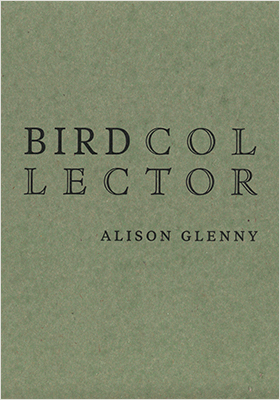
Poetry Shelf review: Alison Glenny’s Bird Collector

Bird Collector, Alison Glenny, Compound Press, 2021

This collection reads as if a Victorian composer, carrying her valise of new operetta libretti, collided in the street with a watchmaker, his briefcase of sketches for a new time-keeping device, and a genderfluid astronomer toting the patent forms for a mechanised solar model made of blown egg shells and bird skulls. Their papers, shuffled together by misdirected desires, unspoken and even unconscious intentions, lead to an entirely new work — a sheaf of pages where the negative space of silence speaks as pressingly as the shape of song.

Emma Neale

Alison Glenny’s new poetry book, Bird Collector, is a perfect sequel to the shining lights of her debut, The Farewell Tourist. What stood out out for me in the first collection is exquisitely revisited in the second: white space, silence, musicality, plenitude, word awareness, the footnotes. Bill Manhire, Airini Beautrais, Erik Kennedy and Emma Neale have endorsed the book. Brilliantly. To the point they almost make future reviews redundant. If you need signposts and pathways into the book, these four contributions are gold. Words that reoccur: awe, song, fragmentary, curiosities, silence, imagination, the unconscious, the gaps.

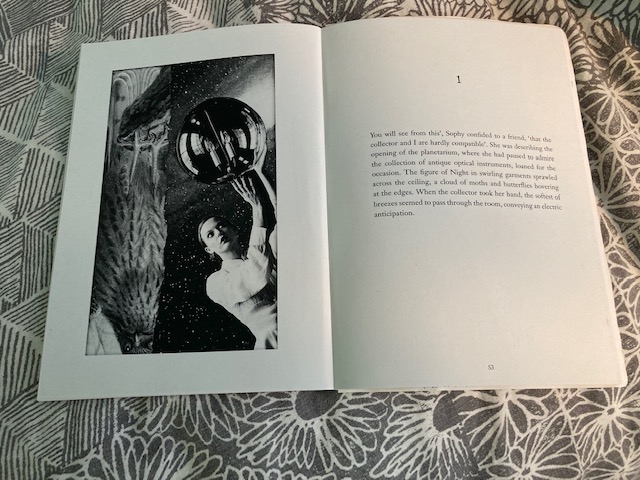
Chris Holdaway, through his Compound Press, has lovingly produced the book, using recycled materials, printing and binding it in Auckland. It includes sublime illustrations by Carrie Tiffany and by Alison herself. I am talking mesmerising. Wow! Alison’s collage-like images are gorgeous, visual overlays!

Bird Collector is in two parts: ‘Bird Organ’ and ‘Nights with the Collector’. Two halves of a beating heart. There is the off-real and the intensely real. Little caches for the hidden, little nooks for the startles. The opening poem holds out the possibility of narrative, character, the potency of things. I am picturing the poetry as paper art unfolding in water, and upon each occasion, the appearance and disappearance unexpected, as the poem comes into being. This is the joy of poetry. The way we read a poem to some surprising form of life. These are the opening lines of the opening poem, ‘Key’:

‘But we do not know in advance which key will unlock the hidden melody. Discovering it is a matter of chance—like opening a drawer at random and finding snow, or the ghost of a bird fluttering among the cogs and feathers.’


You enter the strange but it is not estranging. You come across gaslight and candles as the shade and light flicker. You enter the beautiful but not the beautifying. Sentences sing for the sake of song, and then sing along a thousand flight paths: ‘The notebooks chronicle her internal weather.’ This sentence is from ‘Bird’ where all manner of things and experiences, feeling and reactions, hide or hover over body or clothing. What is this poetry like? I keep losing words to tell you. I keep feeling I am standing in an image-rich, disorienting space, reminiscent of a steam-punk room, that stencils intricate maps on my eyes.

And perhaps each poem becomes the chest of drawers you slowly pull open. Ever so slowly you open the poem. Breathing in scent and melody, fascinations and intriguing juxtapositions. Little actions. Minute epiphanies. Individual words that are shivers, glints, clouds, seepage, dissolution: ‘The difference between use and exchange lay in an abstraction. When she opened the instrument, a cloud of butterflies flew out of the ghostly remains of a forest.’

At times there is a single sentence on the page or even simply a poem title which is expanded upon in a series of footnotes, on the facing page and is always always embraced by the white space, the generous silent beat (for example, ‘Footnotes to a History of Mourning’, Footnotes to a History of Birdsong’).

At times the poems feel like a series of hauntings to me.
At times it feels like scatter and rustle and perfume.

Why do I keep making comparisons to the making of a poem as I read this? The second section is set in a planetarium. The narrative foregrounds catalogues, collecting, cataloguing the collections. Keeping, discarding, keeping discarding. Caring for the souvenir, the ‘tiny shards’. Managing the challenge of falling snow. The sequence of paragraphs/poems offers endings that speak of ash and fracture, then move into poetry skeletons. A handful of words falling like snow down the page. And then the skeleton becomes footnotes, an intriguing aside that catapults you in fresh directions of contemplation, reverie. And what remains? Shadow and light? Ash? The weather? A love story. A lost story? The key is missing we read, and yet every time we travel through the book, we assemble our own key.


‘Some fragments of paper always remained from the burning of the

catalogues. She likened them to telescopes, pointing to a part of the

sky where everything is centred upon vacancy.’


from ‘Footnotes to a History of the Fragment’


The sources cited in the acknowledgements would enhance our reading pathways. I am wondering how we collect as we read. I want to check out: the poetry of Stéphane Mallarmé (again), Susannah B Mintz’s essay ‘Forms of Self-Disclosure in the Lyric Essay’ and Jasmine Gallagher and Kristina Marie Darling on specific found forms.

Alison is one of our most original poets: lyrical, heart-sustaining, mind-altering, hallucinogenic, attentive. Bird Collector demands the very best superlatives you can summon. For me this this is poetry standing on its tip-of-the-toes best, it’s sublime.

Alison Glenny lives on the Kapiti coast. Her Antarctic-themed collection of prose poems and fragments, The Farewell Tourist, was published by Otago University Press in 2018.

Compound Press author page

Image by Alison Glenny

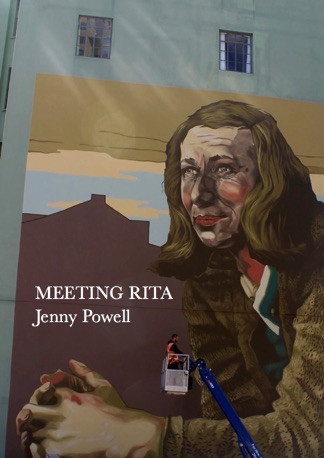
Poetry Shelf noticeboard: Paula Green reviews Jenny Powell’s Meeting Rita at Kete Books

Meeting Rita, Jenny Powell, Cold Hub Press, 2021

Hanging around in the gallery

for a ticket-only discussion

of fashion, we were singles

leaning on opposite walls.

Judgement flicked like a whip

and we couldn’t change a thing.

Rita and I

were wearing the same coat.

from ‘Meeting Rita’

Meeting Rita is poetry as sumptuous brocade, rich in detail and shifting views. The writing is measured, finely-crafted, lyrical. Individual words, phrases and the building lines surprise and delight. Endnotes offer background contexts for each poem, fascinating detail acquired from the poet’s research.

Full review here

Cold Hub press page

Poetry Shelf audio: Shari Kocher reads from Foxstruck and Other Collisions

Foxstruck and Other Collisions, Shari Kocher, Puncher & Wattmann, 2021

Shari Kocher reads five poems from Foxstruck and Other Collisions

‘All the Silver Ships You Carry’

‘As We Spiral Pine Tree Mountain’

‘Not the Horses’

‘Goats Cheese with Honey and Rosemary on Toast on Sunday Morning’

‘Peak-to-Peak Amplitude is also the sound of the wind on the tundra, singing’

The poems in Foxstruck and Other Collisions cross many registers and seek to intervene in the ‘death drive’ at work in the over-culture at every level. At the same time, art as a measure of resistance is also riddled with colonisations of every kind. Though it’s hard for this poet to speak about her own work in any comprehensive way, the poems in this collection tackle the labour of love and the work of eros not as modes in which to answer historical and contemporary atrocities, but as provisional structures in which to witness and invoke the kinesis of a tangible ‘life-force’ larger than the self, inherently more mysterious, unknowable, and ecological than the scholarship this poet has undertaken will ever grasp. In this arbitrary selection of five poems, a vision of diverse artistries and bold scholarship is explicitly referenced, from the astronomy of Rebecca Elson, the encaustic paintings of New Zealand artist Amy Melchior, fellow New Zealand artist Kate Van der Drift, one of whose river works adorns the cover of this book, writings by Clarice Lispector and Carson McCullers, the philosophy of Gaston Bachelard, to diffuse and implicit connections with the influential work of Kerry Reed-Gilbert, Deborah Bird Rose and Constanza Ceruti, among others. If poetry is to be a shelter of any kind, then the biosphere that breathes it must be porous and open to the sacred, however that term is both contested and defined.

Shari Kocher, July 2021

Shari Kocher is the author of Foxstruck and Other Collisions (Puncher & Wattmann, 2021) and The Non-Sequitur of Snow (Puncher & Wattmann 2015). Sonqoqui: a Threnody is currently in translation under the auspices of The Peter Steele Poetry Prize (2020). She holds MA and Doctorate degrees from Melbourne University, where she sometimes works in the creative writing program. She also works in a freelance and remedial capacity, but during lockdown, finds herself working primarily on a collection of short stories and new poetry, while shadow-boxing a monograph on Dorothy Porter and Anne Carson. Website

Puncher and Wattman page

Poetry Shelf review

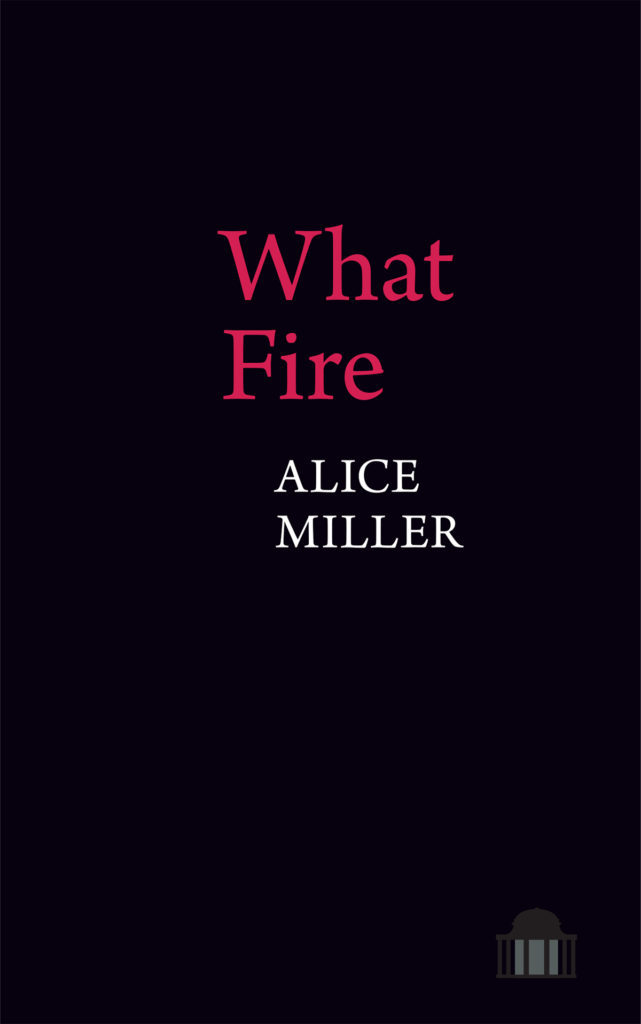
Poetry Shelf celebrates new books: Alice Miller reads from What Fire

What Fire, Alice Miller, Pavillion, 2021

Alice reads ‘After The Internet’

Alice reads ‘New Wings’

Alice reads ‘Seams’

Alice Miller is from Māhina Bay and currently lives in Berlin. Her third poetry collection, What Fire, has just been published by Pavilion in the UK. Her first novel, More Miracle than Bird (Tin House, 2020) was on the New York Times summer reading list. 

Friday Poem at The Spinoff: ‘The Twin Peaks’

Pavilion Poets at Liverpool University Press page (Alice Miller)

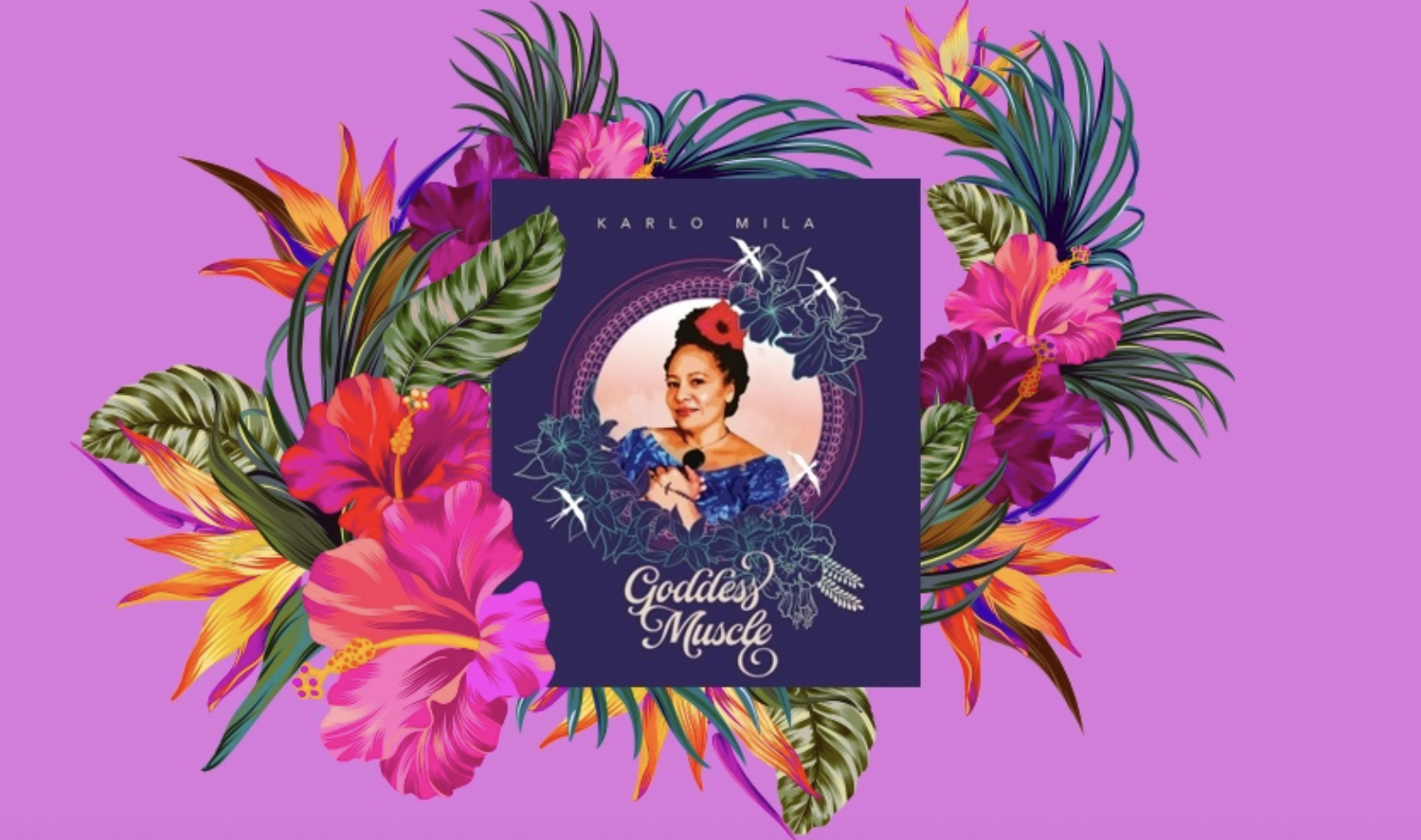
Poetry Shelf noticeboard: The Spinoff celebrates Karlo Mila’s Goddess Muscle

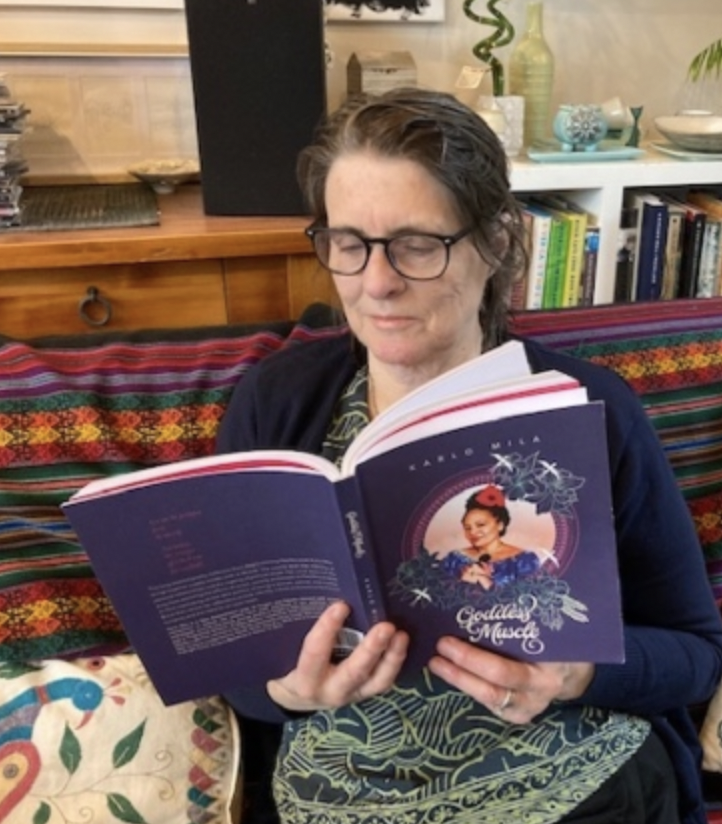
Catherine Woulfe from The Spinoff invited six women to write a short piece celebrating Karlo Mila’s Goddess Muscle: Selina Tusitala Marsh, Leilani Tamu, Nadine Anne Hura, Kirsten Lacy, director of Auckland Art Gallery Toi o Tāmaki, Rebecca Sinclair, deputy pro-vice chancellor at the college of creative arts, Massey University and me. We each contributed a paragraph and a photograph.

I so loved this book. It is the kind of book that rises above your reading shelves and sticks, and was one of my top poetry reads of 2020. I was also privileged to hear Karlo read at my Wild Honey session at VERB. Such charisma on the page and in the air.

I got my daughter to take a photo of me with the book and before I could stop myself I lost in a poem, savouring the poetry richness, forgetting to smile for the camera, transported, uplifted a universe away from the lounge. If you haven’t read Goddess Muscle yet please do. Check out the celebration here. This is my piece:

Goddess Muscle is a gift. I can barely account for how it will stretch your reading muscles, your beating heart, your enquiring mind, your compassion, your music cravings, your empathy. Karlo has extended her own poetic muscle and offered poetry that is wisdom, strength, refreshed humaneness. I am all the better for having read it.

The collection is crafted like a symphony, an experience of shifting life, seasons and subject matter, so as you read the effects are wide reaching. Karlo faces significant political issues: climate change, the Commonwealth, colonialism, racism, Ihumātao, “the daily politics of being a woman, partner and mother”. She faces these global and individual challenges without flinching. The resulting poems are essential reading, never losing touch with song and heart, always insisting in poetic form how we can do better. How we can be a better world, recharge humanity. I would like to see these poems read in secondary school. You can read Moemoeā: (composed for poets for Ihumātao) here.

Karlo reads from Goddess Muscle here.

My review at Poetry Shelf

Poetry Shelf – poets on their own poems: Karlo Mila reads ‘For Tamir Rice with Love from Aotearoa’