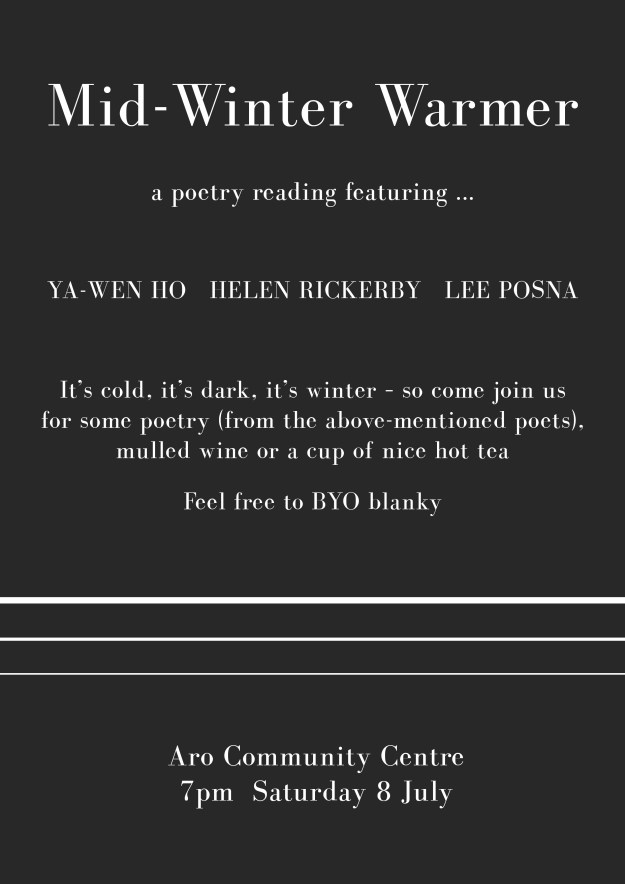
Wellington mid-winter poetry warmer with Helen, Ya-Wen and Lee
Leave a reply

Accomplished poet, editor, art critic and journalist David Eggleton has been awarded the Fulbright-Creative New Zealand Pacific Writers’ Residency.
He will use the $30,000 award to complete a collection of poems exploring his Pasifika heritage. These will include poems inspired by the myths and legends of Te Moana Nui a Kiwa and will incorporate work about Mana Moana, the power of the ocean and ancient Pasifika connections.
“I hope to research and begin a prose memoir about my mother’s extended family, my cousins, scattered across the Pacific,” said Eggleton.
David Eggleton is of Rotuman, Tongan and Palagi descent. He grew up in Fiji and South Auckland, and now lives in Dunedin. Formerly a factory labourer and city council gardener, he is now a full-time editor, poet, art critic, reviewer and freelance journalist whose reviews, articles, essays and short stories have appeared in a large number of publications since the mid-1980s. These include the Listener, Art New Zealand, New Zealand Books, Art News, Architecture New Zealand, Urbis, Metro, Landfall.
“My Pasifika heritage runs all through my writing from the beginning as part of my personal context and background and I have always drawn from this heritage and history, but not necessarily overtly: instead it is there as a presence or part of a dialogue with ideas about cultural crossover,” said Eggleton.
As the recipient of this year’s award, David will be based at the Center for Pacific Islands Studies at the University of Hawai‘i at Mānoa in Honolulu for the Spring (February-May) semester of the US academic year.
Hawai‘i has been identified as a strategic location for artists and is considered the hub of Pacific writing with its numerous universities, library resources, networks, writers’ forums and publishers. It is also an important link to the mainland US and has a strong indigenous culture.
“I heard about the Fulbright residency through conversations with a number of Pasifika writers and have been aware of it since its inception, but this is now the time I feel ready to take it up and use it to allow me to develop a particular Pasifika-based project, namely to complete a collection of poems exploring my Pasifika heritage.”
The Fulbright-Creative New Zealand Pacific Writers’ Residency is for a mid-career or senior New Zealand writer of Pacific heritage to carry out work on a creative writing project exploring Pacific identity, culture or history at the University of Hawai‘i for three months. One award valued at NZ$30,000 is granted each year, to be put towards the costs of three months of writing.
Previous recipients have included poets Tusiata Avia, Karlo Mila and Daren Kamali, filmmakers Sima Urale and Toa Fraser, and playwrights Victor Rodger and Miria George.
When I was eight my parents packed me off to Little Sir Echo Camp for Girls on Lake Armington in the foothills of New Hampshire cofounded and owned by Mary Hoisington and Margaret Conoboy ten years earlier. Apparently the women chose the name because of an echo that bounces off the surrounding White Mountains. An actual child may or may not fit parental fantasies. I hated the place. Most of all I dreaded riding classes and spent many nights praying I would be assigned the tired elderly horse with a creaking stomach for the next day’s obligatory ride around the ring. On the one visiting day allowed per summer we rowed across the lake and picnicked on a secluded beach at the edge of a pine forest. I begged them to ransom me. But no. Around four P.M. they left for Boston, leaving me alone with my dread of being lost in the past; absent.
Full extract here

This terrific series edited by Guy Somerset also includes Bill Manhire and Catherine Chidgey.
To celebrate Ian Wedde’s Selected Poems, we are invited to share a smidgeon of Ian’s reading life:
‘The first book to capture my imagination was … A toss up between May Gibbs’ Snugglepot and Cuddlepie (I was scared of the Banksia Men) and Rudyard Kipling’s Jungle Books (I was Mowgli!).’
Ian’s full book shelf here
Sadly this was Guy’s last edition, but he left a terrific Glastonbury link as an adieu.

A TransPacific Poetics, Litmus Press, 2017
Edited by Lisa Samuels & Sawako Nakayasu
Thursday 27 July 530-7 PM, Gus Fisher Gallery, 74 Shortland Street, Auckland
With Murray Edmond, Ya-Wen Ho, Melanie Rands, & Lisa Samuels
Join us as we launch A TransPacific Poetics, a new collection of poetry, essays, and poetics committed to transcultural experimental witness in both hemispheres of the Pacific and Oceania. The works in ATPP re-map identity and locale in their modes of argument, resituated genres, and textual innovations. A TransPacific Poetics includes Lisa Samuels, Don Mee Choi, Melanie Rands, Jai Arun Ravine, Ya-Wen Ho, Murray Edmond, Susan M. Schultz, Eileen Tabios, Craig Santos Perez, Corey Wakeling, Lehua Taitano, Stuart Cooke, Sean Labrador y Manzano, Barbara Jane Reyes, Myung Mi Kim, and Sawako Nakayasu, with cover art by Dagmar Vaikalafi Dyck, who will also be present for this launch event.
Free & all welcome. Book copies available for a celebratory reduced price of $30 (cash only).
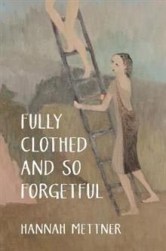

Fully Clothed and So Forgetful by Hannah Mettner (Victoria University Press, 2017), 91 pp., $25; The Internet of Things by Kate Camp (Victoria University Press, 2017), 61 pp., $25
One quality I love about first volumes of poetry is that they often contain an element of the poet’s origin story. Hannah Mettner’s Fully Clothed and So Forgetful certainly does: there are poems referencing childhood, relationships with siblings and wider family, elements of cultural confusion after an across-the-world move, parenthood – all described with deftness, wit and originality. How about that title? It’s a delight … inviting, and very human.
full review here
As Rick Stein would say, we need more of this! Such a very good idea.
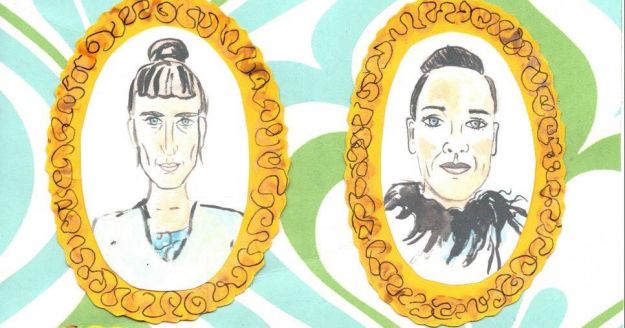
From Maria and Airini:
‘(Our portraits are by the wondrous Sarah Laing) Airini and Maria are going on tour in July! Like rock stars only way cooler. Napier 15th, Thames 16th, Auckland tbc, Wellington 28th, Palmerston North 29th and Paraparaumu Beach on the 30th. We’re promoting our new books: Maria‘s and Airini‘s.’
See here for details
Paula’s seven thoughts on Maria’s new book here.

The Ski Flier Maria McMillan, Victoria University Press, 2017
The mountain and sky push each
other but just enough so the mountain
is held up by the sky, and the sky
does not fall into the sea.
from ‘The Ski Flier’
‘11.3’ leapfrogs from dream static to the body as satellite and this time the loop is heart. The other dreams her uniformed children go to war:
(..) and my sadness is larger
than my ability to take them to some
place hidden by the sheer force of my fury
and I wake knowing myself ordinary
and afraid.
The leapfrog movement, like a musing mind alighting on this and then that, takes you to a satellite base which leads to this strange and genius ending:
(..) Our lives
so many small signals that could no longer
fall onto the ground and receive rain and rot.
monster’ ‘There will be no mountains in this poem/ only people walking along footpaths in flat cities.’ ‘Whoever knows my name/ knows the sky was dark.’
By breakfast you’d remembered how we were all cruel
and the starry jacket I bought you was wrong.
Every room is painted the spectacular colour of your yelling.
(…) And
there is a movement when they pass,
the snow and the ski flier,
each taking on the character of the other.
Victoria University Press author page
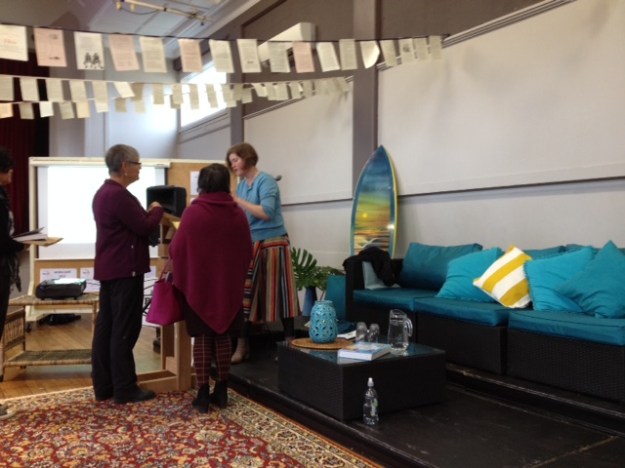
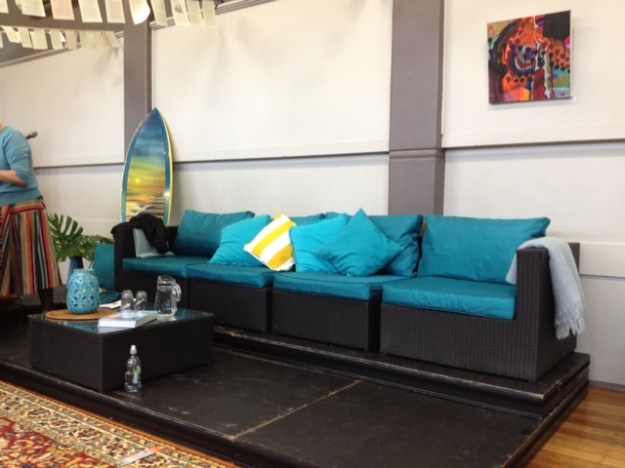
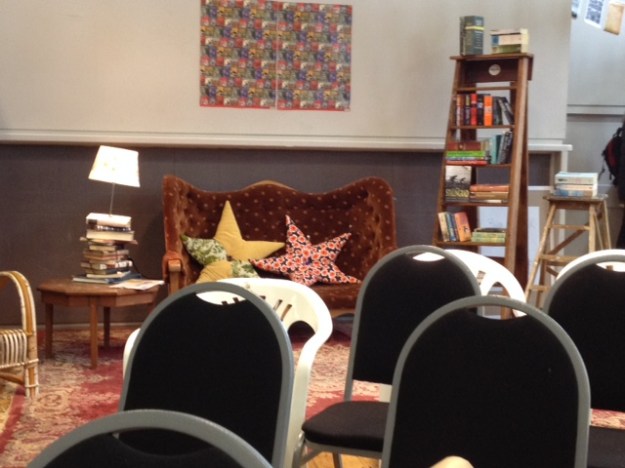
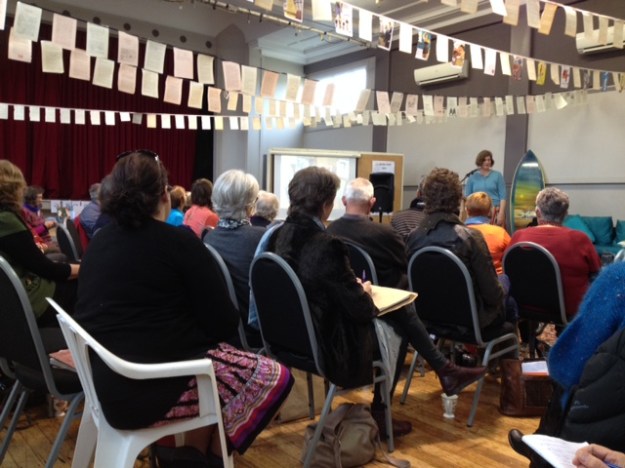
This is the cosiest literary-festival hall I have been to. The organisers have worked hard to make such an inviting space. Yesterday I got to hear Sarah Laing give and illustrated talk on her Katherine Mansfield graphic model and it was inspired and inspiring. Loved seeing how the book took shape and how life, doubt and discovery sparked its final form.
Looking forward to my poetry session at 11.30 this morning.
After lunch my mother walks into the dining room
and my father and I both
blow our noses.
In the past when I thought about people my parents
were somehow
not among them. But some wound stayed
wide in all of us, and now I see in their faces
strange rivers and waterfalls, tilted over with broom.
You are watching the brown-paper covers of books grow
out around your father, as he dreams there
against the wall, thinking perhaps
how rocks are not quite lands.
Gregory Kan, from untitled sequence in This Paper Boat (Auckland University Press, 2016)
Kevin Ireland picked Gregory’s poem and had this to say: “Gregory Kan’s sequences in This Paper Boat are full of self-discoveries and surprises. The words really do swirl around and head off in different directions — just like the paper boats that inspired them.”
Group Two (go here for poems)
Tusiata Avia
‘I cannot write a poem about Gaza’
Fale Aitu/ Spirit House
(VUP, 2016)
picked:
Teresia Teaiwa
‘Fear of Flying (in broken Gilbertese)’
Poetry Foundation site
Kevin Ireland
‘Flying across Australia’
Looking out to sea
(Steele Roberts, 2015)
picked:
Gregory Kan
[Any of the sequences]
This Paper Boat (AUP, 2016)
Diana Bridge
‘Big Bang’
In the supplementary garden
(cold hub press, 2016)
picked:
John Dennison
‘Sleepers’
Otherwise
(AUP, 2015)
Andrew Johnston
‘Deuteronomy’
Fits and Starts (VUP, 2016)
picked:
Bill Nelson
‘The whys and Zs’
Memorandum of Understanding (VUP, 2016)
Michael Harlow
‘The late news’
Nothing For It But To Sing (OUP, 2016)
picked:
Paul Schimmel
‘With Words’
Reading the Water (Steele Roberts, 2016)
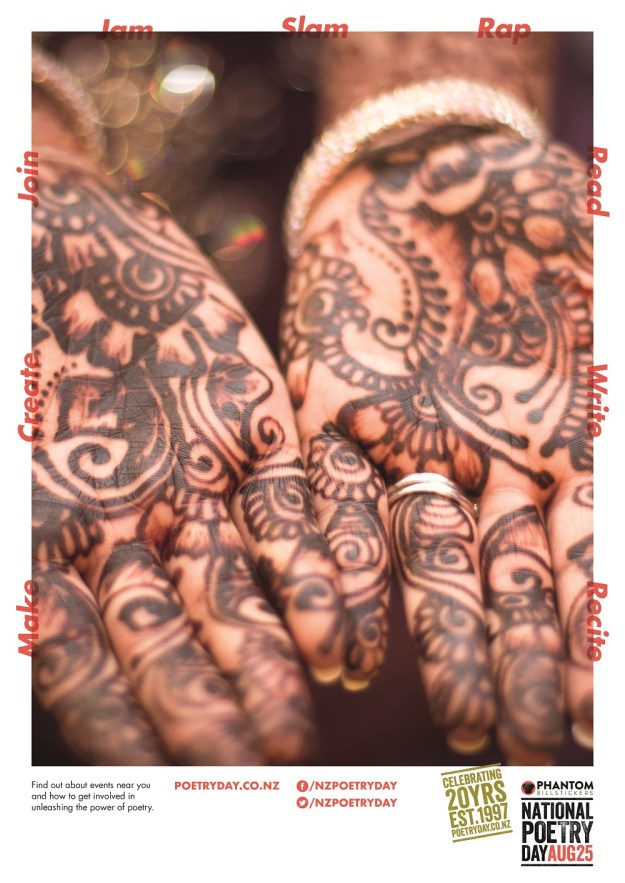
Phantom Billstickers National Poetry Day celebrate 20 years with diverse
poetry collection
To mark the 20th anniversary of Phantom Billstickers National Poetry Day (NPD), 20 leading Kiwi poets were asked to select one of their own poems, something they felt spoke to New Zealanders now. They also chose a poem by an emerging poet, writers they feel make essential reading for us in 2017.
The result is the 20/20 Collection – 40 poems by New Zealand poets who represent the diversity and vibrancy of talent in our contemporary national literature. The list includes Poet Laureates, Ockham New Zealand Book Awards winners, and strong new voices from recent collections and anthologies.
NPD has been running continuously since 1997 and is always celebrated on the last Friday in August. Poetry enthusiasts from all over New Zealand organise a feast of events – from poetry slams to flash and pop-up events – in venues that include schools, libraries, bars, galleries, surf clubs, and parks. This year’s NPD will be held on Friday 25 August.
Launched on May 24, the 20/20 Collection will be published in groups of ten poems between now and NPD. Featured poets are: Jenny Bornholdt and her pick, Ish Doney; Paula Green and Simone Kaho; Vincent O’Sullivan and Lynley Edmeade; Apirana Taylor and Kiri Piahana Wong; Alison Wong and Chris Tse; Tusiata Avia and Teresia Teaiwa; Kevin Ireland and Gregory Kan; Diana Bridge and John Dennison; Andrew Johnston and Bill Nelson; Michael Harlow and Paul Schimmel; C.K. Stead and Johanna Emeney; David Eggleton and Leilani Tamu; Elizabeth Smither and Rob Hack; Richard Reeve and Michael Steven; Robert Sullivan and Ngahuia Te Awekotuku; Bill Manhire and Louise Wallace; Selina Tusitala Marsh and Reihana Robinson; Cilla McQueen and David Holmes; James Norcliffe and Marisa Capetta; and Brian Turner and Jillian Sullivan.
Paula Morris, NPD spokesperson for the New Zealand Book Awards Trust, said that she was “excited to see the range of voices selected here, and the ethnic and geographic diversity in the poets chosen by our twenty established writers. This list speaks to a ‘new’ New Zealand literature, and reflects how much our culture is changing and growing.”
Many of the poets featured in the 20/20 Collection will take part in events on 25 August, Phantom Billstickers National Poetry Day 2017. Event organisers are encouraged to register their poetry event online as soon as possible: http://www.nzbookawards.nz/national-poetry-day/how-to-register-your-event/.
Now into their second year of naming rights sponsorship of National Poetry Day, Phantom Billstickers will support NPD and 20/20 on the ground, online and in print, with funky billstickers that celebrate our nation’s poets. Business Development Manager Kelly Wilson says, “If given a platform, poetry speaks to people. We are very proud at Phantom to support National Poetry Day and provide platforms all around the country for the poetic voice of New Zealand.”
Phantom Billstickers National Poetry Day is proudly administered by the New Zealand Book Awards Trust.
Notes to Editors
National Poetry Day was established in 1997 with a mandate to celebrate discovery, diversity, community and pushing boundaries. It is a one-day national poetry-event extravaganza held on the last Friday of August each year. This is the second year of National Poetry Day operating under the sponsorship of Phantom Billstickers.
Phantom Billstickers is a street poster company which has consistently helped New Zealanders express themselves since 1982. Recognising and supporting home-grown talent has always sat comfortably alongside its commercial campaign work. Phantom actively promotes New Zealand music, art, poetry and culture around the country and across the world, putting poetry on posters and a literary mix of work into cafes via its quarterly magazine Café Reader.
The New Zealand Book Awards Trust was established as a charitable trust in 2014 to govern and manage the country’s two major literary awards – The Ockham New Zealand Book Awards and the New Zealand Book Awards for Children & Young Adults – as well as National Poetry Day, and to ensure their longevity and credibility.
The 20/20 Collection features work by living New Zealand poets with one exception: Tusiata Avia’s selection of a poem by Teresia Teaiwa. Sadly, Teresia died of cancer in March, aged just 48. She was a much loved and influential
figure in Pacific studies, and the committee hopes that her inclusion in 20/20 encourages more people to seek out her important creative and critical work.
Paula Morris (Ngati Wai, Ngati Whatua) is an award-winning novelist, short story writer and essayist. A frequent book reviewer, interviewer and festival chair, Paula holds degrees from universities in New Zealand, the U.K. and the US, including a D.Phil from the University of York and an MFA from the Iowa Writers’ Workshop. She is convenor of the Master in Creative Writing programme at the University of Auckland in New Zealand.