I am off to Word Cafe in Raglan this weekend to do a poetry session on Sunday morning – might get to see Sarah Laing talk about her book on the Saturday.
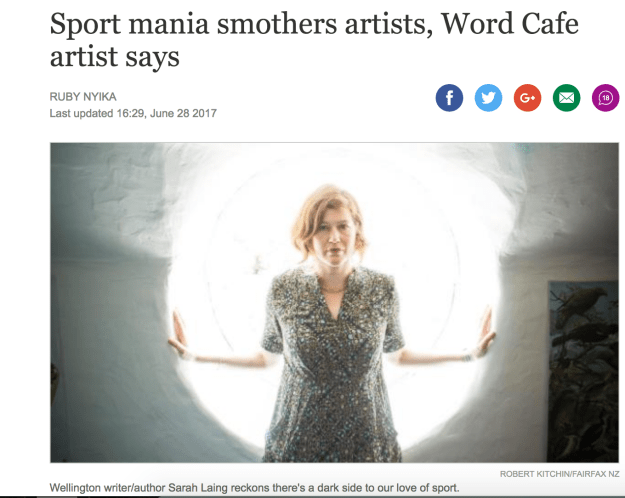
Full article with Sarah’s musings here

I am off to Word Cafe in Raglan this weekend to do a poetry session on Sunday morning – might get to see Sarah Laing talk about her book on the Saturday.
Full article with Sarah’s musings here
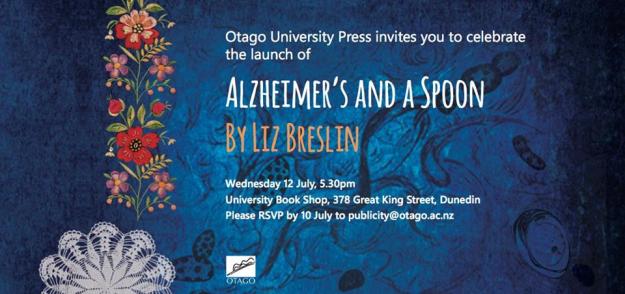
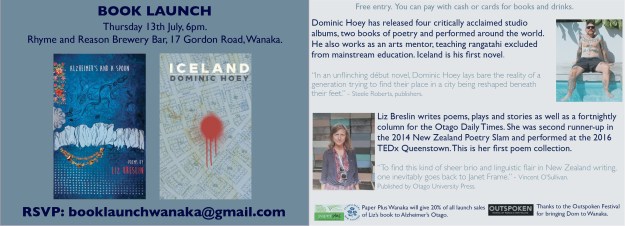
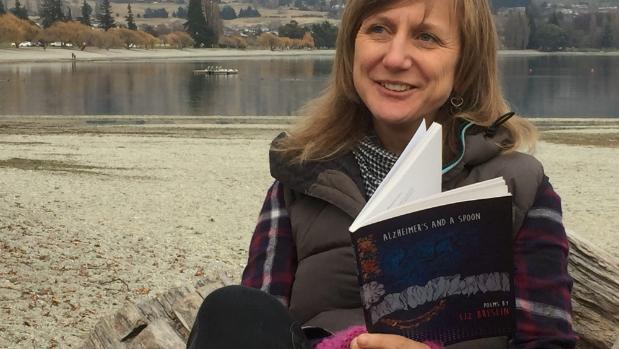
Wanaka poet, Liz Breslin, reads her poem ‘Dichotomy,’ from her first published collection of poems, Alzheimer’s and a Spoon, published by Otago University Press, and to be launched in Wanaka on July 13th.
From Liz:
What’s better than a book launch? A double book launch. A double book launch with beer. A double book launch in Wanaka with beer brewed in Wanaka. Words by Liz Breslin and Dominic ‘Tourettes’ Hoey. Books – a novel and some poems. Beer.
Come and listen to Dom and Liz launch their new books. Dom’s novel has been called ‘an unflinching début’ and Liz’s poems have got ‘sheer brio and linguistic flair.’ Since Liz has got the rhymes covered, is Dom bringing reason? Maybe. Probably. Possibly.
He describes his novel, Iceland, as “a tragic love story set in the neighbourhood. It’s about what happens when people are forced to live in a memory of their home. There’s also lots of funny stuff too.”
You’d think funny stuff would be short on the ground in a book about Alzheimer’s, but there’s also humour in Liz’s book. Her back cover blurb says –
“Alzheimer’s and a Spoon takes its readers on a tangled trip. Public stories – a conversation at the Castle of the Insane, online quizzes to determine if you’re mostly meercat or Hufflepuff. #stainlessteelkudos. Personal tales, of Liz’s babcia, a devout Catholic and a soldier in the Warsaw Uprising, who spent her last years with Alzheimer’s disease. There is much to remember that she so badly wanted to forget.”
Dom’s coming to the launch thanks to the Outspoken Festival – and he’s definitely an outspoken entertainer himself. Luc Bohyn, Outspoken’s originator, is excited to bring Dom down as it creates the synergies he enjoyed about Outspoken. Different voices in the same space always make for an interesting evening.
Liz and Dom’s books are as diverse and entertaining as their creative careers are to date. Dom has two poem collections and four studio albums to his name – this is his first novel. He also performs spoken word, is working on a one-man play and spends his time teaching rangatahi excluded from mainstream education.
Liz is known to some people locally for her fortnightly column in the Otago Daily Times, or for her plays, and though she’s had individual poems published, this is her first collection.
“I’m totally completely massively delighted to be published by Otago University Press,’ says Liz. “They’ve been brilliant to work with, and I love having the professional standards and support.”
Liz and Dom are both “pretty good performers” and looking forward to entertaining people when sharing their words at Rhyme and Reason.
And what a great place for a celebration! Apart from the name being an obvious fit, Rhyme and Reason have got their own beers on tap, a selection of other local brews, a tonne of enthusiasm and their own font. And what word nerd doesn’t want to have a ook launch in a brewery that has its own font?
Launch details:
Thursday July 13th, Rhyme and Reason brewery bar, 17 Gordon Road, 6pm.
No entry charge. You can pay cash or EFTPOS for books and drinks.
Paper Plus will be selling books and donating 20% of all launch sales of Liz’s book to Alzheimer’s Otago.
rsvp: booklaunchwanaka@gmail.com
A personal essay by Kaipara novelist Kelly Ana Morey. ‘I can’t be the ‘Māori’ writer people want me to be,’ she writes, ‘all I can be is myself.’
Two weeks ago I buried my father. He had a good innings and largely got to die in the privacy and comfort of his own home due to sterling care-giver work by my brother. For which I will be forever grateful to him. It’s not an easy job. After the service we took Dad up to Kaitaia cemetery which has sweeping views across Pukepoto and out to Ahipara. It was a still hazy day and out near the coast a tyre fire raged. Thick black smoke roiling across a galvanised sky as the home fires burnt. I looked around the extended Far North family gathered at the graveside. So many brown faces. If I ever have any doubt about exactly who at least half of me is, all I have to do is come back to Kaitaia. “You’re a Hori just like the rest of us,” the cousins joke as we sit on car bonnets afterwards, frantically sucking at cigarettes and talking about how long it’s been since we gave up the smokes.
And they’re right. I am a Māori. In my own funny way. And it’s connected to here, the Far North where my great grandfather, the Jewish trader, met and married Katerina, a high-ranking Ngāti Kuri woman. They started a family and set up trade stores to service the far northern gum fields. This should be the place I feel the most grounded, and yet I don’t. To be honest I don’t even know why I feel so ambivalent about the north. I think it’s somehow tangled up with my mother’s trenchant unhappiness that is deeply buried here in a location she never learned to love.
Full article here
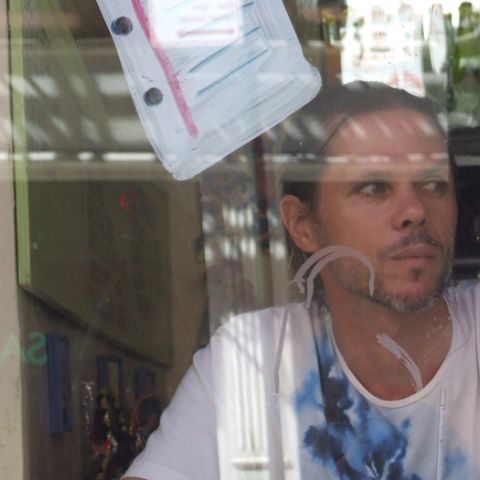
New Zealand poet Charles Olsen receives the XIII Distinction POETAS DE OTROS MUNDOS (‘Poets From Other Worlds’) awarded by the Fondo Poético Internacional (‘International Poetry Fund’) in recognition of the high quality of his poetic oeuvre.
Son of an Anglican priest and an opera singer, Charles Olsen moved to England in 1981 and to Spain in 2003. He travelled to Spain because of his interest in the Spanish painters Velasquez and Goya, and to study flamenco guitar. He has published the poetry collections Sr. Citizen (Amargord, 2011), which includes a foreword by New Zealand poet Pat White, and Antípodas (Huerga & Fierro, 2016). His poems have been included in anthologies in Spain and Colombia as well as Blackmail Press (editions 28 and 39) and the latest NZ Poetry Yearbook 2017 (Massey University Press). Although he didn’t speak Spanish before moving to Spain now writes many of his poems in Spanish and has also translated many Spanish and New Zealand poets.
He has also taken his poetic vision into different areas such as the performance Agita Flamenco which premiered in the New Zealand pavilion of the Venice Biennale – a show including flamenco dance and piano – and his poetry films, which have been shown in festivals such as Liberated Words (Bristol), Sinestèsia (Barcelona), and ZEBRA Poetry Film Festival (Berlín). He collaborated with video-creations in the show Parpadeos, presented this year in the Netherlands Flamenco Biënnale.
For the last six years he has run the online poetry project Palabras Prestadas (Given Words) with the participation of poets from throughout the Spanish-speaking world and this year he is running a special edition of Given Words in English for the Phantom Billstickers National Poetry Day which is open to all New Zealanders.
His partner, Colombian poet Lilián Pallares, with whom he runs the audiovisual producer antenablue – the observed word, has been awarded at the same time the XIV Distinction POETAS DE OTROS MUNDOS. In 2011 she was selected as one of the ten best young writers of Latin America by About.com, New York. Charles recently translated her book of short stories ‘Sleepwalking City‘ into English.
The awards will be presented by the Aragonese poet, Ángel Guinda, president of the Fondo Poético Internacional, on Sunday 9th July of the current year, in Madrid, Nakama Bookshop (Calle Pelayo 22), at 12:30 midday.
The previous distinctions have been awarded to the poets Theodoro Elssaca (Chile), Subhro Bandopadyay (India), Zhivka Baltadzhieva (Bulgaria), Mohsen Emadi (Iran), Ahmad Yamani (Egypt), Inés Ramón (Argentina), Rubén Grajeda Fuentes, ‘Leo Zelada’ (Peru), Nicanor Parra (Chile), Abdul Hadi Sadoun (Iraq), Mohamed Alfaqueeh (Libia), Soleh Wolpé (Iran) and Luljeta Lleshanaku (Albania).
The third category for the Sixth International Hysteria Writing Competition is poetry. That means a poem with the very loose theme “things of interest to women.” Oh, and a maximum of twenty lines, not including spaces. Our writer in residence Alex Reece Abbott has asked some award-winning poets and judges from around the world to share their best pointers for writing poetry for her post this month – big thanks go to the fabulous Frankie McMillan; Camille Ralphs; Jane Clarke and Aki Schilz for their support and valuable insights.
Camille has also kindly shared a poetry generator, so even if you’ve never written a poem before, there’s plenty of ideas to get you started for our deadline of August 31 2017. You can enter the poetry category on the Hysteria website.
Remember, you can make as many entries to Hysteria as you like, and you are not restricted to any category, so you may like to check out our other pointers and generators for flash fiction and short stories too.
So, here’s what my cyberkuia (wise women online) around the world had to say about poetry…
 All the best for this project – here are my top tips for poetry…
Frankie McMillan is a New Zealand short story writer and poet. Her latest book ‘My Mother and the Hungarians and other small fictions’ (Canterbury University Press) was longlisted for the 2017 NZ Ockham Book Awards. In 2005, she was awarded the Creative New Todd Bursary.
Other awards include winner of the New Zealand Poetry Society International Poetry Competition in 2009 and winner of the New Zealand Flash Fiction Competition in 2013 and 2015. In 2014, she held the Ursula Bethell writing residency at Canterbury University and in 2017, the University of Auckland/ Michael King writing residency.
For the rest of the piece see here
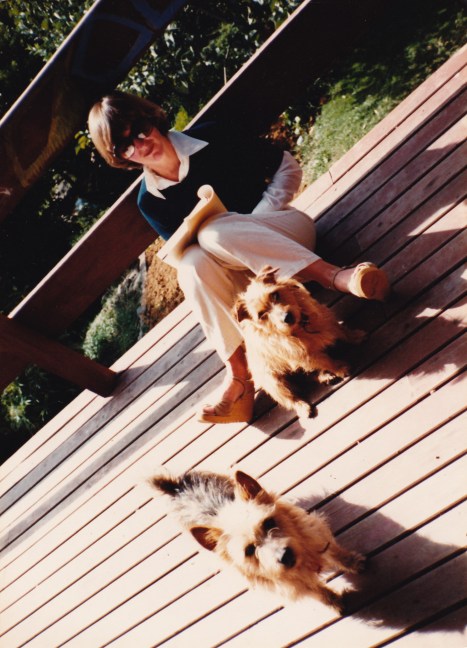
Elizabeth Smither with Rusty and Sneaky
‘The Labradors have made nests already
simply by lying in the long grass
sucking the green into their bodies’
from ‘Lying in the long grass between two black Labradors’ in Night Horse
I recently read through the alluring stretch of Elizabeth Smither’s poetry; from Here Come the Clouds published in 1975, to the new collection, Night Horse, just released by Auckland University Press. I was drawn into melodious lines, pocket anecdotes, bright images and enviable movement. Harry Ricketts talked about the transformative quality of Elizabeth’s poems in an interview with Kathryn Ryan, and I agree. As you follow reading paths from the opening line, there is always some form of transformation. The poetry, from debut until now, is meditative, andante, beautiful.
Elizabeth Smither has written 18 collections of poetry, five novels, five short story collections, journals, essays and reviews. She was New Zealand’s Poet Laureate (2001-3), was awarded the Prime Minister’s Award for Literary Achievement in Poetry in 2008, the same year she received an Hon D. Litt from Auckland University. She has appeared widely at festivals and her work has been published in Australia, USA and UK.
To celebrate Night Horse (Auckland University Press, 2017), Elizabeth agreed to answer a few questions.
‘You can run as fast as Atalanta
who bowled three apples at her suitors
Double Red Delicious’
from ‘An apple tree for Ruby’ in Night Horse
What sparked your imagination as a child? Was reading a main attraction or did you also write? Did particular books endure?
Reading and writing. I liked to say long sentences to myself as I walked. The first thing I can remember writing about was my pet New Zealand White rabbit. All the usual books of the period: Anne of Green Gables, Little Women, A Girl of the Limberlost which I found faintly terrifying. I can see these are the precursors of George Eliot and Jane Austen. As a teenager I had a crush on French writers: Colette, Gide, Mauriac, Sartre, de Beauvoir, Simenon. My father was a great novel reader and he impressed on me the sacrifices made by writers like Charles Dickens. I was scared of Quilp in The Old Curiosity Shop and never got past the page on which he appeared.
‘The cats are out by the letterboxes
at the ends of long driveways
waiting to see how the night will shape itself.’
from ‘Cat night’ in Night Horse
Your debut poetry collection, Here Come the Clouds, appeared in 1975, your eighteenth volume, Night Horse, was published in June this year. I see the same poetic attentiveness and ability to assemble detail that both stalls and surprises the reader. Do you see any changes in the way your write poems, or what you bring to poems, over the past decades?
Elizabeth Caffin wrote of an assured voice but I am unaware of it. I think it is more a question of a philosophy: Keats being lost in the leaves of a tree; being most ourselves when we are unconscious of what the self is; not feeling we are the centre of the universe but one of its parts. It is also a balancing act: the outside world meeting the interior; the sad existing alongside the pleasing, our mixed motives and our inability to ever know more than a fraction. In compensation we have the lovely leap of the imagination. I think poetry in many ways is a dare.
Have any poets or books affected or boosted your poetic directions?
Wallace Stevens was a huge discovery. I used to spend a year reading a major poet. Stevens, Roethke, Berryman, Plath, Sexton, Bishop, Lowell, Synder, The Beats, Black Mountain. Now I am less of a swot and read wherever I please. And when I am tired and jaded I re-read Hercule Poirot.
‘More moon tonight. 14 per cent bigger
and closer to the earth. The whole sky
seems to leap to greet a visitor.’
from ‘Perigee moon’ in Night Horse
In 1975, very few women poets were getting published in New Zealand. Did you feel you were writing within a community of poets? Men or women? Was it difficult to get your first book out?
Part community, part social movement: Greer, Friedan, Steinem, Kedgley, Mead. The United Women’s Convention. We were all swallowing American poets at that time, looking for a freer way forward. My first book I owe to Sam Hunt who was visiting and found a folder of poems he gave to Alister Taylor. After Alister came McIndoe and then AUP.
‘Fast the pulse of the music, every beat
clear as a little stream running over stones’
from ‘At the ballet’ in Night Horse
Your new collection is a delight to read and offers so many poetic treats. I was thinking as I read that your poems are like little jackets that can be worn inside out and outside in. In stillness there is movement and in movement there is stillness; in musicality there is plainness and in plainness there is musicality. In the strange there is the ordinary and in the ordinary there is the strange. What do you like your poems to do?
I want them to do everything. Everything at once. I want them to feel and think (and feel the thinking in them as you read). I want them to be quick, in the old sense of the word: the opposite of dead. I want them to not know something and try to find it out – I would never write a poem with prior knowledge – I think ignorance can be bliss or at least start the motor. And as I write more I find out more and more about musicality. Isn’t one of the loveliest moments in music when harmony breaks through discord as though it is earned and you know that discord, instead of being a thicket or a dark wood, is part of it?
‘Down their sleeves (his jacket, her blouse)
run currents the early evening stars detect
and whose meaning is held in great museums’
from ‘Holding hands’ in Night Horse
I love that idea! What attracts you in the poetry of others?
Boldness, form (the pressure of it), language as clear as it can be, given the difficulty or otherwise of the content, not being self-centred, engaging the reader. Visceral was the quality Allen Curnow looked for when I had the temerity to leave a poem in his letterbox. ‘I poked it with a stick and it was alive.’ James Brown does it in ‘Flying Fuck’ (‘The Spinoff, June 9, 2017); Stephen Romer in some lines about cleaning a barn (‘Carcanet Eletter: Set Thy Love in Order)
‘Perhaps in our cool northern air
you rose some echelons
being lighter, the barn empty’
while Carol Ann Duffy excoriates Theresa May with lines that reach back to the roots of poetry:
‘The furious young
ran towards her through fields of wheat.’
‘Morals that are so pure they blaze
the sunlight back into the air’
from ‘A landscape of shining of leaves’ in Night Horse
Janet Frame worked hard to get the rhythm right in her poems and she wasn’t always satisfied (ah, the rogue self-doubt! I adore her musical effects). I find you are able to slow down the pace of your poems so that I linger as reader upon an image, a word, an anecdote, a side-thought to see what surfaces. Does this reflect your process as a writer?
I think, since I write in longhand, it may echo the pauses during composition.
Do you, like Janet and countless other poets, have poetry anxieties?
Just the big anxiety, the generalised one. To be better, to get closer, to go deeper, knowing that a rigorous equation awaits. I particularly felt this in ballet: any advance, even within the safety of a spotlight, opened a further and equivalent unknown. My other anxiety is that, having embarked on a poem at speed and decided on a stanza form, the stanzas won’t add up when I have finished.
‘Eggs in foil were hidden everywhere
until the taste of sweetness palled.
She sits in an armchair with her bear’
from ‘Ruby and fruit’ in Night Horse
Your poetry does not slip into a self-confession or grant a window on your most private life, yet it acts as an autobiographical record of your relations with the world, people, animals and objects. How do you see the relationship between autobiography and your poems?
Some of the recent autobiographical poems remind me a little of Elgar’s ‘Enigma Variations’. Ruminating portraits of friends or events illustrating a friend. The ‘Enigma Variations’ are tender but well-defined, different in tone. Autobiography, to me, has many hazards. We all excuse ourselves and even the most honest and analytic among us favour some perspectives over others. I feel confident that something of ourselves always gets in and reveals more than we can imagine. ‘Am I in this poem?’ has never worried me. I know I am.
Are there taboo areas?
No, never. It’s just a case of what you can handle.
‘It was all those unseen moments we do not see
the best of a friend, the best of a mother
competent and gracious in her solitude’
from ‘My mother’s house’ in Night Horse
‘Later you’ll scrub individual stains
from the white field: the rim of someone’s glass
down which a red droplet ran, a smear
of eggy quiche, a buttered crumb.’
from ‘The tablecloth’ in Night Horse
I especially love the ongoing friendship and granddaughter poems, but I particularly love the first poem, ‘My mother’s house.’ Kate Camp and I heard you read this at the National Library’s Circle of Laureates and were so moved and uplifted that we asked for copies! Unseen, you are observing your mother move through the house from the street (you gave us this introduction) and see her in shifting lights. The moment is extraordinary; are we are at our truest self when we are not observed? There is the characteristic Smither movement through the poem, slow and attentive, to the point of tilt or surprise. The final lines reverberate and alter the pitch of looking: ‘but she who made it/who would soon walk into the last room/of her life and go to sleep in it.’ Do you have a poem or two in the collection that particularly resonate with you?
I’m fond of ‘The tablecloth’ after I observed my friend, Clay, scrubbing at a corner of a white damask tablecloth in the laundry after a dinner party. It reminded me of the old-fashioned way of washing linen in a river. It’s both a doll-sized tablecloth and something almost as large as the tablecloth for a royal banquet around which staff walk, measuring the placement of cutlery and the distance between each chair. ‘Ukulele for a dying child’ tumbles all over itself in an incoherent manner because the subject is so serious and no poet can do it justice. The grandmother poems will probably be ongoing because it is such an intense experience: something between a hovering angel and a lioness. Going back to your remark about ‘My mother’s house’ I agree with the truth that is available in our unobserved moments. Perhaps there is a balance between our social and our private moments which might comprise something Keats called ‘soul-making’.
‘Next morning she was called again
to undo the work of her marvellous wrists.
“Miss Bowerman, can you let out the water?”‘
from ‘Miss Bowerman and the hot water bottles’ in Night Horse
There is no formula for an ending but I often get an intake of breath, a tiny heart skip when I read your poems. What do you like endings to do?
The endings I like best have some extravagance in them, like the ending of ‘Cat Night’ where the road which still retains the day’s warmth turns into carriages and cocottes on the Champs-Elysées.
‘Let the street lights mark
the great promenade down which love will come
like black carriages on the Champs-Elysées.’
There’s a big difference between the size of a cat and a carriage but the emotion is the same.
Which New Zealand poets have you read in the past year or so that have struck or stuck?
Diana Bridge, Claire Orchard, John Dennison, yourself in New York, Michael Harlow, Geoff Cochrane and all the laureates.
Or from elsewhere?
Lots of Australians. I’ve just read Rosemary Dobson’s Collected Poems.
Do you read widely in other genres?
Yes, I particularly like hybrid forms – travelogues that turn into miniature poetry collections, diaries, memoirs that admit to no rules as if they understand the psychology of the reader who is liable to become bored, and also the limits of being an author. My main love remains the novel, followed closely by the short story and the detective story.
I was once asked to pick a single New Zealand poem I love to talk about on Summer Noelle. What poem would you pick?
Since Allen Curnow: Simply by Sailing in a New Direction, a biography by Terry Sturm, edited by Linda Cassells and Allen Curnow: Collected Poems, edited by Elizabeth Caffin and Terry Sturm are being published by AUP later this year, and since our pohutukawa are threatened by myrtle rust, I would pick ‘Spectacular Blossom’.
‘ – Can anyone choose
And call it beauty? – The victims
Are always beautiful.’
Auckland University Press Night Horse page and author page
Booksellers review by Emma Shi
Radio NZ National review by Harry Ricketts with Kathryn Ryan
Video here
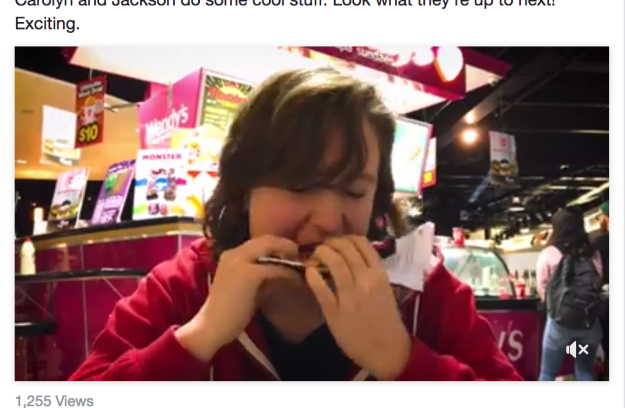
We’re hungry! Submissions are now open for issue three of Mimicry, guest-edited by Carolyn DeCarlo and Jackson Nieuwland of the zine ‘Food Court’.
Calling art, design, photography, music, poetry, fiction and nonfiction. Submit up to three pieces; for writing, 2000 words max per piece.
Email your submission to mimicryjournal@gmail.com with a personal bio of around 20 words.
Deadline 1 August 2017.
Video:
Starring Freya Daly Sadgrove
Song (edited from): Jalapeño by Hans Pucket
Video by Holly Hunter and Todd Atticus
An award-winning Christchurch writer and a literary historian/poet are the two University of Canterbury Ursula Bethell Writers in Residence for 2017.
Christchurch author Karen Healey writes books and short stories about smart girls with tough problems and angry boys with secrets. She’s the award-winning author of Guardian of the Dead, The Shattering, When We Wake, and While We Run. When We Wake was recently adapted as a Radio New Zealand dramatic reading. She also appears in the geek podcast The Nerd Degree, teaches high school English, and volunteers for the Green Party.
A UC alumna, Karen Healey says she is thrilled to receive the residency and has already planned what she’ll do with her time back at UC.
“I’m so grateful to UC – my alma mater! – for giving me this opportunity! The novel I proposed has been gnawing a hole in my backbrain for years, but I knew it would require dedicated research and writing time – and probably a university-level library. I didn’t have those things, so I worked on projects I could fit around my other commitments. Thanks to the generosity of UC and Creative New Zealand, I’m able to finally get to grips with this challenging work,” she says.
A former UC English academic, now Wellington-based, John Newton is a poet, literary historian and weekend musician. He is the author of The Double Rainbow: James K. Baxter, Ngāti Hau and the Jerusalem Commune (VUP, 2009) and three books of poetry, most recently Family Songbook (VUP, 2013). Hard Frost: Structures of Feeling in New Zealand Literature 1908-1945, to be published by VUP in October, is the first instalment of a three-volume history of New Zealand literary nationalism.
“My main project for the residency is a book-length satirical narrative in verse, provisionally titled Slack Key Guitar. The setting is an imaginary Pacific Paradise, not unlike Waiheke Island. Its themes belong loosely to the unofficial history of Romanticism,” he says.
Previous recipients of the residency include Owen Marshall (1981), Margaret Mahy (1984), Keri Hulme (1985), Fiona Farrell (1992), Sue McCauley (1993), Catherine Chidgey (2003), Charlotte Randall (2005), Carl Nixon (2006), Tusiata Avia (2010), and Eleanor Catton (2011).
About the Ursula Bethell Residency
Ursula Mary Bethell (1874–1945) was a Christchurch poet and artist. The Ursula Bethell Residency in Creative Writing, jointly funded by the University of Canterbury College of Arts and Creative New Zealand, was established by the University of Canterbury in 1979 to provide support for New Zealand writers and foster New Zealand writing. The Residency allows authors of proven merit in all areas of literary and creative activity an opportunity to work on an approved project within an academic environment. Since the residency’s inception, UC has been home to more than 40 fiction-writers, poets and dramatists, many of whom have made a valuable contribution to the development of young writers studying at the University.
In 1997 Landfall celebrated its 50th anniversary. To mark the occasion, then editor Chris Price launched the Landfall Essay Competition, sponsored by Otago University Press. From 2009, the competition has been an annual award.
The purpose of the competition remains as it was at the outset: to encourage New Zealand writers to think aloud about New Zealand culture, and to revive and sustain the tradition of vivid, contentious and creative essay writing in this country – as embodied in the non-fiction of early Landfall contributors such as Bill Pearson, in the essays of past winners of this competition, and in the essays the journal continues to publish.
Full details here
We are pleased to announce a new edition of Given Words for New Zealand’s Phantom Billstickers National Poetry Day, 2017. Last year the words were donated by Australian poet Les Murray, this year we have decided to do things a little differently.
In the first stage we would like you to send us a very short video saying one word of your choice (like in the promo video above). If you want to you can also briefly explain why you have chosen the word. Please send only one word per person. It can be a noun, verb or adjective, and any language spoken in New Zealand. Send the video by email to nzgivenwords@gmail.com along with your name and town. You can record it on any device – the quality is not important as long as we can hear the word clearly! The deadline for sending your words is Sunday 23 July, 2017. This is open to all New Zealand citizens and residents.
The second stage will begin on 1 August when we will publish a video with the selection of our five favourite words from all those you have sent us. Then you will have until National Poetry Day 25 August to send us your poem which must include each of the five words.
We will be awarding a prize for the Best Poem and a prize for the Best Poem by Under-16s. The winner of Best Poem will receive a copy of the New Zealand Poetry Yearbook 2017, courtesy of Massey University Press and the winner of the Under-16 category will receive a copy of Lonesome When You Go by Saradha Koirala courtesy of Mākaro Press. In addition the winning poems will be translated into Spanish and published on the Spanish version of the project Palabras Prestadas.
To receive updates about the competition please subscribe to our newsletter here. We only send emails related with this competition and you can easily opt out at any time.
Video credits: A big thank you to the Olive family and friends from Lower Hutt for donating your words!
If you want to be the first to know what we are doing please subscribe to our newsletter here. We only send emails related with this competition and you can easily opt out at any time.
You can also follow us on twitter @givenwords
For further enquiries you can contact us at nzgivenwords@gmail.com

