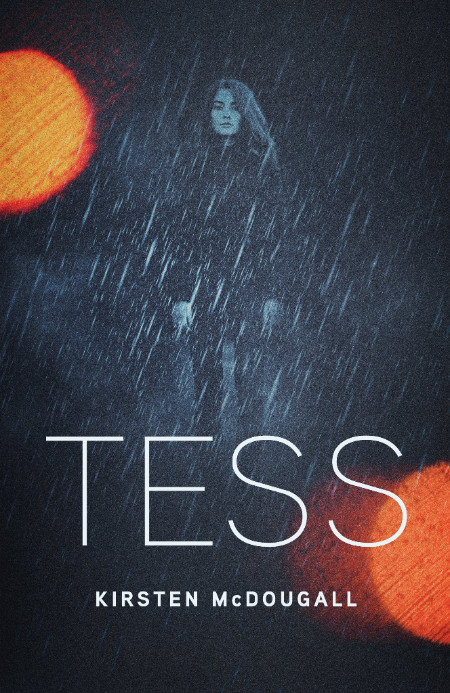
You are warmly invited to the launch of
Tess
by Kirsten McDougall
on Tuesday 15 August, 5.30pm–7.00pm
at Meow, 9 Edward St, Te Aro
Cash bar
Books will be for sale courtesy of Unity Books
$25, p/b
About Tess

You are warmly invited to the launch of
Tess
by Kirsten McDougall
on Tuesday 15 August, 5.30pm–7.00pm
at Meow, 9 Edward St, Te Aro
Cash bar
Books will be for sale courtesy of Unity Books
$25, p/b
About Tess
My children are abducted by 17th-century French courtesans
In the rose garden near the big house
where somebody famous was either
born, or not, all the ladies spread their
pinks out in the sun. Pretty young ladies
with expensive, dewy faces who want
my children for their photogenic walls.
They look as though they’re picnicking
with their floral bubbles and their green
men but their stiletto fingers give them
away. And my children were just feeding
ducks, but where have they gone?! Quick
say the birds Find them Find them, gobbling
their trails of bread. The ladies strengthen
in the light and their prickles rise and my
nose is so full of their French scent that
I start to sneeze. The ladies wilt a little in
revulsion. Their corals and blushes and rouges
are falling brown, then grey; old ladies with
shallow bones and prickles blunted with
age. And where are your children they
want to know and I want to know too.
I’ve looked everywhere. There’s a low
graze of desperation in my throat, which
stings as I call their names. I uproot one
of the ladies and use her to beat back a
path through the others, until they look
almost young again in the freshness
of their bruises. When I get back to the
pond most of the spinsters have frosted
in the ground. The children are there
wearing new fur coats. One is putting logs
on a fire, while the other pulls dinner
from the snow.
©Hannah Mettner, from Fully clothed and so forgetful (Victoria University Press, 2017)
Author note: This is the poem that helped me realise that there was a way to integrate the emotional authenticity that I want my poems to convey (in this case the fear of ‘losing my children’) with something less literal. For me, this meant that rather than merely ‘stating facts’ in a pleasant or interesting way with line breaks, I was able to tease out multiple concepts and feelings simultaneously in an environment less concretely related to the real world. So, this poem deals with my fear of losing my children after the breakup of my relationship with their father, but holds with that the fear of a potential ‘stepmother’, and the fear of them doing fine without me, but because none of this takes place in a recognisable world (rosebushes don’t usually turn into young women), I felt freer to say all that.
Hannah Mettner is a Wellington writer originally from Gisborne. She runs the online poetry journal Sweet Mammalian with Sugar Magnolia Wilson and Morgan Bach. Her first book, Fully clothed and so forgetful, came out earlier this year.
From Paula: For Poetry Shelf’s Winter Season, I invited 12 poets to pick one of their own poems that marks a shift in direction, that is outside the usual tracks of their poetry, that moves out of character, that nudges comfort zones of writing. It might be subject matter, style, form, approach, tone, effect, motivation, borrowings, revelation, invention, experimentation, exclusions, inclusions, melody …. anything!
Sad to miss this event! Glad I get to read to the book!
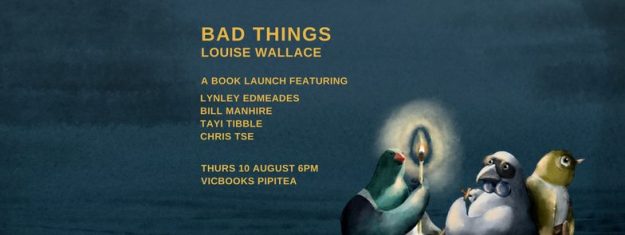

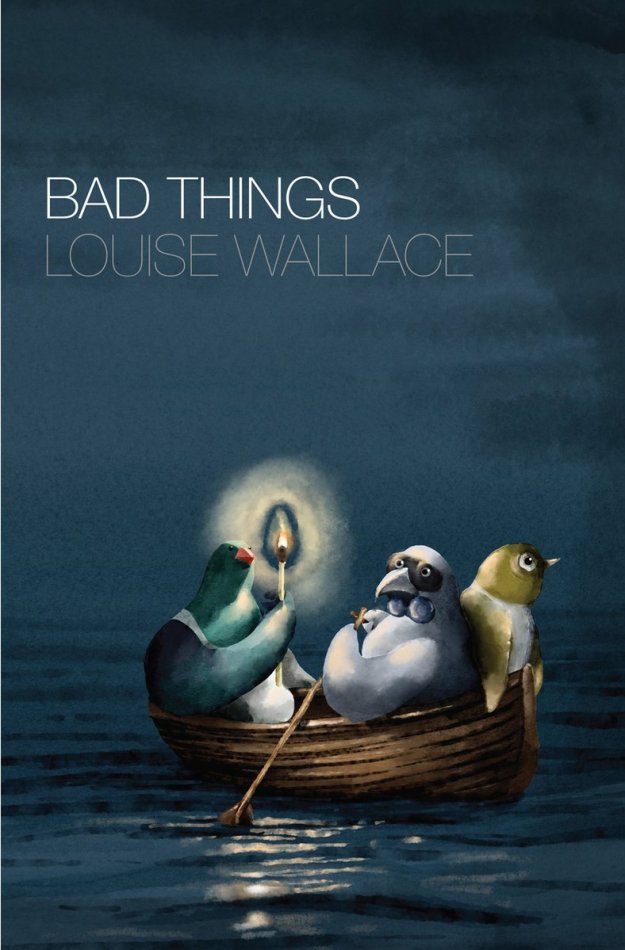
Book launch for BAD THINGS: a new book of poems by Louise Wallace. With readings from Lynley Edmeades, Bill Manhire, Tayi Tibble and Chris Tse. All welcome.
Books by all authors available for purchase on the night, along with limited edition cover art prints by Kimberly Andrews.
Drink, nibble, get your books signed and be merry.
VUP page
Nau mai, haere mai. Come and help celebrate the launch of Airini Beautrais’s new collection, Flow: Whanganui River Poems.
Featuring stories from the catchment, river and town.
Shipwrecks, floods, soldier-settlers, surveyors, missionaries, protests, poets, petrolheads, deviants, sly-groggers, environmentalists, heroes, anti-heroes and complicated characters.
With readings by Airini, Maria McMillan, and special guests.
All welcome. Drinks and nibbles will be served (in adjacent space as food and drink can’t be consumed in the museum. Please do not bring these items).

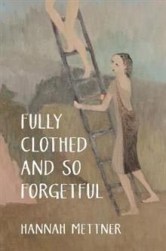
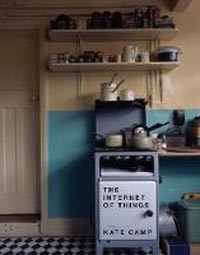
Fully Clothed and So Forgetful by Hannah Mettner (Victoria University Press, 2017), 91 pp., $25; The Internet of Things by Kate Camp (Victoria University Press, 2017), 61 pp., $25
One quality I love about first volumes of poetry is that they often contain an element of the poet’s origin story. Hannah Mettner’s Fully Clothed and So Forgetful certainly does: there are poems referencing childhood, relationships with siblings and wider family, elements of cultural confusion after an across-the-world move, parenthood – all described with deftness, wit and originality. How about that title? It’s a delight … inviting, and very human.
full review here
As Rick Stein would say, we need more of this! Such a very good idea.
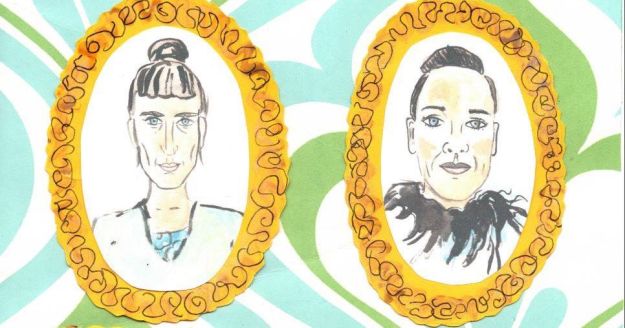
From Maria and Airini:
‘(Our portraits are by the wondrous Sarah Laing) Airini and Maria are going on tour in July! Like rock stars only way cooler. Napier 15th, Thames 16th, Auckland tbc, Wellington 28th, Palmerston North 29th and Paraparaumu Beach on the 30th. We’re promoting our new books: Maria‘s and Airini‘s.’
See here for details
Paula’s seven thoughts on Maria’s new book here.
Congratulations to the winners, commiserations to those who missed out and hats off to Victoria University Press for an extraordinary showing. VUP is a strong supporter of local writing, publishing more poetry that anyone else without compromising on quality. Three cheers VUP! Hats off to all NZ publishers, large and small, who back local writers and books. We are in debt to you. Away from the glitz and flare of an awards ceremony, there is an active terrain of writing and writers. Hats off to that too!
And hats off to the winners! Enjoy this moment of well-deserved recognition by your peers.
This year’s four category award winners will appear at a free event at the Auckland Writers Festival: The State We’re In on Friday 19 May at 5.30pm in the Heartland Festival Room, Aotea Square.
Fiction: Catherine Chidgey
Internationally renowned Ngāruawāhia resident Catherine Chidgey has won New Zealand’s richest writing award, the $50,000 Acorn Foundation Fiction Prize, for her novel The Wish Child. The award was announced this evening at the 2017 Ockham New Zealand Book Awards.
The panel of judges — Bronwyn Wylie Gibb, Peter Wells, Jill Rawnsley and inaugural international judge the Canadian writer Madeleine Thien — said “The Wish Child exposes and celebrates the power of words – so dangerous they must be cut out or shredded, so magical they can be wondered at and conjured with – Chidgey also exposes the fragility and strength of humanity … Compelling and memorable, you’ll be caught by surprise by its plumbing of depths and sudden moments of grace, beauty and light.”
The Wish Child, Chidgey’s fourth novel, comes 13 years after her last work, The Transformation, was published to critical acclaim. Chidgey’s previous novel Golden Deeds was chosen as a Book of the Year by Time Out (London), a Best Book by the LA Times Book Review and a Notable Book of the Year by the New York Times. Her debut novel, In a Fishbone Church, won a Commonwealth Writers Prize (South East Asia and South Pacific).
Her latest novel, published by Victoria University Press, is one of four Ockham New Zealand Book Awards category winners, selected by four panels of specialist judges out of a shortlist of 16, which were in turn drawn from 40 longlisted titles from 150 entries.
Poetry: Andrew Johnston
Paris-based Andrew Johnston won the Poetry category for his collection Fits & Starts (Victoria University Press), a book described by the category’s judges’ convenor, Harry Ricketts, as a slow-burning tour de force.
“The judges’ admiration for Andrew Johnston’s remarkable collection grew with each rereading, as its rich intellectual and emotional layers continued to reveal themselves … Using a minimalist couplet-form, the collection is at once philosophical and political, witty and moving, risky and grounded, while maintaining a marvellously varied singing line.
“To reward Fits & Starts with the overall poetry prize is to reward New Zealand poetry at its most impressive and its most promising.”
Nonfiction: Ashleigh Young
Ashleigh Young (Wellington) took the Royal Society Te Apārangi Award for General Non-Fiction for her collection of personal essays Can You Tolerate This? (Victoria University Press).
The category’s judges’ convenor, Susanna Andrew, says Young’s work sets a high bar for style and originality in a form that has very little precedent in this country. “Always an acute observer, it is in Young’s commitment to writing as an art that the true miracle occurs; she tells us her story and somehow we get our own.”
Young catapulted to international recognition earlier this year when she won the Yale University US$165,000 Windham-Campbell Prize for the collection.
Illustrated Non-Fiction: Barbara Brookes
Dunedin writer and historian Barbara Brookes won the Illustrated Non-Fiction category for her meticulously documented work A History of New Zealand Women (Bridget Williams Books).
The category’s judges’ convenor, Linda Tyler, says Brookes’ work combines deep research, an immensely readable narrative, superbly well-integrated images and is distinguished by close attention to both Māori and Pakehā women.
“Putting women at the centre of our history, this sweeping survey shows exactly when, how and why gender mattered. General changes in each period are combined effortlessly with the particular, local stories of individual women, many not well-known. A wider sense of women’s experiences is beautifully conveyed by the many well-captioned artworks, photographs, texts and objects.”
Best First Books:
The Judith Binney Best First Book Award for Illustrated Non-Fiction: Ngarino Ellis for A Whakapapa of Tradition: 100 Years of Ngāti Porou Carving, 1830-1930, with new photography by Natalie Robertson (Auckland University Press).
The Jessie Mackay Best First Book Award for Poetry: Hera Lindsay Bird for Hera Lindsay Bird (Victoria University Press).
The E.H. McCormick Best First Book Award for General Non-Fiction: Adam Dudding for My Father’s Island: A Memoir (Victoria University Press).
The Hubert Church Best First Book Award for Fiction: Gina Cole for Black Ice Matter (Huia Publishers).
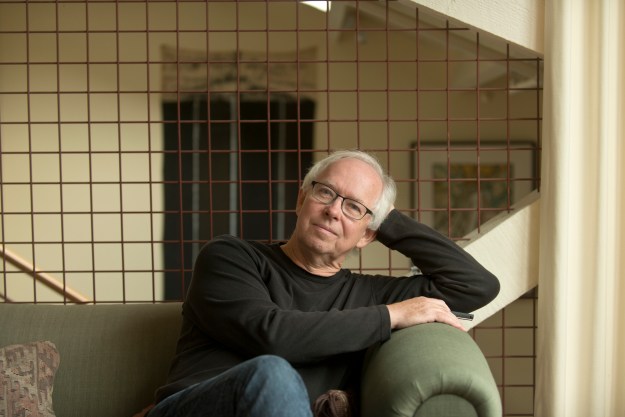
Photo Credit: Grant Maiden
‘Did you all survive?
On that first day of school, I mostly remember
being terrified: the dark interior, the children in rows
at their separate desks, and I was now to be one of them.
In a field by the school, there were bales of hay.
I remember inkwells.
That was perhaps a harder day.’
from ‘The Question Poem’
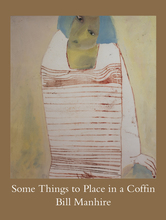
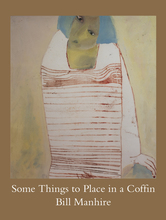
Some Things to Place in a Coffin Bill Manhire (Victoria University Press, 2017)
Bill Manhire’s new collection of poetry offers the reader a sumptuous reading experience: there is coolness, heat, air, movement, suspension. There are some poetry books that maintain a cavernous distance as I read, but I just click with Bill’s poems. My review of Bill’s book of riddles, Tell me My Name, is here.
Bill lives in Wellington, and is an emeritus professor at Victoria University. His first book of poems, The Elaboration, with drawings by Ralph Hotere, appeared in 1972.
PG: What challenges you most when you write a poem?
BM: Getting properly underway. I’m quite good at finding phrases that nag away at me, and I keep them in my head or on paper – but finding my way forward from them can be a problem, or even knowing if I can find my way forward. I seem to know how long a poem is going to be, roughly what its shape will be and so on, but things often collapse about two thirds of the way through. I suspect there are quite a few poems over the years where it looks like I’ve landed on my feet near the end but I’ve actually broken my ankle.
PG: What delights you most?
BM: Knowing that a poem is actually there, but that it needs some work to be fully itself. Doing that last little bit of work – so different from whatever inspiration is supposed to be – is strangely exhilarating.
PG: Your new collection, as with Lifted and Victims of Lightning, refreshes what poetry can do: how it can soothe and challenge and prompt wonder. Initially the Zen-like movement of the poems struck me (or you could track an oxymoron effect): silence yields music, stillness leads to activity, simplicity yields knots, economy yields richness. Such movement prolongs contemplation. Have you ever thought of your poetry in this way?
BM: I don’t think I think very deeply or coherently about poetry, especially my own. I don’t have any aims when I write, even with a commissioned poem like ‘Known unto God’. But I get great pleasure from a poem when at some point it pushes me sideways from myself, pushes me out of habitual assumptions, changes the pace of my inner life. I like it when a poem starts off quietly and then starts resonating – a sort of ripple effect – and I certainly like it when a poem looks innocent and amiable then suddenly gets dangerous and agitating. Tonal shifts – code-switching, logopoeia – seem to be key to individual poems, too; and maybe even more, inside a book, to the way poems keep each other company.
The window waits for light.
The path to the river waits
for twigs and stones ands feet.
The day hopes to be successful,
a prose day really, nothing untoward
and so it, too, waits. Also the car waits.
from ‘Waiting’
PG: There are several ‘waiting’ poems and it seems to me this book has benefited from a different relationship with time (a little like your Menton sojourn did for Lifted). Away from your hectic university life, has your time with poetry changed to the degree you are able to wait with a poem differently?
BM: It’s not in the least relevant, but I think Waiting for Godot is the great poem of the 20th century.
I don’t think this is what what you’re getting at either, but we all start out in the world full of appetite and desire and with a strong sense only of the immediate moment. And then I suppose there’s that troubling, invigorating phase later that mixes memory and desire, to borrow the start of Eliot’s The Waste Land. Your past and future are fighting it out in the present. And then if you last the distance there’s a lot more past and much more of this thing called memory, which as someone said is pretty much the imagination in reverse. I think I’m in this last time zone. I’ve even prefaced the collection with a little poem about memory.
PG: I found the ‘waiting’ poignant because it felt both philosophical and political.
BM: That’s a generous way of putting it. I suspect it’s more that I’m very much a fatalist. This probably has something to do, someone once told me, with being the child of an alcoholic – you’re totally under the circumstances. The great human beings are the ones who change the circumstances, or have a shot at doing so. But my feeling is that most of the time most of us are under the circumstances, and so how you behave is what measures your worth as a human being.
They dug me up in Caterpillar Valley
and brought me home –
well, all of the visible bits of me.
Now people arrive at dawn and sing.
And I have a new word: skateboarding.
from ‘Known unto God’
PG: The collection seems open to anything (Chairman Mao’s impersonator, surveillance notes, the school bus, the trenches, a Sunday School mural, a body blown to bits, war, Ralph Hotere’s coffin). Do you have no-go areas as a poet?
BM: I’m pretty protective about my personal life. No one could accuse me of oversharing. If you were to try and turn the first-person I in my poems into someone called Bill Manhire, it would all be pretty baffling. Sometimes it’s someone else altogether, sometimes someone with some of my features, sometimes (but rarely) the full myself. As Emily Dickinson says, ‘When I state myself, as the representative of the verse, it does not mean me, but a supposed person.’
Of course the life is there in certain poems, but displaced or approached obliquely. ‘The Question Poem’ deals with the aftermath of an event like the Christchurch earthquake, but the speaker in the poem, trying to deflect the very direct questions about catastrophe, reaches back to memories of his first day at school – and I guess that’s essentially my own first day at school. Likewise, ‘The Schoolbus’ is fairly true to a particular patch of my childhood.
But I’m never a completely missing person. I’m there in every poem in some form or other, even if it’s just via a small tonal inflection or a tiny hesitation.
How Memory Works
Come over here
we say to the days that disappear.
No, over here.
PG: You are the master of the miniature poem—I liken your examples to a drop of wine that dances on the tongue. What attracts you to this form? What holds your attention in a small poem?
BM: I think I’m drawn to the short poem for visual rather than auditory reasons. There’s nothing more wonderful than a few words, just two or three lines, sitting in the middle of a white page. The words and letters start to grow out into the space around them – which I guess is what you also want the reader’s imagination to do. In some ways the words look vulnerable, but to me they’re powerful.
I like putting little poems on Twitter, and that’s partly because I miss the days when I could type out a handwritten poem and see it as it as itself without my protective care. You need to find ways of making poems remote, independent – there they are on the screen, out in the world. But there’s something undermining about the way Twitter clutters the screen, so it’s not the same.
Soon enough the enemy will come,
limping out of a place that will not heal.
And soon enough it will be gone,
this world that you once woke into.
from ‘The Enemy’
PG: Initially I view your poetry as steered by a mind drifting, stalling, looping. I was watching the surprising lines of a gull at the beach this morning, the way it arced and stretched, hovered with such grace, landed with light feet. I was fascinated by the beauty and the unpredictability and began to compare it to the way your poems move. Which led me to the way politics also feed the poems. There are subtle entries and there are toothpicks: ‘That is why China waits,/ and America waits.’ ‘You cannot reach the beautiful world.’ In this world under threat, is it now more important that political views are visible, whether overt or subtle?
BM: There are poems in the new book with a political dimension, and maybe there are more of them than there used to be. It’s highly satisfying to make a local-body politician say, ‘I do not think that I am rubbish’! And sometimes a political element’s there but a little oblique. ‘Poem in an Orchard’, for example, is about rendition. I don’t set out to write politically. I’m not into palpable design. But I’m a citizen who votes and signs petitions and tries to pay attention. And I’m a human being, so I can do gasping and outrage and anxiety and distress – and sometimes hopefulness – in poetry just as others can. I think the US invasion of Iraq intensified some of those things for me, and that’s probably evident in some of the poems written since then.
I’ve always felt slightly ashamed that I let the Listener mildly censor a poem I wrote years ago called ‘Wellington’. It was a piece against Muldoon, and included the lines ‘the boys from Muldoon Real Estate / are breaking someone’s arm’. They wanted to change it to ‘Beehive Real Estate’, and I weakly said yes. Was it better for the doctored poem to appear in the Listener than not? I don’t know. I restored the true reading when the poem appeared in a book. But I don’t imagine either version would have hastened Muldoon’s downfall. Labour’s Grant Robertson once told me that there was briefly a Dunedin band called ‘Muldoon Real Estate’, which is nice. Probably one of those stories that’s too good to check.
PG: The poem, ‘Falseweed’ was originally published as a little pamphlet by Egg Box Publishing in Norwich. It has a different feel to your other poems. The words are scattered like seeds on the expanse of white page. There is linguistic inventiveness that boosts both music and image, particularly in compound words:
leafcandle pencilheart wintertwig scribblegrass anchorwhite tongue-true.
What are the origins of this poem? Did it feel like you were shifting your musical key in terms of the words on the line?
BM: Yes. there’s some sort of musical shift – in some ways back to poems like ‘The Seasons/If I Will Sing There’ or ‘Wulf’. Your seeds image is a good one, as the poem is pseudo-botanical. I started noticing, a bit obsessively, just how many poets in the UK and North America were using the vernacular names of plants in their poems: poets like Jen Hadfield, Alice Oswald, Robert Hass. It’s maybe connected to Robert Macfarlane’s Landmarks project recovering regional and dialect landscape terms. For a pakeha New Zealander like me it’s possible to feel envious of these language troves. About a year ago the English poet Sasha Dugdale tweeted: ‘Path on Seaford Head through restharrow, agrimony, moon carrot & selfheal.’ Now there’s a lyrical outing!
Anyway, I thought I would try to make a poem that teased that whole fashion – seed-packet poetry, I’ve heard it called – along with my own language inadequacies, by inventing my own weeds and grasses. But then as I wrote I found myself producing a poem very much about writer’s block and a kind of world-weariness.
Now darkness brings out
the little paperclip
plus a clump or two
of scribblegrass –
*
If we had seeds
we would scatter them
scatter them –
*
oh pencilheart –
oh smudge-of-lead.
PG: Is there one poem in particular that really works for you in this collection?
BM: I’d have to say ‘Known unto God’ – in part because of publisher generosity with formatting. I like the way it’s been able to sit like a small chapbook inside the larger book. Each speaker in the poem gets their own page – so that that thing I was talking about earlier in terms of small poems, the mix of vulnerability and powerful presence, is made visible. The fact that the sequence effectively opens with a double-sided black page sets up the elegaic mood, too. The whole thing looks right.
PG: Which poem took you by surprise?
BM: Again, ‘Known unto God’. I want to say I didn’t know I had it in me, but of course I didn’t have it in me – it was always out there in the world. My work was to catch it, edit it hard, and get the choreography right.
Victoria University Press page
Susanna Andrews shares her review on Radio NZ National
Bill describes his writing day for The Listener
‘This Reading Life: Bill Manhire’ for NZ Festival

 NZ Poetry Shelf