Tag Archives: Sue Wootton

Poetry Shelf The Summer Season: Poets pick poems – Sue Wootton picks Rhian Gallagher


The Wash House


The turning on was slower done — the firebox stoked,

the wooden lid the copper had, gilded shine of its deep pan.

And side by side two great stone sinks

for suds and rinse, could hold a muddy child.


The place became a store — chook mash,

pig grits — housed a mat and dust of wares,

played host to mouse. Cat found a hide for bed

and laid her kittens there.


One small window choked with web,

light gave way across the floor; each step

softening to listen hard

though you could never say what for.


Warped tracks of tallboy teased, opened to a world of finds.

A jar of pennies turned to bank. Rust crept

along the blades of knives. And each oilskin coat, from its nail,

stiffened like a corpse impaled. The kittens ended in a sack.


The shedding held small lost endeavour, walls with cracks

poached by the weather, dissolved the meanest acts of time

where garden slept in seed sachets, the mewing

ghosts, the lynching strength of binder twine.


©Rhian Gallagher, Shift Auckland University Press, 2011.


Rhian Gallagher publishes beautiful poems, each one of them burnished to a sheen. Her first volume, Salt Water Creek, was published in the UK and shortlisted for the 2003 Forward Prize for best first collection.  In 2012, her second collection, Shift (Auckland: AUP), won the NZ Book Award for Poetry.

How to choose a favourite poem from her oeuvre? I can’t, actually – there are many poems from her two collections that I love. So it’s been a deep pleasure these past few days to read both books again in search of one poem to talk about. At random, here are a few of the Gallagher lines that slay me: What did I ask of you, water of no-going…? (“Salt Water Creek”);  Reaching for you was to hear the light expand (“A Winter’s Room”); Give us this day, cobbles worn to shine like water (“In the Old Town”); To walk off the edge of the green world (“Under the Pines”); It’s always been a wired country (“Paddocks”); Heat radiated from the schist, the air felt migrated (“The High Country”). The spirit animating these poems is open and alert; the writing is sensual and intelligent.

“The Wash House” is one fine example among many possible fine examples.

It’s a poem I simply cannot tire of. It casts its enchantment early through lulling lyricism, assonance, consonance and internal rhyme. I’m hooked before I know I’m hooked. Into this sound-cradle, Gallagher embeds concrete visual details: the firebox, the wooden lid of the deep and shiny copper, the stone sinks, a muddy child. Ah, you might think, how nostalgic. You would be wrong. As the poem progresses, its lyrical charm builds and intensifies. By the middle stanza, we’re hypnotised. Quietly and slowly, we step with the poet behind the “window choked with web”. We “listen hard”. Our eyes and ears adjust, and suddenly we’re in the “world of finds”, and what we find there is both brutally real and threaded through with the uncanny. Gallagher’s exquisite, multi-dimensional craftwork is invisible, but everywhere, in this poem (take the selection and placing of the last word, for one example). I recommend reading “The Wash House” aloud – I recommend learning it by heart.

Sue Wootton


Sue Wootton lives in Dunedin where she is a PhD student researching the affinity between medicine and literature. She is the selecting editor for the Otago Daily Times Weekend Poem column, and co-editor of the Health Humanities blog Corpus: Conversations about Medicine and Life. Her novel Strip (Makaro Press) is longlisted in the 2017 Okham NZ Book Awards. Her fifth poetry collection, The Yield, will be published in March by Otago University Press.

website here

corpus.nz

Wellington’s LitCrawl -‘LitCrawl was a whole fireworks display’ ‘a clarion call’

Wind

We are swept by currents of air that swoop
and tease like unseen birds.
The wind is not often a warning here, in this city.
©Diana Bridge


The literary grassroots keep on doing stunning things through out New Zealand; there is boutique publishing, on and off the edge publicity, along with vibrant events.

It feels necessary and vital that we keep doing so. I was tempted to fly down to Wellington for their recent LitCrawl weekend (12 -13th November) but I am up to my elbows writing my new book and not ready for another research trip quite yet.

So I invited locals to send photos and pieces of writing- LitCrawl postcards. Then the earthquake and the incessant aftershocks swiped hard at Wellington residents (sleepless nights, anxious children, floods, uncertainty) along with so many elsewhere.

Understandably not everyone has been able to write anything but I ‘ve decided to post what I have because it seems like this was a joyous occasion for writers and readers.

Diana Bridge sent me some poems which I thought was so lovely – like my own private LitCrawl. The fragment above seems prescient. I have posted two more below.

The way the pieces have pulled this hard hard week – tufts of an election off shore and the earthquake – and managed to produce such gorgeous writing – heck it moved me to tears posting this. I can’t thank you enough Bee Trudgeon, Sarah Forster, Helen Rickerby, Sugar Magnolia Wilson, Catriona Ferguson.


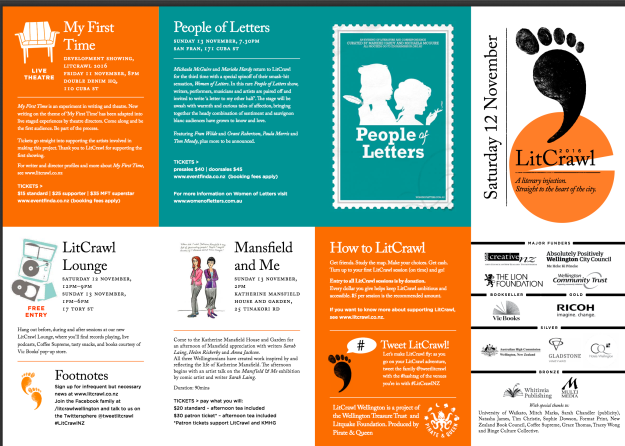
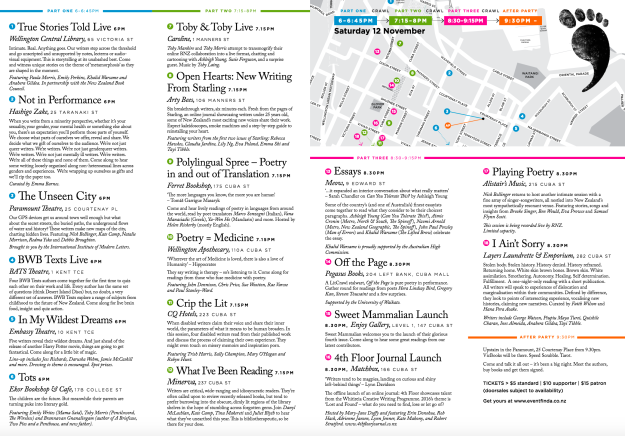
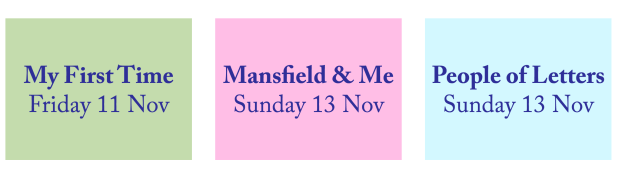
The programme:

Screen Shot 2016-11-16 at 12.44.09 PM.png


Screen Shot 2016-11-16 at 12.44.27 PM.png


Screen Shot 2016-11-16 at 12.43.39 PM.png


What is LitCrawl?

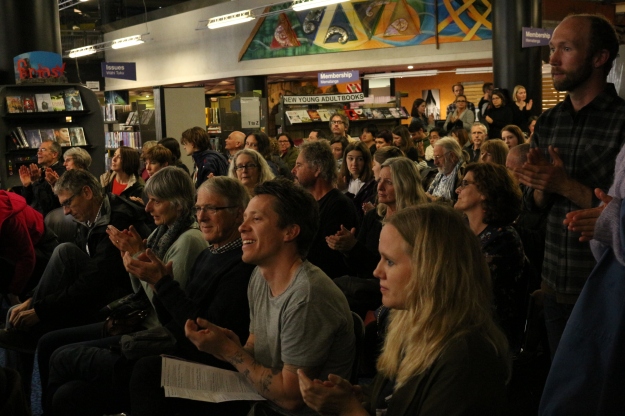
LitCrawl =  a fast-talking, street-loving celebration of writers, publishers, performers, editors, musicians, journalists, lyricists, artists, comedians… and the people who want to hear them speak. For 2016, the programme stretched over three nights and two days with the main event, the crawl itself, on Saturday night. Over 100 writers appeared before over 2500 audience members in 19 venues. All ticketed events sold out.

Claire Mabey (organiser, along with Andrew Laking) You can hear Claire in conversation with Jim Mora this afternoon at 3pmish on RadioNZ


IMG_8465.JPG

True Stories Told Live –Featuring Paula Morris, Emily Perkins, Khalid Warsame and Anahera Gildea. In partnership with the New Zealand Book Council. Wellington Central Library

‘True Stories Told Live has become a regular part of the LitCrawl programme. Despite the howling gales we had a fabulous turn out for our storytellers, Mayor Justin Lester, Emily Perkins, Khalid Warsame, Paula Morris and Anahera Gildea on Saturday night. Our theme for the evening was Metamorphosis with the subtext being how reading and books can change us. The storytellers responded to the theme with brio, generously sharing some intimate and life-changing moments. It was a wonderful start to the audience’s LitCrawl journey.’

Catriona Ferguson  CEO NZ Book Council    

15034436_10154242042816731_1648041473_o.jpg

15064087_10154242044516731_1087345395_o.jpg

Playing Poetry


And in the world outside these Gardens
canals of silver-beet arrive to part our city streets.

©Diana Bridge


Bee Trudgeon from Porirua Libraries sent in these LitCrawl postcards:

(‘It’s been a great weekend here in Wellington, in spite of the wild weather Friday night through Saturday night. Lit lovers proved themselves a resilient bunch, and great times were in abundance. I walked past more packed venues than those I’ve reviewed for you at the Lit Crawl. Here’s hoping you’ll get some more accounts to do this brilliant event justice.’)

Crip the Lit, CQ Hotels, 223 Cuba Street, 7.15PM

Proud feminism met disability fellowship when writers Robyn Hunt, Sally Champion, Trish Harris and Mary O’Hagan reclaimed the word crippled and put inspiration porn in its place at their packed panel session. This was a clarion call to bust open the closets disabilities of all kinds (visible and invisible, self- and externally-imposed) can erect around those living with them.

Robyn read a blog post regarding the hurdles sight impairment threw up for a budding reader with limited access to appropriate resources. Sally remembered early days far from parents in hospital, where her soul craved the attention her body was getting. Trish read from her newly published memoir The Walking Stick Tree (Escalator Press), which mixes memoir and essay to explore a life lived both in and far beyond the presumed cage hampered physicality suggests to those with a limited grasp on the transcendent power of the human spirit. Mary read from her memoir Madness Made Me (Open Box, 2014), honouring the highs of mental illness as human experiences more rich than those untouched might recognise.

Mary summed up the prevalent mood by poo-pooing any suggestion of bravery, pointing out the need to simply get on with what must be done.


Essays, Meow, 9 Edward Street, 8.30PM

Simon Sweetman (Off the Tracks) proved the perfect emcee for this heaving session of superior essayists, in a venue renowned for treating the literary like rock stars. Ashleigh Young (Can You Tolerate This?) may have been uncomfortable behind the mic’, but killed nonetheless, with tales of bizarre childhood Mastermind sessions under the spotlighted scrutiny of her father the quizmaster. Rarely is a child’s inner life so intimately given voice. International guest Khalid Warsame (reluctant and rare poster boy for Australian African masculinity) read two sentences spanning 15 years and a well-founded distrust of the police. It was a masterful and extreme test of the form.  Aimee Cronin nostalgically evoked an idyllic, salt-sprayed, ice-cream sticky childhood summer, hard-won from the ashes of broken marriage. The effect was a sigh just the safe side of a scream. Naomi Arnold took us to the places family and lovers would rather we couldn’t go. She provided a fine reminder that, if not for voyeurism, the essay would be too polite to be as compulsively palatable as this crew proved it can be. A brilliant set gobbled up by a crash keen crowd.


Selina Tusitala Marsh: Tala Tusi: The Teller is the Tale (A New Zealand Book Council Lecture) National Library, November 11, 2016 Reviewed by Bee Trudgeon for NZ Poetry Shelf

For many, it had been a raw few days of uphill battling. Not 48 hours since hearing He Who Shall Not Be Named had won the White House, and just three hours since hearing Leonard Cohen had died, people were sorely in need of some serious attention to the issues of diversity and what was threating it, and the comfort that poetry was alive and well. With the Wellington weather closing in, and turning to bed or drink (or both) a panacea being broadly touted by my distraught American friends, I had a strong feeling Selina Tusitala Marsh’s New Zealand Book Council Lecture could be as close to a cure as I could count on.

Her lecture in five parts and an epilogue, Tala Tusi: The Teller is the Tale, was a lyrical series of ruminations and recollections on the importance of culturally diverse voices, reading as fuel for writing, the holy nature of second-hand bookshops, and a significant encounter with the Queen.

Aptly dubbed the Smiling Assassin by her Muay Thai kickboxing trainer, her regal presence sets a fine example of how we all might face the differences of opinion so hard to understand, during a week when the Ku Klux Clan had been photographed on a bridge crossing a highway during workday commute hours.

In the same vein, consider the time earlier in the year when, as the Commonwealth Poet and guest reader at Westminster Abbey, Selina extended a hand to a certain Baron What’s-his-face, only to have her hand left hanging. Selina refused to let him reduce her to the level of his apparent opinion.

As she says, it is part of her name – the proto-Polynesian ‘ala’ – to be a path, not a wall. In a year when far too much has been said in the name of a certain proposed wall, such words are balm to all humanity.

In addition to an ironically instructional excerpt from Paula Morris’s ‘Bad Story (so you don’t have to write it’, four poems were performed: Robert Louis Stevenson’s ‘Requiem’ (as we were transported to Samoa in the late 1800s), ‘Tusitala’ (Selina’s 1996 manifesto piece), ‘Pussy Cat’ (penned for the potential racist, and the Duke who dared question the ‘post’ in ‘postcolonial literature’), and (thrillingly) the royally commissioned ‘Unity’

‘There’s a U and an I in unity / costs the earth and yet it’s free…’

Never have the lines been more necessary.

Near closing, Selina acknowledged, “People will walk over me and if they do so ungraciously, that’s their karma; but people will walk over, and that’s about connection.”  If the world had not exactly been put to rights, the battle cry for continued attempts to affect so had certainly been sounded. Round One to diverse poetry.

Fa’afetai, Selina. ‘What you do affects me.’

Complete lecture available here.


15033863_10154242045566731_619402000_o.jpg

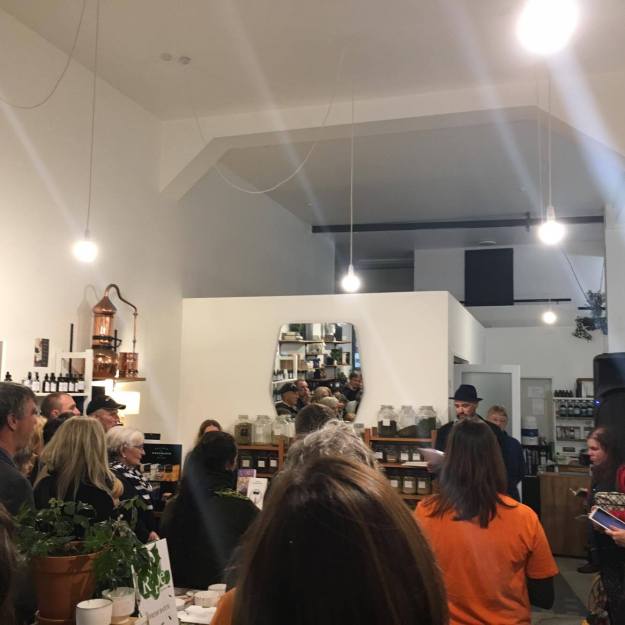
Poetry = Medicine at the Apothecary (more photos from here below)

‘Wherever the art of Medicine is loved, there is also a love of
Humanity’ – Hippocrates
They say writing is therapy – so’s listening to it. Come along for
readings from those who fuse medicine with poetry.
Featuring John Dennison, Chris Price, Sue Wootton, Rae Varcoe
and Paul Stanley-Ward.


A LitCrawl letter from Helen Rickerby:

LitCrawl 2016

LitCrawl was more than a bright spark in the middle of a crazy and hard week – a week filled with the alarming US election, torrential rain and slips, earthquakes, tsunami and then more torrential rain, flooding, wind and more slips – LitCrawl was a whole fireworks display. It seems quite a long time ago now, being before the 7.5 earthquake that woke so many of us up after Sunday night had just tipped over into Monday morning. But it’s important to celebrate such a wonderful event, especially in the midst of everything else.

When LitCrawl started two years ago I was a bit worried that having multiple events on at the same time would split the audience – I thought I knew by sight, if not by name, everyone who was likely to come to a literary event in Wellington. But that first year I realised this was something special: every event was well attended – if not full – and there were people there who I had never even seen before. Where did they come from? we wondered. And then the next year, they came out again – even more people to even more events. And this year, even more events, and more people – despite more rain!

I think one of the strengths of LitCrawl – by which I really mean a strength of event organisers, the wonderful Claire Mabey and Andy Laking – is that they have drawn together people from many different parts of the Wellington literary community and beyond to perform and curate sessions. So it feels like something that everyone owns and has helped to make, rather than a top-down thing organised for us.

The heart of LitCrawl is the Saturday night, where multiple events are held around the city in three different time slots, but since the beginning there have been some satellite events on different days. This year the first one was Friday night’s My First Time, where three short theatre pieces by first-time theatre writers were performed, for the first time. The pieces were very different from each other: Sarah Jane Barnett’s relationship drama set in the not-too distant future; Pip Adam’s wonderful nuts post-modern take on contemporary life that might have just been snippets from the internet; Faith Wilson’s slam-poetryish musings on race, economics and what she’d like to do with and to her dentist. The audience was invited to be part of the process by emailing in their feedback about the pieces, which are still in development.

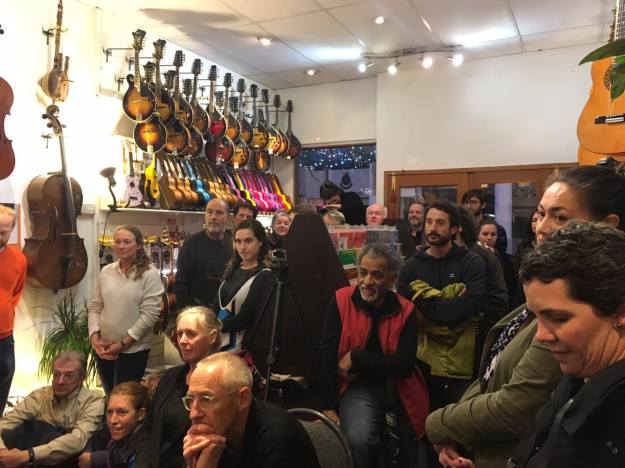
On the night of LitCrawl proper it is always really hard to choose what to attend, and your heart gets a bit broken about the things you have to miss. Because I was running a session in the middle block, that took care of two of my choices – the time I needed to be there to set up made it too difficult to get to the first session. My session, Polylingual SpreePoetry in and out of Translation, was at Ferret Bookshop, and there was a good turnout to hear poetry from and in Māori, Greek, Mandarin and Italian from Kahu Kutia, Vana Manasiadis, Ya-Wen Ho and Marco Sonzogni (with me reading a couple of English translations). I had wanted to curate that session to celebrate the fact that English isn’t the only language spoken in New Zealand, and it seemed especially timely to be celebrating diversity. Afterwards, people were really enthusiastic about the session and hope to see it return, so we’ll see.

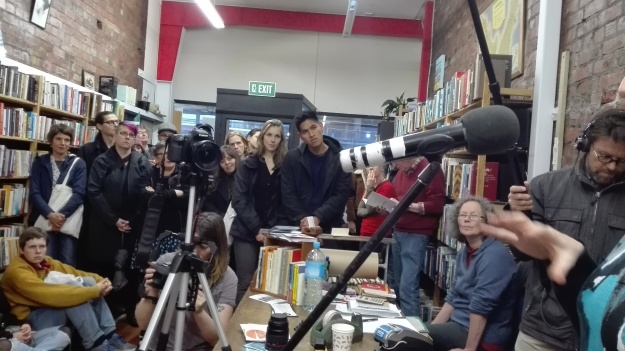
Next I was planning to go to the Essays session (see above PG!), which I’m told was fantastic and full, but it was also much further away than several wonderful poetry sessions in the Cuba Street area. I ended up at Pegasus Books, or, rather, outside Pegasus Books, which was just as well because there was quite a crowd there and we would never have fitted in the shop. Thanks to a good sound system we could mostly hear the readers: Steven Toussaint, Hera Lindsay Bird, Greg Kan and Lee Posna, over the diners behind us at Oriental Kingdom and other revellers in Left Bank. After that, most people headed to the after party at Paramount, generally via some kind of eatery, to mingle and catch up with other LitCrawlers and possibly have their fortunes read by the resident tarot card reader.

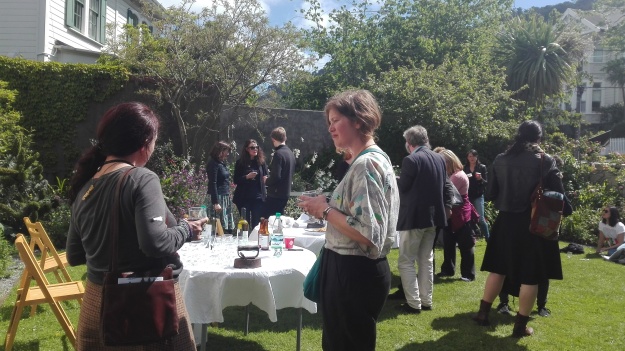
The next day I was really delighted to be part of a panel discussion with Sarah Laing and Anna Jackson about why we have found the life and work of Katherine Mansfield so compelling. The event was especially special because it was at the Katherine Mansfield Birthplace, in an upstairs room amid an exhibition of Sarah’s drawings for her graphic bio-memoir (I think I have just made up that term) Mansfield and Me. The sun came out in time for us all to have our afternoon tea on the lawn, which was very pleasant. It was a bit alarming to hear a few hours later, in the early hours of the morning, that there was damage to house after a neighbouring brick wall fell on it during the quake. Fortunately, it now sounds like there is no serious damage, so we can all go back and have a proper look at Sarah’s exhibition and sketchbooks when it reopens.

A friend visiting from Auckland was told on Saturday night ‘You should move back to Wellington, it’s having a literary renaissance’, and I thought – you know, I think she might be right. And I think it’s because there are quite a few ordinary people who are just organising things and doing things here at the moment, and I think that if LitCrawl wasn’t the start of this little renaissance, it certainly is one of its shining stars. Thanks Claire and Andy, we really appreciate it!

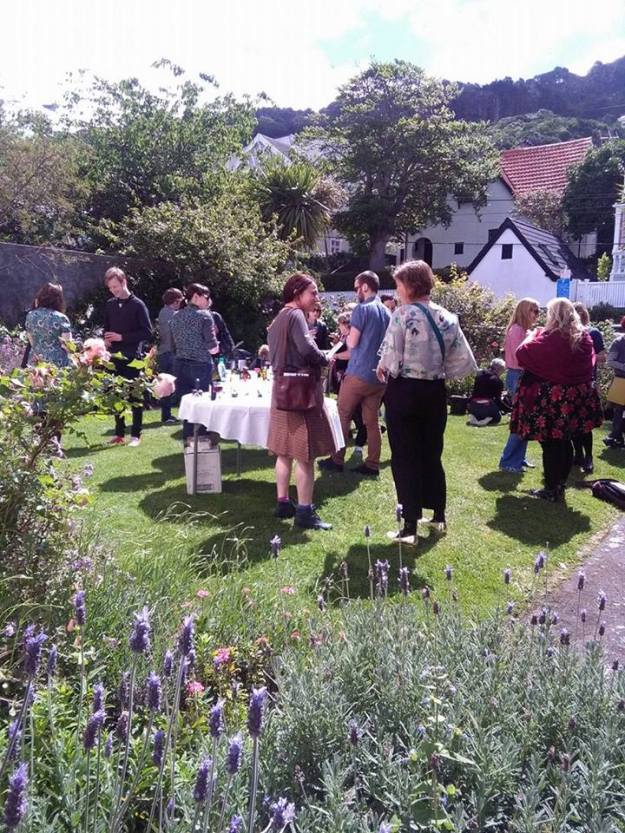
photos from Helen:


Polylingual.jpg

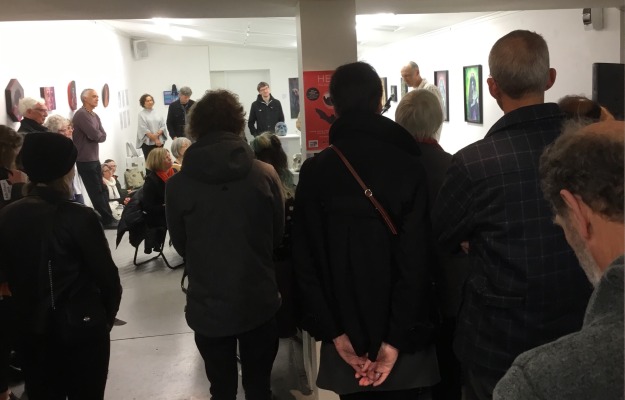
Polylingual – some of the audience at Polylingual Spree at Ferret Bookshop

‘The more languages you know, the more you are human’
– Tomáš Garrigue Masaryk Come and hear lively readings of poetry in languages from around the world, read by poet translators Marco Sonzogni (Italian), Vana Manasiadis (Greek), Ya-Wen Ho (Mandarin) and more. Hosted by Helen Rickerby (mostly English).


Mansfield 1.jpg

Mansfield 1 – Some of the Mansfield event-goers having afternoon tea on the lawn, including Sarah Laing


Mansfield 2.jpg

Mansfield 2 – Another view of the afternoon tea-ing, including Anna Jackson talking to Vana Manasiadis. The offending brick wall (which fell down in the quake) can be seen beside the house, on the left.

Yes, after a splendid event at the Katherine Mansfield House with the sun shining and afternoon tea and poems, the place suffered damage in the quake.

CxG8YFsUsAA9zkR.jpg


A letter from Sarah Forster from NZ Booksellers:

Hi Paula

I didn’t go to any poetry last night, mores the pity, but the three events I did go to – True Stories Told Live, Toby & Toby and Essays were all brilliant. I have attended every year since it began. Here are a few bits and pieces for you to weave in.

At the end of LitCrawl 2016, Juliet Blyth noted to me that the most special thing about LitCrawl is that everybody sees it as being for them. There is no demographic that didn’t turn out, despite the terrible Wellington weather.

At True Stories Told Live at the Wellington Central Library, I sat in front of a family of five, the three girls aged roughly 5-11, and though they were bickering beforehand and saying ‘This is going to be boring,’ as soon as the stories began I didn’t hear a peep. As Wellington’s Mayor Justin Lester told of his upbringing with his father searching for white gold, as well as a new mistress in every port they lived in; as Paula Morris wove the spell of the Little House on the Prairie; Emily Perkins told of the changes wrought by self-help books, and an enduring, changing, friendship; Khalid Warsame told of his panic attacks and how the pain of an anonymous other – and a book – somehow eased his own pain; and as Anahera Gildea pulled us through the most painful experience of her life – but the one that led to her finally publishing her writing, and selling her art – these kids sat spellbound. True Stories Told Live at its best is utterly brutal – the laughs are always there, but the truth-telling takes your breath away. I am not sure how we didn’t float out of there on a sea of tears after Gildea’s story, and I want to thank her if she is reading this, for sharing it.

At Toby & Toby at Caroline Bar, it was standing room only, as Toby Manhire interviewed first Susie Ferguson, then Ashleigh Young. This was a louder crowd, but engaged nonetheless. There were probably about 300 of us all crammed in the back of the bar, standing – I had a handy barstool to kneel up on, which made me only 3 inches taller than my friend Harriet Elworthy was standing. How do we deserve Susie Ferguson on our airwaves,  Shannonn Te Ao  in our art galleries, Ashleigh Young as one of our best editors and writers?

It was a one-two for me with Ashleigh, as she was one of the speakers at the final event I attended, at Meow Bar. Again there was a huge range of ages, though starting from 18 this time, as well as those in the more traditional festival-going age group (the boomers). Essays featured three female essayists – Ashleigh plus Aimie Cronin and Naomi Arnold – and again I was privileged to see Khalid Warsame in performance.
As well as reading from their work, each of them talked a little about essay-writing, and the difficulty of deciding how much of your family and friends’ experiences you are allowed to use. Khalid was fascinating – he is the director of the Young Writer’s Festival in Newcastle, and as an African Australian, he has realised his point of view is incredibly unique. He talked about being pigeonholed as other, and read aloud half of a four-sentence essay, on this theme.

Everything I saw at LitCrawl opened my eyes and my mind in one way or another. Pirate and Queen (aka. Claire Mabey and Andrew Laking) are geniuses: the only complaint I have was that I had to choose from at least 2 options per session that I desperately wanted to attend: an excellent problem to have. While most of the events I attended were very packed, most didn’t need to send people away. The volunteers were better deployed than previously as well. What could have been just another soggy Saturday night in Wellington was touched with magic, thanks to this generous, informative, inspirational event.

cheers, Sarah


Some photos from Mary McCallum:

IMG_1796.JPG

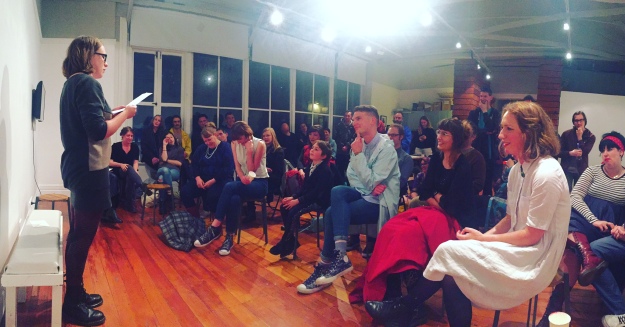
Sue Wootton reads at The Apothecary, with Jayne Mulligan VicBooks


IMG_1797.JPG

Chris Price reads at The Apothecary

IMG_1792.JPG

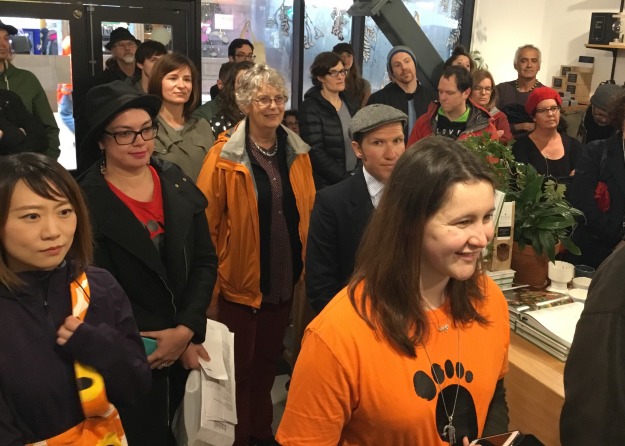
Happy litcrawlers at The Apothecary in Cuba Street, listening to readings around medicine and poetry.

IMG_1800.JPG

Launch of the 4th Floor Journal at Matchbox in Cuba Street


From Sugar Magnolia Wilson:

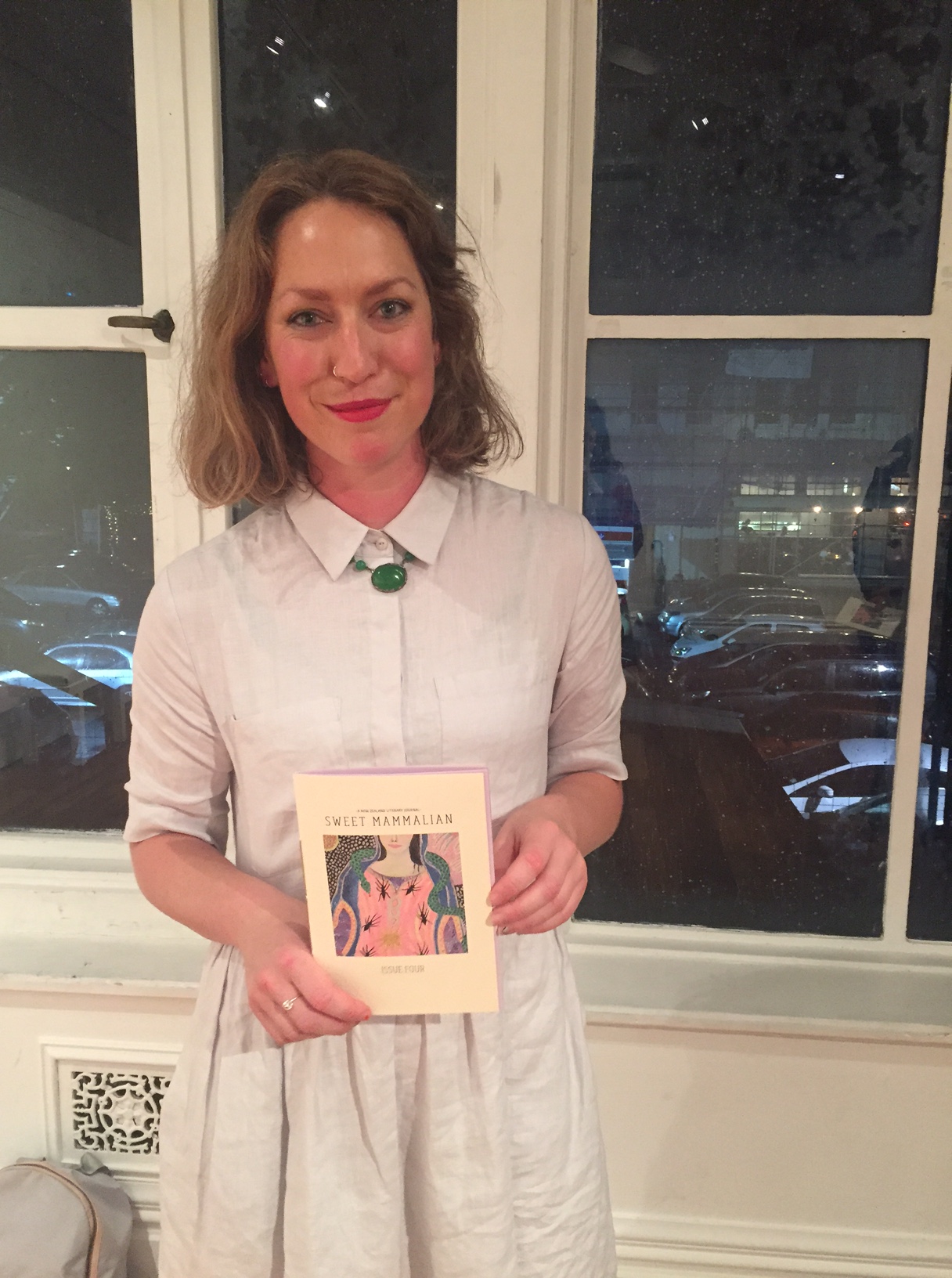
My take on it was – once again litcrawl was a really fun, loving and positive event where people got a chance to meet new folk and bond over writing and literature. I especially love having new contributors in Sweet Mammalian, one of whom came to Wellington especially for litcrawl and to read at our launch. So great to meet new people and always great community vibes at litcrawl.

issue four is now live

Photos from the Litcrawl Sweet Mammalian launch:

image2.JPG


image3.JPG


What a glorious, sumptuous, heart-boosting occasion. Thank you so much everyone who sent me things. In the light of what you are enduring, to have sent these treasures in is quite special. The last words goes to a poem Diana sent me. The early NZ women poets I am currently reading found much solace in the sky, the bush and the sea. This is a poem of solace. Thank you everyone!


Footing it with the magnolias

As the track winds steeply down
trees thin and gaps appear in leafy walls.
Broadening view-shafts open

on the Garden’s settled old world heart.
Here is the showcase that changes
with the seasons. Colours co-ordinate

an artist’s take. Spotlight on ceremony
when stately tulips bright as guardsmen bloom.
Though things are not so cut and dried

even in classical spring. Sunlit tussocks
fountain beside paths. Artful inclusion
of the indigenous, the vegetable patch.

Beds hemmed with parsley. Cineraria or
phlox held in evergreen embrace. No plant
undercutting any other – a gorgeous

composite is what they aim for here.
And in the world outside these Gardens?
Canals of silver-beet arrive to part our city streets.

©Diana Bridge

Congratulations to a very fine poet! Sue Wootton’s good news

Sue Wootton longlisted for University of Canberra Vice-Chancellor’s Poetry Prize 2016

Monday, 15 August 2016

Sue Wootton headshotWarmest congratulations from all at OUP to Sue Wootton, whose poem ‘Strange Monster’ has been longlisted for the University of Canberra Vice-Chancellor’s International Poetry Prize 2016. Sue’s poem is one of 60 selected from over 1200 entries. Head judge Simon Armitage will determine the winning poem, which will be announced on Friday 16 September at the Poetry on the Move festival.

Sue’s collection The Yield will be published by Otago University Press in 2017.

Poetry Shelf, Poet’s Choice: Sue Wootton makes her picks

1423778022214-1  front-cover

I really enjoyed Excerpts from a Natural History (Pokeno: Titus Books, 2015) by Holly Painter. A beguiling collection: witty, warm and smart. A beautifully designed book, too.

John Dennison’s Otherwise (Auckland: AUP, 2015) contains gentle, serious work. It’s refreshing for its calm and formal tone, as well as for its dedication to contemplation and celebration, both.

Recently I’ve been reading Mary Ruefle’s collected lectures: Madness, Rack, and Honey (Seattle/New York: Wave Books, 2012). Much here that fruitfully sustains, and just as much that fruitfully unsettles: “I suppose, as a poet, among my fears can be counted the deep-seated uneasiness surrounding the possibility that one day it will be revealed that I consecrated my life to an imbecility.”

Sue Wootton

13237099 13237099

Poem Friday: Sue Wootton’s ‘Lingua incognita’ –


Lingua incognita


Some words dwell in the bone, as yet

unassembled. Like the word you want


for Weary Of The City, for Soul Tired; the word

you seek for Confusion Where Affection Once Existed


or the single vowel-filled syllable which would accurately render

Sensation of Freefall Generated by Receipt of Terrifying Information.


Down in the bone the word-strands glimmer and ascend

often disordered, often in dreams,


bone-knowledge beating a path through the body to the throat

labouring to enter the alphabet.


Maybe the bones ache.

Maybe the throat.


Your cells your language, occasionally articulate

in a rush of ease, the body clear as wellspring saying this is


The Moment of Illumination When One Allows that Water Yields to Rock, and Always Flows


and sometimes the only word to assemble in the throat is Yes

and sometimes the only word to assemble in the throat is No.


© Sue Wootton 2015


Author bio:  Sue Wootton’s poetry and fiction has been widely published, anthologised and translated. Her most recent publication is Out of Shape, a letterpress portfolio of poems hand set and printed by Canberra letterpress artist Caren Florance. She was recently placed second for the Gwen Harwood Poetry Prize, and longlisted for the 2015 Canberra University Vice Chancellor’s Poetry Prize. A former physiotherapist, Sue has a special interest in the practice of the creative arts in healthcare. She holds a Master of Arts in Creative Writing from Massey University, awarded with distinction, on the subject of creative fiction and the phenomenology of illness. She lives in Dunedin and is the current selecting editor for the Otago Daily Times Monday Poem column. Her novel, Strip, is forthcoming next year from Mākaro Press.

Sue’s website

Paula’s note: I love the way this poem grapples with the elusiveness of words, building in momentum from that point in the bone to that point in the throat. Inventive. Surprising. The elusive moments/notions/images glint as they escape. The ending shifts the pitch of the poem and delivers, for me, a moment of poignancy. I love this.


Sue Wootton on Vona Groake at Dunedin Writers’ Festival (what a delicious breakfast!)

Vona Groake in conversation with Liam McIlvanney, Dunedin Writers’ and Readers’ Festival

10 May 2015

It was a dreadful slot on the schedule—nine o’clock on a Sunday morning, on Mothers’ Day, to boot—but an hour with Vona Groake? No contest. The conversation between her and Professor Liam McIlvanney (here wearing his academic-teacher-of-contemporary-Irish-poetry hat, not his crime writer’s hat) was an absolute delight. Liam’s well-informed but gentle and open-ended questions prompted a flowing conversation, further extended and deepened near the end of the session when Vona responded to questions from the floor. Liam’s approach allowed Vona to articulate—uninterrupted!—some ideas on the source and sustenance of her craft. Their erudite, thought-provoking (and often funny) discussion probed the way that poetry grows out of language itself, looked at the influence of tradition on contemporary poem-makers, and was interspersed with readings of some of her poems. Ah, nourishment. And what a delicious breakfast.

Sue Wootton


Where else to catch Vona:

Auckland: Vona is at the Auckland Writers Festival this weekend where she is announcing the winner of The Sarah Broom Poetry Award and reading a few of her poems.

Upper NZI Room, Aotea Centre, Sunday May 17th, 1.30 to 2.30 


Wellington: On Thursday May 21st (12.15 to 1.15) Vona is conversation at the City Gallery in Wellington.

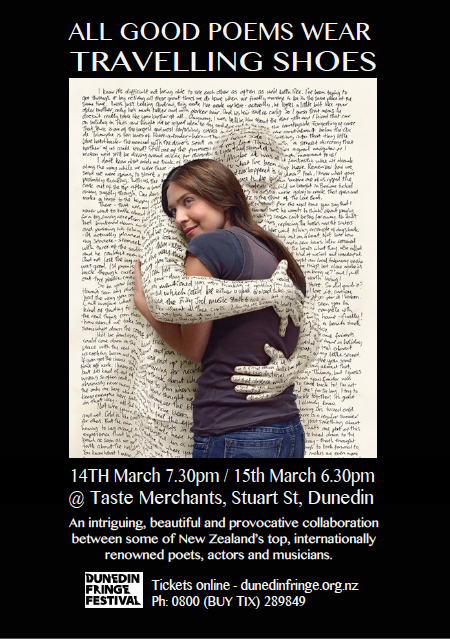
All Good Poems Wear Travelling Shoes: A Dunedin Fringe Festival event

Screen shot 2015-02-19 at 11.31.43 AM

As part of the Dunedin Fringe Festival, a new Dunedin ‘City of Literature’ event combines literary luminaries with the cream of the new ‘Dunedin Sound’.

Some of New Zealand’s top poets have combined with the cream of the new ‘Dunedin Sound’, acting and creative talent.

Eight Dunedin poets have had one poem each interpreted and embodied by a team of musicians and actors to produce eight distinct and unique works.

These works will be performed by the musical and acting teams during the event, which also includes the poet’s own reading of their featured poems; this way the audience can compare the created piece with the poets own reading.

The combination of the distinct art forms of Poetry, Music and Acting will ensure an energetic and diverse event that is sure to hold something for all tastes.

This provocative and engaging event showcases some of the literary talent that underpins Dunedin’s status as a UNESCO City of Literature while at the same time heralding the quality of Dunedin’s musical and creative talent.

Poets featured : Emma Neale, Sue Wootton, James Dignan and Carolyn McCurdie, Shae McMillan, Giles Graham, Ian Loughran & Sas Ambicus.

Musicians featured include members of Dunedin bands Strange Harvest, Opposite Sex, Kilmog and acclaimed Christchurch Cellist Nicole Reddington.

Players include: Kiri Martin, Dell Mcleod, Tim Player & Ian Loughran.

The event was created and devised by Dunedin Poet, writer and broadcaster Ian Loughran

Where: Taste Merchants, Lower Stuart Street, Dunedin

When: 14 March 7.30pm & 15 March 6.30pm

Contact: Ian Loughran

Email ianloff@yahoo.com.au

Tel: 03 467 5425  mobile: 0210 272  5165

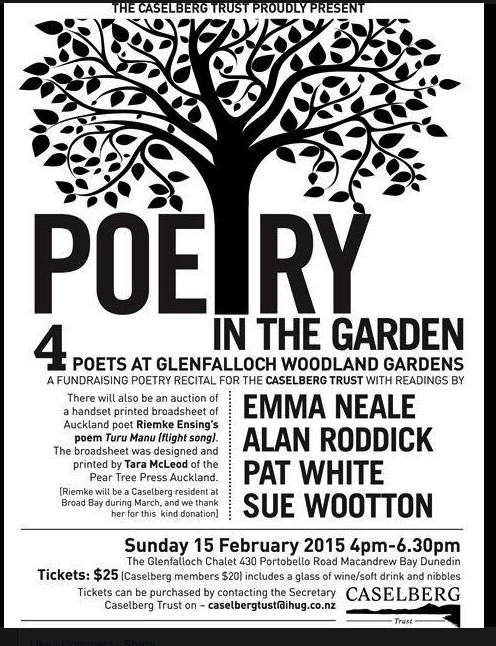
The Caselberg Trust presents Poetry in the Garden as a fundraiser for a local residency

Screen shot 2015-01-28 at 1.51.42 PM

Updated From Poets and Fans of Poetry: Favourite poetry reads of 2014

I am not sure if two lists make this an annual event (so I resisted temptation to put ‘annual’ in the title!), but here are the books that have stuck with local poets and fans of poetry in the past year. Unlike most ‘best of 2014 book lists’, the invitation is to select favourite reads no matter where or when those reads were published. The only limitation—this is a poetry list.

Over summer, I will muse over the future of my two blogs. If I do decide to keep them running, I will make a few changes changes to clear space for my own writing time. One thing is certain, I can never review all NZ poetry books on this blog. I have a huge stack of books I want to review, but know I can only do a handful over the next few weeks.  I guess with the scarcity of poetry reviews in New Zealand, I feel pressure to share all the wonderful writing that I discover.  I would certainly be keen to post reviews and musing by other poets.

Thanks to everyone who contributed to this list at a time when we all have such busy schedules, and thanks to everyone who contributed to the blog over the past year. It wouldn’t work with out you. Thanks, too, to everyone who shared my posts on social media and who followed both this and NZ Poetry Box.

John Adams:

The Life-guard, Ian Wedde, AUP.

Stark metaphors, sustained muscular writing that disturbs. A strong surface with an underbelly that provokes contemplation and rewards reflection. The final group “Shadow stands up” successfully blends quotidian observation with humour. Stuff to savour.

Autobiography of a Marguerite, Zarah Butcher-McGunnigle, Hue & Cry Press.

The disquieting disclosures of these poems builds a unique experience of family; patterns of mother and daughter; trials of close binding. How can we be, with such context? A journey to a foreign part.

Fearing the Kynge, Bernard Brown, Foundation Press (c/o 14 Birdwood Crescent, Parnell.

A short collection around Henry VIII and those who passed through his life, sometimes more quickly than they’d wished. Beautifully illustrated, the text ranges from the hearty pun to closely worked items that reward revisiting.

Sailing Alone around the Room, Billy Collins, Random House.

This masterly collection includes unforgettable, accessible gems. I love his riff on Blues; and any poet will weep with laughter at the enacted difficulty of Paradelle.

Rosetta Allen:

Cloudboy Siobhan Harvey Otago University Press

‘When the eye was overcast,
there could be no poetry.’

If the face was made to mirror the stars, then the entire body responds to the cloudscape that is this beautiful collection of poetry called Cloudboy. Harvey herself says ‘The body is a nest alive with new song’, and I feel it as I read her perfected lines, full of ever changing details of the atmosphere between a very special son, and an obviously devoted mother. No longer a passive pass time, cloud watching has become an active search for understanding, beauty, love and courage. And I too find myself looking up, with appreciation.
One Human in Height Rachel O’Neill Hue & Cry

‘I love that Father finds the faint trace of cyanide on his ring finger just in time and chops it off.’

I found the words of O’Neill’s poetry happily settled on the page. The humility trumpets itself without fanfare. Each poem, each line containing a neatly package surprise – I a kid in the back seat of a her car, unravelling lollies, and remembering, feeling part of the scene, included and instantly befriended. I adore the rhymes in the midst of lines, the lists that are not lists, the epiphanies that pile up until you have to let some go, the meaning where there is no meaning, and I believed every bit of it – almost.

Sarah Jane Barnett:

The Lonely Nude by Emily Dobson (VUP) An extremely beautiful collection about dislocation, identity, expectation, and the body. It traces Dobson’s own experiences of leaving New Zealand, living in the US, and her return. Dobson’s poems are spare and exquisitely crafted. She’s definitely my #1 poetry crush of 2014.

Etymology by Bryan Walpert (Cinnamon Press) Even though Etymology came out in 2009, I only managed to read it this year. As the title suggests, the poems are about the way we create meaning, not only in terms of words, but in our relationships and lives. It’s so sharp and clever that it made me want to give up writing.

Curriculum Vitae by Harold Jones (Xlibris/self published) Jones’ debut collection was my surprise of the year. Generally speaking, self published collections aren’t very good. I should have known that this would be the exception when I found out Jones has been published as part of AUP New Poets 4. Curriculum Vitae is a wonderful exploration of aging, regret, and memory. It was the only collection this year that made me cry.

Airini Beautrais:

2014 has been such a fruitful year for poetry. I haven’t quite finished reading all the wonderful local books that have come out, some as recently as last week. I have loved Hinemoana Baker’s waha/mouth (VUP 2014). And Maria McMillan’s Tree Space is an amazingly assured first full-length collection (also VUP 2014).

Diana Bridge:

For me this year has been weighted towards prose. I began it with the biography of Penelope Fitzgerald, which I interleaved with a re-reading of all her novels. Her last, The Blue Flower, was recently described with insight by Alan Hollinghurst as having ” something of the overall effect of a poem, a constellation of images and ideas.”

While I am waiting for the next collection of wonderful Australian poet, Judith Beveridge, I have been reading through her last two: Wolf Notes and Storm and Honey (Giramondo, 2003 and 2009), relishing her naturalist’s eye coupled to extraordinary and sustained imaginative powers. All her poems are filled with grace and intelligence.

Now a single poem, one I had been searching for since I first read it in the New York Review (October 7, 2004): Seamus Heaney‘s ‘ What Passed at Colonus’, written in memory of Czeslaw Milosz. I would want this to be one of the last poems I ever read.

Amy Brown:
Horse with Hat, by Marty Smith (VUP, 2014): This collection is a poignant and wry family biography. It juxtaposes earthy and transcendent subjects (the racetrack, the farm, Catholicism, war) as naturally as its stunning accompanying collages (by Brendan O’Brien) do. I especially loved Smith’s horses; I can picture the ‘dawn horses’ ‘who flatten, who scatter’ perfectly.

Final Theory, by Bonny Cassidy (Giramondo, 2014): This verse novel develops an eerie, quietly filmic atmosphere of post-apocalypse. Cassidy is an Australian poet, who wrote part of this poem while travelling in New Zealand – the landscape she describes is simultaneously recognisable and alien – a place where ‘three stilled turbines balance the space like stupas’ and ‘the ocean’s a mouthed thought’. Exquisitely clear and unsettling, it is the sort of book I’d love to write one day.

Mondrian’s Flowers, By Alan Loney and Max Gimblett (Granary Books, 2002): I stumbled upon this poetic biography of Piet Mondrian while reviewing Loney and Gimblett’s recent eMailing Flowers to Mondrian. Only 41 books were made, each with rough-cut watercolour pages and an exposed primary-coloured spine. Three long poems by Loney in tribute to Mondrian are punctuated by Gimblett’s watercolours. Reading it is a meditative act; if you’re in Wellington, I recommend looking at the copy in the National Library. Her

Rachel Bush:

Marty Smith, Horse with Hat Victoria University Press Marty Smith’s work is new to me. Rural New Zealand, family stories, and the stories of a generation are combined in her excellent first volume of poetry. It’s poignant stuff that doesn’t balk at the sorts of tough, sad realities that exist in all families.

Lindsay Pope Headwinds Makaro Press Lindsay Pope’s engaging first book of poems is very timely. Family events, like the birth of a grandchild and low key domestic things like making muesli feature in it, but he’s also drawn to write about solitary lives like that of the caretaker on Stephens Island or the man in ‘Outpost’ whose closest contact with the outside world comes through the radio he operates.

Vincent O’Sullivan Us, then Victoria University Press I enjoy the ease with which Vincent O’Sullivan can refer as easily to a Dunedin Beach as he does to lines from Robert Frost or Wallace Stevens or to the poetry of McGonagall. He investigates difficult questions, but doesn’t come up with facile, tidy answers to them.. This is a collection thoughtful, witty, sure-footed poems.

Michael Harlow Sweeping the Courtyard: The selected poems of Michael Harlow Cold Hub Press
Poems chosen from seven books of poetry by Michael Harlow make  for a lively and varied collection. He is interested in and  sensitive to how each poem looks on the page. I enjoy his distinct and often quirky voice.

Kay Cooke:
Essential NZ Poems Facing The Empty Page selected by Siobhan Harvey, James Norcliffe and Harry Ricketts. Published by Godwit. A real  treasury indeed of NZ poets. (Although I missed Tim Jones and Helen Lehendorf not being there).

Si no te hubieras ido / If only you hadn’t gone by Rogelio Gueda with translations from the Spanish by Roger Hickin and an introduction by Vincent O’Sullivan. A gem of a book with poems about distance, love and Dunedin. Published by Cold Hub Press.

You Fit The Description: The Selected Poems of Peter Olds published by Cold Hub Press. The long-awaited collection of Olds’ poetry; a prolific New Zealand poet whose background in poetry in Aotearoa stretches back to the James K. Baxter era. I’m thoroughly enjoying this book which is sure to become a classic. I haven’t finished reading it yet, but so far – It’s a cracker.

A chapbook that has both inspired and thrilled me with its re-imagined worlds within worlds, delicately traced with a steely eye, is Jenny Powell’s Trouble published by Cold Hub Press.

Ruth Arnison’s PoARTry @ Olveston (self-published) with its clever mix of paintings and words, is also a favourite from my 2014 pile of poetry.

Karen Craig:

I’m looking at the three books I’ve laid out on my table and what I notice is that they all have lots to do with the sea, seabirds, islands. And I have a wonderful feeling that if I were to pry up their covers I’d hear sounds of imaginary oceans, like when you hold a seashell up to your ear. Because, like seashells, these poets have taken the sounds of our world and clarified and amplified them, made them resonate, turned them into a deep, quiet, prolonged roar. Each with a different pitch, of course.

1. Richard Blanco Looking for The Gulf Motel, University of Pittsburgh Press 2012 (You can get it at Auckland Libraries!). Richard Blanco’s seasides are Cuba, where he was born; Florida, where as a boy he emigrated with his family; and now Maine, where he ended up for love. He sings the enigma of memory, the yearn of sorrow, the terror of romantic love. “The sea is never the same twice. Today / the waves open their lions’ mouths hungry / for the shore, and I feel the earth helpless.”

2. Michele Leggott Heartland Auckland University Press 2014. These poems burn like the hot blue stars which recur in one of them. You dive in to their mesmerising, punctuationless (as always) whirl and find at the heart a distillation of spirit that is so honest as to be unforgettable. The long poem about the introduction into her life of her guide-dog ends with the simplest of phrases, “her name is Olive”, and it’s as if a choir broke out.

3. Bob Orr Odysseus in Woolloomooloo Steele Roberts 2014. Bob Orr embraces the sacred and the profane better than anyone. From the ancient mysteries to modern gazes, from Penrose to Valparaiso, his imagery amazes me and his turns-of-phrase make me want to get down on my knees and say Hallelujah! “As the Southern Cross / salts these hours / I shiver beneath signs and wonders.”

David Eggleton:

There were a number of outstanding poetry books I read this year, but these in particular offered things which have stayed with me.

  1. Kay Mackenzie Cooke’s book-length sequence Born to a Red-Headed Woman (Otago University Press) offers a remarkable evocation of growing up in rural Southland: ‘The teacher draws close, / her own fingers cool, // narrow streamlined/ dragonflies that touch down/ briefly where my fingertips/ have begun to make mist, / What lovely moons you have, she says.’
  2. In Sweeping the Courtyard: the Selected Poems of Michael Harlow, Michael Harlow’s poems are like miniature echo-chambers, their lines teasing and entrancing with repetitions of words and phrases which resonate with subtle implications: ‘We were walking out of the park, your/ hair on fire under a full fall of moon, / the flowering almond its bridal white/ fading earlier than was remembered// I could hear, a leaf-fall of thought . . .’
  3. I was impressed by the restless inquisitive searching tone, the careful observation, in Jenny Powell’s small collection Trouble (Cold Hub), as in her poem describing the scene in a photograph ‘Guided Walking Party on the Franz Josef Glacier, New Zealand c. 1908’: ‘five women/ standing on/ frozen contortions of time/ frock hems damp/ from trailing overground undulations . . .’
  4. I was also pleasurably arrested by the precise and telling imagistic phrases that made up Hinemoana Baker’s collection waha:mouth (Victoria University Press), as for example in ‘what the whale said’: ‘ I break/ the brine, my flukes a black book// a mast in your mind/ cross of the drowned. . .’
  5. I was amused by the rhythms and rhymes forming sweet and sour stanza combinations in Tim Upperton’s poetry collection The Night We Ate the Baby (Haunui Press), as in ‘All the Things I Never Knew’: ‘Bobbie watches headlights move/ across the wall. / A little rain begins to fall — / a little rain to end the day. // It falls differently in L.A./ Choctaw Ridge is far away.’
  6. Likewise, I enjoyed the almost whispered whimsy and well-turned verses in Peter Bland’s short book Hunting Elephants (Steele Roberts), as in his dream-poem about James K. Baxter: ‘Not/ a pretty sight/ with his soup-stained beard/ but there’s a lovely/ holy glow / to his skin . . .’
  7. Tom Weston’s collection Only One Question (Steele Roberts) contains a number of extraordinary poems, especially about crime and punishment. He shows us characters who have the fatalism, or else the tragic destiny of Joseph Conrad’s characters, as in the title poem: ‘When he sends children to prison the parents go too, / trailing along like wind-ripped flags.’
  8. And, finally, I was taken with the rapping urgency of Leilani Tamu’s street-wise voice in The Art of Excavation (Anahera Press), as in ‘You’, a poem about her father: ‘. . . driving around Auckland in your crusty-as car/ a hole in your sock, an empty pocket, a heart full/ of dreams but never a cent . . .’

Laurence Fearnley:

Dylan Thomas SELECTED POEMS (Penguin Classics)

I watched a couple of science fiction/space movies recently and, in general, I found them pretty dull and really long. But, a couple of them  included poems by Dylan Thomas. The film Solaris had ‘And Death Shall have No Dominion’ and Interstellar included ‘Do Not Go Gentle Into That Good Night.’ So I found my copy of Dylan Thomas’s poems and I noticed in its introduction that Thomas is described as ‘dense and often difficult’. I don’t know about that.  I liked the imagery in some of the poems – ‘Where birds ride like leaves…’ (When I Woke)  or ‘…the shabby curtains of the skin…’ (A Process in the Weather of the Heart), for example . After reading Thomas I got out my James K Baxter and Janet Frame books and spent a while flicking back and forth between the three writers.

Joan Fleming:
I have never read anything like George Dyungayan’s Bulu Line: A West Kimberley Song Cycle (Puncher & Wattman, 2014), edited and translated by Stuart Cooke. Cooke braids a dimensional translation of an Aboriginal song-poem from many strands: the words of the song in language, traditional owners’ verbatim explanations, an ethnomusicologist’s commentary, and his own circling, cycling rendering in english. Such important work; this book is a bit of a game-changer.

Siobhan Harvey:

Alexandra Fraser, Conversations by Owl Light (Steele Roberts) is a first collection which engages with concepts of chemistry, love, botany, family, astronomy, tarot and ancestry. The author’s evocative language, pinpoint accuracy and sumptuous concern for human interaction make is a 2014 standout.

Ancestry also underpins another exciting first book, Leilani Tamu’s The Art of Excavation (Anahera Press). Excavating her family and Pacific history, the book is an entwining of legend and cultural realism.

Miriam Barr, Bullet Hole Riddle (Steele Roberts) packs a powerful punch. A triptych charting the narrator’s cruel, abusive history, it’s a book of unflinching honesty and potent impact.

Dinah Hawken:

The Great Enigma, New Collected Poems, Tomas Transtromer, New Directions Books, 2006.

This has been my favourite book for a couple of years. I’d love to be able to write like him and it would take too long to tell why.

Body English, Text and Images by Len Lye, edited by Roger Horrocks, Holloway Press, 2009.

I splashed out and bought this book a few months ago, not long after reading Roger Horrocks’ biography of Len Lye.
I knew I would love it because Lye was so extraordinary; particularly in his understanding of how the body gives rise to all creative ventures including poetry. ‘ I hold/words in the bone.’

Otari, Poems and Prose, Louise Wrightson, Otari Press, 2014.

This very new, first book by Louise Wrightson has been written slowly, close to home. Louise lives on the edge of Otari/Wilton’s Bush in Wellington and has written a book about place that is dedicated, funny and beautifully produced.

David Hill: 

I’d like to mention:  1. Ruby Duby Du, by Elizabeth Smither (Cold Hub Press, PO Box 156, Lyttleton). Smither’s enchanting poems for her new grand-daughter, which manage to combine tenderness with her distinctive cool, meticulous observation.

2. A Treasury of NZ Poems for Children, ed by Paula Green, illustrated by Jenny Cooper (Random House). Yes, I know I’m not supposed to include Paula Green’s poems, but she’s just (“just”!!) the editor of this terrific anthology which ranges from Baxter to school-kids. Exuberant, engaging, educational, and made more so by Jenny Cooper’s magic illustrations.

Bill Manhire:

Do song lyrics count as poetry? If so, I’ve been enjoying The Lines Are Open from The Close Readers (aka Damien Wilkins). It includes tracks about departed writing friends like Barbara Anderson and Nigel Cox. One of them – “The Ballad of Tarzan Presley” http://theclosereaders.com/track/the-ballad-of-tarzan-presley – makes my heart hurt yet somehow leaves me happy.

It’s been a strong year for New Zealand poetry.  So many accomplished first collections! I was pleased to see Frances Samuel’s Sleeping on Horseback (VUP) in print – I’ve been waiting for some version of this book for about ten years. Another impressive first book is Kerry Hines’s Young Country, in which the poet’s words keep company with the images of 19th-century photographer William Williams. It’s a mix that can seem easy and obvious, but is surprisingly hard to do well. Between them, Hines and Auckland University Press make the task seem effortless.

A couple of other great reading pleasures this year have been A Dark Dreambox of Another Kind: The Poems of Alfred Starr Hamilton (edited by Ben Estes and Alan Felsenthal, and published by The Song Cave) and Maurice Riordan’s new collection from Faber, The Water Stealer.  Alfred Starr Hamilton is the poetry equivalent of the apparently naïve artist, of a Chagall or an Alfred Wallis. He has an appealing clumsiness, and specialises in astonishing small moments, as in his one-line poem “Carrot”: “I wanted to find a little yellow candlelight in the garden.” Maurice Riordan manages to be lyrical and thoughtful all at once, and is also the editor of The Finest Music: Early Irish Lyrics, a handsome anthology which includes translations from Tennyson to Riordan himself, as well as a number specially commissioned for the book.

Alice Miller:

Sam Sampson, Halcyon Ghosts (AUP, 2014)
‘shadow this, take and come up/  shadow, come to the present … the sur-/ face… the Lion —– the Light  —– the Luminous’

Lee Posna, Arboretum (Compound Press, 2014)

Steven Toussaint, Fiddlehead (Compound Press, 2014)

Emma Neale:

Poetry books this year I enjoyed…. I still have many books on my bedside table that I’m still only part way through – e.g. Stefanie Lash’s Bird Murder and Hinemoana Baker’s Waha-Mouth and more and more… but of those I have finished, the memorable ones are:

Siobhan Harvey, Cloudboy – I hope it’s all right to nominate a book I edited – it’s the only one I’ll let myself name out of some other wonderful books I worked on this year – but this one stood out for the ’tensile delicacy’ with which it maintains the extended metaphor of boy and mother as shifting cloudscape; for its subtle use of line and page as physical space as well as rhythmic unit; for its music and invigorating intelligence. It is an important milestone in local publishing, I reckon, for the poise in that sustained motif; for the fact that the metaphor never feels strained or gimmicky; and for the richness of the psychology in the relationships portrayed across the developing sequence.

Alice Miller, The Limits – for its dreamy eeriness, its evocation of beauty even as it catches the jittery sense of a civilisation crumbling; for its creation of the atmosphere of dread and yet a sense of old-new mythology as well.

Michael Harlow, Sweeping the Courtyard – a selected from Harlow seems long overdue, and it’s a joy to have this now that older volumes are out of print. His sense of the surreal, the power of the subconscious, and his ear attuned to the lilt and rise of a sometimes slightly eccentric syntax shows a musical ear for how to upend where the emphasis normally falls in a line. It keeps us listening closely to the swerve and duck of words: how meaning can shimmer from one sense to another, depending on how you hold light to the line. His sense of the power of the subconscious and seems to perhaps have filtered through to a poet like Alice Miller.

Peter Olds, Selected Poems – I am a latecomer to Peter’s work, and the stretch of experience here, as well as the energetic vernacular, was both refreshing and sometimes devastating to read. Many of the poems record pushing himself right to the edge of risk, and the cost is shown to be very bleak at times – which means that the mischievous, finger-flipping humour that survives in some poems is all the more welcome.

Tim Upperton, The Night We Ate the Baby –  I kept waiting for my kids to ask why I was reading this book. They never did. I enjoyed it for its technical control and its grim, self-loathing, Beckettian humour. It reminds me a little of Simon Armitage’s work: Simon Armitage meets Wendy Cope in a horror film with dialogue done by Dylan Moran? Something like that: it leaves me a happy kind of uncomfortable.

Zarah Butcher McGonnigle Autobiography of a Margeurite – I loved the concept – sometimes I loved the concept more than individual poems, but this was a bold, adventurous debut.

Cilla McQueen Edwin’s Egg and Other Poetic Novellas –  witty, surprising, gracefully succinct, playful – the implied dialogue between archival image and the text was gorgeously unseating and sideways, sometimes; others, poignant, piquant, peppery, plangent.

Vivienne Plumb:

My favourite poetry read of this year was a copy of Paris Spleen by Charles Baudelaire, purchased at the wonderful Scorpio books independent bookstore, 113 Riccarton Rd, Christchurch.  Originally published in 1869, this new reprint is from Alma Classics Ltd, U.K. (2010). These pieces by Baudelaire are considered to be very early prose poems.
Baudelaire wrote that ‘Parisian life is rich in poetic, marvellous subjects’, and described in a letter of 1862 his ambition to make the pieces that were eventually dubbed ‘prose poems’.
Excellent!

Lindsay Pope:

Leaf-Huts and Snow-Houses by Olav H. Hauge. Pat White introduced me to this Norwegian poet. He lived nearly all his life in his native Ulvik where he worked as a gardener. His writing is simple and precise yet laced with a lot of wisdom.

Lindsay Rabbitt:

Odysseus in Woolloomooloo, by Bob Orr (Steele Roberts, 2014), 60 pp., $19.99

‘If James Joyce could reanimate Ulysses [Odysseus] on the banks of the Liffey, why not bring the wily old wanderer to the South Pacific?’ Iain Sharp posits in his review of Odysseus in Woolloomooloo (a harbour-side Sydney suburb) in the July edition of Landfall Review Online, which I tout as my favourite review of a NZ poetry book, coincidentally on my favourite NZ poetry book (that I’ve read) published 2014. I have five of Bob Orr’s eight books of verse in my bookcase, including his first, the scarce-as-hen’s-teeth Blue Footpaths, published by The Amphedesma Press out of London in 1971, and this beautifully-produced latest offering sees Orr, a boatman on the Waitemata Harbour, and one of our finest lyric poets, at the top of his game, whether retracing his boyhood homeland in rural Waikato, or recalling his Wellington days, or visiting a terminally-ill friend in Sydney, or wandering the streets of Auckland, or out night fishing: ‘As the Southern Cross / salts these hours / I shiver beneath signs and wonders.’

Jack Ross:
Char, René. Furor and Mystery & Other Writings. Trans. Mary Ann Caws & Nancy Kline. 1992. Introduction by Sandra Bermann. Foreword by Marie-Claude Char. Black Widow Press Translation Series. Black Widow Press. Boston. MA: Commonwealth Books, Inc., 2010.

This is a big, generous dual-text selection of a lot of work form the whole span of René Char’s career, from early surrealist days, though the darkness of the Vichy years in France, and into postwar existentialism and disillusionment. Char was one of Paul Celan’s favourite poets, and a close personal friend, and the affinities between the two poets are quite striking — though probably more in the mood and underlying seriousness than the surface texture of their work.

I’ve also been reading a lot of NZ poetry books this year for Poetry NZ. I tried to say something about each of them at the back of the latest issue, but you can link to the detail of my remarks.

Lisa Samuels:

A few poetry books I found in 2014, with room for more

Iain Britton, Photosynthesis (Kilmog Press 2014). A beautifully hand-made art book in 40 copies, with 20 poems that attend to the medial line between the conscious report of observed and felt phenomena and the image moment that swerves the mind.

Jill Magi, Labor (Nightboat 2014). An essay in poetry, framed as a workography, that lays bare the devastated internal landscape of university labor. The university lecturer must strain the bad faith of corporate academia through her body in order to try and make a good faith realm for students and ideas.

Alan Halsey, Rampant Inertia (Shearsman 2014). From asemic (and glossed) clinamen to translingualism to talking places, this book has a world-attending and word-spelunking energy I crave in poetry.

Stephanie Anderson, In the key of those who can no longer organize their environments (Horseless Press 2013). Call it cento, source work, or reassembled appropriation, this book knows how to balance its languages in a vibrant sonic think-space for social thought and bodies in peril and houses and history.

Doc Drumheller, 10 x (10 + -10) = 0 (The Republic of Oma Rapeti Press 2014). A complex and delightful document of lingual devotion and social mixing. Drumheller has assembled his 10 pamphlets produced over 10 years to make helixes of anagrams and energetic rhymes. The poet as seer and Shakespearean “fool” for cultural attention.

Sam Sampson:

This year I’ve been revisiting Keith Waldrop’s Transcendental Studies: A Trilogy (University of California Press, 2009). When first opening the book I was drawn to his use of collaged lines and the effortless sway between the personal and metaphysical. The topology, or bricolage of purloined texts adds to the rich texture and music of his poems. He suggested in a recent interview, that poetry is ‘having nothing to say, and saying it,’ explaining, he was more interested in a sense of music, than the drive towards a philosophic, or information based poetics.

I’ve also had the pleasure of reading two recent volumes from the American publisher Black Ocean: Zach Savich’s Century Swept Brutal, and Elisa Gabbert’s The Self Unstable.

At the local level, I really enjoyed Alice Miller’s collection The Limits (Auckland University Press, 2014), with its elliptical and economical syntax. The imagery is deceptively refractive, and (as Barbara Guest suggests), at its best, a circling, or delimitation of the frame extends the line beyond the page.

The second discovery was an event I was involved in for the New Zealand Electronic Poetry Centre (nzepc) LOUNGE #41, where the NZ based American poet Steven Toussaint read. His rhythms contain a remarkable subtlety, an unmistakable momentum of word and thing (word-ling). There are a number of his poems online, or you could search out his chapbook Fiddlehead (Compound Press, 2014).

Iain Sharp:

I was pleased to see Alan Brunton’s Beyond the Ohlala Mountains topping The Listener’s belated list of 2014 poetry books. With its breadth of vision, wit and musicality it tops my list too, but I’d also like to draw attention to a couple of Auckland University publications that The Listener did not mention.

Sam Sampson’s second book Halcyon Days is the brainiest local poetry, I reckon, since the untimely demise of Leigh Davis. Yes, it’s challenging work, but the reward is in peeling back the layers and discovering the care with which Sampson has chosen each phrase.

Kerry Hines’s debut, Young Country, not only pays tribute to (and reproduces some of the fascinating images of) the great underrated New Zealand photographer William Williams but also opens up new approaches to writing about our colonial past.
Marty Smith:

waha/mouth Hinemoana Baker (Victoria University Press)

is breathtakingly, cracklingly alive. It should be read with a de-fibrillator. I get breath loss and my heart-beat jumps when the poems go leading into unexploded places, then all over again with wrenching images, like Tinkerbell

‘       I turn from black to white inside

my own limbs. Who makes this howl, whose

hindquarters drag like a bag of coal?’

Raw relationships are opened up, as in the itching madness of ‘Malady,’ and ‘running’ pulls me breathless

and still you caught me grabbed

my arm my clothes my woollen jersey unravelled as you

pulled until there was a thin gray thread

getting longer between us and the faster I ran

the colder I got

and the travelling sadness of this:

I miss you, It’s like a cave in this mouth.

It’s a terrible saxophone solo.

Read the back cover. I’d like to think that I read this book with a candle guttering in my mouth the whole way.

 Bird murder Stefanie Lash

I’m completely besotted. The first place I love it is the sound echo in the title, but really the first place I love it is the little embedded crime sticker. You can’t peel it off, can’t get away from it, because this is a post-colonial protest at the fate of the Huia. I have to admit to a nostalgia for the world of my great-aunt and my grandmother, who were full Victorian Gothic, so I might be a suspect judge. But my fascination really comes from the twisty linguistic inventiveness. I love how the protest is laid out in the conventions of a traditional murder mystery, but full of flavour in an amped up version of this genre. And yet, not. It’s laid out in lush and hallucinatory images, in gorgeous language. Look at this murder scene –

‘the man is grey, and a shining black concave meniscus

of blood has formed, like oil on water,

where he has dropped his whiskey glass

and the characters are absolutely skewered:

Mrs Cockatrice is rosy, lucent:

her guests, enchanted.

Mrs Teck’s lips peel off her teeth

in a real storm of delight.

Mr Cockatrice, always sheepish,

always just on the brink of a toast.

Not saying anything about the huia, that pleasure shall be left untouched for the reader. I will say, what a feat, to keep to the form so that the narrative feeds its own texture into the whole drama. I just love it.

 Tree Space Maria McMillan

I love how these poems are experiments with hushes and stops and gaps, so when I read it I get a sense of space, of joy in the richly observed world, in its breathing biology, as it were, in the stops of sadness which are a powerful reminder of what we must do to keep it.

‘The ocean is never

the same twice. You don’t know if you’ll open the door

on yellow fish flicking past, or a swarm of jellyfish little

fisted stomachs pulsing

I love how the poems sharply enact the sensations of their worlds, so the smell of the bush floor rises up in Tree Space

In the dark birds are heavier and we can hear the small valleys of

their footfalls.

It’s true that death and life smell the same here

so it gives me a slight creeping dread, but then it moves straight to ‘leap like a sugar glider’.

I love how the intricacies of scientific wonder carry such a pure joy

Joe tells me the flagella

in these new colonies

is trapped inside

so each daughter

makes a tiny hole in herself

and pushes her whole self through,

turns herself right side out

the opposite of the observations of our collective humanity –

‘ The kingdoms of life are often revised.

Humans are closer than turtles to dinosaurs.

Truth had two legs before it had four.

And I love how deceptively simple the cover is, itself anchored but floating. I happen to know Maria has knitted gloves of this cover.

Elizabeth Smither:

‘I am a poet who is a woman, not a woman poet’ Ruth Fainlight has said. I dip into her New and Collected Poems (Bloodaxe, 2010) every year for a voice that is warm and wise and tough. Last Christmas she sent me a card designed by her photographer son: stone angels in flight over a cemetery. I love to think of her wild dead brother, Harry, threatening to burn down the offices of Faber & Faber if they didn’t return the poems of his they were going to publish.

Chris Tse:

I’d like to name two books and one poetic curios that have reminded me this year of the possibilities and joy that poetry can bring. Reading them was like surveying a city from the top of a skyscraper – there’s a sense of wonderment mixed with danger as you grapple with a dizzying and unfamiliar view of the familiar. All three are daring, inventive bodies of work that reveal and give so much more with subsequent readings – the hallmark of all great poetry:

Bird Murder by Stefanie Lash (Mākaro Press, 2014)
Autobiography of a Marguerite by Zarah Butcher-McGunnigle (Hue & Cry Press, 2014)
Pen Pal by Sugar Magnolia Wilson (Cats & Spaghetti Press, 2014)


Reina Whaitiri:

A Treasury of NZ Poems for Children published by Random House New Zealand.
This is a beautifully produced book. Everything works really well. The illustrations are absolutely delightful and will bring pleasure to any child, young or old. The poems themselves cover such a wide range of topics and they too will delight.

Dark Sparring by Selina Tusitala Marsh and published by AUP.
There is such a wealth of wisdom and profound insight in the poems presented here.
The CD included is an extra bonus and reminds us that poetry should be heard and not
only read quietly to one’s self.

Puna Wai Korero published by AUP.
The poems in this anthology reveal some deep-seated resentments and longings as well
as heart-felt love and desire. They offer insights into the hearts and minds of Maori, some living today and some who have passed on.

Kirsti Whalen:

Motherland Fatherland Homelandsexuals by Patricia Lockwood Penguin, New York
A strange, beautiful navigation of a feminist dreamscape. Hilarious and moving in equal measure.

Bullet Hole Riddle by Miriam Barr Steele Roberts
The most arresting modern poetry collection I may have ever read, tackling abuse and consent with lyrical command.

Castaly by Ian Wedde  AUP
This collection predates me but I loved the challenge of it: the longer poems casting out in exploration and the shorter acutely observed.

A History of Silence Carrie Rudzinski  Self published
Rudzinski generally performs her work, but her words sing equally vibrantly from the page. This book is much like going on a road trip with someone you love, while questioning everything.

Sue Wootton:

Here my poetry picks for 2014. Comments for these first two are taken from my fuller reviews which appear in Takahe 82 and 83.

Zarah Butcher-McGunnigle Autobiography of a Marguerite Auckland: Hue & Cry Press (2014).
This book-length poetic narrative speaks powerfully to the claustrophobic effect of chronic illness: the endless burrowing for meaning, the constant search for a sense of order, the fleeting glimpses of certainty which dissolve as soon as they’re probed. The usual orientation measures no longer apply: “Outside there is no weather…my watch has stopped.” Butcher-McGunnigle’s writing goes to the aching heart of disconnection and of longing for repair.

Janis Freegard The Continuing Adventures of Alice Spider by. USA: Anomalous Press (2013).  Alice is frank and tart (actually “she’s a trollopy little tart”). She sets traps with words and makes you wriggle like heck when you get caught. Alice Works ought to be pinned above every writer’s desk. It tells what happens when Alice gets a real job. After a while Alice concludes: “Work is the sale of strength, of thought, of dexterity. Alice takes up writing. She sells her soul.”

Also: I have really enjoyed these 3 collections: Si no te hubieras ido/If only you hadn’t gone by Rogelio Guedea (with superb translations by Roger Hickin), Cold Hub Press 2014. A poetic sequence about absence, yearning, solitude and love: “I know you’re asleep while I’m writing this,/ there on the other side of the world, / that’s why I do it, just to see if we might bump into each other / in some corner of your dreams: otra vez.”

Parallel by Jillian Sullivan, Steele Roberts 2014. A collection which examines the warp, weft and weave of family, developed from the manuscript which won Sullivan the 2011 Kathleen Grattan award for a sequence of poetry: “how every kind of death we don’t desire / hangs like a mask above our stories, above our vows.”

Edwin’s Egg &other poetic novellas by Cilla McQueen, Otago University Press, 2014. What’s not to love here? This wee box, opened, spills pure delight: “The more the imagination grasps at the idea the greater the void created.”  Also: “The scones are satisfying.”


July On the Shelf: Picks by Vincent O’Sullivan, Sue Wootton, Ros Ali, Sam Sampson

Vincent O’Sullivan: I can’t imagine moving further from the kind of poetry we tend to write in New Zealand, and the kind we probably mostly read ( allowing for the crass generalisation that of course implies!), than to what I’ve been so delighted by over the past couple of months in Ilan Stavans’ huge anthology, The FSG Book of Twentieth Century Latin American Poetry (Farrar Straus and Giroux, 2011). The Introduction is smart in the best sense, informative and challenging. Then seven hundred pages of poets from a dozen countries. There are the poets one can’t help but have come across, the marvellous so un-English figures like Neruda and Paz and Vallejo, but then so many others I didn’t know, and was bowled by – the Brazilian Carlos Drummond de Andrede, say, whose ‘The Elephant’ is probably the best animal poem I have read. A book to open at random, where you’re hardly ever likely not to be snared.

Of poets closer to home, I’ve especially admired Caoilinn Hughes’ Gathering Evidence (Victoria University Press, 2014). We don’t have many writers so at ease with either the long line’s six or seven stresses, or with so sustaining narrative as poetry ( I mean narrative with the same qualities as good narrative in prose, and then more as well.) And this, with the taut, vivid phrasing of fine lyric. A book you come out of, feeling the horizon is that touch further than you thought.

Vincent O’Sullivan is the current New Zealand Poet Laureate. Victoria University Press released a collection of his short stories, The Families, earlier this year. You can see my review of it here.


Sue Wootton: A collection I’ve been re-reading with great pleasure recently is The Overhaul by Scottish poet Kathleen Jamie (Picador, 2012), winner of the 2012 COSTA Poetry Prize and shortlisted for the 2012 TS Eliot Prize.  It’s a book that gives you sharper eyesight, better hearing, that makes your body into compass and barometer.  Jamie’s voice in these poems is clear and concise, managing to appear almost matter-of-fact while also being elegant and lyrical. She gives equal weight to everything she scrutinises – to spider, roe deer, stag, osprey, hawk, swift, blackbird, weather-beaten clinker, bluebells, roses. A collection that seems to me be part rapture, part lament, it’s full of questions, like this from The Spider: “Who tore the night?/ Who caused this rupture?/ You, staring in horror/ – had you never considered/how the world sustains?”

My Poetry Book of the Winter this year is The 20th Century in Poetry, edited by Michael Hulse and Simon Rae (Pegasus, 2013). This rich anthology opens in 1900 with Thomas Hardy and ends in 2000 with Jeffrey Harrison. In between it takes in a broad sweep of English language poets from a variety of countries. New Zealanders include Vincent O’Sullivan, Elizabeth Smither, A.R.D. Fairburn, Bill Manhire, James K Baxter and Katherine Mansfield. With almost 800 pages of poems, it’s a joy to open at random. Just now I picked it up to write about it and it fell open at Gwen Harwood. I read ‘Prize-Giving’ and closed the book. I picked it up again:  Tony Harrison (‘The Mother of the Muses’).  The third time, it gave me ‘The Steeple-Jack’ by Marianne Moore. You can’t really go wrong.

Sue Wootton is a Dunedin poet. Her latest venture is Out of Shape, a letterpress collaboration with Caren Florance of Ampersand Duck (Canberra). The exhibition of framed poems from this unbound book is on until July 4th at The Fix cafe in Frederick Street, Dunedin.  See website for details.

Ros Ali: It’s too hard to choose favourite books of poetry. Like trying to rank best friends. So I’ll cheat a little and tell you about two books I’ve dipped into the most over the last few months, to help inspire my students to enter ‘imaginary gardens with real toads in them.’

Essential Poems from the Staying Alive Trilogy, edited by Neil Astley (Bloodaxe Books, 2012) is a ‘portable travel companion’ housing numbers of my favourite poems from the popular UK Staying Alive, Being Alive and Being Human anthologies

Take Naomi Shihab Nye’s, “Kindness”, for example. I give this poem to all my students at the beginning of the year, hoping they, too, will look to it in difficult times and find:

… it is only kindness that makes sense anymore,

only kindness that ties your shoes

and sends you out into the day to mail letters and purchase bread,

only kindness that raises its head

from the crowd of the world to say

it is I you have been looking for,

and then goes with you everywhere

like a shadow or a friend.


Another small and important book, an essential reader in the classroom, is Why Poetry Matters by Jay Parini (Yale University Press, 2008).

Here, we are eased backwards and forwards in ‘conversation with the traditions,’ as Parini discusses the craft and experience of poets from Ancient Greece to modernist America. Of most significance, perhaps, for young people finding their identity in the world and on the page, Parini deals with poetic voice, which he perceives as ‘offer[ing] an antidote to the bludgeoning loud voices of mass culture … thus staking a claim for what used to be called the individual soul.’

Parini observes that poetry’s power and transcendence are internal. Poetry ‘doesn’t usually send masses into the streets to protest a war or petition for economic justice. It works in quieter ways, shaping the interior space of readers, adding a range of subtlety to their thoughts, complicating the world for them.’

I love that Parini gently nudges us to conclude that yes, poetry matters. It matters profoundly. Poetry allows, among other things, insight into the ‘substance of our lives…to see ourselves freshly and keenly.’

Ros Ali teaches English and runs a Writing Programme at St Cuthbert’s College. She also works with  Jo Emeney in the  Young Writers’ Programme, of the Michael King Writers Centre, offering writing workshops  for senior secondary students. Recently Ros and Jo ran series of student workshops  for New Kiwi Voices, sponsored by the Albert-Eden Local Board.


Sam Sampson:

Stunning debut of the repairing of a life, Leigh Davis (Otago University Press, 2010)

‘The only joy of poetry is the trance of language. All the rest is sentiment’

(Leigh Davis, Sunday Star Times, July 25, 2010)

The late Leigh Davis wrote this book after a major operation to remove a brain tumour. It charts not just the resurrection of language, but also the metamorphosis of language. Emerging from the chaos of trauma, the book takes us on a journey, the mapping of a new voice…the re-emergence of an old voice…the distillation of a polyphonic voice. Visually the introductory notebook pages ( Simple / Broken / Beautiful) preserve (collect, if you will) a sense of origins, contexts, which the new composition will never quite obscure.

As a composition it is authentic in its format of fourteen-line semi-autobiographical utterances. The body will die, but the language is an embodied presence. To progress we must surrender to such a presence and be comforted by incoherence. Delivered in almost meditative flashbacks we feel the bumps and joins (of Davis’s favourite texts) trace the surface of the poem, and feel where one piece of language meets another – where texture and temperature change.

The proem, or ars poetica that begins the book is both elusive and revelatory: I want to reflect what I live with, to extract representation’s / subtle body in even the most intimate moments.

By the Bias of Sound Selected Poems: 1974 – 1994, Gustaf Sobin (Talisman House, 1995)

When I first encountered Gustaf Sobin on the Shearsman Press website, I was so moved by his clarity of vision that I used a fragment as an epigraph for my first book (wanting to say / wanting to / hear/ what it is that / I wanted to say), and when he died in 2005, dedicated a poem to him in my new book. Sobin was an expatriate American poet who spent most of his adult life in France, moving to a small hillside village in Provence, near the home of Rene´Char, whom he admired greatly. His syntax is to break the line, the word, and embody language, such that it is never inert. Nouns become verbs, the inanimate becomes animate with each unit of breath. As Heidegger’s investigation into ‘Being’ (Dasein), Sobin’s poetry attempts to strip away artifice and provide a musical scaffolding for the thought-speech continuum. One of my all time favourite poems is Sobin’s ars poetica: ‘The Earth As Air: An Ars Poetica’.

An Elemental Thing, Eliot Weinberger (New Directions, 2007)

Reading Weinberger was like turning a multifarious kaleidoscope that throws up new angles with each viewing. Thirty-five prose fragments / essays (including the Preface) where the only rule is that the information is verifiable. It reminded me of my early studies in ethnomusicology and the discoveries of ethnomusicologist William P. Malm’s – Music Cultures of the Pacific. The Near East and Asia – I returned to as an attentive explorer. As with Malm’s investigations, Weinberger’s poetic essays both narrate and articulate liminality inside and outside the frame of reference. Where does the text / key take us? Is the music even dictated by a key? As a form, does the prose element restrain the voice or accelerate the vision?

Century Swept Brutal, Zach Savich (Black Ocean, 2013) and The Self Unstable, Elisa Gabbert (Black Ocean, 2013)

I’ve just received two volumes from the small U.S. press Black Ocean.

The first by Zach Savich stakes out a fractured quality of mind; unsettling, and responsive, it is at once being consciousof its own consciousness.

He writes: …Beauty being cause / not effect; not perceived / perceived with / Century-swept brutal, the new flags / dry on wires.

He sings: Asters in the sill / hat brim thin. / Willow’s the only green for a time. / I place in a small envelope. / I gauge the season by what is in my hands…

Elisa Gabbert’s prose blocks, build a frame for the self, the body framed, the language re-framed. An alphabetically arranged index at the end of the book throws the reader toward a referable lexicon of subject matter: If information has replaced the story, what will replay information?

From ‘Enjoyment Of Adversity: Love & Sex’:

Girls want to be beautiful. Boys want to be powerful. In other words, everyone wants to be powerful. The appeal of Houdini and lingerie is the same: The more straps you wear, the nakeder you look. The only natural responses to vulnerability are love and violence.

Sam Sampson‘s latest poetry collection, Halcyon Ghosts, was recently published by Auckland University Press. I will post an interview with Sam this week and review his collection shortly.