Tag Archives: Ockham NZ book Awards

Some poems from the Ockham NZ poetry finalists: Briar Wood’s ‘Kuramārōtini’


Kuramārōtini


So the story goes

that trickster Kupe

cheated his friend

into diving overboard

to free the lines

then paddled rapidly away.


Some hoa.

Best to know that

legendary navigators take huge risks

and do not make the safest companions.


Ākuanei—

she asked herself—

what do I want—

home in Hawaiki

or the travelling years?


What does he want—

the waka my father gifted—

Matahourua and me?


Or maybe unhappiness

with the man she’d married

drove her to the coast.

It’s possible—

she was curious and Hoturapa wasn’t

the kind of man who liked a journey

so she chose Kupe.


Yet even an inveterate traveller

might become weary in a waka

on the open sea,

looking out for landfall.


Travelling direct to her destination—

as the future loomed towards her

she named that radiant land

on the horizon

Aotearoa.


©Briar Wood from Rāwāhi


Briar Wood grew up in South Auckland, Aotearoa New Zealand. Until 2012, she lived and worked as a lecturer in Britain. Welcome Beltane (Palores Press, 2012) made poetic links between family histories and contemporary places. The most recent collection Rāwāhi (Anahera Press, 2017) is focused through a return to Northland places where her Te Hikutū ki Hokianga, Ngāpuhi Nui whakapapa resonates with ecological concerns.

Poems from the Ockham NZ Book Award poetry shortlist: Tony Beyer’s ‘The Characters’


The Characters


a comfort to think

that in Nagano where


typewriters used to be made

they still remember


Bashō’s visit and the long-

expired snow he came to view


each snow flake

then as now unique each


fluent stroke of the brush

comprehensible but singular


© Tony Beyer from Anchor Stone


Tony Beyer was born and grew up in Auckland, and now lives in Taranaki after a career as a secondary school teacher in several parts of the North Island. His seventeen poetry titles include Jesus Hobo (Caveman Press, 1971), The Singing Ground (The Caxton Press, 1986), The Century (HeadworX, 1998), Electric Yachts (Puriri Press, 2003), Dream Boat: selected poems (HeadworX, 2007) and Anchor Stone (Cold Hub Press, 2017). His work has been widely published, anthologised and reviewed in New Zealand and elsewhere.

Poems from the Ockham NZ Book Award poetry shortlist: Elizabeth Smither’s ‘Tenderness’


Tenderness


                           I


A tree in the centre of a corn field

the corn rising in its ranks like braided hair

to meet the lowest branches


a tree that has replaced at least twenty

corn stalks with their divided leaves

twenty golden cobs sweetly surrendered


for this lovely grace: leaf sweep touching

leaf sweep, the whole field given by

this rising trunk, a focus


the pattern drawn from the edge of the field

to the centre where the tree

delivers a blessing.


II


The forest planation blankets hills.

Neat-ankled, swift-running

the dark pines descend


except on one little hilltop a ride

of grass begins and runs

with the trees which seem to bend


tenderly towards it: a bed from which

a child has risen and begun walking

the solicitousness of pine branches over grass.


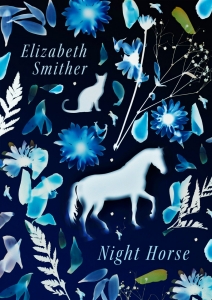
©Elizabeth Smither from Night Horse


Elizabeth Smither’s most recent poetry collection, Night Horse, was published by Auckland University Press in 2017. She also writes novels and short stories.

Poems from Ockham NZ Book Award poetry finalists: Briar Wood’s ‘Kuramārōtini’


Kuramārōtini


So the story goes

that trickster Kupe

cheated his friend

into diving overboard

to free the lines

then paddled rapidly away.


Some hoa.

Best to know that

legendary navigators take huge risks

and do not make the safest companions.


Ākuanei—

she asked herself—

what do I want—

home in Hawaiki

or the travelling years?


What does he want—

the waka my father gifted—

Matahourua and me?


Or maybe unhappiness

with the man she’d married

drove her to the coast.

It’s possible—

she was curious and Hoturapa wasn’t

the kind of man who liked a journey

so she chose Kupe.


Yet even an inveterate traveller

might become weary in a waka

on the open sea,

looking out for landfall.


Travelling direct to her destination—

as the future loomed towards her

she named that radiant land

on the horizon

Aotearoa.


Briar Wood from Rāwāhi (Anahera Press, 2017)


Briar Wood grew up in South Auckland, Aotearoa New Zealand. Until 2012, she lived and worked as a lecturer in Britain. Welcome Beltane (Palores Press, 2012) made poetic links between family histories and contemporary places. The most recent collection Rāwāhi (Anahera Press, 2017) is focused through a return to Northland places where her Te Hikutū ki Hokianga, Ngāpuhi Nui whakapapa resonates with ecological concerns.

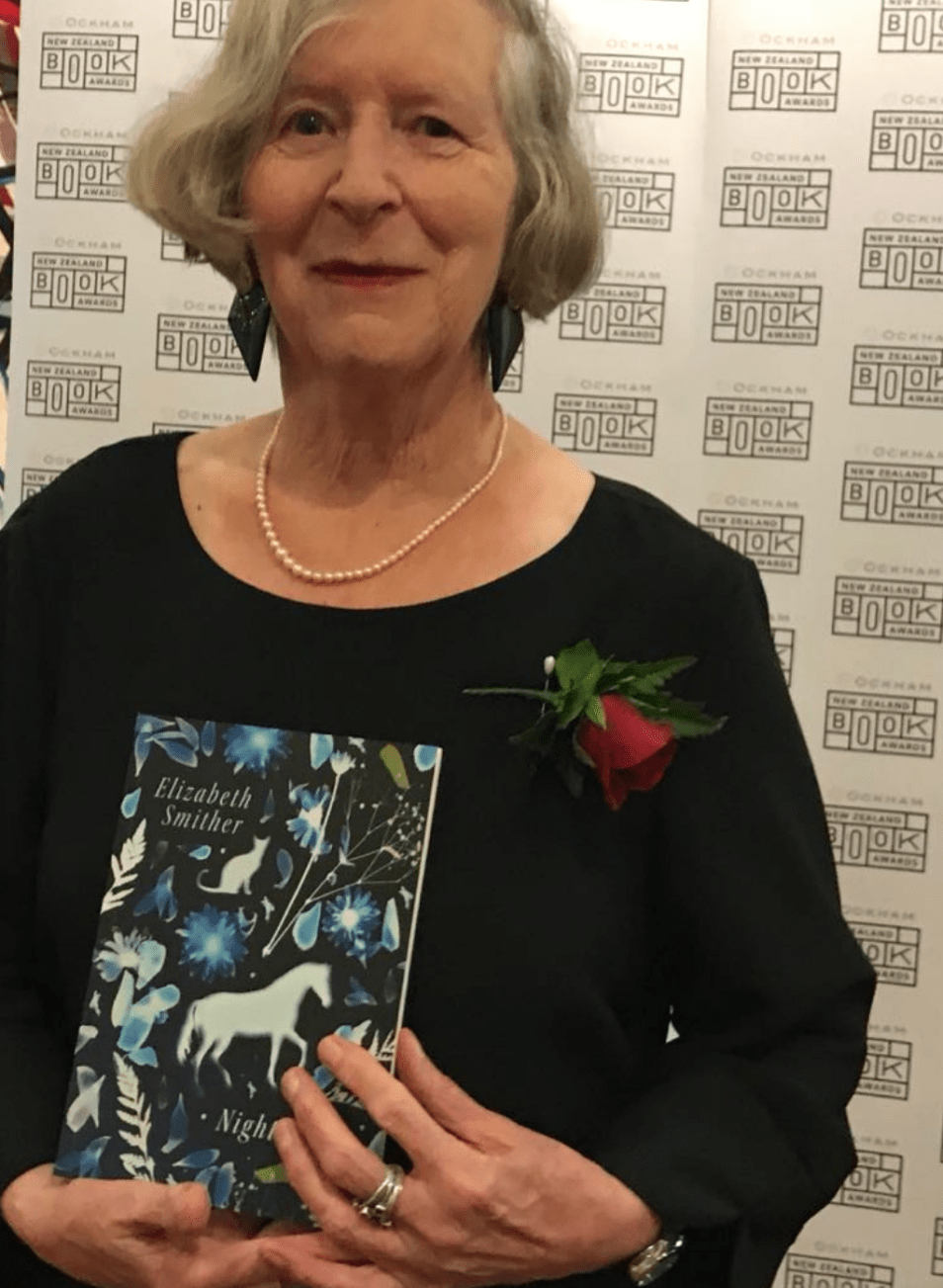
12 Questions for the Ockham NZ Book Awards poetry finalists: Elizabeth Smither


DSC_0067.jpg


Congratulations on your short-list placing Elizabeth!


What poetry books have you read in the past year?

Everything by Wislawa Szymborska and the Penguin Modern Poets series (3 poets in each clutch purse-sized collection): Emily Berry/Anne Carson/Sophie Collins; Malika Booker/Sharon Olds/Warsan Shire etc.


What other reading attracts you?

Almost anything. At the moment I am re-reading Rex Stout and the yellow pyjama-wearing detective Nero Wolfe.


Name some key starting points (or themes) for your collection.

I never discover a theme until a collection is put together. The connections between individual poems can be as subtle and perverse as the most delicate rhyme or rhythm.


Did anything surprise you as the poems come into being?

Perhaps the secret life of animals?


Find up to 5 individual words that pitch your book to a reader.

‘The heart heals itself between beats’ because it was a commission with an extra scoop of fear attached.


What matters most when you write a poem?

Depth and uncertainty.


What do you loathe in poetry?

Nothing. It’s important not to loathe anything.


Where do you like to write poems?

Propped up on a bank of pillows in bed, with the concert programme on the radio and perhaps a glass of wine.


What are strengths and lacks in our poetry scenes?

The chutzpah of our independent publishers; a tendency for too much adulation.


Have you seen a festival poetry session (anywhere) that has blown you off your seat (or had some other significant impact)?

Margaret Atwood and Hans Magnus Enzensberger at the Aldeburgh festival. I read first and sat down between them, shivering.


If you could curate a dream poetry session at The Auckland Writers Festival which poets would be there and who would mc or chair it?

I think I’d do a Dead Poets session. Keats and Shelley, Robert Lowell, William Empson, John Crowe Ransom, Tomas Tranströmer, Szymborska, of course… the possibilities are endless. It might have something of the bitchy tone of ‘The Real Housewives of Melbourne’.  To chair it one of the Paulas: Green or Morris.


Night Horse AUP author page


1497223465774-1.jpg


The Ockham NZ Book Award Poetry Finalists: an interview with Tony Beyer


Screen Shot 2018-03-20 at 8.55.02 AM.png


Congratulations on your short-list placing!

Thank you!


What poetry books have you read in the past year?

My favourite NZ books in 2017 were Stu Bagby’s Pockets of Warmth (Antediluvian Press) and John Gibb’s Waking by a River of Light (Cold Hub Press). Recent publication of their respective collected poems has sent me back volume by volume through Galway Kinnell and A. R. Ammons, admired late US poets. Also a delight to have Alistair Te Ariki Campbell’s Collected Poems – VUP’s finest ever publication!


What other reading attracts you?

Very interested lately in female North American long-form poets, specifically Rachel Blau du Plessis, Beverly Dahlen, Daphne Marlatt and Eleni Sikelianos. I read a lot of European and Asian fiction in translation. Non-fiction usually includes Victorian and ancient history.


Name some key starting points (or themes) for your collection.

Finding myself unexpectedly between teaching engagements and having to re-think my assumed identity. The New Pacific Studio fellowship in late 2011, when I was encouraged to be creatively selfish. Since then I seem to have established a modus operandi that keeps me writing whatever else is going on.


Did anything surprise you as the poems came into being?

There was a strong awareness that these were some of the poems I had waited a long time to be able to write.


Find up to 5 individual words that pitch your book to a reader.

Right here now and always.


Which poem particularly falls into place for you?

‘Li Bai’ focuses many of the concerns in the book about environment, identity, time, culture and memory, etc. ‘The characters’ probably does the same in a more succinct, oblique manner. I suppose my basic allegiance is to poetry.


What matters most when you write a poem?

I want to tell the truth and communicate with others. The work is more important than I am.


What do you loathe in poetry?

Reductive expectations.


Where do you like to write poems?

Everywhere.


What are strengths and lacks in our poetry scenes?

Strengths: the new work appearing from younger poets, inventing the future and guaranteeing there will be one; growing bilingual and multilingual awareness has enriched our Pacific possibilities and commands response. Both factors indicate our unique position and opportunities in the Anglosphere.


Have you seen a festival poetry session (anywhere) that has blown you off your seat (or had some other significant impact)?

Have not attended festivals.


If you could curate a dream poetry session at The Auckland Writers Festival which poets would be there and who would mc or chair it?

NZ now: Airini Beautrais, Sarah Jane Barnett, David Howard and Erik Kennedy, MC’d by Stu Bagby.

For all time: Tomas Tranströmer, Charles Olson, Lauris Edmond and C. P. Cavafy, chaired by William Carlos Williams.


9780473411046


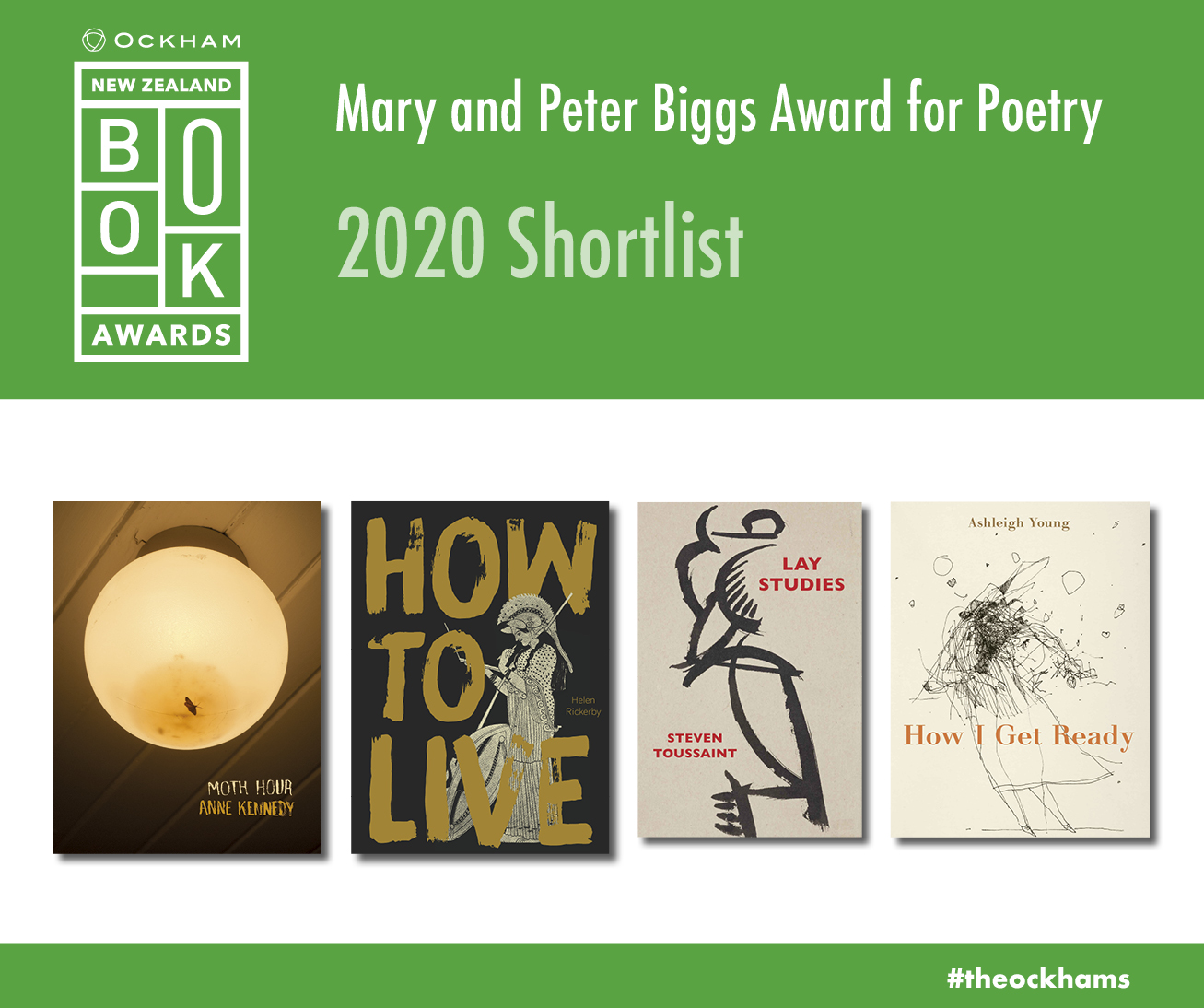
The Ockham New Zealand Book Awards Poetry shortlist


NZ-book-awards-trust_logo@2x.png

All shortlists here

Book awards draw attention to books that hook judges for any number of reasons. Hopefully the awards attract new readers and generate new conversations. Check out reactions at The Spin Off to all four lists. In 2017, and I seem to say this every year, New Zealand published an astonishing array of poetry from a diverse range of presses. I loved so much of it, I would have turned down an invitation to judge an award. Yes there were books I utterly loved that didn’t make the long list. Yes there were books from the long list that I utterly loved that didn’t make the short list.

I am really familiar with three of the books on the short list, while the fourth is a pleasing discovery. Each of these books contain poems that gave me goosebumps. So in the spirit of generosity I celebrate the judges’ choices.

What do these poets have in common? Attentiveness!


1497223465774.jpg

Elizabeth Smither’s Night Horse   (Auckland University Press)

Last year I read through the captivating stretch of Elizabeth Smither’s poetry: from Here Come the Clouds published in 1975, to the new collection, Night Horse. I was drawn into melodious lines, pocket anecdotes, bright images and enviable movement. Harry Ricketts talked about the transformative quality of Elizabeth’s poems in an interview with Kathryn Ryan, and I agree. As you follow reading paths from the opening line of the first poem — ‘Once, near nightfall, I drove past my mother’s house’—there is always  some form of transformation. The poetry, from debut until now, is meditative, andante, beautiful.

I see a continued poetic attentiveness and an ability to assemble detail that both stalls and surprises the reader. I was thinking the poems are like little jackets that can be worn inside out, and outside in, because Elizabeth offers stillness in movement, and in movement stillness. She generates musicality in plainness, and in plainness there is music. In the strange, there is the ordinary, and in the ordinary, there is strangeness.

Elizabeth so often slows down the pace of her poems so we may linger upon an image, a word, an anecdote, a side-thought to see what surfaces.

I especially love the ongoing friendship and granddaughter poems, but I particularly love the first poem, ‘My mother’s house.’ Kate Camp and I heard Elizabeth read this at the National Library’s Circle of Laureates last year and were so moved and uplifted that we asked for copies! In the poem, unseen, Elizabeth observes her mother move through the house from the street (she told us this autobiographical fact) and sees her in shifting lights. The moment is breathtaking; are we are at our truest self when we are not observed? There is characteristic Smither movement through the poem, slow and attentive, to the point of tilt and surprise. The final lines reverberate and alter the pitch of looking: ‘but she who made it/who would soon walk into the last room/of her life and go to sleep in it.’


It was all those unseen moments we do not see

the best of a friend, the best of a mother

competent and gracious in her solitude


from ‘My mother’s house’


TheYield-360-360x530.jpg


Sue Wootton’s The Yield  (Otago University Press)

Sue Wootton’s shortlisted collection is a sumptuous read, a read that sparks in new directions, while clearly in debt to everything she has written to date. You enter a sumptuous feast of sound and image amongst other glorious things. Several poems feature knitting, and knitting is a perfect analogy for the way Sue’s poems interlace the aural and the visual to produce sensual patterns. The poems have enviable texture and that texture engages both mind and heart.

As I read, the poetry of David Eggleton and Michele Leggott comes to mind.  They both write out of their own skin in ways that are quite unlike the local trend to write conversational poetry. I can see a similar idiosyncratic pulse driving Yield poems as though Sue is pushing boundaries, resisting models, playing and challenging what she can do as a poet.

I am also struck by the heightened musical effects. Sue has always had an attentive ear, but this collection almost feels baroque in the leapfrogging alliteration, assonance and sweet chords. There are traces of the personal in the poems—deaths, a family picnic, illness, a declaration to live life to the utmost, friendship—but I would suggest Sue hides in the crevices. Some of the poems (‘The needlework, the polishing,’ ‘Pray,’ ‘Priest in a coffee shop,’ ‘Graveyard poem,’ ‘Poem to my nearest galaxy’) engage with some kind of spirituality, either through a church building or prayer.

So many poems in the collection stand out for me (and indeed there are a number of award-winning poems here). I especially love ‘Calling,’ ‘Wild,’ ‘Lunch poem for Larry,’ ‘Admission,’ ‘Picnic,’ ‘Unspooling,’ ‘Strange monster,’ ‘A treatise on the benefits of moonbathing,’ ‘The crop,’ ‘Daffodils.’ Ha! Quite a list of poems that matter.

The alluring cover befits the allure of the poems within.


Measure my wild. Down to my last leaf,

my furled, my desicated. This deciduousness,

this bloom. Calculate my xylem levels,

my spore count, fungal, scarlet

in a bluebell glade. Whoosh,

where the foliage closes on a great cat.


from ‘Wild’


Rawahi-Front-Cover_high-res.jpg


Briar Wood Rāwāhi   (Anahera Press)

Briar Wood’s poetry collection gathers, with a wide embrace, details of travel and living, and as the lived-in world grows on the page, the poems set up all manner of conversations. This book draws upon whakapapa, love, relations, ecology, the past and the present. Its warmth and its empathy are infectious.

Briar offers poetry that is both spare in delivery and rich in connection because people and places matter. The book cover glitters white on blue – and for me that is a treat of reading within. Words shine out like little gold nuggets on the line, layering and overlapping, and never losing sight of what matters deeply to the poet.

Poetry can be a way of laying down roots and setting up home in the poem, and on these occasions, it is as though Briar sings home in to being.


The sea at night is blacklit,

kikorangi, kōura, topazerine, pango,

a haul of images pouring from nets,

darker than oil underground


from ‘Paewai o Te Moana’


9780473411046.jpg


Tony Beyer’s Anchor Stone (Cold Hub Press)

Tony Beyer was such a discovery for me, I now need to track down his back list. Anchor Stone offers a distinctive voice with each poem judiciously layering detail that animates people, places and events. I am drawn to the measured pace, the slow and steady revelations that beguile and compound. The mix of economy, surprise, wit and physicality is glorious. You get linguistic agility, askew slides and a touch of daring.

No subject is redundant when it comes to poetry – think the land, friendship, trees and stones –  as Tony underlines. ‘Paths’ demonstrates such poetic fluidity, in a sequence of 100 small poems that furnish the outbreath and the inbreath of writing. It is as though each little poem walks its way into thought. Contemplation. The title suggest that these poems are miniature anchors but they are also kite-like in their imaginings and renditions and our need to attend to the physical world we inhabit.

Poetry can embrace beauty, flawed or otherwise, along with ways of belonging.


there is someone

everywhere in this house

living or

having lived here

their presence preserved

by a window fastening

the way a door

closes or partly closes


from  ‘Paths’


Each of these collections generates distinctive and diverse poetry pleasures. A big hug to the poets and big hug to all those who missed out on either list. Poetry awards can be tough times when you write, especially when exceptional books don’t make lists, long or short. But for these deserving four poets, it is time to crack open the bubbles and celebrate.


Congratulations to the Ockham Book Award Poetry Longlisters

Screen Shot 2017-11-28 at 6.17.55 AM.png

Congratulations poets – this is a strong showing.


Here is my conversation with NZ Poet Laureate, Selina Tusitala Marsh.

My conversation with Airini Beautrais.

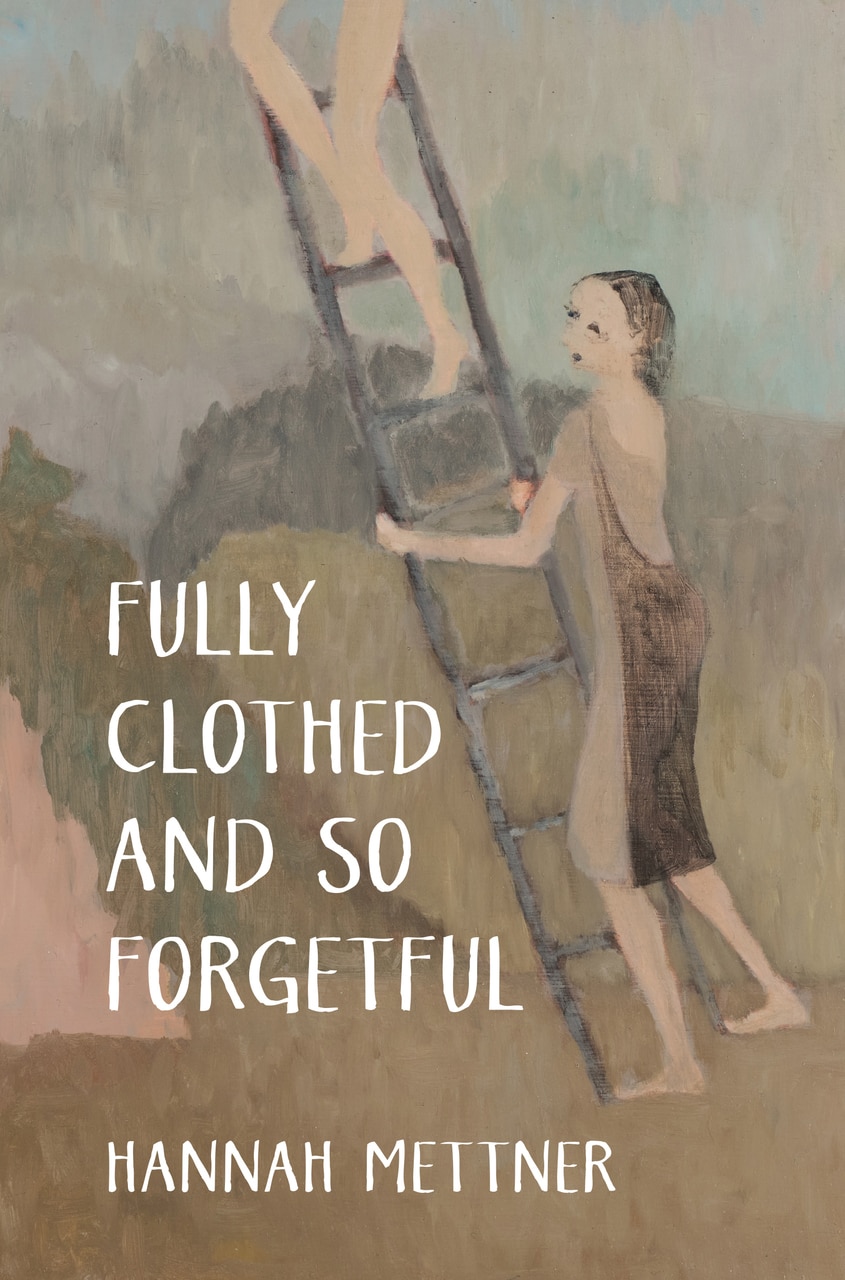
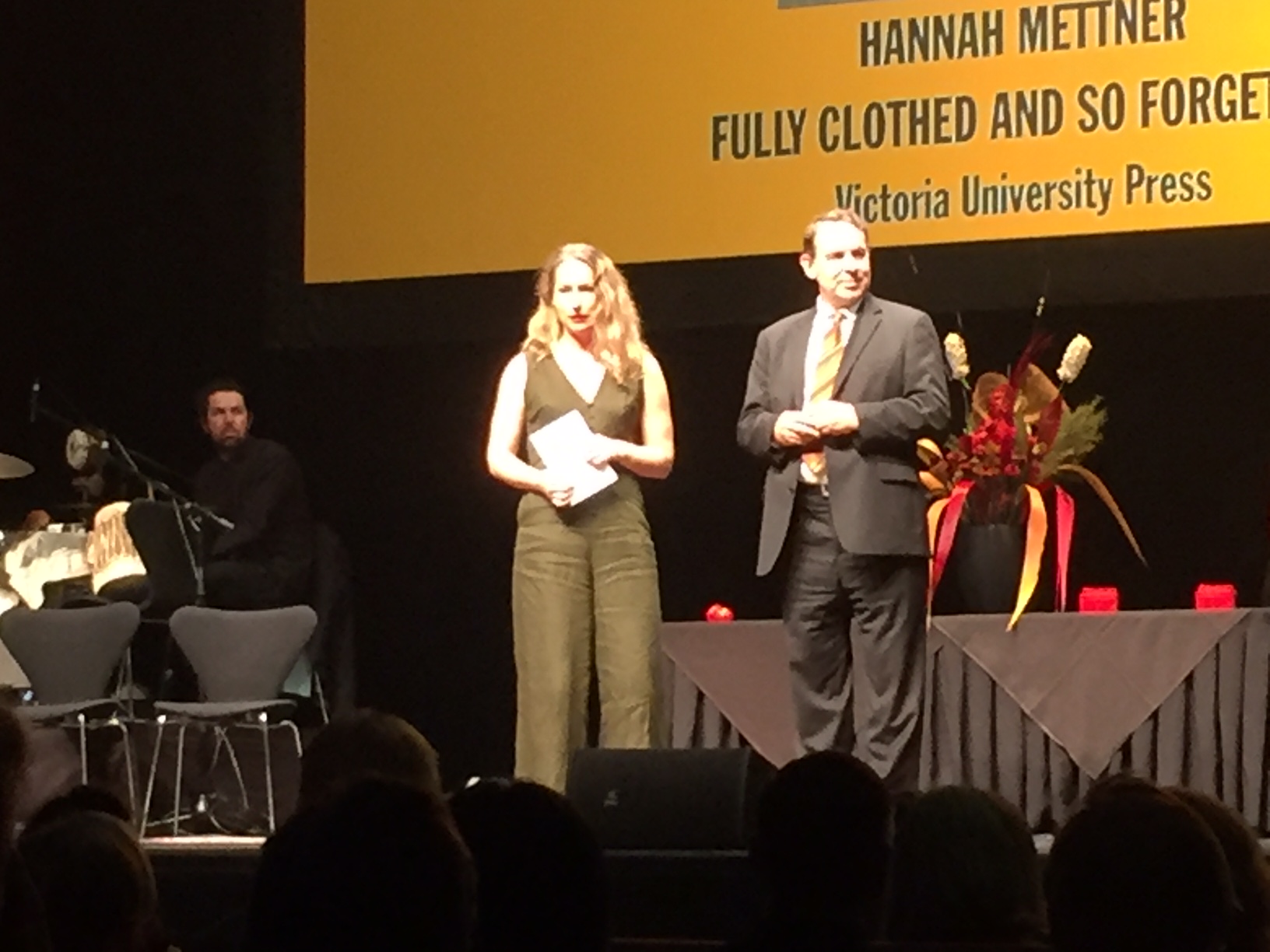
My conversation with Hannah Mettner.

My conversation with Elizabeth Smither.

My conversation with Sue Wootton.

Two poems and my response to Kate Camp’s collection

Two poems and my response to Briar Wood’s collection.


I haven’t yet read the other  collections – but I loved these enough to have showcased them on the blog. I would sing the praises of them anywhere.


The Poetry Award will be judged by poet, novelist and creative non-fiction writer Alison Wong; poet and deputy chief executive, Māori, at Manukau Institute of Technology Robert Sullivan; and Otago poet, publisher, editor and librettist Michael Harlow.

My commiserations to those who missed the list. This year has produced an extraordinary array of poetry books from main and boutique presses. And yes, very good books are missing (it’s like trying to squeeze your books in your holiday bag and the bag just won’t shut) so I am going to flag just a few.

The glorious books of Bill Manhire (there are two!), Michele Leggott and Nina Powles.  I would add Louise Wallace, Maria McMillan, James Brown, Caron Smeaton, Reuben Todd. .


Congratulations to those on the longlist.  A toast to you, to your publishers and booksellers and to those who spread its joy far and wide.


Rest of award results and details of poetry books here


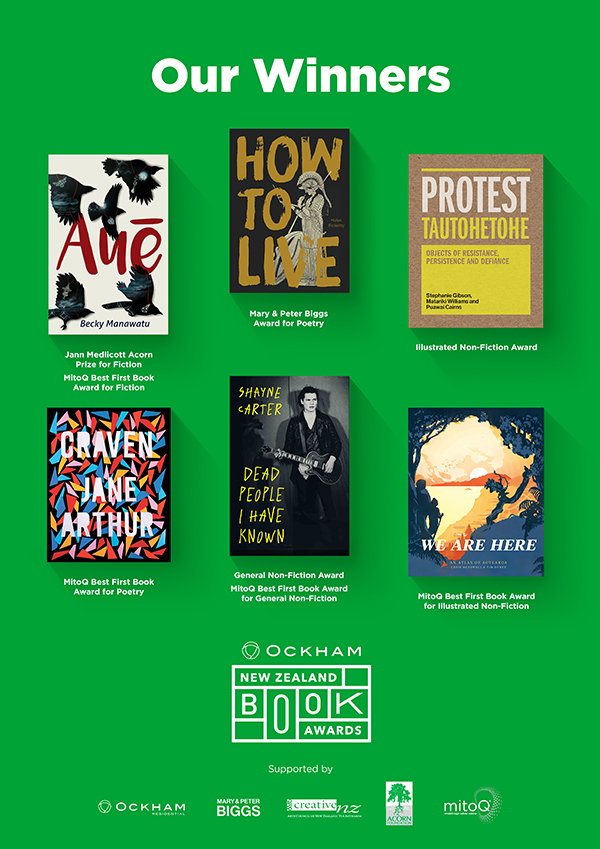
Hats off to The Ockham NZ Book Award Winners

Congratulations to the winners, commiserations to those who missed out and hats off to Victoria University Press for an extraordinary showing. VUP is a strong supporter of local writing, publishing more poetry that anyone else without compromising on quality. Three cheers VUP! Hats off to all NZ publishers, large and small, who back local writers and books. We are in debt to you. Away from the glitz and flare of an awards ceremony, there is an active terrain of writing and writers. Hats off to that too!

And hats off to the winners! Enjoy this moment of well-deserved recognition by your peers.

This year’s four category award winners will appear at a free event at the Auckland Writers Festival: The State We’re In on Friday 19 May at 5.30pm in the Heartland Festival Room, Aotea Square.


Fiction: Catherine Chidgey

Internationally renowned Ngāruawāhia resident Catherine Chidgey has won New Zealand’s richest writing award, the $50,000 Acorn Foundation Fiction Prize, for her novel The Wish Child. The award was announced this evening at the 2017 Ockham New Zealand Book Awards.

The panel of judges — Bronwyn Wylie Gibb, Peter Wells, Jill Rawnsley and inaugural international judge the Canadian writer Madeleine Thien — said  “The Wish Child exposes and celebrates the power of words – so dangerous they must be cut out or shredded, so magical they can be wondered at and conjured with – Chidgey also exposes the fragility and strength of humanity … Compelling and memorable, you’ll be caught by surprise by its plumbing of depths and sudden moments of grace, beauty and light.”

The Wish Child, Chidgey’s fourth novel, comes 13 years after her last work, The Transformation, was published to critical acclaim. Chidgey’s previous novel Golden Deeds was chosen as a Book of the Year by Time Out (London), a Best Book by the LA Times Book Review and a Notable Book of the Year by the New York Times. Her debut novel, In a Fishbone Church, won a Commonwealth Writers Prize (South East Asia and South Pacific).

Her latest novel, published by Victoria University Press, is one of four Ockham New Zealand Book Awards category winners, selected by four panels of specialist judges out of a shortlist of 16, which were in turn drawn from 40 longlisted titles from 150 entries.


Poetry: Andrew Johnston

Paris-based Andrew Johnston won the Poetry category for his collection Fits & Starts (Victoria University Press), a book described by the category’s judges’ convenor, Harry Ricketts, as a slow-burning tour de force.

“The judges’ admiration for Andrew Johnston’s remarkable collection grew with each rereading, as its rich intellectual and emotional layers continued to reveal themselves … Using a minimalist couplet-form, the collection is at once philosophical and political, witty and moving, risky and grounded, while maintaining a marvellously varied singing line.

“To reward Fits & Starts with the overall poetry prize is to reward New Zealand poetry at its most impressive and its most promising.”


Nonfiction: Ashleigh Young

Ashleigh Young (Wellington) took the Royal Society Te Apārangi Award for General Non-Fiction for her collection of personal essays Can You Tolerate This? (Victoria University Press).

The category’s judges’ convenor, Susanna Andrew, says Young’s work sets a high bar for style and originality in a form that has very little precedent in this country. “Always an acute observer, it is in Young’s commitment to writing as an art that the true miracle occurs; she tells us her story and somehow we get our own.”

Young catapulted to international recognition earlier this year when she won the Yale University US$165,000 Windham-Campbell Prize for the collection.


Illustrated Non-Fiction: Barbara Brookes

Dunedin writer and historian Barbara Brookes won the Illustrated Non-Fiction category for her meticulously documented work A History of New Zealand Women (Bridget Williams Books).

The category’s judges’ convenor, Linda Tyler, says Brookes’ work combines deep research, an immensely readable narrative, superbly well-integrated images and is distinguished by close attention to both Māori and Pakehā women.

“Putting women at the centre of our history, this sweeping survey shows exactly when, how and why gender mattered. General changes in each period are combined effortlessly with the particular, local stories of individual women, many not well-known. A wider sense of women’s experiences is beautifully conveyed by the many well-captioned artworks, photographs, texts and objects.”


Best First Books:

The Judith Binney Best First Book Award for Illustrated Non-Fiction: Ngarino Ellis for A Whakapapa of Tradition: 100 Years of Ngāti Porou Carving, 1830-1930, with new photography by Natalie Robertson (Auckland University Press).

The Jessie Mackay Best First Book Award for Poetry: Hera Lindsay Bird for Hera Lindsay Bird (Victoria University Press).

The E.H. McCormick Best First Book Award for General Non-Fiction: Adam Dudding for My Father’s Island: A Memoir (Victoria University Press).

The Hubert Church Best First Book Award for Fiction: Gina Cole for Black Ice Matter (Huia Publishers).

Reviewing the very fabulous poetry books on the Ockham NZ Book Award short list

I have gained much pleasure from reading the books on the long list. Of course – how can it not be?! – excellent poetry books did not make the cut.  Take Chris Price’s glorious Beside Herself for example. I was transported by the uplift in Chris’s writing and celebrated it as one of her very best. I have said good things about all of the books because they gifted me reading experiences to savour. In my view, the long list was a go-to-point for the terrific writing that we are producing. I could not have picked four if I tried. I would have headed for the hills!

Boutique Presses are doing great things in New Zealand as are the University Presses, but in this showing, and with such noteworthy books appearing each year, and in quite staggering numbers, I am sendingsend a virtual bouquet of the sweetest roses to VUP. Three extraordinary books on the shortlist! Wonderful.

I adored the books shortlisted and will share my thoughts.


Tusiata Avia’s book is so rich and layered and essential. I have been reading and writing about this book in the past few months, and the more I read and write, the more I find to admire and move and challenge me. I wrote this after going to the launch:

0b1eb042-a027-4f9f-bae5-5ca96dfd4ed5.jpg       IMG_3432

Fale Aitu / Spirit House Tusiata Avia, Victoria University Press, 2016 (VUP author page)

Last night I drove into the city into some kind of warm, semi-tropical wetness —like a season that no longer knew what it ought or wanted to be — to go to the launch of Tusiata Avia’s new poetry collection. Tautai, the Pacific Art Gallery, was a perfect space, and filled to the brim with friends, family, writers and strong publisher support. I loved the warmth and writerly connections in the room. I have been reading Tusiata’s book on planes as poetry now seems to be my activity of choice in the air. I adore this book and have so much to say about it but want to save that for another occasion. I was an early reader so have had a long-term relationship with it.


the launch

The room went dark and an MIT student, bedecked in swishes of red, performed a piece from a previous collection, Blood Clot. Mesmerising.

Tusiata’s cousin and current Burns Fellow, Victor Rodger, gave a terrific speech that included a potted biography. I loved the way he applauded Tusiata not just as a tremendous poet, but as a teacher and solo mother. Her names means artist in Samoan and he saw artist in the numerous roles Tusiata embodies. Writing comes out of so much. He identified her new poems as brave, startling, moving and political. Spiky. I totally agree.

Having dedicated her book to her parents, Tusiata said that it was hard to be the parent of a poet who wrote about family. When she told her mother what she was writing, her mother embraced it. She opened her arms wide. She said the skeletons need to come out. The atua. Tusiata’s speech underlined how important this book is. It is not simply an exercise in how you can play with language, it goes to the roots of that it means to be daughter, mother, poet.  It goes further than family into what it means to exist, to co-exist, in a global family. When a poet knows how to write what matters so much to her, when her words bring that alive with a such animation, poise and melody, it matters to you.

Four poems read. Lyrical, song-like, chant-like, that place feet on ground, that open the windows to let atua in and out, that cannot turn a blind eye, that hold tight to the love of a daughter, that come back to the body that is pulsing with life.

Yes I had goose bumps. You could hear a pin drop.

Fergus Barrowman, VUP publisher, made the important point that these poems face the dark but they also face an insistent life force.

Congratulations, this was a goosebump launch for a goosebump book.


Hera Lindsay Bird’s debut book broke me apart, gushed oceans of reaction through me and quite simply filled me with the joy of poetry. This is what I posted earlier on the blog:

Hera_Lindsay_Bird_final_cover__03325.1460344863.220.220-1.jpg


All I care about is looking at things and naming them’

‘I love life’

Hera Lindsay Bird Hera Lindsay Bird, Victoria University Press, 2016


For the past week or so, after visits to our key research libraries,  I have been writing about Jessie Mackay, a founding mother of New Zealand poetry. What I am writing is under wraps but my relationship with both the woman and her poetry is not clear cut. She moves me, she astonishes me, she irritates me, but I am always filled with admiration. One question bubbling away is: how different is it for women writing over a hundred years later?  Sure, contemporary poems are like a foreign country, we have changed so much. But what of our behaviour as poets? Our reception? What feeds us? What renders us vulnerable and what makes us strong?

I want to draw a pencil line from Jessie Mackay to Hera Lindsay Bird and see what I can peg on it. But I want to save these thoughts for my book.

Hera Lindsay Bird has attracted the biggest hoo-ha with a poetry book I can recall. It felt like I was witnessing the birth of a cult object. Images of the book cover on the side of a bus or a building (photoshopped?!?!) created a little Twitter buzz. Lorde tweeted. Anika Moa tweeted. Tim Upperton reviewed it on launch day on National Radio. Interviews flamed the fan base on The Spin Off, The Wireless and Pantograph Punch. The interviews promoted a debut poet that is hip and hot and essential reading. Poems posted have attracted long comment trails that apparently included downright vitriol (I haven’t read these and I think just applied to one poem). The Spin Off cites this as one of a number of factors in the shutting down of all comments on their site. The launch was jam packed, the book sold out, and took the number one spot on the bestseller list. Hera is a poet with attitude. Well, all poets have attitude, but there is a degree of provocation in what she says and writes. Maybe it’s a mix of bite and daring and vulnerability. Just like it is with JM, Hera’s poetry moves, astonishes and irritates me, but most importantly, it gets me thinking/feeling/reacting and prompts admiration.


A few thoughts on Hera Lindsay Bird by Hera Lindsay Bird  (VUP author page)


This book is like rebooting self. Each poem reloads Hera. Click click whirr.

At first you might think the book is like the mohawk of a rebellious punk who doesn’t mind hate or kicking stones at glass windows or saying fuck at the drop of a hat.

The word love is in at least two thirds of the poems. It catches you at times with the most surprising, perfect image:

‘when we first fell in love

the heart like a trick candle

on an ancient, moss-dark birthday cake’


‘it’s love that plummets you

back down the elevator shaft’


You could think of this book as a handbook to love because Hera doesn’t just write love poems, she riffs on notions of love:

‘It’s like falling in love for the first time for the last time’

or: ‘What is there to say about love that hasn’t already been’


Some lines are meant to shock you out of reading lethargy:

‘I feel a lot of hate for people’

or: ‘My friend says it’s bad poetry to write a book’

or: ‘Some people are meant to hate forever’


or:

‘It’s a bad crime to say poetry in poetry

It’s a bad, adorable crime

Like robbing a bank with a mini-hairdryer’


Hera reads other poets and uses them as springboards to write from: Mary Ruefle, Bernadette Mayer, Mary Oliver, Chelsey Minnis, Emily Dickinson.

Sometimes the book feels like a confessional board. Poetry as confession. It hurts. There is pain. There is always love.

This poetry is personal. Poems (like little characters) interrupt the personal or the chantlike list or the nettle opinion the honey opinion as though they want a say and need to reflect back on their own making, if not maker.

Love hate sex girlfriends life death: it is not what you write but how you write it that makes a difference, that is the flash in the pan, not to mention the pan itself.

Hera writes in a conversational tone, sometimes loud, sometimes quiet, as though we are in a cafe together and some things get drowned out but the words are electric and we all listen spellbound.


She uses excellent similes. On poetry:

‘This is like an encore to an empty auditorium

It’s a swarm of hornets rising out of the piano’


‘Neither our love nor our failures will save us

all our memories

like tin cans on a wedding car

throwing up sparks’


‘I can only look at you

Like you are a slow-burning planet

And I am pouring water through a telescope.’


Hera likes to talk about bad poems; like the wry punk attitude that says look at my bad style. I am not convinced that there is much in the way of bad poetry here unless you are talking about a vein of impoliteness. It kind of feels like a set of Russian dolls – inside the bad poetry good poetry and inside that the bad and then good and so on and so forth. There is always craft and the ears have been working without fail.

One favourite poem in the book is ‘Mirror Traps’ but I am saving that for the Jessie Mackay pencil line.

Hera’s sumptuous book comes out of a very long tradition of poets busting apart poetic decorum, ideals and displays of self. It’s a while since we have witnessed such provocation on our local poetry scene. What I like about this scintillating writing is that each poem manifests such a love of and agility with words — no matter how bad it tries to be. It is addictive reading. Yes there is a flash that half blinds you and spits searing fat along your forearms, but you get to taste the sizzling halloumi with peppery rocket and citrus dressing.


‘I love to feel this bad because it reminds me of being human

I love this life too

Every day something new happens and I think

so this the way things are now’


PS I adore the cover!

Hera Lindsay Bird has an MA in poetry from Victoria University where she won the 2011 Adam Prize for best folio. She was the 2009 winner of the Story! Inc. Prize for Poetry and the Maurice Gee Prize in Children’s Writing. She lives in Wellington with her girlfriend and collection of Agatha Christie video games.


In a spooky moment of synchronicity, I was walking along Bethells Beach this morning in the crisp gloom hoping Gregory Kan’s book made the shortlist, not realising the decision was out today. I loved the inventiveness, the heart, the attentiveness, the thrilling electricity of his language and so much more:

1455844200262.jpg


Gregory Kan This Paper Boat Auckland University Press 2016 (AUP author page)


Gregory Kan’s debut poetry collection, This Paper Boat, is a joy to read on so many levels.

Kan’s poetry has featured in a number of literary journals and an early version of the book was shortlisted for the Kathleen Grattan Poetry Prize in 2013. He lives in Auckland.

Paper Boat traces ghosts. We hold onto Kan’s coat tails as he tracks family and the spirit of poet, Robin Hyde (Iris Wilkinson). The gateway to family becomes the gateway to Iris and the gateway to Iris becomes the gateway to family. There is overlap between family and missing poet but there is also a deep channel. The channel of difficulty, hard knocks, the tough to decipher. There is the creek of foreignness. The abrasiveness of the world when the world is not singular.

Kan enters the thicket of memory as he sets out to recover the family stories. He shows the father as son fishing in the drains, the mother as daughter obedient at school. Yet while he fills his pockets with parental anecdotes, there is too, the poignant way his parents remain other, mysterious, a gap that can never be completely filled:


In the past when I thought about people my parents

were somehow

not among them. But some wound stayed


wide in all of us, and now I see in their faces

strange rivers and waterfalls, tilted over with broom.


The familial stands are immensely moving, but so too is the search for Iris. Kan untangles Iris in the traces she has left – in her poems, her writings, her letters. He stands outside the gate to Wellington house, listening hard, or beside the rock pool. There is something that sets hairs on end when you stand in the footsteps of ghosts, the exact stone, the exact spot, and at times it is though they become both audible and visible. Hyde’s poems in Houses by the Sea, are sumptuous in detail. I think of this as Kan muses on the rock-pool bounty. When he stands at her gate:


I have to hear you to keep you

here, and I have to keep you

here to keep coming back.


I think too of Michele Leggott’s plea at the back of DIA to listen hard to the lost matrix of women poets, the early poets. To find ways to bring them close.

Kan brings Iris (Robin) close. His traces. Iris becomes woman as much as she does poet and the channel of difficulty fills with her darknesses as much as it does Kan’s. There is an aching core of confinement: her pregnancy, her loss of the baby, her second pregnancy, her placement of the baby elsewhere, her mental illness. His confinement in a jungle. His great-aunt’s abandonment as a baby.


The strands of love, foreignness and of difficulty are amplified by the look of the book. The way you aren’t reading a singular river of text that conforms to some kind of pattern. A singular narrative. It is like static, like hiccups, like stutters across the width of reading. I love this. Forms change. Forms make much of the white space. A page looks beautiful, but the white space becomes a transmission point for the voices barely heard.

At one point the blocks of text resemble the silhouettes of photographs in a family album. At another point, poems masquerade as censored Facebook entries.Later still, a fable-like poem tumbles across pages in italics.

The writing is understated, graceful, fluent, visually alive.

I want to pick up Hyde again. I want to stand by that Wellington rock pool and see what I can hear. I have read this book three times and it won’t be the last.


In the final pages, as part a ritual for The Hungry Ghost Festival, Kan sends a paper boat down the river ‘to ensure// that the ghosts find their way/ back.’

The book with its heartfelt offerings is like a paper boat, floating on an ethereal current so that poetry finds its way back to us all (or Hyde, or family).


Auckland University Press page

A terrific interview with Sarah Jane Barnett

Sequence in Sport


Finally Andrew Johnston’s book caught me in a prolonged trance of reading. This from my SST review:

Fits_Starts_cover1__39122.1449546458.140.215.jpg

Andrew Johnston, Fits & Starts Victoria University Press (VUP author page)

Based in Paris, Andrew Johnston writes poetry with such grace, and directs his finely-tuned ear and eye to the world and all its marvels. The poems in his new collection, Fits& Starts, luxuriate in white space and they are all the better for it. You want to savour each set of couplets slowly.

The middle section filters Echo through the chapters of the Bible’s First Testament; the final section runs from Alpha through to Zulu and forms an alphabet of exquisite side tracks. With Echo coasting through the sequences, it is not surprising rhyme catches the deftness of Bill Manhire.

Ideas drift like little balloons in and out of poems, experience lies in gritty grains. What is off-real jolts what is real. A taste: ‘How I married distance/ and how close we are.’

This book replays the pulse of living, dream, myth. I am buying it for a poet friend.