Tag Archives: Ockham NZ book Awards

Poetry Shelf Celebrates Okham Book Awards poetry long list: Gregory Kan picks a poem

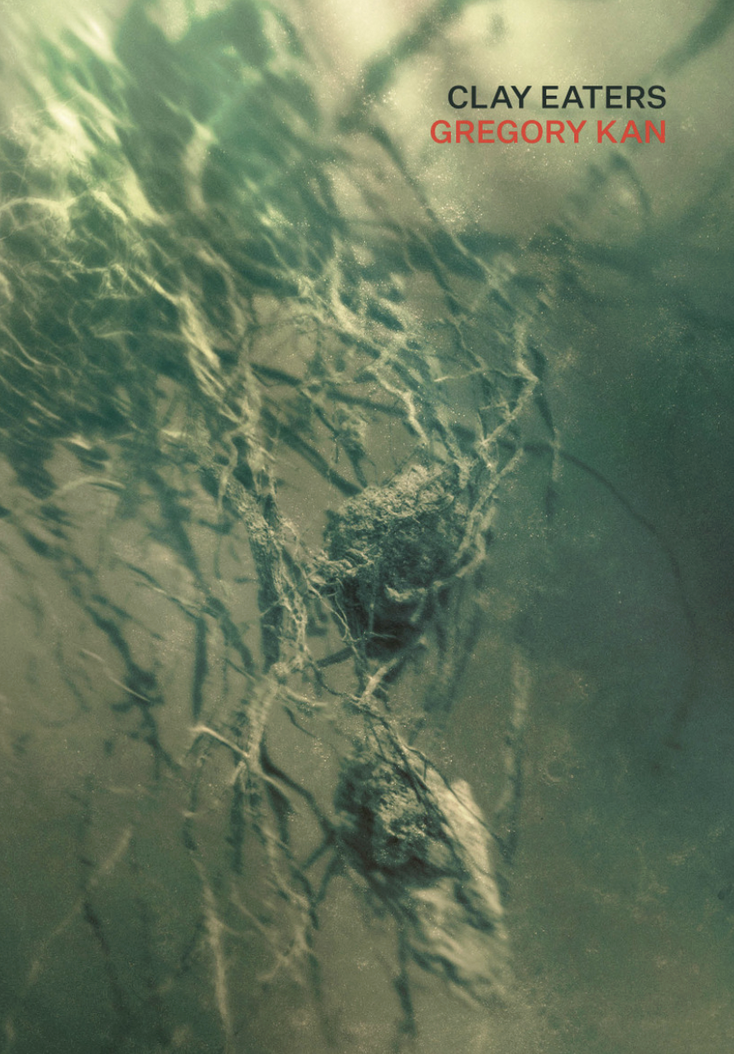
Clay Eaters, Gregory Kan
Auckland University Press, 2025

Not wanting to be bent

Over each and every loss

Divided my mind into multiple plots

Of land, with fences

Growing around each of them

Pretended

That there was nowhere else to go

That where I was

Was all that was left

And years went by

Like on television

Gregory Kan
from Clay Eaters

“I feel like I’ve written this poem many times, differently.” Gregory

From Paula Green’s review on Poetry Shelf:

I have just finished reading Gregory Kan’s Clay Eaters and I am caught in an eddy of multiple hauntings. How to translate this transcendental state of reading? How to share this poetry nourishment? I will begin with the notion that the collection resembles a landscape of braided rivers: a polyphonic source, the tributaries, the gentle currents and the torrents, the obstacle boulders and the jagged edges, the ripples and the calm. The beauty. The fierceness. The shifting waters. The place to stand and ponder. The place to stand and be. Poetry as braided river. Poetry as wonder.

Poetry that is personal and invented and incredibly moving.

Who were you, really

Outside of us, outside of me

Outside of all my

Useless bargaining

There are autobiographical braids. The family who moves from Singapore to Aotearoa. The poet who returns to Singapore six years later to do compulsory military service on Pulau Tekong. A father who suffers a stroke. A partner and a beloved cat who dies. Siblings and their offspring.

Poetry that is slowly unfolding as we traverse the braided currents. The visual layout offers shifting movement as we move amidst silence, the double spacing, the single spacing, the space to ponder, the spare and the dense, the jungle and the family room, the familiar and the unfamiliar.

Poetry as mapping. Maps are a recurring motif on an island that has a chequered history of cartography and naming, where orienteering is a key lesson for the military trainees. Yet I find myself viewing this as more than jungle mapping, because these poetic braids are a way of mapping self, of heart. There are the slippery currents of losing and finding one’s way in both past and present, the porous areas between here and there. There is no translation for a dish, kueh: ‘Neither cake nor jelly / Neither dumpling nor pudding / But somewhere between them all’. For me that signalled the inhabited space. Nothing set in concrete. Nothing static. The forever changed. Like the braided river flowing, the same but different.

This is poetry that navigates a tough experience, the poet’s military cadet years, those jungle ghosts, where spirits may dwell in trees: ‘The island didn’t seem like a place for people’. Where it’s the ‘Endless trees running deep into the red clay earth’. And it’s the weight of packs and mysterious stories and escape longings. The hammering weapons. Heart wrenching. This ache.

And then.

This is poetry that draws forward the father, there in his invalid wheelchair or his study, notebooks piling, books on shelves. The difficulty and ease of being with him, then and now. And the family, the mother, the siblings and the offspring, coming into view. And a scene, this together family scene, after the ‘archetypal family feast’, that is a catch in my throat, as the dreams accrue and connect.

Gregory Kan is a writer and developer based in Pōneke/Wellington. His first collection of poetry, This Paper Boat, was shortlisted for the Ockham New Zealand Book Awards for poetry in 2017. Under Glass, his second collection, was longlisted for the award in 2020. He was the 2017 Grimshaw Sargeson Fellow.

Auckland University Press page

Listen to Gregory read here

Poetry Shelf celebrates the Ockham NZ Book Awards poetry long list: Sophie van Waardenberg chooses a poem

No Good, Sophie van Waardenberg
Auckland University Press, 2025

Cremation Sonnet

When you come back your eyes are huge and bursting.
You come back with clean long hair.
You come back normal but you’re swelling
in the middle like a bird. Your skin luminous.
Or your skin something else. Last night—
did you know—you came back caved in, beaten,
and tomorrow you’ll be perfect, wading nowhere
through a football field of loose complacent light.
You come back: you do not know me. Or if you do,
you do not love me. Or if you do, it’s not enough.
Still you come back, forty-eight and starving,
twenty-two and blushing from a pantomime.
Dead dead traveller, what song is it,
when you come back, that you sing?

Sophie van Waardenberg
from No Good

This is the first of a bunch of ‘Cremation Sonnets’ that make up the middle chunk of No Good. There were a lot more of those sonnets that didn’t make it into the book, and I almost feel like I could write just as many if I tried to again now, but I don’t think I’ll try to again. Grief gets boring. (And I think some of the poems are about that, about how boring it is.)

This one, though, comes from the dreams I had — still have, sometimes — of my dad being alive again. He died when I was thirteen, and for a long while there was nothing I wanted more than to have him back. But it is never comforting to have a dead person come back in a dream, at least not for me, because they are not themselves and have nothing new to say to you. They are what your sleeping brain makes from scraps: some kind of ghoul or stupid caricature. If I wanted to achieve anything in particular with this poem, it was probably to at least gesture at that weird cavernous space between longing and horror. How can you bear that desire for something you can never have again? How can someone be gone? I think grief is more like confusion than sadness.

The thing is, these sonnets weren’t actually horrific to write. They were sometimes quite fun. I remember being in a bit of a frenzy, writing one or two of them a day — most of them unpromising. I had a pretty on-again off-again relationship with metre, obviously, and I made no attempt to rhyme. Still, there are plenty of iambs lolloping around in here. ‘A football field of loose complacent light’ is definitely a result of working in metre; I love how that constraint can force me into a less predictable line. The most fun I have when I’m writing is when I surprise myself, and I did that a lot when I wrote these poems.

Sophie van Waardenberg

Poetry Shelf review extract:

What initially hooks us into a poem? For me, there is no singular response. Indeed if there were, it might limit what poetry can be and do. When I first started reading Sophie van Waardenberg’s new collection, No Good, I jotted down two words in my notebook: rhythm and voice. I was hooked. I was drawn into the musical cadence of a speaker speaking, drawn into the under and over currents of spiky, thistle, bloom. And as I read the collection, on a number of occasions over the past few months, crucial questions arrived. I was especially musing on the way a poem might become both self and other.

The title is the perfect welcome mat into the collection, particularly coupled with the cover illustration, where ‘good’ wavers, and I gaze at the beetle on the apple that is both good and not good. Pausing on the welcome mat, a cascade of (centuries) of good girl propaganda spins in my mind, and I am peering into the no good to see the next apple in the bowl, a portal of good in the pillowcase of no good.

Full review here

Sophie van Waardenberg is a writer from Tāmaki Makaurau. She holds an MFA from Syracuse University where she was editor-in-chief of Salt Hill Journal. Her first chapbook, ‘does a potato have a heart?’, was published in AUP New Poets 5 (2019). Her poems about eating carbohydrates and kissing girls can be found in Cordite, Sweet Mammalian, The Spinoff and Best New Zealand Poems.

Listen to Sophie read two poems on Poetry Shelf: ‘Self-Portrait as Adolescent Covered in Flour’, ‘Hymn to the Insomniac in Fool’s Spring’

Auckland University Press page

Poetry Shelf celebrates the Ockham NZ Book Award poetry longlist: Anna Jackson chooses an extract


Poetry Shelf has invited poets to choose a poem from their longlisted collections and to write a few comments on the poem and poetry. Today Anna Jackson:

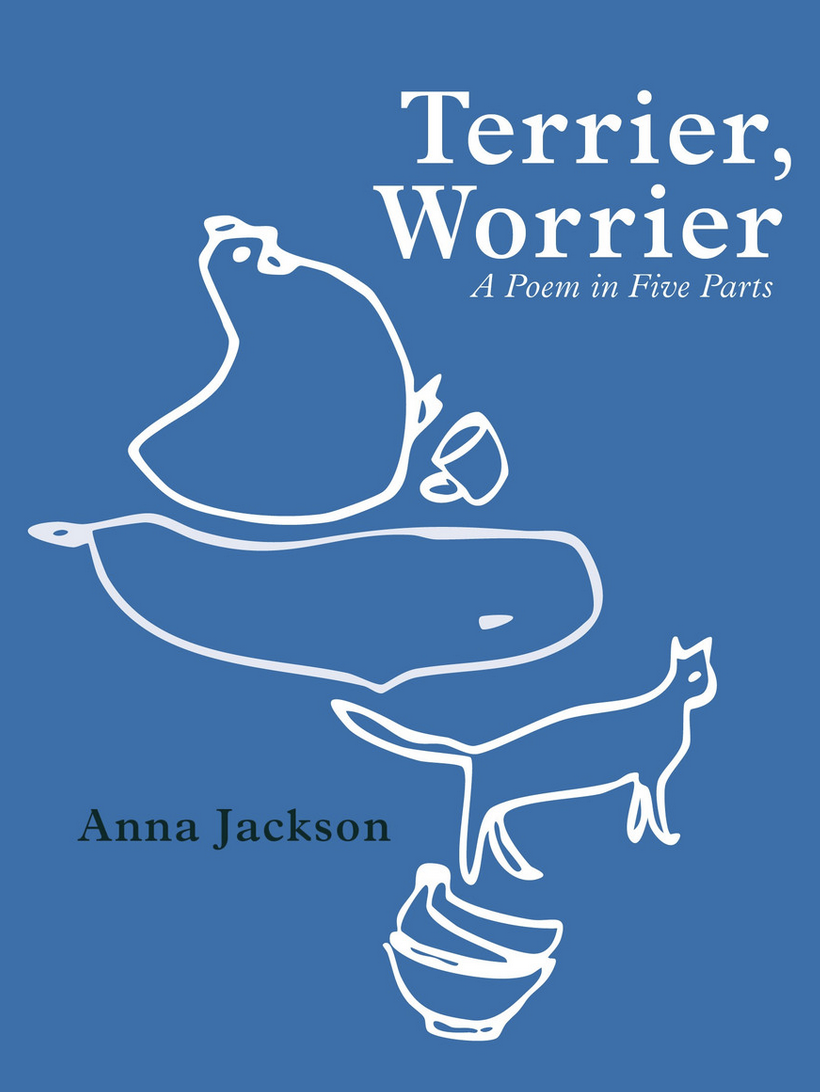
Terrier, Worrier A Poem in Five Parts, Anna Jackson
Auckland University Press, 2025


Terrier, Worrier is one long poem so instead of choosing a poem from it for Poetry Shelf I have selected an extract.  This should be easy because every paragraph is almost a self-contained little poem, but to me what makes Terrier, Worrier a poem are both the gaps between the paragraphs and the repetitions, returns and resonances across the collection as a whole.  Thought doesn’t lead straight on to another thought but is present under the surface of the forward movement of the prose and emerges transformed elsewhere in relation to a new idea.  I don’t know if this is really poetry or just how the mind works.  In Terrier, Worrier thoughts are prompted by conversations, funerals, the behaviour of my hens, questions posed by philosophers, massages, memories and dreams. 

This extract includes the dream that gives the collection its title, and, with that sentence in the middle, connects narratives about my hens and worries about motherhood and daughterhood that run through the collection.  

This summer, I kept dreaming about a terrier. It was not a recurring dream but a recurring terrier that appeared in dream after dream, often needing to be released from somewhere it was trapped.  It did seem as if my unconscious was hard at work trying to tell me something I was repeatedly failing to grasp.  I thought, a terrier is a good symbol for the work of digging up something underground but still alive. 

Wilma had not been interested in me as a person when she was still part of a flock but now she looked in the eye which is not something she had ever done when the other hens were still alive.  I thought she was looking at me person to person now, whereas before she had only looked at me as an object.  I thought, there is a difference between being tame, and being a friend. 

There is a difference between being a tame, and being a daughter.

I wondered whether I could hear terrier as a version of the word worrier, a worrier being not someone who makes you worry but someone who themselves worries, who worries away at things like a terrier might worry away at a sock.  A terrier would be someone who allows themselves actually to indulge in the feeling of terror.  I tell myself “I am not okay, but I will be okay,” but maybe I need to stop saying that and release the terror, or maybe the terrier is not myself but represents someone else’s terror which needs to be heard. 

I thought, it tells us something about poetry that when we need to talk to ourselves about something we don’t know we know, we tell it to ourselves when we are asleep, in images we struggle to remember when we awake, and often take more than one reading to fully understand.

Anna Jackson

From Paula Green’s Poetry Shelf review (a review in nine loops):

There’s a long black cloud streaking from the west coast to the backyard bush sprinkling salt and pepper rain. Terrier, Worrier is generally written in the past tense, with many stanzas beginning with ‘I thought’, yet for me, curiously, wonderfully, it carries the charismatic freight of the present tense, the sweet fluidity of the gerund, the present participle . . . where be-here-now fluency prevails regardless of gaps, rest-stops, hesitancy. Reading is to be embedded in the moment of the past as reader, so that what happened, and what was thought, becomes acutely present. Dive into the poetry currents in the collection, and along with the writer, you will might find yourself filtering, evaluating, experiencing, valuing, photographing, documenting, thinking. Savouring a moment.

My full review here

Anna Jackson is the author of seven collections of poetry as well as Diary Poetics: Form and Style in Writers’ Diaries 1915–1962 (Routledge, 2010) and Actions & Travels: How Poetry Works (Auckland University Press, 2022). She lives in Island Bay, Te Whanganui-a-Tara, and is associate professor in English literature at Te Herenga Waka  Victoria University of Wellington.

Anna Jackson’s website
Auckland University Press page


Poetry Shelf celebrates the Ockham NZ 2026 Book Awards Poetry Long List: Erik Kennedy

Poetry Shelf has invited poets to choose a poem from their longlisted collections and to write a few comments on the poem and poetry. Today Erik Kennedy:

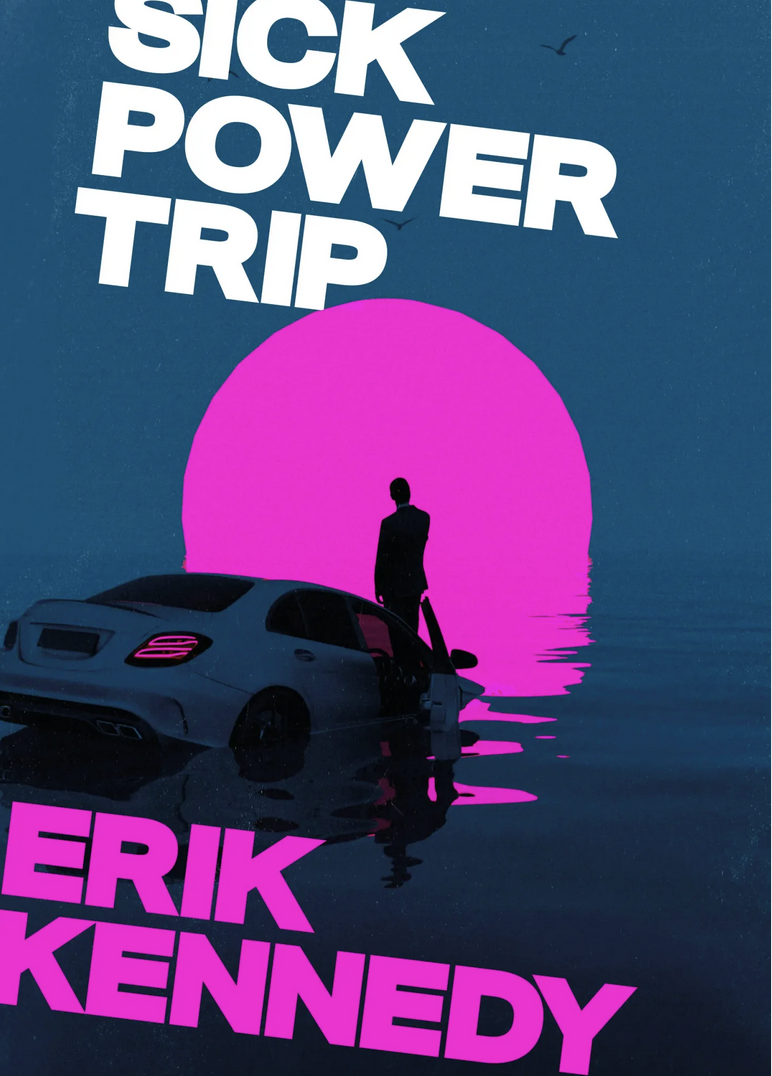
Sick Power Trip, Erik Kennedy
Te Herenga Waka University Press, 2025

Animals on Leads

We entered the town and the first thing we saw
was a woman taking her ferret for a walk.
‘Nice day for it,’ I said significantly. The ferret
was going everywhere at once, an absolute possibility engine

producing the energy of a ten-man brawl in a two-man toilet.
And us, should we visit the town’s oldest church
with its medieval eagle lectern and greensand voussoirs,
or should we ramble to the squinty, stony seafront, walled in

by white gin-palace-style hotels? Let’s let the twitchy ferret
be our compass needle, straining against its bonds,
the confident quadrupedal scamperer pulling its minder along
until she’s going north and south, finding nothing and God.

Erik Kennedy

‘Animals on Leads’ is perhaps not a typical Sick Power Trip poem. It doesn’t lean into the collection’s preoccupations with things like illness and politics and war. It is explicitly not set in Aotearoa. And there is barely any glumness to it; it is almost chipper. But I like it a lot because I like poems that tell true stories, and I wish I had more of them. (The problem is that I don’t lead an interesting enough life to generate reams of fascinating ‘true story poems’.)

The setting of the poem is Eastbourne, East Sussex. There are two solid clues as to the location. ‘The town’s oldest church / with its medieval eagle lectern and greensand voussoirs’ is St Mary the Virgin, which is an absolutely stonking Grade I listed building. I lifted the language in that second line directly from the leaflet about the church’s architecture. And ‘the squinty, stony seafront, walled in // by white gin-palace-style hotels’ is a feature of Eastbourne more than any other South Coast resort town. I rate Eastbourne surprisingly highly. On looks it is at least an 8 out of 10. On culture it is becoming more like Brighton. The sea itself is pretty clean, which is a luxury in twenty-first-century England. And it has a wonderful collection of Eric Ravilious works at the Towner gallery.

And of course a third way we know the poem is not set here is the presence of a pet ferret. A ferret is an animal that certainly doesn’t belong in New Zealand, given that its great passion in life is eating birds and eggs. But in England, being walked on a lead, a ferret is a different proposition altogether. It stands for chaotic exuberance. The lines ‘The ferret / was going everywhere at once, an absolute possibility engine // producing the energy of a ten-man brawl in a two-man toilet’ have probably earned me more compliments for their deranged splendidness than any other lines I have ever written. Something in this image speaks to people.

It might be obvious to say this, but the ferret is not the only animal ‘on a lead’ in the poem. The owner of the ferret, dragged about according to her mad mustelid’s whims, is in my view also an animal on a lead. I mean, we all are, in one way or another. A lead always connects two animals, and the hierarchical relationship between them may not be what you would expect. I think there is some joy in the serendipitous meanderings of creatures without meaningful plans. Quite a lot of joy, in fact. When I said ‘Nice day for it’ to the woman in line 3 of the poem, I really meant it.

Erik Kennedy

Erik Kennedy (he/him) is the author of the poetry collections Another Beautiful Day Indoors (2022) and There’s No Place Like the Internet in Springtime (2018), both with Te Herenga Waka University Press, and he co-edited No Other Place to Stand, a book of climate change poetry from New Zealand and the Pacific (Auckland University Press, 2022). His poems, stories, and criticism have been published in places like berlin lit, FENCE, The Florida Review, Los Angeles Review of Books, Poetry, Poetry Ireland Review, the TLS, and Western Humanities Review. Originally from New Jersey, he lives in Ōtautahi Christchurch.

From Poetry Shelf review:
“Erik’s collection has stuck with me for a number of reasons. I have never read a collection quite like it and I love that. It feels like there are two significant settings. Firstly, an extraordinary band of wit and humour, with unexpected scenarios, shifting angles and points of view. Secondly, the necessary and imperative knottiness of humanity, from exposed self to a wider global reach. Not an either or view, but an incredible shifting light on how to live and how to survive. A poetic prism on the contemporary world that might be sharp, jagged, wise, personal.” Full review here and reading by Erik here

Te Herenga Waka University Press page
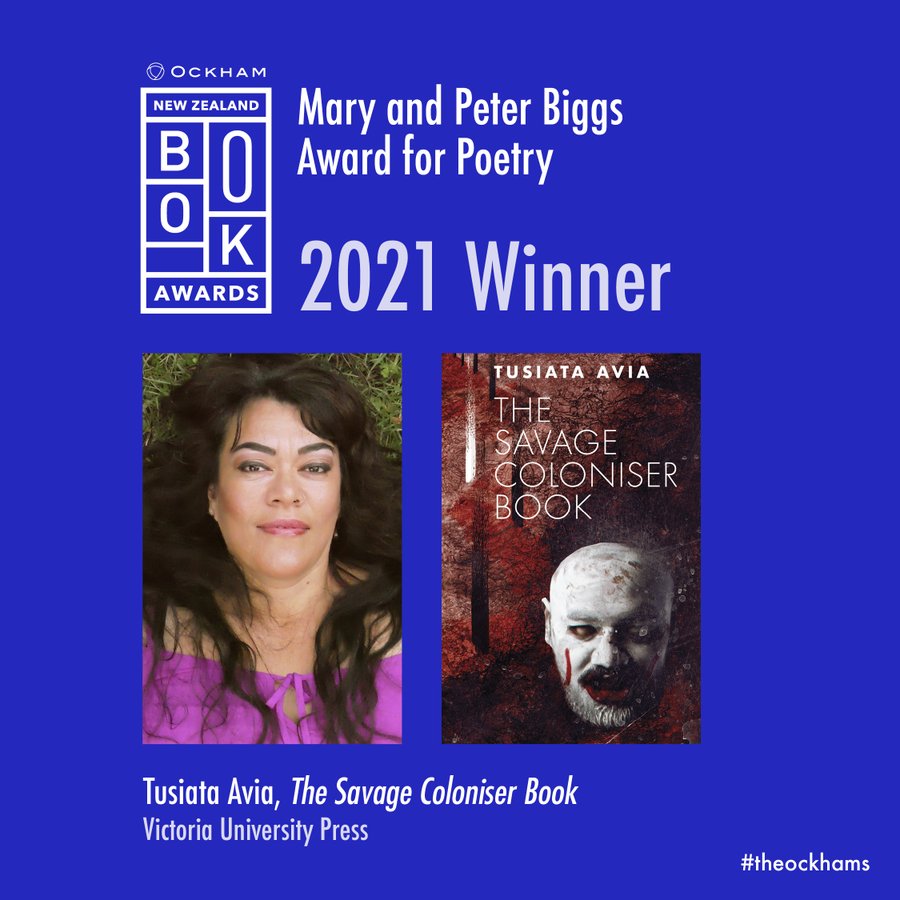
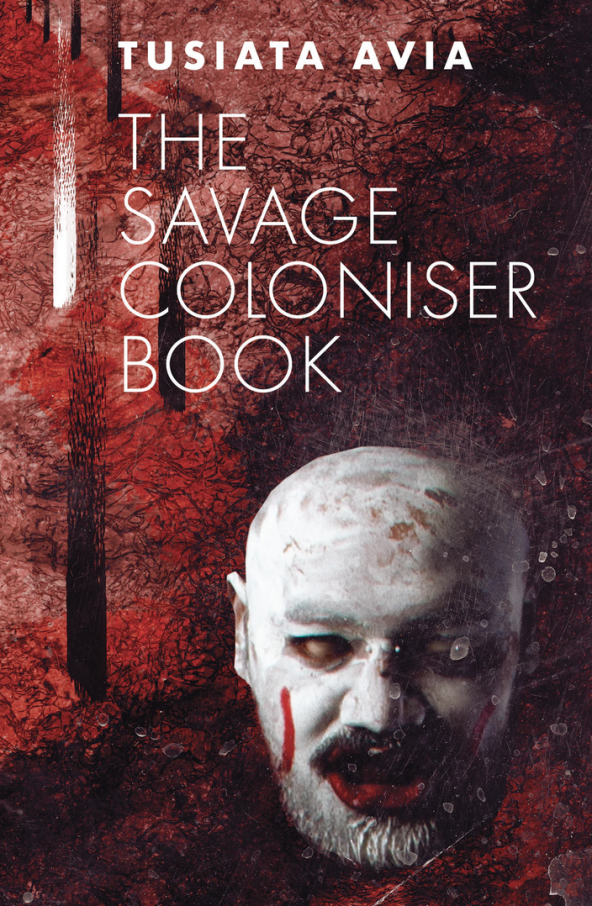
Poetry Shelf congratulates Tusiata Avia, the Ockham NZ Book Award Poetry winner (ten things she loves, a poem, an interview)

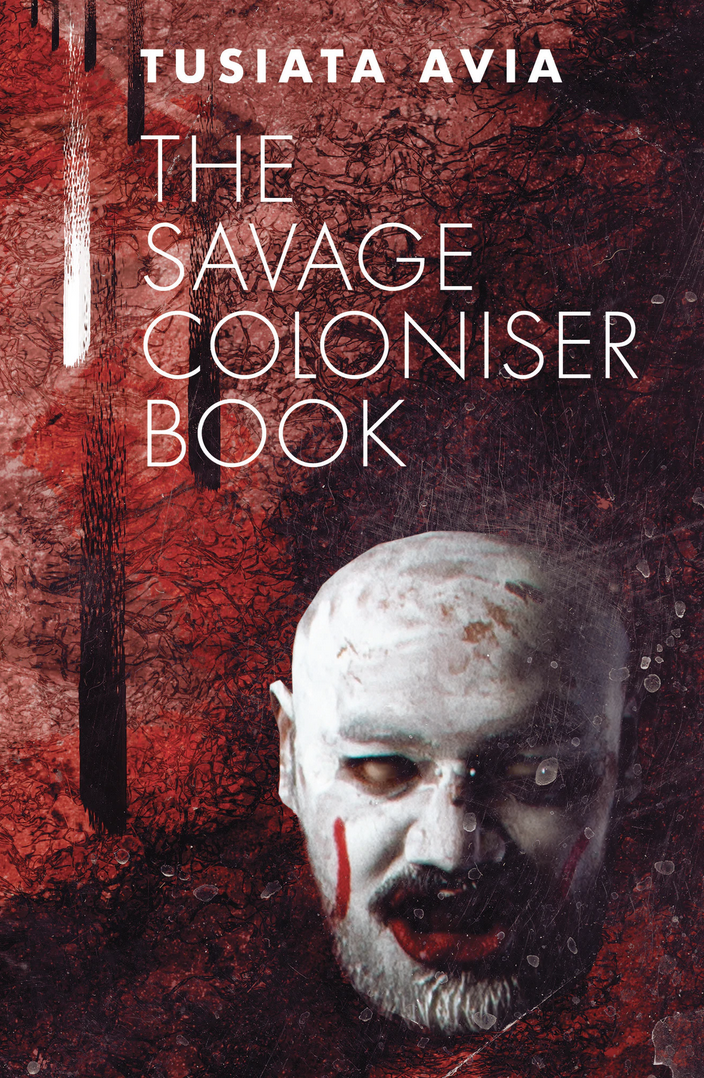
Such heartfelt congratulations to Tusiata Avia, a much loved poet who has and who continues to inspire generations of poets. Yes Pasifika poets, yes young women writing, and yes, most importantly, yes us all. Her award-winning book is magnificent. She places herself in these necessary poems: her ravaged heart, her experience, wounds, scars, thinking, feeling, urge to speak out, sing, perform, no matter the price, holding out history, the coloniser, the colonised, Ihumātao, the Australian bush fires, translating for the gutted woman, the abortioned woman, her mother, her daughter, her lovers, but at times she is disabled with epilepsy, her father a presence, and she places a prayer for her daughter, for the stars, water, lungs, and for the reader, here in these poems, she places a prayer. Extraordinary.

Ten things I love

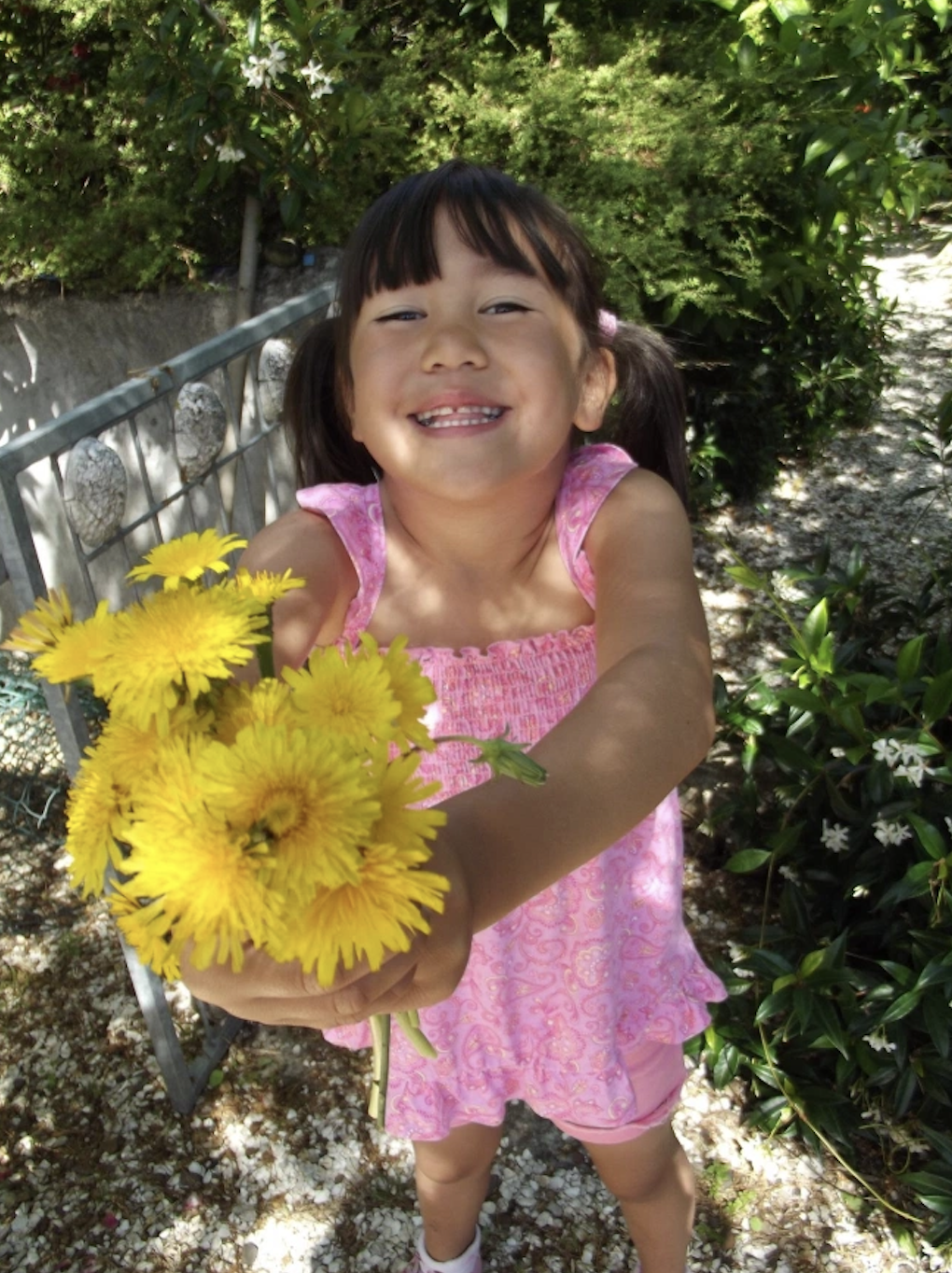
1. A photograph: The photo is of Sepela – exactly 10 years ago, a week after the big earthquake when we escaped to Hinemoana’s who lived in Kapiti then.

2. A poem by someone else: All they want is my money my pussy my blood by Morgan Parker (and pretty much anything from her book, There are more beautiful things than Beyonce.

3. A song: Back to Life by Soul II Soul

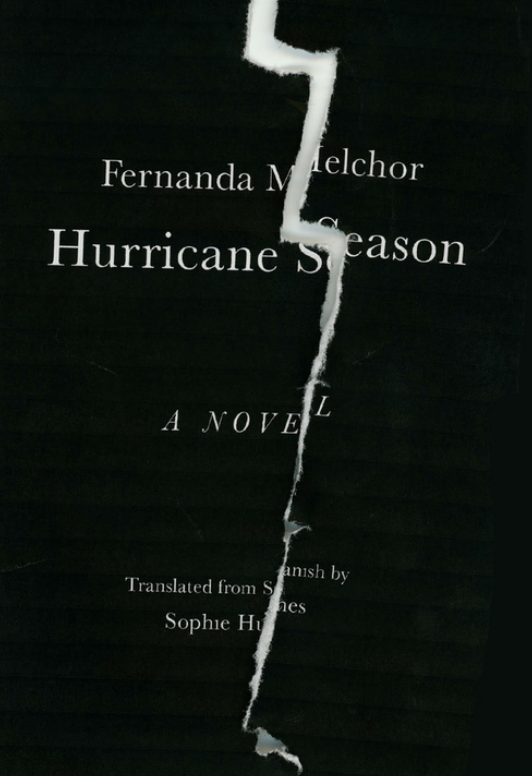
4. A book: Hurricane Season, Fernando Melchor, trans. Sophie Hughes, New Directions, 2020 (my favourite book of 2020)

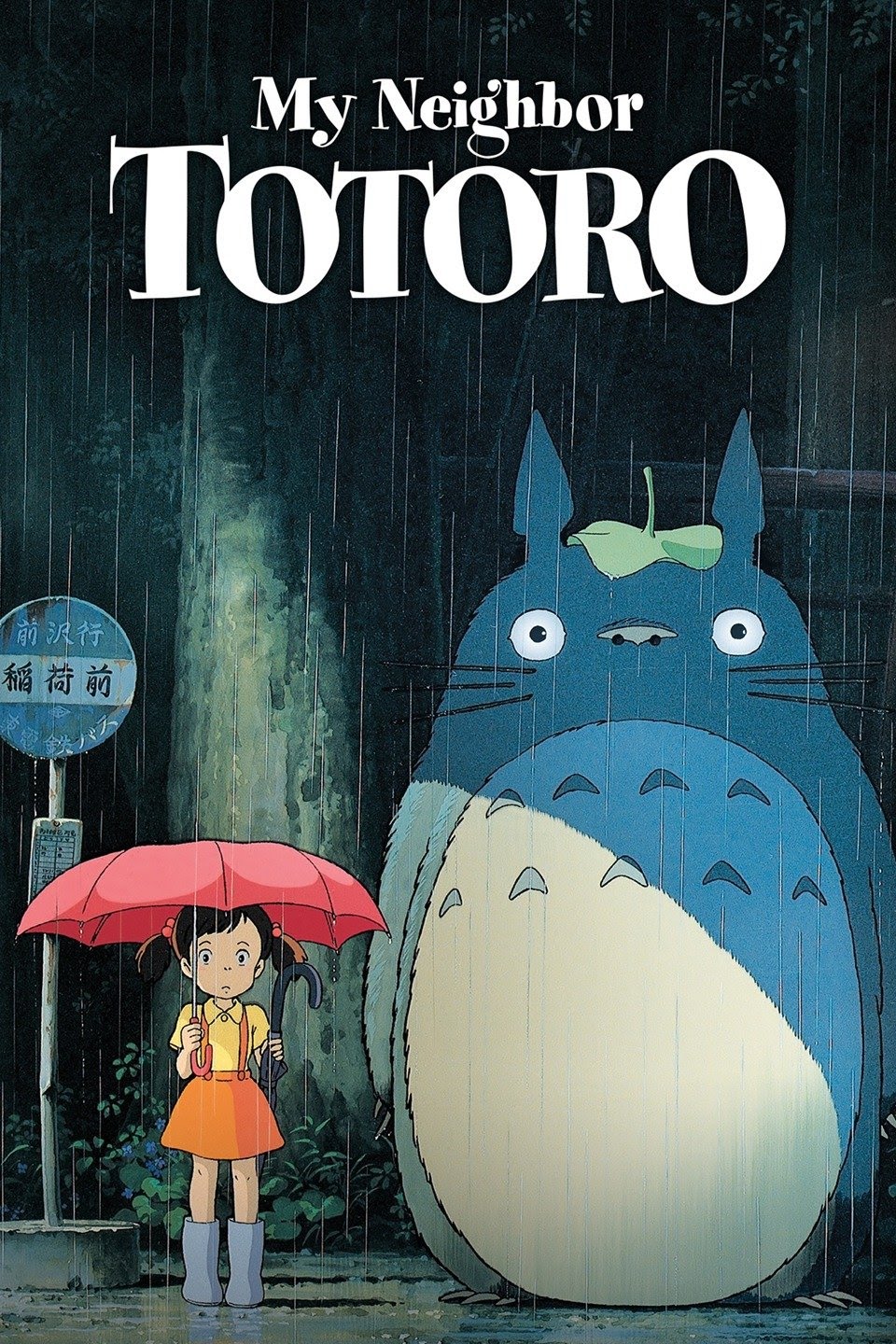
5. A movie: My Neighbour Totoro

6. A place: South Sinai coast, Egypt

7. A meal: taro (cooked in the umu) and palusamu

8. A poetic motif: Can’t think of one, but I can think of a form I love – the pantoum.

9.  A place to write: Where ever the ‘thing’ is happening (see Five questions below)

10. A poem from my book (Tusiata did a stunning performance of this at the awards PG):

250th anniversary of James Cook’s arrival in New Zealand

Hey James,

yeah, you

in the white wig

in that big Endeavour

sailing the blue, blue water

like a big arsehole

FUCK YOU, BITCH.

James,

I heard someone

shoved a knife

right up

into the gap between

your white ribs

at Kealakekua Bay.

I’m gonna go there

make a big Makahiki luau

cook a white pig

feed it to the dogs

and FUCK YOU UP, BITCH.

Hey James,

it’s us.

These days

we’re driving round

in SUVs

looking for ya

or white men like you

who might be thieves

or rapists

or kidnappers

or murderers

yeah, or any of your descendants

or any of your incarnations

cos, you know

ay, bitch?

We’re gonna FUCK YOU UP.

Tonight, James,

it’s me

Lani, Danielle

and a car full of brown girls

we find you

on the corner

of the Justice Precinct.

You’ve got another woman

in a headlock

and I’ve got my father’s

pig-hunting knife

in my fist

and we’re coming to get you

sailing round

in your Resolution

your Friendship

your Discovery

and your fucking Freelove.

Watch your ribs, James

cos, I’m coming with

Kalaniōpu‘u

Kānekapōlei

Kana‘ina

Keawe‘ōpala

Kūka‘ilimoku

who is a god

and Nua‘a

who is king with a knife.

And then

James,

then

we’re gonna

FUCK.

YOU.

UP.

FOR.

GOOD.

BITCH.


Tusiata Avia

Five questions

Is writing a pain or a joy, a mix of both, or something altogether different for you?

A mix, for sure. Often, I don’t feel like writing – unless I have an experience (internal or out in the world) that I feel the need to write about immediately. At times like that, I feel a sense of urgency, sometimes verging on desperation, to stop whatever I’m doing and write. I have pulled the car over on a busy motorway and searched for a piece of paper to scribble it down . I’m not great at the discipline of writing every day.

Name a poet who has particularly influenced your writing or who supports you.

I don’t read her so much these days, but I love Sharon Olds. She helped me to write more openly – to be honest and vulnerable.

Was your shortlisted collection shaped by particular experiences or feelings?

Colonisation, racism, illness, a bit of Covid – all the relaxing stuff.

Did you make any unexpected discoveries as you wrote?

The whole book was unexpected. I was writing another book called Giving Birth To My Father, which took ages. After a while (quite close to my deadline) I realised it wasn’t ready for the outside world. The Savage Coloniser Book had to come together really quickly, if I wanted it published for 2020. I knew I had a few poems that were very ‘2020’ lying about. I wrote to those poems in a short amount of time.

Do you like to talk about your poems or would you rather let them speak for themselves? Is there one poem where an introduction (say at a poetry reading) would fascinate the audience/ reader? Offer different pathways through the poem?

During poetry readings/ performances I used to think the poem should speak for itself but many poems really need an introduction, particularly when people are not experiencing them on the page.

Tusiata Avia is an acclaimed poet, performer and children’s writer. Her previous poetry collections are Wild Dogs Under My Skirt (2004; also staged as a theatre show, most recently Off-Broadway, winning the 2019 Outstanding Production of the Year), Bloodclot (2009) and the Ockham-shortlisted Fale Aitu | Spirit House (2016). Tusiata has held the Fulbright Pacific Writer’s Fellowship at the University of Hawai‘i in 2005 and the Ursula Bethell Writer in Residence at University of Canterbury in 2010. She was the 2013 recipient of the Janet Frame Literary Trust Award, and in 2020 was appointed a Member of the New Zealand Order of Merit for services to poetry and the arts.

Poetry Shelf review

Selina Tusitala Marsh’s review at ANZL

Poetry Shelf: Tusiata‘s ‘Love in the Time of Primeminiscinda’ (The Savage Coloniser Book)

Tusiata reads ‘Massacre’ (The Savage Coloniser Book)

Leilani Tamu review at KeteBooks

Faith Wilson review at RNZ National

Victoria University Press page
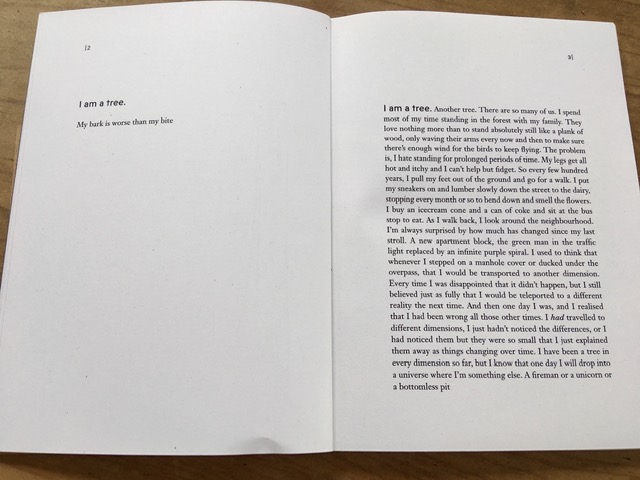
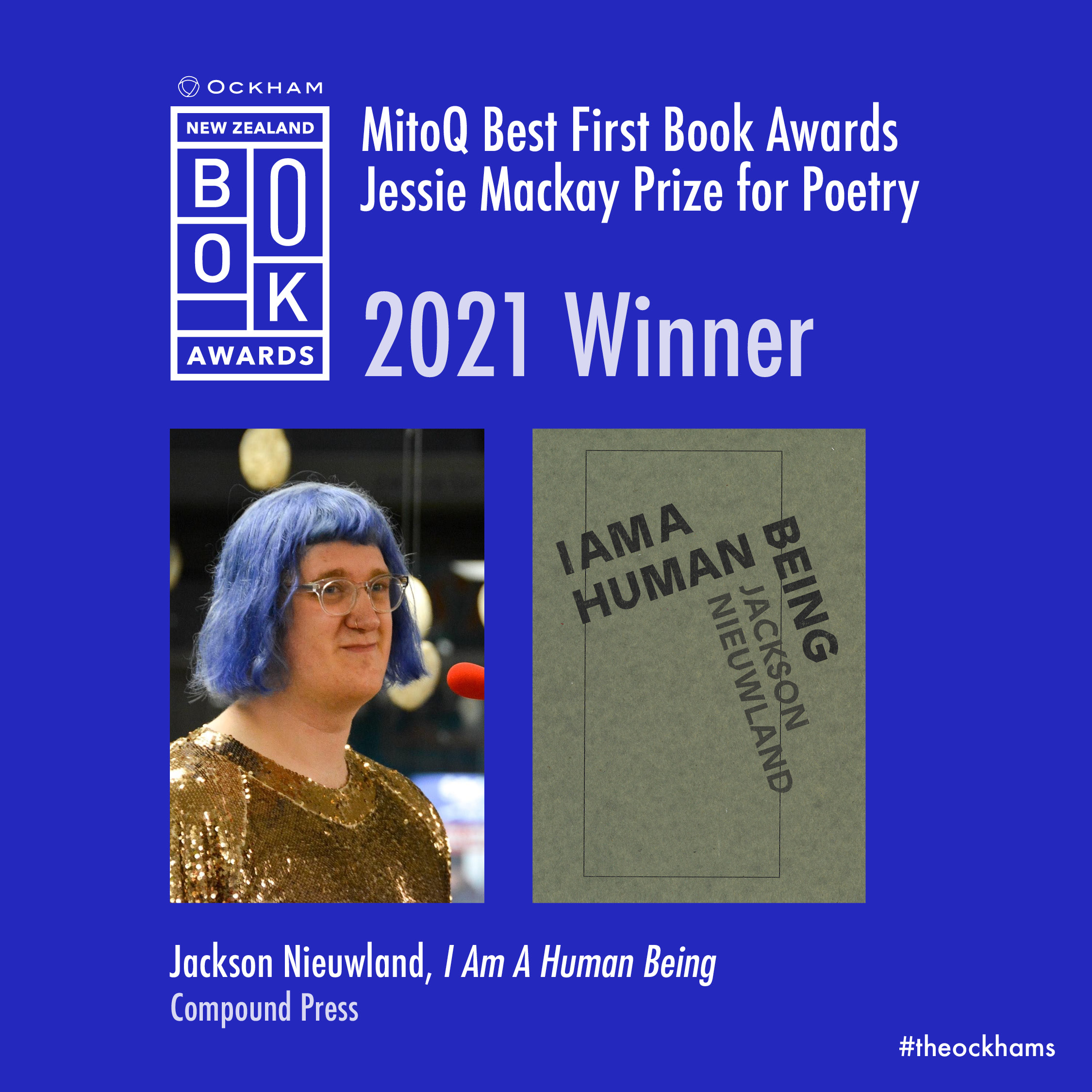
Poetry Shelf congratulates Jackson Nieuwland, the Ockham NZ Book Award Best First Book Poetry winner (with a reading and a review)

Jackson reads from I Am a Human Being

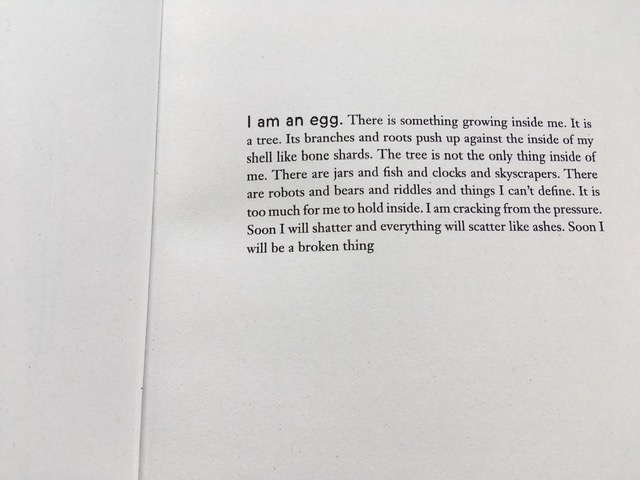
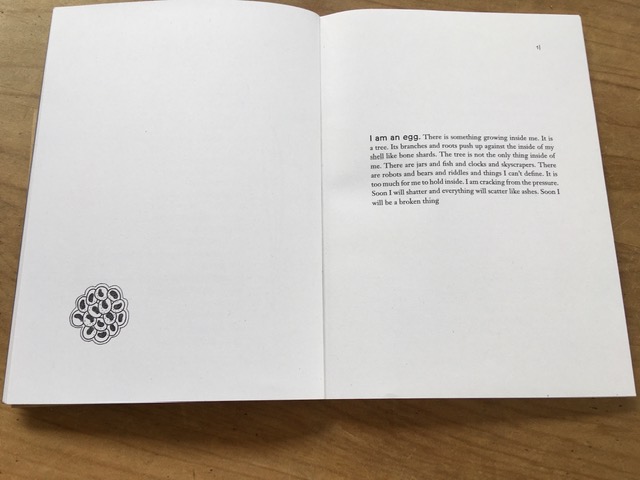
Sometimes you pick up a poetry book and you know within a page or two, it is a perfect fit, a slow-speed read to savour with joy. That’s how I felt when I started reading Jackson Nieuwland’s I am a human being. I love the premise embedded in the title, that in turn generates a sequence of poems that form a secret title list poem (I am an egg, I am a tree, I am tree, I am a beaver, I am a bear, I am a dog, I am a bottomless pit, and so on).

The opening poem offers an image that, in its exquisite and heart-moving detail, underlines the range of the book: physical, metaphorical, fable-like, metaphysical, autobiographical. In one poem the speaker suggests they are not quite sure who they are yet, that there is no single word that adequately defines them (‘agender, genderfluid, trans …’). This book, so long in the making, lovingly crafted with the loving support of friends, with both doubt and with grace (think poise, fluency, adroitness), this book, in its lists and its expansions, moves beyond the need for a single self-defining word.

Instead we are offered the image of the egg – and the way we hold a universe of things inside us, and that sometimes we might break.

This is intimate poetry. This is slowing down to observe the quotidian, the daily comings and goings, the things you see and feel when you stop and reflect and imagine, that then tilts to surprise. There is uplift and there is slipstream.

This is contoured poetry because it ignites so many parts of you as you read. You will laugh out loud as you read. You will feel the poignant witty wise delightful magical joy. The shifting melodies. There are keyholes to light and keyholes to dark. The speaker speaks of outsiderness, of what it is to fit, and what it is to not fit.

Sometime you will turn the page to a glorious pun.

Sometimes the vulnerability is a sharp ache above the surface of the line. This from ‘I am version of you from the future’:

Your past self looks at you with sympathy.

They pull you into a tight hug.

You begin to sob

releasing years of tears

that had been held inside

due to the conditioning you received

from a patriarchal society

and the overload of testosterone

pumping through you body.

As you sink into your own embrace,

the two versions of you merge into one,

and you begin again

given a chance to do it all over

but differently this time,

with an open heart

like quadruple bypass surgery.

The risk of death is high

but what other choice do you have?

I am a version of you from the future.

This is just the beginning—

I am a human being was one of my favourite poetry book of 2020. I like the addition of Steph Maree’s line drawings. I like the way the poetry stretches in its imaginings to draw closer to an interior real that is never fixed. I like the way the poetry is both anchor and liberating kite. I like the acknowledgement that, in order to know who you are, you need to embrace many things. I love this book so very much from first page to last. In the endnotes, the page where the poet gives thanks, I read the best acknowledgement ever:

And thank you for reading

this book. I’ve gone back and

forth with myself for years

about whether these words are

worth anyone’s time. It means

the universe to me that you’ve

read all the way to the end. I

hope you found something that

meant something to you.

Jackson Nieuwland is a human being, duh. They are a genderqueer writer, editor, librarian, and woo-girl, born and based in Te Whanganui-a-Tara. They co-founded the reading/zine series Food Court. This isn’t even their final form.

Compound Press page

Pantograph Punch review (Vanessa Crofskey)

Landfall on Line review (Erik Kennedy)

Chris Holdaway (Compound Press) celebrates Jackson’s place on the longlist with a poem

Poetry Shelf celebrates Ockham NZ Book Awards Poetry shortlist: Nina Mingya Powles and ten things she loves

Ten things I love

  • A photograph

Me in Beijing, taken by my partner.

  • A poem by someone else

a dream of foxes


in the dream of foxes
there is a field
and a procession of women
clean as good children
no hollow in the world
surrounded by dogs
no fur clumped bloody
on the ground
only a lovely line
of honest women stepping
without fear or guilt or shame
safe through the generous fields.

Lucille Clifton

Full poem and video at poemhunter

  • A song

“First Love / Late Spring” by Mitski, from her album bury me at makeout creek.

A song I listened to while beginning to write the book in Shanghai.

  • A book

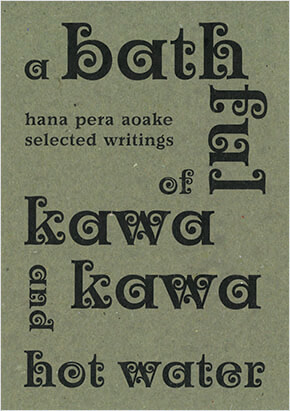
A bathful of kawakawa and hot water by Hana Pera Aoake (Compound Press).

  • A movie

Minari

  • A place

Five Mile Bay, Lake Taupō, my first swim after arriving back in Aotearoa.

  • A meal

Char kuay teow and sweet milk tea.

  • A poetic motif

A window.

  •  A place to write

Next to the windowsill where I’ve planted daffodils, in the sun, the cat perched next to me.

  • A poem from my book

Night train to Anyang

light changes as we cross into neon clouds

voices flicker through the moving dark

like dream murmurs moving through the body

red and silver 汉字 glow from building tops

floating words I can’t read rising into bluest air

they say there are mountains here but I can’t see them

there are only dream mountains high above the cloudline

I come from a place full of mountains and volcanoes

I often say when people ask about home

when I shut my eyes I see a ring of flames

and volcanoes erupting somewhere far away

when I open my eyes snow is falling like ash

Five questions

Is writing a pain or a joy, a mix of both, or something altogether different for you?

Writing gives me adrenaline, which is sometimes a kind of joy, or at least relief. Writing –when it’s going well –  gives me energy in the moment itself, but often leaves me utterly drained.

Name a poet who has particularly influenced your writing or who supports you.

There are so many poets who have supported me and deeply influenced me; it wouldn’t be fair to name just one. I am endlessly grateful to poets Alison Wong, Helen Rickerby, Anna Jackson, Bhanu Kapil, Sarah Howe and Jennifer Wong – I walk in their footsteps.

Was your shortlisted collection shaped by particular experiences or feelings?

The book is so distinctly shaped by a particular period in my life. Some poems feel ancient to me now, distant and far away –  but I don’t mind that. I was living in Shanghai, my first time living alone, feeling both brave and terrified at the same time. The poems are shaped by isolation, longing, aloneness (but not always loneliness) and in-betweenness.

Did you make any unexpected discoveries as you wrote?

Always –  I think this is how writing works for me. I have a loose outline in my mind of something I want to get down on the page, usually starting with a particular image, and then the writing itself reveals to me the place I want to go. I can’t quite explain how it happens, only that I’m following threads, making connections as I go. When something unexpected happens, I think that’s when I’ve written something good.

Do you like to talk about your poems or would you rather let them speak for themselves? Is there one poem where an introduction (say at a poetry reading) would fascinate the audience/ reader? Offer different pathways through the poem?

I prefer to let the poems do the work, although I enjoy giving some background details about some poems, such as “The First Wave”, which was written while listening to the online livestream of Radio NZ while I was in Shanghai at the time of the Kaikoura earthquake in 2016. Or, “The Great Wall”, which I affectionately call my Matt Damon poem, titled after the 2016 movie of the same name.

Nina Mingya Powles is a poet, zinemaker and non-fiction writer of Malaysian-Chinese and Pākehā heritage, currently living in London. She is the author of a food memoir, Tiny Moons: A Year of Eating in Shanghai (The Emma Press, 2020), poetry box-set Luminescent (Seraph Press, 2017), and several poetry chapbooks and zines, including Girls of the Drift (Seraph Press, 2014). In 2018 she was one of three winners of the inaugural Women Poets’ Prize, and in 2019 won the Nan Shepherd Prize for Nature Writing. Magnolia 木蘭 was shortlisted for the 2020 Forward Prize for Best First Collection. Nina has an MA in creative writing from Victoria University of Wellington and won the 2015 Biggs Family Prize for Poetry. She is the founding editor of Bitter Melon 苦瓜, a risograph press that publishes limited-edition poetry pamphlets by Asian writers. Her collection of essays, Small Bodies of Water, is forthcoming from Canongate Books in 2021. 

Nina reads ‘Faraway love’ from MAGNOLIA 木蘭

Review on Poetry Shelf here

Seraph Press page

Nina’s website

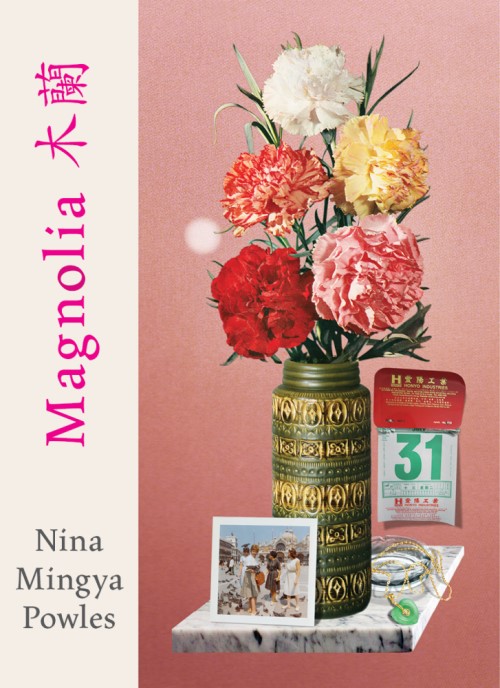
MAGNOLIA 木蘭, Nina Mingya Powles, Seraph Press, 2020

Poetry Shelf noticeboard: Warm congratulations to the Ockham NZ Book Awards shortlisted poets

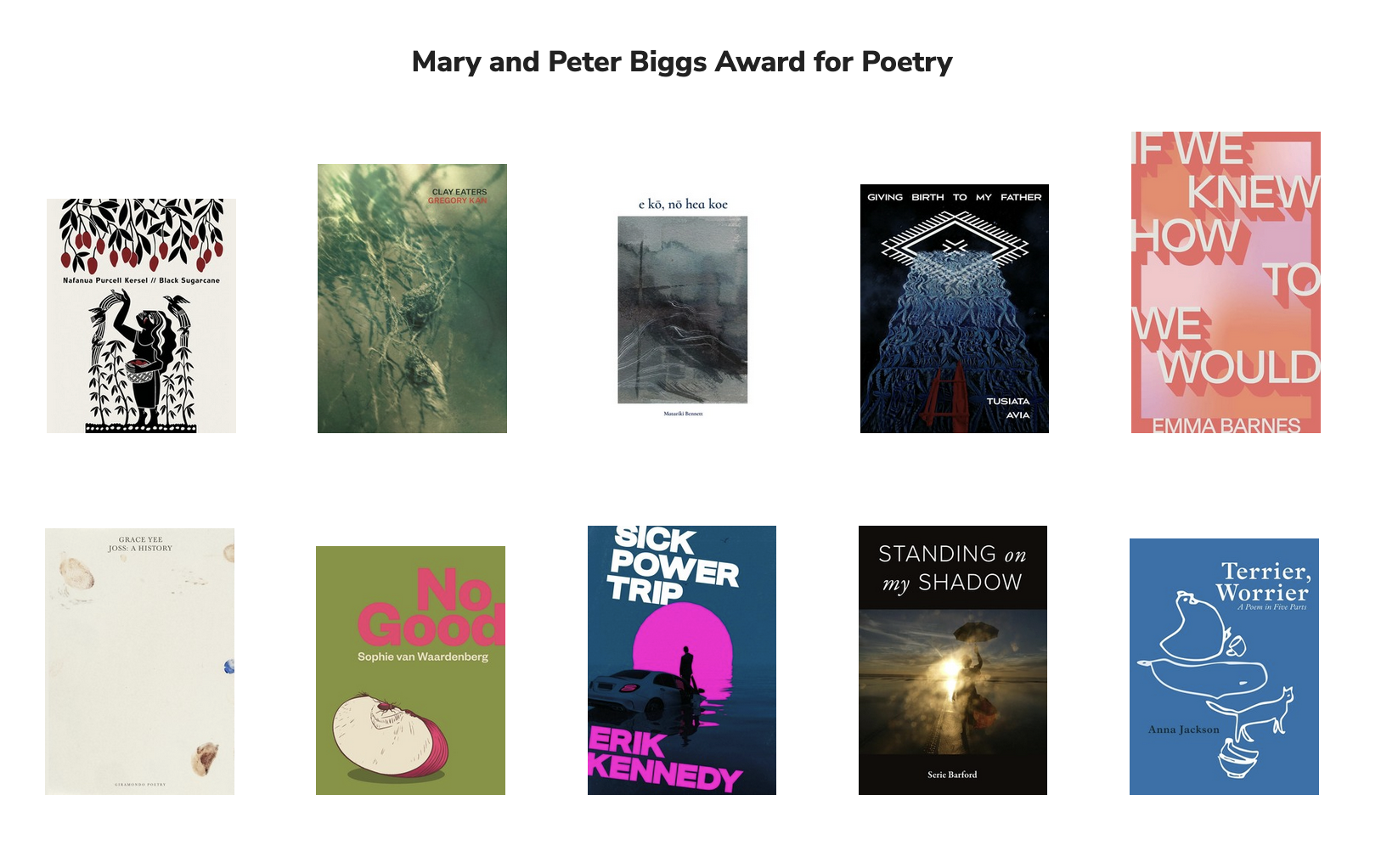
The finalists in the 2021 Mary and Peter Biggs Award for Poetry are:

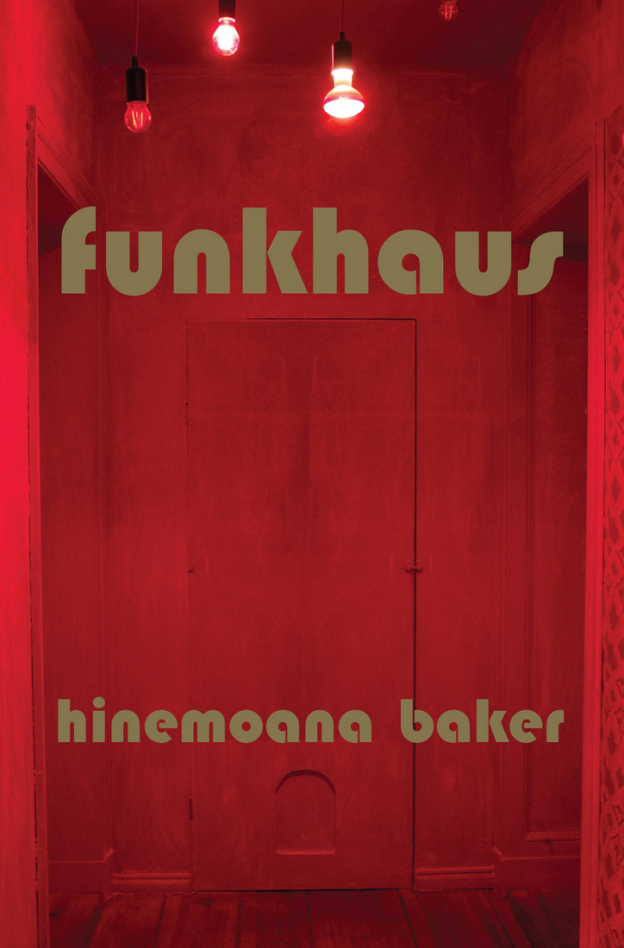
Funkhaus by Hinemoana Baker (Victoria University Press)

Magnolia 木蘭by Nina Mingya Powles (Seraph Press)

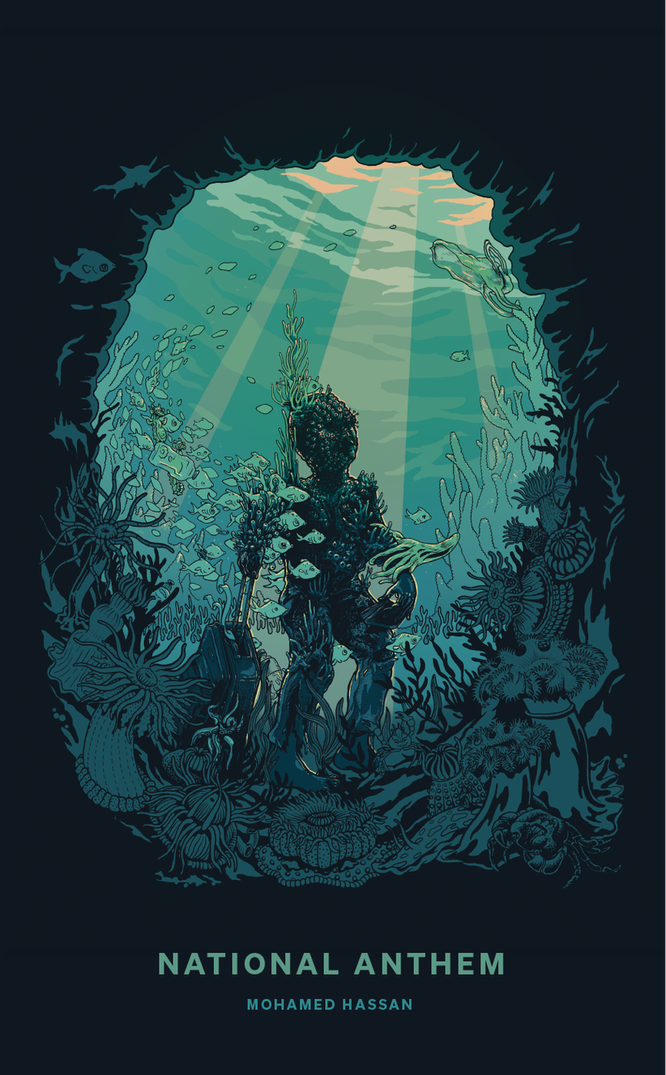
National Anthem by Mohamed Hassan (Dead Bird Books)

The Savage Coloniser Book by Tusiata Avia (Victoria University Press)

Full shortlist and judges’ comments here.

“Poetry collections published in Aotearoa in 2020 show a wealth of exceptional and original work.  It’s an exciting situation for New Zealand poetry. The four shortlisted collections are striking, all exhibiting an acute global consciousness in difficult times,” says Poetry category convenor of judges Dr Briar Wood.

I was so excited about the poetry longlist, I spent the last few months celebrating each poet on the blog. What sublime books – I knew I would have a flood of sad glad feelings this morning (more than on other occasions) because books that I have adored were always going to miss out. I simply adored the longlist. So I am sending a big poetry toast to the six that didn’t make it – your books will have life beyond awards.

I am also sending a big poetry toast to the four finalists: your books have touched me deeply. Each collection comes from the heart, from your personal experience, from your imaginings and your reckonings, from your musical fluencies. The Poetry Shelf reviews are testimony to my profound engagement with your poems and how they have stuck with me.

Over the next weeks I am posting features on the poets: first up, later this morning, Tusiata Avia.

Mary and Peter Biggs CNZM are long-time arts advocates and patrons – particularly of literature, theatre and music. They have funded the Biggs Family Prize in Poetry at Victoria University of Wellington’s International Institute of Modern Letters since 2006, along with the Alex Scobie Research Prize in Classical Studies, Latin and Greek. They have been consistent supporters of the International Festival of the Arts, the Auckland Writers Festival, Wellington’s Circa Theatre, the New Zealand Arts Foundation, Featherston Booktown, Read NZ Te Pou Muramura (formerly the New Zealand Book Council), the New Zealand Symphony Orchestra, the Featherston Sculpture Trust and the Kokomai Arts Festival in the Wairarapa. Peter was Chair of Creative New Zealand from 1999 to 2006. He led the Cultural Philanthropy Taskforce in 2010 and the New Zealand Professional Orchestra Sector Review in 2012. Peter was appointed a Companion of the New Zealand Order of Merit for arts governance and philanthropy in 2013.


Poetry Shelf celebrates the Ockham NZ Book Awards Poetry longlist: Karlo Mila reads from Goddess Muscle

Karlo Mila reads ‘Letter to JC Sturm’, from Goddess Muscle Huia Publishers, 2020

Dr Karlo Mila is a New Zealand-born poet of Tongan and Pākehā descent with ancestral connections to Samoa. She is currently Programme Director of Mana Moana, Leadership New Zealand. This leadership programme is based on her postdoctoral research on harnessing indigenous language and ancestral knowledge from the Pacific to use in contemporary leadership contexts. Karlo received an MNZM in 2019 for services to the Pacific community and as a poet, received a Creative New Zealand Contemporary Pacific Artist Award in 2016, and was selected for a Creative New Zealand Fulbright Pacific Writer’s Residency in Hawaii in 2015.

Goddess Muscle is Karlo’s third book of poetry. Her first, Dream Fish Floating, won NZSA Jessie Mackay Best First Book of Poetry Award at the Montana New Zealand Book Awards in 2006. In 2008, Karlo collaborated with German-born artist Delicia Sampero to produce A Well Written Body. Karlo’s poetry has been published in in many anthologies, in a variety of journals and online. 

Huia Publishers author page

Poetry Shelf review

NZAL review (Lana Lopesi)

@RNZ Karlo talks with Kathryn Ryan on Nine to Noon

Poetry Shelf celebrates the Ockham NZ Book Awards Poetry longlist: Tusiata Avia reads from The Savage Coloniser Book

Tusiata Avia reads ‘Massacre’ from The Savage Coloniser Book (Victoria University Press, 2020)

Tusiata Avia is an acclaimed poet, performer and children’s writer. Her previous poetry collections are Wild Dogs Under My Skirt (2004; also staged as a theatre show, most recently Off-Broadway, winning the 2019 Outstanding Production of the Year), Bloodclot (2009) and the Ockham-shortlisted Fale Aitu | Spirit House (2016). Tusiata has held the Fulbright Pacific Writer’s Fellowship at the University of Hawai‘i in 2005 and the Ursula Bethell Writer in Residence at University of Canterbury in 2010. She was the 2013 recipient of the Janet Frame Literary Trust Award, and in 2020 was appointed a Member of the New Zealand Order of Merit for services to poetry and the arts.

Victoria University Press page
Poetry Shelf review