Tag Archives: Bill Manhire

The Harcourts Hawkes Bay Arts Festival Blog- on Bill Manhire

For full blog see here


‘Yesterday, as part of the Hawke’s Bay Readers & Writers Festival, I went to see ‘the godfather of NZ literature’, Bill Manhire, in conversation with Aotearoa’s latest poetry sensation, Hera Lindsay Bird. And I can’t tell you what a golden hour that was, such a privilege! Hera steered their talk, and the Q+A session that followed, with just the right tautness and slack to keep things sharp yet in flow.

The conversation ranged over many topics: the joy of “doing different voices”; the difference between writing poetry and prose; ‘the beige short story’; New Zealand’s periodic literary angst about its ‘contempory literary situation’ and the usefulness (or not) of such discussions; cultural cringe; the potential for translation; creative collaboration; the definition of a poem—“poetry trembles in that mid-space … it’s ‘a prolonged hesitation between sound and sense’ … the music has always been crucial to me”.

Bill discussed his forthcoming poetry book, Some Things to Place in a Coffin, named after a poem written for and about the painter Ralph Hotere, with whom he collaborated over the years. And shared a couple of his other poems, beautifully read with a gracious, measured ease, along with a recent, humorous short story about a “deranged children’s writer”. I was deliciously captivated.’

Best Books I never wrote – Mahy Manhire, Neale and McQueen

pocket_book.jpg

To celebrate my new poetry collection, Fairfax invited me to share some book titles for their regional papers. It is very fitting the weekend I am at the glorious IBBY Congress in Auckland, my first pick is by Margaret Mahy.


The Lion in the Meadow, Margaret Mahy

No matter what I write, Margaret Mahy’s fiendishly elastic, daringly inventive way with words is like my phantom grandmother. Take a lion, a matchbox, a boy and a mum and you get a classic story to which New Zealander writers are all in debt. The ending is genius and still gives me goosebumps.


for the other three  … see here

Morning Shivers, Fierce Light, Unmissable: Bill Manhire’s poem, Suzie Hanna’s short film


Part of Fierce Light

Poem:  Bill Manhire

Animator:  Suzie Hanna

Voice:   Stella Duffy

Sound Design:  Phil Archer


Fierce Light brought together leading poets from countries that participated in the First World War, including Yrsa Daley-Ward, Jackie Kay, Bill Manhire, Paul Muldoon and Daljit Nagra, to create new works that endeavour to understand the incomprehensible; exploring contemporary events while also contemplating the First World War. These works were presented alongside a series of specially commissioned short films, each made in response to the new poems and themes raised within them.

Co-commissioned by 14-18 NOW, Norfolk & Norwich Festival and Writers Centre Norwich

Poem also appeared on BBC Radio 3


This is so moving; so perfect in its simplicity and rhyme, its flickering images, as though the past can never settle, always slightly out of grasp, the resonant voice drawing us in, the physical detail also flickering with heartbreak and static. It is one story and it is manifold. This is what poetry can do when it meets up with an animator. Memorable. PG

Ika Issue 4 – a feast indeed

Ika_web_1.jpg

With the latest issue, Ika is planting its feet firmly on the NZ writing landscape, as a journal to take notice of. Each issue tweaks the design a little. This one looks good. Poems luxuriate on the page. The art is honoured. The internal design is appealing to the eye.

Anne Kennedy, with her astute eye and ear, has assembled writing that matches the fresh appeal of the design. Like Sport, the journal acknowledges its links to its Creative Writing programme and allows established writers to rub shoulders with students. I applaud the celebration of Pacific writing. You will find art, poetry, fiction, an interview and nonfiction. A feast indeed.

Lovely launch at Auckland Central Library on Saturday with a fitting speech by Sue Orr, a handful of readings and  wow-factor song.


A taste of poetry:

Annaleese Jochems: She is a graduate of MIT and is now doing a Masters in writing at Victoria. Her poem is your entry into the book and it leaves you wanting more. Just what a new voice offers: surprising lines, audacity, elasticity.

I must go home for dinner,/ but I don’t want to go home/ where I play my unrequited/ love like a banjo


Poet and publisher Kiri Piahana-Wong has a suite of poems that I think are her best yet. How do you reproduce feeling in a poem in 2016? Kiri shows how: ‘A month later my chest/ still felt like a stone/ was inside it so I stayed/ there and I kept waiting’


Bill Manhire also has a suite of poems. The first poem, ‘We Work to be Winners’ got under my skin because I loved the surprising juxtapositions of one line alongside the next. It got me thinking about the origins of the poem. Sometimes if you know that, it changes the way you read the lines. In this case I began inventing origins as I waited in a festival queue. It felt like the poem had a fascinating backstory which could become a poem in its own right. It might be a found poem (but from where? that is what intrigues). It could be written from the point of view  of someone who writes a sentence in a diary each Thursday. Or the offbeat biography of a hippy from the 1970s. Get the journal and decide for yourself. First line: ‘I left the ashram running for my life.’

Craig Santos Perez: ‘Micronesians in Denial’ brings mouth-watering detail alongside history alongside political spikes. I also loved ‘Aunty of rainwater and Smoke’ – the title says it all. This is poetry song and poetry joy.

David Eggleton (winner of Poetry Category at NZ Book Awards last week) is hitting his poetry straps so to speak. You get two poems that are a linguistic explosion in the ear with musical chords sneaking in and rhythms pulling you along at breakneck speed. It is not just aural gold though because there is the visual weave that ignites all senses.

Awks: you winged Auk-thing, awkward, huddling;

you wraparound, myriad, amphibious,

stretchy try-hard, Polywoodish

juggernaut’ (from ‘Edgeland’)


I am flicking in and out of the journal waiting for a session at the festival and stumble upon these lines by Hera Lindsay Bird (she has a book out with VUP later this year!): ‘O Anna/ let us jettison the manky quilts/ of our foremothers’ Yep – it is a terrific poem.


Courtney Sina Meredith’s ‘of all the bricks we laid in our sleep’ stuck with me, haunted me as I drove home on Sunday with festival fatigue. this poem was like a haunting refrain. ‘and hear your soft waiata/ through the floorboards’


This stanza from Doug Poole‘s ‘The light I had hoped’ also got to me:

As a child I would lie awake listening to my grandmother slapping

clothes on her bedside chair, speaking aloud her thoughts of the day,

clicking rosary beads and whispering her prayers


This afternoon I fell upon  ‘Chasing Spirits’ by Kim M. Melhuish. A voice keeps asking ‘how’s this’ and the answers tumble like little poetry postcards perfectly formed:

two words

fishing for love

pink orchids

finger paint

the night ahead.


And then it was this delicious morsel from Vivienne Plumb from ‘Peach Tree’:

The cactus unfurls its one brilliant

blinding flower. Excuse me,

there is no poetic peach tree here.


AND I still have to read poems by these poets: Airini Beautrias, Bryan Walpert, Charlotte Steel, Elizabeth Morton, Gregory O’Brien, Makyla Curtis, Manisha Anjali, Ria Masae, Richard Von Sturmer, Sophie van Waardenberg.

I applaud everyone involved. This is a journal worth subscribing to.


Enquiries: ikajournal@gmail.com

submit at


The Stories of Bill Manhire – a wee review and a wee interview – ‘I think that by and large I’ve written against rules’

bill_front_jacket__25142.1439156427.220.220.jpg  bill_front_jacket__25142.1439156427.220.220.jpg  bill_front_jacket__25142.1439156427.220.220.jpg

Bill Manhire occupies a significant position in our literary landscape — as both a poet and as founder of the International Institute of Modern Letters. As poet he is lauded on an international stage and at home was recognised  as our inaugural Te Mata Poet Laureate. As teacher and mentor at Victoria University, his outstanding contribution to our writing communities was honoured by the naming of the Bill Manhire House at IIML (April 2016). I have read Bill when he is not writing poems and have admired his clarity and elasticity of thought, but I had not read the early fiction in his recently released The Stories of Bill Manhire (VUP). Things escape us for all kinds of reason. In the 1990s, I focused on all things Italian as I wrote my doctoral thesis and missed too many local things. What a loss!

Amongst so many books I have loved, three books have really got under my reading skin in the last month: Cilla McQueen’s memoir, In Slanted Light, Tusiata Avia’s Fale Aitu, and Bill’s short stories.

Each of these books took me by surprise. Like little thunderbolts where you can feel your heart rate pick up as you read. Bill’s book didn’t cleave me apart like Kafka’s axe to the head or heart (he says the frozen sea within) but felt like the utterly satisfying thirst-quenching intake of sparkling water.  Writing that is effervescent, clear, restorative. I guess that is doing something miraculous to your parched state (a different kind of frozen sea). This is what words can do.

To celebrate this book – a short review from me and an interview with Bill.


A wee review:

The stories in this collection are gathered from The New Land: A Picture Book, South Pacific and Songs of My Life. There are previously unpublished stories, The Brain of Katherine Mansfield where you choose your own adventure, and the memoir, Under the Influence.

The writing is inventive, refreshing, surprising, on its feet skipping kicking doing little jumps.

How can I underline how good it is? As I read my way into days of reading pleasure, I squirmed cringed gasped laughed out loud sighed did wry grins wriggled on the spot leapt over the gaps laughed out loud again and felt little stabs that moved.

The stories highlight place and character, become nostalgic with detail that glints of when we were young (well for me anyway). You might move from the Queen’s visit and telling jokes to a dog named Fairburn, to a sci-fi keepsake on the tongue, to questions and answers on writing, to a dead-end job. Yes, the subjects are captivating but it is not so much what the stories pick as a starting point but how they travel. Take any story and it is a rejuvenating read. ‘Nonchalance’ for example, is like a series of postcards, travel or writing tips; or arrival tips with love and broken heart, soldiers, soldiers’ wives and the locals. You enter a realm of first things and floating elements. The readerly effects are kaleidoscopic.

To give you a taste of the book (I hope this doesn’t ruin things for you), here are some of the first and last lines. So important in a short story – these just nail it.


First lines:

Some critics write me off as just another ghost character activist, whereas I think I add up to a lot more than that.

The bishops come ashore.

Through here?

You are just an ordinary New Zealander.

The poet looks at the poet’s wife and says: You are my best poem.

He says: ‘Give me something significant.’

A slight scraggy moustache.

There are many tricks I have used repeatedly throughout my career to date, and others that I have done only really as one-offs.


Last lines:

Like a gasping in the chest.

The paddocks are left grey, stretching out to the edge of the frame.

Clouds pour across the sky and my lungs fill with air as though they might be sails.

No.

But jokes are too difficult: I’m getting someone else for that.

God bless him, and all the other poets.

That is how it is, adventure and regret, there is no getting away from it, we live in the broad Pacific, meeting and parting shake us, meeting and parting shake us, it is always touch and go.


The ‘Ghost Who talks’ made me laugh out loud with all its literary references alongside or inside the tricky business of getting ‘you’ and ‘I’ active in a story. Ha! It felt like the pronoun ghost out stalking. Then again the playful absurdities in ‘Kuki the Krazy Kea’ made me squirm with its dry wryness. Or the magician’s performance tips. Head back to the stories at the start of the book and the bits that taste a little different:  details of a nuclear winter, Ghandi’s funeral pyre, the melancholy of an empty pool, a mother colour-tinting photographs at the kitchen table. Bill enters the story to give writing tips here and there, to tilt the world a touch so you have to steady your reading feet (where next! What next!), to frame a judicious amount of missing bits, to be a little bit cheeky, to catch something provocative or lovely or poignant. This is a book I will recommend to friends.


A wee interview:


What satisfies you about writing a story?   

Pretty much what satisfies me about writing a fully-functioning poem.  There’s pleasure in the mix of surprise and inevitability, which needn’t be plot and character based. Sometimes it can just be a sense of musical completion.

I also like it if readers are given room to move and even a little work to do, and they end up feeling pleased about this, rather than grumpy. Maybe that’s explicit in The Brain of Katherine Mansfield, which is my shot at a choose-your-own-adventure story. But the best writing always invites readers to make choices as they go along. I’ve always liked Whitman’s take on the text-reader relationship: “I seek less to state or display any theme or thought, and more to bring you, reader, into the atmosphere of the theme or thought—there to pursue your own flight.”


Were there any rules you wanted your stories to obey? Or disregard? I love the way some of the stories sneak in instructions for start-out writers.

I think that by and large I’ve written against rules and tried to avoid what’s sometimes called the beige short story, of which the great exemplar is probably Joyce’s ‘The Dead’.  Glorious stuff, but . . . well, Joyce didn’t want to go on doing it, did he? Mark Haddon was writing about beige stories in the Guardian recently: ‘modest, melancholic stories, not arcs with beginnings, middles and ends, so much as moments and turning points.’  I’m a big fan of melancholy, but you read too many stories like that in a row, quiet epiphany after quiet epiphany, and the whole world starts to feel a bit insipid.

I suppose those instructions for beginning writers represent a complaint against the formulaic. What I mean is this sort of advice, which comes from a New Zealand book called How to Write and Sell Short Stories published back in the 1958:


PLOTS TO AVOID

(a)  Plots with a sex motif.

(b)  Where religion plays a dominating role.

(c)  Plots where sadism or brutality appear.

(d)  Plots with a basis of divorce.

(e)  Plots where illness or disease must be emphasised.

(f)  Plots dealing with harrowing experiences of children.

(g)  Plots dealing with politics.


And so on. Remove plots like those, and it’s hard to see what’s left.  I’m generally quite troubled by short story writing manuals, and by creative writing workshops that behave like short story manuals.


I also love the detail that catapults the reader to specific times and places  — how much did that sort of thing matter to you?

Getting the voice right in each case felt like the most important thing, and of course details are a crucial part of that.  Quite a few of the stories are really dramatic monologues, opportunities to try out some other voice or personality. That’s most obvious when they’re written in first person, but also in a strange way it’s also there in close third person.  The story called “Highlights” is third-person but it comes across in a flat, somewhat affectless voice – because it’s about a rather passive person. Anyway, the voice thing mattered to me, and I found myself trying on a range of idioms. I don’t think in general it’s a good idea to read a lot of short stories in a row, especially if they’re by the same writer, but I hope there’s quite a variety of narrating voices in the book.


Can you recommend some short-story writers?

There’s so much I haven’t read, but I’d go for Grace Paley every time.  Also Donald Barthelme and Lydia Davis. Gogol is my greatest favourite, especially “The Nose”, which I was once able to read in Russian. Early Sargeson.  Some of Ashleigh Young’s personal essays feel to me like beautifully told short stories – they just happen to be true, or true-ish. And the best of Barbara Anderson’s stories go on being brilliant – full of such sudden things. William Brandt’s collection, Alpha Male, has rather dropped out of sight, but it’s pretty fantastic – he does these wonderfully indignant, damaged narrators.


Do you have a favourite in the collection?

Probably “The Days of Sail”, though that may be because I know the back-story – it’s prompted by a covered-up assassination attempt on the Queen in Dunedin during the 1981 Royal tour.  A 17-year-old took a potshot at her from the top of a Med School building in Great King Street. Imagine if it had been successful! Dunedin would be totally on the map! Anyway, I built a rather cranky story around that fact.  There’s a nice radio adaptation that used be in the RNZ archive that I’d quite like to hear again.  It ends with a children’s choir singing “God Defend New Zealand”.


Do you find endings difficult (I have to say I loved the endings!)?    

Yes, they’re the hardest things.  I think I manage to get them right most of the time – except maybe for “The Death of Robert Louis Stevenson”, which of course is obliged to end with his death.  Not exactly a twist in the tail. Maybe the best ending is in “The Brain of Katherine Mansfield”.  Or, I should say, endings. I’ve met people who feel quite put out by the apparently brutal instruction, “Close the Book”, which comes at the close of several of the plot strands.

But “The Brain” is also about white middle-class complacency and its right-wing tendencies – so there is a “real” ending, too.  I won’t quote it, but anyone who wants to see what I mean can try to get to section 50 online, courtesy of Richard Easther and Jolisa Gracewood:   I’d also advise readers to pause on Greg O’Brien’s illustrated section headings.  There are lots of good visual arts jokes, along with a couple of depictions of C K Stead as a mad Nazi brain surgeon.


Victoria University Press page

Reading Sport 44 on a wet Sunday keeps the blues away

Sport_44_Cover__64545.1456369674.220.220.jpg Sport_44_Cover__64545.1456369674.220.220Sport_44_Cover__64545.1456369674.220.220

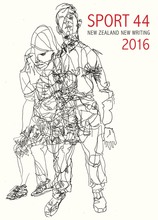
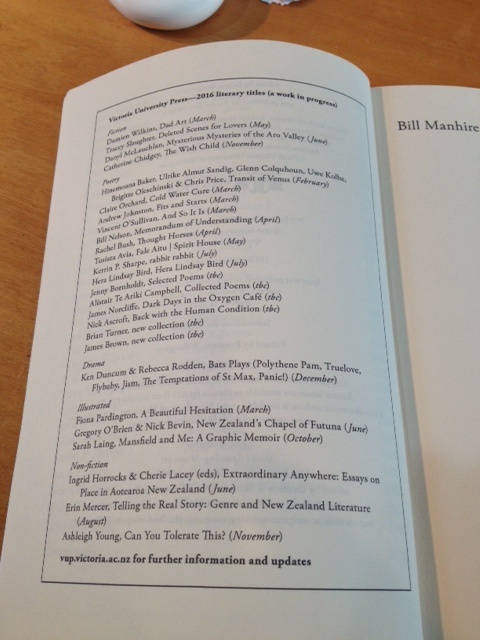
The new edition of Sport includes 8 essays along with the usual spread of poetry and fiction. At the start of the book is an impressive advertisement for Victoria University Press’s forthcoming publications. This Press is a consistent and exemplary supporter of New Zealand writing whether poetry, fiction or non-fiction.


Why I am singing VUP’s praises:

There are 15 poetry collections in the offing (okay some might not appear until next year, but still!). We are going to see books by Tusiata Avia and Hera Lindsay Bird over the next few months.

Sarah Laing‘s new book is out in October (Mansfield and me: A Graphic Memoir).

There are 4 works of fiction (Catherine Chidgey has a new novel out in November!)

And I am looking forward to the collection of essays Ingrid Horrocks co-edited having tasted some in Ruapehu and Ashleigh Young‘s essays (November).


Sport 44

some preliminary highlights:

Usually, I read all the poems first but this time I was in the mood for a bite of fiction so I dove straight into Kirsten McDougall‘s ‘A Visitation.’ The story responds to the collapse of the internet and the arrival of Clarice Lispector to make a batch of eggs to tempt an indifferent palate. I adored this story so much it made me want to take up writing short fiction. It is sweet writing; warm, witty, funny, thoughtful, polemical. I do hope there is a new collection in the pipelines. I read this on a plane with two hours sleep and it was such an uplift. ‘I saw anew the detritus in the house I had allowed to build up like a plaque to the heart.’

The journal always puts in me in touch with writers I am unfamiliar with. This time a glorious suite by Oscar Upperton: ‘The ship is a sort of dark undoing.’

And Philip Armstrong‘s utterly inventive narrative, ‘Life of Clay,’ which keeps you on your toes as you read: ‘I can tell you it began with nothing/ but the wide white bare and empty endless plain/ but there was something there already there.’

I have already posted some of Rachel Bush‘s poems here.  Movingly, achingly beautiful. Written when life has fingertips against death.

Jenny Bornholdt‘s exquisite haiku: ‘It is eight degrees/and the Thorndon outdoor pool/ is swimming with leaves.’

Ashleigh Young‘s ‘Process’ which is sad and happy and a little bit witty and a little bit true: ‘On this day our city is a perfect haircut, its losses gently layered/ and what is left, falling gracefully.’ Oh word shivers!

Tusiata Avia‘s ‘Gaza’ which brings heart and politics together and rips your easy Sunday slumbering with poetic teeth: ‘I cannot write a poem about Gaza because I cannot eat a whole desert.’

The stillness, the extraordinary image, the enigmatic bridge between title and poem in Louise Wallace‘s ‘The body began to balance itself’. You just have to read the whole thing!

Hannah Mettner‘s ‘The day Amy died’ that takes a moment that pricks with sharp detail and pricks even deeper when the moment is declared and time and noise go haywire.

Maria McMillan‘s ‘The Ski Flier’ is a whoosh of a poem that sucks you up into story and music and is so evocative: ‘And/ there is a moment when they pass,/ the snow and the ski flier,/ each taking on the character of the other.’

Harry Rickett‘s ’14A Esmonde Road’ exudes the mood of place, that historic property where Janet and Frank lived; and you can just feel the phantoms stalking the poem until you get to the perfect ending.

The first poem, ‘Falseweed,’ is by Bill Manhire and was published as a little pamphlet by Egg Box Publishing in Norwich. It has a different feel to some of Bill’s recent poems. The words are scattered like seeds on the expanse of white page. Or pebbles. But I like the idea of seed as they are so fertile. I can see the roots and buds bursting out. There is linguistic inventiveness that boosts both music and image, particularly in compound words:

leafcandle  pencilheart  wintertwig  scribblegrass  anchorwhite  tongue-true.

I felt like I was following a dandelion kiss and pausing to see where it landed. The poem is about childhood and writing and a mind floating, roaming. Words floating, roaming. It is beautiful and mesmerising: ‘I began to recall/ how the words came knocking.’ ‘Oh pencilheart –/ oh smudge of lead.’


And still much to read; more poems, more fiction and the bundle of essays. This is a terrific issue.

The VUP ad:

IMG_3295


A Little Poetry Shelf Diary: A weekend at Matahiwi Marae to launch our new Poet Laureate, CK Stead


IMG_3281.JPG


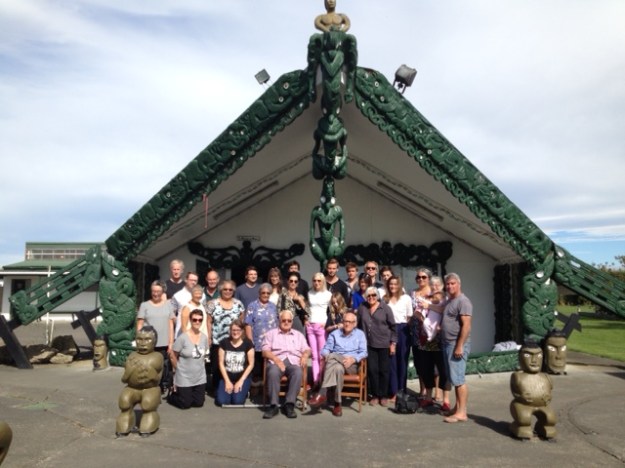
This weekend friends, family and poets gathered to join CK Stead celebrate his Poet Laureateship and the presentation of the tokotoko. It was a marvelous occasion that will stand in my memory for a long time. The weekend featured two key events. The formal and informal proceedings at Matahiwi Marae on the Saturday morning and a Poets’ Night Out in the evening.

With exemplary dedication to New Zealand poetry, Te Mata Estate’s Peter Buck and poet Bill Manhire established the award twenty years ago. In 2007, The National Library took over the administration, although the Buck family still remain involved, and donates a stipend of wine to the Laureates. Unlike most of the visitors, I got called onto the marae on the Friday evening with Chris Szekely and Peter Ireland from the National Library, and a number of their colleagues, including Oliver Stead and his son Isaac. Peter was the driving force behind detail of the weekend, and Ian Wedde’s moving tribute to him at The Circle of Laureates hit the mark. Thoughtful, attentive, committed to making a celebration fit for a Laureate. His back-up team are pretty special too (Joan, Cellia Joe, Lynette, Jason and Oliver).

Kaumatua Tom Mulligan and other members of the marae welcomed us with much aroha.

Joan, Cellia, Jason and I practiced some waiata back in the whare nui. CJ on ukulele.We crack up when CJ says all her family knows she can’t sing and she just fakes it. We are all fooled and I wonder what I can’t do but could fake and get away with.

On Friday night we hived off to Havelock North (one poet, five librarians) for dinner at Maine where the food was divine. We fell greedily into the comfort of the best hot chips ever and with that salty comfort digging deep into our bones were ready for whatever the weekend delivered. One plate of salmon with the best Niçoise salad and I was ready for a weekend of poetry and celebration.


Saturday morning

I got up early to walk in the near rain and saw a black cat stock still on a fence post eyeballing my lack of sleep. Not budging an inch until a car came down the gravel road and sent the cat sliding down like a snake into the golden corn. I had no idea what it meant. But it glowed with options.


CK Stead was called onto the marae with his whanau (around 20), poets Gregory O’Brien and Chris Price, her partner Robbie Duncan, and other guests. To have such family support felt very special. He is poetry but he is most definitely family. His daughter had travelled from London with her children.

After the formal speeches and the waiata exchanges, the tokotoko was presented to Karl by a kuia. She had such presence. Jacob Scott, who carves the tokotoko for each Poet Laureate said he had wanted to make a tokotoko for a gentleman and a scholar that could be used on a daily basis if needed. He had gained inspiration from Karl’s poem, ‘Scoria.’

Karl responded with a speech that mixed graciousness, humbleness, love. He said he was not only honoured by the role but honoured by the marae: ‘by being here, by your presence, by your aroha.’

Before he read a few poems, Karl talked about place, about the importance of one’s childhood occupation of place, and the way that place becomes one of return. He grew up with three maunga facing him whichever way he turned. He also underlined the primacy of poetry for him since his teenage days and the way he has ‘always come back to poems.’ With much humbleness, he added,’that’s why it is extraordinary at this late stage in my career as a writer to be honoured as Poet Laureate.’

Karl paused in his korero and then said; ‘I am getting advice from the tokotoko. We have to get used to one another.’

At that we all paused.

I am delighted that the Poet-Laureate role honours our elders, our writing taonga. It felt good to be part of the protocol. The talking. The listening. The exchange.


MC-ed by Marty Smith, the informal part of the morning was like a miniature poetry reading. As his invited poets, Chris, Gregory and I read a couple of poems and Chris sang a Bill Manhire song with her partner Robbie. What made this section special were the performances from local secondary students. One student used the analogy of a bird to explore the Poet Laureate’s original function to write poems on dictated subjects. She was keen to let a Laureate fly free! A student played a solo violin piece, one sang a Māori version of ‘Hallelujah,’ while another wrapped up the morning with Van Morrison’s ‘Moondance.’ Wonderful! I pictured us all dancing slow motion with the wind in our hair. Instead the wind whipped the music sheet up and away.

It was a morning of korero, waiata, music and poetry and it felt good to inhale both words and song. Nourishing. We moved to the whare kai where a tremendous lunch of fresh local produce matched the hubbub of conversation. You don’t get to experience many days like this in your lifetime. Such warmth, and connections.


Saturday night

Marty Smith was the MC extraordinaire in a poetry reading of two halves. It’s ages since I have heard Chris and Greg read, but to hear them read in this context was something special with poems handpicked for the Laureate occasion. Greg read a terrific poem now showcased in the selection of Best NZ Poems from 2015, while Chris confirmed that her new book is her best to date (we have an interview in the pipeline!). Three young opera singers from Project Prima Volta wowed us with two arias. The room befitted the occasion: white cloths on tables, astonishing flower/plant arrangements, platters of food, Te Mata wine. Karl started and ended the night and showed very clearly why he is Laureate. He read across his range and his last set gave me goosebumps. The clarity of voice, the poetic strata, the acute detail that makes you want to pick up your pen and write.


Sunday morning

Breakfast and poroporoaki for everyone on the marae. The goodbyes. At breakfast Karl and I talked about the weekend and how we both spent chunks of the night wide awake as though we had to rehearse the next day and analyse the day before. I probably had about two or three hours sleep a night and it seemed like a state of wakefulness that kept me on high alert. What had happened, what was about to happen. I had brought seven books to match most moods (everyone laughed at my big bag of duvet and books) but I only got to read snatches of The Lie Tree. The gap between YA fantasy and the marae was unbridgeable. I got up early and walked my way into wakefulness before Emma Scott, Jacob’s sister, took me out to the river mouth and then coffee at her brother’s house. To see the meeting waters, where river meets ocean, to soak up the gleam of sun on waves and estuary, felt like a poem on the surface of the world. We talked and we looked. Emma is a stone mason. We talked about poetry and we talked about stone. We talked about what holds things together. It matters that we hold up our treasured poets. Give them a place to stand and speak.

There was much korero after breakfast, and song. Chris and Robbie sang a mesmerising Bob Dylan number, almost lullabying me into necessary slumber.

Peter Ireland, running on empty after little sleep, spoke with characteristic thought and thanked everyone personally. It felt like a garland of words to wear out into the world of planes and trains and motorways. Or for me, a place of solitude and bush.

Jacob said it beautifully. He said that the Poet Laureate was significant for the marae. That it spread the hapu’s power and influence. That this is now Karl’s place as well. The undercurrent is that poetry matters. Jacob said it is significant ‘that the Poet Laureate can articulate the thoughts and expressions of who we are. Of what we can do. Of what we have got. And what we could do.’ Like a bird.

We all felt in debt to Tom Mulligan and his drawing together of this poetry clan. With much aroha and generosity of place, stories and a willing ear.

Our heads are full of days we cannot remember, but for many of us, this weekend will not be one of them.

Thank you. Especially Karl, The National Library and Matahiwi Marae.


The performances.


A quick trip into Havelock North to drink the best coffee and eat the best lemon tart in a cafe on the brink of closing for the day. Peter was a very good guide.


The writers, friends and family ate at Pipi Cafe, a cafe renowned for its love of poetry and its excellent pizzas in Havelock North.

Poets’ Night Out


IMG_3258

IMG_3276

The last morning.

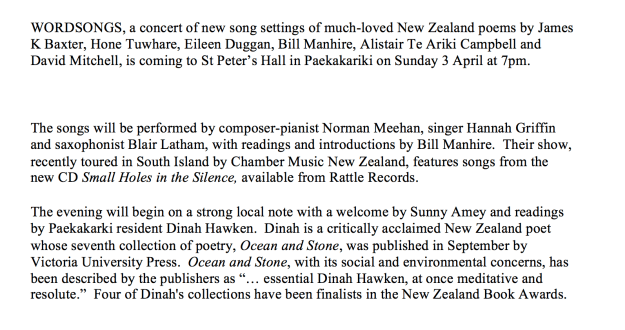
Maria McMillan on Wordsongs


Wordsongs, St Peters Hall, Paekākāriki, 3rd March 2016


I go partly because there’s like a major poetry type gig in Paekākāriki and I’m a Paekākāriki poet and it feels a bit rude not to go. Imagine, I think, if there’s only six people there without me and they decide never to have anything poetry related in our village ever again. Yes, we call it a village and I needn’t have worried. Having scoffed down as much of a delicious fried-rice concoction as I possibly could in 94 seconds  I arrive three minutes late and take the Very Last Seat. It’s an actual excited crowd, in carefully arranged tiers. They’ve turned St Peters Hall around so we face the direction of the sea and one long side of the hall with its cool house-shaped wooden-window shutter things. The huge red velvet curtain hangs over the stage to our left and the doors to the village main street to our right.

I love this hall but truthfully, I’m a bit wary of poetry set to music. It’s the puritanical killjoy in me which says, honey, you need to decide, music or poetry. Just get away with your weird, not very interesting bongo drumming interspersed with a man saying two words usually something like organic tomatoes in  a quiet yet loud, yet well modulated, yet with working-class-solidarity voice and then pausing a full minute while making eye contact with every member of the audience before saying wet. But I know it’s kind of prudish of me and I need to open myself to new experiences so I am willing and here and listening.

Local poet, Dinah Hawken, who starts us off, makes me feel very comfortable. She reads her poetry sans music, the way it should be (sorry) and she starts with a good long poem about environmental catastrophe. The poem earns its length and I enjoy Hawken’s meditative delivery. She reads slowly and thoughtfully and the poem turns from lament to challenge to conversation. I feel like I’m hearing more and more poetry like this, laced with planet grief and helplessness and wonder. I’m glad it’s being written.

The main act is  Bill Manhire with singer Hannah Griffen, pianist Norman Meehan and Hayden Chisholm on saxophone and clarinet. To begin with I think Chisholm is tuning up, his sax is breathy and rough and understated and there’s no clear strong notes but then I realise this is part of it all. He’s throat clearing and then the other clear notes come, but through the set I see this replication of human noises, and also the absorbing of other sounds and instruments. I hear reverb and the plucking of a guitar, slow growling, didgeridoo and the noise of traffic all through his instruments.

In this first song, an interpretation of Baxter’s High Country Weather, the piano and singing come in beside the brass and I’m startled by how much action, how much sound can be produced by just three people. Griffin’s voice is like some really good jazz club singer. I get that vibe through the night. I want to be sitting at a small lamped table having intimate conversations. She sings big, beautiful and clear, high and low.  Next Bill, congenial and with charming anecdotes that thrill the poetry nerd in me, reads Rain by Hone Tuwhare and then the three musicians play it back to us. I get it now. I can listen to the poems read as poems, and listen to the music as music. No bongo drums. No organic tomatoes and soulful stares. It’s a relief. And when I hear Rain sung I’m struck by how lineation changes with the music, the words become split and lumped in different way. We can hear hidden rhymes and rhythms which may be a subtle backbone to verse on the page but in music are drawn out and played with. Cool.
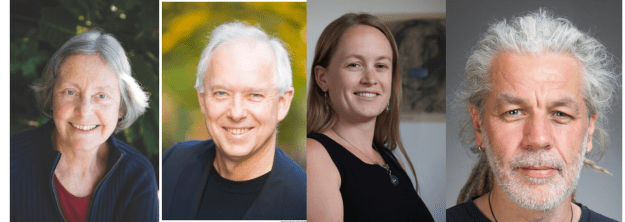
Meehan tells us the set is pretty much the album Small holes in the silence, featuring versions of  Manhire and other poets’ work as songs. We hear interpretations of Alistair Te Ariki Campbell, Manhire, David Mitchell, and my favourite piece, two poems by Eileen Duggan. I can’t actually hear the words as Griffin sings so perfectly in tune with the sax, so my liking this all the same proves how thoroughly mature I’ve become about the whole poetry and music mash up. What I love in this song is the way the sax more than ever takes the role of a voice; for a moment the sax and the singer are a duet and in a kind of heady triumph. After that the two seem to swap places; Griffin no longer singing words but sounds become another instrument and the saxophone becomes a human voice. It’s a meandering interesting work. I also love Manhire’s stories about and poem for Cornish poet Charles Causley. The evening ended with a spoken and then musical interpretation of Manhire’s rhyming list poem ‘1950s.’ The crowd loved it, they threw flowers, they cheered, they stomped. Well, they didn’t but I’m sure if they thought of it they would have. They applauded long and hard. I wander out into the Paekākāriki night. Now the traffic sounds like a saxophone. The crossing signals go off. A train, windows bright, rumbles past us on its way to Waikanae. I wave.

Maria McMillan


Dinah Hawken to open WORDSONGS

I seem to have been a roving poetry reporter these past few weeks but time to shut the hatches and stay at home. This event will be good – I judge this on my experience of hearing Hannah sing Bill at the AWF a few years ago. Transcendental experience.

I urge you to check this poetry event out and would love a wee response from a poetry patron to post on the blog.


Screen Shot 2016-03-23 at 10.12.24 AM.png


Screen Shot 2016-03-22 at 6.28.24 PM.png


Tickets $20 from Eventfinder or Darcey’s Fruit Shop.  Limited door sales at $25.

QUERIES: Gilbert Haisman.  Tel 04 904 8428 or 022 0122 103. Email: thewordshop@paradise.net.nz

A Circle of Laureates, a galaxy of poetry

This event prompted me to hunt for cheap fares to Wellington because it seemed like a rare and special poetry occasion. And it was! A sold-out event!

The National Library, as current administrator of the NZ Poet Laureate awards, hosted the evening as part of Wellington Writers Week.  John Buck from Te Mata Wines instigated the Laureateship in 1997, with Bill Manhire taking the debut spot. John was there with wine to share. He still retains an involvement.

Fergus Barrowman from VUP was the MC. He made the important point that the award is ‘an activist portfolio not just an honour.’ The earliest debut publication by a Laureate was in 1964 while the most recent debut was 1988.  Three generations of poets! Cilla McQueen and Michele Leggott calculated over 700 years of life/poetry experience across the ten laureates to date.

Bill Manhire (1997) spoke about what the Laureateship meant to him and the two ways it expanded his sense of what he might do as a poet, as a public figure. Firstly he began to write poems with some kind of public dimension. Secondly he explored the way the role centred on the promotion of poetry. He wanted to ‘talk it up.’ Both are options we can be thankful for. Bill’s poems that stand on a public stage are poems that embrace the knots and crests of humanity. I talked about the way ‘Hotel Emergencies’ does this on Summer Noelle in January.

Bill read ‘Erebus Voices’ and I sat there thinking this is a poem that belongs in the world and can be heard again. And again. And then again. Because it both moves and matters. Bill shows so adeptly the way poems can shift us to laughter, to wry grins at the surprise of it all, but also lead to far more unfathomable movements of the heart.

‘I am here beside my brother, terror./ I am the place of human error.’

I especially loved the way he started with the poem of a fellow poet. He ‘talked her poem up,’ and I fell in love with it all over again: Rachel Bush’s ‘The Strong Mothers.’


Hone Tuwhare was represented by his son Rob. We listened to Hone read ‘No Ordinary Sun,’ we listened to Rob read Hone and then Rob picked up his guitar and sang a Graham Brazier version of one of the poems. A version of friendship. Quiet, haunting, utterly melodic. This was love. Hairs standing on your arm on end from start to finish in the Tuwhare bracket.

‘Oh tree/ in the shadowless mountains/ the white plains and/ the drab sea floor/ your end is at last written.’


Elizabeth Smither read a cross section of poems that delighted the audience. But one as-yet-unpublished poem in particular stuck to me. Kate Camp, her mum and I – all went ‘wow.’ I adored the story of Elizabeth seeing her mother move through her house, the windows bright, unaware of the daughter driving by. By the time I got to congratulate her, dear Elizabeth had already signed her copy for Kate. How lovely! Like a bouquet of flowers. Elizabeth emailed the poem so I can read and write about it for my book.

‘It was all those unseen moments we do not see/ the best of a mother/ competent and gracious in her solitude’


Brian Turner with his delicious wit said: ‘I’ve been called a political animal many times and it’s not always a compliment!’ And that is what makes his poems so enduring. The way he hits the right pitch of land and sky but with a deep love that is unafraid to match beauty with issues. He read a cluster of short poems where every word sang. Gee whizz this was good. Here are few lines I loved without the line breaks (sorry):

‘and the shadows are mauve birthmarks on the hills’

‘If the sky knew half of what we were doing down here it would be inconsolable and we would have nothing but rain’

‘where a river sings, a river always sang’

See what I mean!


Jenny Bornholdt

Jenny rued the way Wellington Writers Week has dropped ‘readers’ from the title. She said she would reclaim readers, in the perfect setting (the library), with a longish poem: ‘A long way from home.’ This was a highlight for me. The poem is all about illness and reading; the ability to read and a time when it flees. Here are some sample lines:

‘How as a child, books were the lens// through which I eyed the muddy track to adulthood’

‘For six weeks now I’ve been outside weather/ and of reading. Outside of myself.’

‘I have tried to read but nothing/ sticks. That anchor of my life has been raised and// I’m all at sea.’


Michele Leggott, like Bill, brings poetry to a a public arena through her tireless promotion and expansive love. Michele read an extract from a long work (‘The Fasciclies’) that bridges Taranaki and Lyttelton, the 1860s and the 1970s, and the connections between two women.

My notebook is full of Persian-like doodles of birds and shapes interspersed with notes but, as I listened to Michele, my pen stalled. I felt like I could hear Robin Hyde with her luminous detail and observations in the seams. For this was luminous writing. There is a bridge between reader and poem. Sometimes you cross it. Sometimes it seems impassable. I just wanted to cross the bridge and read the whole poem.

You can find the whole piece here.


Cilla McQueen read ‘Ripples’ a long poem that showcases her strengths as a writer. It is in her latest collection, The Radio Room (2010). Another highlight. Other poets make an appearance, Joanna and Hone. Moving. Uplifting in a way.

‘After the funeral service you leaned down towards me out of a cloud;/  “Kia mau!” you shouted into my mind.’

Cilla McQueen’s memoir is due next week from Otago University Press.


Ian Wedde also has a childhood memoir out, The Grass Catcher, which is on my must-read list. Ian’s poetry produces my ideal poetry trifecta of relations: music, ideas, heart. Oh! And singing its way through, a sense of story. He read from ‘The Life Guard.’ Ha! It’s all here. Listen to the start:

‘You have to start somewhere/ in those morose times,/ / a clearing in the forest say,/ filled with golden shafts of sunlight// and skirmishes’


Vincent O’Sullivan has a new book out from VUP, which I am about to review for a newspaper, so perfect to hear him read his poetic contours. He has the ability to refresh anything. To tilt tropes, to enhance the music of a line, to poke you with an idea, to make you feel. Once again I got caught up in the moment of listening and didn’t catch lines in my notebook.


Ck Stead is the current Poet Laureate. He began with a poem about Allen Curnow, who he felt would have been Laureate if he had lived within the Laureate time span. Karl had struggled over whether to read a top-hit kind of poem or read new things. I know that feeling and first thought I would only ever read a poem once in public when first published. That soon fell by the wayside.

It was a moment of audience empathy as Karl confessed he thought he would read it, then wouldn’t, then finally after hearing Bill, decided he would. And we were glad, indeed, as he read an elegy for his mother. Utterly moving.

Poetry is such a love for Karl. He made this clear when I was filming his ‘thank you’ speech for the Sarah Broom Poetry Award. And hearing him read on this occasion, lifted the poems off the pages where I have loved them, to a new life in the air/ear.

from ‘Elegy’ but without that scattered layout that makes much of white space (sorry):

‘She’s there somewhere/ the ferryman/ assures me.// He tells me/ she was reluctant to go/ but silent – // stood in the prow/ no tears/ and never looked back.’

Karl filled the room with the warmth of poetry. Music. Heart. Ideas. A perfect end.


The tokotoko table, with all the talking sticks carved especially for each poet, was like a quilt with stories. I wished someone had held up the mother tokotoko for all to see and told that story. And indeed held up each tokotoko, for each tokotoko has its own.

Karl will get his at the Matahiwi ceremony in April. I am honoured to be part of this occasion along with Gregory O’Brien and Chris Price.


A Circle of Laureates was a magnificent occasion. I bumped into Elizabeth Knox the next day and we were both enthusing about how good it was. Peter Ireland from the National Library had put in all the hard work! Kindly acknowledged on the night by Ian. Every poet held my attention. There is a big age range here, but to me, it is a way of honouring our poetry elders.

As a poet, I write with one foot in the past and one foot in the future.I want to know who I’m writing out of. This is my tradition. This is my innovation. This circle.

It reminded me of Selina Tusitala Marsh’s’s poem ‘A Circle of Stones in her debut collection where she honours the women she writes from, towards and beside.

Thank you to everyone who made this event possible. It was worth my spur-of-the-moment cheap flight, my accidental data blow out, my misbooking home that meant a new booking, the chance to hear the Lauris-Edmond finalists, and losing myself in Jessie Mackay in The Alexander Turnbull Library.  Thirty-six hours of poetry. Heaven.

Thanks! Ten Poets Laureate to celebrate!