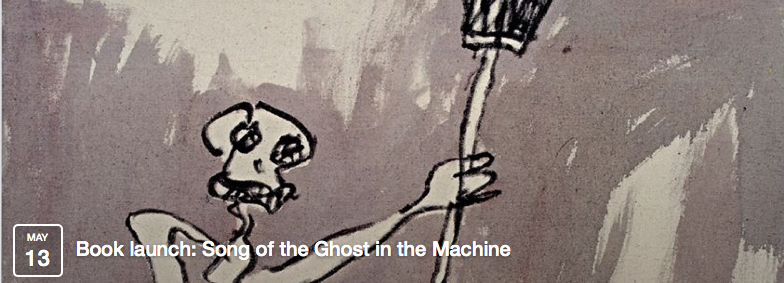
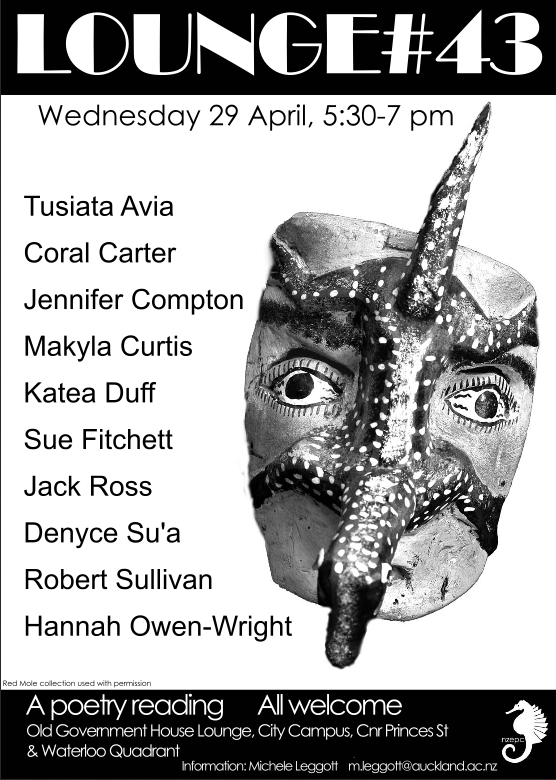
When: Wednesday May 13th, 5.45pm
Where: Gus Fisher Gallery, The Kenneth Myers Centre, 74 Shortland Street, Auckland

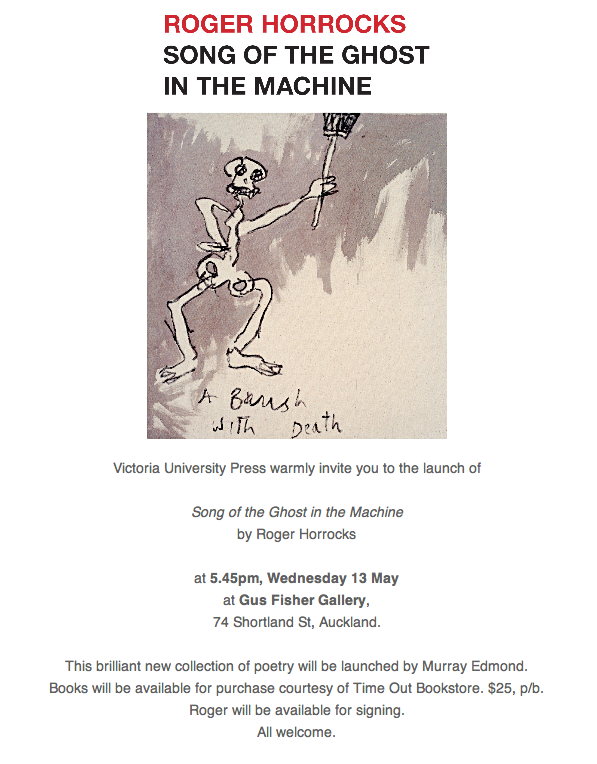
When: Wednesday May 13th, 5.45pm
Where: Gus Fisher Gallery, The Kenneth Myers Centre, 74 Shortland Street, Auckland
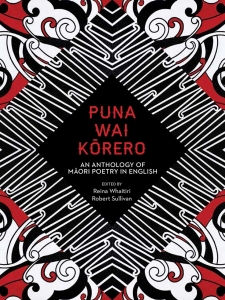
Puna Wai Kōrero: An Anthology of Māori Poetry in English editors Robert Sullivan and Reina Whaitiri (Auckland University Press, 2014)
I am curious as to how many Māori poets we can name beyond a handful, beyond the much loved Hone Tuwhare. Open a New Zealand literary journal and do we still fall upon a Pākehā bias? The arrival of Puna Wai Kōrero: An Anthology of Māori Poetry in English (2014) presents us with a selection of writing that celebrates a wide and vibrant field. The editors, Robert Sullivan and Reina Whaitiri have brought a glorious range of voices into the spotlight.
Robert, of Ngāpuhi/Irish descent, is a poet and anthologist, and is currently Head of the Creative Writing Programme at Manukau Institute of Technology. Reina, of Māori/ Pākehā descent, is also a poet and an anthologist, and has taught English at the Universities of Auckland and Hawai’i. Along with Albert Wendt, Robert and Reina edited Whetu Moana (AUP, 2003) and Mauri Ola (AUP, 2010).
Puna Wai Korero is a moving feast. The poets selected come from a variety of locations, circumstances, backgrounds, writing preferences. The choices of style, tone, subject matter and poetic techniques are eclectic. There is humour, inward reflection, love and loss. There are poems of the marae and poems of elsewhere. There are mothers, fathers, sons and daughters. There is politics on the quiet and politics loud and clear. There is grief. There is home. There are familiar voices, there are those that are not. There are writers known for their fiction.
Through all this, I flipped a question that I carried with me through my doctoral thesis (does it make a difference if the pen is held by a woman?) to ask: Does it make a difference if the pen is held by a Māori. Do some writers deliberately and gloriously foster a Māori voice (perhaps, where the poet stands and writes from, how the poet stands and writes from, how the oratory traditions of the marae inflect the poetry, how genealogy inflects the poem and so on). I spent seven years hauling my question through politics, law, history, psychology, familial relations, art, literature, history, patriarchy within an Italian context and the Italian language. Over the past months, I have held a book that drew me in close to all of these things within the miniature frame of a poem and within the context of Aotearoa. You can view the poems within whatever cultural luggage you bring to them (a Western paradigm of how to write a poem and how to break a poem, both cemented by tradition and innovation). Or you can step out of that luggage and approach these poems afresh, and in doing so open out the ways in which we can make and read and hear poetry.
This was the first joy of reading this anthology — navigating the burgeoning questions for which I felt inept at answering.
The second joy, the equally sustaining joy, was the discovery of new writers along with a return to those well loved (whenever I visit secondary schools I share my James K Baxter/Hone Tuwhare anecdotes that kickstarted me on the path of poetry in 1972). A wee taste of what I have loved: a tingle in reading Hilary Baxter’s ‘Reminiscence,’ the heart and gap in all of Hinemoana Baker’s poems, the sharp kick of Arapera Hineira Blank’s ‘After watching father re-uniting with sons in prison,’ the utter joy of Bub Bridger’s ‘Wild daisies,’ the force of Ben Brown’s ‘I am the Māori Jesus,’ the insistent catch of Marewa Glover’s ‘Pounamu,’ the evocative laying of roots in Katerina Mataira’s ‘Restoring the ancestral home,’ the pocket narrative in Trixie Te Arama Menzies’s ‘Watercress,’ the piquant detail of Paula Morris’s ‘English grandmother,’ the subtle shifts in Kiri Piahana-Wng’s ‘Four paintings,’ the verve and aural steps of Vaughan Rapatahana’s ‘Aotearoa blues, baby’ (I want to hear him read this!), the sumptuous detail in Reihana Robinson’s “God of ugly things,’ the poetic and political and personal stretch of Alice Te Punga Somerville’s ‘mad ave,’ all of JC Sturm (especially ‘At times I grieve for you’), Robert Sullivan (especially ‘Voice carried my family, their names and stories’), Apirana Taylor (especially ‘Te ihi’ and ‘Haka’) and Hone Tuwhare (especially, most utterly especially ‘Rain’).
This is a book of returns, to be kept on every shelf. Bravissimo!
Years and years ago I bought an anthology called Sudden Fiction and I loved the way the writing fell on the page in bright drops. Were the miniature pieces agonised over and crafted to a sweet and shiny essence or were they a quick and vital shedding of narrative (stream-of-conscious-like)? Tiny. Surprising. Saporous. I don’t remember such details and I can’t find my weather-beaten copy but I do remember the way the anthology sparked my attention.*
Nowadays, look each way and you find Flash Fiction.
Poet Michelle Elvy is a key supporter and writer of Flash Fiction in NZ. Many other NZ poets move between poetry and the lure of flash-fiction territory: Frankie McMillan, Owen Marshall, Mary McCallum, Rachel Fenton, Caoillin Hughes, Elizabeth Welsh, Gail Ingram, James Norcliffe.
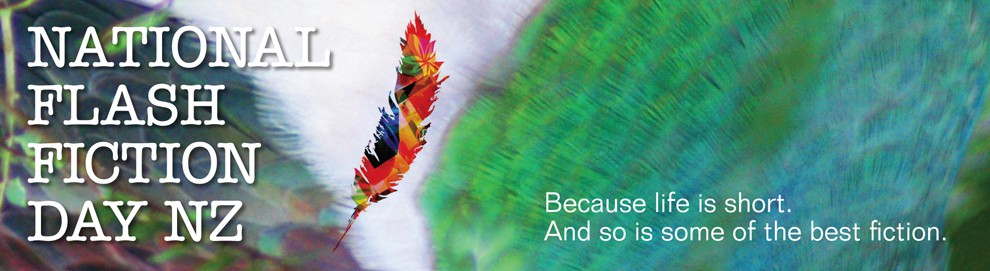
National Flash Fiction Day is New Zealand’s celebration of the shortest form of fiction writing, on the shortest day of the year.
The 2015 NFFD competition opens Feb 1 – April 30. See the competition page for information and guidelines.
The 2012, 2013 and 2014 competitions were great successes with 300 entries each year. You can find the winners from previous years by clicking on the tabs at the top of the page.
In past years, National Flash Fiction Day has been celebrated with prize-giving ceremonies and presentations by the judges as well as readings in various hotbeds of flash all across Aotearoa.
Events will be posted on the website as they are put together this year.
website here
contact: nationalflash@gmail.com
*Ha! I went online and discovered this: ‘Here Are 70 of the very best short-short stories of recent years including contributions from such contemporary writers as Raymond Carver, Leonard Michaels and John Updike; a few Modern Masters as Hemingway and Cheever; and an assortment of talented new young writers. Sudden Fiction brilliantly captures the tremendous popularity of this new and distinctly American form.’ The book was published in 1983 so I was living in London. Maybe I left it there. I am sure there were women in it! But I can’t recall.
For more, ongoing information check out the Facebook page here
“The only way to save a rhinoceros is to save the environment in which it lives, because there’s a mutual dependency between it and millions of other species of both animals and plants.”
— David Attenborough, BBC Interview
Early in his career, Wystan Curnow was invited to give a lecture on what it meant to be a critic. “But that presented certain difficulties,” he later wrote in the Bulletin of New Zealand Art History. “For instance, I was not sure I was one.”
It was 1974 and Curnow was working at the University of Auckland’s English department. He was, by definition of his employment, regularly engaged in the business of literary criticism, but he had avoided being a critic of books by New Zealand writers. As for his other interests, he conceded he might be considered an art critic. “At least,” he wrote, “if a dozen or so notes and brief essays published over a period of fifteen years in magazines all but one of which are now defunct makes one an art critic in New Zealand.” Ruefully, he concluded, it seemed it did.
Like many others before and after him, Curnow’s hesitation stemmed from the occupational versatility our country demands from its creative practitioners. Because of how small our population is, the market for any art form is prematurely capped and its growth is precariously stunted, economically and artistically. Industries have to be propped up by public funding and philanthropy, and being able to specialise as a writer or an artist or a musician becomes either a unique luxury or a financially risky lifestyle choice.
Because of this risk, artists often end up expanding their talents horizontally, whether they want to or not. It’s remarkably and sometimes advantageously easy to do in a country with so many shoes to fill. We see musicians who are also teachers who are also music writers who are also promoters. We see actors who are also publicists who are also producers who are also casting agents. We see the rise of the cultural ambassador: people who – rather than honing a specific craft – hone the skills of an entire industry. Like plants, we grow in the direction of the sun, but here the sun shines with a hazy, erratic glow.
Not sure of the details yet of fundraising but will keep you posted.
The IIML revives the National Schools Poetry Award for 2015
How you can help
Kia ora,
In 2003 Bill Manhire set up the only national poetry competition for high school students in Aotearoa. Last year we had to cancel the Award through a lack of funds. We have just launched a fundraising campaign to help revive an important literary event for young writers which each year has attracted more than 300 poets from across the country.
We’re not starting from scratch. We already have some support from Creative New Zealand. But we still have a large shortfall. With your help we can deliver a full Award, securing the workshop which is such a vital part of the experience, and promoting poetry throughout our high schools.
The Award is about much more than a winning poem. English teachers use the award to generate excitement and activity around Creative Writing. Ten shortlisted poets are flown to Wellington for a weekend of workshops with great poets hosted by the International Institute of Modern Letters. These young writers become ambassadors for creativity when they return to their schools.
The Award has made a difference. Students who have been shortlisted in previous Poetry Awards have gone on to study Creative Writing at tertiary level, won other national writing prizes for emerging writers and have been published in national magazines and literary journals.
Ruby Solly, from Western Heights High School, Rotorua, was the 2013 runner-up: ‘After I came back from the poetry workshop I became very committed to school and writing as I had been given a taste of what it was like to be with other writers and to see what kind of course or occupation I could end up in as a poet. The workshop showed me various ways of both ‘sparking creativity’ and refining my work to make it the best that it could be. These skills helped me to achieve publication in both Minarets (literary journal) and Redraft. It was definitely a highlight of the year for me.’
Margie McLaren, who teaches at Baradene College, writes: ‘The main benefit is the new confidence instilled in the students about the value of poetry in a utilitarian world which does not always attach the significance to poetry that it deserves . . . The Award is an affirmation of the many benefits of working with and celebrating language, and the special ways in which poetry can reflect human experience. The opportunity of entering for the Award has been a very positive and rewarding experience.’
We hope you can support us!
Ngā mihi nui,
Damien Wilkins
Director
International Institute of Modern Letters