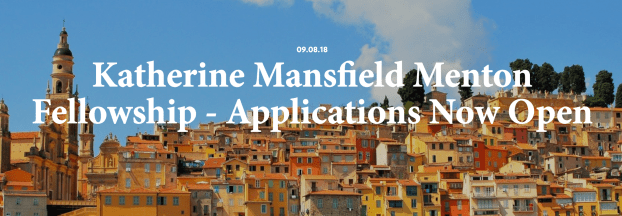
The Katherine Mansfield Menton Fellowship Advisory Committee is looking for an established creative writer to spend three months or more in Menton in southern France to work on a project or projects.
Tihe Mauriora, e nga iwi o te motu, anei he karahipi whakaharahara. Ko te Katherine Mansfield Menton Fellowship tenei karahipi. Kia kaha koutou ki te tonohia mo tenei putea tautoko. Mena he tangata angitu koe i tenei karahipi, ka taea e koe haere ki te Whenua Wiwi ki te whakamahi to kaupapa, kei te mohio koe, ko te manu i kai i te matauranga nona te ao. Ko koe tena?
We’re getting listeners to download our Voxpop app onto their smartphones and read a two minute poem so we can play it on air during the show all week.
If you write poems and would like to read one to be heard on Lately with Karyn Hay next week on RNZ National, we’d love to hear it. Download the RNZ Voxpop App from the Appstore or wherever you get your apps, and read a short poem of up to two minutes onto it. Simple as that. Make sure you say who you are, and what it’s called and – if you like, other deets such as where it’s been published. Karyn will play it on air next week on her show. We already have lots of poems to play, some from published authors, others from complete novices. Have a go! And please, share away!!
Instructions for the app:
1. To download the VoxPop app search for “RNZ VoxPop” in the app store on your iPhone or android phone.
2. Give yourself a username and give the app permission to use the microphone.
3. Select the question you wish to answer and it will bring up the microphone to begin recording.
4. Touch the microphone in the red circle to begin recording and then touch it again to end recording. You can “replay” to listen back and if you are happy hit the “publish” button to send the reading to us.
If you have any issues or questions email me: ceinwen.curtis@radionz.co.nz
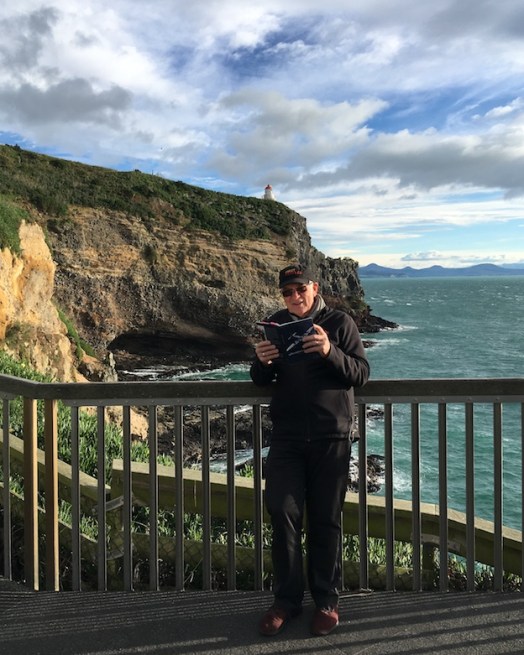
Jeffrey Paparoa Holman reads ‘Toroa Feeding – Taiaroa Heads’, from Fly Boy (Steele Roberts: 2010).
Jeffrey Paparoa Holman is a Christchurch poet and a writer of non-fiction, and senior adjunct fellow in the School of Humanities and Creative Arts at the University of Canterbury. Born in London, Jeffrey immigrated to New Zealand in 1950, growing up in the Devonport naval base in Auckland, then the coal mining town of Blackball on the West Coast of the South Island. He has worked as a sheep-shearer, postman, psychiatric social worker and bookseller.
Jeffrey’s poetry collection As Big as a Father was longlisted for the Montana New Zealand Book Awards (2003). In 2007, Jeffrey and Martin Edmond won the Copyright Licensing Limited Award giving them $35,000 each towards a non-fiction project. Best of Both Worlds: The Story of Elsdon Best and Tutakangahau, was published by Penguin in 2010. Jeffrey was the 2011 Waikato University Writer-in-Residence and in the same year shortlisted for the Ernest-Scott History prize, Australia. In 2012, he was awarded the Creative New Zealand University of Iowa Residency. The resulting book, The Lost Pilot: A Memoir was published by Penguin NZ (2013). In 2014, Jeffrey travelled to Berlin on a Goethe-Institute scholarship, pursuing research for his current project, a family history based on links with his German relations.
Jeffrey’s SHAKEN DOWN 6.3: Poems from the Second Christchurch Earthquake was published by Canterbury University Press in 2012. His most recent collection, Blood Ties: New and Selected Poems was published by Canterbury University Press in 2017.
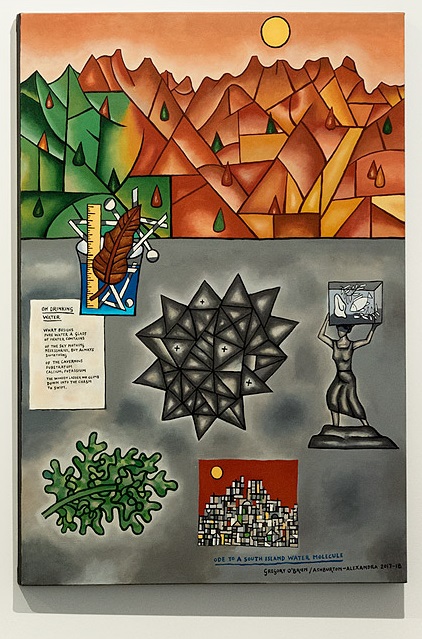
This poem was included in a painting of mine in the Water Project exhibition, curated by Shirin Khosraviani at the Ashburton Art Gallery. The exhibition has just come down–but will be touring the nation over the next year or two. Pic of the painting, ‘Ode to a South Island water molecule’:
Gregory O’Brien is currently living in Alexandra, Central Otago, where he is working on a new collection of poems and finishing Always song in the water, a book of travels in Northland and aquatic regions north of there.
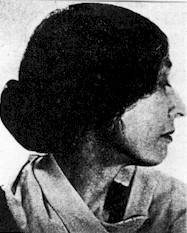
nzepc presents Lola Ridge’s New Zealand and Australia, an author page that includes Ridge’s antipodean poetry and video of biographer Terese Svoboda reading and talking about Lola Ridge in Hokitika, where the poet lived 1880-1903.
This long overdue collection of writings, images and recordings in the one place will open up avenues into a poet who got lost in the shadows. Thanks again to the dedicated excavation work of Michele Leggott and Brian Flaherty.
A Readers and Writers evnet with the New Zealand Poet Laureate, Selina Tusitala Marsh, who performed her epic “The Queen’s Sequence”, inspired by her meeting Queen Elizabeth II in 2016 and other queens. After the interval fellow poets Tusiata Avia, Serie Barford and former Laureate Jenny Bornholdt who shared selected readings, with poet Paula Green as chair. Tusiata Avia.
A Readers and Writers evnet with the New Zealand Poet Laureate, Selina Tusitala Marsh, who performed her epic “The Queen’s Sequence”, inspired by her meeting Queen Elizabeth II in 2016 and other queens. After the interval fellow poets Tusiata Avia, Serie Barford and former Laureate Jenny Bornholdt who shared selected readings, with poet Paula Green as chair. Tusiata Avia.
Vaughan Rapatahana’s interview with Tusiata Avia – with a generous serving of poems – is unmissable. Here is just one question that got me musing:
Would you define yourself as a Kiwi poet having a perspective that is different than the ‘normal’/mainstream (i.e. generally, Pākehā New Zealander) one? If so, how so?
It’s a funny old thing defining myself. Certainly other people: reviewers, academics, and the like define me as different to the mainstream, but in my experience they like to use their pegs to stake me out in a certain shape. It would be disingenuous to say I wasn’t (different to the Pākehā mainstream) but the defining always makes me squirm. I get really uncomfortable with the binary of mainstream and other. I don’t like being other. Or othered.
My good friend Hinemoana Baker once said something along the lines of: I reserve the right to be what ever it is I am feeling at the time. I think she was quoting someone else — but it was in reference to being of mixed heritage. The point being, right at the moment, as I write this I don’t feel like claiming the Pasifika space, the Samoan space, the mixed heritage space or the Kiwi space. As a poet/ writer, there is a much broader space I can move about in.
Going West always dedicates a significant part of its programme to poetry and this year is no exception.
‘New Zealand’s leading authors, poets, playwrights and musicians offer audiences a fortnight of fresh ideas, future-thinking, language and laughter at the 23rd Going West Writers Festival 1-16 September.’ Good location & food!
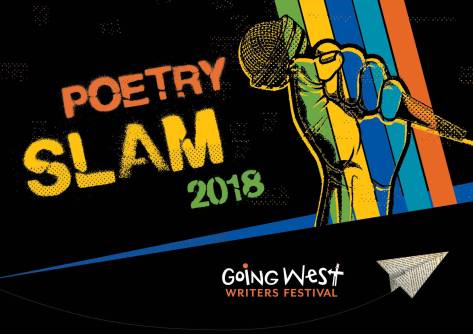
8 September Going West Poetry Slam. Glen Eden Playhouse
14-16 September Going West Writers Festival weekend. Titirangi War Memorial Hall
If you think poetry is all about fields of daffodils and iambic pentameters, think again. Here, at the Going West Poetry Slam, poets lay it on the line to see who’s got the chops to rise to the top.
The weekend poetry events (14th -16th September):
Poet Serie Barford is the Opening Night’s Curnow Reader
Does a city a writer make? Three visiting Wellington poets – Chris Tse, Helen Heath and Anna Jackson – explore what it’s like to live, work and write in the windy city with Paula Green.
Going West is honoured to partner with Auckland University Press to host the launch of a new collection of poetry from C.K. Stead,That Derrida Whom I Derided Died: Poems 2013-2017.
As we incorporate artificial intelligence, automation and robotics into our lives and even our bodies, we continue to wrestle with what it all means for us as humans. Helen Heath and Dr Jo Cribb are joined by Vincent Heeringa to discuss these issues.







 NZ Poetry Shelf