Category Archives: Poetry Awards

To celebrate Prime Minister’s Literary Award: a poem by David Eggleton

35

Prime Minister’s Literary Award for Poetry 2016: David Eggleton

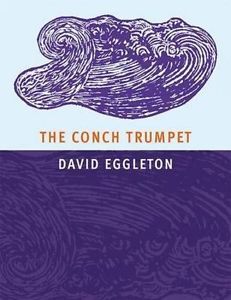
To celebrate David Eggleton’s well-deserved honour, here is a poem from his award-winning book, The Conch Trumpet. Having just watched the second presidential debate, reading this lucid lament was a perfect antidote to my allergic reaction to stupidity.

David has gifted us a sumptuous and kinetic weave of lines across decades. He dares to challenge. He makes words sing. He lets us into an idiosyncratic and  warm absorption of the world about him, whether it is back country or city streets. Read one of his poems, and you get to see the world a little differently. Hear him read one of his poems and you are shuffling on your feet. His poetry is a banquet of constant return.

Congratulations David!


Clocks, Calendars, Nights, Days


Bitterness of bees dying out,

honeyless clouds, forest drought,

red, yellow, charcoal’s grain,

eyes smarting from a world on fire,

air thick with grit; cleave to it.

                                      by clocks, calendars, nights, days


Bog cotton frenzy of winter

dancing erasures over hills,

leaf litter corrected by snow;

fog quickly swallows the sea,

then starts in on the shore.

                                  by clocks, calendars, nights, days


Skerricks of twigs skim high,

flung far from grips of fists;

remember to dip your bucket

deep into the morning sun,

but don’t drown in apathy.

                                    by clocks, calendars, nights, days


Then down in earth’s mouth,

a slow song about the rain,

as you heave from the dark

to hear a thunderous beat

clocking on the old tin roof.

                                         by clocks, calendars, nights, days


By fast, slow, high, deep;

by sing, dance, laugh, sleep;

by climb, fall, jump, walk;

by chance, breath, cry, talk;

by clocks, calendars, nights, days.

                                    by clocks, calendars, nights, days


©  David Eggleton, The Conch Trumpet, Otago University Press, 2015

Congratulations: David Eggleton wins Prime Minister’s Award for Literary Achievement in Poetry

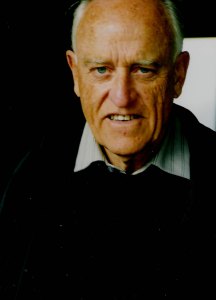
davideggleton.jpg


The recipients of the Prime Minister’s Awards for Literary Achievement for 2016 have been announced today. Writers Atholl Anderson, Marilyn Duckworth and David Eggleton will each be awarded $60,000 in recognition of their outstanding contribution to New Zealand literature.

The three winners were agreed by the Arts Council of Creative New Zealand, based on public nominations and the recommendations of a selection panel. Atholl Anderson will be recognised for non-fiction, Marilyn Duckworth for fiction and David Eggleton for poetry.

Arts Council Chairman, Dr Dick Grant, says, “The Prime Minister’s Awards for Literary Achievement differ from other prizes in that they recognise a career and a significant body of acclaimed work, rather than a single work of literature. The contribution of nominees to the literary community over time is also taken into consideration.”

Dr Grant says, “I congratulate these wonderful authors on their selection for this prestigious award. It’s important that we honour New Zealand writers in this way, to recognise achievement at the highest level, but also to inspire young writers to envisage a writing career for themselves that will continue to build on this literary legacy into the future.”

The awards will be presented at a ceremony at Premier House in Wellington, on Wednesday 12 October.

The Prime Minister’s Awards for Literary Achievement were established in 2003. Every year, New Zealanders are invited to nominate their choice of a writer who has made a significant contribution to New Zealand literature in the genres of non-fiction, poetry and fiction. New Zealand writers are also able to nominate themselves for these awards.

Nominations are assessed by an expert literary panel and recommendations forwarded to the Arts Council of Creative New Zealand for approval.  This year’s selection panel was Jock Philips (Chair), Jill Rawnsley, John Huria, Morrin Rout and Murray Edmond.

A full list of previous recipients can be found on the Creative New Zealand website.

Creative New Zealand and Unity Books invite you to a free literary event

The recipients of the 2016 Prime Ministers Awards for Literary Achievement will read and discuss their work with broadcaster, Kathryn Ryan.

This is a free event at Unity Books, 57 Willis Street, Wellington on Thursday 13 October, 12-12.45 pm. All welcome.

Additional notes: author biographies

David Eggleton (Dunedin). David Eggleton has published eight collections of poetry, most recently The Conch Trumpet, which was the winner of the Ockham New Zealand Book Award for Poetry in 2016. He is well-known as a performance poet and as well as his poetry appearing in numerous anthologies over a long period of time, he has also been involved with many documentaries and recordings of New Zealand poetry. While continuing to produce his own poetry, Eggleton also gives back to the New Zealand poetry community by editing both Landfall magazine and Landfall Review Online. As one of his nominators commented, ‘he has, for over 30 years, made a vital contribution to the poetry community throughout New Zealand.  He is truly a bard, a bard with street credentials. He sings our nationhood.’

Marilyn Duckworth OBE (Wellington). Marilyn Duckworth has a long history of publishing fiction. She has published 16 novels, a novella, a collection of short stories, a collection of poetry and her autobiography. Duckworth has received numerous awards, fellowships and residencies over the course of her career including the Katherine Mansfield Memorial Fellowship to Menton, the Victoria University Writer-in-Residence, the Auckland University Writer-in Residence and, more recently, she has been the New Zealand Society of Authors President of Honour. Duckworth has also been active in the literary community as a mentor and support to many writers and she has been a Trustee on the Katherine Mansfield Memorial Fellowship Trust for many years.

Professor Atholl Anderson (Ngāi Tahu, Blenheim). Atholl Anderson CNZM, FRSNZ, FAHA, FSA is an outstanding writer, researcher and communicator who has carried out many years’ research throughout the Pacific and Indian Oceans. He has directed numerous archaeological excavations, published prolifically, and been the recipient of many awards including the 2015 Humanities Aronui Medal from the Royal Society and the 2016 JD Stout Fellowship. He has made a significant contribution to tribal history in southern New Zealand, with books such as The Welcome of Strangers (1998) and Ngāi Tahu: A Migration History, edited with Te Maire Tau (2008). He is an Emeritus Professor at the Australian National University, Adjunct Professor of History at the University of Canterbury and Honorary Professor of Anthropology at the University of Otago. His publications include Tangata Whenua: An Illustrated History, with Judith Binney and Aroha Harris, which won the Non-fiction award at the 2016 Ockham New Zealand Book Awards. This book has also won several other awards over the past year.

#awf16 Going to the Sarah Broom Award


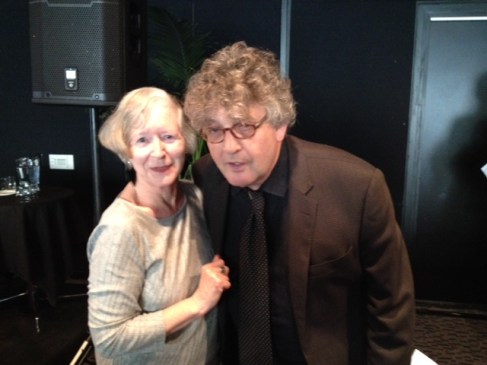
(excuse my photos but I have managed an eerie poetry light on everyone!)
IMG_3461

Going to the Sarah Broom Award is always a sad-glad occasion for me as I get to remember a wonderful poet and to celebrate the vitality of New Zealand poetry.

This year was no exception. The award is a gift from Sarah’s husband, Michael Gleissner. His dedicated drive to support NZ poetry offers an award for a poet at any stage of their career. For the past two occasions, an overseas judge has selected the shortlist and winner. This year, acclaimed Irish poet, Paul Muldoon, was judge. He had no idea who wrote the poems and insisted on reading all the entries (over 250) because he wanted to find the entries that ‘judge you, that read you and impress themselves upon you.’


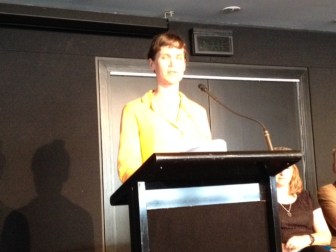
Paul’s short list: Airini Beautrais, Elizabeth Smither and Amanda Hunt

Paul began with a moving tribute to Sarah, Sarah’s family and her poetry. He read her poem (among others) ‘Holding the Line’ and said: ‘We’re all trying to hold the line of poetry which seems a little perilous, but that’s what we’re all trying to do.’

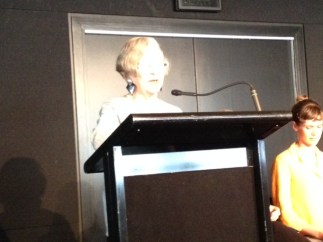
Each poet read a handful of poems.
 

IMG_3452

The winner, Elizabeth Smither read the poem about her mother that she read at the Laureate Circle event in Wellington. Kate Camp and I were in a frenzy to read it again. Elizabeth so kindly gave Kate her copy and signed it and emailed me one. It is the kind of a poem that has built a room of its own in my head. The sort of poem that rises and pierces your heart with the acute depiction of a moment. Elizabeth is outside in her car in the street seeing her mother move through her house without realising her daughter is watching. Elizabeth followed it with a poem, ‘The name in the fridge’ that made me laugh out loud. She and friend had put the name of someone they wished ill of in the freezer but nothing bad happened (see poem below). As Paul said, Elizabeth has the skill to blend humour with seriousness. Yes, her poems can handle that and so much more. The stillness, insight and deep connection to humanity makes Elizabeth a poet writing at her very best.

Elizabeth is a former NZ Poet Laureate, has published numerous poetry collections that have garnered awards and high praise, along with short stories and novels. She lives in New Plymouth.


The name in the fridge

Someone we both disliked: you wrote

his name on a slip of paper

folded it, and inserted it in the freezer


under a tray of ice cubes, next to

a frozen chicken, frozen vegetables

a casserole sectioned into cartons.


You’d read about it. Nothing too serious

would happen. Perhaps he’d lose his job

or his dog would need taking to the vet.


The dog would recover, the bill be huge.

His wife might flirt with someone at a party

and be noticed: notice was a big part of it.


When nothing happened after six months:

his dog had puppies, he got promoted

we took out the paper, ice-encrusted


and brushed it against our jerseys. Soft

powder fell into the sink. You said

you’d take it with you when you went to England


as if it would be more potent there.

A huge fridge near an Aga

stuffed with grouse and pheasants and wild boar.


©Elizabeth Smither
 

IMG_3456


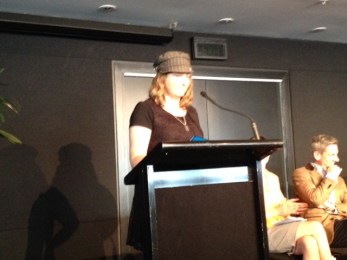
Airini Beautrais read from a sequence of poems that forge links with the Whanganui River. As a poet she bends the line and then makes it glow with luminous detail so that as you listen to the contours of voice you are both skimming the slopes of  every day living and doing little side jumps to out-of-the-everyday. It all comes down to voice. To human beings finding their way in different circumstances. As I listened I felt like I want to read the river, to read the whole sequence, and follow people as much as river currents.

Airini has published three collections of poetry and is a graduate of IIML. Her most recent collection, Dear Neil Roberts, was longlisted for the Ockham NZ Book Awards in the Poetry Category. Like Amanda she studied ecological science at university. Her debut collection was named Best First Book of Poetry at the Montana NZ Book Awards 2007. She lives in Whanganui.

Airini acknowledged the significance of  Sarah’s poetry: ‘As a mother and writer I find Sarah’s poetry particularly moving, and also inspirational. I am inspired by her bravery and strength. She has left us an important legacy.’


Observatory


Kids, who wants to look up through the telescope?

This is the largest unmodified refractor telescope in use

in New Zealand. Birthday girl, you first. I hope

you’ll see a planet up there, with rings. That might come loose

if you fiddle with it, be careful. It looks like smoke?

That would be a cloud. Is that really a planet? Yes.

Nah, I stuck a picture up on the end. That was a joke.

Could an asteroid destroy humanity? Well, I guess

there’s a chance. No object we know of threatens us any time soon.

Is there life like ours, out there? Keep looking up, wave a little.

Parents, bring your kids back one Friday night, maybe the moon

will be visible. Who hasn’t had a turn yet? Look there, and it’ll

be right in the middle. Ha, that’s what everyone says. You know how

they called this planet Saturn? They really should have named it Oh wow.

©Airini Beautrais
 

IMG_3453


Amanda Hunt read a bunch of native bird poems that were glorious renditions of birds but offered so much more in terms of life and living. Like Elizabeth she had the ability to make us laugh and pause. There was the joy of hearing a poet for the first time that you know absolutely nothing about and have no idea what effect her poems will have on you. I loved the static between visual detail and people doing things.

Amanda is a poet and ecologist based in Rotorua and, while she has been writing poems for awhile, is beginning to seek increased publishing opportunities. She studied medicine and environmental science at the University of Auckland. She has worked in environmental and resource management throughout New Zealand and Australia, but returned to her home town a few years ago.

Amanda said that she ‘felt the award helps to keep Sarah’s amazing work very much alive and it was a real honour to be reading at this event in her name.’


Overture

He says

the grey warbler sounds

like the beginning of a Bizet aria


a small pale bird

ruffling its feathers

inside a red dress

one wing outstretched

as its sings the same song

over and over


all our birds have

funny names and

our voices are strange so

he has to ask us to repeat

what we say

over and over


the cold is on the border

of being worth dressing for

he came without gloves

it’s still winter and the

wind blitzes us from the south


but in the morning he’s not sure

if it’s snow he sees on the hills or

the sun in his eyes


we drive on the wrong side of the road

there are no newspapers in his language

and he still wakes late with jet lag


and yet

every morning

in the kowhai tree behind his house

the first notes of a song

he already knows.

©Amanda Hunt
 

IMG_3459

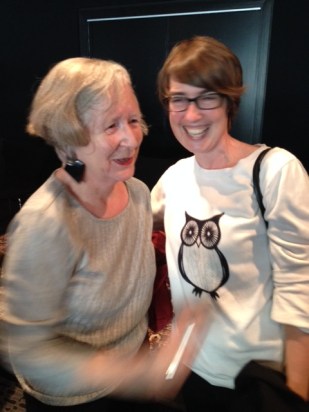
(Elizabeth with her AUP editor, Anna Hodge)

When Elizabeth was announced as winner she was a little shocked (I do think the finalists could be told back stage so they don’t have to sit on stage for an hour, with the the sizable store of nerves that build when you are about to read in public). She searched in her bag for a piece of paper while Paul supplied her with another poem to read.

I thought her thank-you speech was very moving. She said, ‘It feels like having your first poem accepted again. The chase is always on the for the next poem that might be better though it is always moving out of reach.’

Elizabeth was reminded of her short story where a young girl, notebook in arm, struggled to be a writer in Paris. Elizabeth had included this quote from Mavis Gallant in her story: ‘She was sustained by the French refusal to accept poverty as a sign of failure in an artist.’

Elizabeth said that poets would be familiar with this and ‘That is why the Sarah Broom Award is so marvelous. Sarah and Michael have exactly understood the position, the amount is perfect, the conditions are wonderful.’

Like Airini and Amanda, she paid moving tribute to Sarah’s poems: ‘I heard that a whole new cluster of planets has just been discovered. That’s how I think of Sarah’s poems: flying through space, serene and beautiful, wrought from tragedy and beauty.’

Elizabeth also thanked the audience! She made us feel that as readers we matter: ‘And I want to thank the audience for being present. Poetry could not survive without you. The girl in the French cafe was counting on that: if she could write something, someone would read it and she then would be a writer.’

Thanks to AWF for hosting this event.

Thanks for a terrific occasion Michael. Three very special writers. One very special award.
IMG_3458

cp-gleam.jpgcp-tigers-at-awhitu.jpg

Back home and I discover Bernadette Hall receives Prime Minister’s Award for Poetry – I am doing a little poetry jig of joy


img_1396

I have been a fan of Bernadette Hall’s poetry for a long time so was delighted to see she has received this honour. I missed the initial release when I was walking the beauty of Stewart Island. This is well deserved. A little dance of poetry joy ensues! Reading a book by Bernadette is poetry pleasure. Utterly satisfying for ear, eye, heart and mind.

You can see the full achievements of Bernadette as both poet and teacher here on the Creative NZ press release here.

My review of Bernadette’s most recent collection Life & Customs here.

Bernadette talks to Poetry Shelf here.


Victoria University Press page

New Zealand Book Council page

New Zealand Electronic Poetry Centre page

Canterbury University Press page

Best NZ Poems edited by Bernadette Hall here

My review of The Lustre Jug in The NZ Herald

Poetry Shelf congratulates our new Poet Laureate

k4a

Photo credit: Marti Friedlander

CK Stead is our new Poet Laureate.


I was in the thick of stand-still, rush-hour traffic on the way to a South Auckland School this morning when I heard the news and it gave me a much needed boost. Poetry has always been a primary love in the broad spectrum of Karl’s work. His poetry catches your attention on so many levels because his poems become a meeting ground for intellect, heart, experience, musicality, craft, acumen, a history of reading and thought, engagement with the world in all its physical, human and temporal manifestations.

I am delighted to celebrate this result.


Here is a snippet from an interview I did with Karl for Poetry Shelf last year:

Your poems are delightfully complex packages that offer countless rewards for the reader—musicality, wit, acute intelligence, lucidity, warmth, intimacy, playfulness, an enviable history of reading, irony, sensual detail, humour, lyricism. What are key things for you when you write a poem?

It has to be a meeting of words and feeling, in which the words are at the very least equal in importance, and the feeling can be of any kind, not just one kind. I like wit, think laughter can be tonic, but of course it doesn’t fit all occasions.

There were a number of significant poets in NZ from the 1940s onwards and you have interacted with many of them (Curnow, Mason, Glover, Baxter and so on). Were there any in particular whose poetry struck a profound chord with you?

Curnow was always the most important for me. But when I was young Fairburn’s lyricism seemed very attractive; Glover at his rare best (the Sing’s Harry poems); Mason likewise (‘Be Swift O sun’); Baxter – especially in his later poems: they have all been important to me.

Do you think your writing has changed over time? I see an increased tenderness, a contemplative backward gaze, moments where you poke fun at and/or revisit the younger ‘Karls,’ a moving and poetic engagement with age, writerly ghosts and death. Yet still there is that love and that keen intelligence that penetrates every line you write.

You are very kind! I certainly feel ‘older and wiser’ in the sense that things don’t matter so much, one accepts the fact of human folly and one’s own share in it. Indignation doesn’t stop, but there is a kind of weary acceptance, and laughter. I still feel embarrassment – especially when looking back – but I recognize that as not only a safeguard against social mistakes, but also as another manifestation of ego, as if one feels one should be exempt from folly.

There have been shifting attitudes to the ‘New Zealand’ label since Curnow started calling for a national identity (he was laying the foundation stones that we then had the privilege to use as we might). Does it make a difference that you are writing in New Zealand? Does a sense of home matter to you?

When I was young I was a literary nationalist. Now I regard nationalism as a form of tribalism and the result of genetic programming no longer suitable or safe in the modern world. So I have changed a lot. But I still recognize regional elements as important, even essential, in the poetic process. I think Curnow himself became more a regional poet and less a nationalist one; but the arguments that had swirled around all that had had the effect of committing him to positions which he didn’t want to resile from, so he remained the committed nationalist, perhaps after the need had passed.

What irks you in poetry? What delights you?

I suppose any kind of excess, of language or of feeling; and solemnity – especially the sense that poetry is taking itself too seriously and asking for special respect.

There are many kinds of delight in poetry, but almost all of them involve economy. If an idea or an experience or a scene or a personality or whatever can be conveyed as well in 10 words as in 20, those 10 words will be full of an energy which the more relaxed and expansive version lacks. They will be radio-active.

Name three NZ poetry books that you have loved.

Singling out living poets might be invidious, but here are three by poets now dead: You will know when you get there (Curnow); Jerusalem Sonnets (Baxter); Pipe Dreams in Ponsonby (David Mitchel).

The full interview here.


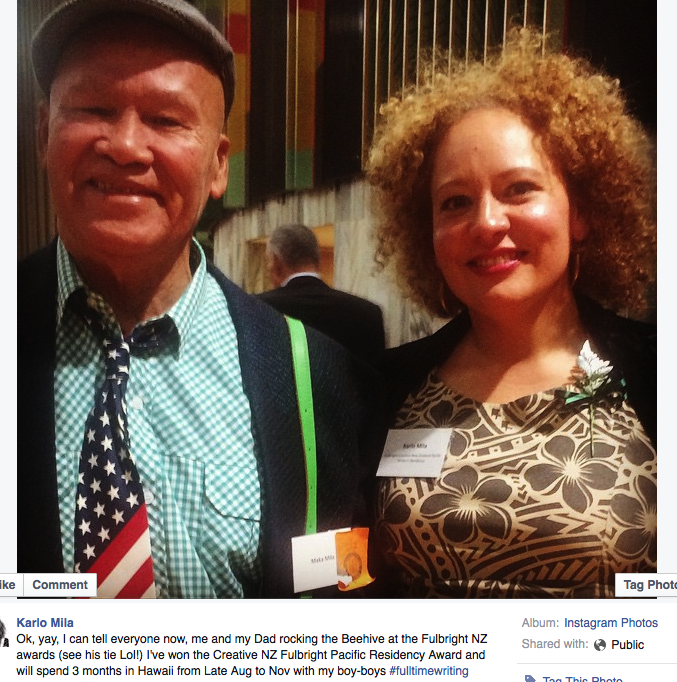
Congratulations! The CNZ Fulbright Pacific Residency Award goes to Karlo Mila

Screen shot 2015-06-23 at 10.45.39 AM

Great to see this award go to Karlo Mila. Congratulations.

Poem Friday: Ashleigh Young’s ‘Become road’ clung to me like a poetry limpet as I left the room

Become road

When the car stops we are beginning already to become road.
A little taken apart and buried, the way birds, leaves
become road. Become road beneath
the burying of cars. All become driven over,
all become under. Even weather is taken
a little apart and buried. That we have been hit tonight
is relief; we no longer need to wonder when. Pain becomes
a story we will tell you years from now.
Sound becomes the dream you’ll nurse us from.
For now we are a passenger belted in
to the happening, looking back
at our tame furred moon. On our way home
the night had been too pleasant: rows and rows
of blue glass jars like the BFG’s jars
of dreams: the night was too pleasant
for what we had done. As we cycled uphill
the person we once were was cycling downhill
and each exhalation pushed us further apart.
Before we got hit we saw the shadows of trees
become road. Then the trees. A woman walking
a dachshund through the trees become road.
We saw the dog’s eyes glinting in the road.
The shine of his leash, caught in the road.
We heard voices in the trees become road, and the sound
of someone’s phone ringing in the trees become road.
As traffic clears, the road softens and takes us
deep in its arms, which though hard, accommodate
everyone. Early morning, as the road begins
its upward surge we hear footsteps nearing
from somewhere inside the road, as if
we have been recognised.

© Ashleigh Young


Note from Paula: This was one of the poems that Ashleigh read out at the Auckland Writers Festival in the session for the Sarah Broom Poetry Award. Ashleigh was a finalist in the award along with  Alice Miller (I was her stand in)  and Diana Bridge (winner). This poem really struck a chord with me, clung to me like a poetry limpet as I left the room. Curiously, as I listened, it was a little hallucinogenic — time slowed down, the world stretched out to a state of dissolve and all that mattered was the elongated moment of the poem. Everything inside the poem seemed bright, shining, crystal clear yet simultaneously unreal, mysterious, out of reach. Disconcerting. Strange and estranging. The words so perfectly catching the momentum of anecdote yet lilting sideways, looping back like a Zen master as everything becomes road and time laps back upon itself (‘As we cycled uphill/ the person we once were were was cycling downhill’). Really, that state I had to snap out of as I sat on stage in front of the packed audience is the state embedded in the poem — when catastrophe strikes. The world stretches like chewing gum to become so real it is unreal. This is what poetry can do; it can take those unfathomable, unspeakable moments and cast them within a poetic frame that recasts you. You get to see and feel and shift a bit. Thank you Asheigh Young, thank you.


Sarah Broom Poetry Award judge’s comments (Vona Groarke) on Ashleigh here.

Katherine Mansfield Menton Fellowship: Applications now open

APPLICATIONS INVITED FOR 2015 KATHERINE MANSFIELD MENTON FELLOWSHIP Established and mid-career New Zealand writers are invited to apply for the Katherine Mansfield Menton Fellowship 2015. The Fellowship is one of New Zealand’s longest-standing and most prestigious literary opportunities. In 2015 it offers a residency of three months or more in Menton, France and an allowance of NZ$35,000 to cover return travel to France and living and accommodation expenses. The support of the city of Menton enables a New Zealand author to work at the Villa Isola Bella, where Katherine Mansfield lived and wrote during the latter part of her life. Applications are sought from established writers across all genres of creative writing: fiction, poetry, literary non-fiction, children’s fiction and playwriting. Since it was established in 1970, there have been 45 recipients of this fellowship including Janet Frame, Michael King, Lloyd Jones, Witi Ihimaera, Vincent O’Sullivan, Bill Manhire, Ian Wedde, Elizabeth Knox, Dame Fiona Kidman, Jenny Pattrick, Ken Duncum and the 2014 recipient, Mandy Hager. The Fellowship is an initiative of the Winn-Manson Menton Trust and is administered by Creative New Zealand. Applications close at 5pm on Friday 26 June, 2015 For application information on The Katherine Mansfield Menton Fellowship To find out more about the Fellowship go here.

Winner announced at AWF- Sarah Broom Poetry Prize 2015


 Diana Bridge

Wellington poet Diana Bridge was announced as the winner of the Sarah Broom Poetry Prize at the Auckland Writers Festival on Sunday 17 May.

Bridge has published five collections of poems, the latest of which, Aloe & other poems, came out in 2009. She was awarded the Lauris Edmond Memorial Award in 2010, for her distinguished contribution to New Zealand poetry, and her essay, “An attachment to China” won the 2014 Landfall essay competition.


The award-winning Irish poet Vona Groarke was guest judge for the prize in 2015. She describes Bridge’s poems as “colourful and playful, but also careful, thoughtful and wise.”  “There is a kind of fierce beauty to this work, alongside its rigorous intellect and formal grace.” Bridge accepted the $12,000 award at the Sarah Broom Poetry Prize event.


“I am overwhelmed and proud to be the recipient of an award set up to honour the work of Sarah Broom”, she says.

“I like to think that a tiny particle of her courage served to stiffen my spine the day I chose the poems I sent off. For I picked poems not in the hope that they might just work in a New Zealand context, or in what I imagined might be the context of the competition. I chose the poems that mattered most to me.”

“So – in went the story of Arjuna, from the Hindu text, the Baghavad Gita; in went a poem that was a response to the whole – prolific – output of the formidable professor of poetry at Oxford, Geoffrey Hill; in went a poem called ‘The Henrys’ that tackles all those terrible medieval and Tudor executions we have been subjected to in print and on the screen in recent years.”

“I am excited that we are ready for poems that spring from anywhere on the globe.”

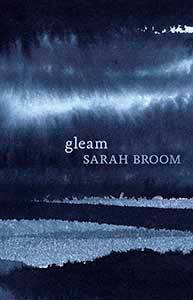
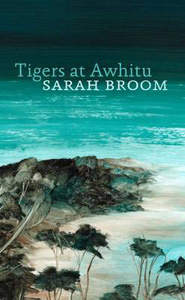
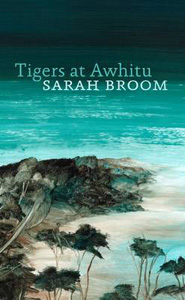
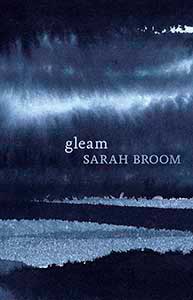
The prize, now in its second year, was established to celebrate the life and work of Sarah Broom (1972-2013), author of Tigers at Awhitu and Gleam.


Vienna-based Alice Miller and Wellington’s Ashleigh Young were also shortlisted.


Diana Bridge
Bridge, who has a Ph.D. in Chinese poetry, has worked on the China-based poems of Robin Hyde and published an essay, “O to be a dragon”, and a Translation Paper, “An Unexpected Legacy: Xie Tiao’s poems on things”.  She is at present working on the translation of a selection of classical Chinese poems.

Vona Groarke writes: “Whether it is the violence of medieval history, the engagement with nature, or a re-imagining of Ovid that is the subject, Diana Bridge’s poetry has authority and elegance. Technically sophisticated, this work is complex but never obscure; lyrically charged but never sentimental. It is unflinching in its observational commitment, but also enjoys its ability to fashion unusual and arresting imagery. There is a kind of fierce beauty to this work, alongside its rigorous intellect and formal grace. In a description that rings true of much of her work, her poem ‘Prospero’s Stones’ notes, ‘driven phrases that lap /around each other’: this is a poetry that is linguistically alert, but that also remembers to ply sound and meaning into the kind of poetic weave that is colourful and playful, but also careful, thoughtful and wise.”


Finalists for The Sarah Broom Poetry Prize 2015


    cp-tigers-at-awhitu cp-gleam

The judges are delighted to announce the three finalists for the Sarah Broom Poetry Prize 2015.


The prize attracted almost 200 entries from across the spectrum of New Zealand poets, from the new and emerging to the established and the iconic. The shortlist was chosen by the 2015 guest judge, Irish poet Vona Groarke.


The finalists are:

Diana Bridge: a Wellington-based poet, the author of five collections, including aloe & other poems (2009).

Alice Miller: a New Zealand poet based in Vienna, whose first book The Limits was published in 2012.

Ashleigh Young: a Wellington-based editor, essayist, and poet, whose first collection of poetry, Magnificent Moon, was published in 2012.


“The Sarah Broom Poetry Prize is about celebrating poetry,” says judging panel member Sarah Ross. “The diversity of the entries received, and the tonal and formal complexity of the best work, its deftness, its moments of insight, poignancy, and humour – all of this has made the judging process enormously rewarding. So too has working with the generous and perceptive Vona Groarke.”


The Sarah Broom Poetry Prize aims to make a substantial ongoing contribution to supporting poetry in New Zealand. The value of the prize is $12,000 in 2015.


The three finalists will read in a free session at the Auckland Writers Festival on Sunday 17 May from 1.30-2.30pm in the Upper NZI Room, Aotea Centre, Auckland. Vona Groarke will announce the winner at this event

Queries should be emailed to: enquiries@sarahbroom.co.nz

For photos or other details of finalists please email sarahceross@gmail.com

For more information about Sarah Broom or the Poetry Prize visit www.sarahbroom.co.nz


FINALIST DETAILS:

Diana Bridge

Photo credit: Simon Woolf

Diana Bridge has published five collections of poems, the latest of which, aloe & other poems, came out in 2009. She was awarded the Lauris Edmond Memorial Award in 2010, for her distinguished contribution to New Zealand poetry, and her essay, ‘An attachment to China’ won the 2014 Landfall essay competition. Diana is based in Wellington.

Vona Groarke writes: “Whether it is the violence of medieval history, the engagement with nature, or a re-imagining of Ovid that is the subject, Diana Bridge’s poetry has authority and elegance. Technically sophisticated, this work is complex but never obscure; lyrically charged but never sentimental. It is unflinching in its observational commitment, but also enjoys its ability to fashion unusual and arresting imagery. There is a kind of fierce beauty to this work, alongside its rigorous intellect and formal grace. In a description that rings true of much of her work, her poem ‘Prospero’s Stones’ notes, ‘driven phrases that lap /around each other’: this is a poetry that is linguistically alert, but that also remembers to ply sound and meaning into the kind of poetic weave that is colourful and playful, but also careful, thoughtful and wise.”


Alice Miller

Photo Credit: Dylan Whiting

Alice Miller’s first book The Limits was published by Auckland University Press and Shearsman in 2014. She is a graduate of the International Institute of Modern Letters and the Iowa Writers’ Workshop. Last year she was a Grimshaw Sargeson Fellow, a Visiting Writer at Massey University, and a resident at the Michael King Centre. She is based in Vienna.

Vona Groarke writes: “The ‘I’ and ‘We’ of Alice Miller’s poetry are rarely familiar and never predictable. The same is true of her poems, which are fully-charged and teem with surprises of imagery, narrative and language. Nothing moves in a straight line in this work: instead, the poems tend to turn on small pockets of beguiling mystery. Characters emerge out of an apparent nowhere and do the darndest things before they slip off again, as if in secret, out of the sightline of the poem. It all makes for an intense and intensely involving experience: the lines are so well managed and the narrative so deftly and subtly manoeuvred as to leave one ruffled, but pleasantly so. What might seem like aphorism turns out to be a strange and complicated proposition, as in ‘Saving’ where, ‘some of the moments we cling to most / are the futures we never let happen’. This is work that turns on a sixpence, and that manages each of its fascinating turns with assurance and aplomb.”


Ashleigh Young

Ashleigh Young is an editor, essayist, and poet. Her first collection of poetry, Magnificent Moon, was published by Victoria University Press in 2012, and recent work appears in Sport, The Griffith Review, Five Dials, and Tell You What. She co-teaches a workshop in science writing at Victoria University with science writer Rebecca Priestley, and she blogs, mostly about cycling, at eyelashroaming.com. Ashleigh is based in Wellington.


Vona Groarke writes: “Ashleigh Young’s poems defy their tight spaces to offer expansive and resonant narratives. Hers is a poetic world that derives great charge and vigour from proper nouns – named people and places -and specific, beautifully delineated detail that, as in flash fiction, sparks an entire world to life. People talk to each other in these poems, and whole lives get encapsulated in the kind of language that is as exact as it is vivid, as careful as it concise. Take for instance, ‘Electrolarynx’ with its arresting line: ‘Then our silence made a condemned building of us all’, or the opening of ‘Become road’: ‘When the car stops we are beginning already to become road’. These are poems that begin with the familiar, and then carefully walk it to the edges of perception, where it catches the light in arresting, singular and finely memorable ways.”