Category Archives: NZ Poets

Poetry Shelf Review: Kerrin P Sharpe’s Rabbit Rabbit – There is a honeyed fluency that is downright enviable

Rabbit_Rabbit_cover_final__90799.1461637251.220.220.jpg   Rabbit_Rabbit_cover_final__90799.1461637251.220.220.jpg   Rabbit_Rabbit_cover_final__90799.1461637251.220.220.jpg


I fall with the rhythm of rowing

into long narrow light

bridges sigh like single oars


from ‘last supper in Venice’


Rabbit Rabbit Kerrin P Sharpe , Victoria University Press, 2016


Victoria University Press is publishing a heavenly suite of poetry books this year (actually all the presses are!). So many good poetry books I think I need a poetry book club where we can talk about poetry to our heart’s content with coffee and sweet little cakes. A once a month indulgence!

Kerrin P Sharpe is a very fine poet whose previous books hooked me with their agility, their lightness of touch, their grounding. She is currently the Writer-in-Residence at St Andrews College in Christchurch. In 2008, she was awarded the NZ Post Creative Writing Teacher’s Award by the International Institute of Modern Letters. She is a terrific mentor for young writers.

Kerrin’s latest book is an utter treat in the way things condense to the near point of evaporation and then unfold with such grace you get goosebumps. Bare threads shiver and shimmer as speech-bubble anecdotes hover above and below. There is necessary tenderness. Sometimes it is like looking into the mysterious dark of family archives where things or photographs or memories twitch in the patchy shadows. You move from smoky dream to real life to near fable.

If you think of poem writing as hitting the whirr and pace on a bike so the whole world feels perfect, then Kerrin is hitting that perfect whirr and pace as she writes. There is a honeyed fluency that is downright enviable (enhanced by the lack of capitals and full stops).

So many poems stand out, but I keep returning to the mother poems: the pitch of the line, the tilted head of the daughter looking, the inventive tropes, the extraordinary stories that resist mother frames. These poems belong in an anthology of mother poems because they are surprising in where they take you, the way they move you and the presence of things that do little cartwheels on the page.

I loved the way the mother’s Astrakhan coat prompts mystery that meets strange fable that meets down-to-earth pathos in ‘when a crayfish could feed 6 men‘:


yet though the coat

cracked the small change

it was when my mother’s money

stretched beyond the frontier towns


that she no longer wore

what after her funeral  seemed

little more than a fleece


There is a glorious and daring alignment of the mother’s belly and the ship she builds in ‘The mary blanche in situ.’ All poem borders slip and slide. Where does mother begin and ship end? Where does trope set sail and real life intrude?  Entering the poem is like entering a show, both magical and wondrous, and you just want to get another ticket and go through again.


my mother built her own ship

because she hated

the idea of drowning


In ‘the morning of my mother’s funeral her cup is sober minded,’ a single tea pot pours, in a little stream, like stream-of-conscious English Breakfast,the grief and thoughts of a key life moment. The poem catches the unrealness of losing a loved one; of life not stopping its circular routines and paying attention with you.


two plumbers install a shower

my mother will never use


they eat her peanut rockies

in the coronation tin


A delicious inventiveness drives the collection as a whole, as though reality is strained through kaleidoscopic filters to refurbish ordinary things with off kilter tints. There is the train that keeps a son breathing, there is the mouth of the sky that opens and drops bodies, the daughter that decides the bee sting is a butterfly kiss. In ‘a language goes silent,’ a Chinese fruit shop uses the bare threads, the strange tilts to move you:


Amy and Harry

lived in the fruit

of their shop

like mango stones


I adore this book. It shows just what things can do when you let them loose in a poem. Wonderful!

Poetry Shelf Poem – Heidi North-Bailey’s ‘The Women’ is like a delicious sweet almond with a bitter sweet kernel

Mary McCallum from Mākaro Press and Heidi North-Bailey have given me permission to post this marvelous mother poem from Heidi’s debut poetry collection.  The poem is so beautifully lyrical, exquisitely layered, the gaps large and resonant, the line of women vital; the hidden stories pull you back for another look, and then another. This is one of my favourite poems of the year to date.

The Women - North Bailey.jpg

The Women - North Bailey2.jpg


©Heidi North-Bailey 2015


Possibility of Flight cover WEB


Poetry Shelf Postcard: Anahera Gildea’s Poroporoaki

6688514.jpg

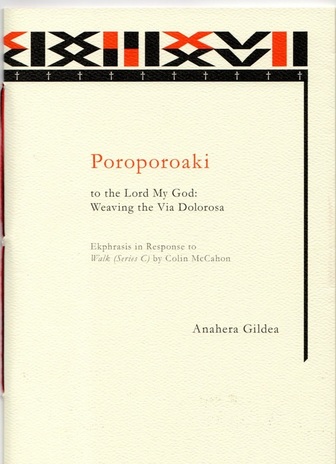
Poroporoaki to the Lord My God: Weaving the Via Dolorosa: Ekphrasis in Response to Walk (Series C) by Colin McCahon 

Anahera Gildea, Seraph Press, 2016

Designed and produced by Helen Rickerby of Seraph Press, this is the most exquisite chapbook imaginable. Add the gorgeous paper stock to the extra heavenly endpapers, the hand stitching and an internal design that is elegant and minimalist and you have a rare poetry treat. It is a work of beauty and all poets will be dreaming of their very own chap book. I for one!


XIV

Sometimes it is enough

to sit and look out.

Other times you have to walk

across bone, stone and shell.


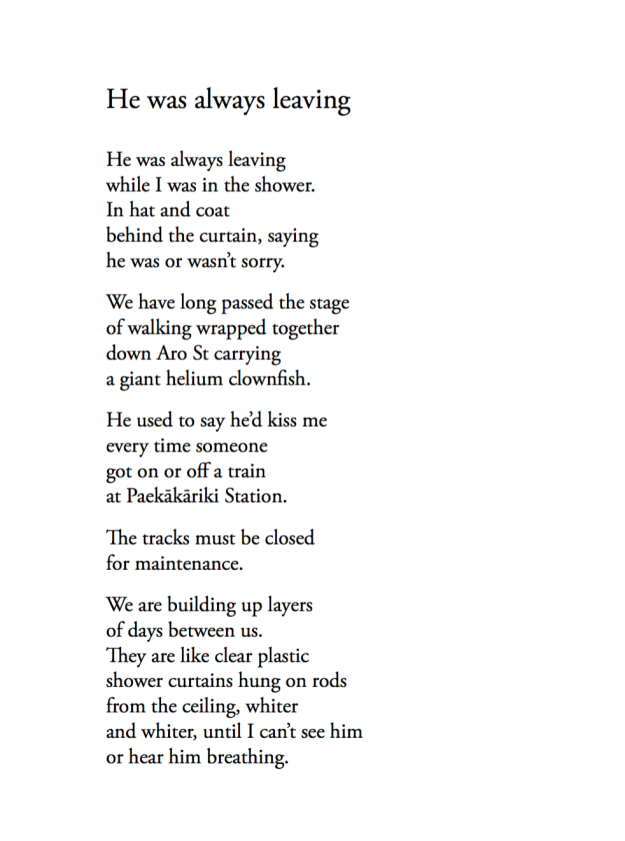
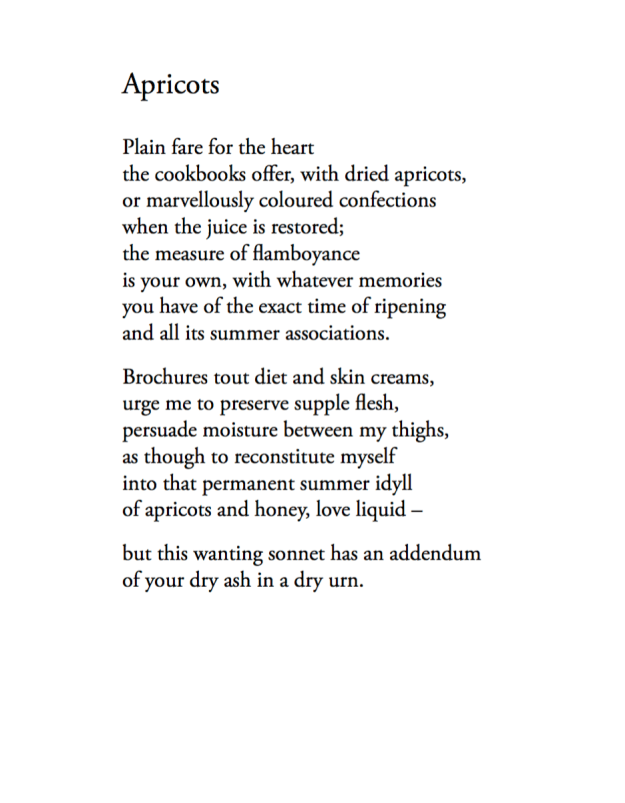
Anahera Gildea’s poem is written in response to ‘Walk (Series C)‘ by Colin McCahon and is as much for James K Baxter as it is a response to the painting. It is an example of poetry as gift/taonga. Each line carefully stitched like the stitching in the kahu-kuri she makes for Baxter. This poet knows you don’t need many lines on the page to entice a reader to linger. You are walking alongside McCahon’s painting, you are walking along the wild and dark threat and wonder at Muriwai Beach, you are walking the Stations of the Cross and you are walking the poem. It is, for me, a very moving sequence.


Anahera (Ngāti Raukawa-ki-Te-Tonga, Kāi Tahu, Te Āti Awa, Ngāti Toa, Ngāi Te Rangi) is a Wellington-based writer who has had her poems and short stories published in a variety of journals. She recently completed the Masters of Creative Writing at Victoria University of Wellington and is currently finishing her first novel.
Seraph Press page

Three poems from Hoopla 16: Helen Jacobs, Harvey Molloy, Ish Doney


Mākaro Press recently released its third series of Hoopla poetry collections. Under the guiding eye of series editor, Mary McCallum, each year includes a debut, a mid-career and a late-career New Zealand poet. The design is uniform and eye-catching with simple but striking covers and fold-in jackets.

To celebrate this series, Mākaro Press has given Poetry Shelf permission to post a  poem from each collection (tough picking!)


This year sees a collection by young poet Ish Doney. Ish completed a design degree in Wellington, and currently lives in Scotland with an aim to move elsewhere soon. The poems generate a youthful zest, as they navigate love, loss, home, family, departure, distance. Feeling is paramount but, rather than smothering the poems, sets up shop in the pace of a line, sharp and surprising detail, images that prick your skin.


Screen Shot 2016-04-22 at 2.45.18 PM

Mid-career poet, Harvey Molloy has published widely both here and abroad. He was born in Lancashire but moved to New Zealand as a teenager and now lives in Wellington. As the key word on the cover indicates, these poems move through kaleidoscopic worlds.  This is a poet unafraid of directions a poem might take, of stories being told, of shifting forms, of a mind reflecting, contemplating, observing.Screen Shot 2016-04-22 at 2.47.20 PM.png

Helen Jacobs (Elaine Jakobsson) was once the Mayor of Eastbourne, but moved to Christchurch in 1995. She has been publishing poems for 35 years both in New Zealand and abroad. Since her arrival in Christchurch in 1995, Helen has belonged to the Canterbury Poets Collective. At the age of 85, she has now relinquished some of her lifelong passions such as gardening and bush walks but not writing. Her new poems come out of old age with delicious vitality — her ear and eye are active participants in the world. The collection renews your relationships with the things that surround you.


Screen Shot 2016-04-22 at 2.47.33 PM.png


Poetry Shelf Review: Gregory Kan’s This Paper Boat floats on an ethereal current so that poetry finds its way back to us all


1455844200262     1455844200262

Gregory Kan This Paper Boat Auckland University Press 2016


Gregory Kan’s debut poetry collection, This Paper Boat, is a joy to read on so many levels.

Kan’s poetry has featured in a number of literary journals and an early version of the book was shortlisted for the Kathleen Grattan Poetry Prize in 2013. He lives in Auckland.

Paper Boat traces ghosts. We hold onto Kan’s coat tails as he tracks family and the spirit of poet, Robin Hyde (Iris Wilkinson). The gateway to family becomes the gateway to Iris and the gateway to Iris becomes the gateway to family. There is overlap between family and missing poet but there is also a deep channel. The channel of difficulty, hard knocks, the tough to decipher. There is the creek of foreignness. The abrasiveness of the world when the world is not singular.

Kan enters the thicket of memory as he sets out to recover the family stories. He shows the father as son fishing in the drains, the mother as daughter obedient at school. Yet while he fills his pockets with parental anecdotes, there is too, the poignant way his parents remain other, mysterious, a gap that can never be completely filled:


In the past when I thought about people my parents

were somehow

not among them. But some wound stayed


wide in all of us, and now I see in their faces

strange rivers and waterfalls, tilted over with broom.


The familial stands are immensely moving, but so too is the search for Iris. Kan untangles Iris in the traces she has left – in her poems, her writings, her letters. He stands outside the gate to Wellington house, listening hard, or beside the rock pool. There is something that sets hairs on end when you stand in the footsteps of ghosts, the exact stone, the exact spot, and at times it is though they become both audible and visible. Hyde’s poems in Houses by the Sea, are sumptuous in detail. I think of this as Kan muses on the rock-pool bounty. When he stands at her gate:


I have to hear you to keep you

here, and I have to keep you

here to keep coming back.


I think too of Michele Leggott’s plea at the back of DIA to listen hard to the lost matrix of women poets, the early poets. To find ways to bring them close.

Kan brings Iris (Robin) close. His traces. Iris becomes woman as much as she does poet and the channel of difficulty fills with her darknesses as much as it does Kan’s. There is an aching core of confinement: her pregnancy, her loss of the baby, her second pregnancy, her placement of the baby elsewhere, her mental illness. His confinement in a jungle. His great-aunt’s abandonment as a baby.


The strands of love, foreignness and of difficulty are amplified by the look of the book. The way you aren’t reading a singular river of text that conforms to some kind of pattern. A singular narrative. It is like static, like hiccups, like stutters across the width of reading. I love this. Forms change. Forms make much of the white space. A page looks beautiful, but the white space becomes a transmission point for the voices barely heard.

At one point the blocks of text resemble the silhouettes of photographs in a family album. At another point, poems masquerade as censored Facebook entries.Later still, a fable-like poem tumbles across pages in italics.

The writing is understated, graceful, fluent, visually alive.

I want to pick up Hyde again. I want to stand by that Wellington rock pool and see what I can hear. I have read this book three times and it won’t be the last.


In the final pages, as part a ritual for The Hungry Ghost Festival, Kan sends a paper boat down the river ‘to ensure// that the ghosts find their way/ back.’

The book with its heartfelt offerings is like a paper boat, floating on an ethereal current so that poetry finds its way back to us all (or Hyde, or family).


Auckland University Press page

A terrific interview with Sarah Jane Barnett

Sequence in Sport


Poetry Highlights at Wellington’s Writer’s Week in March

For the full programme see here but this is the poetry on offer.


I would love to go to the Laureate Circle but can’t make it at this stage (might just fly down on a whim!). I would really like to post pieces on any of the poetry events at the festival. Any takers?


Friday March 11th 7pm  A Circle of Laureates

Screen shot 2016-01-30 at 9.48.49 AM


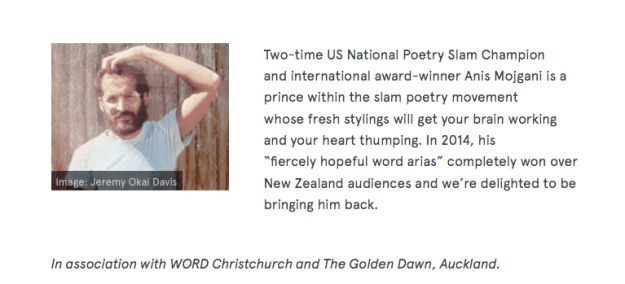
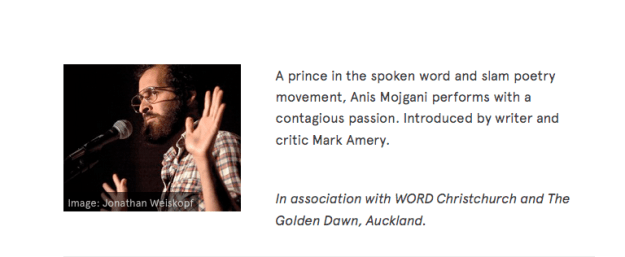
Friday March 11th 5pm   Anis Mojgani and Marty Smith

Screen shot 2016-01-30 at 9.55.17 AM


Thursday March 10th 1.45pm Anis Mojgani

Screen shot 2016-01-30 at 9.57.28 AM


Sunday 13th March 2.30 pm  Anis Mojgani with Mark Amery

Screen shot 2016-01-30 at 9.59.20 AM


Saturday 12th March 3.30 pm Five Poets and a Prize


Screen shot 2016-01-30 at 10.00.52 AM

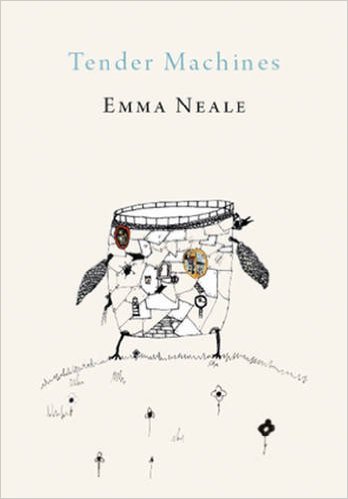
Poetry Shelf review — Emma Neale’s Tender Machines takes you into a deep private space in her writing; in ways that sing and challenge, that move and muster every poetic muscle and tendon as you read

418MHC3lAEL._SX346_BO1,204,203,200_    418MHC3lAEL._SX346_BO1,204,203,200_


Emma Neale Tender Machines Otago University Press 2015

Emma Neale’s new poetry collection features a striking drawing by her son, Abe. Surprising, inventive, poetic even. The poetry is Emma’s best yet, dare I say it. To step off from the title, tenderness meets sharp edges meets exquisite moving parts, small yet perfectly formed. The collection holds you in the intimate embrace of home, yet takes you out into the wider allure of the wider world. Issues, ideas, preoccupations.

The first section, ‘Bad Housekeeping,’ is where poet tends hearth. Mostly, and movingly, Emma navigates her relations with her young son.  She is up against the elbows of insistence, demands, resistance. The mind of the mother is anchoring, roving, admitting. She is in the heart of a toddler tantrum and in the palm of world issues. These poems affect you. You can savour the poetic craft that is honey for the ear. Such musical harmonies and schisms. That is one joy of reading. You can enter the toughness and rewards of motherhood. It is as though maternal experience is the stock pot that is simmered and concentrated to a syrup that is both sweet and tart on the tongue.  The poems become the kind of poems you can hang stories upon; of this child and that child, of this moment of mothering and that. Poetry has the ability to bear story, experience, imaginings, ideas, music — all in its one tender machine (oxymoron and all). These remarkable poems do this. ‘Hard Task, Master’ is a miniature snapshot of the child — its ending breathtaking:


as he tries

to build and build

the deck of himself

against the hard, tall wall

of the world.


At times it is the concatenation of verb or noun on the line that catches you in a knot of maternal thought — son glued to mother, mother glued to son. As in ‘Towards a Theory of Aggression in Early Childhood Development’:


Hit, push, lash, scratch,

these cheeks, this jaw, this shoulder,

are these in truth our edges, outlines, will we cry

as he does, daily, nightly, sky-wrenching as sunrise

yet still hold him in our arms


There is poetic braveness here that doesn’t loiter in conventional maternal paradigms. This is a poet opening layers of skin to get to where it hurts, confuses, demands, yet never loses sight of the enduring bond. The love. This is from ‘Domestic’:


you’re our darling our treasure.


You fling a tea cup at the cat,

plump up her spine like a goose-down pillow,


jab your thumbs at your father’s face

as if to pull out its two blue plums


but ah, little fisty-kins, honeyghoul, thorny-pie,

grapple hook of your daddy’s flooded eye,


stitch by stitch hope’s small black sutures

sew love’s shadow behind you.


The rest of the collection represents a mind engaged with the world at large. There is a strong political vein that never relinquishes the notion that the personal is political and that, importantly, the political is personal. Big issues such as consumerism, the compromised state of the planet, greed, waste are there potency ingredient in the ink of the pen, yet Emma’s ideas find poetic life in a variety of ways. Always there is an attentiveness to sound, to the way the poems hit the ear before the eye/mind drifts elsewhere. Assonance is plentiful. Delicious. The musicality is a first port of admiration that sends you back to reread with ears on alert. One poem, overtly and self-reflexively, plays with musical effects, yet delivers a subterranean plea for the earth (‘”Properly Protecting the Most Pure Marine Ecosystem Left on Earth Was Not Consistent with the Government’s Economic Growth Objective”‘. Here is a sample:


The spring tries to write

its long lyric poem again:

grass blade rhymes wing tip;

leaf rim, gull keen;

salt foam, thought arc;

surf break, line break;

historical break, heart break;

riven river, toxic stream;

smoked ozone, glacial melt.


So many standout poems. I especially loved the way ‘Suburban Story’ moves. It begins with a ‘shopkeeper at my old corner store’ and then travels through a poignant catalogue of losses, minor and major. Again the exquisite ear at work, again the pulsating detail.

This is a collection of reflection, revelation, absorption. Emma wrote many of these poems during her tenure as The NZSA/Beaton Fellow, The Otago Robert Burns Fellow and The University of Otago/ Sir James Wallace Pah Homestead Writer in Residence. Such awards benefit the poet immeasurably with the gift of writing space and time. You can see it in the gold nuggets of this book. In another favourite poem, ‘Sleep-talking,’ the clogged channels of thought become poetry. Emma takes you into a deep private space in her writing; in ways that sing and challenge, that move and muster every poetic muscle and tendon as you read — in this poem and in the book as a whole.


Perhaps for the self to hold its own air

it must be played in the key of sleep:

the body an instrument that over time

we must keep pitched, soaked in night like a reed softened in water,

while dreams tune the mind’s strings with a touch that seems

as precise as if the musician’s ear cranes deep


Otago University Press page

RNZ review

Emma Neale on her title

From the book: ‘Origins‘ posted on Poetry Shelf

Poem Friday: Anna Jackson’s ‘Scenes from the photographer’s childhood: wardrobe’ — Within that silent beat, poetry blooms


Scenes from the photographer’s childhood: wardrobe


She kneels in the red light of her wardrobe, leaning

over one tub of chemicals to pull out the dripping

sheet from the one in the far corner, the space so

small, the smell so sharp, the image not that

of her mother, poking her amused face

around the bathroom door as she heaved

it open, pushing across the floor the barricade

set up to keep her out, nor of her own fury, still

sharp days later, but the shot she had taken

seconds earlier of her body, her legs

half shaven, still half dressed in foam.

Every night, without fail, whatever

time she takes her bath, within minutes

her mother suddenly just has to wash

her hands. It is this, even more than the

ruined image, that makes her scream

when her mother opens the wardrobe now,

an extended scream that the exhausted

mother next door, in her faded blue thrift

shop dress, covered in spilt milk, thinks will

never end, and so joins in, even though

it will wake the baby, which it does: and now

they are all screaming, the girl in B, the neighbour

in G, and the baby in F, a long, tense chord

of such helpless rage, almost a panic, it seems

it must rise up, it will ruin them all, there

can never be any release, their throats, all three,

scraped raw, the scream continuing, the

exhausted mother holding, perfectly, her note

of G, as the baby drops to E, the photographer

rising to C, holding for four beats and then

stopping, just as the baby stops, and so

the mother stops too and for the long moment

before the baby starts again, stands rapt

in the most perfect silence

she has ever known and will ever know

again, milk all through her dress, blue

jug in pieces on the floor,

exactly at the midpoint of her life.

© Anna Jackson 2015


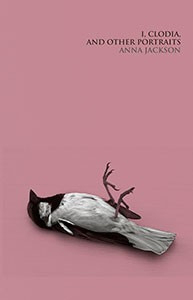
Author bio: Anna is the Programme Director in the English Department at Victoria University. She has published five poetry collections, including Thicket, which was shortlisted for the New Zealand Post Book Awards in 2011. Her latest collection  I, Clodia, and Other Portraits was published by Auckland University Press in  2014 (my review here). Anna is currently organising a Ruapehu Writer’s Festival with Helen Rickerby to be held in Ohakune, March 2016 (Facebook page here).

Paula’s note: This surprising poem, holds narrative in its palm, a sharp moment that reverberates  with implication. I get to the end and I am pulled back to the beginning, again and again. The musical chord that holds the moment together (and thus the poem)  jars, unsettles — until that moment of silence and it feels like time has iced over. Within that silent beat, poetry blooms. Ha! I need to get to work but this poem keeps distracting me. I adore the power of poetry to do just that.


1415925155755    1415925155755


Auckland University page

New Zealand Book Council page

Anna Jackson’s poem, ‘Afraid of falls?’ on Poetry Shelf.

Anna Jackson’s interview on Poetry Shelf


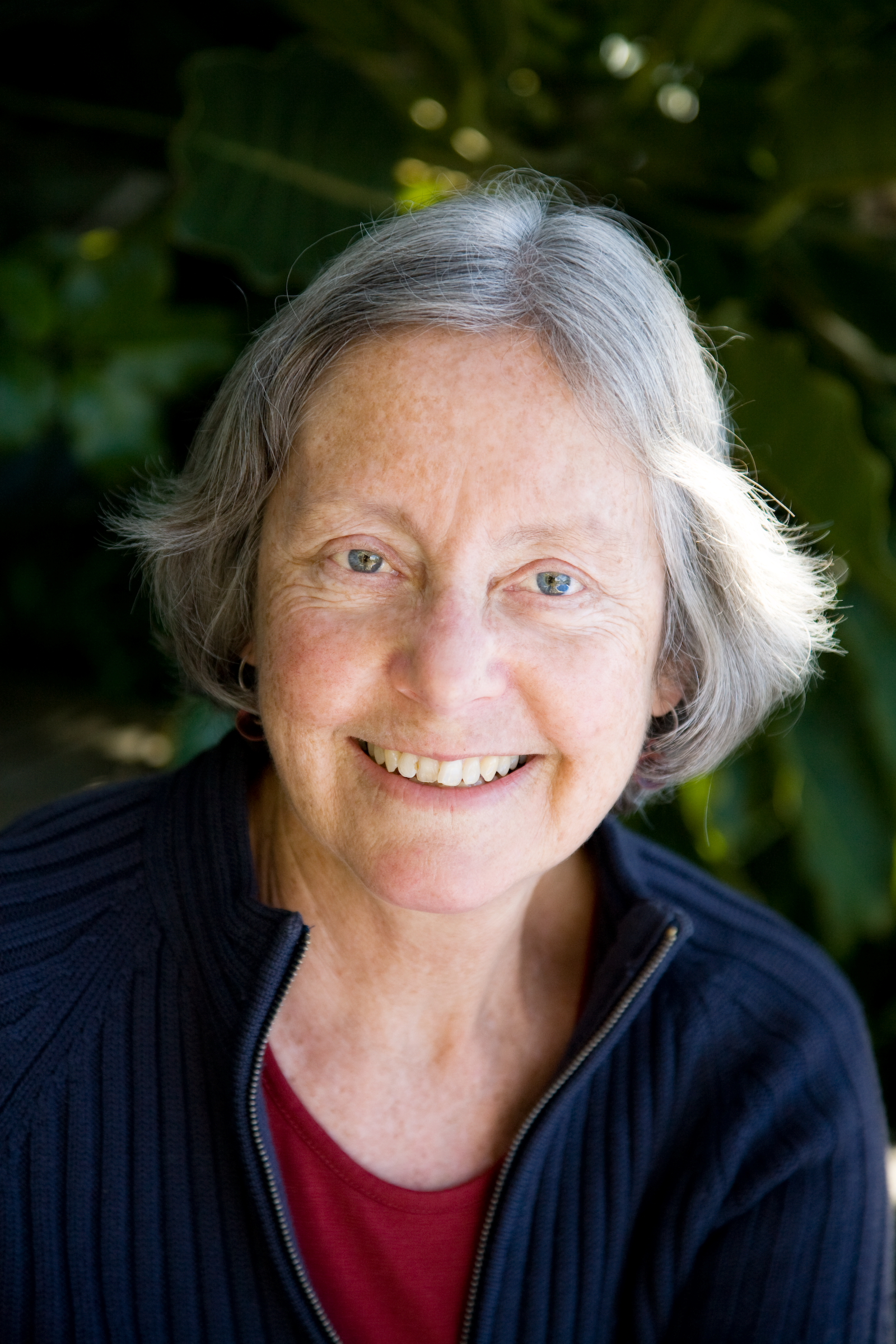
Poetry Shelf interviews Dinah Hawken — ‘any attempt to mirror the natural world is about relationship’

_MG_3288c52510c0-ccf5-4568-88dc-14eed8f6eafe


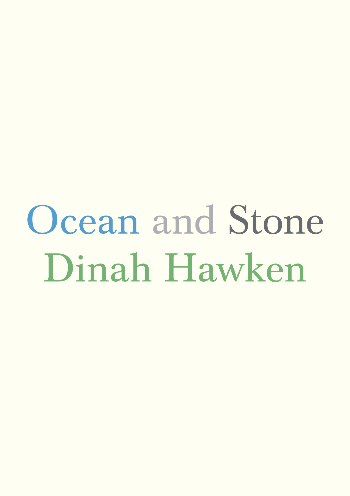
Dinah Hawken is one of New Zealand’s most critically acclaimed poets. Born in Hawera in 1943, she trained as a physiotherapist, psychotherapist and social worker in New Zealand and the United States. Most of the poems in her award-winning first collection It Has No Sound and Is Blue (1987) were written in New York in the mid-1980s while she was studying at Brooklyn College and working with the homeless and mentally ill. Her two most recent books, One Shapely Thing: Poems and Journals (2006) and The Leaf-Ride (2011), were both shortlisted for the New Zealand Book Awards. Dinah was named the 2007 winner of the biennial Lauris Edmond Award for Distinguished Contribution to Poetry in New Zealand. She lives in Paekakariki. Victoria University Press has just released a new collection of poems, Ocean and Stone.


Did your childhood shape you as a poet?

Yes I’m sure it did. One of my favourite memories as a child is my father reading A.A.Milne – the poems – to me when he came home from the farm. We didn’t have a lot of children’s books in those days (40’s and 50’s) and so he read them over and over again and we knew them by heart. Sometimes my younger brother and I would act a poem out: ‘Sir Hugh was singing hand on hip/when something sudden came along …’. What I loved, looking back, was the way my father and his voice changed when he read these poems. Suddenly he was a changed man, a more mysterious and musical man, and the poems had somehow changed him.

There was one poem that had a profound, perhaps lasting, effect on me psychologically. ‘The Dormouse and the Doctor’ – do you remember it? The dormouse was living happily ‘in a bed of dephiniums (blue) and geraniums (red)’ when the Dr came hurrying around and prescribed instead a bed of chrysanthemums (yellow and white). When ‘they took out their spades and dug up the bed/of delphiniums (blue) and geraniums (red),’ I was devastated at the injustice and imposition of it. They didn’t understand that ‘much the most answering things that he knew/were geraniums (red) and delphiniums (blue)’. I was worried by this story – the powerlessness of the small, the arrogance of grown ups – but at the same time I was impressed with the dormouse’s solution of imagination: ‘I’ll pretend the chrysanthemums turn to a bed/of delphiniums (blue) and geraniums(red).’ It made me determined to fight to remain myself, to hold onto my ideas and attractions even if I was misunderstood. Like the dormouse I was a dreamy child, but also an active one – a tomboy, keen on sports and outside a lot with bare feet. I thought of myself as a reader not a writer.


As a young adult, were there any poets in particular to which you were drawn?

When I went to Dunedin as a school leaver, to study Physiotherapy, James K. Baxter was living there and I went to some of his poetry readings and lectures. He was the first NZ poet I had ever heard or read and The Rock Woman (selected poems) was the first book of poetry (besides A Pageant of English Verse) that I had ever owned. I’ve just taken it off the shelf and it is one of the most worn books in my poetry collection. I felt the emotion and music in those poems, the power of ‘the best words in the best order’, and the sense of being understood as a human being who lives in this place, this landscape. Existential questions were in the air for me at 18 or 19 and one poem, ‘The Cold Hub’ gave me a strong sense of fellow-feeling and therefore consolation. Poetry as consolation became important for me.

The next year in Palmerston North was significant for me in terms of poetry too. I had a boyfriend who not only liked poetry (a rare find) but who really loved Baxter and who introduced me to e.e. cummings and Yevtushenko. Both mind-opening in their own ways. What’s more, in Palmerston North, I also made a close friend, Phillappa, a nurse, who read poetry and wrote it. She showed me it was possible even though I didn’t start writing seriously – though secretly – till I was in my late 30’s. She was the first person I showed my poems to at that time. And a couple of years later I applied for Bill Manhire’s undergraduate creative writing course.


Your new collection, Ocean and Stone, is one of your best yet. At times, the poems lead me to a place and point of contemplation (outside urban bedlam). The poems remind me of the way I go down to the beach in the morning and all is the same (sand sea sky), yet there is always a pull of shifting nuances. Do you ever see your poems as a way of translating relations with the natural world, both private and nourishing?

Yes I do. Moments and experiences in the natural world give me such pleasure and uplift that I do have an urge to record and share them even though words so often fail the actual experience. But the attempt feels important. And I’m glad you used the word ‘relations’ because any attempt to mirror the natural world is about relationship. I’m a person who wonders a lot and the world around me is one of the most ‘answering things’ that I know.


And wanders in that wondering. That’s what hooks me as a reader. I find your poems are often things of beauty, yet there is a political edge here. It is as though we can no long view the ocean, for example, solely through the exquisite lens of its moods and bounty. Do you see yourself as a political poet? Overtly so or in more subtle ways?

As time has gone on I realize that I am both a nature poet and a political poet though I don’t set out to be. And I hope not exclusively. A poem usually begins with a phrase, a word, an image or a feeling that has a grip on me in some way. It can be a light and friendly grip or an intense, even painful, grip. The poem develops from that and, because of my interests and preoccupations, political concerns or the landscape, often become a part.

In Ocean and stone there is a poem called ‘The uprising’ that was a commission for Lloyd Jones’s issue of the Griffith Review called Pacific Highways. I began the poem thinking about the Pacific, with no conscious intention of writing a political poem. But I’d just read a book about the state of the world’s oceans and the facts in that book, and my feelings in relation to them, naturally flowed into the poem.

But it’s a balancing act to write a political poem and I sense that many poets might disapprove of my attempts – on the grounds of didacticism, emotionality etc. I’m naturally a direct person and I’ve had to learn more indirect and layered ways of expressing myself in poetry. But I’m also willing to be direct about strong personal feelings – a political poem is also a personal poem.


No matter how many times you write a stone poem, Dinah, you have the ability to replenish the subject (I posted one of my favourites from your new collection here). Do you have other motifs to which you are drawn?

Isn’t it amazing how stirring a small stone, like a blank page, can be? I’ve just looked up that famous poem ‘Pebble’ by Zbigniew Herbert where he writes that the pebble ‘is a perfect creature/ equal to itself’ that ‘does not frighten anything away.’ That seems so true to me.

As far as other motifs go, I don’t know. Water, its fluency? Leaf, its green, its growth? ‘The child’? I find myself thinking a lot at the moment about ‘the stranger’.


Yes definitely water! And the child. The grandchildren poems add a different layer to the collection. They remind me of the way women are often keepers of the family archives (scrapbooks, photo albums, treasure boxes). Do  you feel these poems are as much a gift to the family as they are for the reader?

Definitely. I did write them as a kind of scrapbook, a record of my grandchildren’s early development, trying to ‘hold’ some of the delight and moments of discovery that babies and toddlers go through. I started, in my last book, with Elsa from new-born to 16 months and then carried on with Nate from about that age to two and a half. Such an extraordinary time, as a child meets the world. And as a parent you are often too busy to stand back and see it happening.

I’m about to put all the grandchildren poems together in a small volume for the family – and perhaps for other parents of small children as well.


The untitled fragments throughout the book (that ‘stem from the epigraph which is a found poem from The Unsettling of America by Wendell Berry’) are so fertile. I particularly loved: ‘a blank page has limits// and no limits.’ What kind of limits do you bump against as a writer?

I no longer have the external limits of time and stress and children and work that many younger writers have – I feel very lucky in that respect. I love writing without pressure – but on the other hand I do have the limits of older age; lack of energy, poorer memory, uncertain health. I find it harder to find words, I seem to have less access to dreams that were a great resource earlier in my life. Many of the poems in the second part of Ocean and Stone are about living with various kinds of decline.

There’s a difference between limits and limitations and so I also have to live within my inherent limitations as a writer. It seems important at this stage to try and see clearly what they are, whether they have any give in them, and to thrive within them. Limits and limitations have a bad name but I see them as the boundaries within which we can have the most ease and can be the most creative.


I love that dichotomy. Is doubt a key part of the writing process along with an elusive horizon of where you are satisfied with a poem?

Another way of considering the contradiction of ‘limits// and no limits’ is to think about faith and doubt in the writing process. They both seem to be essential: faith to believe that something can come from nothing; and doubt to be always willing to question what comes. When I began writing I would lurch, often painfully, between one and the other, now (fingers crossed) it’s more like quietly shifting weight. But you can’t write, can you, without doubt? You can only try to hold confidence and uncertainty in some kind of balance as you go.

I often have an intuitive idea of when a poem is finished in terms of content and length but the editing and re-arrangement inside it can go on for months. Leaving it for a good length of time helps me a lot – to free up and be less attached to what’s there. I don’t have poet friends, or a group, to share this process with at the moment but have in the past found feedback from others invaluable. It was great to have Fergus and Ashleigh at VUP look carefully at my manuscript for Ocean and Stone.


What poets have mattered to you over the last year?

The two most important books for me in the last year or so – both as a reader and a writer – are The Great Enigma by Tomas Transtromer and Faithful and Virtuous Night by Louise Glück. I’ve been attached to Louise Glück’s poetry in the past and was thrilled to discover this one (Carcanet 2014) and find it so impressive. Without your question I mightn’t have noticed that these two books, though different, have the same attraction for me. Both poets use accessible language and strong short sentences developing a narrative that is clear but at the same time mysterious. I love that. They have quite different tones; Glück’s intense, sometimes threatening, Transtromer’s lighter, more surprising. I was strongly aware of Transtromer while writing the first sequence in my book ‘The lake, the bloke and the bike’ but I’m not sure if, or how, his poems might have influenced mine.


What activities enrich your writing life?

Almost everything I do has the potential I expect, but when I think of Ocean and Stone, I see how it reflects a number of my non-writing activities. For example, babysitting grandchildren, gardening, friends, walking on the beach, Tai Chi Chuan. The last sequence in Ocean and Stone , though triggered by the McCahon painting, has a number of the names of Tai Chi postures in it and I wanted the poem to be a kind of Tai Chi sequence even if the reader doesn’t recognize it at all.

There’s no doubt that I’m a poet whose material comes from her own world but in Ocean and Stone I enjoyed very much re-telling the Sumerian myths, forgetting myself, and entering stories from another time and place. Yet stories that have relevance still.


Victoria University Press page

NZ Book Council page

Back home and I discover Bernadette Hall receives Prime Minister’s Award for Poetry – I am doing a little poetry jig of joy


img_1396

I have been a fan of Bernadette Hall’s poetry for a long time so was delighted to see she has received this honour. I missed the initial release when I was walking the beauty of Stewart Island. This is well deserved. A little dance of poetry joy ensues! Reading a book by Bernadette is poetry pleasure. Utterly satisfying for ear, eye, heart and mind.

You can see the full achievements of Bernadette as both poet and teacher here on the Creative NZ press release here.

My review of Bernadette’s most recent collection Life & Customs here.

Bernadette talks to Poetry Shelf here.


Victoria University Press page

New Zealand Book Council page
New Zealand Electronic Poetry Centre page

Canterbury University Press page

Best NZ Poems edited by Bernadette Hall here

My review of The Lustre Jug in The NZ Herald