



Mon 16 Jul – Mon 1 Oct 2018, 12.15pm–1.15pm
Cost Free event, every Monday lunchtime
Full programme here
July 30, 12.15–1.15pm
Harry Ricketts – a poet, editor, biographer, critic, and academic, is joined by editor and Victoria University Professor of English Jane Stafford to discuss his latest work.
Harry has published over thirty books, including the internationally acclaimed The Unforgiving Minute: A Life of Rudyard Kipling (1999), How to Catch a Cricket Match (2006), and Strange Meetings: The Lives of the Poets of the Great War (2010).
His eleventh and most recent collection of poetry is Winter Eyes (2018). Winter Eyes has been described as ‘Poetry as comfort, poetry as confrontation’.
These are elegiac and bittersweet poems of friendship, of love’s stranglehold, of the streets and buildings where history played out.
August 6, 12.15–1.15pm
Come and hear the new wave of New Zealand poets in a reading and discussion chaired by poet and essayist Chris Price.
These poets write works of boldness with an acute eye on relationships in the modern world. Therese Lloyd’s The Facts, Poūkahangatus by Tayi Tibble (Te Whānau ā Apanui/Ngāti Porou), He’s So MASC by Chris Tse, and People from the Pit Stand Up by Sam Duckor-Jones are diverse and exciting books of poetry.
Each writer engages with language in innovative ways to explore and reimagine love, trust, intimacy, and the politics of being.
August 13, 12.15–1.15pm
Pastoral yet gritty, intellectual and witty, sweet but with stings in their tails, the poems and sequences collected in the career-spanning new book Pasture and Flock are essential reading for both long-term and new admirers of Anna Jackson’s slanted approach to lyric poetry.
Jackson made her debut in AUP New Poets 1 before publishing six collections with Auckland University Press, most recently I, Clodia, and Other Portraits (2014). Her collection Thicket (2011) was shortlisted for the New Zealand Post Book Awards in 2012. As an academic, Jackson has had an equally extensive career authoring and editing works of literary criticism. She is joined by poet and publisher Helen Rickerby for an exploration of her career as poet, essayist and critic.
August 20, 12.15–1.15pm
Best New Zealand Poems is published annually by Victoria University’s International Institute of Modern Letters.
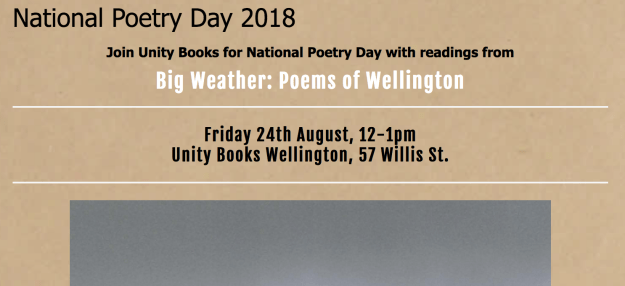
Get ready for Phantom Billstickers National Poetry Day on 24 August by coming along to hear seven of the best read work selected for Best New Zealand Poems.
Poets Airini Beautrais, Chris Tse, Marty Smith, Liz Breslin, Greg Kan, Makyla Curtis, and Hannah Mettner are introduced by Best New Zealand Poems 2017 editor Selina Tusitala Marsh.
Visit the Best New Zealand Poems website (link is external) to view the full selection.

Saturday June 23rd Sam Duckor-Jones and Marolyn Krasner BATS Theatre Wellington
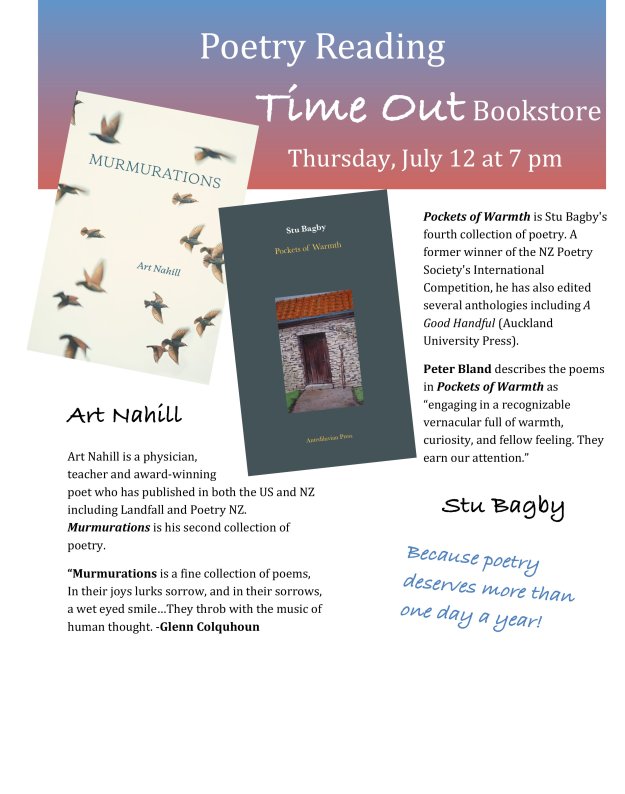
Sam is reading from his debut collection People From The Pit Stand Up (VUP). He is a sculptor and poet who lives in Featherston. In 2017 he won the Biggs Poetry Prize from the International Institute of Modern Letters at Victoria University of Wellington.

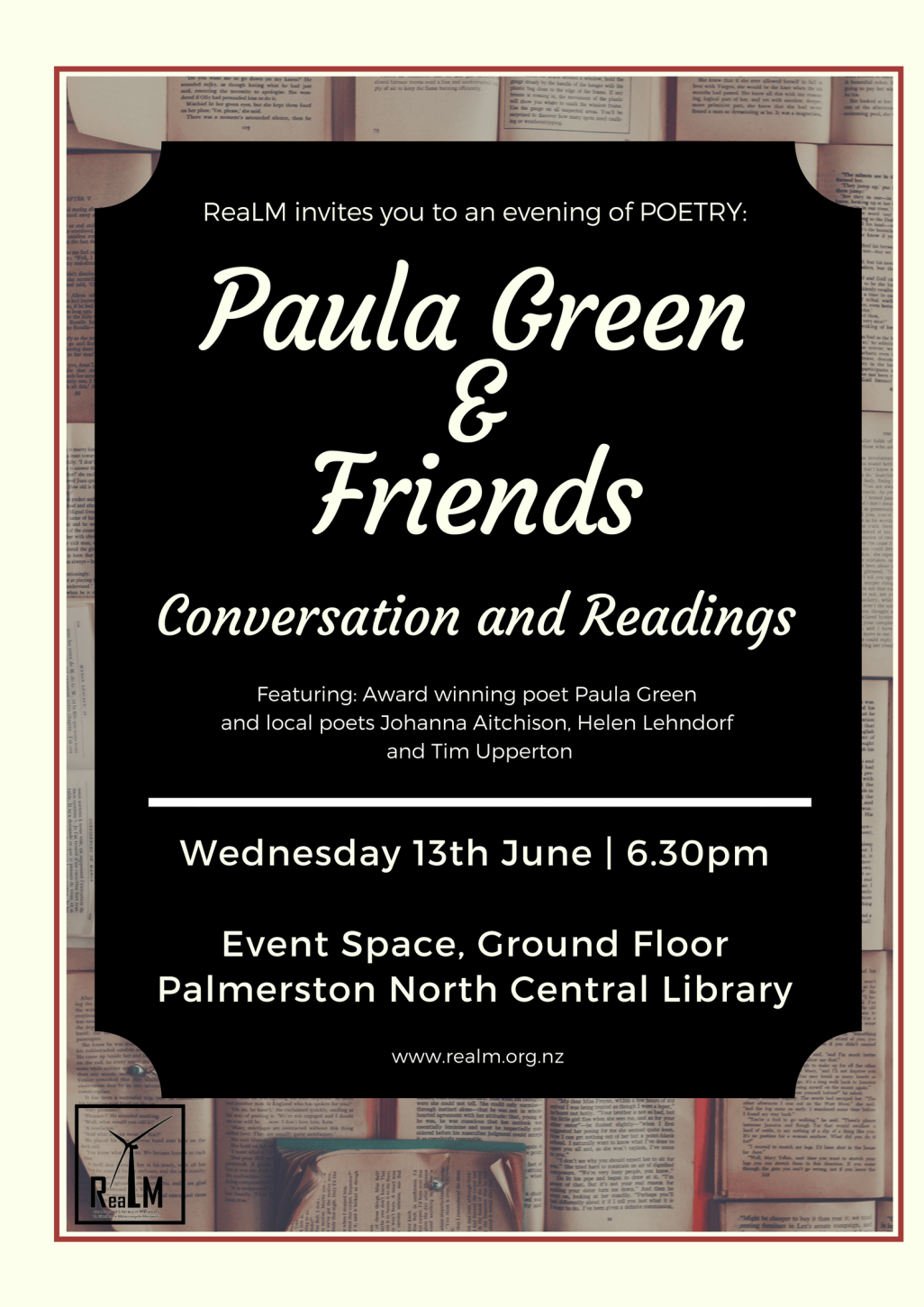
I am heading to Palmerston North next week to do a a few things at the RealM Manawatu conference so thought I would organise a poetry reading with friends.
Johanna Aitchison, Helen Lehndorf and Tim Upperton don’t live in the same city as me, I’ve hardly ever met them, but I have had enduring friendships with their writing. When I was trawling through the poetry archives for a year or so, for Wild Honey, I was captivated by friendships among the early women poets. These involved exchanging letters, drinking tea and sharing secrets but also included sustained engagements with each other’s writing. I liked that.
I got to thinking about the diverse communities we write in and how we also have support crews whether people or poetry: poetry friendships. I most certainly do.
So on Wednesday 13th June, at 6.30 pm, I will be in conversation with Helen, Johanna and Tim at the Palmerston North Central Library. In the meantime you can hear a poem from each of us – an online miniature poetry reading.
An audio tasting platter
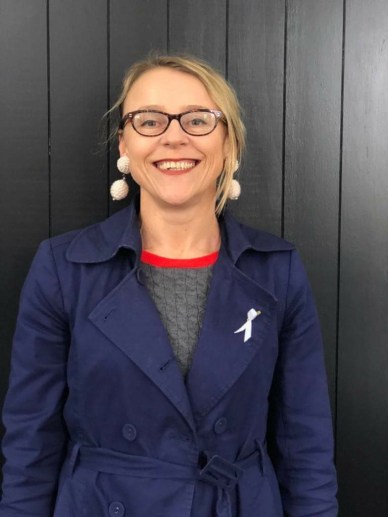
Photo credit: Barira Nazir
Johanna Aitchison reading ‘Cockroach’
Johanna Aitchison is a doctoral candidate at Massey University examining alter egos in contemporary lyric poetry. Her hobbies are running, op-shopping, and she’s always keen for a good karaoke session.
≈

Helen Lehndorf reading ‘the things you are not ready for’
Helen Lehndorf is a writer and writing teacher. Her book ‘The Comforter’ made the New Zealand Listener’s ‘Best 100 Books of 2012 and her poem ‘Wabi-sabi’ was selected for Best New Zealand Poems in 2011. Her second book, about the practice of journaling, ‘Write to the Centre’ was published by Haunui Press in 2016. Her essay ‘The Sensory Seeker’ appeared in Massey University’s 2017 anthology ‘Home’. She loves permaculture, community activism and helping people access their innate creativity.
≈
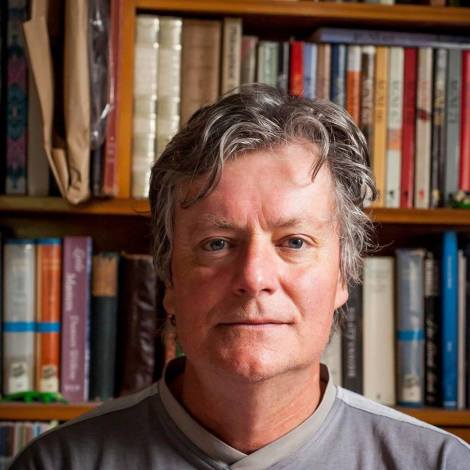
You can hear Tim Upperton read ‘My Lazy Eye’ at The Pantograph Punch here
and he reads ‘The truth about Palmerston North’ with a discussion by the editors at Poetry Foundation here
Tim Upperton’s second poetry collection, The Night We Ate The Baby (Haunui Press), was an Ockham New Zealand Book Awards finalist in 2016. He won the Caselberg International Poetry Competition in 2012 and again in 2013. His poems have been published widely in magazines and journals including Sport, Landfall, NZ Listener, and North and South in New Zealand, and Poetry, Shenandoah, and Agni in America. His work is also anthologised in The Best of Best New Zealand Poems (Victoria University Press), Essential New Zealand Poems (Random House), Villanelles (Everyman), and Obsession: Sestinas in the Twenty-First Century (Dartmouth University Press). He reviews books occasionally for the NZ Listener, Metro, The Pantograph Punch, Landfall, and The Spinoff, and is completing a Creative Writing PhD researching the poetry of Frederick Seidel.
≈
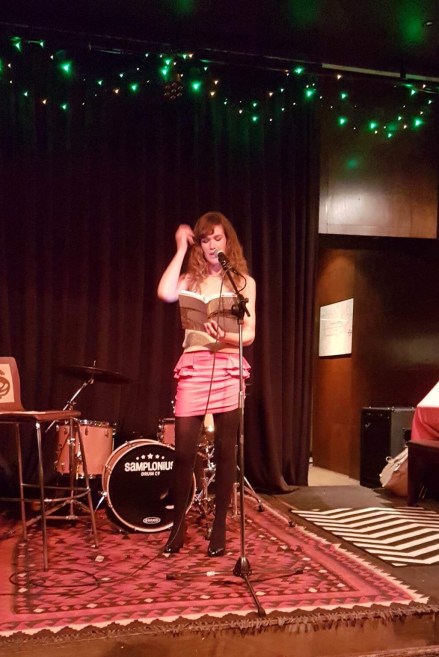
And here is me reading ‘School House Bay’:
In case you don’t get to hear Airini Beautrais read at the Auckland Writers Festival this weekend – you can hear her reading a new poem.
Listening
Your love’s a country I will never see
again, a horse that will not take the bit,
a dusty dress I am too fat to fit,
(read: passionate – you’d bust too easily),
a box I’ve locked and then misplaced the key,
a post card I will never receive, a hit
I simply missed, a dog that will not sit,
a prize catch on the hook that wriggles free.
But still I am a wide receiving dish,
listening, listening to signals from the sky
until my ears are thrashed. The cries of birds,
the groans of growing trees, movements of fish,
the rumbling earth, crowd out the sounds that I
am searching for: mute thunder of your words.
© Airini Beautrais
Airini Beautrais lives in Whanganui. Her most recent book of poetry is Flow: Whanganui River Poems (Victoria University Press, 2017). ‘Listening’ is from a work in progress, a narrative sonnet sequence.
You can catch Airini at the Auckland Writers Festival:
Friday May 18th 5.30 until 6.30 Homage to the River Upper NZI Room
Friday May 18th 6 until 7.30 Call on O’Connell 90 minutes literary mayhem on O’Connell Street
Sunday May 20 10.30 – 11.30 The Art of the Poem with James Brown, Choman Hardi and Terese Svoboda. Upper NZI Room
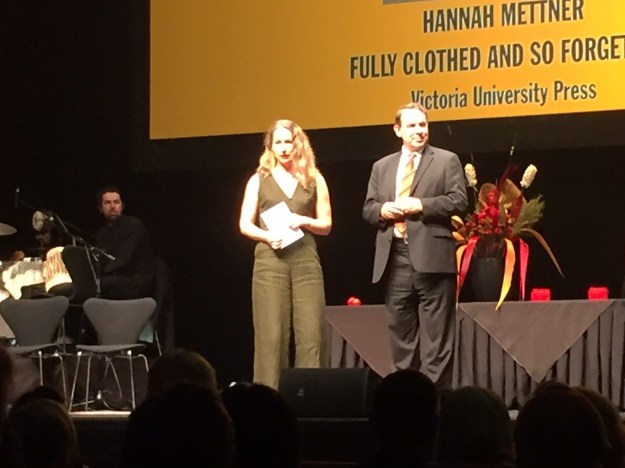
Hannah Mettner, Fully Clothed and So Forgetful – winner of the Best First Book Award at the Ockham NZ Book Awards 2018
We believe in the steps.
We tell our children and then our
grandchildren about the cool
pond at the top where sun-
carp clean our feet and where
we can sleep. The steps are one of
the beautiful mysteries of
life, like how did we get here,
fully clothed and so forgetful?
from ‘Higher ground’
Paula: ‘Fully Clothed and So Forgetful gave me goose bumps as I read and took me beyond words to that state where you stand somewhere wild and beautiful and just stall beyond language to absorb the world. My initial reaction is simply to tell the reader to read the book. But then I start accumulating a list of what I think the poetry is doing: the poems are inventive, unpredictable, melodic, on the move, strange, love-soaked.’
Hannah: The key thing that matters to me in a poem (whether one I’m writing or reading) is that it gets me in the gut. I get very frustrated by poetry that feels empty, or emotionally disengaged or distant, or is teasing the reader or holding them at arm’s length. I just find it boring, I mean, I know that different poems and poets have all sorts of intellectual fare to offer, but I want to be emotionally moved by a poem, and nothing less.
from our interview
My children are abducted by 17th-century French courtesans
In the rose garden near the big house
where somebody famous was either
born, or not, all the ladies spread their
pinks out in the sun. Pretty young ladies
with expensive, dewy faces who want
my children for their photogenic walls.
They look as though they’re picnicking
with their floral bubbles and their green
men but their stiletto fingers give them
away. And my children were just feeding
ducks, but where have they gone?! Quick
say the birds Find them Find them, gobbling
their trails of bread. The ladies strengthen
in the light and their prickles rise and my
nose is so full of their French scent that
I start to sneeze. The ladies wilt a little in
revulsion. Their corals and blushes and rouges
are falling brown, then grey; old ladies with
shallow bones and prickles blunted with
age. And where are your children they
want to know and I want to know too.
I’ve looked everywhere. There’s a low
graze of desperation in my throat, which
stings as I call their names. I uproot one
of the ladies and use her to beat back a
path through the others, until they look
almost young again in the freshness
of their bruises. When I get back to the
pond most of the spinsters have frosted
in the ground. The children are there
wearing new fur coats. One is putting logs
on a fire, while the other pulls dinner
from the snow.
©Hannah Mettner, from Fully clothed and so forgetful (Victoria University Press, 2017)
Author note: This is the poem that helped me realise that there was a way to integrate the emotional authenticity that I want my poems to convey (in this case the fear of ‘losing my children’) with something less literal. For me, this meant that rather than merely ‘stating facts’ in a pleasant or interesting way with line breaks, I was able to tease out multiple concepts and feelings simultaneously in an environment less concretely related to the real world. So, this poem deals with my fear of losing my children after the breakup of my relationship with their father, but holds with that the fear of a potential ‘stepmother’, and the fear of them doing fine without me, but because none of this takes place in a recognisable world (rosebushes don’t usually turn into young women), I felt freer to say all that.
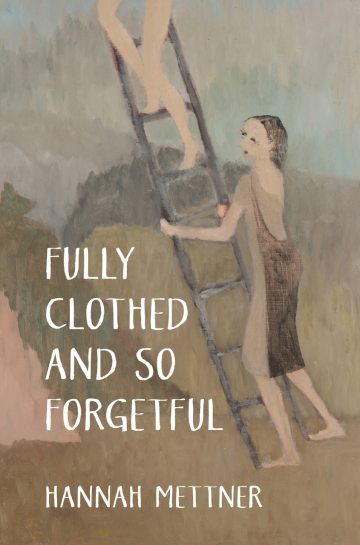
Victoria University Press page
Radio NZ National: Harry Ricketts reviews the book with Kathryn Ryan
Award night:
 NZ Poetry Shelf