
Wind
We are swept by currents of air that swoop
and tease like unseen birds.
The wind is not often a warning here, in this city.
©Diana Bridge
The literary grassroots keep on doing stunning things through out New Zealand; there is boutique publishing, on and off the edge publicity, along with vibrant events.
It feels necessary and vital that we keep doing so. I was tempted to fly down to Wellington for their recent LitCrawl weekend (12 -13th November) but I am up to my elbows writing my new book and not ready for another research trip quite yet.
So I invited locals to send photos and pieces of writing- LitCrawl postcards. Then the earthquake and the incessant aftershocks swiped hard at Wellington residents (sleepless nights, anxious children, floods, uncertainty) along with so many elsewhere.
Understandably not everyone has been able to write anything but I ‘ve decided to post what I have because it seems like this was a joyous occasion for writers and readers.
Diana Bridge sent me some poems which I thought was so lovely – like my own private LitCrawl. The fragment above seems prescient. I have posted two more below.
The way the pieces have pulled this hard hard week – tufts of an election off shore and the earthquake – and managed to produce such gorgeous writing – heck it moved me to tears posting this. I can’t thank you enough Bee Trudgeon, Sarah Forster, Helen Rickerby, Sugar Magnolia Wilson, Catriona Ferguson.
The programme:
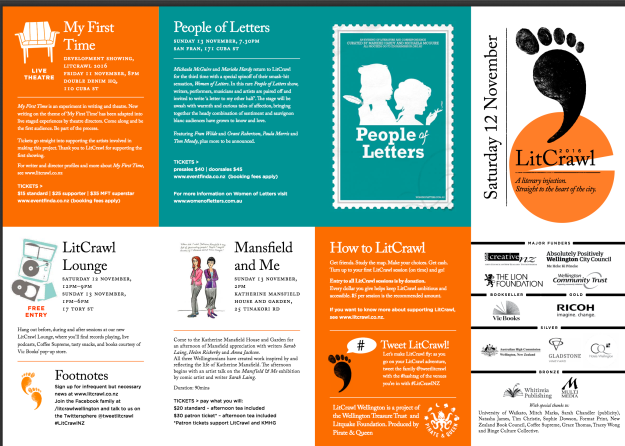
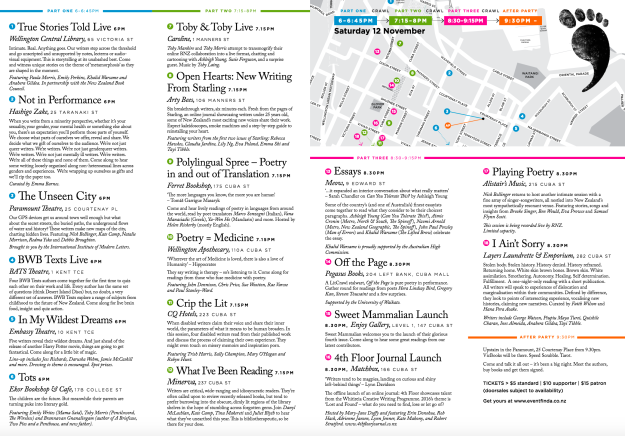
What is LitCrawl?
LitCrawl = a fast-talking, street-loving celebration of writers, publishers, performers, editors, musicians, journalists, lyricists, artists, comedians… and the people who want to hear them speak. For 2016, the programme stretched over three nights and two days with the main event, the crawl itself, on Saturday night. Over 100 writers appeared before over 2500 audience members in 19 venues. All ticketed events sold out.
Claire Mabey (organiser, along with Andrew Laking) You can hear Claire in conversation with Jim Mora this afternoon at 3pmish on RadioNZ
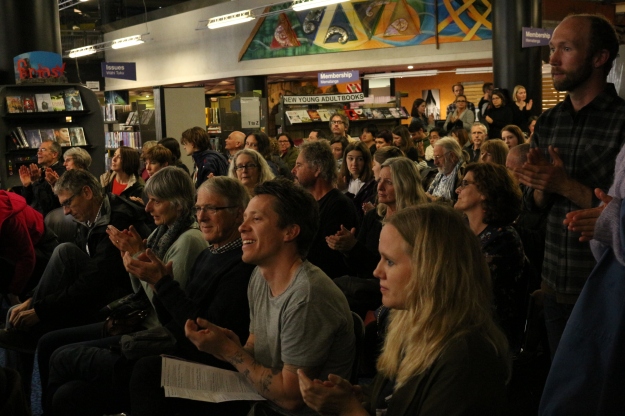
True Stories Told Live –Featuring Paula Morris, Emily Perkins, Khalid Warsame and Anahera Gildea. In partnership with the New Zealand Book Council. Wellington Central Library
‘True Stories Told Live has become a regular part of the LitCrawl programme. Despite the howling gales we had a fabulous turn out for our storytellers, Mayor Justin Lester, Emily Perkins, Khalid Warsame, Paula Morris and Anahera Gildea on Saturday night. Our theme for the evening was Metamorphosis with the subtext being how reading and books can change us. The storytellers responded to the theme with brio, generously sharing some intimate and life-changing moments. It was a wonderful start to the audience’s LitCrawl journey.’
Catriona Ferguson CEO NZ Book Council

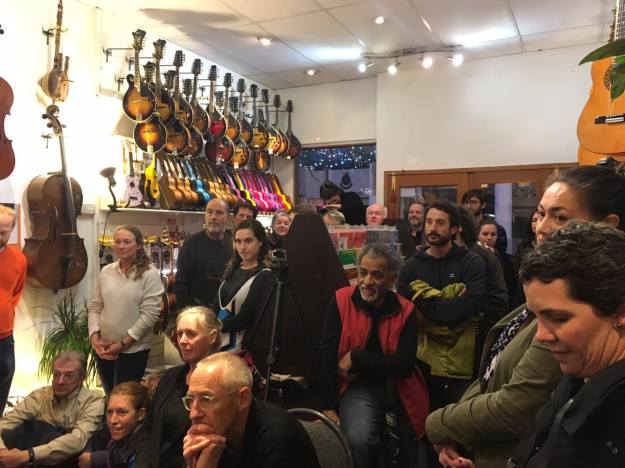
Playing Poetry
And in the world outside these Gardens
canals of silver-beet arrive to part our city streets.
©Diana Bridge
Bee Trudgeon from Porirua Libraries sent in these LitCrawl postcards:
(‘It’s been a great weekend here in Wellington, in spite of the wild weather Friday night through Saturday night. Lit lovers proved themselves a resilient bunch, and great times were in abundance. I walked past more packed venues than those I’ve reviewed for you at the Lit Crawl. Here’s hoping you’ll get some more accounts to do this brilliant event justice.’)
Crip the Lit, CQ Hotels, 223 Cuba Street, 7.15PM
Proud feminism met disability fellowship when writers Robyn Hunt, Sally Champion, Trish Harris and Mary O’Hagan reclaimed the word crippled and put inspiration porn in its place at their packed panel session. This was a clarion call to bust open the closets disabilities of all kinds (visible and invisible, self- and externally-imposed) can erect around those living with them.
Robyn read a blog post regarding the hurdles sight impairment threw up for a budding reader with limited access to appropriate resources. Sally remembered early days far from parents in hospital, where her soul craved the attention her body was getting. Trish read from her newly published memoir The Walking Stick Tree (Escalator Press), which mixes memoir and essay to explore a life lived both in and far beyond the presumed cage hampered physicality suggests to those with a limited grasp on the transcendent power of the human spirit. Mary read from her memoir Madness Made Me (Open Box, 2014), honouring the highs of mental illness as human experiences more rich than those untouched might recognise.
Mary summed up the prevalent mood by poo-pooing any suggestion of bravery, pointing out the need to simply get on with what must be done.
Essays, Meow, 9 Edward Street, 8.30PM
Simon Sweetman (Off the Tracks) proved the perfect emcee for this heaving session of superior essayists, in a venue renowned for treating the literary like rock stars. Ashleigh Young (Can You Tolerate This?) may have been uncomfortable behind the mic’, but killed nonetheless, with tales of bizarre childhood Mastermind sessions under the spotlighted scrutiny of her father the quizmaster. Rarely is a child’s inner life so intimately given voice. International guest Khalid Warsame (reluctant and rare poster boy for Australian African masculinity) read two sentences spanning 15 years and a well-founded distrust of the police. It was a masterful and extreme test of the form. Aimee Cronin nostalgically evoked an idyllic, salt-sprayed, ice-cream sticky childhood summer, hard-won from the ashes of broken marriage. The effect was a sigh just the safe side of a scream. Naomi Arnold took us to the places family and lovers would rather we couldn’t go. She provided a fine reminder that, if not for voyeurism, the essay would be too polite to be as compulsively palatable as this crew proved it can be. A brilliant set gobbled up by a crash keen crowd.
Selina Tusitala Marsh: Tala Tusi: The Teller is the Tale (A New Zealand Book Council Lecture) National Library, November 11, 2016 Reviewed by Bee Trudgeon for NZ Poetry Shelf
For many, it had been a raw few days of uphill battling. Not 48 hours since hearing He Who Shall Not Be Named had won the White House, and just three hours since hearing Leonard Cohen had died, people were sorely in need of some serious attention to the issues of diversity and what was threating it, and the comfort that poetry was alive and well. With the Wellington weather closing in, and turning to bed or drink (or both) a panacea being broadly touted by my distraught American friends, I had a strong feeling Selina Tusitala Marsh’s New Zealand Book Council Lecture could be as close to a cure as I could count on.
Her lecture in five parts and an epilogue, Tala Tusi: The Teller is the Tale, was a lyrical series of ruminations and recollections on the importance of culturally diverse voices, reading as fuel for writing, the holy nature of second-hand bookshops, and a significant encounter with the Queen.
Aptly dubbed the Smiling Assassin by her Muay Thai kickboxing trainer, her regal presence sets a fine example of how we all might face the differences of opinion so hard to understand, during a week when the Ku Klux Clan had been photographed on a bridge crossing a highway during workday commute hours.
In the same vein, consider the time earlier in the year when, as the Commonwealth Poet and guest reader at Westminster Abbey, Selina extended a hand to a certain Baron What’s-his-face, only to have her hand left hanging. Selina refused to let him reduce her to the level of his apparent opinion.
As she says, it is part of her name – the proto-Polynesian ‘ala’ – to be a path, not a wall. In a year when far too much has been said in the name of a certain proposed wall, such words are balm to all humanity.
In addition to an ironically instructional excerpt from Paula Morris’s ‘Bad Story (so you don’t have to write it’, four poems were performed: Robert Louis Stevenson’s ‘Requiem’ (as we were transported to Samoa in the late 1800s), ‘Tusitala’ (Selina’s 1996 manifesto piece), ‘Pussy Cat’ (penned for the potential racist, and the Duke who dared question the ‘post’ in ‘postcolonial literature’), and (thrillingly) the royally commissioned ‘Unity’…
‘There’s a U and an I in unity / costs the earth and yet it’s free…’
Never have the lines been more necessary.
Near closing, Selina acknowledged, “People will walk over me and if they do so ungraciously, that’s their karma; but people will walk over, and that’s about connection.” If the world had not exactly been put to rights, the battle cry for continued attempts to affect so had certainly been sounded. Round One to diverse poetry.
Fa’afetai, Selina. ‘What you do affects me.’
Complete lecture available here.
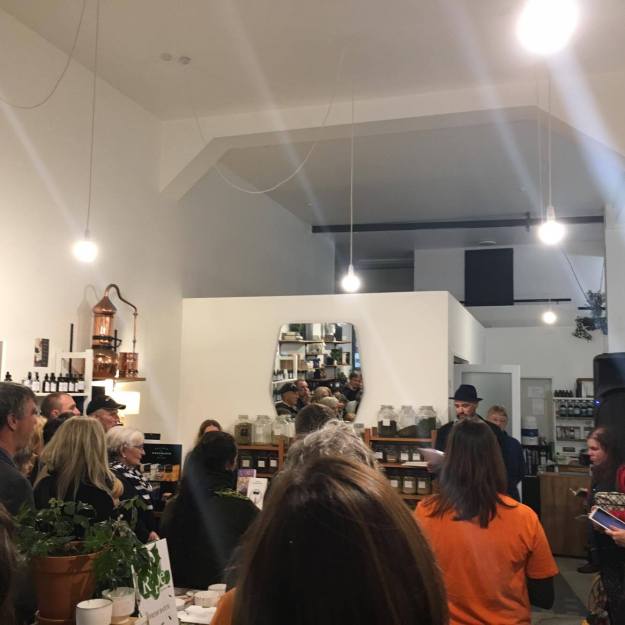
Poetry = Medicine at the Apothecary (more photos from here below)
A LitCrawl letter from Helen Rickerby:
LitCrawl 2016
LitCrawl was more than a bright spark in the middle of a crazy and hard week – a week filled with the alarming US election, torrential rain and slips, earthquakes, tsunami and then more torrential rain, flooding, wind and more slips – LitCrawl was a whole fireworks display. It seems quite a long time ago now, being before the 7.5 earthquake that woke so many of us up after Sunday night had just tipped over into Monday morning. But it’s important to celebrate such a wonderful event, especially in the midst of everything else.
When LitCrawl started two years ago I was a bit worried that having multiple events on at the same time would split the audience – I thought I knew by sight, if not by name, everyone who was likely to come to a literary event in Wellington. But that first year I realised this was something special: every event was well attended – if not full – and there were people there who I had never even seen before. Where did they come from? we wondered. And then the next year, they came out again – even more people to even more events. And this year, even more events, and more people – despite more rain!
I think one of the strengths of LitCrawl – by which I really mean a strength of event organisers, the wonderful Claire Mabey and Andy Laking – is that they have drawn together people from many different parts of the Wellington literary community and beyond to perform and curate sessions. So it feels like something that everyone owns and has helped to make, rather than a top-down thing organised for us.
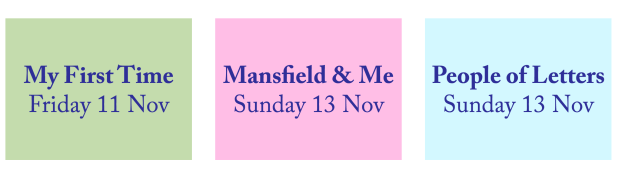
The heart of LitCrawl is the Saturday night, where multiple events are held around the city in three different time slots, but since the beginning there have been some satellite events on different days. This year the first one was Friday night’s My First Time, where three short theatre pieces by first-time theatre writers were performed, for the first time. The pieces were very different from each other: Sarah Jane Barnett’s relationship drama set in the not-too distant future; Pip Adam’s wonderful nuts post-modern take on contemporary life that might have just been snippets from the internet; Faith Wilson’s slam-poetryish musings on race, economics and what she’d like to do with and to her dentist. The audience was invited to be part of the process by emailing in their feedback about the pieces, which are still in development.
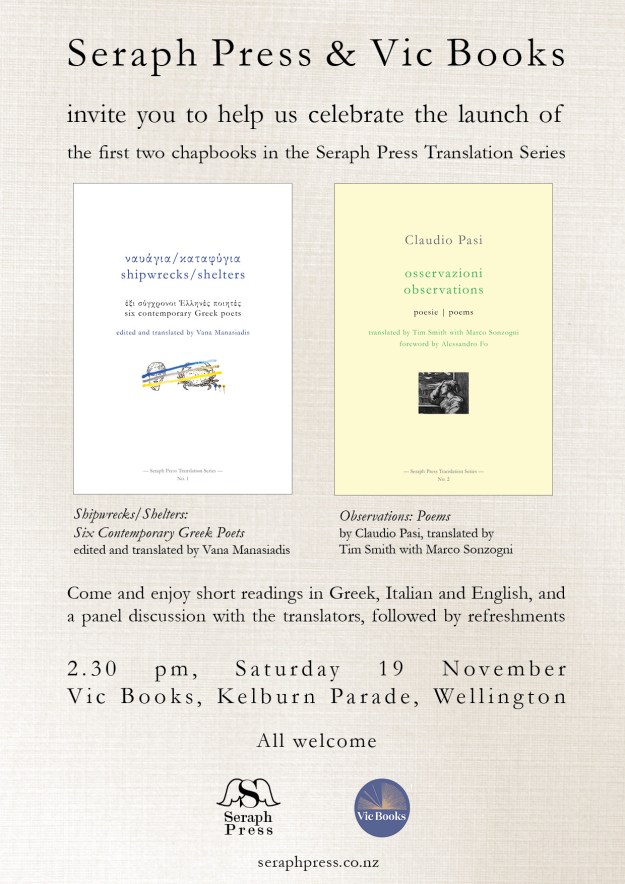
On the night of LitCrawl proper it is always really hard to choose what to attend, and your heart gets a bit broken about the things you have to miss. Because I was running a session in the middle block, that took care of two of my choices – the time I needed to be there to set up made it too difficult to get to the first session. My session, Polylingual Spree – Poetry in and out of Translation, was at Ferret Bookshop, and there was a good turnout to hear poetry from and in Māori, Greek, Mandarin and Italian from Kahu Kutia, Vana Manasiadis, Ya-Wen Ho and Marco Sonzogni (with me reading a couple of English translations). I had wanted to curate that session to celebrate the fact that English isn’t the only language spoken in New Zealand, and it seemed especially timely to be celebrating diversity. Afterwards, people were really enthusiastic about the session and hope to see it return, so we’ll see.
Next I was planning to go to the Essays session (see above PG!), which I’m told was fantastic and full, but it was also much further away than several wonderful poetry sessions in the Cuba Street area. I ended up at Pegasus Books, or, rather, outside Pegasus Books, which was just as well because there was quite a crowd there and we would never have fitted in the shop. Thanks to a good sound system we could mostly hear the readers: Steven Toussaint, Hera Lindsay Bird, Greg Kan and Lee Posna, over the diners behind us at Oriental Kingdom and other revellers in Left Bank. After that, most people headed to the after party at Paramount, generally via some kind of eatery, to mingle and catch up with other LitCrawlers and possibly have their fortunes read by the resident tarot card reader.
The next day I was really delighted to be part of a panel discussion with Sarah Laing and Anna Jackson about why we have found the life and work of Katherine Mansfield so compelling. The event was especially special because it was at the Katherine Mansfield Birthplace, in an upstairs room amid an exhibition of Sarah’s drawings for her graphic bio-memoir (I think I have just made up that term) Mansfield and Me. The sun came out in time for us all to have our afternoon tea on the lawn, which was very pleasant. It was a bit alarming to hear a few hours later, in the early hours of the morning, that there was damage to house after a neighbouring brick wall fell on it during the quake. Fortunately, it now sounds like there is no serious damage, so we can all go back and have a proper look at Sarah’s exhibition and sketchbooks when it reopens.
A friend visiting from Auckland was told on Saturday night ‘You should move back to Wellington, it’s having a literary renaissance’, and I thought – you know, I think she might be right. And I think it’s because there are quite a few ordinary people who are just organising things and doing things here at the moment, and I think that if LitCrawl wasn’t the start of this little renaissance, it certainly is one of its shining stars. Thanks Claire and Andy, we really appreciate it!
photos from Helen:
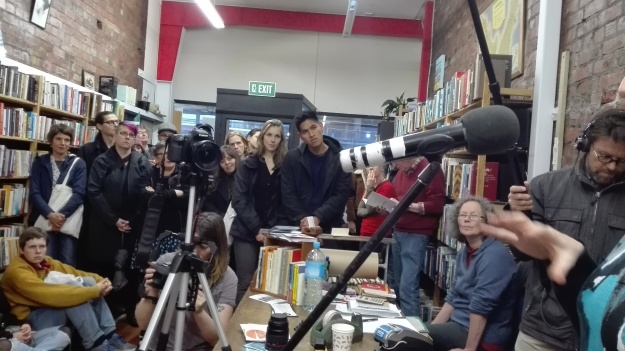
Polylingual – some of the audience at Polylingual Spree at Ferret Bookshop
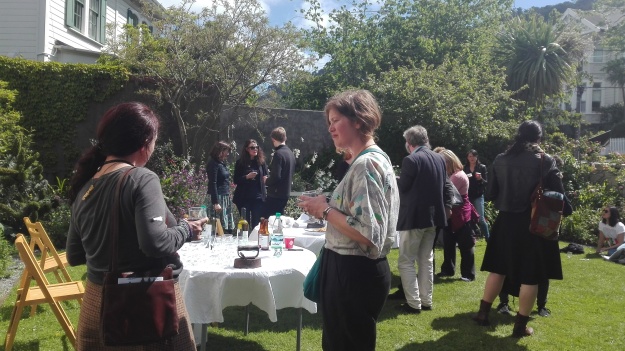
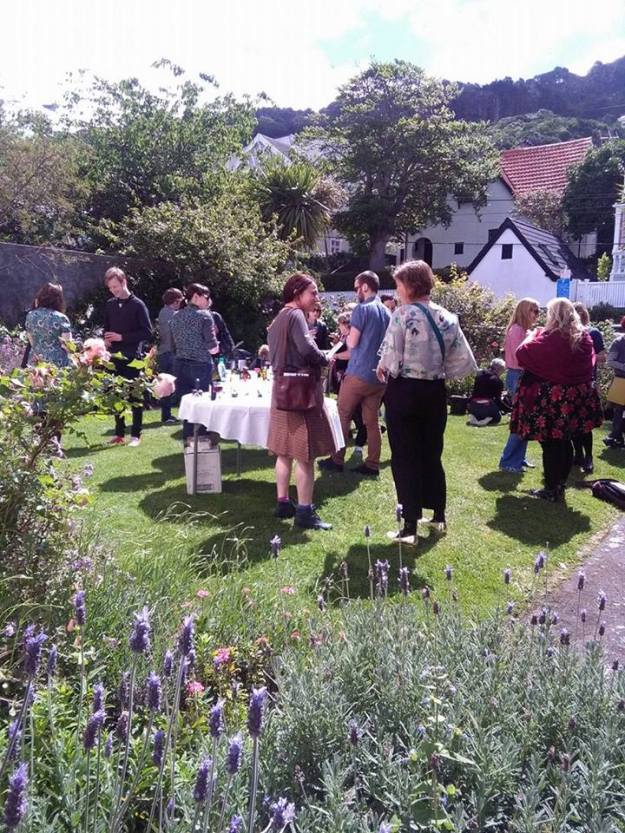
Mansfield 1 – Some of the Mansfield event-goers having afternoon tea on the lawn, including Sarah Laing

Mansfield 2 – Another view of the afternoon tea-ing, including Anna Jackson talking to Vana Manasiadis. The offending brick wall (which fell down in the quake) can be seen beside the house, on the left.
Yes, after a splendid event at the Katherine Mansfield House with the sun shining and afternoon tea and poems, the place suffered damage in the quake.
A letter from Sarah Forster from NZ Booksellers:
Hi Paula
I didn’t go to any poetry last night, mores the pity, but the three events I did go to – True Stories Told Live, Toby & Toby and Essays were all brilliant. I have attended every year since it began. Here are a few bits and pieces for you to weave in.
At the end of LitCrawl 2016, Juliet Blyth noted to me that the most special thing about LitCrawl is that everybody sees it as being for them. There is no demographic that didn’t turn out, despite the terrible Wellington weather.
At True Stories Told Live at the Wellington Central Library, I sat in front of a family of five, the three girls aged roughly 5-11, and though they were bickering beforehand and saying ‘This is going to be boring,’ as soon as the stories began I didn’t hear a peep. As Wellington’s Mayor Justin Lester told of his upbringing with his father searching for white gold, as well as a new mistress in every port they lived in; as Paula Morris wove the spell of the Little House on the Prairie; Emily Perkins told of the changes wrought by self-help books, and an enduring, changing, friendship; Khalid Warsame told of his panic attacks and how the pain of an anonymous other – and a book – somehow eased his own pain; and as Anahera Gildea pulled us through the most painful experience of her life – but the one that led to her finally publishing her writing, and selling her art – these kids sat spellbound. True Stories Told Live at its best is utterly brutal – the laughs are always there, but the truth-telling takes your breath away. I am not sure how we didn’t float out of there on a sea of tears after Gildea’s story, and I want to thank her if she is reading this, for sharing it.
At Toby & Toby at Caroline Bar, it was standing room only, as Toby Manhire interviewed first Susie Ferguson, then Ashleigh Young. This was a louder crowd, but engaged nonetheless. There were probably about 300 of us all crammed in the back of the bar, standing – I had a handy barstool to kneel up on, which made me only 3 inches taller than my friend Harriet Elworthy was standing. How do we deserve Susie Ferguson on our airwaves, Shannonn Te Ao in our art galleries, Ashleigh Young as one of our best editors and writers?
It was a one-two for me with Ashleigh, as she was one of the speakers at the final event I attended, at Meow Bar. Again there was a huge range of ages, though starting from 18 this time, as well as those in the more traditional festival-going age group (the boomers). Essays featured three female essayists – Ashleigh plus Aimie Cronin and Naomi Arnold – and again I was privileged to see Khalid Warsame in performance.
As well as reading from their work, each of them talked a little about essay-writing, and the difficulty of deciding how much of your family and friends’ experiences you are allowed to use. Khalid was fascinating – he is the director of the Young Writer’s Festival in Newcastle, and as an African Australian, he has realised his point of view is incredibly unique. He talked about being pigeonholed as other, and read aloud half of a four-sentence essay, on this theme.
Everything I saw at LitCrawl opened my eyes and my mind in one way or another. Pirate and Queen (aka. Claire Mabey and Andrew Laking) are geniuses: the only complaint I have was that I had to choose from at least 2 options per session that I desperately wanted to attend: an excellent problem to have. While most of the events I attended were very packed, most didn’t need to send people away. The volunteers were better deployed than previously as well. What could have been just another soggy Saturday night in Wellington was touched with magic, thanks to this generous, informative, inspirational event.
cheers, Sarah
Some photos from Mary McCallum:

Sue Wootton reads at The Apothecary, with Jayne Mulligan VicBooks

Chris Price reads at The Apothecary
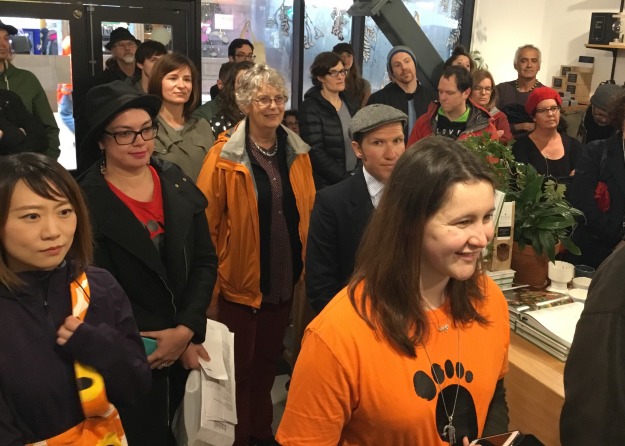
Happy litcrawlers at The Apothecary in Cuba Street, listening to readings around medicine and poetry.
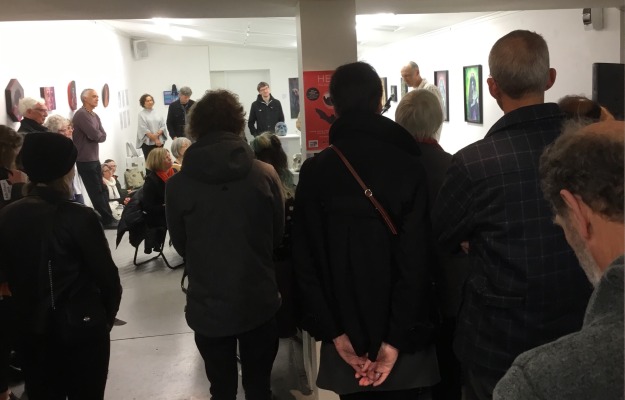
Launch of the 4th Floor Journal at Matchbox in Cuba Street
From Sugar Magnolia Wilson:
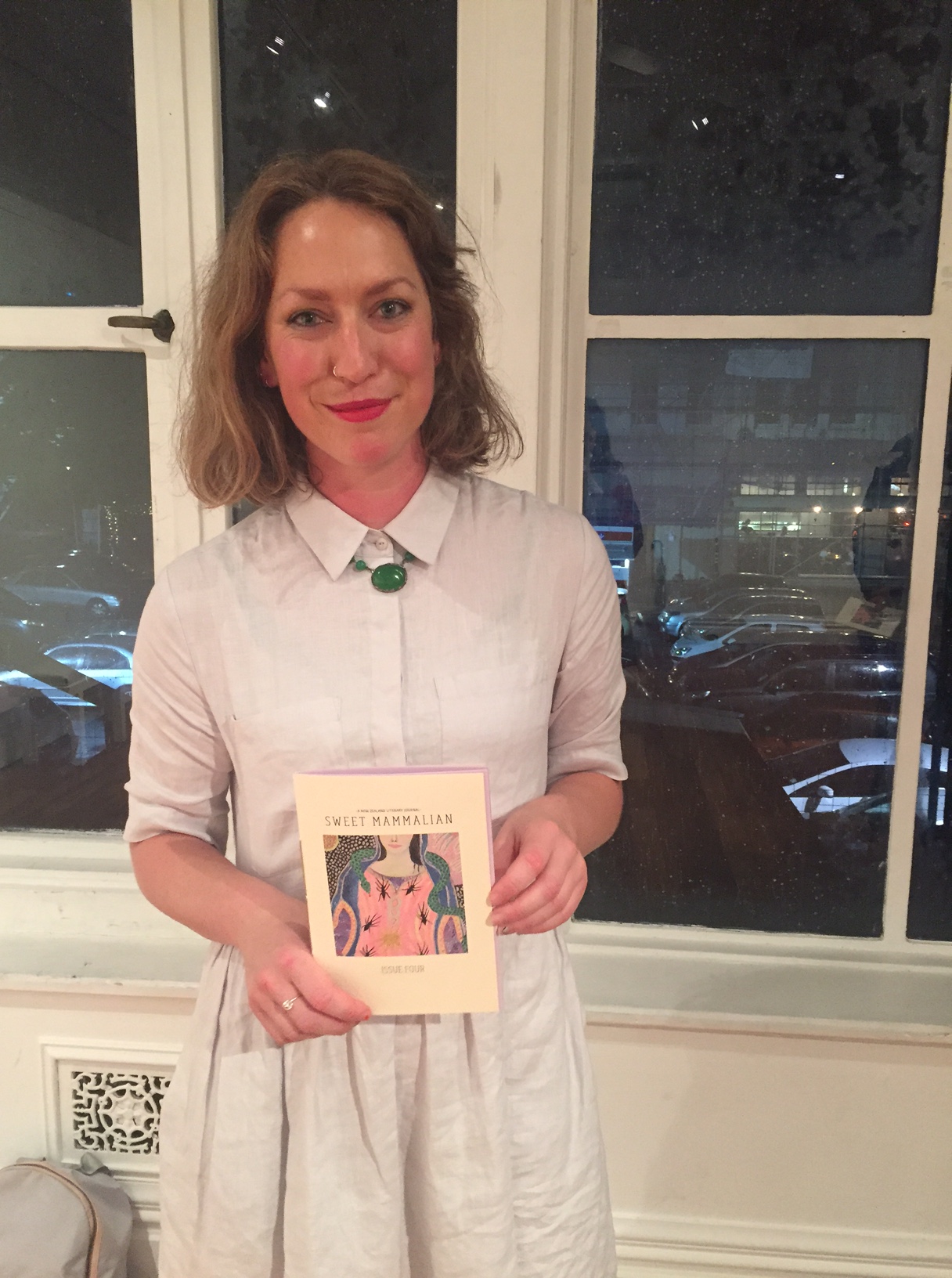
My take on it was – once again litcrawl was a really fun, loving and positive event where people got a chance to meet new folk and bond over writing and literature. I especially love having new contributors in Sweet Mammalian, one of whom came to Wellington especially for litcrawl and to read at our launch. So great to meet new people and always great community vibes at litcrawl.
issue four is now live
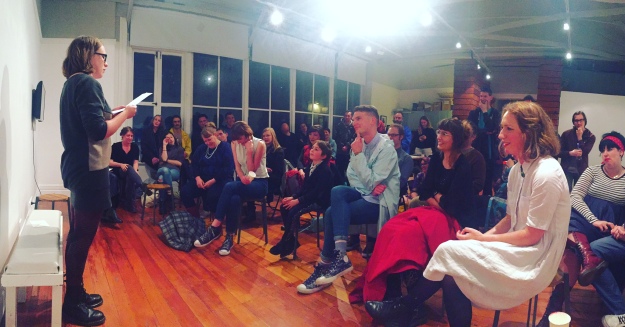
Photos from the Litcrawl Sweet Mammalian launch:
What a glorious, sumptuous, heart-boosting occasion. Thank you so much everyone who sent me things. In the light of what you are enduring, to have sent these treasures in is quite special. The last words goes to a poem Diana sent me. The early NZ women poets I am currently reading found much solace in the sky, the bush and the sea. This is a poem of solace. Thank you everyone!
Footing it with the magnolias
As the track winds steeply down
trees thin and gaps appear in leafy walls.
Broadening view-shafts open
on the Garden’s settled old world heart.
Here is the showcase that changes
with the seasons. Colours co-ordinate
an artist’s take. Spotlight on ceremony
when stately tulips bright as guardsmen bloom.
Though things are not so cut and dried
even in classical spring. Sunlit tussocks
fountain beside paths. Artful inclusion
of the indigenous, the vegetable patch.
Beds hemmed with parsley. Cineraria or
phlox held in evergreen embrace. No plant
undercutting any other – a gorgeous
composite is what they aim for here.
And in the world outside these Gardens?
Canals of silver-beet arrive to part our city streets.
©Diana Bridge
 NZ Poetry Shelf