Category Archives: NZ poetry

Poetry Shelf Spring Season: Peter Ireland picks poems

‘Otherwhere’

To choose a small selection of New Zealand poems you like? This sounds straightforward, but I didn’t find it so. There is no shortage of poems in that category, plenty of poetry books to take from my shelves, and abundant resources to refer to, but I found no easy way in. It felt as though poems attach to particular moments, have a context which resist relocation. Where to begin then?

Sarah Broom’s collections Tigers at Awhitu and Gleam came to mind, as they often do, and so that’s where I started from. I chose ‘tender’ from Gleam; a spare, delicate filament of feeling and pain to represent both books. Broom heads the poem, ‘Cohen,’ in Gleam with the L.C. line – ‘there is a crack in everything, that is how the light gets in.’ To this light I would add a description of the value of poetry by Anna Jackson, ‘to hold open a space for feeling.’ Sarah Broom’s poetry certainly revealed both.

The heading for my selection, however, comes from the title poem of Michele Leggott’s Mirabile Dictu. A book of fifty-six poems written during the time she was the first New Zealand Poet Laureate and, in a period, when her world became progressively dark; became an ‘otherwhere.’ But that is neither a remote nor dark place, rather, full of light and glowing with a love for life.

The otherwhere of Hilaire Kirkland’s ‘Observations ii’ is a starker landscape, an unflinching confession of feeling and desire. Poetry still hot to the touch. Childhood is the otherwhere of Iain Lonie in his poem and as I read it, it’s the poet on the beach returning to his childhood home; while the poet remains watching him go. Sad.

Otherwhere is the point and place of Michael Jackson’s poetry. A traveller at home where he finds himself – and to quote the poet, there writing poems that ‘are like windows that give us a glimpse of a world we travel through all too quickly.’

Peter Olds is not facing blindness or death, nor coming to terms with place, rather he is looking for something in the otherwhere of a second-hand shop. He is not sure of what but returns home with a wetsuit to hang up in the cupboard behind the vacuum cleaner.  


the poems

tender

when I look around me
the world is very bright

it is so light and shiny
that my long bones shiver

I am not quite sure
I have what it takes
to stay alive in the world

I need to stay very still
and let the air move past
and through me

I am tired and tender

when my limbs meet each other
crossing on my lap
I want to cry
with the pleasure
of resting them

when tears come
my bones turn to water

and I sleep

Sarah Broom

from Gleam, Auckland University Press, 2013. Published with kind permission from the Sarah Broom estate.

Mirabile dictu

imagine    the world goes dark
a bowl of granite or a stone bird
incised by tools the nature of which
is unknown  just that they are metal
and therefore from otherwhere
just that the weight of the bowl
precludes light and lightness
of thought    my feet take a path
I can no longer see  my eyes
won’t bring me the bird  only now
has my hand found the stones
I could add to the smooth interior
of my despair  the world goes dark
I look into the eyes of my stone bird
hammers before memory
silence and the world is not

that is no country
for the unassigned  smell of sunlight
on skin in a darkened room   cabbage tree
shadows dancing in the hologram
on the ceiling     not here
and not there   an in-box the size
of a house    I bury my face
in his neck  breathe in
butter taste of summer corn
sweet plums an apricot almost
perfect in its remembrance
I took the road to anhedonia
forgetting the child on my hip
burying his face in my shoulder
I am that child only that child
looking into the eyes of stone

she flinches
because my hands surprise her
feeling for the soft coat the place to clip
lead to collar     she doesn’t see too well
an old dog going deaf but selectively
the nose now only nine thousand times
more acute than mine    the back legs
beginning to fold but still good
for a tip toe raid on the cat’s plate
look at her  black pearl an old lady
out for a walk in the sunshine   slow
and we go into the shadows   stumbling
sometimes on a stone step   the footing
problematic but the maps still delivering
coordinates and forecasts    little dog
black weight on the bed at midnight
love uncloses your eyes   the stone bird
is blind and something I must face
sits behind it making a noise like water

descant on the other madrigal
power tools shaping wood and stone
machining a filigree that falls like moonlight
on the workshop floor    did I dream this
or did I walk out of the house
asking forgiveness and unable to see
anything but my feet entering the shadow
hearing small waves fall over themselves
at the water’s edge    now my hand
finds the bird and my fingers trace
the incisions in fantastica replica
not here and not there     an otherwhere
pouring itself through the gap    

Michele Leggott

from Mirabile Dictu, Auckland University Press, 2009

Observations ii

daily the neighbour’s dog is withdrawn to the park
ignores his mistress and courts her
the mongrel in a canine pas-de-deux
I have a dog most like to this which bites the heels of men

I must subdue it then.

my old dog blindly whimpers in the dark
hunts for its bounding hare in dreams
through my thorned channels and deep streams
and twitches bloodwet at my feet till I am rudely woken

so I shall whip it then.

I have a hound too weak and too afraid to bark
which cringes for the flesh that I withhold
and aching nuzzles me when nights are cold
till I allow my animal to feed and thrive again

it will devour me then.

Hilaire Kirkland

from Blood Clear & Apple Red, Wai-te-ata Press, 1981, also in An Anthology Of New Zealand Poetry in English, eds Jenny Bornholdt, Gregory O’Brien, Mark Willliams, Oxford University Press, 1997

The house of childhood

I watched you walk along that mile of beach
to the house at the end of the beach

the home I’d pointed out, the house of childhood.
How well I remembered the garden, its grey stone wall
the stone rest in the garden, overlooking the sea.

And so you set off bravely, to walk that mile
staggering now and then in the sand that ran to you until
the sun blazed overhead, to the right the sea shimmered
I watched you walking that mile, your figure grew smaller and smaller.

Out of the sea’s shimmer came the faint crying
of voices subdued by the sea and the view.
I remembered the stone rest, the thyme scent of the garden
and beyond the stone wall, the sea splashing in the evening.

I pointed all this out to you, this house of my childhood
and watched you set off towards it, staggering slightly
not looking back, growing smaller and smaller
until you passed into the sand, into the stone wall

and under the garden, the earth of the garden, under the sea.

Iain Lonie

from A Place to Go on from: The Collected Poems of Iain Lonie, ed. David Howard, Otago University Press, 2015. Published with kind permission from the Iain Lonie estate.

Three Key West Poems

Between the satisfaction of frivolity
and the austerity of exile, I had to choose
and it has cost me my life’s happiness

– José Martí

1: Hemingway House

He had everything, or so it seemed,
the biggest house, the largest
swimming pool, one best seller
after another, money no object,
a writing room above the Carriage House
in which a lesser writer
might aspire to genius,
heads of trophy animals,
shelves of books,
backpack and barometer,
a table for his portable Remington,
and ever the lighthouse in his line of sight.

But the photos of the old man reeling in
500-pound sailfish or marlin from Pilar,
his custom-built fishing-boat, belie
the hazardous currents
and heavy seas he could not quell,
the one opponent he could not KO
in his backyard boxing ring
or drown in his blue pool,
something impervious to drink
and fame, that it would take a shotgun
in Idaho to kill.

What demonic ripples cross
our minds as we drift through his house,
now a national monument,
peering at photographs of his four wives
and his aging face,
the carved bedstead he bought from Spain,
the six-toed cats whose lineage
thrives beneath the Christmas and Traveler’s palms,
the banyan and flamboyants
on Whitehead Street, where after the tour
we walk to where a bollard
marks the southernmost point in the United States
and across the water, embargoed
and invisible, the island that Cuban exiles
once waited to reclaim.

2: The Idea of Wallace Stevens at Key West

I am walking beside the sea that fluttered its
empty sleeves and whose dark voice spoke
to one who made it an image of inconstancy.

On a coral key you cannot dig a grave,
therefore these whitewashed, stacked
sarcophagi.  A tour bus passes as I try to read

the names through black iron railings, urns
with artificial flowers, decaying foliage;
a breath of wind in the bedraggled palms

like incessant rumor-mongering.  Most
are Cuban names, names of those who
never made it back, but sat on wooden porches

in Olivia Street as roosters crowed,
chickens scratched, and the click and clack of dominoes
presaged their sepulchers,

bookending birth and death with a woman’s name –
Mary Louise Baez (“the sunshine of our home”)
or Angelina P. Oropeza (“No greater mother ever lived”),

sentiments echoing in my head when I stop
at the Dollar Store on Truman Street for water,
glimpse the strip club opposite

called Bare Assets, and push on
to Reynolds Street where Wallace Stevens
wintered.

Only the sea remains the same,
its answering yet unavailing constancy
at the end of a nondescript suburban street,

no hint of money as “a kind of poetry,”
and the Casa Marina across from the tennis courts
like a prison for white collar criminals.

The same black wrought iron railing
that surrounds the cemetery encloses a white sand
private beach, but there’s no Pale Ramon,

accompanying a businessman in a Panama,
finding order in the ocean’s ambiguity,
only a freshening wind

and a shrimp boat on the Gulf
as full throttle, jet skis buck the broken waves
and thunderclouds like anvils

build toward evening when they may
or may not break, and the man in espadrilles
and his ghostly companion pad back to their hotel

with an image in mind that will
in another generation overwhelm
a poet in the antipodes

inhaling the smell of kelp
and facing the same reality
of which direct knowledge is impossible.

3: The Waterfront Playhouse

There remained
the question of how you were to find your way between
the house with Italian chandeliers and the grand hotel
with its hymns and prayers.
Was it our task to reconcile
the view across the Gulf
with that weed-choked, plastic-littered sea within a sea
or integrate the two, discovering ourselves
reborn in palm-laced shadows and splintered light,
between what did not eventuate and what befell
when the sea’s cross currents were too dangerous –
the fringing reef and its lagoon,
the raked sand, the decomposing wrack,
the drunken bar,
the garden by the pool
the rainy night the poet and the novelist
came to blows, one breaking his hand
on the other’s jaw, their lame apologies?

Will we say on leaving Florida
that this was where we were happiest,
preparing our packed lunch of salad greens,
French bread, and pitted olives from Kalamata
whose groves I knew by heart?
that we discerned the difference
between desire and what we simply need,
slaking our thirst with water,
making love in an air-conditioned room
Bolero playing on the radio
and no question of life or death,
not even when we had to leave
the place they advertised as Paradise?

Michael Jackson

from Walking to Pencarrow: Selected Poems, Cold Hub Press, 2016

The wetsuit

I go into a second-hand shop:
there’s something I want to buy
I don’t know what.
CDs, surfboards, stuffed guitars,
something that talks?
not a phone
not a TV,
a radio, perhaps? —
something small & shiny
you can tuck in your pocket
hide in your hand,
something that has a tongue in it
something that talks?
not a couch,
not a sandwich-maker that’s been through
a Castle Street fire.

I wade through the usual crap:
stuffed cameras, mouth organs,
music posters, ski boots, dark glasses
I don’t want —
a 12-bar heater, a wedding dress,
a mountain bike I don’t want …
Is it sex?
Is it sex I want? —
I’m in the wrong shop.

A man in a bright blue shirt approaches,
“Can I help?” he asks politely.
“I’m looking for something — I don’t know what.”
He shows me a PC, a DVD, a TV LCD, a car stereo,
a cellphone you can photograph yourself on
& send the picture to your friends, hands free —
I reject them all …
“You’re out of date,” the man says
after I tell him I still use a typewriter.
“What you need is a computer: email,
on-line, text, photo i.d.,
Trade Me.” (Woe is me!)

I buy a wetsuit & head home.
“And what do you think you’re going to
do with that?” my partner asks sarcastically
as I hang it in the cupboard behind the
vacuum cleaner — “You can’t even swim!”
“Oh, I thought it would come in handy
in the garden when it’s raining,” I reply —
“& I’ll be ready if Maori Hill ever gets
hit by a tsunami.”

Peter Olds

from Under the Dundas Street Bridge, Steele Roberts, 2012 and in You Fit The Description: The Selected Poems of Peter Olds, Cold Hub Press, 2014

Peter Ireland works for the National Library. He has worked on exhibitions for forty years or more, and has also had the good fortune of helping to look after our Poets Laureate since 2007.

Sarah Broom (1972 – 2013) was born in Dunedin and grew up in Christchurch before completing an MA at the University of Leeds and a doctorate in modern poetry at Oxford University. She subsequently published Contemporary British and Irish Poetry (Palgrave Macmillan, 2006). Sarah lectured at Somerville College, Oxford, at the University of Otago and held a postdoctoral fellowship at Massey University (2000). When she was pregnant with her third child she was diagnosed with stage four lung cancer. She published her debut collection Tigers at Awhitu in 2009 and Gleam, a posthumous collection, was published in 2013 (both AUP). Her husband Michael Gleissner established the Sarah Broom Poetry Prize in her honour in 2014.

Michael Jackson is internationally renowned for his work in the field of existential anthropology and has been widely praised for his innovations in ethnographic writing. Jackson has done extensive fieldwork in Sierra Leone since 1969, and also carried out anthropological research in Aboriginal Australia, Europe, and New Zealand. He has taught in universities in New Zealand, Australia, the United States and is currently Distinguished Professor of World Religions at Harvard Divinity School. His most recent books include The Varieties of Temporal Experience (2018), Selected Poems (2017), and The Paper Nautilus: A Trilogy (2019). Cold Hub Press author page.

Hilaire Kirkland (1941 – 1975) attended the University of Otago in the 1960s and travelled through Europe in the early 1970s, teaching English in Portugal. She published a poetry chapbook and poems in journals, and frequently performed her work. Her poems appeared in several anthologies posthumously, and a collection of poems, Blood Clear & Apple Red, was published by Wai-te-ata Press in 1981. She was awarded an aegrotat BA at National Women’s Hospital shortly before her death.

Michele Leggott was the inaugural New Zealand Poet Laureate 2007–09 under the administration of the National Library. She received the Prime Minister’s Award for Literary Achievement in Poetry in 2013. Her collections include Mirabile Dictu (2009), Heartland (2014), and Vanishing Points (2017), all from Auckland University Press. In 2020 Mezzaluna: Selected Poems was published (also by AUP). She coordinates the New Zealand Electronic Poetry Centre (nzepc) with Brian Flaherty at the University of Auckland.

Peter Olds was born in Christchurch in 1944, he left school at sixteen and after meeting James K. Baxter in Dunedin in the 1960s, began writing poetry. He was a Robert Burns Fellow at the University of Otago in 1978. In 2005 he was an inaugural recipient of the Janet Frame Literary Trust Award for Poetry. He lives in Dunedin. His previously published collections include Lady Moss Revived (1972), Freeway (1974), Beethoven’s Guitar (1980), It Was a Tuesday Morning: Selected Poems 1972-2001 (2004), Poetry Reading at Kaka Point (2006), Under the Dundas Street Bridge (2012), and You fit the description: The Selected Poems of Peter Olds, with an introduction by Ian Wedde (2014, Cold Hub Press). His most recent collection is Taking My Jacket for a Walk (2017, Cold Hub Press).

Poetry Shelf Spring Season

Tara Black picks poems

Victor Rodger picks poems

Poetry Shelf Celebrates: Winners of Given Words 2021 read their poems

The winners of the Given Words competition for Phantom National Poetry Day were announced last Friday 17 September. The director of Given Words, Charles Olsen, invited poets Pat White, Savarna Yang and Aine Whelan-Kopa, to read their poems for NZ Poetry Shelf.

All entries had to include five words chosen from the te reo poetry film Noho Mai, which features a poem by Peta-Maria Tunui. The poems could be written in English or te reo Māori or a mix of the two, with the five words being: pō/duskhau/breathtūpuna/ancestorshiki/raise, and karoro/black-backed gull.

The winners and one special mention were selected by Mikaela Nyman, Michael Todd and Charles Olsen. Their comments on some of the poems along with a selection of 45 poems by both adults and under-16s can be read on Given Words, along with a reflection on the use of te reo in many of the poems by Peta-Maria Tunui.

Pat White was the winner of ‘Best Poem’ for his poem ‘After visiting the IC ward.

After visiting the IC ward

You might think at dusk
that a black-backed gull, and the terns
would be flying for the rookery.
The fishing folk with an empty basket
might trudge homeward, instead of
standing longer on those moving dunes
dividing shore between offshore tūpuna
and inland ancestors, here sea birds
just like words tie the waves’ surge
to lives between two worlds.

Another chance to keep going as if
every breath matters, coming to
rattling rest, as waves do over shell
and pebbles shifting over and over
the planet’s body, one grain of sand
at a time. Your bed occupying
a place between light and dark
the soul poised to raise a voice
in praise of one more day
giving thanks, flying in the mind
to where uplift drafts will raise
pin feathers of an albatross wing
tipped slightly to infinite nautical miles
over the breaker’s lip, reflecting
water movement into light carrying
driftwood to be dragged home.
for burning like the flicker of
life burning in your chest.

Pat White

Savarna Yang, aged 13, won ‘Best Poem by Under-16s’ for her poem ‘Eventide’.

Eventide

alabaster moths flutter
on indigo shadows of dusk
I press my toes into cold sand,
listen to the inbreath and outbreath of sea
and I remember my tupuna tāne,
how he died moored to a ventilator,
breaths drowned in risen tides
far from his whānau

the moon spills silver over ocean ripples
I raise my face to the sky
through a blur of tears
the first stars form an outline of wings,
tips of white against the black
I imagine my tupuna
flies free as a karoro

Savarna Yang

Aine Whelan-Kopa received a Special Mention for her poem ‘Hiki te hoe’.

Hiki te hoe

I got goosebumps today
When Tāwhiri breathed
And I heard the words
When I opened my heart
To tūpuna
They whispered
Hoea te waka
Hoea te waka
Hoea te waka
Like a chorus
And on the beat
It hurt like hope
But felt like home
I’m sorry I ever told them to go
Hoea te waka
Their words sing on
In my puku-heart
As wiriwiri
In my head-heart
Sways the pūriri
In my heart-heart
There’s aroha
And that’s everything
It pumps my veins
Out of and into
The pull
The row
The drag
The flow
Hiki te hoe
Hoea te waka
I’m moving on
Out of te pō
Upon
Cool waters misty
Like a lake before dawn
Hoea te waka
To where karoro flies
Hoea te waka
To where the green flash glows
Hoea te waka
To where the four winds blow
Ngā hau
Hoea te waka
Along the long awa
Guided by whispers
And one hundred tuna
Black and blue
Hoea te waka
By starlight
To sunlight
With Hine ā Maru
And you

Aine Whelan-Kopa

About the Poets

Pat White lives just out of Fairlie in the South Island of Aotearoa/New Zealand. There he works as a writer and painter, with his wife Catherine, a musician and painter. He has published a number of volumes of prose and poetry since the 1970s, including; How the Land Lies, (VUP 2010) prose memoir essays, Watching for the wingbeat; new and selected poems (Cold Hub Press 2018). He was editor of Rejoice Instead: Collected poems of Peter Hooper (Cold Hub Press, 2021).


His entry in Given Words honours the experience of a son who was in an Intensive Care Ward four years ago. ‘Such events hone our appreciation of every breath, and the need of each of us to give thanks for the miracle of ordinariness that is daily life. This afternoon the sun is shining, soon it will be time for a glass of red wine while sitting looking at the mountains to the west. Who knows a poem may be gifted on a gust of wind … if we sit quietly enough?’

Savarna Yang is thirteen years old, home-schools, and lives near Ōtepoti, Dunedin. You can often find her spinning and weaving wool from her pet sheep or baking mountains of cookies (especially over lockdown). She plays football for her local team but unfortunately they have lost every single game this season… She loves writing short stories and reviews.


Of the inspiration for her poem she says, ‘My grandparents live overseas, in Australia and China. I haven’t seen them for a long time and maybe I won’t get to see them again. In Aotearoa, we had an elderly friend nearby we loved like a grandparent. They died in hospital during lockdown when we could not visit to say goodbye.’

Aine Whelan-Kopa lives in Tāmaki Makaurau Auckland and grew up in very small rural, coastal towns in the Hokianga and Taranaki. She is of Ngāti Hine, Te Hikutu o Hokianga, Ngāpuhi and Irish descent. Being bi-racial has been challenging and impactful, writing and art are ways for Aine to express herself and explore her identity. The mix of te reo Māori and English in her poetry is a natural extension of the way she talks.
Aine is a student majoring in psychology and aims to use art therapy to help children affected by trauma. Whānau, whenua, atua and taiao are the cornerstones of her connection to Te Ao.


Hiki Te Hoe was written as a note to self that in order to get to where you want to go you need to pick up the paddle and start to row. Aine loves running and chocolate equally, because life is about balance.

Poetry Shelf video: Vaughan Rapatahana reads at Medellin Columbia Poetry Festival

Vaughan Rapatahana begins many of his poems with a whakataukī. He is reading English versions of his poems that are then read in Spanish, but I love the way he brings in te reo Māori. Words say so much that are lost in translation, especially in poetry where each word is a rich vessel – words such as karakia and whanaunga. Vaughan’s poems consider death, place, whānau, significant issues such as global warming, the treatment of Māori. One poem particularly moved me: ‘Talking to my son in a funeral home’. Vaughan wondered why he keeps writing poems about and for his son who committed suicide 16 years ago. He shares his recent epiphany: that he writes of his son to keep his son alive. Later he reads a second poem, ‘The Zephyr’, a list poem, that is equally compelling (‘The zephyr that is my lost son still frisks me’). Ah. Ah. Ah. He reads a love poem he has written in te reo Māori to his wife, because he says he finds it easier to write how he feels in his first language.

To hear this coming together of te reo Māori, English and Spanish – a poetry meeting where words are held across distance to draw upon depth and intimacy – is a rare and glorious treat. Thank you.

Vaughan Rapatahana (Te Ātiawa) commutes between homes in Hong Kong, Philippines, and Aotearoa New Zealand. He is widely published across several genre in both his main languages, te reo Māori and English and his work has been translated into Bahasa Malaysia, Italian, French, Mandarin, Romanian, Spanish. Additionally, he has lived and worked for several years in the Republic of Nauru, PR China, Brunei Darussalam, and the Middle East.

You can read Vaughan’s knitting (love) poem here.

Vaughan Rapatahana reads and responds to ‘tahi kupu anake’

Poem: kia atawhai – te huaketo 2020 / be kind – the virus 2020

Poetry Shelf Monday Poem: Vana Manasiadis ‘Skylla draws the planet as three lippy women’

from one spark:
Skylla draws the planet as three lippy women


the planet as Klytaemnestra

 don’t shove you everywhere the tail yours        don’t
sear you the fish to the lips my                like the fish out
 of water                               δεν τρέμω         the fish stinks
 from the head             like the fish     σαν     out of water                
won’t cut I the throat my            το ψάρι     won’t lower
I the tail my           won’t shake like the fish I    


the planet as Medea

              show I the teeth my               
 squeeze I the teeth my
armed until the teeth  fight I
       with nails and with teeth   
 talk I inside from the teeth
talk I outside from
                                    the teeth                                   
  if don’t you have teeth
                   can’t you to bite
you can’t dodge this
    δράκου δόντι να’χεις δεν γλιτώνεις
not even with a dragon’s tooth


the planet as Antigone

from one spark grows a bushfire
 put I the hand           to the fire
     from one spark
είμαι                grows a bushfire
am I lava                     and fire
 the eyes my         throw sparks
                      fall I        
                  φωτιά     to the fire
the eyes                   my
                                     throw sparks
grab I the fire              και
                              put I the hand
   λάβρα                   to the fire
grab I the fire                  am I lava             
 lava                           am I and fire
and fire                   

Vana Manasiadis

Vana Manasiadis is a Greek-New Zealand poet and translator born in Te Whanganui-a-Tara and based in Tāmaki Makaurau after many years living in Kirihi Greece.  She is 2021 Ursula Bethell Writer-in-Residence at Te Whare Wanaga o Waitaha Canterbury University. Her most recent book was The Grief Almanac: A Sequel (Seraph Press).

Poetry Shelf audio: Tim Grgec reads from All Tito’s Children

All Tito’s Children, Tim Grgec, Victoria University Press, 2021

An intro:

Tim reads ‘Infectious Divides’:

Tim reads ‘Lost Tendencies’:

Tim Grgec was the 2018 recipient of the Biggs Family Prize for Poetry. Having failed to achieve his childhood dream of playing for the Black Caps, he now has delusions of becoming a great writer. His first book, All Tito’s Children, is out now with Victoria University Press.

Victoria University Press page

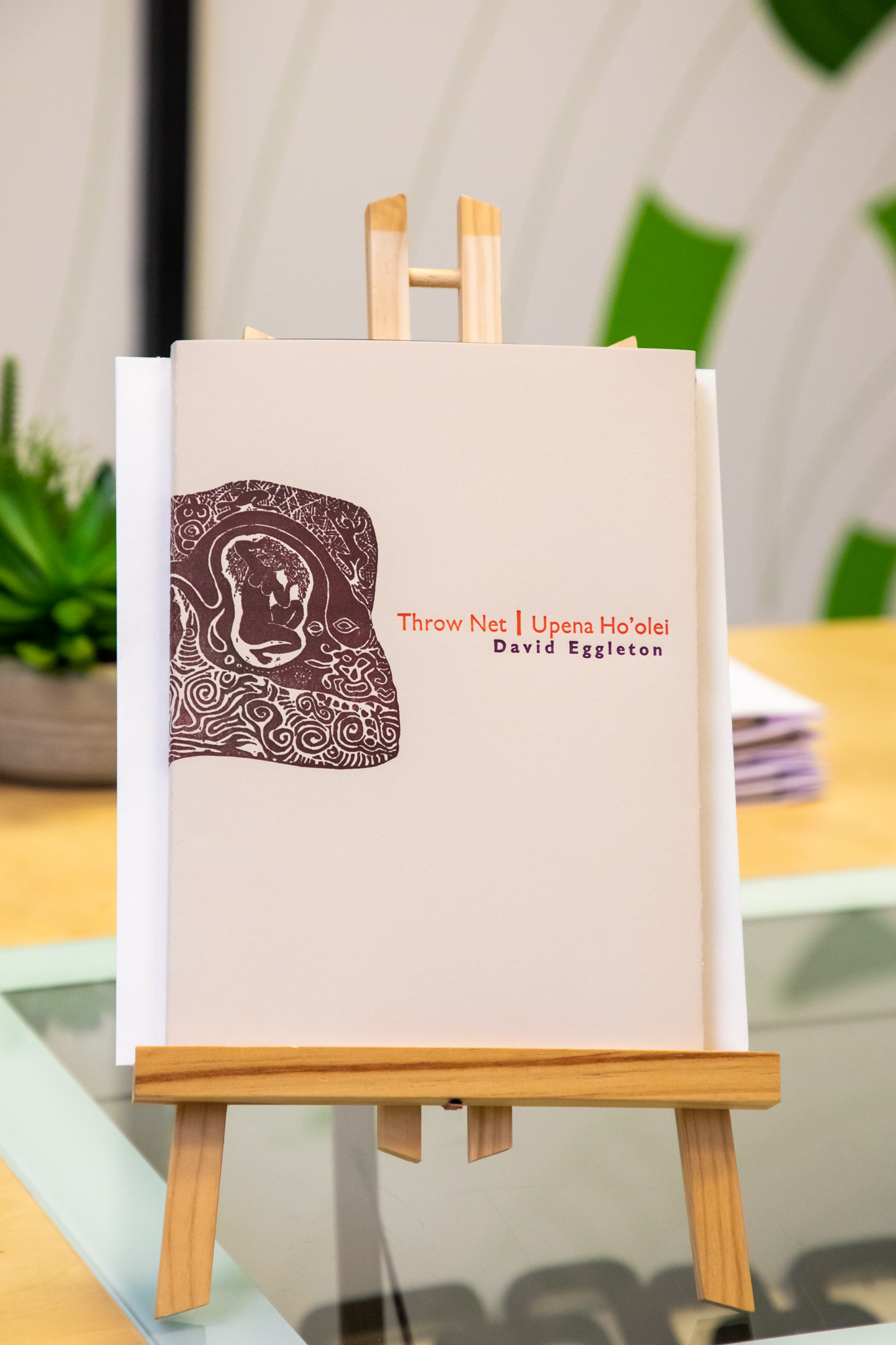
Poetry Shelf review: David Eggleton’s Throw Net | Upena Ho’olei

Throw Net | Upena Ho’olei, David Eggleton, artwork by Tonu Shane Eggleton, National Library / Fernbank Studios, 2021


I’m mesmerised by the sunshine’s sheen,
and every minute particular feels mine.

The sea disgorges its catalogue of shells
on the white page of sand for no-one.

On my hotel bed, I dream and sail.


from ‘Tourist Island’

Our current Poet Laureate, David Eggleton, has published a handset, hand-bound collection of poetry with artwork (woodblock prints) by his brother Tonu Shane Eggleton. Brendan O’Brien, beautiful-book craftsman extraordinaire, has produced an edition of 100 at his Fernbank Studios. The book is exquisite. I run my hand over the rough edged paper (Kerkall, plus Stonehenge for the covers). It is book joy. Holding this book. Holding this beauty. The artwork is an evocative sheen on the page.

The National Library, which has administered the New Zealand Poet Laureate Award since 2007, published the book. The award was established by Bill Manhire and winemaker John Buck as the Te Mata Poet Laureate Award n 1996. Throw Net | Upena Ho’olei is fittingly dedicated to John.

In 2018 David spent three months at the University of Hawai’i’s Moana Campus, as the Fulbright-Creative New Zealand Pacific Writer Resident. The poems began in notebooks while he was there, and were completed upon his return.

Throw Net | Upena Ho’olei, with nine poems and a scattering of artworks, is the perfect place to sojourn.

This is poetry that celebrates the moment. It feels like the poet is inhabiting a particular place, at a particular time, and slowly breathes in the experience. The poem establishes a heightened relationship with place, a translation of experience within measure poetic form. The treasured details offer sound and visual explosions to the point I am imbibing a poetry feast, a delectable banquet. I am unashamedly drawn to food metaphors because poetry is a form of nourishment on the tongue, in the heart, in the lungs. This is poetry that is so very nourishing.

There is quietness, there is melody, there are shifting keys and multiple forms. I am breathing in salt and ocean, and undulating voyage. I am lingering over vignette and anecdote. In this time of limited travel and strict local borders, poetry is a travel plan, an itinerary of respite and joy. You might swim with turtles and hear the church bells ring out. There is ‘the chop of waves’ and ‘ukelele strums’. Expect mountains and lava and sun, much much sun. I am feeling skin glazed as I spend a whole Saturday drifting in and out of these poems. Pleasure crafts. Such honeyed vessels.

I love this lovingly crafted chapbook. Such economy, such fluidity, such reach. I dream and I set sail.


The snores of a sleeper on a beach towel
recite genealogy under volcano’s glow.
A sunken raft of manta rays stirs after dark.

Hands hula-hula, shaping sandwiches
into islands; mechanically, a shark
takes a bite out of the moonlight.

Someone slings a hammock between trees.
Each wave is a line; each line is breaking;
and even the mountains are setting sail.


from ‘Throw Net’

David Eggleton NZ Poet Laureate blog

You can order a copy at the Library Store at $70 per copy. email: natlib-retail@dia.govt.nz

NZ Poetry Shelf interview

Otago University Press page

NZEPC page with poems

Poetry Shelf Monday poem: Elizabeth Welsh’s ‘all the intertidal meadows’

all the intertidal meadows


my therapist casually suggested that I embody seagrass; this seemed dangerously close to social prescribing, but I had been reading Fontaine with its daymares repeatedly that autumn, together with articles on forest bathing, which seemed earthy, hungry, darkly prescient, so I experienced the briefest of pauses before I embraced it, placing a dark halo over a quivering body evolved from terrestrial plants, returning to the wide-open space of underwater hollows, to silence, to quaking, glittering light. they have flowers and seeds and roots and leaves and connective tissues; they have ribboning foliage, holding firm in built-up silt on tidal flats.

when we found the audio recorder we wanted to buy, the sales assistant outlined the different ways I could record conversations, as if this was the object’s sole purpose. I thought about the taking of another’s voice, the permission we were granting ourselves to grasp the sung shrieks of grass, and I turned to look at your mended lips, reading their unhurried movement. we took the handheld recorders into the soft carpet marsh of the wetlands, stopped our footfalls and created slight archives of our meagre silence, our scant pause. you were annoyed when I interrupted to ask how we define aural stimulus; but what is noise and what is sound? is there a moment – a blurred boundary? is a sound always so fitfully tender and sinking?

your lungs of clay heaved with the cold and unsympathetic air, my tendons stretched, elastic over our loud together loneliness. if you took a diecut mould and used it on me, you’d find: there’s your body and hers and safe and hard and compost and squeaking tedium and peaty soil; there’s microbes and knuckles and luminescence and practice and precarity and crushing blends of all this. we sign up for a noxious plant maintenance scheme when we leave via the ranger’s hut, and she informs us that it is mainly cordgrasses that we will be tackling. they strangle the groundcover, she murmurs earnestly, and we know to nod many times and make appropriate noises. all the intertidal meadows are swollen, she grows tiny as she talks, and I struggle to lip-read what she’s saying as she moves closer and closer to the compressed, rising earth

Elizabeth Welsh

Elizabeth Welsh is a poet, papermaker and academic editor. She is the author of Over There a Mountain, published by Mākaro Press in 2018. Her poetry has been published in New Zealand and the United Kingdom, and she is Auckland Council’s Artist in Residence for 2021, creating site-specific poetry and handmade paper on/from the wetlands at Āwhitu Regional Park. She lives in Titirangi with her husband and daughter.

Poetry Shelf noticeboard: Siobhan Harvey receives 2021 Janet Frame Literary Trust Award for Poetry

Photo Credit: Liz March

JANET FRAME LITERARY TRUST

Gift for Auckland Poet on Janet Frame’s Birthday (28 August)

2021 Janet Frame Literary Trust Award for Poetry goes to Siobhan Harvey

The Janet Frame Literary Trust is delighted to announce the recipient
of the 2021 Janet Frame Literary Trust Award for Poetry.  Auckland
poet Siobhan Harvey will receive $5,000 from a fund set up by Janet
Frame for the purpose of encouraging New Zealand authors “of poetry
and imaginative prose”. The biennial award is timed to commemorate
Janet Frame’s birth date on the 28th of August. Janet Frame was
famously saved from an imminent lobotomy when a doctor noticed that
she had won a literary prize. She received many grants and prizes over
her long career and wanted to give back to her fellow writers.

Siobhan Harvey is originally from England and made New Zealand her
home 20 years ago. She is the author of eight books of poetry and non-fiction.
Her latest volume of poetry and creative non-fiction, ‘Ghosts’ (Otago
University Press 2021), explores themes of migration, homelessness and
family trauma. The UK Poetry Archive describes her poetry as “that of
a quester – a voyager — meditating on separation and discovery, on
time lost and time regained, on the tug of distant familial
connections, and the new global connectivity which means never being
out-of-touch.” Harvey is a lecturer in creative writing at the
Auckland University of Technology and her work is published widely in
New Zealand and international journals and anthologies.

Siobhan Harvey said that she was humbled “to be honoured in a legacy
left by New Zealand’s foremost author” as well as finding herself the
recipient of an award given previously to writers whose work she
admires, such as Peter Olds, Tusiata Avia, David Eggleton, Catherine
Chidgey and Alison Wong.

 “In this fraught time of a global pandemic and in an era in which the
financial earnings of writers in New Zealand are below the minimumwage, this bequest allows me to fund writing time I would not have been able to afford otherwise.”

Siobhan Harvey is the author of eight books, including Ghosts (Otago University Press, 2021) and 2013 Kathleen Grattan Poetry Award-winning Cloudboy (OUP, 2014). She received the 2020 NZSA Peter & Dianne Beatson Fellowship, and won the 2020 Robert Burns Poetry Award and the 2019 Kathleen Grattan Award for a Sequence of Poems. Her work appears in recent anthologies: Arcadian Rustbelt: Poets Emerging 1980–-1995 (University of Liverpool Press, 2021), Feminist Divine: Voices of Power and Invisibility (Cyren US, 2019) and, translated into Italian, in Alessandra Bava (ed.), HerKind: Anthology of Contemporary New Zealand Poets (Editione Ensemble, 2021).

Janet Frame site

Award Page

Siobhan Harvey reads from her new book Ghosts

The Friday Poem: ‘If befriending Ghosts’ from Ghosts

ANZL page

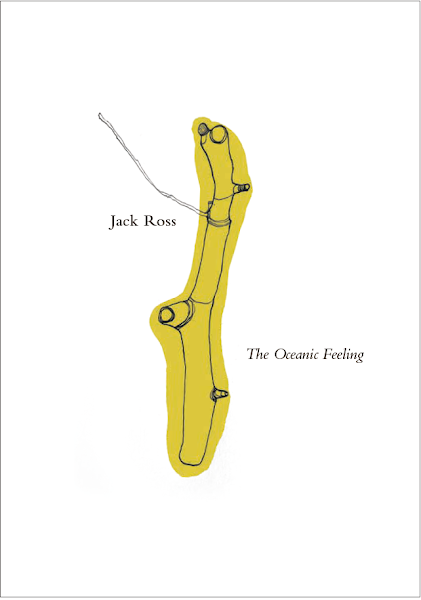
Poetry Shelf review: Jack Ross’s The Oceanic Feeling

The Oceanic Feeling, Jack Ross, Salt and Greyboy Press, 2021

Here I go reviewing a book again with the subterranean feeling I experienced last March, barely articulated, drenched in uncertainty, fearing for the well being of Aotearoa, fearing for the well being of our frontline workers, fearing for our understaffed hospitals, fearing that supermarkets will deal with aggressive behaviour from some shoppers, yet full of gratitude for our Government’s swift response, for everyone choosing to stay at home and wear a mask. The subterranean Covid effect saw me drifting around the house yesterday with Jack Ross’s new poetry collection, The Oceanic Feeling, in my hand. Not writing a word. Word-drifitng in and out of countless books. Worrying about Afghanistan. Listening to Reb Fountain. Worrying about Haiti. Sydney. All the people living alone. The homeless.

The title is so fitting. The oceanic feeling.

Layer it up. Stand by the ocean and get an intake of ocean beauty. Sit at my kitchen table looking onto the tail end of the Waitākere ranges and my potential for worry is oceanic. Below the surface in my blood and bones. Above the surface in those intruding thoughts that I try not to let settle at the station.

I love this title. This beautifully produced book with its white cover and striking image holds an ocean of feeling. Add in the white space, the unsaid. Add in the physical, the images that glint and hold your attention.

The cover drawing is by Swiss-New Zealand artist Katharina Jaeger, and is part of the suite of images included in the collection. Bronwyn Lloyd’s afterword explores the connections between the drawings and the poetry. Katharina was inspired by her father’s manic pruning, and rather than use the the pile of clippings as prunings, drew them instead. Bronwyn makes a vital link between prunings and the skeletons in the artist’s closets, in the poet’s closet, and by extension in our closets.

Poetry is both pruning and planting and, at times, opening the closet door is to shine a light on the tough, the difficult, the surprising.

Jack’s terrific new collection does just this. The poetry seeks perspective in the corrugations and felicities of the everyday. In the little and larger events that shape and have shaped life. That nurture love, that spark a sense of humour, that trigger contemplation. The poems occupy the present but they also recuperate the past. I am moved by this.

The book is essentially in two sections, like two halves of a heart, with ‘Family Plot’ alongside ‘Ice Road Trucker’. Family poems alongside poems that consider the academy, poetry journals, travel, public art, reading, thinking. There is also a tiny cluster of small poems and of translations.

The poetry peers into the mist, and swivels to embrace the clearly sighted.

A sublime example is ‘What to do till the sentinels come’. The poet’s mother (I am making this assumption) has forgotten to feed Zero the cat when they are away. The cat hides in the garden shed, unfed. Here is the mist and the close at hand. The poem as the pruned twig.

it’s not that my mother
neglected her task
on purpose
she’d written in her diary

FEED THE CAT!
it’s just that her mind
now fills in blanks
with certainties

not doubts
there was a slight pause
before that “fine”
all I know is our cat

left alone
in the storm
my mother alone
in the fog of her brain

In the opening poem, ‘Lone Pine’, a tree crew are pruning the pines. The physical scene unfolds, and in reaching the visual impact of the tallest tree with its branches stripped bare, the loss doubles back. This is the pruned branch laid on the page: ‘standing bare / just like my father at the end’.

2021 is the season of memoirs. Long form and all revealing.

And yes, The Oceanic Feeling is a form of memoir. Fragmented. Selective. Revealing. It is also a form of engagement with both ideas and feelings. Poetry as a way of discovering chords between here and there, this and that, now and then. So many layers. So many connections. ‘Family skeletons’ does this. The sister with her suicidal thoughts, witnessed throwing a rope over a tree, who later succeeds with pills, is both presence and absence. Again I am picking up a branch laid upon the page and I am feeling it deeply.

Ah, I am moving in so many directions, as I read Jack’s collection, from the cars loved and then replaced, to bookshelves and superstitions, to wrangling over the colours of a graduation hood, to a university department lovingly built up over time, to be faced with cutbacks.

What makes this book resonate so deeply with me is movement. Physical and emotional movement. Not on a grand over-the-top flare of sentimentality but in small measured steps that favour contiguity. I relish the shift between what is easily witnessed in the everyday and what is much harder to fathom, what is retrieved in glimmers and shards across time. it is a collection that warrants a prolonged sojourn. Glorious.

I am going to leave you with ‘What do you want?’. The poet is in a Feilding library, having driven down for a function. The poem swerves and I am utterly affected.

What do you want?

said the librarian
       in Friendly Feilding
to come in from the cold
       was my reply

we’re closing an hour early
       for a function
the function I’d driven down for
       I walked away

he’s crying
       but he doesn’t know
why he’s crying
       said my sister

to the primer one teacher
       who wanted to know why
I guess I do too
       I guess I do

I was small and afraid
       of a brand-new place
so many people
       but what remains

is kindness
      my sister
trying to help
      unavailingly

Jack Ross

Jack Ross works as a senior lecturer in creative writing at Massey University. He is the author of five poetry collections and eight works of fiction, most recently Ghost Stories (Lasavia Publishing, 2019) and The Oceanic Feeling (Salt & Greyboy Press, 2021). He blogs here

Jack reads from The Oceanic Feeling

Notes to The Oceanic Feeling

Jack reads and comments on ‘1942’

Poetry Shelf celebrates new books: Dinah Hawken reads from Sea-light

Sea-light, Dinah Hawken, Victoria University Press, 2021

Cover: Breaker Bay, Looking South, Gerda Leenards, 2007

Dinah Hawken reads ‘Haze’, ‘The sea’ and ‘Faith’ from Sea-light

Dinah Hawken is one of New Zealand’s most celebrated poets. She was born in Hāwera in 1943 and now lives in Paekākāriki. Sea-light is her ninth collection of poetry.

Few writers have the skill to return to the land and the sea with such originality and genuine knowing as Hawken.’ —Sarah Jane Barnett, NZ Booksellers

‘As a poet she utilises economy on the line to build richness above, between and beyond. That plainness of talking makes the impact even stronger, deeper, wider.’ —Paula Green, NZ Poetry Shelf

Victoria University Press page