Category Archives: NZ poetry

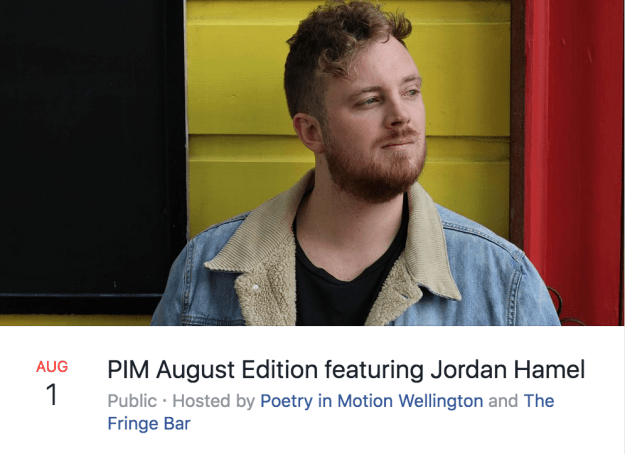
Poetry Shelf noticeboard: Jordan Hamel feature poet at Wellington’s Poetry in Motion

Screen Shot 2019-07-29 at 9.55.02 AM.png


Details here

Jordan grew up in Timaru on a healthy diet of Catholicism and masculine emotional repression. He fell in love with words the day his high school English teacher read a James K. Baxter poem aloud to the class. When he’s onstage he feels 27 years of anxiety slip away into the accepting embrace of a crowd who spend every day fighting their own silent battles.

Jordan has performed at festivals across Aotearoa and has had his poetry published in various literary journals, but he wants to publish a book sometime in the near future so a tangible piece of his vanity will outlive him. He has performed at LitCrawl Wellington, and is a performer and organiser of Welcome to Nowhere festival. He spends his spare time writing about pop culture and interviewing musicians, angry that his parents never made him learn an instrument as a child.

Evening begins, as usual, with an open mic.

Poetry Shelf Monday poem: Richard Langston’s ‘Sunday in the Islands’


Sunday in the Islands


A rooster crowed – the villagers in their black dresses

and tata, their black suits, white white shirts,

the flower of their devotion. A pig ambled in the rain.

Then they began to open their mouths

to listen and find one another,

they began to fill up the mystery,

to waken our souls.

This blending of human voices,

low and high and humming, and lifting.

They sang themselves out of themselves.

They summoned their dead from under garlanded mounds,

the bright sails of their embroidered names.

They sang them out of the depths of their ocean –

from their watery wrecks.

They sang for our brief moment here,

offered up this,

this shattering blue cathedral of song.


Richard Langston


Richard Langston is the author of 5  books of poetry: Boy (2003); Henry, Come See the Blue (2005); The Newspaper Poems (2007); The Trouble Lamp (2009); Things Lay in Pieces (2012). All published by FitzBeck. He works as a director for Country Calendar.

Poetry Shelf noticeboard: @pantographpunch Jackson Nieuwland reviews essa may ranapiri’s ransack

Screen Shot 2019-07-29 at 9.00.59 AM.png

Jackson Nieuwland reviews essa may ranapiri’s debut collection of poetry.

ransack is a landmark in Aotearoa publishing. A collection by an openly takatāpui/nonbinary poet, writing explicitly about queer issues and experiences, published by Aotearoa’s largest publisher of poetry. I and many others have been waiting for this for a long time, longer than we ourselves have even realised, and essa may ranapiri has delivered it for us: a book that speaks to our experience, a book full of beauty and pain.

go here. It’s a terrific review!

Poetry Shelf audio spot: Janis Freegard reads ‘Requiem’


internet res-8552.jpg


‘Requiem’ was first published in the Atlanta Review (USA) in 2017. (I wrote the first draft during a Kahini workshop on the Kapiti coast).


Janis Freegard’s most recent publications are a novel The Year of Falling (Mākaro Press, 2015) and a poetry collection The Glass Rooster (Auckland University Press, 2015). Based in Wellington, she is a member of the Meow Gurrrls poetry group and blogs occasionally.

Poetry Shelf Monday poem: Jeffrey Paparoa Holman’s ‘entrar en el silencio’ (in Spanish/English/German)


entrar en el silencio


entrar en el silencio que no es un silencio

restos de un zapato por boca de un eje

oxidado caldera a un tenedor en el arroyo

estanque de anguilas, donde desmanteló la draga

terminó su canción en un valle de escombreras

entrar en el silencio que no es un silencio


entrar en un silencio que nunca fue

las ruedas de un helecho de germinación lokie

una señal de tren vestido de líquenes

el signo de una mina donde los muertos

todavía persisten perdido a los amantes queridas madres

entrar en un silencio que nunca fue


introducir entonces el mundo sin llamar

la excavación de perforación sluicing tala

agricultura pesca arando un sueño

acarreando una isla de las constelaciones

en el resplandor de un reinado extranjero

introducir entonces el mundo sin llamar


entrar en el silencio entrar entrar la oscuridad

la colmena de la invitación entrar

la majestad Introduce el vino entrar

el desierto mientras que usted puede entrar en

con banderas y entrar con instrumentos

entrar en el silencio  entrar  entrar


enter the silence


entering the silence that is not a silence

remains of a shoe by the mouth of a shaft

rusted boiler at a fork in the creek

pond of eels where the dredge dismantled

ended its song in a valley of tailings

entering the silence that is not a silence


enter a silence that never was

the wheels of a lokie sprouting fern

a railway signpost clothed in lichen

the sign to a mine where the dead

still linger lost to lovers dear to mothers

enter a silence that never was


enter then the world without knocking

digging drilling sluicing felling

fishing farming ploughing a dream

hauling an island from the constellations

into the glare of an alien reign

enter then the world without knocking


enter the silence enter the dark enter

the hive of the invitation  enter

the majesty enter the wine  enter

the wilderness while you may  enter

with flags and enter with instruments

enter the silence  enter  enter


geben Sie die Stille


Eingabe der Stille, die keine Ruhe

bleibt eines Schuhs durch den Mund einer Welle

verrosteten Kessel mit einer Gabel in den Bach

Teich von Aalen, wo der Bagger abgebaut

beendete seine Songs in einem Tal der Tailings

Eingabe der Stille, die keine Ruhe


geben Sie eine Stille, die niemals war

die Räder eines Lokie Sprießen fern

ein Eisenbahn Wegweiser in Flechten bekleideten

das Zeichen, um eine Mine, wo die Toten

noch verweilen, um die Liebhaber lieb Mütter verloren

geben Sie eine Stille, die niemals war


Geben Sie dann die Welt, ohne anzuklopfen

Graben Bohrungen Schleuseneinschlag

Fischerei Landwirtschaft Pflügen einen Traum

Schleppen eine Insel von den Sternbildern

in die Blendung einer fremden Herrschaft

Geben Sie dann die Welt, ohne anzuklopfen


geben Sie die Stille einzugehen die dunkle eingeben

der Bienenstock der Einladung geben

die Majestät geben Sie den Wein geben

die Wüste, während Sie können eingeben

mit Fahnen und mit Instrumenten geben

geben Sie die Stille geben geben


from an unpublished series called ‘Wild Iron’


Jeffrey Paparoa Holman is a Christchurch poet and a writer of non-fiction, and senior adjunct fellow in the School of Humanities and Creative Arts at the University of Canterbury. Born in London, Jeffrey immigrated to New Zealand in 1950, growing up in the Devonport naval base in Auckland, then the coal mining town of Blackball on the West Coast of the South Island. He has worked as a sheep-shearer, postman, psychiatric social worker and bookseller.

Jeffrey’s poetry collection As Big as a Father was longlisted for the Montana New Zealand Book Awards (2003). In 2007, Jeffrey and Martin Edmond won the Copyright Licensing Limited Award giving them $35,000 each towards a non-fiction project. Best of Both Worlds: The Story of Elsdon Best and Tutakangahau, was published by Penguin in 2010. Jeffrey was the 2011 Waikato University Writer-in-Residence and in the same year shortlisted for the Ernest-Scott History prize, Australia. In 2012, he was awarded the Creative New Zealand University of Iowa Residency. The resulting book, The Lost Pilot: A Memoir was published by Penguin NZ (2013). In 2014, Jeffrey travelled to Berlin on a Goethe-Institute scholarship, pursuing research for his current project, a family history based on links with his German relations.

Jeffrey’s SHAKEN DOWN 6.3: Poems from the Second Christchurch Earthquake was published by Canterbury University Press in 2012. His most recent collection, Blood Ties: New and Selected Poems was published by Canterbury University Press in 2017.

Poetry Shelf review: Bob Orr’s One Hundred Poems and a Year

9780947493837.jpg


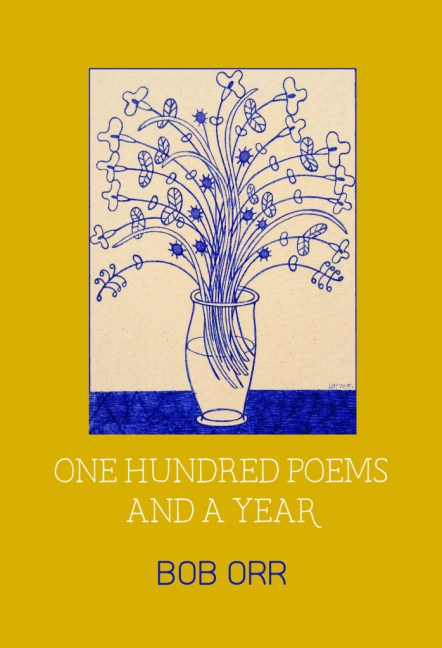
Bob Orr, One Hundred Poems and a Year Steele Roberts, 2018


Consider this book of mine

as if it were a rucksack


containing what you might need

if you were to step outside your door.


There are poems heavily knitted

as fisherman’s jerseys


in case you should find yourself

all at sea.  (…)


from ‘Rucksack


Bob Orr was born in the Waikato. He worked as a seafarer on Waitematā Harbour for 38 years and now lives in a cottage on the Thames Coast. In 2016 he received the Lauris Edmond Memorial Award for Poetry and in 2017 was the Writer in Residence at the University of Waikato where he wrote most of One Hundred Poems and a Year, his ninth collection.

The book looks gorgeous – beautiful cover design with an oxygenated font and layout inside. Everything has room to breathe. Barry Lett’s exquisite drawing of ‘Blue Flowers’ on the cover is revisited in a poem.


Because sometimes you

remind me of a Catalan fisherman

these are the blue flowers of the Mediterranean


***


With a felt-tip pen

bought in a supermarket

one day you created myriad blue stems


from ‘A vase of blue flowers’ for Barry Lett


The poems are equally full of air and verve. The opening poem, ‘Rucksack’, is a perfect entry point as it likens the collection to a rucksack you might take with you for the day. We can expect poems we might shower with; that favour the casualness of jandals, the toughness of tramping boots, bare feet. The poem’s final image flipped me. Bob’s poetry moves through the air, out in the complicated, beautiful world and then underlines human vulnerability with the final line’s ‘bare feet’:

I wrote them while walking down a road with bare feet.

The collection is steeped in the sea: you will find boats, sea birds, ocean harvests and harbours as Bob travels by land and by ocean. He travels in the present time and he travels back through the past, gathering in friends and places, other poets, beginnings and endings. Poetry, the writing and reading of it, is ever present as the world becomes a page, a script to be read, a poem to be crafted.


I mention the containers

of the Maersk Hamburg Sud or P&O Line


if only because my autobiography

 or even this poem


and the cargo it must carry

would be incomplete without them.


from ‘Autobiographic’


There is death and endings; there is marriage and beginnings.


This evening I fly back

a delta-winged moth


my sadness like moondust

my night vision glowing like an infra-red camera


a stranger to these parts

gliding between the bittersweet shadows of apartments


to enter again if only I could find them

the strawberry fields that were said to be forever.


How many times and for what purpose

did we have to break

each other’s

hearts?


from ‘A woman in red slacks’


I missed this book when it came out last year – and it is such a treasure. The fluid lines at times feel like the arc of a bird drifting across the sky and at other times draw upon the ebb and flow of the sea – always beautifully measured. Poetry has so many effects upon us – reading this book the effects are both multiple and satisfying. It comes down to music, intimacy and exquisite reflection, and an engagement with the world that matters. I love this book.


Steele Roberts author page


Poetry Shelf audio spot: Victoria Broome reads ‘The Heart of My Father’


cover 2.jpg


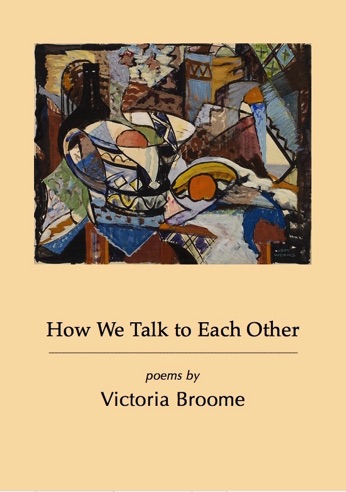
Victoria Broome, ‘The Heart of My Father’ from How We Talk to Each Other, Cold Hub Press, 2019


Victoria Broome has published poems in literary journals and anthologies, was awarded the CNZ Louis Johnson Bursary (2005) and has twice been placed in the Kathleen Grattan Award (2010, 2015). How We Talk to Each Other is her debut collection.


Cold Hub Press author page

Poetry Shelf review of How We Talk to Each Other


Poetry Shelf Monday Poem: Elizabeth Morton’s ‘You can’t, always’


You can’t, always


I’m not going to cry. All winter the television

sulks in the corner of our love. You put the lentils

in a colander to flush the ugly bits. You peel oranges

to their pith and talk about your past like it was mine too.

You say it was sunnier in Queens than it could ever be in

an unhappy kitchen with a lover made of feathers.

I want to tell you about the way a man can look down

a corridor, the way a hunter visits his scope. There are things

too big to ever fold into your hands. A barbule is enough

to demonstrate how even soft things fall down,

like small people from towers that trade in shadows.

When I say I need you, it clambers up a stairwell in my throat

like you were the only window left in 110 levels of pain.

I’m not going to say I get it. You toss the lentils

in a brine pot and power-up the television.

You say we spend too much of life watching

the kind of comedies that make you sad. Like Home Improvement

and The Cosby Show that make you think of time

and the way we were happy in Queens

before small people sat on window ledges, before

the hunter’s scope settled on an ordinary bird.

I’m not going to cry. All morning chopping onions,

watching Bill Cosby hug his wife in Brooklyn Heights

before he was a rapist, and before you first registered

towers on the skyline by their absence.

When I say I need you I am a soft thing falling

on something familiar, and it is violence

in the way dispassionate surgery is violence

or the way The Cosby Show is what you get

before you get what you never wanted.


I’ll take what I can.


Elizabeth Morton


Auckland writer, Elizabeth Morton, is published in New Zealand, Australia, Ireland, the UK, Canada and the USA. She was feature poet in the Poetry New Zealand Yearbook 2017, and is included in Best Small Fictions 2016. Her first poetry collection, Wolf, was published with Mākaro Press in 2017. She is completing a MLitt at the University of Glasgow, usually in her pyjamas.


Poetry Shelf noticeboard: National Poetry Day at UBS Canterbury


Screen Shot 2019-07-13 at 9.18.17 AM.png

National Poetry Day just seems to get better and better. What a genius idea UBS Canterbury!


66423352_2372831266134463_1768919999260393472_n.jpg


Poetry Shelf classic poem: Medb Charleton picks Janet Frame’s ‘I Take into My Arms More Than I Can Bear To Hold’


I Take Into My Arms More Than I Can Bear To Hold


I take into my arms more than I can bear to hold

I am toppled by the world

a creation of ladders, pianos, stairs cut into the rock

a devouring world of teeth where even the common snail

eats the heart out of a forest

as you and I do, who are human, at night


yet still I take into my arms more than I can bear to hold


 Janet Frame

from The Goose Bath, Vintage, 2006

(posted with kind permission from the Janet Frame Literary Trust)


Note from Medb Charleton:

The first time I read this poem it gave me that feeling only poetry can give, my nervous system was instantly held captive by the emotions generated and then freed as those emotions connected with my own lived experiences and ability to dream of life inside this mysterious art form.

Each line, in its weighted simplicity, its juxtaposed images, deciphers that moving and syntactically wonderful title. When I read it in more and more detail, I can see Frame’s musicality of diction with the effortless onomatopoeia, assonance, the line breaks, the repetition with which she somehow manages to weave the philosophical and moral themes that interested her.

A softness and beauty prevails even though adversity and disillusionment are present. The poet is willing to risk all, must in fact if she is to live, and with that very burden, one that she can barely carry, there is something of a pleasure and wonder in everyday things and the destructive capacity of the beautiful. Even she herself is accountable as you and I are. The world threatens to become too much. Not just the suffering, endurance and hardship in the world and in nature, but also its incredible creations, its mysteries – she feels it all intensely and it’s this unbearable weight that she holds.

The repetition of the title in the closing line, its gentle insistence, is both a plea and an acceptance of unattainable goodness with the hope that through this art of making, the poem itself, that she may find truth enough to absolve life’s cruelties, the weight of responsibility and bewildering unknowns and perhaps even be able to bear the pain or emotional intensity of beauty when found.


Medb Charleton grew up in Sligo, Ireland. She did an MA in Creative writing at the IIML in Wellington and since has published poems in Landfall, Sport, JAAM and online.

Janet Frame (1924-2004) published eleven novels, five story collections, a previous volume of poetry (The PocketMirror, 1967), a children’s book and a three-volume autobiography. She won numerous awards and honours, including New Zealand’s highest civil honour when she was made a Member of the Order of New Zealand in 1990. In 2003 she received the Prime Minister’s Award for Literary Achievement and was named an Arts Foundation Icon Artist. Pamela Gordon, Denis Harold and Bill Manhire edited The Goose Bath, Janet’s posthumous collection of poems in 2006.