Category Archives: NZ Literary Festivals

I agree! ‘Inaugural Ruapehu Writers Festival wildly successful’

IMG_3168

Helen Rickerby has just posted a slide show from the Ruapehu Writers Festival. And this:

‘We’re still on a high from the fabulous experience that was the inaugural Ruapehu Writers Festival in Ohakune last weekend. We were pretty sure it would be a fun and worthwhile event, but it exceeded our expectations in every way. Several participants, including Elizabeth Knox and Paula Green, said it was the best festival they’ve ever been to!

From the opening event on Thursday, which was opened with a karakia by Hune Rapana of local iwi Ngati Rangi and was MCed by Johnny Greene, Head of English at Ruapehu College, we started to suspect we were in for something special. As those of you who were there will know, on Friday, as more and more people arrived, we enjoyed session after session of articulate and brilliant ideas and readings. By Friday afternoon, the room we used for most sessions had reached its capacity of 80–100, and the spill-over people were lounging in the hallway or sitting on the deck, listening through the open French doors. Also through open doors we could hear the bubbling of a stream across the road, and a couple of times a day the speakers needed to pause for a few moments while a train went past on the nearby Main Trunk Line.’

For the rest of the piece and the slide show see here.

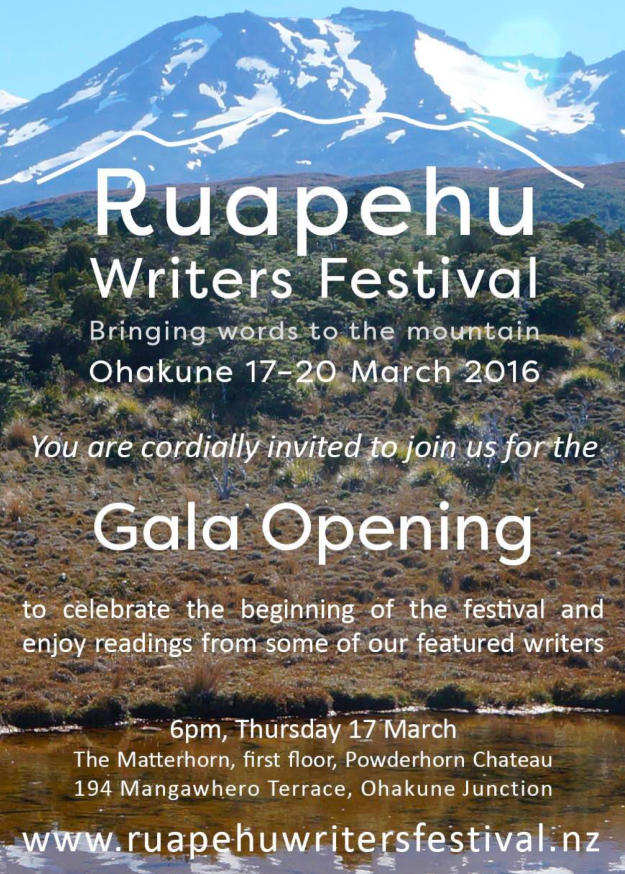
Ruapehu Writers Festival gala night

I am very excited to head off in the morning to this festival. Writers are coming from far and wide to touch base with Ohakune readers. It seems like no other festival with children doing a horse ride with Stacy Gregg, a waterfall walk, a bunch of writers doing the crossing on Monday (ah if only!), festival lecture by Elizabeth Knox, truck loads of poets and fiction writers, non fiction as well. Martin Edmond for a start.

Some writers are going as readers.

Not too late to plan a weekend by the mountain!

Loads of hard work by the organisers getting a festival off the ground for the first time.

So thanks! So good to see such a bustle of literary activity outside the main centres and universities.


Screen Shot 2016-03-15 at 7.55.23 PM.png

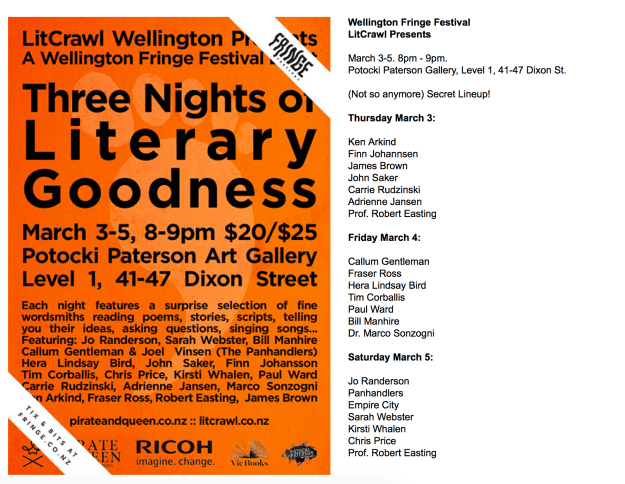
LitCrawlcomes back to Wellington like a juicy box of chocolates I see

LitCrawl is three nights of Literary Goodness. Each night is different, and every one is a juicy box of chocolates. Artists include: The Pandhandlers (as seen in Writing Tunes & Playing Poetry in last year’s LitCrawl), Bill Manhire, Robert Easting, Sarah Webster, Hera Lindsay Bird, Tim Corballis, The Empire City, Chris Price, Ken Arkind. Plus more.

When: Thurs 3, Fri 4 & Sat 5 March
Where: Potocki Paterson Art Gallery, Level 1, 41 – 47 Dixon St
Tickets: Get them! At the Fringe site here. Doorsales available if there’s room left.


Screen Shot 2016-02-18 at 4.16.21 PM.png

A new writers festival like no other: Ruapehu Writers Festival, Ōhakune, 17–20 March 2016


Ruapehu image with logo low-res


Tickets are on sale now for the country’s newest, and quirkiest, writers festival, to be held in Ōhakune in March. And even if you can’t make it, you can still be involved by donating to its crowdfunding campaign.


A pony ride with a popular children’s author, a literary waterfall walk, poets on bikes and a venue like something out of Twin Peaks: this doesn’t sound like the average writers festival. But then the first ever Ruapehu Writers Festival, which will be held in Ōhakune on 17–20 March, is not an average writers festival.

Locals and visitors alike will be able to enjoy a long weekend of events – including readings, panel discussions, workshops, sessions for children and a poetry slam – featuring 40 New Zealand writers, from the well-known to the up-and-coming. Tickets and season passes are on sale now, and a Boosted crowdfunding campaign to support the festival is running until the end of February.

Festival sessions include a Friday night lecture by award-winning novelist Elizabeth Knox, a fiction-writing workshop with Auckland writer Sue Orr and the pony ride with Stacy Gregg, the author of the popular Pony Club Secrets series. The setting will be acknowledged in a session about local history with leading non-fiction writer Martin Edmond, who grew up in Ōhakune, and local historian Merrilyn George, and another on the Desert Road.

Other well-known writers who can be heard at the festival include novelists Emily Perkins, Fiona Farrell, Nicky Pellegrino, Jenny Pattrick and Fiona Kidman and poets Paula Green, Harry Ricketts, Tusiata Avia and James Brown. Local writers are also being included, such as novelist and Taumarunui High School teacher Antony Millen, and editors from four of New Zealand’s literary presses will talk about what they look for in new writing. The complete programme is available on the festival website.


The festival is the brainchild of poet, lecturer in English literature at Victoria University, and 2016 Katherine Mansfield Fellow Anna Jackson . She and her husband Simon Edmonds, owner of Tuatua café, have a house at Rangataua, next door to Ōhakune. “We realised that Ōhakune, half way between Auckland and Wellington, is the perfect place to hold a writers festival. While many people visit during winter for skiing, it’s at its most beautiful in summer. And the local community has been so enthusiastic about having this event in their town.”

Joining Jackson and Edmonds on the organising committee is poet and Seraph Press publisher Helen Rickerby. She says, “This is going to be an informal and fun festival, and I think the fact that it’s being organised by writers has given it a different approach.” Jackson says she expects readers and writers involved to come out of the session still talking about some of the ideas and books discussed. Readers and writers will also have chances to meet each other and keep talking about ideas on the waterfall walk – free for anyone to come along.


The festival will be based at the Powderhorn Chateau, right next to the Ōkahune railway station. “It is a fantastic venue, with large spaces and two decks to relax on in between sessions. Being in an alpine forestry town, the hotel has log walls, which reminds me of the hotel in Twin Peaks – but less creepy,” Rickerby laughs.

Tickets are on sale now, with earlybird season passes at just $90 (until 6 February) and individual sessions at $14, with concessions also available.


Edmonds says, “It was important for us to keep prices low, so as many people as possible could afford to come. We have some funding from Creative NZ, but we hope people will support our crowdfunding campaign so we can pay for accommodation and travel for the guest writers, who are generously donating their time.” Because Boosted contributions are eligible for a tax credit, donors will get 33 cents back from every dollar they donate.


  • Donate to the Boosted crowdfunding campaign.
  • Find out more about the Ruapehu Writers Festival and buy tickets here.


Media:

  • For more information contact Chris Wilson on 04-463 9498, 021 0525 300 or chris.wilson@vuw.ac.nz, or Anna Jackson at anna.jackson@vuw.ac.nz.
  • To interview the organisers or any of the participating writers, email anna.jackson@vuw.ac.nz.
  • Profiles and photos of participating writers are available on the festival website.
  • A media kit, including downloadable logos and images, is available the festival website.

Poetry Highlights at Wellington’s Writer’s Week in March

For the full programme see here but this is the poetry on offer.


I would love to go to the Laureate Circle but can’t make it at this stage (might just fly down on a whim!). I would really like to post pieces on any of the poetry events at the festival. Any takers?


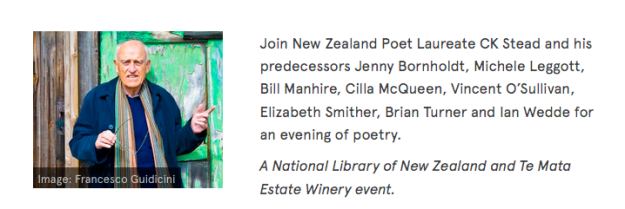
Friday March 11th 7pm  A Circle of Laureates

Screen shot 2016-01-30 at 9.48.49 AM


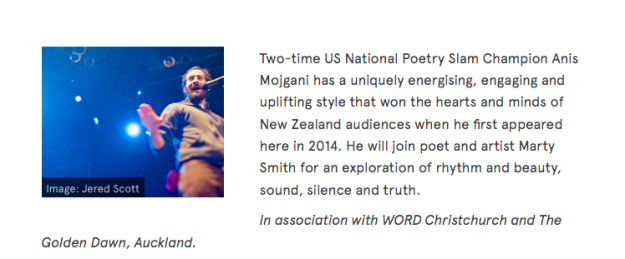
Friday March 11th 5pm   Anis Mojgani and Marty Smith

Screen shot 2016-01-30 at 9.55.17 AM


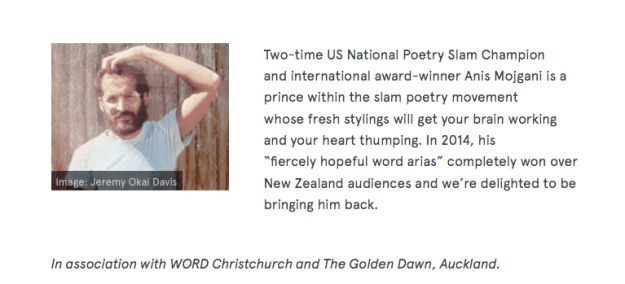
Thursday March 10th 1.45pm Anis Mojgani

Screen shot 2016-01-30 at 9.57.28 AM


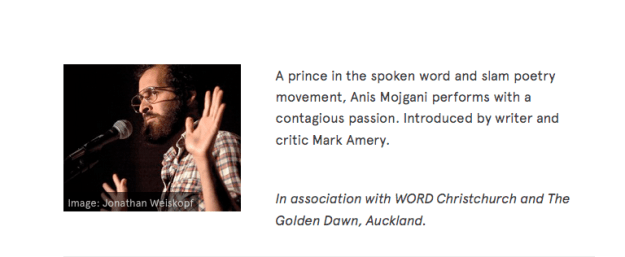
Sunday 13th March 2.30 pm  Anis Mojgani with Mark Amery

Screen shot 2016-01-30 at 9.59.20 AM


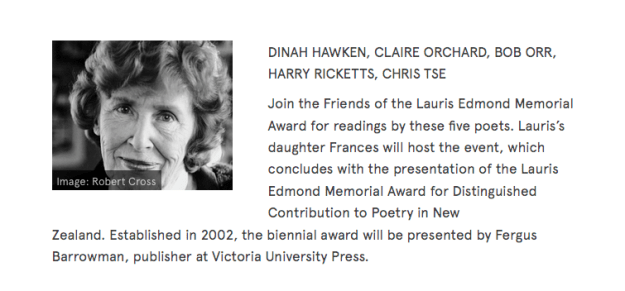
Saturday 12th March 3.30 pm Five Poets and a Prize


Screen shot 2016-01-30 at 10.00.52 AM

Ruapehu Writers Festival Fundraising Campaign

Message from Victoria University:

We are planning a Ruapehu Writers Festival for 17-20th March. It’ll be the first of its kind in the Ruapehu area. The inspiration behind it came from wanting to take literary festivals out of the metropolitan areas and into small town New Zealand. Our rural towns, mountains, rivers and landscapes have inspired some remarkable writing and we want these words to be heard in the places that inspired them. We also want to inspire a new generation of readers and writers.

But we need your support to make this idea happen. We’re launching a fundraising campaign today to raise the funding we need to get the festival off the ground. We have secured some funding from Creative NZ and we’ll raise some income from selling tickets, but we still need another $7,000 to make the festival happen. So we’re asking our community and supporters to get on board and donate any amount you can, big or small, through our Boosted website here. You can read more about the festival there too.

Please help us make the festival a huge success – every donation, big or small, will make a huge difference. Your donations will be tax deductible as the website is run through the Arts Foundation so you’ll get a receipt.

And please help us spread the word by sharing on social media and telling your friends and family, and of course buy your tickets to come along too! You can buy tickets here.

Thank you!

Cheryl Spain
Development Manager – Faculties of Humanities, Social Sciences and Education
Victoria University
Phone: 04 463 6479

Winner announced at AWF- Sarah Broom Poetry Prize 2015


 Diana Bridge

Wellington poet Diana Bridge was announced as the winner of the Sarah Broom Poetry Prize at the Auckland Writers Festival on Sunday 17 May.

Bridge has published five collections of poems, the latest of which, Aloe & other poems, came out in 2009. She was awarded the Lauris Edmond Memorial Award in 2010, for her distinguished contribution to New Zealand poetry, and her essay, “An attachment to China” won the 2014 Landfall essay competition.


The award-winning Irish poet Vona Groarke was guest judge for the prize in 2015. She describes Bridge’s poems as “colourful and playful, but also careful, thoughtful and wise.”  “There is a kind of fierce beauty to this work, alongside its rigorous intellect and formal grace.” Bridge accepted the $12,000 award at the Sarah Broom Poetry Prize event.


“I am overwhelmed and proud to be the recipient of an award set up to honour the work of Sarah Broom”, she says.

“I like to think that a tiny particle of her courage served to stiffen my spine the day I chose the poems I sent off. For I picked poems not in the hope that they might just work in a New Zealand context, or in what I imagined might be the context of the competition. I chose the poems that mattered most to me.”

“So – in went the story of Arjuna, from the Hindu text, the Baghavad Gita; in went a poem that was a response to the whole – prolific – output of the formidable professor of poetry at Oxford, Geoffrey Hill; in went a poem called ‘The Henrys’ that tackles all those terrible medieval and Tudor executions we have been subjected to in print and on the screen in recent years.”

“I am excited that we are ready for poems that spring from anywhere on the globe.”

The prize, now in its second year, was established to celebrate the life and work of Sarah Broom (1972-2013), author of Tigers at Awhitu and Gleam.


Vienna-based Alice Miller and Wellington’s Ashleigh Young were also shortlisted.


Diana Bridge
Bridge, who has a Ph.D. in Chinese poetry, has worked on the China-based poems of Robin Hyde and published an essay, “O to be a dragon”, and a Translation Paper, “An Unexpected Legacy: Xie Tiao’s poems on things”.  She is at present working on the translation of a selection of classical Chinese poems.

Vona Groarke writes: “Whether it is the violence of medieval history, the engagement with nature, or a re-imagining of Ovid that is the subject, Diana Bridge’s poetry has authority and elegance. Technically sophisticated, this work is complex but never obscure; lyrically charged but never sentimental. It is unflinching in its observational commitment, but also enjoys its ability to fashion unusual and arresting imagery. There is a kind of fierce beauty to this work, alongside its rigorous intellect and formal grace. In a description that rings true of much of her work, her poem ‘Prospero’s Stones’ notes, ‘driven phrases that lap /around each other’: this is a poetry that is linguistically alert, but that also remembers to ply sound and meaning into the kind of poetic weave that is colourful and playful, but also careful, thoughtful and wise.”


#AWF 2015 A Letter to Poetry Shelf: Laurence Fearnley on being a Festival Chair

This is a terrific letter — open, honest, generous, thoughtful and it is the mark of the kind of writer Laurence is, the kind of woman she is. I was at her session, and yes, I felt uncomfortable at the point she got heckled. For the audience, for the other panelists and for Laurence herself. To be honest, I was sitting in the front row, and because I could almost reach out and touch the speakers, at times I almost started joining in! Truely, I had to stop myself and say, no I am NOT on this panel! That is a measure of the vitality of the conversation. Yes, there might be ways to improve as chair (I always feel this no matter what I do!) but this session sparked all kinds of thoughts in my head. All credit to the chair. I was also utterly impressed with Laurence’s level of engagement with the work. When someone takes time out to read your books and to think about your books it is incredibly moving (not all chairs do this!).

I think there are many ways to be a chair. We are all different as this glorious festival demonstrated. You had the nerves and infectious enthusiasm, that utter passion for poetry from John Campbell, and the ensuing poetry conversation with Carol Ann Duffy. A special occasion indeed. You had the measured way of Jim Mora that welcomed the general reader as much as the writer when he spoke with Tim Winton. Equally special. You had the sparkling reach of Noelle McCarthy in conversation with Helen Macdonald. Gold! All different, all producing different kinds of vital conversations. These are all professional talkers so does it make a difference when the chair is a writer?

I like the fact Laurence asks for help here. Perhaps the festivals could build a short list of experienced chairs willing to briefly mentor (answer the questions of) fledgling chairs. In a reply to my festival post Laurence poses some of the questions she might ask.

What about the heckler? I agree with the points below wholeheartedly,  but I have been guilty of this to the point I ended up on the front page of the Sunday Star Times and was hounded by reporters. At the now infamous session that Kim Hill chaired where she was rude to the international panelists, and talked at length without allowing them to speak, I yelled at her from the back “We have come here to hear three fabulous writers speak, not three fabulous writers under attack.’  Etched in brain. The audience stood and clapped in unison. I felt like I was going to faint. You had to be in the room to understand what happened. Perhaps I am responsible for this new species of festival hecklers. I am the hugest fan of Kim’s radio show, her interviews are the best but I felt a line was being crossed. I guess Kim has never forgiven me. I was rude. Alice Sebold hugged me. There is always a price when you speak out publicly, even as a heckler.

It all comes back to that word that Eleanor Catton floats: kindness. We need kindness. We need critical debate. But we don’t need to knock the stuffing out of people. Read the article  I posted before this one on reviewing books.

If I could, I would reach and give Laurence a hug. Thanks heavens someone did. I admire your courage enormously.

Paula Green


Hi Paula

You raised the issue of chairing in your blog and I’d like to reply. At the weekend I chaired a session ‘Art of the Novel’. Despite having been a writer on upwards of 50 panels, it was my first time as a chair for a group of novelists and the combination of my inexperience, nerves, and over-enthusiasm (and probably over-thinking) proved to be a a disaster. Twenty minutes into the session an audience member started heckling me. I couldn’t hear what he was saying but it was soon communicated that I was talking too much and interrupting.

As the Auckland festival becomes larger I can see problems concerning chairing increasing. Audience members clearly have little tolerance for poor chairs so dissatisfaction will increase.

There are some fantastic, skilled chairs out there (Fiona Farrell, Paula Green, Kate de Goldi, Jolisa Gracewood, Emily Perkins to name a few I have had the pleasure of meeting) and I was wondering if there might be value in including a back-stage, 40 minute chairing session at the start or end of each festival day for people like me who have not chaired a panel, or for people who feel a little rusty. I know we are sent notes on chairing (which I re-read, believe me) but it would have been fantastic for my nerves if I had been able to ask an experienced chair a couple of questions concerning problems I had. For example: reading the panelists works raised some complex ideas that I wished to discuss. How could I have communicated those questions, maintaining the complexity of the idea without the question becoming confused, and needing additional clarification or follow-up questions that interrupted the writer? I am sure, that with your experience, you would have ideas on how to tackle those problems.

So, would any of you be prepared to offer help in this way?

I don’t think heckling is the answer to shaking up a poor session. I think it creates a flee or fight response in the chair, makes the audience apprehensive (is it a one-off heckle, is the audience member nuts and will continue heckling, what impression is this making on the panelists), and the panelists uncomfortable (because they are usually nice, sympathetic people).

After my panel – when I had already got the message – a woman came up to me, grabbed my arm and snapped, “learn to button your lips.” It was a shit remark, coming at the end of a bad session, and surplus to requirements. Thank God for the kindness of Stephanie Johnson, Jill Rawnsley and Charlotte Henry.

Laurence Fearnley


What I loved about the Auckland Writers Festival

photo

John Campbell called to the audience to applaud Eleanor Catton’s publisher, Fergus Barrowman. Terrific!

Some musings ….

1.This year I was part of the programme for schools and families at the festival and what a joy that was. I have already written about this on my blogs but the two School Days are a gift to Auckland City. To have the ASB Theatre packed to the brim with students ranging from Year 7 to Year 13 (over the course of the days) was extraordinary. I sat in the audience on Day 2 and was surrounded by a hubbub of book chat on what had been seen and what was coming up. These students were inspired not only to read and write and think and puzzle and ponder and feel and laugh– but also to face the big issues on how to exist in the world as a human being. This is the power of words—the way they can move and transport and shape us. The way we can be challenged. To have a long snake of a queue of students telling me they LOVED poetry with such enthusiasm after my session was a tick for NZ poetry. As Rick Stein says about local food producers: ‘We need more of this!’  See my post here.

2. The inaugural free family events in The Herald Theatre were a hit. Children clustered in the foyer to hear my favourite picture-book author read (Kyle Mewburn) and more! And pack into the theatre itself to witness the word wizardry of the Etherington Brothers along with others. I made up poems of the spot with the 5 to 10s and it was oohs and aahs from the parents as magical words spilled out into the air. It was fun and warm and energising.

3. The number of free events is also a gift to Auckland City. It is an open invitation to everyone to join in this celebration of ideas, stories, experiences, traditions, discoveries in conversations at local, national and international intersections.

4. The extraordinary opportunities to see some of the world’s and New Zealand’s most beloved writers- think Alice Walker for a start, then Keri Hulme, Eleanor Catton, Lloyd Jones, Sam Hunt, Patricia Grace.

5. I missed sessions—if only I could zip back in time and see them but here are some of my highlights (you just can’t see everything and it was such a gloriously eclectic programme!). What stood out for me were the electric combinations of chair and interviewee– that moved the interview into the realm of conversation. And some outstanding readings.

Eleanor Catton in a scintillating conversation with John Campbell. The blood pumping through was fueled by a shared passion and deep engagement with books, ideas, humanity. John started by saying, ‘The morning you won Ellie, there was a spring in the national step.’ Ellie had correctly guessed his star sign off stage (Libra) which was a terrific way to start. When John asked if she believed in astrology she said she was cautious about dropping an A Bomb too soon in case she lost the audience’s respect! These were some of Ellie’s standout comments: I value wonder, curiosity, belief. People who trust in relations are strong people in the world (that ties in with Patrica Grace’s view!). The difference between precision and pedantry is one of my dinnertime conversations. A mark of true feeling is if you speak it and people feel uncomfortable. Good ideas are always born out of bad ideas. I am grateful for the way Maori enable a connection with ritual. I’ve learned on the road how few forums there are for conversation (she is not asked to develop any strong statements she makes such as the way women are interviewed differently). Nobody can feel creative unless they truly believe there’s no right answer. Screwing up is impossible. You get older but the novel doesn’t; it’s funny, a snapshot of how you thought. You give pieces of the conscious, subconscious, unconscious. John wrapped it up by saying, ‘None of this seems to have corrupted you and we are really proud of you.’ It was one of those sessions where you walked out uplifted.

Elizabeth Knox was in dazzling form (rightly so, Wake and Mortal Fire are magnificent) and in conversatin with David Larson. Some gems include: In a YA novel you can’t deprive readers of hope. Wake is Mortal Fire‘s dark twin. When you put people in difficult situations, they can be amazing. My underbrain does a lot of thinking. As a girl I was very awake; now I am much more muted. I was always trying to flee from what the critic said. Silly. But now my toolbox is very big.

Cornelia Funke and I had a wonderful day exploring my favourite west-coast haunts. These two gems from her session stuck with me: You have to bottle up the magic and let it brew. The best things are not always loved by the majority.

Jim Mora to Alexander Smith-McCall: ‘You are very unusual writer because of your warm heart.’ Indeed! This was a session that filled us with warmth and laughter.

Hearing Caoilinn Hughes read from her terrific poetry collection (sadly I missed Alice Miller‘s reading as I was out west). It’s not just the Irish accent that gets you but the heavenly tilt of the words themselves. I did not want her to stop. See my review of Gathering Evidence here. Listen to her read on Kim Hill here.

Going to Siobhan Harvey‘s poetry launch. See my write up here.

I only got to hear half of Alice Walker in conversation with Selina Tusitala Marsh as I had to dash to the green room but it was utterly moving. This is some of what I took with me: The subjugation of women is what drew readers to The Colour Purple and the question, Who is God? At 70, I have been working for 50 years for women. The feminine is lacking in global power– we need a radically different system. Revolution has to start in your heart with tenderness; you have to feel your own pain, as John Lennon said– not just blood, bombs, name calling.

Hearing Adam Johnson read. He started by saying, ‘I am going to read this from deep in the novel so it won’t make sense.’ He started reading and you were immediately transported. Astonishing.

Hearing Tina Makereti read from her wonderful novel where The Rēkohu Bone Sings. How I love this novel–so to hear her read in her melodic tones was such a treat. See my review here. Then Fiona Kidman read from hr new book, The Infinite Air. I got so caught up in it, in the voice and the pace–I could hear poetry running through the bloodline of the words (as I had with Tina’s). This is now on my must read list. I missed the other two readers sadly.

AM Holmes and Paula Morris was a genius pairing. Effervescent conversation that took you in countless glorious directions. Here are some of my favourite gateways to thought: I just gather the outsiders and hold them close. I think of myself in positive and negative ways as a very American writer. The future is going to be what you can imagine (on teaching writing). I eat more if I inhabit a man (on writing male characters) — I like writers different from me. I will not run away from what a character brings up (on self censorship); I take risks.

Eimear McBride was a startling wondrous discovery. To hear her read from A Girl Is a Half-Formed Thing was to hear what extraordinary things fiction can do when the writer is bound by nothing beyond her desire to tell stories. This from Eimear: I want to bring language back to before thought becomes clear. There is a wider truth you tell about yourself when you write fiction. They are anonymous– and they are anonymous to themselves (on her characters lack of names). A good healthy sense of failure is an important part of being a writer. My interest in poetry is in its licence and how it’s bigger than the words on the page. I had to make language something else to try and express emotions and feelings (on women’s writing).

Finally Patricia Grace provided a high note as an end note. She read beautifully and engaged in a delightful conversation with her former publisher Geoff Walker. What a fitting author to honour. The room filled with her warmth and wisdom– her humanity. Some high points for me: I like to write about communities, relationships. For a long time I didn’t know what writing was as we didn’t have a model. I really appreciated Katherine Mansfield but she was removed from me by time and class. Ever since I have started writing, it has been about ordinary, everyday lives of people — and I still do this. Everything belongs to the characters- the themes, language, setting, stories. Having a lot of characters is a feature of indigenous writers. We belong in families and in the community of ancestors. I was aware I was going to write about people who had rarely been written about. Writing is very important to me– if I couldn’t write I’d be much poorer.

And there it is. If we couldn’t engage with stories as both readers and writers we would be all the poorer. If we couldn’t hear our poets sing and if we couldn’t trace the pathways of our thinkers and our ever changing knowledge we would be all the poorer.

It is a gift to Auckland that the festival hosts such a fertile occasion where we come to share and engage with one another. As both a reader and a writer, I thank Anne O’Brien and her hardworking, visionary team from the bottom of my heart. Thank you!



Emma Neale on being shortlisted for the Sarah Broom Poetry Award

This is a terrific piece of writing. Emma offers us a moving tribute to Sarah, her love of her poetry and a poem– amongst other things.

‘Now that I am settling down a bit from the giddy whirl of the Auckland Readers and Writers Festival, I want to repeat here how much admiration I have for Michael Gleissner and the other trust members who set up the Sarah Broom Award. To do this so soon after losing Sarah must have taken an enormous amount of energy and focus at a very raw and vulnerable time. I know from all the positive feedback and well-wishing I was lucky enough to receive even as a short-listee, that the wider poetry community has been highly aware of the award and the chance it offers to local poets.

It was a hoot to meet Sam Hunt at the session, and Kirsti Whalen showed really professional slam-background confidence. I’ve owned Sam’s poems since I was 13: though back then I didn’t have a clue what all the fuss about love and desire was. Adults seemed tortured by such bizarre emotions. Sam not only takes poetry to the people but also does a mean tap dance — look him up on YouTube. Also his interview on National Radio about the Sarah Broom Award is a marvellous recording. It’s the kind of radio that makes you forget how to multi-task. You just end up frozen in place, dishcloth at the window, struck in an attitude of intense distraction.’

See the rest of Emma Neale’s post here.