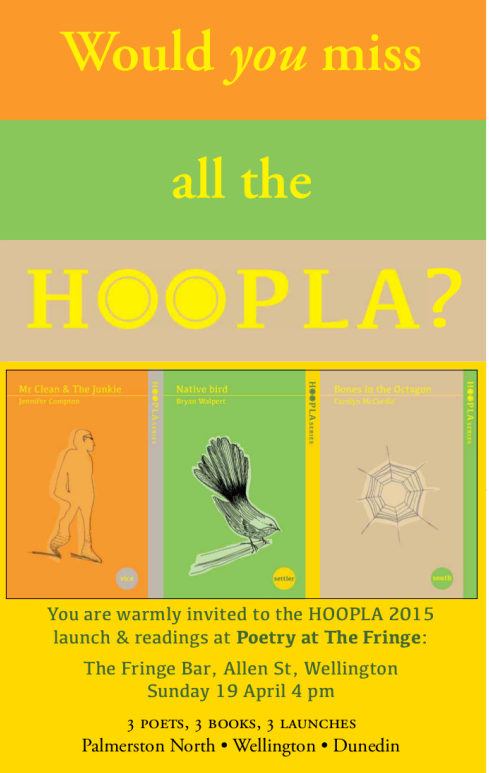
Would you miss the HoopLa ?
Leave a reply

Our current NZ Poet Laureate, Vincent O’Sullivan, has edited Best NZ Poems 2014. It is an eclectic taste of why New Zealand poetry is so very very good at the moment. Congratulations!
Here is a taste of Vincent’s introduction:
“Last year I joked, more accurately than I realised, that there are now more publishing poets in New Zealand than there are commissioned officers in our armed forces. And that was before I considered the three thousand poems that turned out for inspection in 2014. There’s at least a clarity if we’re just noting numbers. But talk of poetry may quickly fall into generalisation and defence of a corner, when it comes to poems that interest us deeply. We are always reading towards the elitism of our own taste, whether or not we quite put it like that. Geoff Page, the editor of the excellent Best Australian Poems 2014, wryly picks up on this when he writes, ‘Our time on earth is finite, and we are invariably hierarchical.’ It’s not a big step from there, of course, to the necessary corrective that we are always teetering on the verge of possible error.
Inevitably then, the discomfort other editors too have felt with that title, ‘Best Poems’. I wish it weren’t called that, because I have never heard a compelling argument to take it seriously. As a philosopher might say, it is a ‘category error’. Instead, what you have are twenty-five poems that I admired when I first came on them, continue to admire as I read them again, and am fairly certain that next time round they will still attract me with the particular kind of attention they give to how something is said, or for their technical elegance, or for the finally indefinable lift that good poetry provides. But let’s not make out that anything more definitive than personal choice is going on. One reader’s shortlist may be another reader’s rejects. Yet what a privilege, and a celebratory one, to be handed the chance to invite readers, ‘Look at these, look at their variety, their elan, their vigour—isn’t that something?’”
Full introduction here
Contents here
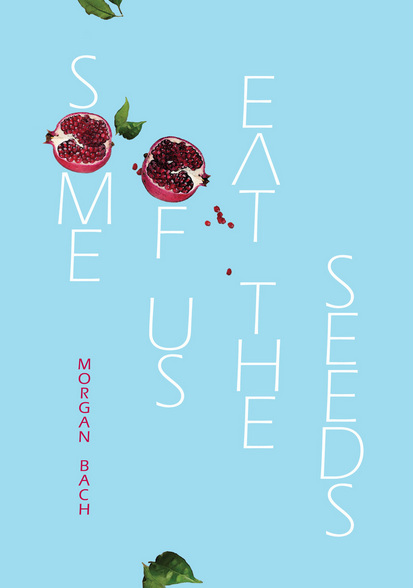
I can’t wait to read this new offering, a debut poetry collection by Morgan Bach, coming soon from Victoria University Press. What an adorable cover.
Morgan Bach’s author page is here.
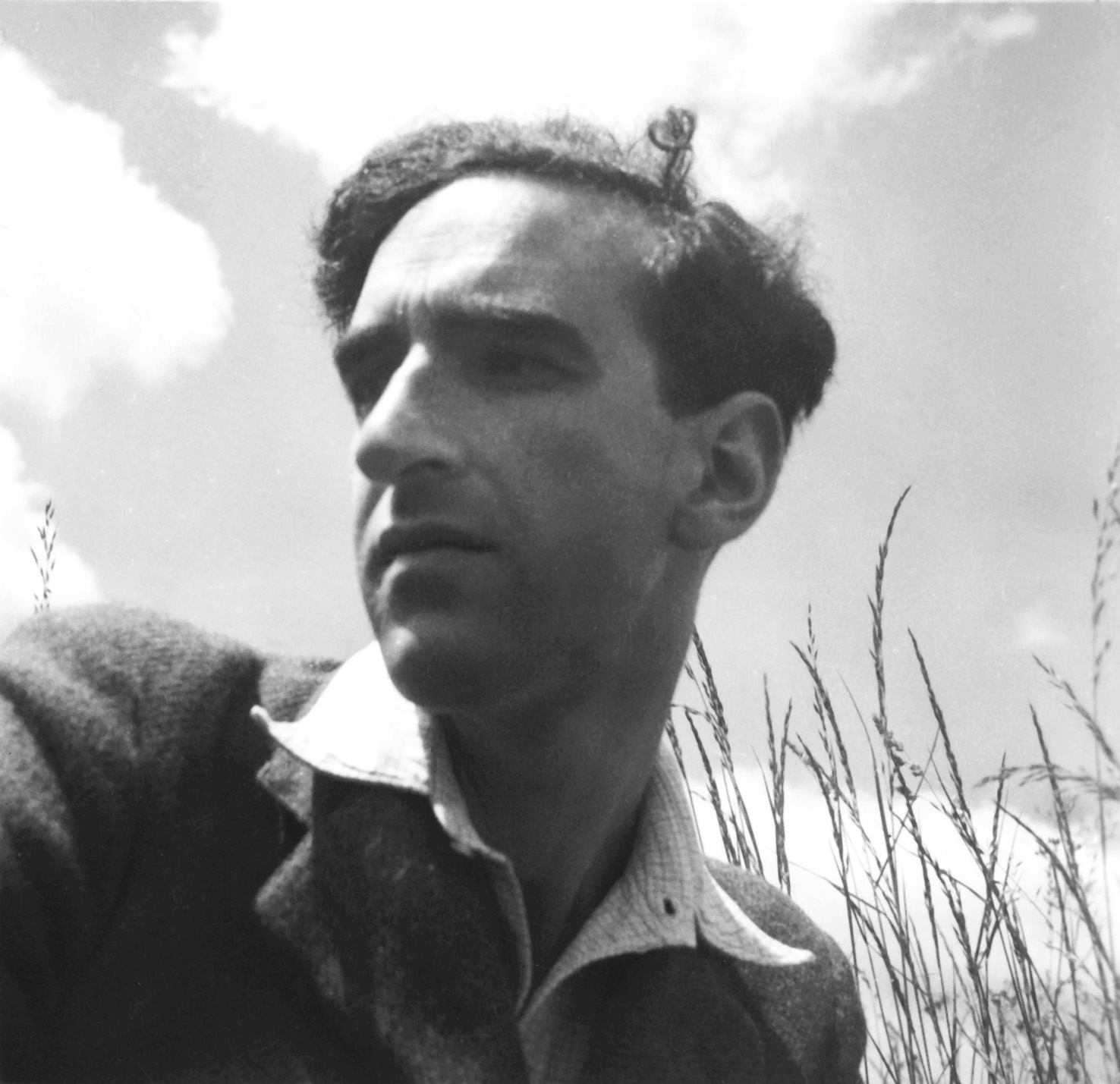
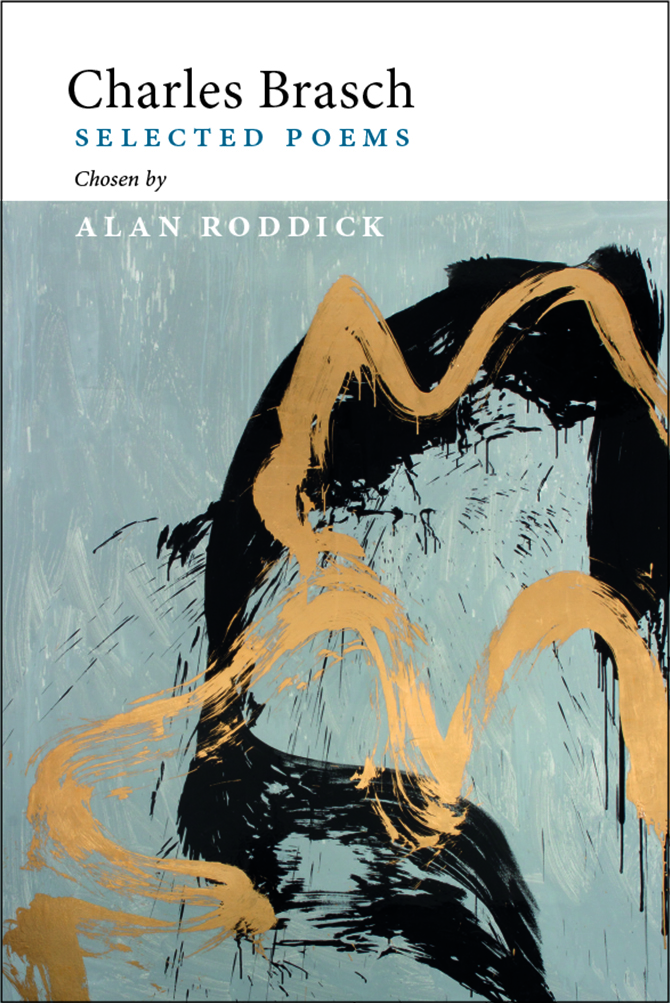
Charles Brasch: Selected Poems edited by Alan Roddick, Otago University Press, 2015
Poet and scholar, Alan Roddick previously edited Charles Brash’s posthumous collection, Home Ground (1974) and his Collected Poems (1984). Charles published a number of collections in his lifetime, mentored younger poets and was the founder and initial editor of Landfall. With his books all out-of-print, this is a timely arrival. One of New Zealand’s most influential literary journals, Landfall has represented poetic trends over decades, and continues to endure with renewed vitality (currently edited by David Eggleton), but it is interesting to step aside from this legacy and explore Brasch’s own poetry. He was a contemporary of RK Mason and ARD Fairburn and was selected by Allen Curnow for A Book of New Zealand Verse in 1951. For many poets, this was a sign of having made it. For Brasch, it knocked back some of the self doubt and sent him traversing new poetic paths. It was indeed a turning point.
One fascination of a selected poems is the way they cover the arc of a poet’s life and, in particular, writing life; the way poems reflect interior changes, and the way a changing world rubs against the process of writing. Charles’s first collection, The Land and the People, was published in 1939 with looming threats of war and world instability. He wrote with an initial attachment to the Romantics but by the 1970s his poetry was freer. The language is less tied to loftiness, to the abstract, to tight rhythms. He writes in plainer language, everyday language, yet you still see resolute connections with the subject matter of his first book: the land and the people. In many ways, the poetic arc of Alan’s selection lays its roots in Brash’s attachment to home, and the poem becomes a frame or form for a navigation of this. A homage at times. A questioning of sorts. Charles held the war at arm’s length, he held the rumpus of the 1960s at arm’s length (you don’t see him in Big Smoke, the anthology that highlights the radical poetry of the 1960s and 1970s). In his last decade or so, he is not rupturing form and content across the page in ways that SHOUT and displace. He is splitting his poems in ways that promote new revelations, new confessions whilst always maintaining his private stance. Love is there; love is struggled with and acknowledged but it is never overt, never clear.
from ‘In Your Presence’
I practise to believe,
And work towards love.
How should I see
Until I study with your eye?
He is unafraid to bare the self portrait in ‘Cry Mercy’:
Getting older, I grow more personal,
Like more, dislike more
And more intensely than ever —
People, customs, the state,
The ghastly status quo,
And myself, black-hearted crow
In the canting off-white feathers.
I was interested to discover that he worked on one of his most famous poems, ‘The Islands’ (originally published in his second book in 1948) for twenty years until he felt like he got it right. This is the poem that contains one of the most often quoted lines in New Zealand poetry:
Everywhere in light and calm the murmuring
Shadow of departure; distance looks our way;
And none knows where he will lie down at night.
The poem that has always resonated the most strongly with me is the sequence ‘Home Ground’ (from his last book, bearing that title) and a substantial part of the sequence is reproduced here. The language is sumptuous yet affords a degree of plainness. Individual lines stall and haunt you (‘I tramp my streets into recognition’). It feels open. It feels like writing this poem mattered greatly to the poet because it draws upon what matters. And within that, as with much great poetry, there is space, silence, mystery.
Silence will not let him go
Entirely; allowed a few notes
At the edge of dusk
He will be recalled before long
And folded into rock
Reassumed by the living stream.
Otago University Press have produced a terrific anthology with care taken over internal design and the cover. There is room for the poems to breathe both in terms of font choice and white space on the page. Alan’s introduction is useful but I do think there was room for more discussion of the poetry itself despite the witty inference in Charles’s ‘Pistol Point’ that poems ought to speak for themselves (‘Poems ask their own questions’). Selected Poems is a terrific introduction to Charles’s poetry; particularly to the way his poems shifted over time, on his own terms, and not at the behest of current poetic trends.
Endnote: I have a policy on this blog of using the first name of a poet. This is the first book I have reviewed by one of the key men poets who emerged in the mid-twentieth century in New Zealand, and it feels like I am transgressing a line by not using ‘Brasch.’ It feels like I have invited him into my kitchen to have a cup of tea informally. ‘Authority’ has sailed out the window.
Otago University Press page here
Gregory O’Brien’s terrific discussion with Kim Hill on the book here
NZ Book Council author page here
Afraid of falls?
We spent our childhoods upright. We rose asleep.
We rose silent, when our breaths were taken.
We sat on the mat, and were told to sit up.
There was so much to learn.
In the weekends, though, my brother
went into the bush behind the house
and he came back talking of the waterfalls.
Oh take me, take me to the waterfalls,
I promise not to fall.
Fruit fell. Whole lawns were carpeted!
Fell, and rotted where it fell.
In the end, we rose apart.
But I remember the waterfalls,
and I remember how the world was so much with us.
© Anna Jackson I, Clodia, and Other Portraits Auckland University Press, 2014
Author’s bio:
Anna is the Programme Director in the English Department at Victoria University. She has published five poetry collections, including Thicket, which was shortlisted for the New Zealand Post Book Awards in 2011.

Author’s note:
When I was little I found it strange that you could “sit up” or “sit down” and the sitting would still be the same either way. I’ve also always loved Chris Price’s poem “Rose and Fell” and how its title makes such a strangeness of the phrase “rise and fall” by placing it in the past tense. So this is a meditation on rising and falling, and on childhood as a time before a fall, when instead of falling asleep you might rise asleep, and keep on rising.
We lived in Titirangi until I was seven, and my brother did go into the bush, and he did come back talking about the waterfalls.
Paula’s note:
This poem is like a little sonata pivoting upon the word, ‘fell.’ Then again, it is as though a word, ‘fall,’ is elbowing a pinhole in the dark expanse of memory to let the light of childhood through. Playfully. Childhood becomes a riff on falling (and rising), and there is a delicate, addictive humour in the overlaying words (‘oh take me, take me to the waterfalls,/ I promise not to fall’). The image of the childhood wonder is made more pungent by the carpet of rotting fruit, the stench of abundance and plenty (time, dreams, play).
The book that contains the poem, Anna’s latest, lifts from the previous collections. It is a book of portraits, and here, in this example, the portrait of a child(hood) might be invented, misremembered, once lived, fleetingly real, achingly so. It was no easy task picking a poem that stood out for me in this book (I am waiting to get a copy of Catallus so I can follow Anna’s reading map as I reread the poems to review). The lift and play of each line is glorious, the image equally so. I have donned the cotton dress of my younger self and the lift and fall moves beyond the gold nugget for ear and eye to that of elusive self. A little sonata that haunts and plays again.
Auckland University page
New Zealand Book Council page
Poetry Shelf interview
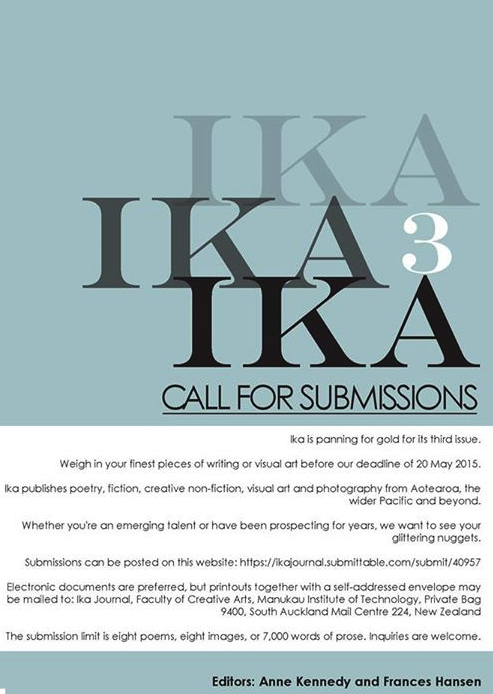
Weigh in your finest pieces of writing or visual art before our deadline of 20 May 2015.
Ika publishes poetry, fiction, creative non-fiction, visual art and photography from Aotearoa, the wider Pacific and beyond.
Whether you’re an emerging talent or have been prospecting for years, we want to see your glittering nuggets.
The submission limit is eight poems, eight images, or 7,000 words of prose.
Submissions for Best New Zealand Poems 2015 are open from 1January 2015 and must be received by 15 December 2015.
What to submit
When to submit
How to submit
Postal submissions should be directed to:
BNZP editor
c/o International Institute of Modern Letters
Victoria University
PO Box 600
Wellington
New Zealand
Email submissions of individual poems or a small selection of poems should be submitted, preferably as attachments, to: modernletters@vuw.ac.nz.
Whether posting or emailing, please include the following information with each individual submission:
The place and date of publication of each poem submitted (including web links if relevant).
Your name, email and the poem title on each page you submit.
I had the pleasure to be a judge for The National Schools Poetry Award a few years ago and think it is a terrific feature of our writing landscape. Aside from the competition, the Wellington workshops are a great opportunity for young writers passionate about poetry and song writing to come together. I endorse this proposed campaign strongly. In my experience, writers came from all over New Zealand, under the umbrella of poetry, to share, to develop and to take off in myriad writing direction directions.
This just out from IIML:
The National Schools Poetry Award was set up by Bill Manhire in 2003. Last year we had to cancel the Award due to a lack of funds. This year Creative New Zealand has given us half what we need to run a full Award. To make up the shortfall we’re launching a Boosted fund-raising campaign. For most of the decade the Award has been running, we’ve been in the wonderful position of having private sponsors (Bell Gully at the start, then NZ Post). Times are tough and now we’re looking for wider support. We’ll be sending out links soon.
In the meantime here’s a great testimonial from Vanessa Scott, Head of English at Pakuranga College: ‘I believe this Award has lifted the profile of poetry within the school and shown the school community how young people can excel in literature and the arts, and that these achievements are just as valid as those won on a rugby field.’


