

‘We are making our grandchildren’s world with our words. We
perceive a world in which everyone sits at the table together, with enough for everyone.
We will make this country great again.’
Joy Harjo from ‘Advice for Countries, Advanced, Developing and falling’ in An American Sunrise (2019)
A weekend in Wellington is always a treat – especially when there are writers and readers events on. I had a blue-sky, social-charging time and I loved it. Laurie Anderson on the Friday night delivered an improvised platter of musical quotations with a handful of musicians that together created a wow blast of sound and exquisite individual turns on percussion, strings, keyboards. Ah transcendental. Just wonderful. Read Simon Sweetman‘s thoughts on the night – he describes it far better than I can.
One bowl of muesli and fruit, one short black and I was all set for a Saturday of listening to other authors. First up Coming to our Senses with Long Litt Woon (The Way through the Woods) and Laurence Fearnley (Scented). Laurence is on my must-read stack by my reading sofa. Her novel engages with the landscape by way of scent, sparked perhaps by by her long interest in the scent of the outdoors. I loved this from her: ‘Writing about the South Island is a political act – I’m digging my heels in and see myself as a regionalist writer’. I also loved this: ‘I’m not a plot-driven novelist. I tend to like delving into sentences. I like dense descriptions. I imagined the book as dark brown.’
Next went to a warm, thoughtful, insightful conversation: Kiran Dass and Jokha Alharthi (Celestial Bodies). Fabulous!
And of course my poetry highlight: Selina Tusila Marsh in conversation with USA Poet Laureate Joy Harjo. I had been reading Joy in preparation for my Poetry Live session and utterly loved her writing. This is how I introduced her on Sunday:
Joy Harjo is a performer, writer (and sax player!) of the Muscogee Creek Nation. She’s the current US Poet Laureate with many awards and honours and has published nine poetry collections, a memoir, a play, produced music albums. She lives in Tulsa Oklahoma where she is a Tulsa Artist Fellow. Reading Joy’s poems, words are like a blood pulse as they question and move and remember – in place out of place in time out of time. I have just read Conflict Resolution for Holy Beings and An American Sunrise. This was what I was thinking when we have to endure the multiple offensiveness of Trump in our faces even at the bottom of the world to pick up Joy’s poetry is a balm that takes you behind and beyond and above and below into a different USA and it is heartbreaking and wounding and the poems might be like rooms where you mourn but each collection is an opportunity for breathtaking body anchoring travel that allows you to see and feel afresh. Joy’s poetry is so very necessary, If you read one poem this weekended read ‘How to Write a Poem in a Time of War’ from An American Sunrise.
But if you went on Saturday night you got to hear Joy read a good sized selection of poems, including the poem I mention above! Joy’s response to her appointment as the first Native American Poet Laureate in USA: ‘a profound announcement for indigenous people as we’ve been so disappeared. I want to be seen as human beings and this position does that. Human beings write poetry. Even if it’s oral, it’s literature.’
So many things to hold close that Joy offered: ‘No peace in the world until all our stories have a place, until we all have a place of respect.’
She suggested we could think of poems as ‘little houses, little bird houses for time grief joy heartbreak anything history what we cannot hold. Go to poetry for times of transformation, to celebrate and acknowledge birth, to acknowledge death. We need poetry.’
Joy: Indigenous poets are often influenced by oral traditions – a reading voice singing voice flute voice more holistic.
Joy: You start with the breath. Breath is essentially spirit.
Joy: You learn about asking, asking for help.
Joy: Probably the biggest part is to listen. You have to be patient.
Joy: The lessons get more intense.
Joy: If you are going to listen to a stone, what range is that?
My energy pot was on empty so was in bed by 8 pm, and so very sadly missed Chris Tse’s The Joy Of Queer Lit Salon. From all accounts it was a breathtaking event that the audience want repeated.
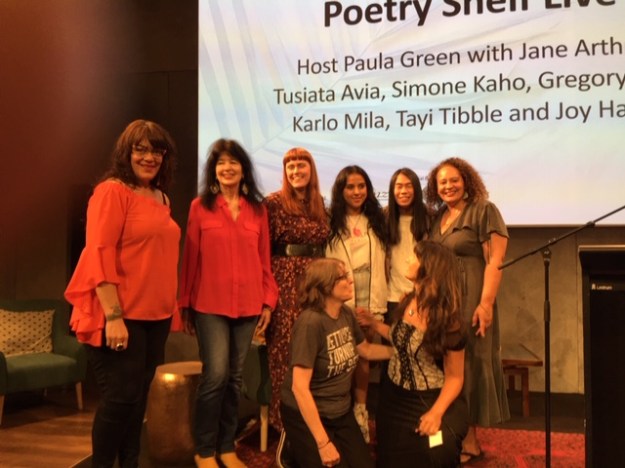
Sunday and I hosted Paula Green’s Poetry Shelf Live. Lynn Jenner was unwell (I was so looking forward to hearing her read as her inventive and moving Peat is so good). My dear friend Tusiata Avia was in town coincidentally so she stepped in and read instead along with Karlo Mila, Simon Kaho, Gregory Kan, Jane Arthur, Tayi Tibble and Joy Harjo.
I love the poetry of my invited guests and got to sit back and absorb. I laughed and cried and felt the power of poetry to move in multiple directions: soft and loud, fierce and contemplative. Ah if a poem is like a little house as Joy says, it is a house with windows and doors wide open, and we are able to move through and reside there as heart, mind and lungs connect.
A friend of Hinemoana Baker’s from Berlin came to me at the end crying and speaking through tears and heaving breath about how moved she was by the session. I got what she was saying because I felt the same way. I guess for all kinds of reasons we are feeling fragile at the moment – and poetry can be so vital. After four years of Wild Honey reading, writing, conversing and listening I have decided the connective tissue of poetry is love aroha. I felt and said that, ‘We in this room are linked by poetry, by a love of it, and that matters enormously’. I felt that at this session.
So thank you Wellington – for all the book fans who supported the events. For the poets who read with me.
I also want to thank Claire Maybe and her festival team. Claire has such a passion for books and such a wide embrace, you just feel the love of books, stories, poetry, ideas, feelings. Yes I would have LOVED to hear Elizabeth Knox, Witi Ihimaera, Lawrence Patchett and Kate Tempest (for starters) on at other weekends but this was a highlight of my year and I am so grateful.
‘Come on Poetry,’ I sigh, my breath
whitening the dark. ‘The moon is sick of you.’
We walk the white path made of seashells
back to the orange light of the house.
‘Wait,’ I say at the sliding door. ‘Wait.’
Hinemoana Baker from ‘manifesto’ in waha / mouth (2014)


ANNA IS DRIVING HER WHITE CAR & HER CAR IS CRYING
Home
Anna’s white car refuses to leave the driveway without shouting goodbye
to all of the titoki,
the camellias,
the silverbeet,
the letterbox,
the veranda,
the trampoline.
Desert
“Those flowers remind me of the blues,” says the white car,
“the sky is bruise bruise bruise,
the tussock is hair follicles of a blond boy.”
“What’s that couch doing on the roadside?” says Anna.
A battered brown leather three-seater.
Anna would wave out if there were people on the couch,
she would shout out “hey!” as she was driving past,
but there are no people on the couch,
no people with legs spaghettied,
no people with light-washed faces,
no people laughing at the television
or crunching Snax & kicking crumbs behind the cushions.
Motel
At the reception Anna pays two hundred & sixty dollars for the unit for two nights.
The motel room says, “Do you like my picture?”
“I like it that you’re clean,” says Anna, “I like it that the bed looks new,
there’s Sky TV, a bath, a toaster,
& the owner has given me a little bottle of milk.”
Anna sits down on the bed & looks at the acrylic painting:
“I like it that your picture is a beach scene,
but you’re beside a lake.
A beach scene is more impersonal than a lake scene,
because it’s not connected to the place we’re in;
it’s neither beautiful nor repulsive,
which is the perfect way for a motel picture to be.”
“But do you like me?” says the motel room.
“I like it that you represent an idea,” says Anna,
“you’re more an idea of a motel than an actual motel.
You’re sufficiently general not to make
any claims on me; I like that.
I like you for what you don’t remind me of,
rather than what you do remind me of,
but I don’t want to get too personal with you.”
The motel room does not tell Anna to “turn the fucking TV on”,
because it wants to delay the moment.
Pool
When Anna was a child she thought a monster lived in the lake
& when she & her sister splashed in the motel pool at night,
she imagined the monster rising & seizing her from the back
dark corner. These were the kinds of things that terrified her.
The motel, however, wouldn’t talk about bland things
to distract her like it does when she’s an adult,
instead it told her to look up from her Weetbix
at snakes corkscrewing around the curtain rails
& that the carpet would display its incisors,
chomp down on her toes & hold her there.
Lake
After Anna finishes talking to the motel room, she walks to the lake & along the path by the lakefront.
There are DANGER stones & stickmen falling off signs at the cliff lip.
Anna notices someone has scraped off some letters:
DANG, ANGE — DANCE!
The red bicycles chained to the fence beside the lake make Anna so sad.
She doesn’t know if it’s the paint
or the child’s bike lying on its chain
or the horror of discovering, when she steps closer,
the missing pedals, seats, handlebars,
which look samesame from far away, but become uncomfortably individual
as she zooms in.
Anna finds a spot by the lake edge to eat her kebab.
She concludes she will never find the perfect spot,
but the spot she finds is good enough,
against the trunk of a pohutukawa,
she sits & bites through her food.
As Anna eats the chicken, the beef, the hummus, the yoghurt, the lettuce, the chili sauce,
she watches a couple drop their clothes, watches the man run-hop that run-hop you do when the water’s cool. The woman’s wearing a black bikini, & after she stops shrieking, the man pulls her in close for warmth.
Anna takes a photo & posts it to Instagram. If you look carefully, you can spot the entwined couple carved into the cold water. Anna calls her husband. “Did you hear about Christchurch?” he asks.
Johanna Aitchison
Johanna Aitchison is a PhD candidate at Massey University, examining how contemporary innovative poets create cohesion in experimental verse. She was the 2019 Mark Strand Scholar at Sewanee Writers’ Conference in Tennessee, and her poetry has appeared, most recently, in Best Small Fictions 2019 and Poetry New Zealand Yearbook 2020.


Whenever someone reviews a book, and they have spent time reading, contemplating and questioning, I am happy. Reviews connect me with books I might want to read. Poet Emer Lyons recently reviewed my mammoth, maze-like book Wild Honey: Reading NZ Women’s Poetry (MUP, 2019) for Landfall Online.
I loved Emer’s review; it confirmed there is no single way to write one. Reacting to a book that celebrates 201 poets, Emer highlights those she made strong connections with (Heather McPherson, Hinemoana Baker, Tusiata Avia, Rhian Gallagher). I love that. Part of my aim was to write a book that sparked poetry interests in the reader – to encourage them to track down particular poets and find out more. Her review invites you into the experience of a particular reader, a little like a reading diary. Yes, give me a personal review over a detached, jargon-driven piece any day. Emer makes it clear that a personal approach can also be a critical approach (she is currently doing a PhD at Otago University). Both the personal and the critical can feed off thought and feeling.
The second thing I loved about Emer’s review is that it got me musing. I said in Wild Honey I would like to see a non-Pākehā woman write a book about Māori and/or Pasifika women poets. This is not apologetic nor guilt ridden but me believing I am not the best person for the job. I can’t, for example, wait to see Selina Tusitala Marsh’s volume on Pasifika women poets. Yet it was essential that my poetry house welcomed widely: across cultures, time and place, and writing preferences. I entered the poetry of others, regardless of difference, and listened. Slowly, slowly, slowly. I can never take my reading travels for granted. I hate the idea of being an authority.
Emer rightly suggested I didn’t make similar points about lesbian poetry. I didn’t state, for example, that I would like to see a not-heterosexual woman write a volume that presented lesbian poetry in new and significant lights – because I wasn’t the best person for the job. And I did not write about lesbian poetry (or sexuality or gender) as a particular focus. It is easy to claim this as one of the many things I did not do in the book but Emer’s argument really got me thinking and I loved that. This is what the very best reviews can do.
I felt invigorated by this review and for that I am grateful.

Bill Nelson reads ‘Red shift / blue shift’.
I wrote this poem after reading a popular science book about the fringes of scientific knowledge. One of those fringes is the size and trajectory of the universe. In the early 20th Century, scientists measured the way light shifts red, or blue, from distant stars. And with this, they discovered that the universe we can see is expanding, that it is big, damn big, and that it probably started with something like the Big Bang. They also discovered that because of the speed of light, we can never know beyond what we can see, and that the universe is ultimately unknowable. All really interesting stuff, but mainly I just liked how the colours were like codes for something else, codes that we just had to observe to unlock their meaning.
Bill Nelson
Bill Nelson has just returned to Wellington from Scotland and France, where he was on the run from authority. His first book of poetry, Memorandum of Understanding, was published by VUP. He is a co-editor at Up Country: A Journal for the NZ Outdoors and his work has appeared in journals, dance performances and on billboards. You can find more about him here.


Full submission (and aims) details
Kei Te Pai Press is now seeking submissions for their debut issue.
They will publish personal essays, prose, poetry, interviews and short stories, but not academic articles. They will also consider illustrations, videos, sound pieces and photography.
Indigenous writers and artists irregardless of experience are strongly encouraged to apply.
Please send any questions, thoughts and your submission to keitepaipress@gmail.com
Submissions are due March 16, 2020

Ah, I have loved so many poetry books published in 2019, so many of which could easily have made this shortlist ( I have no interest in hammering on about who is not here), but I felt a warm poetry glow that these four were picked. I spent a long time with each of these collections because they do what poetry does so well. They make you feel things, ponder the world, walk new tracks, make your body sway, refresh versions of the world, little and large.
I raise my poetry glass to Anne Kennedy, Helen Rickerby, Steven Toussaint and Ashleigh Young. Yep, this is a very fine shortlist.
Anne Kennedy
The thing in the jar
always dies!
The rice cooker steams
so the sun goes down
Deep in the house
sepia gathers
The pencil has eaten
the fragile book
from ‘Thirty-Three Transformations on a Theme of Philip’
I first read Anne Kennedy’s new collection Moth Hour (Auckland University Press) as a piece of music that traces the contours of grief. Words form little melodies, solo instruments sound out, there is echo, overlap, loop and patterning. Above all there is a syncopated beat that leaves room for breath, an intake of pain, an out-sigh of grief, an intake of observation, an out-breath of recognition. There is the fragile word-dance to the light.
Moth Hour responds to a family tragedy; in 1973, at the age of twenty-two, Anne’s brother, Philip, accidentally fell to his death. Anne, her seven siblings (she was the youngest and aged fourteen) and parents now lived with unbearable grief and loss, separately, diversely, as a family.
Like a mesmerising, lung-like piece of music, Moth Hour is a book of return-listening. Every time you place the poetry on the turntable of your reading you will hear something different. It blisters your skin. It touches you. But above all Moth Hour fills you with the variation and joy of what a lithe poet can do.
My full piece here
Auckland University Press author page
Anne Kennedy is a writer of fiction, film scripts and poetry. Her debut poetry collection Sing-song was named Poetry Book of the Year at the 2004 Montana New Zealand Book Awards. The Time of the Giants was shortlisted for the same award in 2006, and The Darling North won the 2013 NZ Post Book Award for Poetry. Her novels include The Last Days of the National Costume, shortlisted for the NZ Post Book Award for Fiction in 2014, and The Ice Shelf longlisted in the 2019 Ockham NZ Book Awards. She lives in Auckland.
Helen Rickerby
I slept my way into silence
through the afternoon, after days
of too many words and not enough words
to make the map she needs
to find her way from here
I wake, too late, with a headache
and she, in the garden wakes up shivering
from ‘Navigating by the stars’
Helen Rickerby’s latest poetry collection How to Live (Auckland University Press) is a joy to read. She brings her title question to the lives of women, in shifting forms and across diverse lengths, with both wit and acumen. Like many contemporary poets she is cracking open poetic forms – widening what a poem can do – as though taking a cue from art and its ability both to make art from anything and in any way imaginable.
Reading this book invigorates me. Two longer poems are particularly magnetic: ‘Notes on the unsilent woman’ and ‘George Eliot: a life’. Both function as fascination assemblages. They allow the reader to absorb lyrical phrases, humour, biography, autobiography, insistent questions. Biography is enlivened by such an approach, as is poetry.
‘How to live’ is a question equally open to interpretation as it ripples through the poems; and it makes poetry a significant part of the myriad answers. I haven’t read a book quite like this and I love that. The writing is lucid, uplifting, provocative, revealing, acidic, groundbreaking. The subject matter offers breadth and depth, illuminations, little anchors, liberations, shadows. I am all the better for having read this book. I just love it.
My full piece here
Poetry Shelf Audio Spot: Helen reads ‘How to live through this’
Poetry Shelf Monday Poem: Helen’s “Mr Anderson, you heartbreaker you’
Anna Jackson’s launch speech for How to Live
Helen Rickerby is the author of four collections of poetry, most recently How to Live (Auckland University Press, 2019). She likes questions even more than answers. Since 2004 she has single-handedly run boutique publishing company Seraph Press, an increasingly important publisher of New Zealand literature, focusing on poetry. Helen lives in a cliff-top tower in Aro Valley, and works as an editor.
Steven Toussaint
abide more tritone idle mode
the dominant’s a leaky still
for quiet divination
for every thought
a finger on
the fret-
board’s shifting centre
where nothing dearer
than the pure heart’s
purring minor
requires demonstration
from ‘Aevum Measures’
Steven’s Lay Studies (Victoria University Press) entrances on multiple levels; initially through the exquisite musical pitch and counterpoints, and then in the way heart and mind are both engaged. His sumptuous poetic terrain is physical, elusive, stretching, kinetic, mysterious, difficult, beautiful. Hearing the poetry read aloud is utterly transporting. An extract from our interview:
Paula: When I listen to the ‘regular pulse’ of ‘Aevum Measures’, I am not dissecting its craft, I am feeling its craft like I feel music before I react to other features. The reading experience might be viewed as transcendental – an uplift from the physical world and from routine. I am suggesting I let myself go in the poem. Does this make sense? And is it, on another level, a way of being spiritual in a ransacked world?
Steven: It makes a lot of sense, and I am gratified to hear that you could lose yourself in the music of the poem. What you describe sounds somewhat like Keats’ notion of ‘negative capability.’ That is to say, if the sonic architecture of the poem is doing its job, then the reader is ‘capable of being in uncertainties, Mysteries, doubts, without any irritable reaching after fact and reason’ at the semantic level. Not that the semantic level – what the poem is literally ‘about’ – is insignificant. The music would be thin and feeble without varied syntax, rich diction, logical continuity and metaphor. And yet, the poem’s semantic sense is ‘heightened,’ elevated out of the ‘horizontal’ realm of mere communication, information, or transaction by its participation in ‘vertical’ patterns of sound whose ‘meaning’ is intuitively felt, as a kind of felicity, but cannot be rationally reduced or summarised away.
And you hit the nail on the head when you point to the spiritual implications of this phenomenon. Walter Pater said that all art ‘aspires to the condition of music.’ Over the past several years, I’ve come around to a different a view. While writing Lay Studies, I fell under the influence of a number of Christian theologians of an Augustinian-Thomistic persuasion, especially Catherine Pickstock, to whom one of the poems in the book is dedicated. She suggests that liturgical doxology is the art toward which all others strive, a gesamtkunstwerk performing the narrative of salvation history. As such, the worshipper willingly submits herself to a mode of expression, praise, that is both recollective and anticipatory. The rhythm of liturgy – interpreted as a gratuitous gift, contoured by procession, repetition, and return – offers an implicit critique of the violence, entropy, and fatal self-enclosedness of historical time. I believe poetry can approach liturgy by analogy. A training in prosody might help us to see the world, ourselves, and our speech-acts sacramentally, as vertically conditioned by grace.
Steven in conversation with Karyn Hay RNZ National
Poetry Shelf Audio Spot: Steven reads ‘Aevum Measures’
Victoria University author page
Steven Toussaint, born in Chicago, immigrated to New Zealand in 2011. He has studied poetry at the Iowa Writers’ Workshop, the International Institute of Modern Letters and philosophical theology at the University of Cambridge. He has published a chapbook of poems, Fiddlehead (Compound Press, 2014), and a debut collection, The Bellfounder (The Cultural Study Society, 2015). His writing has also recently appeared in Poetry, Commonweal, The Spinoff, Sport, and The Winter Anthology. He has been recognised in the past few years by residencies at The University of Waikato, the Michael King Writers’ Centre and with a Grimshaw Sargeson Fellowship. He is currently pursuing graduate study in philosophical theology at Emmanuel College, Cambridge. Victoria University Press recently published his second full poetry collection, Lay Studies.
Ashleigh Young
If a waterfall no longer has water, it is a groove
that suggests a falling motion, just as this trail
suggests a walking motion
but if a person keeps walking until there is no more walk to take
they will no longer look forward to it, so will turn back.
from ‘Guide’
I have written about How I Get Ready (Victoria University Press) in Wild Honey so have tried not to repeat myself (in my review) or even refer to the poems I picked to talk about in the book! But Ashleigh became one of my sky poets for all kinds of reasons.
I like the shape of this book – this matters with poetry – because when a poetry book is good to hold it makes you want to linger even more, to stall upon a page. The book looks good, the paper feels good, and the cover drawing by Sam Duckor-Jones is a perfect fit. His idiosyncratic artwork moves in and out of reality, a person tilted by anxiety, the wind, both exposed and screened. A little like the poems inside the book. This is a collection of waiting, breathing, of curious things, anxieties, anecdotes, lists, found things, recycled words; little starts in your head as you read.
Every poem catches me! Some books you pick up, scan a few pages and then put down because you just can’t traverse the bridge into the poems. Not this one. It is as exhilarating as riding a bicycle into terrain that is both intensely familiar and breathtaking not. The speaker is both screened and exposed. The writing feels like it comes out of slow gestation and astutely measured craft. I say this because I have read this andante, at a snail’s pace. Glorious!
Poetry Shelf Monday Poem: Ashleigh’s ‘If so how’
Victoria University page
Ashleigh Young lives in Wellington and works as an editor at Victoria University Press. She is the author of Magnificent Moon (poems), Can You Tolerate This? (essays), and How I Get Ready (poems). She writes a fortnightly column in Canvas magazine and is the poetry editor at The Spinoff.
Full Ockham NZ Book Awards shortlists.
I am so chuffed (another warm word!) Wild Honey: Reading NZ Women’s Poetry has been shortlisted in the general nonfiction category. Never have any expectations when it comes to awards – just see it as a time to celebrate some of the great books we publish each year.
 NZ Poetry Shelf