Tag Archives: Victoria University Press

A Radio NZ National poetry interview: Megan Whelan and Tayi Tibble

Screen Shot 2018-06-05 at 8.53.21 AM.png


This is electrifyingly good! The book is out in July.  So in the meantime:


Victoria University Press page

Tayi’s Anzac Day poem at The SpinOff

Kaleidoscopes‘ at Starling

‘For a cigarette and a blanket‘ at The Wireless

Identity Politics’ at Poetry Foundation


Poetry Shelf Interview: Paula Green in conversation with Harry Ricketts


HR_004s.jpg

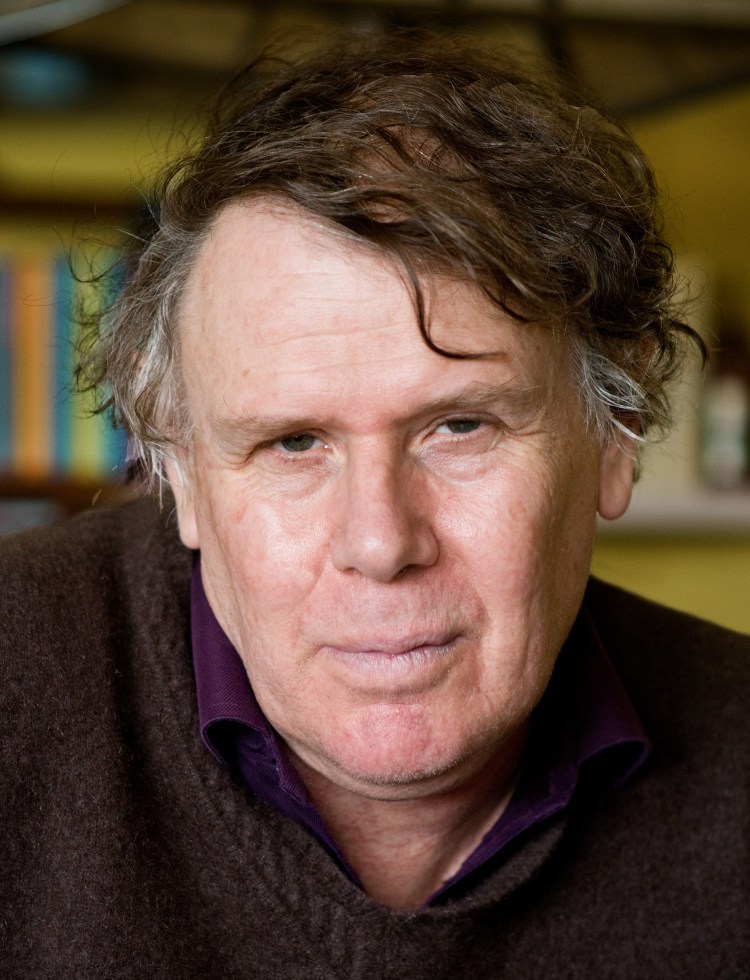
Photo credit: Robert Cross


Harry Ricketts teaches English literature and creative writing at Victoria University. His thirty plus books include poetry, literary biographies and essays. His biography, Strange Meetings: The Poets of the Great War, is a terrific example of how nonfiction can depend upon heart and intellect, deep scholarship and personal engagements. The war poets are illuminated with fresh insight, emphasis and connections. Harry’s latest poetry collection, Winter Eyes, relishes the power of language to do many things: to lay down musical chords, prismatic subject matter, personal revelations. The poems made me grin wryly, stop and reread, and on occasion weep. It was with great pleasure we embarked upon an unfolding email conversation.
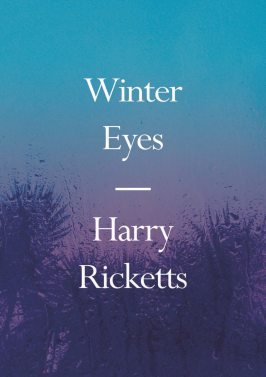
 

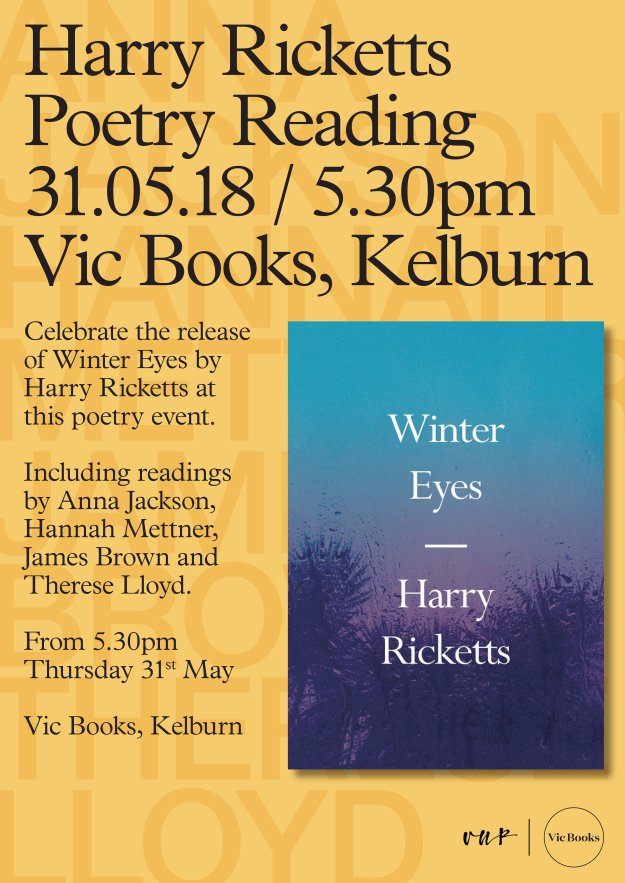
Winter_Eyes_cover__15974.1518725766.jpg

 Harry Ricketts, Winter Eyes

Victoria University Press, 2018


Talking about poetry


iv


The song strokes the past

like a boa, like some fur muff

or woollen shawl

but the past is not soft at all;

it’s rough to the touch

sharp as broken glass.


from ‘Song’


Paula: The first poem, ‘Song’, is the perfect entry into your new collection. The poem, songlike and exquisitely paced, turns in multiple directions. It favours the external alongside the interior, the strange alongside the everyday. Do you see this new book as a stretching out?

Harry: Yes I do in some instances. I certainly hadn’t written anything like ‘Song’ before. It was a poem which seemed to sing itself rather than having to be fetched. Quite often phrases or lines will come to me, and I’ll jot them down and come back to them and see if they’ll catch fire. I’ll usually do several drafts, fiddling around, chopping and changing, finding new possibilities. That wasn’t the case with ‘Song’. I wrote the first few sections all in one go; then later added a bit more, and it seemed to know when to end. A few of the other poems happened like that, too. I’m not sure the emotional topography is all that different, though.


She bites at the cheese scone

I’ve buttered and quartered, chews

slowly. ‘Yesterday,’ she begins,

‘it was whurr-whurr-whurr.’ Stops.

‘It was,’ I say. ‘But today

it’s calm and bright.’ ‘Yes,’ she agrees


from ‘Picnic’


Paula: The emotional topography is contoured and that is one of the reading pleasures. In fact some of the poems are acute emotional hits even though the strata of feeling is subtle. I am thinking of ‘Picnic’ and the mother observations that are restrained and tender. Or the word play in ‘Margravine Cemetery, Barons Court’ that almost becomes a haunting. To what degree are you putting yourself in the poems as opposed to a composite speaker?

Harry: I am mostly putting myself into the poems, or bits of myself anyway; they are all personal to varying degrees, even confessional, though I know for some people that’s become a degraded term. The ‘mother’ poems are about my own mother in a direct, if slivery, way. I suppose I’m trying to maintain one side of a conversation with her now that she can’t complete sentences any more. In a different way, I think that’s also true of the sequence about my late stepson. But in other poems a kind of transformation does seem to have occurred, and the speaker both is and isn’t me. I think that’s true of ‘Song’, ‘Margravine Cemetery’, ‘Fields of Remembrance’ and some of the triolets and tritinas. ‘S. 1974’, on the other hand, is straight ventriloquism.


This grave is a-tilt

As though the earth moved:

Agnes. Something. Faithful …


Red and yellow leaves steering down

The soft October afternoon.


from ‘Margavine Cemetery, Barons Court’


Paula: The mother poems work so beautifully, and I now realise why I felt like I was eavesdropping on intimate moments. I think the personal movement – this shifting from confession to shards to grey areas to ventriloquism – is what heightens the multi-toned effect of reading. Nothing feels like an exercise. There are the diverse currents of feeling but there are also the eclectic conversations. Could you see this as a collection of conversations that stretch out to place, family, incident, other writers?


Cape daisies mauve the hills, give me a spring

to the spirit my mother beside me will not hold

onto, any more than the rhododendron’s pink –

‘Oh lovely!’ She too was once in the pink,

a student in the black-out, and it’s spring,

and she’s in love’s stranglehold


from ‘Spring’


Harry: Yes, I agree, though I hadn’t quite seen the collection like that till you pointed it out. I think poems are forms of conversation with others, real and imagined, often conversations one would like to have had. Years ago, a friend and I used to play what we called The Dylan Game. We imagined ourselves in a railway carriage, empty except for us. The train stops at a station. Into our compartment steps Bob Dylan. There is no corridor; the next stop is twenty minutes away. What will we say to him and he to us? The game went on for some months till we realised we’d be so nervous and star-struck, we wouldn’t be able to say a word. Among the many other things poetry can do, it can fill some of that gap, with family, friends, other writers, fictional characters, the living, the dead. Those kinds of conversations have been an aspect of your poetry, too, haven’t they?

Paula: Yes, and I haven’t quite thought of it like that either. All those people that stalk through my poems! I like the idea of poetry inhabiting a gap, furnishing a gap almost – writing the gap. I am also struck how you stretch form in this collection. The ‘Grief Limericks’ are a case in point. Steve Braunias published these on The Spin Off and it has had a near record number of views. How did the tight rhyming form work for such tough subject matter? Are there other examples that you feel transcend form as exercise and catch something extra?


I once had a stepson called Max,

liked Gunn and Blood on the Tracks.

But things were askew,

were tangled in blue.

I once had a stepson called Max.


from ‘Grief Limericks’


Harry: The constraints of any reasonably tight poetic form can sometimes actually be a help in writing poems involving strong and difficult feelings. John Donne has a couplet: “Grief brought to numbers cannot be so fierce, / For he tames it, that fetters it in verse”, though I’m not convinced about the ‘taming’ exactly. ‘Grief Limericks’ is part of a sequence of elegies for my late stepson Max. As I say in the Notes at the back of the collection, I got the cue from Nick Ascroft’s ‘Five Limericks on Grief’ in his recent collection Back with the Human Condition, though I follow Edward Lear’s original format in which line one is repeated as line five. It’s the clash of the form’s comic associations and inexorable patterning with such unexpected subject matter. I don’t think of any of the triolets and tritinas in Winter Eyes as ‘exercises’. A few are meant to be playful in a mordant sort of way, but each is also trying to catch some flashing moment, some twist of feeling.

Paula: Yes! Repetition is such a lure; on the one hand it is a thing of comfort, it heightens feeling or relishes playfulness. The glare of the water in ‘Lake Rotoma’ cuts into the daily routine: ‘Mostly we eat, talk, drink and read.’  There is the flashing moment, the twist of feeling.

On the back blurb, poetry is offered as both comfort and confrontation. This works for me as I read through the collection. I don’t think I have seen these two words in partnership in a blurb and they really got me thinking about being both reader and writer. They explain why I love your book so much but also, and this surprised me, tap into my writing life. What do you want as a poetry reader? Did any books particularly stick with you as you wrote Winter Eyes?

Harry: I want many different things as a poetry reader. I want to be pulled into a world. I want to be startled. I want to be shown things. I want the hairs to stand up on the back of my neck. I want to be moved. I want to be amused. (I don’t want to be patronised, bullied or conned.) I dip in and out of a lot of poetry, ancient and modern, local and overseas. I was reading Airini Beautrais’s and Therese Lloyd’s poetry very intently during the two to three years I was writing the poems in Winter’s Eyes, because I was lucky enough to be one of their creative writing PhD supervisors. Their work has certainly stuck, as has Andrew Johnston’s Fits & Starts, Hera Lindsay Bird’s Hera Lindsay Bird, Nick Ascroft’s Back with the Human Condition and Chris Tse’s How to be Dead in a Year of Snakes. But there are various poets who are just part of my mental landscape, and some of them show up in these poems one way or another: W.H. Auden, Philip Larkin, Bill Manhire, Lauris Edmond, Derek Mahon, Wendy Cope, Andrew Marvell, Carol Ann Duffy …. songwriters like Dylan.


This ‘thinly plotted’ pantomime

must always end too soon.

There’ll be time, we say; there’ll be time

to rewrite our part in the pantomime


from “Hump-backed Moon’


Paula: What you want as reader sums up the effects I have had reading Winter Eyes. I was amused by ‘On Not Meeting Auden’, moved by the Max and mother poems, and got goose bumps as I read ‘Song’ and ‘Hump-backed Moon’. This multi-toned book takes you many places. Do you just write for the page? Or do you also write to read aloud?


Out there, all this hot, bright morning

the tūī working the flax,

white bibs bobbing up and down.

In here, it’s cooler and dimmer.

Deep in my English Auden

suddenly in your ghost again.


from ‘Love Again’


Harry: I usually write with the page in mind. I like the visual aspects of poems, the line-breaks, the verse-breaks, using syllabics as an organising principle or skewing a set form, all the possibilities of shaping words and rhythms on the page. The English poet C.H. Sisson, who wrote mostly in free verse, says somewhere that the proof of a poem is in its rhythm, not a fashionable view. I like poems that sing, particularly if it’s a broken song. I do sometimes think while working on a poem that it might go okay aloud or later discover that it seems to. ‘Song’ works all right aloud, I think; but ‘Love Again’, one of the elegies for my stepson, is quite compressed in places and is probably better on the page. It’s hard following a lot of new poems at a reading; it’s easy to lose track; you can’t stop and go back. My ideal poetry reading is where I know most of the poems already and can enjoy listening to how the poet reads them. Of course, some poets are mesmeric readers. Bill Manhire is. Seamus Heaney was.

Paula:  Jesse Mulligan interviewed Jane Arthur, the Sarah Broom Poetry Prize winner, last week and got her to read the same poem twice. I thought that was genius. So yes, when you hear Bill read ‘Hotel Emergencies’ or ‘Kevin’ or the Erebus poems after having read or even heard them before, you just feel more enriched. I have to say I really loved your reading at Miaow last year. I could feel the audience around me move forward and listen.

The process of writing a poem is so mysterious. Was there one poem in this collection that took you by surprise?

Harry: Thank you for what you say above. Very generous. Several of the poems took me by surprise. I was in the middle of a university meeting when the opening line of ‘Grief Limericks’ came into my head: “I once had a stepson called Max”. I hadn’t been thinking about him. ‘Good at Languages’, about my friend Nigel, started when I was, as in the poem, walking down the steps to the Von Zedlitz Building where I work. I heard this blackbird and instantly thought of him and the lines he would quote from John Drinkwater’s poem. ‘Napier, Christmas 2017’: we were driving to Napier and suddenly just before we got there way out in a field there was a sign saying “Shock your Mum. Come to Church” in huge letters, and I knew I had to write a poem around it. Actually, I think most of the poems took me by surprise, and I’m grateful they did.


Thank you Harry. It is always a pleasure to talk poetry with you.


Good at languages


(for Nigel, 1950-2008)

You were good at languages,

could play any tune by ear:

“Doesn’t it go something like this?”

you’d say, and so it did. Poetry

wasn’t your thing, but you had two

standbys you could always pull out.

The first you’d remembered

from Alec Annand’s A Level

English class. I was so impressed

the first time you produced it,

early one summer morning in 1970

as you drove us in your Morris Traveller

to the Ribena factory in Coleford

(“Gateway to the South”, you called it).

The pigeons as usual were eating

gravel off the road and clattering up

from under the wheels. And suddenly you came out

with “O sylvan Wye, thou wanderer

through the woods.” And there it was

down there below us, not in a poem,

but real, woody (and silvery), wandering.

This morning as I walk down the steps

from Glasgow St to Von Zedlitz

a blackbird starts to sing. Which was your other

standby (remembered from some other class):

“He comes on chosen evenings

My blackbird bountiful, and sings

Over the garden of the town …”

I can hear you recite the lines

with that slight grin in your voice.

It’s the palest shadow of you,

but for now, actually forever, it will have to do.


©Harry Ricketts 2018


Victoria University Press page

Radio National: Kim Hill and Harry Ricketts interview

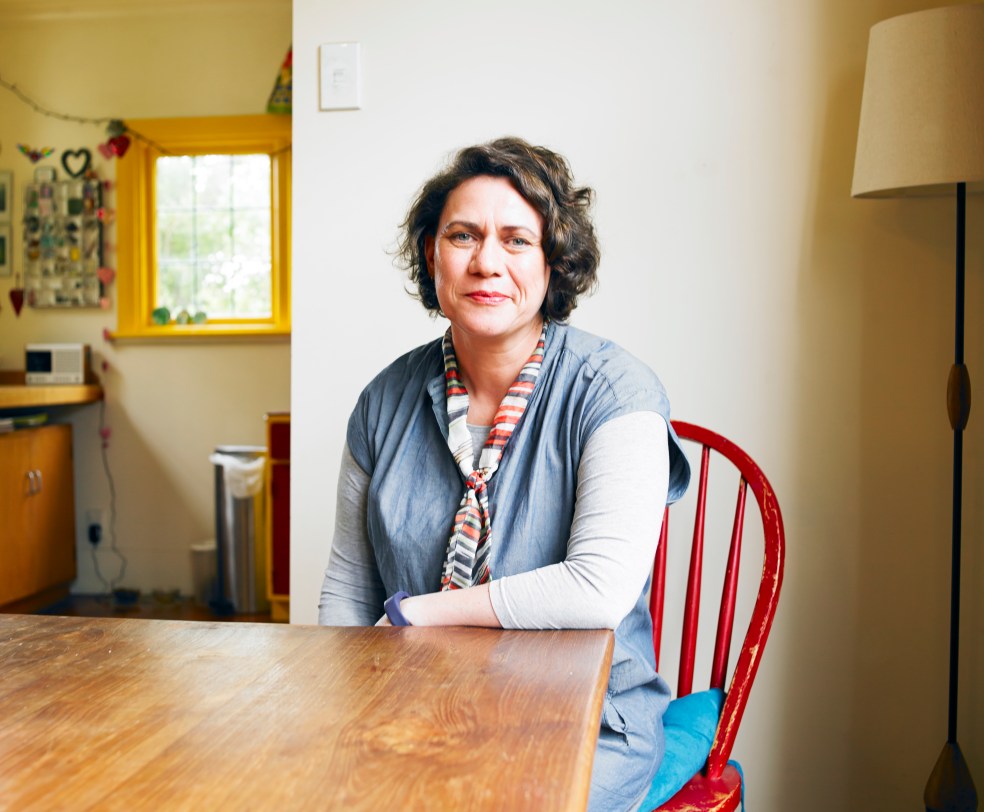
Poetry Shelf in conversation with Helen Heath


Helen Heath by Victoria Birkinshaw 2018.jpg

Photo Credit: Victoria Birkinshaw


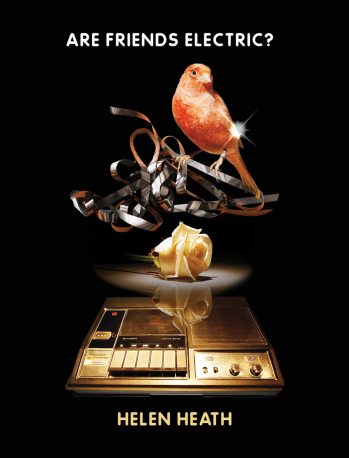
Helen Heath’s debut collection, Graft, won the NZSA Jessie Mackay Best First Book for Poetry Award. It was also shortlisted for the Royal Society of New Zealand Science Book Prize (the first poetry or fiction shortlisted). Helen has a PhD in Creative Writing from Victoria University of Wellington’s IIML. Her new collection, Are Friends Electric, is a poetic smorgasbord that offers diverse and satisfying engagements. To celebrate the new book, Helen and I embarked on an unfolding email conversation.


Are-Friends-Electric__83457.1522198652.jpg


The large electric that is you

is like the help that is you and

the mouth and the associated

kiss. The source is kind, simply

loved. Turning, my bird, turning

to view a scratched course.


from ‘Greg and the bird’


A slowly unfolding email  conversation


Paula:  The first poem, ‘Reproach’, starts with the word ‘you’. It is like an open invitation to enter the book. The next word jump cuts to ‘poet’ and from there to a reading hunger:


You. Poet. You’re hungry to be read


It is the best opening, the most audacious opening, to a book I have read in ages. Then as the poem curves and folds you end up at the footnote and the origins of the poem’s found text. I am reminded of the unreliability of language to represent reality. Tell me about the challenges you lay in the opening line and your experiences with Plato’s Phaedrus.


Helen: Thank you, I’m so glad you think so. The opening line is a response to the feeling of despondency I sometimes get when writing: ‘What’s the point?! Who even reads this?! This will all get lost and forgotten in time!!’ There is a famous passage in Plato’s dialogue Phaedrus where Plato recounts Socrates rejecting the invention of writing, believing it will strip our ability to remember and thereby an essential part of our humanity. Of course, the irony is that we know this because Plato wrote it down. Writing was an early technology and a similar argument is often put forward against various kinds of modern technology, such as smartphones or the internet, claiming they harm the development of memory or social skills.

Nicholas Carr wrote a now famous article in The Atlantic in 2008: ‘Is Google Making Us Stupid? What the Internet is doing to our brains’, which he developed into his book The Shallows. Giovanni Tiso wrote a thoughtful response to it on his blog. Technology can’t be separated from culture, it’s a cultural artifact, like language. “We shape our tools and, thereafter, our tools shape us.” — John Culkin (1967). This all circles back to the anxieties of the opening line and, as you rightly point out, the unreliability of language to represent reality. The poem attempts to wrap up anxieties surrounding the fallibility of language and writing with central themes of the collection.


Paula: Fascinating. The act of writing is itself a way of remembering and negotiating what is hard, elusive, necessary, puzzling. The list could go on! There are a number of found poems in the collection that stage you as first reader then writer. What attracts you to them?

Helen: It became impossible to separate the research from the writing in this collection. This book can almost be seen as a journal of reading and cultural responses. I was writing my way through some big ideas, trying to come to some kind of personal understanding. ‘Thought in motion’ is a phrase that comes to mind.

The other aspect of the found poems is the concept of literary and cultural intertextuality and how that can be seen as an analogue translation of hypertext and the internet as form. I am interested in poems that weave connected and reoccurring themes and ideas through their collections. In this book the poems reference other texts, popular culture, and each other, and (I hope) build up the reader’s understanding of the collection’s thesis incrementally.


Paula:


I am a woman and

this is a bridge,

despite our vast differences

we are very much in love.

One of the most difficult

parts of being in love

with a public object

is that he and I can never


be truly intimate.


from ‘The objects of her desire’


Movement can be such a strength in a poem. A poem as ideas in motion is in such contrast to personal poetry. Yet what I love in your poems is the shifting voice, the conversational tones. Do the found poems also stage forms of ventriloquism?

Helen:  Yes, definitely. I went to a Masterclass with Kei Miller when he visited Wellington in 2014, many of his poems are based on research and I asked him what techniques he used to keep his poetry from getting bogged down in facts and getting stale. He said he tries to focus on voice in his work. I started experimenting with persona poems and found this shape-shifting quite addictive.

I see myself working in a feminist tradition ­­­– the use of persona and alternative memories plays an important role in feminist revisionist mythology. In addition, a modern, post-positivist, scientific approach acknowledges the difficulty, if not the impossibility, of removing the personal from narratives of knowledge; it acknowledges the importance of multiple voices and experiences. I wanted to reflect that in my work.


Paula:


(..) The city is constantly

under construction, so many empty spaces,

so many car parks, you can get lost

in your home town without familiar landmarks.

My google glass app returns the lost buildings

but they jiggle on my hand-held screen.


from ‘Run rabbit’


I also see a common thread of seeing, strolling, collecting, as though this is poet as bricoleur, as though the book is a cabinet of curious things? How does that resonate with you?

Helen:  Yes, I think that is a good description, especially of the first half of the collection. Although, I hope this ‘cabinet of curiosities’ builds into a narrative for the whole book.


Paula:

I ask if you would like a body.

You say, ‘No I’m beyond bodies now,

I’m ready to be fluid, spilling out all over.

I’m ready to spread myself so thin that I’m

a membrane over the world.’ I’m not ready.

I take off my socks and shoes and walk

over a patch of grass very slowly.


from ‘Spilling out all over’


You move into poems that link grief with the effect of technology upon our bodies. Again there is a carousel of voices that may or may not be invented or borrowed but they make you feel something. What was driving you as you wrote these poems?

Helen:  My brother-in-law was dying of cancer while I wrote the collection and that had a profound impact on my work. I was watching my sister and her children go through this devastating loss while I was researching new technologies. The voices aren’t their voices directly, they are invented, but they are deeply influenced by this experience.


Paula: That’s interesting. The way writing can absorb things so it is there hiding in the ink. Were you bringing yourself in close as you wrote or keeping at a little more distance?

 Helen:  The first half of the collection is probably more curious and observational. The second half, while still observed (yet invented) is definitely more personal to me. The collection attempts to zoom in from observer to participant as you read through it.

Paula:  Yes I got that shift. And in a way the second half reflects and refracts back on the first. Did you need a particular place to write the poems?

Helen: I guess it was a particular headspace rather than a physical space. I was deeply immersed in the research and the writing, it was all consuming. Physically, I wrote wherever I could: at home, at varsity, on retreat, on the train, in bed…

Paula: The book is so complex, and satisfies so many layers for the reader, what did it do for you as writer?

 Helen: Haha, it completely did my head in!


Paula: Were there any poetry books you read as you were writing this that tilted things for you? Or simply filled you were awe or admiration?

Helen: I was reading everything I could of Jo Shapcott, Jorie Graham and Deryn Rees-Jones. Jo Shapcott doesn’t write about technology but she is what I would describe as a science poet who creates poems as thought experiments and deeply considers embodiment. I stumbled across Fleur Adcock’s 1971 speculative poem ‘Gas’ for the first time while writing this book, I found it disturbing and exciting. Similarly I was thrilled by Welsh poet Deryn Rees-Jones’ book length poem Quiver (2004) – a speculative murder mystery involving a clone – it’s fantastic.


Paula: Is there a poem that particularly works for you?

Helen:  I’m going to cheat and name three for different reasons. The poem that is the most personal is ‘A rise of starlings’, which is for my sister. I feel my heart crack open when I read it. ‘The Anthropocene’ is a poem, or lyric essay, which I think works because of the way it circles around a subject, attempting and failing to nail it neatly. Finally, I kind of love ‘Greg and the bird’ because it is the whole book scrambled then distilled into one poem that is meaningful and meaningless at the same time.

Paula: Yes, and all three are quite different.  Perhaps the connective tissue is what I might call a humane fluency.  ‘A rise of starlings’, for example, is mesmerising – both still yet full of movement. It is a poem that catches in your throat as you read.


Orion loosens his belt

in our own night sky. You

have drawn new maps

across the darkness, through

wild celestial fields, tracing

messages to me in particles

of dust and light.


from ‘A rise of starlings’


This was such a pleasure Helen, talking poetry, thank you.


Victoria University Press page

Helen Heath website

New Zealand Book Council author page


Poetry Shelf audio spot: award winner Hannah Mettner reads ‘Cat Chakra Alignments’


fullsizerender


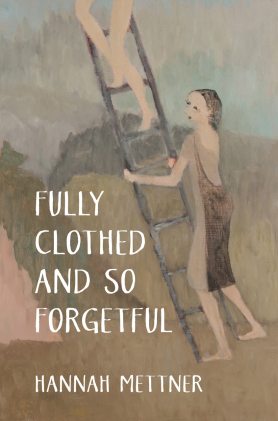
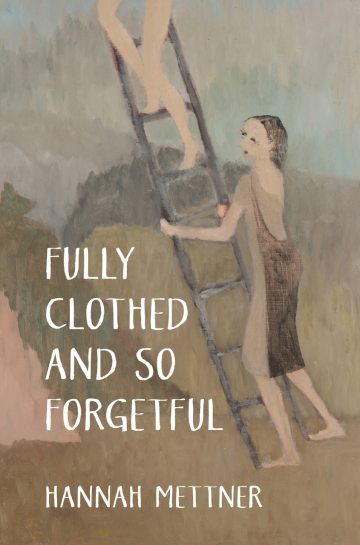
Hannah Mettner, ‘Cat Chakra Alignments’, Fully Clothed and So Forgetful, Victoria University Press, 2017 


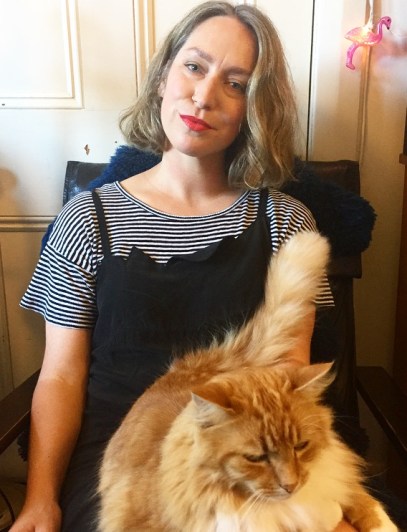
Hannah Mettner is a poet, librarian and mum in Wellington. She co-edits Sweet Mammalian, an online poetry journal, with Morgan Bach and Sugar Magnolia Wilson. Her first collection, Fully Clothed and So Forgetful was published by Victoria University Press in 2017, and won the Jessie Mackay award for the best first book in poetry.


Victoria University Press page


Fully_Clothed_and_So_Forgetful__32303.1486956777


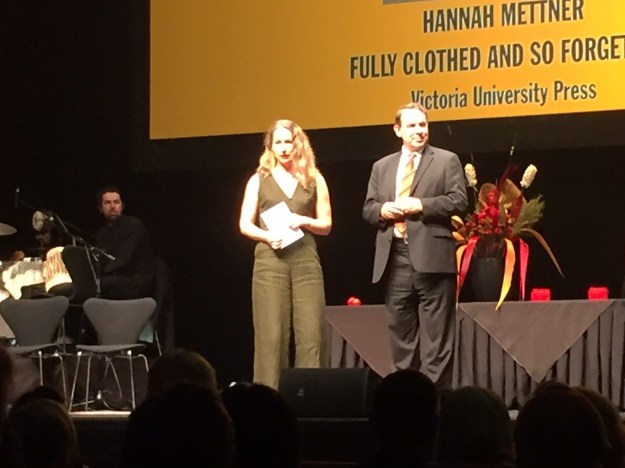
Celebrating Hannah Mettner’s Best First Book of Poetry Award

fullsizerender.jpg

Hannah Mettner, Fully Clothed and So Forgetful – winner of the Best First Book Award at the Ockham NZ Book Awards 2018


We believe in the steps.

We tell our children and then our

grandchildren about the cool

pond at the top where sun-

carp clean our feet and where

we can sleep. The steps are one of

the beautiful mysteries of

life, like how did we get here,

fully clothed and so forgetful?


from ‘Higher ground’


Paula: ‘Fully Clothed and So Forgetful gave me goose bumps as I read and took me beyond words to that state where you stand somewhere wild and beautiful and just stall beyond language to absorb the world. My initial reaction is simply to tell the reader to read the book. But then I start accumulating a list of what I think the poetry is doing: the poems are inventive, unpredictable, melodic, on the move, strange, love-soaked.’

Hannah: The key thing that matters to me in a poem (whether one I’m writing or reading) is that it gets me in the gut. I get very frustrated by poetry that feels empty, or emotionally disengaged or distant, or is teasing the reader or holding them at arm’s length. I just find it boring, I mean, I know that different poems and poets have all sorts of intellectual fare to offer, but I want to be emotionally moved by a poem, and nothing less.

from our interview


My children are abducted by 17th-century French courtesans

In the rose garden near the big house
where somebody famous was either
born, or not, all the ladies spread their
pinks out in the sun. Pretty young ladies
with expensive, dewy faces who want
my children for their photogenic walls.
They look as though they’re picnicking
with their floral bubbles and their green
men but their stiletto fingers give them
away. And my children were just feeding
ducks, but where have they gone?! Quick
say the birds Find them Find them, gobbling
their trails of bread. The ladies strengthen
in the light and their prickles rise and my
nose is so full of their French scent that
I start to sneeze. The ladies wilt a little in
revulsion. Their corals and blushes and rouges
are falling brown, then grey; old ladies with
shallow bones and prickles blunted with
age. And where are your children they
want to know and I want to know too.
I’ve looked everywhere. There’s a low
graze of desperation in my throat, which
stings as I call their names. I uproot one
of the ladies and use her to beat back a
path through the others, until they look
almost young again in the freshness
of their bruises. When I get back to the
pond most of the spinsters have frosted
in the ground. The children are there
wearing new fur coats. One is putting logs
on a fire, while the other pulls dinner
from the snow.

©Hannah Mettner, from Fully clothed and so forgetful (Victoria University Press, 2017)


Author note: This is the poem that helped me realise that there was a way to integrate the emotional authenticity that I want my poems to convey (in this case the fear of ‘losing my children’) with something less literal. For me, this meant that rather than merely ‘stating facts’ in a pleasant or interesting way with line breaks, I was able to tease out multiple concepts and feelings simultaneously in an environment less concretely related to the real world. So, this poem deals with my fear of losing my children after the breakup of my relationship with their father, but holds with that the fear of a potential ‘stepmother’, and the fear of them doing fine without me, but because none of this takes place in a recognisable world (rosebushes don’t usually turn into young women), I felt freer to say all that.


Fully_Clothed_and_So_Forgetful__32303.1486956777.jpg


Victoria University Press page

Radio NZ  National: Harry Ricketts reviews the book with Kathryn Ryan


Award night:


IMG_2312.JPG

Poetry Shelf audio spot: James Brown reads ‘Soft Returns’


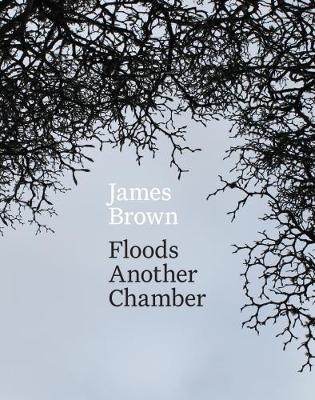
large_9781776561599.jpg


James Brown’s latest poetry book is Floods Another Chamber (VUP, 2017). You can find ‘Soft Returns’ in this collection.

Victoria University Press page


Poetry Shelf review: Therese Lloyd’s The Facts

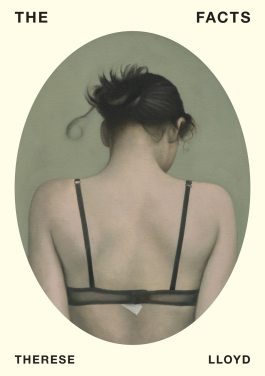
The_Facts_low_res__11927.1513281444.jpg


Therese Lloyd  The Facts Victoria University Press 2018


For three months I tried

to make sense of something.

I applied various methods:

logic, illogic, meditation, physical exertion,

starvation, gluttony. Other things too

that are not necessarily the opposite of one another,

writing and reading for example.

But the absurdity of the thing

made all attempt at fact-finding evaporate;

a sort of invisible ink streamed from my pen

the more data I wrote down: facts are things driven,

as Anne Carson says, into a darkening landscape where other people

converse logically.

from ‘The Facts’


Therese Lloyd’s new collection resides in a captivating interplay of chords. You could say that any poetry book delivers chords whether aural, visual or thematic, and in the light of ideas and feelings. This book does it to a stunning degree. Once you start hunting for them – whether in harmony or not, between poems or within a single example – the rewards are myriad.

Hera Lindsay Bird endorses the book on the back cover: ‘The Facts is mesmerisingly beautiful, and shocking in its intensity. This is already one of my favourite New Zealand books. It won’t make you feel better.’

I didn’t read the back until I had read the poems as I like to start a book with a clean reading slate (if that is possible).  I am thinking of the way reading this book sets up an arc between comfort and discomfort; we are the interlopers into what Therese chooses to let us see.

We enter a collection in debt to a doctoral thesis (IIML), and I am curious about the ideas picked up in the academic component.

This might be the first cluster of chords: shifts between ideas and feelings provoked by the writings of poet Anne Carson and the experience of a broken marriage and a toxic love affair.  This might be an impetus to navigate relations with art, in itself forging a chord with Anne.

I am absorbing the chords as though they flicker between light and dark – and the poem resembles a cinematic space with the external world, and its pressing demands, blacked out so it is just you and the poem. This what flicks for me:

love notlove

truth lies

Carson LLoyd

facts notfacts

pain joy

mother daughter

daughter husband

daughter lover

presence absence

beginning end

end beginning

beauty beauty

deep breath shallow breath

here there

intimacy distance

heart mind

sweet sour

slow stalling

debris order

miracle incidental

share notshare

exposure kept hidden

where you live where you don’t live

mixed clarity

see see

poet poem

poem story


At the core of the book the title poem, the standout-lift-you-off-your-feet poem, achieves the blinding intensity that Hera speaks of: raw, surprising, probing, accumulative, fearless, cutting, detail rich, lucid, testing. On either side the poems offer more subtle chords. Yet any element in my list for ‘The Facts’ might drive a poem. I particularly love the surprising turns of ‘Mr Anne Carson’.

Therese’s collection takes you deep into personal experience that gets hooked up in the poetry of another, in matted ideas and the need to write as a form of survival. It makes you feel as much as it makes you think. It is a riveting read.


I moved all the holiday reading

to the spare room

to keep the literature and the art books

pure

I say squarely in the middle

of the fluffed-up sunroom sofa, I am

careful

not to disturb the cushions

cushion—a curious word

its function of support

is ancillary to its attractiveness

and that’s why cushions have covers

in colourful fabric—I become

an ornament

another word I like

because everything here is decoration

everything here is placed

The story of the things here is not new


from ‘Mr Anne Carson’


Victoria University Press page


Poetry Shelf Spring Season’s poetry fans: Peter Ireland picks Bill Manhire


Kevin


I don’t know where the dead go, Kevin.

The one far place I know

is inside the heavy radio. If I listen late at night,

there’s that dark, celestial glow,

heaviness of the cave, the hive.


Music. Someone warms his hands at the fire,

breaking off the arms of chairs,

breaking the brute bodies of beds, burning his comfort

surely to keep alive. Soon he can hardly see,

and so, quietly, he listens: then someone lifts him

and it’s some terrible breakfast show.


There are mothers and fathers, Kevin, whom we barely know.

They lift us. Eventually we all shall go

into the dark furniture of the radio.


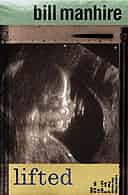
©Bill Manhire from Lifted (Wellington: Victoria University Press, )


Note from Peter:

Between the earth and sky of my 1960s Ashburton was the radio; a New Zealand-made Ultimate complete with earth and aerial wires. I remain in the dark about what you were to do with the earth, but the aerial provided passable reception when attached to the wire wove base of my bed.

The Ultimate was a budget model, suffering in comparison with those radios with a short-wave function that I coveted, but I should have known better than to paint it white in a moment of teenage idleness.

In a house without books and lacking the wit to utilise the local library the radio was my source of stories, together with those told by my father and relations.   I went to bed early most nights to listen to the serialisation of books like Nevil Shute’s A Town like Alice, or Alistair Mclean’s Ice Station Zebra and South by Java Head and was transported.

How could one not feel addressed by Kevin?

In this wondrous poem, Bill makes some stabbing observations in that last ravishing verse, about mothers and fathers we barely know, lifting us, and dark furniture of the radio as ultimate destination. Whether the mothers and fathers are truly those we don’t know, or those we did and couldn’t know, I am more saddened than heartened at the thought. As destination I wouldn’t book to go there, but I do keep returning to Bill’s poem and the transcendent possibilities of its ‘celestial glow.’


Peter Ireland works at the National Library in Wellington where, among other things, he looks after the Poet Laureate. And still listens to the radio.

Bill Manhire, inaugural New Zealand Poet Laureate, has published award-winning poetry, edited anthologies, written short story collections and founded IIML. Lifted won the Poetry Category in the 2006 Montana New Zealand Book awards.  This year he released a new collection of poems, Some Things to Place in  a Coffin, and in collaboration with musician Norman Meehan, published Tell Me My Name, a book of poem riddles (or riddle poems) set to music.


somet_things_to_place_in_a_coffin__40224-1482273596-220-2202.jpg   tell_me_my_name_front__47436-1482273132-1280-1280.jpg    lifted.jpg


Poetry Shelf Spring Season’s poetry fans: Lydia Wevers picks Jenny Bornholdt

Then Murray came


It was the morning for

selling the car, but

when I went out to start it,

it wouldn’t go. Greg went

to get petrol on the bike. I

rang the A.A. Then Ray

arrived. I said I’m sorry, he

said don’t worry and looked at

the car and at the wheels and

in the boot and said she’s a lovely

old thing. He tapped the coil

and the fuel pump to try to

make it go. Greg came back

with petrol, but that didn’t help.

Then, because there was nothing else

to do, we went inside and had coffee

and Ray smoked and talked about

going to Outward Bound and sleeping

and losing a stone.


Then Murray came.

He drove up the hill in his yellow

A.A. car, shaking his head. Got out and said

I was sure you were having me on. Last time I was

here you said you were selling it

and the other day I saw you walking

through town and I thought ‘thank god she’s

sold that thing’. He cleaned the carburettor

and laughed. Put more petrol in, replaced a

filter. I said I wasn’t joking, there’s

someone here who wants to buy it. Murray

laughed and said sure. No, no, I said, it’s

true. Ray. See, there he is, up at the

window. Murray looked up and Greg and Ray

waved. How much is he paying for it? asked

Murray. I started to say and he stopped

me. Said no, on second thoughts, don’t tell

me. I don’t want to hear about this.

Ray came down and took over

holding up the bonnet of the car.

What’s your name? he asked Murray.

Murray, said Murray. Well I’m

Ray, this is Greg and this is

Jen. Hello Murray, we said.

And then the car started.


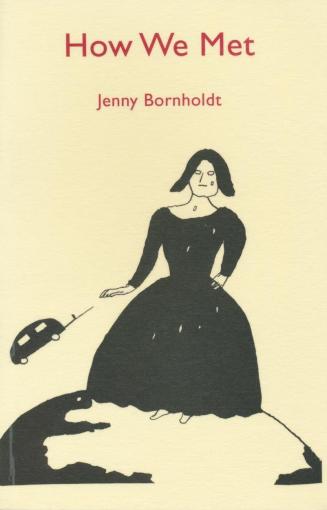
©Jenny Bornholdt from How We Met, Victoria University Press, 1995


met_001__04716.1399604422.jpg


Note from Lydia: I laughed aloud when I first read this poem. Selling a car which won’t start, Greg getting petrol on the bike, Ray smoking and talking about Outward Bound, it is a micronarrative of intense suburban familiarity and yet… also heroic (‘then Murray came’), touching about relationships (‘ I thought thank god she’s sold that thing’ ) and an acute register of local idiom while also suggesting the Pinteresque deeps that lie behind what is said. How much is he paying for it?  asked Murray…no, on second thoughts don’t tell me’.

‘Then Murray came’ has lodged in my head. It shows me the world I live in, but freshly, deeply, newly, wittily. And at the end, after Murray has come (I’d like to know Murray) the car starts.


Lydia Wevers has recently retired as the Director of the Stout Research Centre at Victoria. She is a lifelong reader of New  Zealand writing and a literary historian.


Jenny Bornholdt has published ten books of poems, the most recent of which is Selected Poems. Her collection The Rocky Shore was a made up of six long poems and won the Montana New Zealand Book Award for Poetry in 2009.

She is the co-editor of My Heart Goes Swimming: New Zealand Love Poems and the Oxford Anthology of New Zealand Poetry in English.

Jenny’s poems have appeared on ceramics, on a house, on paintings, in the foyer of a building and in letterpress books alongside drawings and photographs. She has also written two children’s books.