Slowly it dawns, the need to listen to the faint grief of a mourning cello, the sky’s blue jug pouring out a second helping of custard sun, this music that vies with a lost bee and a kereru’s three-note flight path beyond our open door. Nick Tipping’s low voice, sounding like a pilot’s announcement: Enjoy this shadow of trees, this laughter of water. From among a shock of leaves, a tūī’s semi-colon, a piano note, a caught dragonfly cupped in the soft sweat of a child’s hand. The lowest black key repeating—a lawnmower four houses down. Nick corrects himself, ‘Rachmaninoff,’ he says. My grandson comes down to visit from upstairs, says, ‘I thought you were still in bed.’ No. I’m here just awake and no more even though it’s now past noon. I’m here taking it all in. The Concert Programme in summer, volume turned down to 7, the fret of a pīwakawaka. No. I stand corrected. Vaughan Williams’ Lark Ascending.
Kay McKenzie Cooke
Although Kay McKenzie Cooke (Waitaha, Kāti Māmoe, Kāi Tahu) lives in Ōtepoti Dunedin, she continues to hold a deep connection to Murihiku Southland, the province where she was born. She is the author of four poetry collections and three novels.
as our dead rise heading for the stars what if they get snagged on a satellite
will they be caught forever in a rotating purgatory-like state as if stuck on a glaring
disco-blaring merry-go-round that no-one can get off what if they land on the celestial star-link waka –
this is a genuine concern
i imagine a static-y incoming msg from my mum trying to give me her beauty tips
but they’d come in 90 mins apart fits & starts ////// don’t ////// for ///// get
your ////// lip ///// ////// stick ///// and //// re///// member lux//// soap ///// ponds
dry ///// skin //// cream ///// after ///// rins //// ing with ///// cold ///// water
i think i’d prefer ‘te huka mate’ were offline most of the time
Ariana Tikao
The first of the stars
Ask the wind why it howls Ask the storm cloud why it thunders Ask the Living Earthly Things why do they seek shelter from the lashing rains
Little Brother he will answer ‘Kua riri au ki ōku tuākana!’ I am angry with my brothers
You know how brothers are Sometimes they fight like only brothers fight With terrible ferocity
Ask Little Brother ‘He aha koe i riri ai?’ Why are you angry?
Little Brother he will answer ‘Kua hīanga rātou i tō mātou matua Kua hiki atu ki te pōuri kei runga’ They have betrayed our father lifting him to the gloomy darkness above
So Little Brother rages even as his mother weeps and all his brothers fall before him All except one
Ben Brown 2025
Puaka
Set in the blackness of space your glare is a whisper, a glimmer, a sliver, your gleam a loosened feather of flame,
your light a phantasmagorical ghost to haunt our fire-eating solar system through light years that in earthly time measures
four and a half centuries before your light and fire finally makes land as a pre-dawn solitaire
diamond nestled bright in a cushion of dark velvet sky above my door, your gleam as factual
as science, or time and far too real for myth or song alone. Puaka, you are family,
each winter rising again early in our southern sky to blaze blue, singular, easy to locate and kind enough to draw near
as we eat or pray or sing, your appearance so vast, your light so ancient, yet somehow, new and near and small enough to fit my eye.
Kay McKenzie Cooke
NOTE: Puaka (Puanga, sometimes Poaka) Rigel, is the star southern Māori iwi and hapū look to as a harbinger for the Matariki cluster. More information can be found here.
What the stars say
I hear bird bones crack, splinter. I hear offal slosh in a bucket.
Matariki have seen it all before — my star companions remain silent. Have they gone mad?
Yes, mad as a meat axe.
I hear gunshots at the growing wall, I hear laughter at cocktail hour out of mouths as wide as mako shark.
The bleached face of Sirius gives no clue, all are catching a ferry to the Isle of the Blessed.
My ageless self, trapped in a maimai — who knows how temporary?
It seems I am lasting forever, as long as stories repeat.
I blush and quiver to see myself related to this pale imitation of the gods.
Reihana Robinson from Auē Rona, Steele Roberts, 2012
The poets
Ariana Tikao is a Kāi Tahu writer, musician, and curator from Ōtautahi. She was a 2023 Ursula Bethell Writer in Residence at Canterbury University, and was awarded as a New Zealand Arts Laureate in 2020. She has co-written two books Mokorua (2022) and Te Rā: The Māori Sail (2023), and her first poetry collection Pepeha Portal will be published by Otago University Press in 2026.
Ben Brown (Ngāti Mahuta, Ngāti Koroki, Ngāti Paoa) writes children’s books, short stories and poetry for children and adults, general non-fiction, freelance articles and memoir. In 2006 he won Best Picture Book with artist/illustrator Helen Taylor in the NZ Post Children’s Book Awards with their book A Booming in the Night. His poetry has been published in various anthologies here and around the world and Radio NZ and The Radio Network have also recorded him. In 2011 he was the Maori Writer in Residence at the Michael King Writers Centre in Devonport Auckland. His poetry collection Between the kindling and the blaze was shortlisted in the 2014 Nga Kupu Ora Aotearoa Maori Book Awards. In 2021 he was appointed inaugural Te Awhi Rito New Zealand Children’s Reading Ambassador. He was the Te Kaipukahu University of Waikato Writer in Residence in 2024. He is also a father of two, which he considers his best work to date.
Kay McKenzie Cooke (Kāti Māmoe, Kāi Tahu) lives and writes in Ōtepoti. She is the author of four poetry collections. Her first poetry collection Feeding The Dogs won the Jessie McKay prize in 2003.
Reihana Robinson’s latest poetry volume BE THE RISING HUMAN is available from Carson’s Bookshop in Thames, Paradox Books in Devonport and on Amazon and KDP.
Music is the first poetry attraction for me. I am drawn to poems that sing. Poems sing in multiple keys with affecting and shifting chords, rhythms, harmonies, counterpoints, pitch, cadence, codas, crescendo. Tune your ear into the poetry of Karlo Mila, Emma Neale, Sue Wootton, Bill Manhire, Hinemoana Baker, Michele Leggott, Nina Mingya Powles, Lily Holloway, Alison Wong, Chris Tse, Mohamed Hassan, Gregory Kan, Anna Jackson, David Eggleton and you will hear music before you enter heart, mystery, experience, startle. Take a listen to Bernadette Hall or Dinah Hawken or Anne Kennedy. Anuja Mitra. Louise Wallace. How about Grace Iwashita Taylor? Ian Wedde. Tusiata Avia. Tayi Tibble. Rebecca Hawkes. Helen Rickerby. Selina Tusitala Marsh. Murray Edmond. Apirana Taylor. Iona Winter. Rose Peoples. Sam Duckor Jones. Vincent O’Sullivan. Kiri Pianhana-Wong. Jackson Nieuwland. Serie Barford. Listening in is of the greatest body comfort and you won’t be able to stop leaning your ear in closer. I think of one poet and then another, to the point I could curate an anthology of musical poets. I can name 100 without moving from the kitchen chair. Ah. Bliss.
But for this theme I went in search of poems that speak of song. The poems I have selected are not so much about song but have a song presence that leads in multiple directions. And yes they sing. Once again I am grateful to publishers and poets who are supporting my season of themes. Two more themes to go.
The poems
poem to Hone Tuwhare 08
the master
adroit composer of
‘No Ordinary Sun’
has gone
and still
the music grows flows grumbles and laughs
from his pen
only the old house has fallen to the wind and storm
death shakes the tree but the bird lives on
Apirana Taylor
from A Canoe in Midstream: Poems new and old, Canterbury University Press, 2009 (2019)
Between Speech and Song
I’m sorry, you said.
What for, I said. And then
you said it again.
The house was cooling.
The pillowcases had blown
across the lawn.
We felt the usual shortcomings
of abstractions. I hope,
you said. Me too, I said.
The distance between our minds
is like the space
between speech and song.
Lynley Edmeades
from As the Verb Tenses, Otago University Press, 2016
Dust House
my sister is humming
through wallpaper
the front door is shutting
and opening like lungs
to kauri trees
leaping upwards through air
my lungs are pressed
between walls
grey warblers sing like
dust moving through air
the sunflower is opening
and shutting like lungs
my lungs are shifting
the air
Rata Gordon
from Second Person, Victoria University Press, 2020
Lullaby
The woman next door sings so slowly someone must have died. She practices her sorry aria through the walls. When we bump on the steps she is neighbourly, maybe, with her purpled eyes. She tries for lightness. The radio tells me it is snowing somewhere south. Drifts fall down for days. The presenter uses the word ghastly far too often. In the ghastly snow, he says, animals dig for their calves. When we meet on the path my own voice is chestnut and dumb. ‘It’s a ghastly thing,’ I say. ‘It was a ghastly mistake.’ In the dark the woman’s voice touches a sweet, high place. It’s a small cupboard where her children once hid when she’d tried to explain – which you never really can – why the animals must paw in the cold, brown slush. Where are the young? Who hears their low, fallow voices?
Sarah Jane Barnett
from Bonsai – Best small storiesfrom Aotearoa New Zealand, edited by Michelle Elvy, Frankie McMillan and James Norcliffe, Canterbury University Press, 2018
Song
i
The song feels like singing,
looks out the window:
clouds glued to the sky,
harbour slate-grey,
hills like collapsed elephants.
There’s food stuck to the highchair,
a plastic spoon on the floor.
The cat stares up in awe at the fridge.
The song opens its mouth,
but seems to have forgotten the words.
ii
The song wakes up.
It’s dark.
Someone is crying.
The morepork in the ngaio
shakes out its slow spondee:
more pork more pork more pork.
Back in the dream a line
of faces passes the window.
Each face smiles, lifts
its lips to show large teeth.
iii
The song sits at the window, humming
ever so softly, tapping
a rhythm on the table-edge, watching
the harbour slowly losing
colour. At the very far end
of the harbour slightly up to the right,
a zip of lights marks the hill
over to Wainuiomata. If that zip
could be unzipped, thinks the song,
the whole world might change.
iv
The song strokes the past
like a boa, like some fur muff
or woollen shawl,
but the past is not soft at all;
it’s rough to the touch,
sharp as broken glass.
v
The song longs to sing in tune.
The song longs to be in tune.
The black dog comes whenever
the song whistles, wagging its tail.
The black dog waits for the song’s whistle.
The black dog wants a long walk.
vi
The song croons “Here Comes the Night”
very quietly. Meanwhile the baby
spoons its porridge into a moon.
The black dog leads the song
down long, unlovely streets.
The night is slowly eating the moon.
Harry Ricketts
from Winter Eyes, Victoria University Press, 2018
The Crowd
The crowd is seaweed and there’s always one man too tall at least or one man dancing too much or one woman touching too much. We form short bonds with each other. The man next to me we briefly worry is a fascist. But him and I set a rhythm of touches with each other as we’re together and apart from the music and the bodies. When the bassline and the drums are inside my entire body they always shake up grief like sediment in water so that I am the sediment and my tears become water. And I am the water and the seaweed at the same time and I hover in the thick of the sound experiencing myself experiencing sound and feeling and my body as one piece of a larger thing. I want to be part of a larger thing as often as I can. So many days there isn’t enough music to pull us together. We shred each other, other days. A little rip. A tiny tear. A deep cut. We curl backwards into ourselves to do the damage. I follow the line. I rise into it because it is the sea and the only thing to do is to rise. I am bread and I am fire. I am the line of the horizon as it is reflected back to you. We make our own beds and lie in them. You will have said something. To me. Later, as I think it through I remember us neck to neck, clutching.
Emma Barnes
from Sweet Mammalian 7
singing in the wire
The song is a clutch of mailboxes
at the end of an undulating road,
an unsteady stack of bee-hives
beside poplars.
The song is the whine from a transformer,
crickets, waist-high roadside grass,
a summer that just will not let up.
The song is a power pole’s pale-brown
ceramic cup receiving a direct hit
from a clod flung by my brother.
It is looped bars laid
against the white paper of a gravel road.
Released the year and month my father died,
‘Wichita Lineman’ can still bring me the valley
where we lived,
still bring me grief, the sound
of wind through wire, the loneliness
of country verges; but does not bring
my father back. You can ask
too much of a song.
Kay McKenzie Cooke
from Born To A Red-Headed Woman, Otago University Press 2014
thursday quartet 9:15
The stairwell grew and rolled
with slackened half-night. Quite clearly
she saw how her words had become her.
When she sang she remembered; her breath was deep
letters unnudged. The stairwell hummed. Everything
smelt of other people’s hands.
One, two, three. Another life had trained her ready.
She knew these breaths. It had been a day
of near misses, daredevil secret creatures
who followed her home, a line of sight
and the road, misadventured art deco.
Had she been good enough?
At night her window smithied day.
She could see the boats as they came.
The stairwell rose and then uprising
the first notes.
Pippi Jean
Trigger
When Johnny Cash was sad he’d call Willie Nelson and ask for a joke.
Willie knew a dirty joke – good or bad – was the secret to happiness.
Some people haven’t yet realised that Willie Nelson is one of the greatest singers, guitarists
and songwriters. But there’s time. There’s always time. Despite it being funny how it always seems
to just slip away. Still, to add to the legends of Willie smoking pot on the roof of the White House
and blowing out interviewers so that they couldn’t remember where they parked their car or where they lived or worked,
we can now thank Willie not only for his 70 albums and for writing the greatest jukebox weepie of all time…
But, also, on some level, he helped keep Johnny Cash alive for as long as he lasted. Johnny battled his depression
with a dirty joke from Willie Nelson. I’m not saying it works for everyone but it served The Man in Black.
carrying its song to crushed metal, smashed glass,
and fading in echoes of the old folks’ choir.
David Eggleton
from The Conch Trumpet, Otago University Press, 2015
Ephemera
My brother says that he doesn’t
understand poetry. He hears the words
but they all intersperse into a polyphonic
whirl of voices; no meaning to them
beyond the formation and execution
of sounds upon lips, pressing together
and coming apart. I cannot touch or feel
words, but I see them ‒ the word ‘simile’
is a grimacing man, poised on the edge
of polite discomfort and anguish. ‘Dazzled’ is
a 1920s flapper with broad, black eyes
and lank black hair around the edges of
her face. A boy in my music class hears
colours ‒ well, not hearing as such, he says,
but images in his mind’s eye. People play
tunes and ask him what colour it is, but
they play all at once, and he says that it is
the indistinguishable brown of all colours
combined. I think of a boy I used to know
called Orlando, and how this word conjures
the sight of a weathered advert for a tropical holiday
in my mind ‒ a forgotten promise, just ephemera
and not to be mentioned. The History room at school smells
like strange, zesty lemons, like the smell when you
peel a mandarin and its pores disperse their
sebum into the air, or when you squeeze the juice
from a lemon into your hands, and feel it dissolve
the soapy first layer of skin. I always think of
a certain someone when I smell this, even though
they wear a different perfume, and when I listen
to soft guitar ballads I think of them too, even though
I know they wouldn’t have heard them. All
of the sounds and smells and thoughts blend
into ephemera, scorched postcards of violets and
swallows, etched with the perfect handwriting of
old, consigned to antique stores that smell of
smoke. Things of the past with no value, no
substance, just air filled with citrus mist. I collect
each word and strain of what was once fresh in
my mind, in a forgotten jacket pocket, to be discovered
on some rainy day, years later. I’ll pull out the
postcard and think of the way I always look twice
when I see someone with curly hair; the word ‘longing’
is a blue wisp that creeps between the cracks
in my fingers. That wisp hides in these things,
tucked away, like the 1930s train tickets I found
in an old book. I wonder if their owner ever made it
to their destination. I wonder who they were.
Cadence Chung
first appeared in Milly’s Magazine
Love songs we haven’t written
Within the warm wreckage of me,
I’d never dare to ask you, but
in that moment when pain finds it plowing rhythm,
would you want me dead?
It’s a startling thought.
So round and whole and ordinary.
But you can’t know these things until
you’re sunk deep in the geometry of them. Of course,
the bed I lie on would be lily white and threatening levitation.
I would imagine the emptiness I leave and
you would think of all the ways to fill it.
That is the grotesque version.
It should of course be the other way around.
I don’t need misery to write poetry.
For me words come only after precarity passes
and there is safety in sitting still for long stretches.
Words, eventually, have the thickness of matter
left out too long in the sun. My love,
If we had a daughter, I’d be more dangerous.
She’d lick words whole out of the air.
I would recognize her tiny anthem.
Like you, she’d need two anchors, and only one mast.
Like me, she’d be immovable, a miniature old woman
by seven years old.
Catherine Trundle
thursday’s choir
my singing teacher says yawning during lessons is good
it means the soft palate is raised and air circulates the bulb of your skull
to be pulled out between front teeth like a strand of taut hair
gum skin or yesterday’s nectarine fibre
in empty classrooms my body is a pear, grounded but reaching
the piano is out of tune, its chords now elevator doors
a shrieking melody that says: relish the peeling off
floss til you bleed and watch through the bannisters
voices merge like a zip ripped over fingers
reeling backwards and thrown to the wall
are all the arcades, rubber children
midnight sirens and birds sounding off one by one
the sopranos cry out offering forged banknotes
while the altos bring the alleyways
you crash through the windscreen, thumbs deep in pie
laundromat coins with that rhythm
Lily Holloway
Emma Barnes lives and writes in Te Whanganui-ā-Tara. She’s working on an anthology of Takatāpui and LGBTQIA+ writing with co-conspirator Chris Tse. It’s to be published by AUP in 2021. In her spare time she lifts heavy things up and puts them back down again.
Sarah Jane Barnett is a writer and editor from Te Whanganui-a-Tara. Her poetry, essays and reviews have been published widely in Aotearoa. Her debut poetry collection A Man Runs into a Woman (Hue + Cry Press) was a finalist in the 2013 New Zealand Post Book Awards. Her secondcollection Work (Hue + Cry Press) was published in 2015. Sarah is currently writing a book on womanhood and midlife.
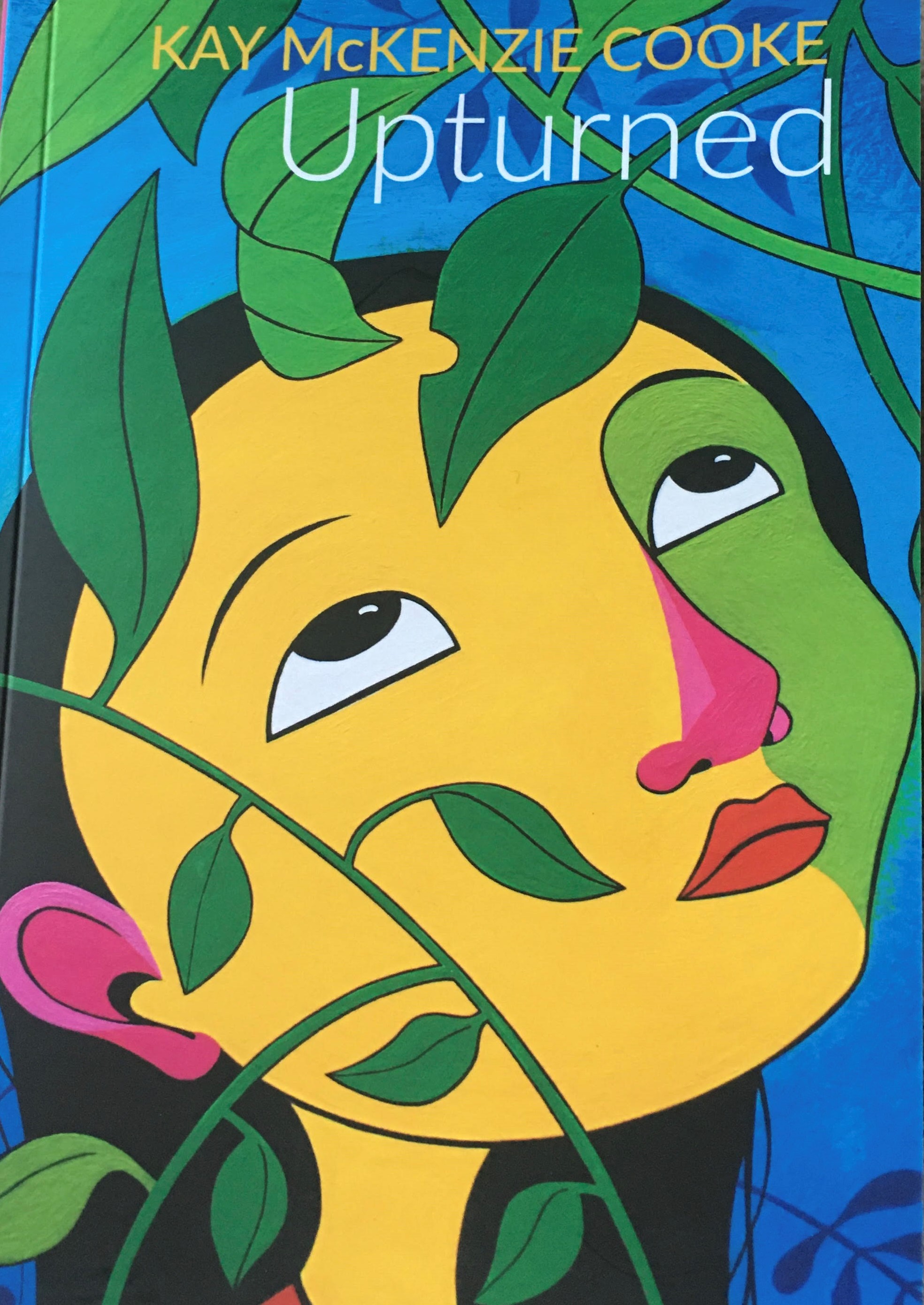
Kay McKenzie Cooke’s fourth poetry collection was published by The Cuba Press in June 2020 and is titled Upturned. She lives and writes in Ootepoti / Dunedin.
Cadence Chung is a student from Wellington High School. She started writing poetry during a particularly boring maths lesson when she was nine. Outside of poetry, she enjoys singing, reading old books, and perusing antique stores.
Lynley Edmeades is the author of two poetry collections, most recently Listening In (Otago Uni Press, 2019). She lives in Dunedin and teaches poetry and creative writing at the University of Otago.
David Eggleton is the Aotearoa New Zealand Poet Laureate 2019 – 2022. His most recent book is The Wilder Years: Selected Poems, published by Otago University Press.
Rata Gordon is a poet, embodiment teacher and arts therapist. Her first book of poetry Second Person was published in 2020 by Victoria University Press. Through her kitchen window, she sees Mount Karioi. www.ratagordon.com
Lily Holloway is a queer nacho-enthusiast. She is forthcoming in AUP New Poets 8 and you can find her work on lilyholloway.co.nz.
Pippi Jean is eighteen and just moved to Wellington for her first year at Victoria University. Her most recent works can be found in Landfall, Starling, Takahe, Mayhem, and Poetry New Zealand Yearbook among others.
Harry Ricketts teaches English literature and creative writing at Victoria University of Wellington Te Herenga Waka. His Selected Poems appeared in June, Victoria University Press.
Simon Sweetman is a writer and broadcaster. His debut book of poems, “The Death of Music Journalism” was published last year via The Cuba Press. He is the host of the weekly Sweetman Podcast and he writes about movies, books and music for a Substack newsletter called “Sounds Good!” (simonsweetman.substack.com to sign up). He blogs at Off The Tracks and sometimes has a wee chat about music on RNZ. He lives in Wellington with Katy and Oscar, the loves of his life. They share their house with Sylvie the cat and Bowie the dog.
Apirana Taylor, Ngati Porou, Te Whanau a Apanui, Ngati Ruanui, Te Ati Awa, is a nationally and internationally published poet, playwright, short story writer, novelist, actor, painter and musician. He has been Writer in Residence at Canterbury and Massey Universities. He frequently tours nationally and internationally visiting schools, tertiary institutions and prisons reading his poetry, storytelling and taking creative writing workshops. He has written six collections of poetry, a book of plays, three collections of short stories, and two novels. His work has been included in many national and international anthologies.
Catherine Trundle is a poet and anthropologist, with recent works published in Landfall, Takahē, Poetry New Zealand Yearbook, Not Very Quiet, and Plumwood Mountain.
Home is a state of mind, it’s where you lay your roots down, where you trace your roots, feed yourself, friends and family, bake your bread and make kombucha, where you stand and sleep and dream, it’s a physical place, a small house with wooden floors and comfortable couches, a garden with kūmara almost ready to harvest, shelves overflowing with books, my family tree, my family treasures, my thoughts of life and my thoughts of death, a series of relationships, myself as mother, partner, writer, home is my reluctance to drive beyond the rural letterbox, it’s contentment as I write the next blog, the next poem, sort the kitchen cupboards, light the fire, conserve the water, feel the preciousness of each day.
The poems I have selected are not so much about home but have a home presence that leads in multiple directions. Once again I am grateful to publishers and poets who are supporting my season of themes.
The poems
all of us
once upon a time
all of us here
were one of them there.
maybe
in another skin
in a life before.
maybe
only a few weeks ago.
land of the long white cloud,
land of no borders,
floating
adrift
near the end of the world,
near the end of the sea.
we came
and stayed
and with our accents
call
this place
home.
carina gallegos
from All of Us, Landing Press, 2018
there’s always things to come back to the kitchen for
a bowl of plain steamed rice
a piece of bitter dark chocolate
a slice of crisp peeled pear
a mother or father who understands
the kitchen is the centre of the universe
children who sail out on long elliptical orbits
and always come back, sometimes like comets, sometimes like moons
Alison Wong
from Cup, Steele Roberts, 2005, picked by Frankie McMillan
What’s the pH balance of yin + yang?
lake / river / liquid / beverage / additional charges or income / (of clothes) classifier for number of washes / hai bian / shang hai / shui guo / zhong guo / Sway by Bic Runga / three drop radicals on my guitar / liquid cement / tai chi at Buckland’s Beach / put your facemask on and listen to the rain on a UE speaker /
It’s not outlandish to say I was raised by the water. Aotearoa is a land mapped in blue pen, each land mass a riverbed. Originally swampland, the water gurgles from kitchen taps and runs silent cartographies underneath cities of concrete.
I was raised by my mama, raised with the treasures of every good cross-pollinated pantry. We have rice porridge for breakfast and mee hoon kueh when I plead. My siblings and I vie for iced jewel biscuits kept out of our reach, packed tightly into red-lidded jars on the highest shelf of our pantry. We stretch torso to tiptoe to reach them, knocking the jars off their perch with our fingertips. The dried goods we ignore on the levels below are the real jewels in the cabinet. From behind the creaky door comes the festivities of Lunar Celebrations: dried mushrooms, dried shrimp, vermicelli noodles, black fungus, herbal remedies, that good luck moss you eat on New Year’s.
Chinese cooking is a testament to soaking. Benches overflow with an array of colanders, damp towels cover small white bowls of noodles, rehydrating. We wash rice in liquid choreography: Pour. Swirl. Measure by the pinky. Drain.
My mum is from Ma Lai Xi Ya, her mum’s mum from Fujian, China. I google map the curve of a bordering coast, trace a line through the wet season pavements of Kuala Lumpur and end up with fingerprints all the way to Oceania. From my house you can see the windmills of Makara, jutting out like acupuncture needles. The sea rushes the wind like nature’s boxing lessons.
We fly back to Malaysia every couple years, past the sea-lapsed boundaries of other countries. In Singapore I am offered moist towelettes on the plane. In KL, where two rivers meet by the oil of Petronas, I shower in buckets of cold water and reunite with faulty flushing.
The first ethnic Chinese came to New Zealand during the 1850’s, following flakes of fortune. They came for the gold rush, fishing for luck on the unturned beds of rivers. Wisps of fortune lay in thousand year old rocks worn down to alluvial alchemy. Chinese last names carried through the cold water creeks. They died in sea-burials.
Tones and tombs. You made your river, now lie in it. Yǐn shuǐ sī yuán. To think of water and remember its source; to remember where one’s happiness comes from; to not forget one’s roots or heritage.
Oriental Bay is the closest beach to us in Wellington City. On weekends, we drive out for picnics, happy to migrate our schedules. The beach was named by George Dupper in the late 1840’s after the boat he arrived on. Fresh off the Bay. Oriental Parade is famous for 22,000 tonnes of imported sand. In my house we are displaced soil in torrential rain. I search ancestry on Wikipedia, then look for my own last name.
Think of water and remember its source. Where do our pipelines go? When do our bodies enter the main frame? Oriental, noun. Characteristic of Asia, particularly the East. Rugs, countries, bamboo leaves. A person of East Asian descent (offensive). A beach with fake grains. Imported goods and exported gooseberries. The fruits of our labour, measured and drained.
I think tourists find the green unsettling. It never stops pouring.
Year of the money. Year of the pig. Year of the scapegoat, the migrants, the rats on the ship. Labour. Lei. Qi Guai. Guai Lo. I google the wind howls around a shipwreck. I google microtraumas until my eyes bleed transparent. I google:
why do chinese people love hot water
can chinese people swim
why are there so many chinese in auckland
chinese people population
chinese people opinion
Ink blue motions stencil sight lines into the harbour of my eyes. I rub at ink sticks until the ocean turns to soot. The rising shadows of New World Power loom from water’s depths. We float currency back to motherlands in a trickle down economy. What’s the pH balance of yin + yang?
I was raised with the dawn promise of an unpolluted skyline, pools in cyan-printed eyes, long white dreams of the colony. My body the cycle of a washing machine, bleached into safety. I was raised in a world full of oysters, one lofty pearl held between the whiskered snout of a dragon. But you can’t feng shui the comments on Stuff articles.
Feng shui just means wind water. It’s not scary. Duān wǔ jié is the annual dragon boat festival. I throw zongzi in the river to protect Qu Yuan’s body. Remember how you moved across the world to know you had been here already? My mum says she caught sight of the harbour and it’s why she will never leave. I watch her from the doorway, her frame hunched across the sink. She belongs here. The soft light of morning streams through the window, catching glints on small rice bowls. I can hear a pot of water boiling. She soaks bones for breakfast, then asks if I’m hungry.
Vanessa Mei Crofskey
from A Clear Dawn: New Asian Voices from Aotearoa New Zealand, eds Paula Morris and Alison Wong, Auckland University Press, 2021
blue beat
Every morning he milked the cow.
It was the chime that woke me and my sister,
metal against metal,
the fall of the empty milk-bucket’s handle
as he put it down to open the gate
right beside our sleep-out.
At the end of the day, in socks,
the cold, clear smell of fresh air
still on him, was his way
of arriving back;
the glass of water he gulped,
the hanky dragged from his pocket,
how he leaned back with a grunt
against the nearest doorpost
to rub and scratch the itch,
or ache, between his shoulders. Once,
seeing me poring over a map of the world
trying to find Luxemburg,
he teased, saying something
about how I couldn’t wait to leave.
None of us knowing then
that he would be the first to go,
leaving us
long before we could ever leave him.
Kay McKenzie Cooke
from Born to a Red-Headed Woman, published by Otago University Press, 2014
We used some
concrete blocks
the hollow kind
that let the grass
grow through
to make a carport
then took a few
out back to
plant a herb garden
parsley thyme
used to step out
mid-dish to snip off
fronds till
it all went to seed
now my mother’s not
been out the
back door in
more than a year
they’ve grown into
massive aberrant
plants to match
the trampolines
around the flats
on either side
Jack Ross
Bliss
If I were to describe this moment
I may write
bliss
If bliss meant quiet, companionship
you in the garden, me hanging washing
the fresh scent of rain on the air
the murmur of voices inside
You and me
not far away
bliss
Rose Peoples
Reasons you should retire to the
small town the poet grew up in
Because you have a Grahame Sydney book on your coffee table. Because you are public figure reinventing yourself as a public figure – in Central Otago. Because you can buy advertising space cheap and write a column about local issues. Because you know how moorpark apricots ripen from the inside and look deceptively green. Because it’s a gold rush a boomer boom town. Because you are a big fan of Muldoon flooding the gorge for the generation of electricity – when the river rose it formed little islands possums, skinks and insects clung to power poles to escape drowning. Because you fell in love when you were sixteen with the dusty curtains in the high school hall – immense as the horizon holding the town in.
Ella Borrie
from Stasis 2020, picked by Aimee-Jane Anderson-O’Connnor
In my mother’s house
Everything is always evening:
curios in candlelight, blowpipes,
riding crops, cabinets of Caligari.
Children used to giggle in the rhododendrons;
dragons wander up to the door.
There were nightingales.
The ghosts hunch, passing the port,
rehash old scandals, broken trysts,
all those garden parties long ago.
Harry Ricketts
from Just Then, Victoria University Press, 2012
Hunting my father’s voice, County Down
It begins with the medieval
throat clearing of crows
high over Scrabo tower. You
were the boy your mother
forgot to drown and still
you holler for help
So here’s a bloody conundrum
shot to blazes and back
and your brother Jimmy
in a slow swim to save you
Dad, the land is full of boulders
an apron of stones
to feed a nanny goat
chalk a plenty to soften your voice
All those stories, enough
to hang a man, come Easter
All that dreaming
the time it took
to dig breath for the fire
the knot and bog
of the back parlour where Jimmy
washed roosters
and sister Maureen, her hair
lovely enough to stop your throat
Frankie McMillan
appeared on a Phantom Poetry Billsticker 2015
SH5
From Bluff Hill we can see the ships come in. Past the buoys stitched crooked like Orion’s belt. My school is art deco seashell and lavender climb. Girls press their hands to the frames and breathe on the glass. There’s this one boy who got peach fuzz before the rest of them. His voice cracks seismic and we all swarm. I practice my California accent down the landline and my mother laughs behind the door. We pass him around like chapstick. Hickies like blossoms on his neck, like rose-purple flags planted behind pine trees and beach grass. There are socials. Socials with glow sticks and apple juice in cardboard cartons. We all look at him. We look at him, through him, to see each other. A postcard is no place to be a teenager. The sea air is too thick. Rusts my bicycle in the garage. Rusts the door hinges. Stings in the back of my eyes.
Our town’s like honey. You get knee deep. Arataki. Manuka. Clover. Sweet. Council flat, Sky TV, pyramid scheme, boxed wine, sun-freckled early twenties. Ultra-scan, veganism, Mum’s club with the girls who went to your kindy. His sisters, their perfume vanilla and daisies, their babies fat and milky. We could have built a vege garden. I could have kept a shotgun under the mattress.
Most of us. Most of us leave. We carve the initials of our high school sweethearts into lumps of driftwood and throw them out to sea. To big cities where no one knows us, where the cops drive with their windows up and their sleeves rolled down. We learn to sleep through the traffic. We keep on leaving till we find a way to go. We leave so one day we can maybe come back.
Aimee-Jane Anderson-O’Connor
from Starling 6
The Shed
It was a shed before it was home to Tongan relatives. The inside smelled like Dad’s work gloves, musk and dirt. Dust caught in cobwebs draped over muddy tools. Overgrown insects nested between the spades and hoes. Wonky stacks of building stuff lay against the walls,window frames, doors, planks with flaking paint and nails poking out. Dad would be busy in the humming dark behind the shed, shovelling smelly things in the compost.
He’d reach the bottom of the pit in one spadeful, burying green- oaty food waste and feathering rich crumbly compost over the top with delicate shakes. I liked the slicing sound of the spade when he dug deep. The mouldy compost frame kept everything together for so many years. To Dad’s left there was the chicken coop, with a motley crew of chickens and a duck. He’d built a pirate-rigging treehouse in the trees above. To his right the long brown garden where everything he planted thrived, giant broccoli and gleaming silverbeet. Runner beans grew up a chicken-wire frame separating the veggie plot from the pet cemetery at the back where flowers grew amongst wooden crosses with cats’ names scrawled on them.
There was a flurry of bush between us and neighbours. One bush grew glowing green seed-capsules we wore as earrings, there was a sticky bamboo hedge and the rotten log sat solidly in a gap. The bush was thick enough for birds to nest in, dark patches in the twigs that cried in spring. Sometimes we’d hear strangled shrieks and sprint to retrieve dying bodies from cats’ mouths; saving lives for a few moments. Dad said we’re allowed to pick flowers to put on graves but otherwise it’s a waste.
Aimee-Jane Anderson-O’Connor was awarded the 2018 Charles Brasch Young Writers’ Essay Competition, and the 2017 Monash Prize for Emerging Writers. Her work has appeared in Starling, Mayhem, Brief, Poetry New Zealand, Landfall, Turbine, Flash Frontier, Mimicry, Min-a-rets, Sweet Mammalian, Sport and Verge. She is Poetry New Zealand‘s 2021 Featured Poet. She writes thanks to the support of some of the best people on this great watery rock.
Ella Borrie is a Te Whanganui-a-Tara based poet from Otago. She co-edited Antics 2015 and her work appears in Mimicry, Starling and Turbine | Kapohau. The title of this poem is inspired by Louise Wallace’s poem ‘How to leave the small town you were born in’.
Kay McKenzie Cooke’s fourth poetry collection was published by The Cuba Press in June 2020 and is titled Upturned. She lives and writes in Ootepoti / Dunedin.
Vanessa Crofskey is an artist and writer currently based in Pōneke Wellington. She was a staff writer for online arts and culture journal The Pantograph Punch and has a collection of poems out in AUP New Poets Volume 6.
carina gallegos, originally from Costa Rica, has worked in journalism and development studies, and with refugee communities since 2011. She published poems in All of Us (Landing Press, 2018) with Adrienne Jansen. She lives in Wellington with her family and refers to New Zealand as ‘home’.
Simone Kaho is a digital strategist, author, performance poet and director. Her debut poetry collection Lucky Punch was published in 2016. She has a master’s degree in poetry from Victoria University’s International Institute of Modern Letters (IIML). She’s the Director of the E-Tangata web series ‘Conversations’ and a journalist for Tagata Pasifika. In 2021 Simone was awarded the Emerging Pasifika Writer residency at the IIML.
Vana Manasiadis is Greek-New Zealand poet and translator born in Te Whanganui-a-Tara and based in Tāmaki Makaurau after many years living in Kirihi Greece. She is 2021 Ursula Bethell Writer-in-Residence at Te Whare Wanaga o Waitaha Canterbury University. Her most recent book was The Grief Almanac: A Sequel.
Frankie McMillan is a poet and short story writer who spends her time between Ōtautahi/ Christchurch and Golden Bay. Her poetry collection, There are no horses in heaven was published by Canterbury University Press. Recent work appears in Best Microfictions 2021 (Pelekinesis) Best Small Fictions 2021 ( Sonder Press), the New Zealand Year Book of Poetry ( Massey University) New World Writing and Atticus Review.
Emma Neale is a writer and editor. Her most recent collection is To the Occupant. In 2020 she received the Lauris Edmond Memorial Award for a Distinguished Contribution to New Zealand Poetry.
Rose Peoples is from Te Awakairangi/Lower Hutt. She is a student at Victoria University and, having finished her law degree last year, decided that the logical next step was to embark upon a Masters in Literature. She is a bookseller at Good Books. Her work has previously appeared in Cordite, Mimicry and Starling.
Harry Ricketts teaches English Literature and creative writing at Victoria University of Wellington Te Herenga Waka. His latest collection Selected Poems was published by Victoria University Press, 2021.
Jack Ross‘s most recent poetry collection, The Oceanic Feeling, was published by Salt & Greyboy Press in early 2021. He blogs on the imaginary museum, here[http://mairangibay.blogspot.com/].
Alison Wong is the coeditor of A Clear Dawn: New Asian Voices from Aotearoa New Zealand (AUP, 2021), the first anthology of creative writing by Asian New Zealanders. Alison’s novel, As the Earth Turns Silver (Penguin/Picador, 2009) won the NZ Post Book Award for fiction and her poetry collection Cup (Steele Roberts, 2006) was shortlisted for the Jessie Mackay Award for best first book of poetry. She was a poetry judge at the 2018 Ockham New Zealand Book Awards.
Kay McKenzie Cooke’s fourth poetry collection was published by The Cuba Press in June 2020 and is titled Upturned. She lives and writes in Ootepoti / Dunedin.
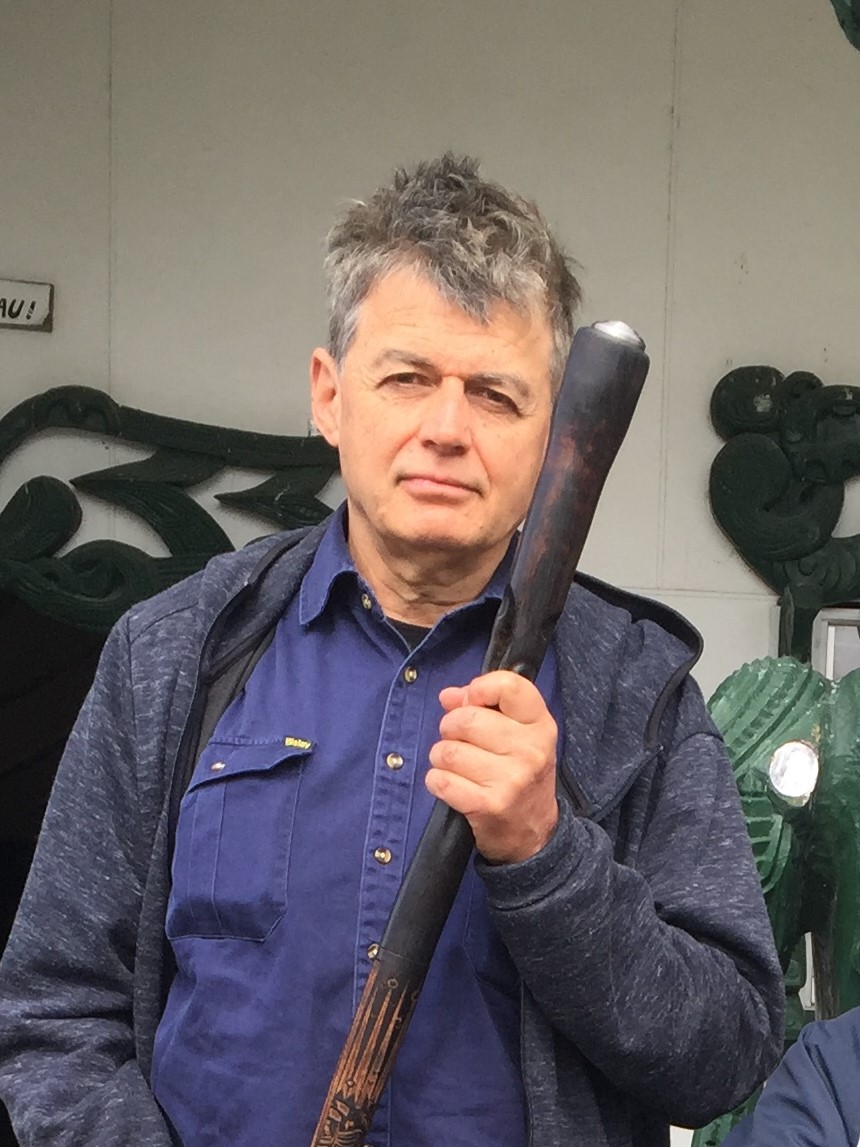
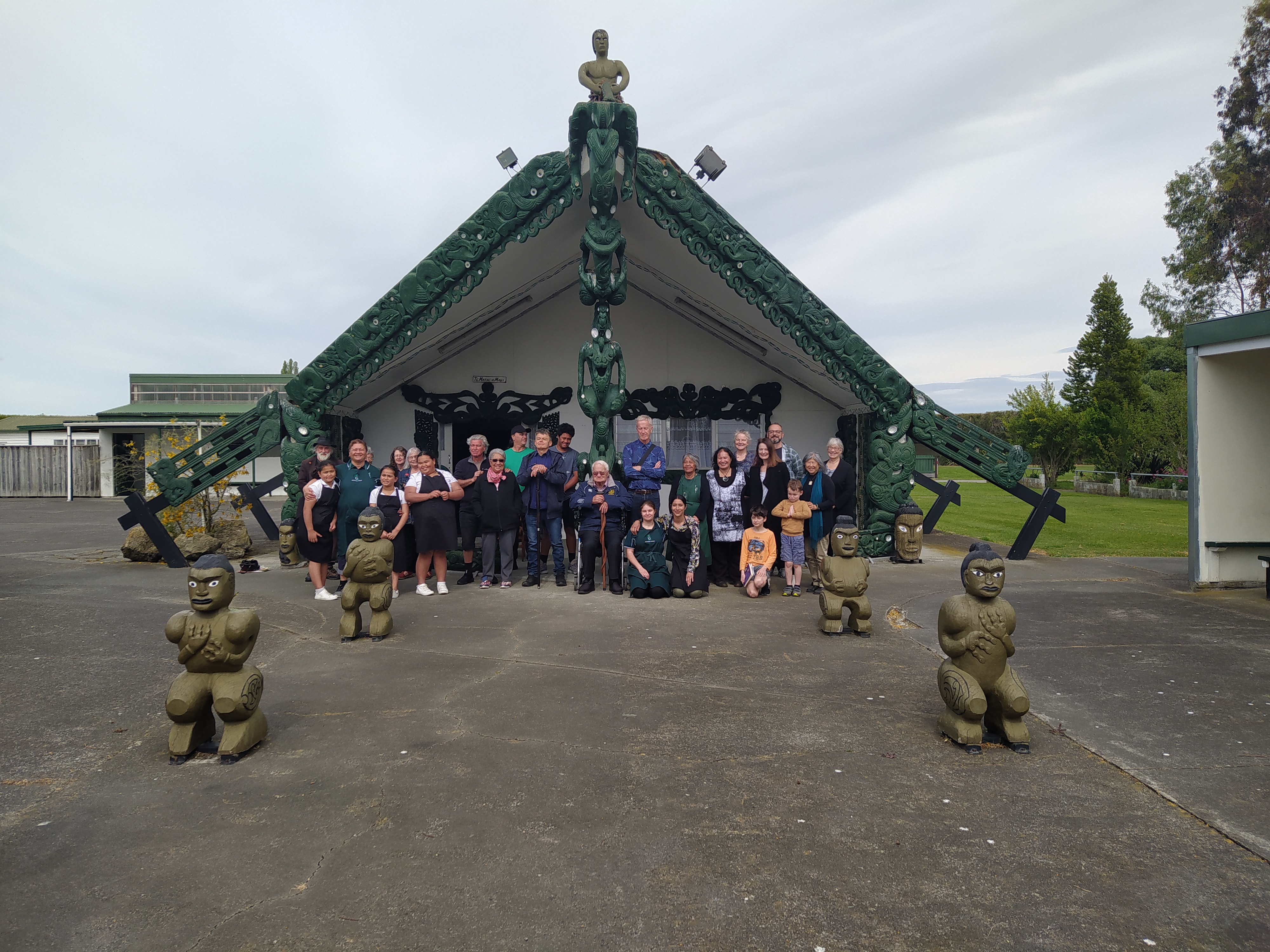
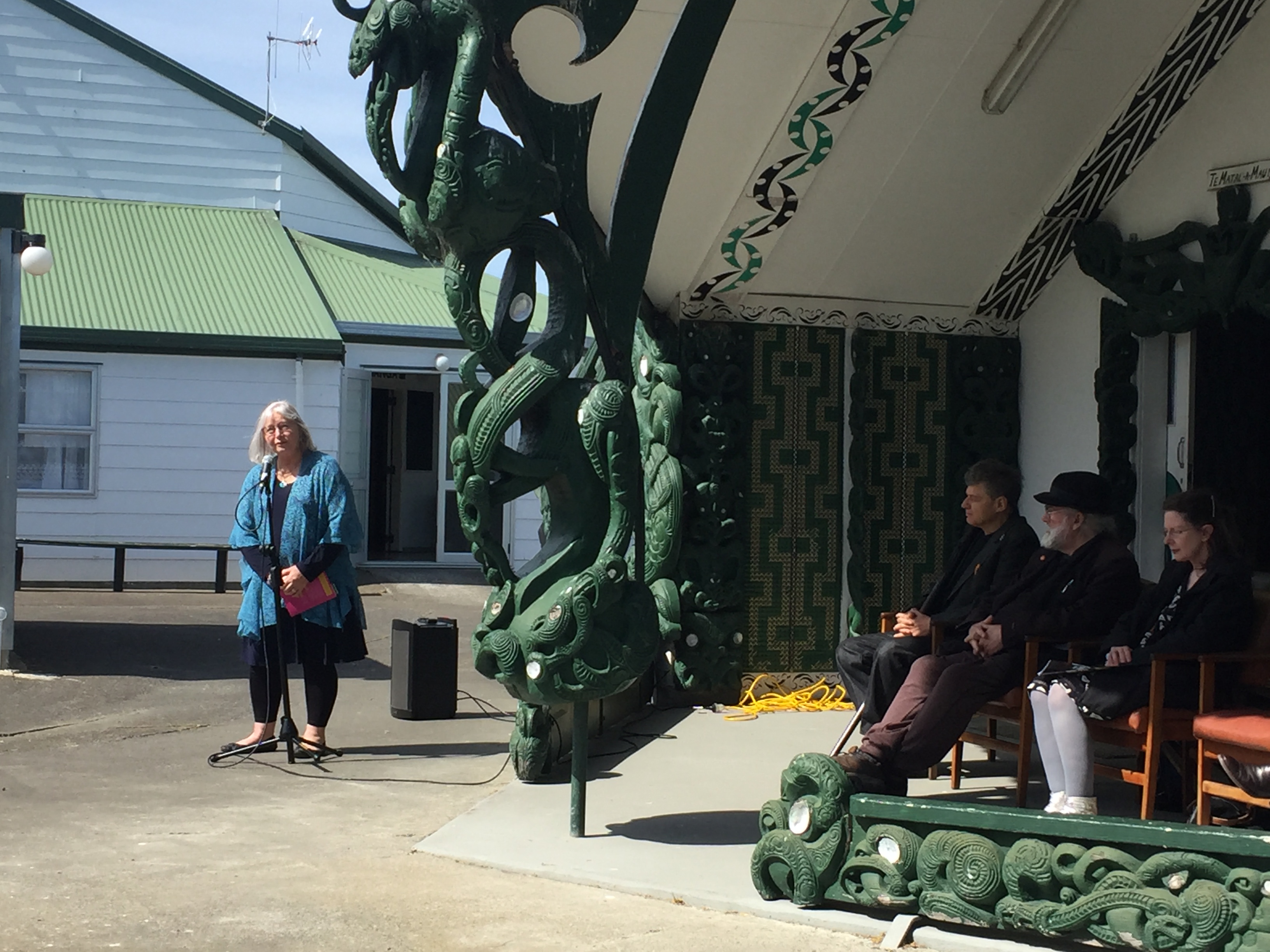
David Eggleton at Matahiwi Marae (photo Lynette Shum)
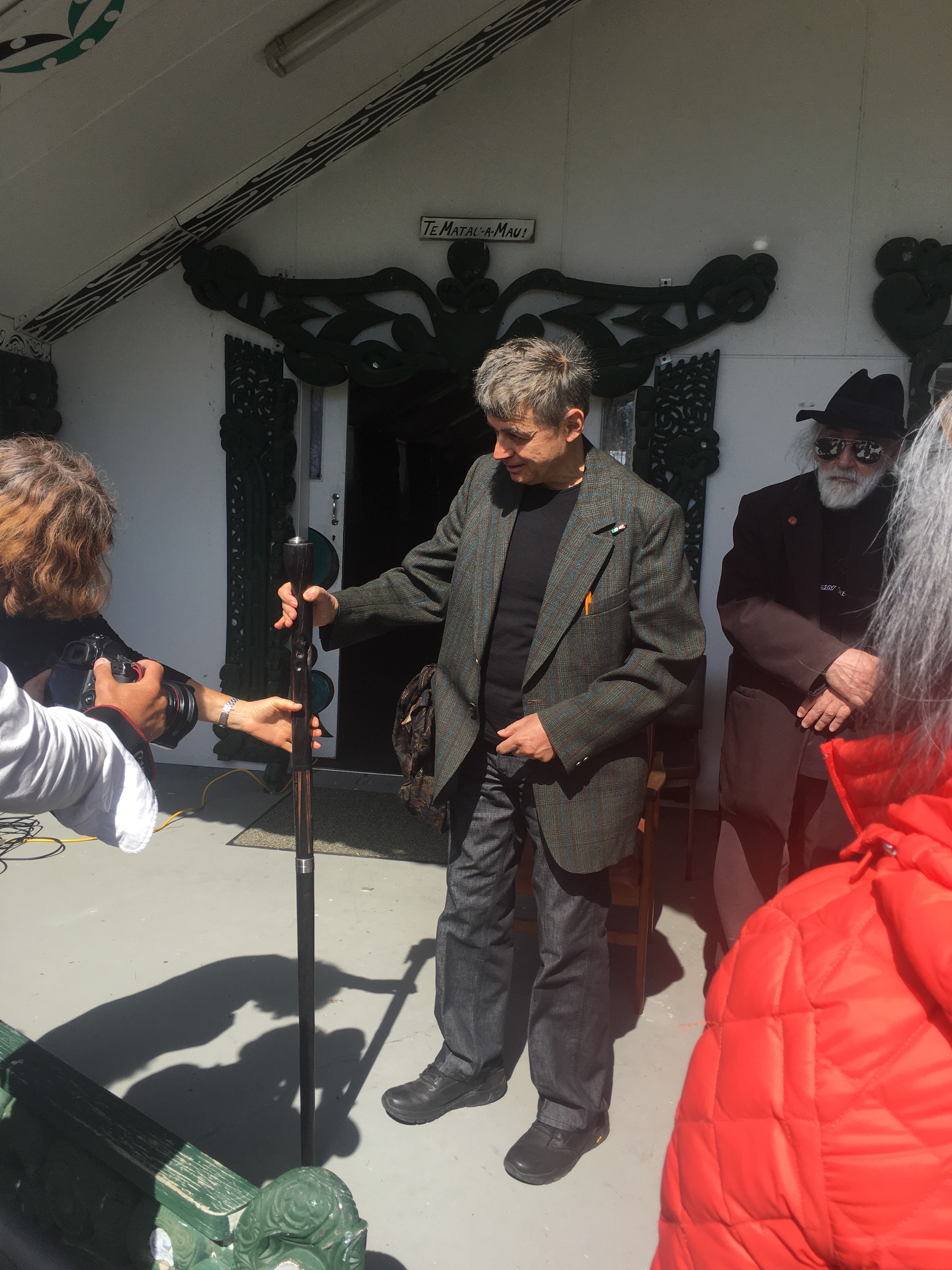
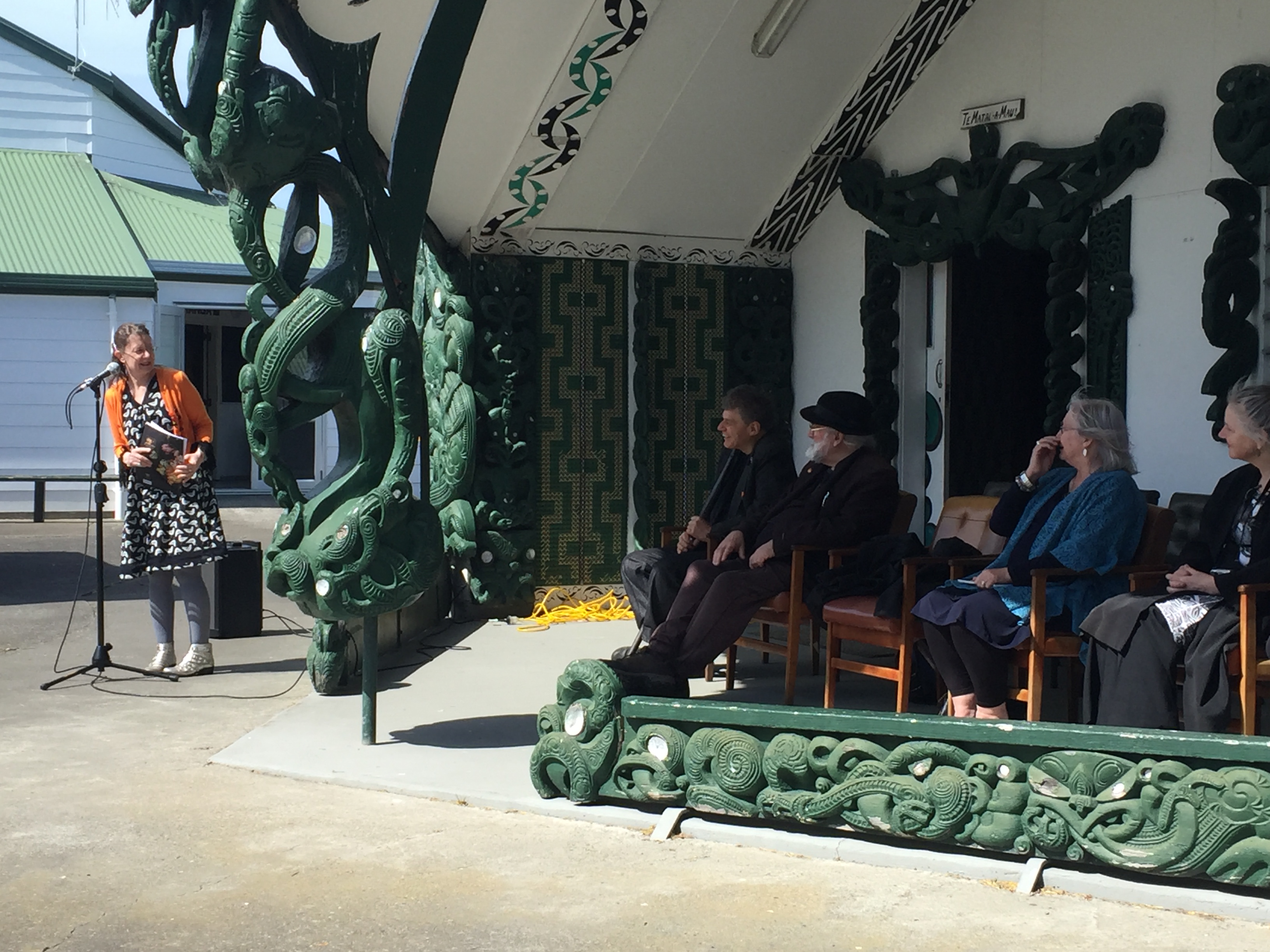
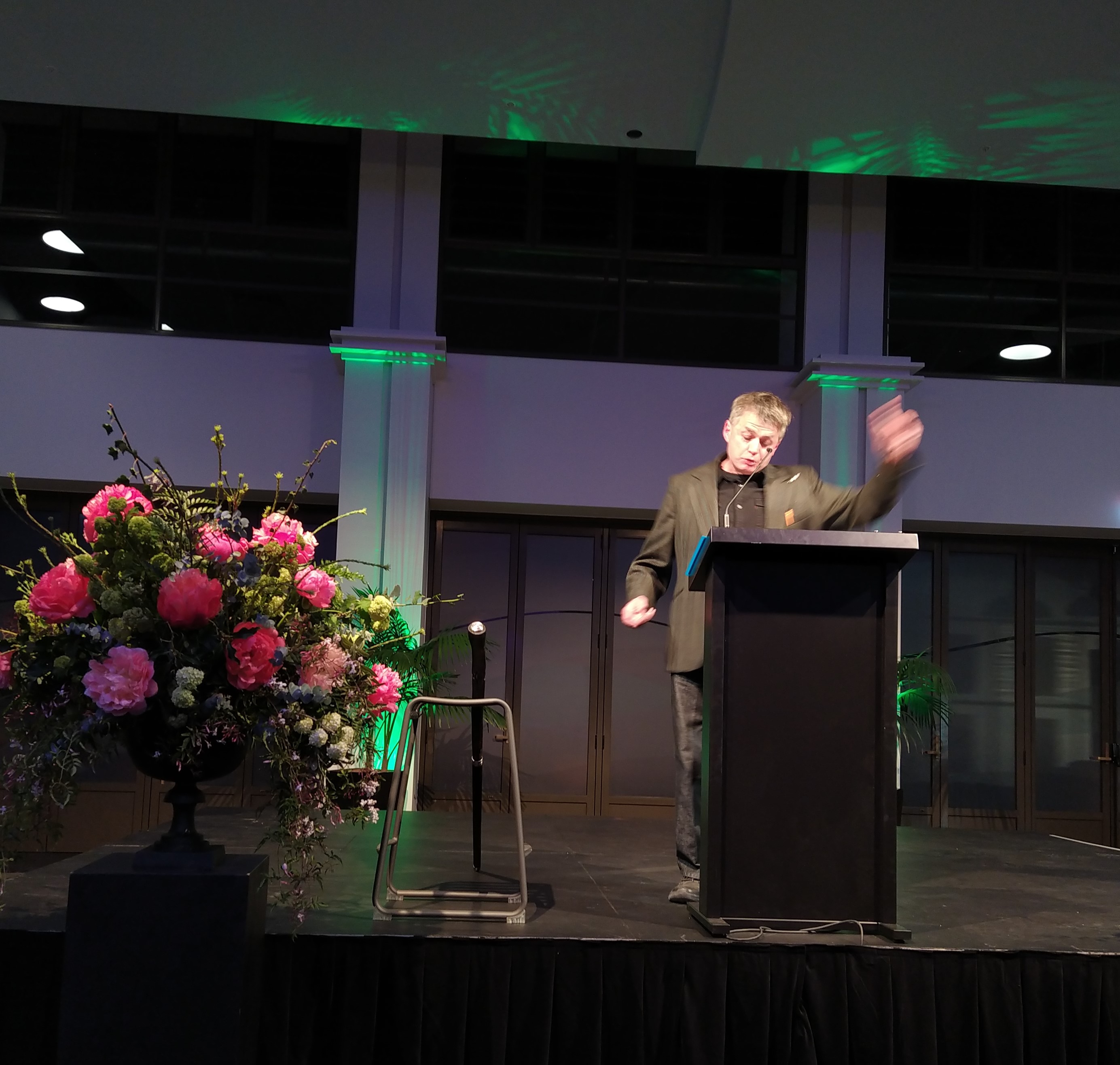
Last weekend David Eggleton celebrated his New Zealand Poet Laureateship at Matahiwi marae accompanied by Charles Ropitini, whanau, friends, National Library staff (including the Library’s empathetic Laureate champion Peter Ireland) and poets (Jenny Powell, Kay McKenzie Cooke and Michael O’Leary). David was presented his tokotoko carved by Haumoana carver Jacob Scott. On the Saturday evening Marty Smith hosted Poets Night Out at the Hasting Events and Arts Centre, Toitoi.
The National Library also announced that due to the restrictions Covid has placed upon David’s Poet Laureate plans his term would be extended for another year. David has gifted Aotearoa a richness of poetry in printed form, but his appearances as a performance poet are legendary, inspirational, charismatic. He is appearing at the Christchurch Word Festival late October and will now be able to bring his poetry to the people over the next two years, as was his aim. Wonderful!
Two of David’s guest poets – Kay McKenzie Cooke and Jenny Powell – share their experience of this special weekend.
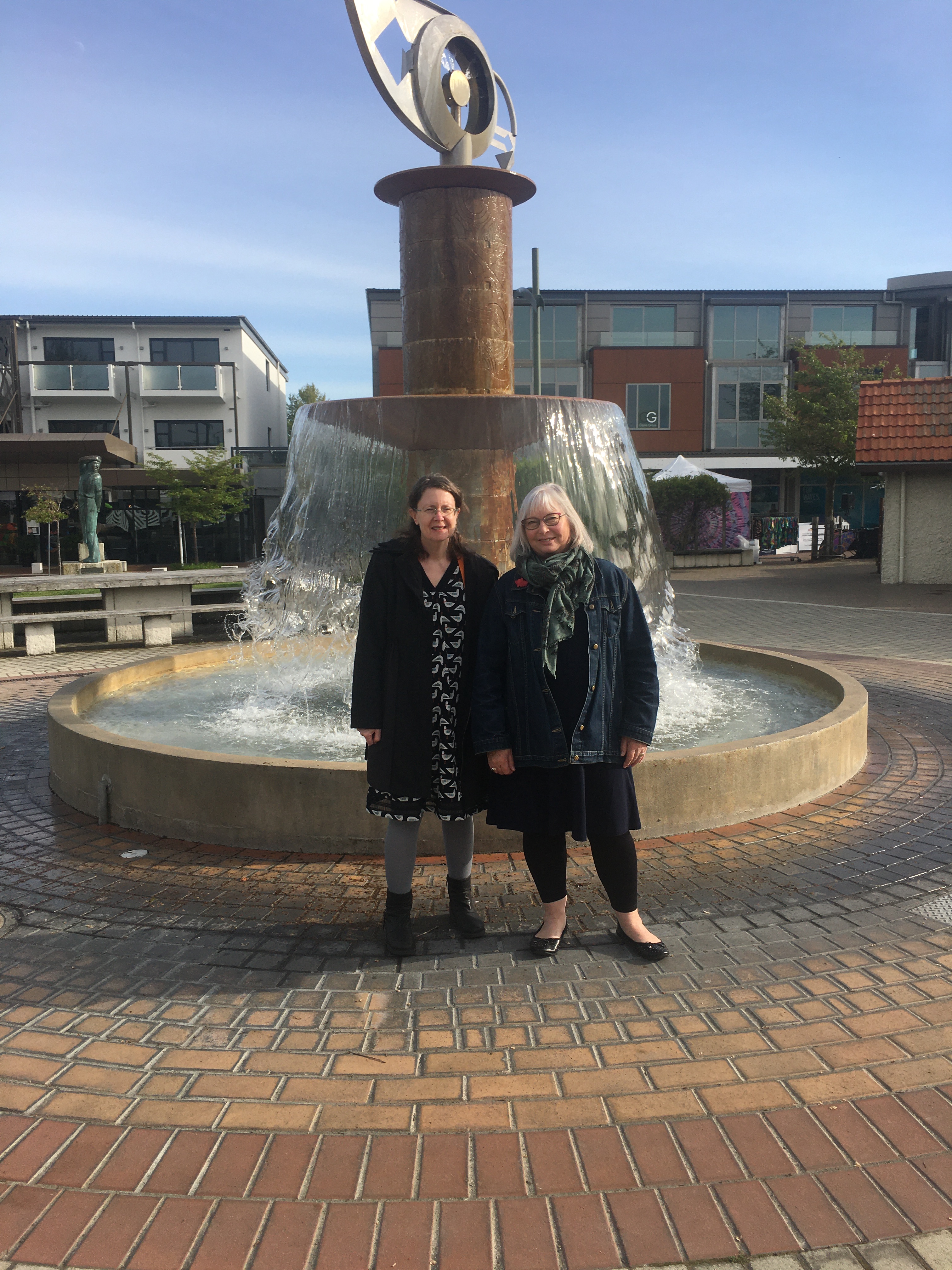
Jenny Powell and Kay McKenzie Cooke
David’s tokotoko is called Te Kore, meaning ‘the void’. The dark maire has a natural hole near the upper end. When he received it his body straightened, as if a spiritual and physical source of creativity became one.
Like the tangata whenua of Matahiwi marae, the tokotoko radiates what is needed. I held it on the way to the evening poetry reading in Hastings and again on the way home. Did it matter? Yes.
The void. The beginning, the creation, the end. Here it was, playing out in a bend of time and words. In the before of my ton weight suitcase, organisational order, waiata to practise, transport logistics, food and food. In the then. Matahiwi marae in its glory of green bounty, Māui hooking us into his welcome, kuia hooking us into love. River flow of oratory, Poems of the south, of love, of colour, of rapid fire Eggleton resonance and the moon beaming in story and song.
In the leaving, small children bound on fields, frail elders offer blessings, words spiral, tears flower. In the meeting house, enduring peace of the deep void.
Jenny Powell
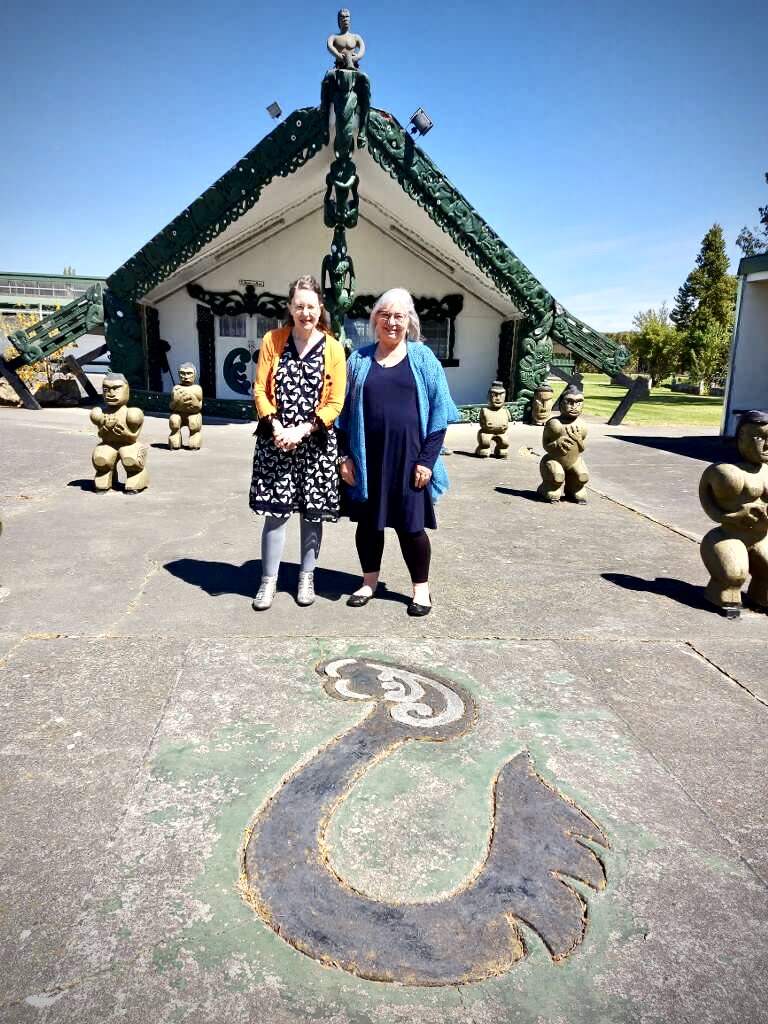
Matahiwi marae (photo Katrina Hatherly)
After Being Introduced
Naturally, there are many other memories but maybe I particularly remember David’s grin, Fieke’s calmness, Jenny’s silver boots, Peter’s careful attention, the humour and innate sense of arrangement from the National library trio (Joan, Lynette and Katrina) and Michael’s Fleetwood Mac black hat and white t-shirt emblazoned with the words: A Hard Day’s Night.
~*~
Friday:
Michael, Jenny and I practice our waiata for David. E Tu Kahikatea. We sing it out in a patch of sun cut to the shape of a motel’s open door. We are kind of happy with how it sounds. Jenny’s top notes, my more middling muddle, Michael’s lower notes verging on bass, all blending to invoke a tree standing braced for whatever will come at it, bolstered by those who stand close to protect and the togetherness of all this conjured up in the final lines.
~*~
Our first chance to meet the National Library trio: Lynette, Joan and Katrina, is at tonight’s dinner. They exude friendliness, kindness, humour, order and care – and that’s just on the first take. There’s room for even more to surface as the weekend unfolds. (Such as the Joni incident – but I am jumping ahead of myself and anyway, it’s probably one of those you-had-to-be-there episodes.)
~*~
Saturday:
Jenny and I are on the hunt for breakfast early and surprisingly enough for us, we manage not to get lost. Go us! As we look out from our outside table onto Havelock North’s shiny newness, including a fountain and locals setting up stalls for a market on clean concrete, a brittle breeze reminiscent of Ōtepoti’s nor’easterly, licks at our ankles.
~*~
Outside the Matahiwi marae gates, that same cold breeze niggles at our backs and shoulders. Charles our te reo-speaking representative, tells us the moon is in a benevolent phase – all augurs well – and points out the maunga, the mountains, in the distance. He names them and tells us the meaning of the name – which, sadly, I promptly forget. However, I do notice that after being introduced, the mountains appear to draw a little nearer.
~*~
More people arrive to join the waiting group. David’s no-fuss whanau flock quietly together. And then the pōwhiri begins, a karanga calling us to proceed in safety. Wings of grief beat in my chest like something fighting waves of memory.
~*~
We are welcomed with kōrero, karakia, by tīpuna, voice, mountain, awa, spirit, wairua, with love, aroha. Charles responds with an operatic kōrero sung on our behalf in te reo, laced with waiata that soars and rolls in an awa of pride. We line up to elbow-hongi, covid-style. A kuia at the end of the line grabs each of us into a hug.
~*~
The unwrapping of the tokotoko begins with a blessing by Jacob, then revealed and handed to David by the carver. Made of maire, it is tall and straight, yet shapely. It is black with a small sweep, or wave, of brown. Pango and parauri. Somewhere, silver glints. The carver tells us it speaks of Māui and his brothers, of boldness and spirit. Of stirring, mischief-making, mixing things up and pitting against. It has weight. Mana. David tests its strength by thumping the ground with it. He appears satisfied. He smiles.
It is time for Michael, Jenny and me to sing our waiata. Unfortunately, all of the previous day’s blend and timing takes flight leaving only the unpolished, rough side of the päua, shy of colour and magic. It’s a pretty rough delivery. No matter. It’s done. The tree still stands. It takes more than that to fell a kahikatea.
David’s son does a far better job, calmly, confidently singing a self-composed song that soothes, charms and rocks like a waka launched on to slowly moving water.
~*~
Saturday night, David, Michael, Jenny and I make poetry the winner at Poets Night Out at the Hastings Events and Arts Centre, Toitoi, in all its glory and glamour; sumptuous flower displays, laser beams creating a dancing landscape on ceiling and walls. The event is bookended by two beautiful young singers and linking it all, Marty in shimmering gold jacket delivering her diamante introductions.
~*~
Sunday:
Mōrena. Back at the Matahiwi marae, we are hugged. Fed. Allowed into more stories. Humour sparks. We are told a little more of the coming into being of David’s Poet Laureate tokotoko; its name, Te Kore; its character, its insistence not to be firewood, but instead a walking, talking stick with fire to fill any void in its belly.
~*~
As we make our reluctant farewells, a kuia gifts Jenny and myself quiet words of encouragement to take back home to Ōtepoti with us. She loves our poetry. She may write some herself now. She particularly loves the way Jenny speaks her poems. I feel there is more she wants to say. Deeper things. But there is no time left.
~*~
More farewells outside the marae as we get into cars. Some of the good-byes are to people we will see again. Others, maybe not. As the car I am in moves away, I notice the maunga, the mountains, have moved. I watch as they fade back into the distance.
~*~
Jenny Powell has published seven individual and two collaborative collections of poems. She is part of the touring poetry duo, J & K Rolling. Jenny is currently in the Wairarapa as the RAK Mason Writing Fellow.
Kay McKenzie Cooke’s fourth poetry collection, titled Upturned, was published by The Cuba Press, mid-2020. At present she is far too busy to write. A predicament she hopes will not be permanent.
David Eggleton is a Dunedin-based writer, critic and poet. His first collection of poems, ‘South Pacific Sunrise’, was co-winner of the PEN Best First Book of Poetry Award in 1987. His seventh collection of poems, ‘The Conch Trumpet’, won the 2016 Ockham New Zealand Book Award for Poetry. He received the Prime Minister’s Award for Excellence in Poetry in 2016. His most recent collection of poetry is Edgeland and Other Poems, with artwork by James Robinson, published by Otago University Press in 2018. He is the current Aotearoa New Zealand Poet Laureate.
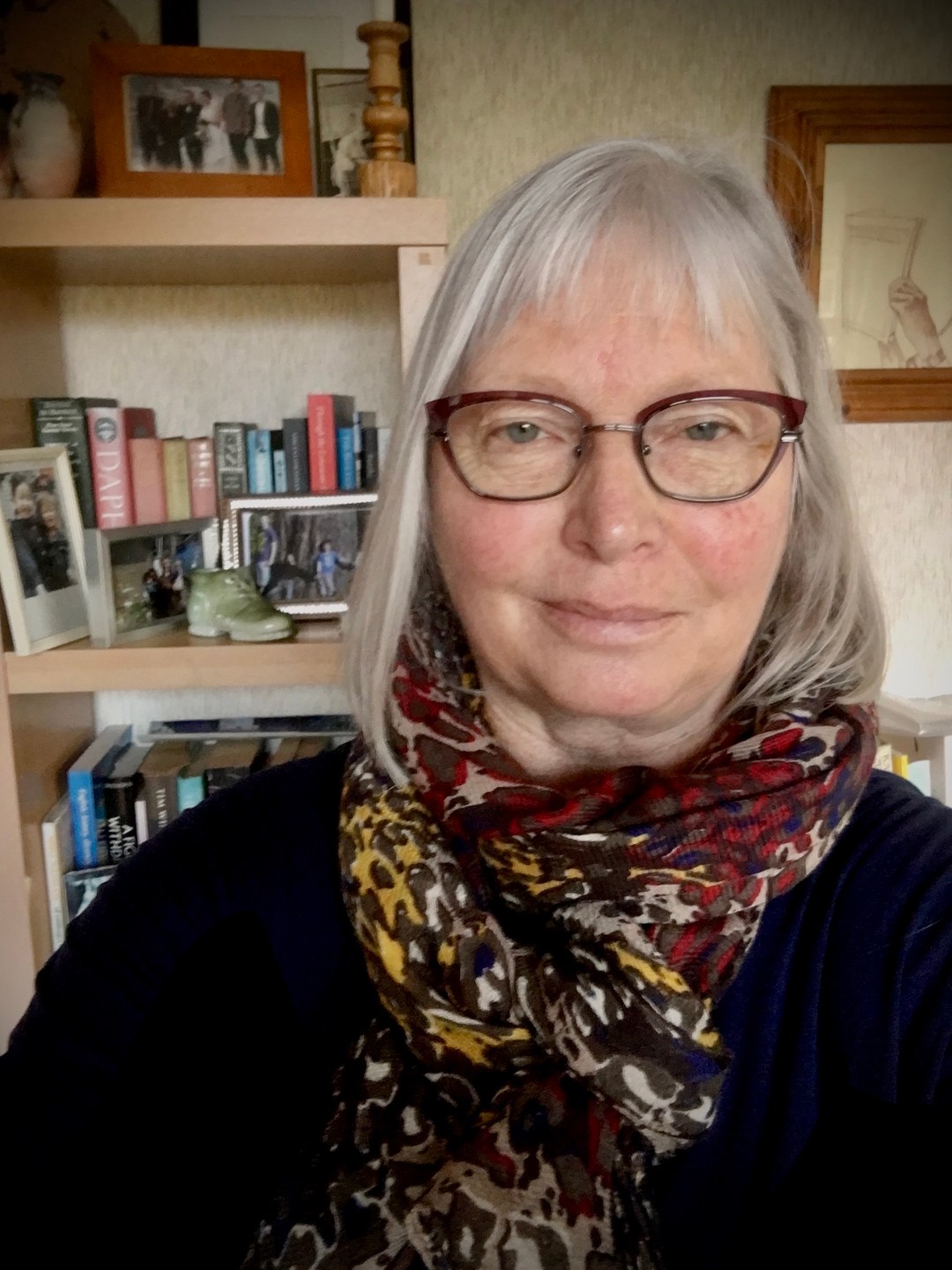
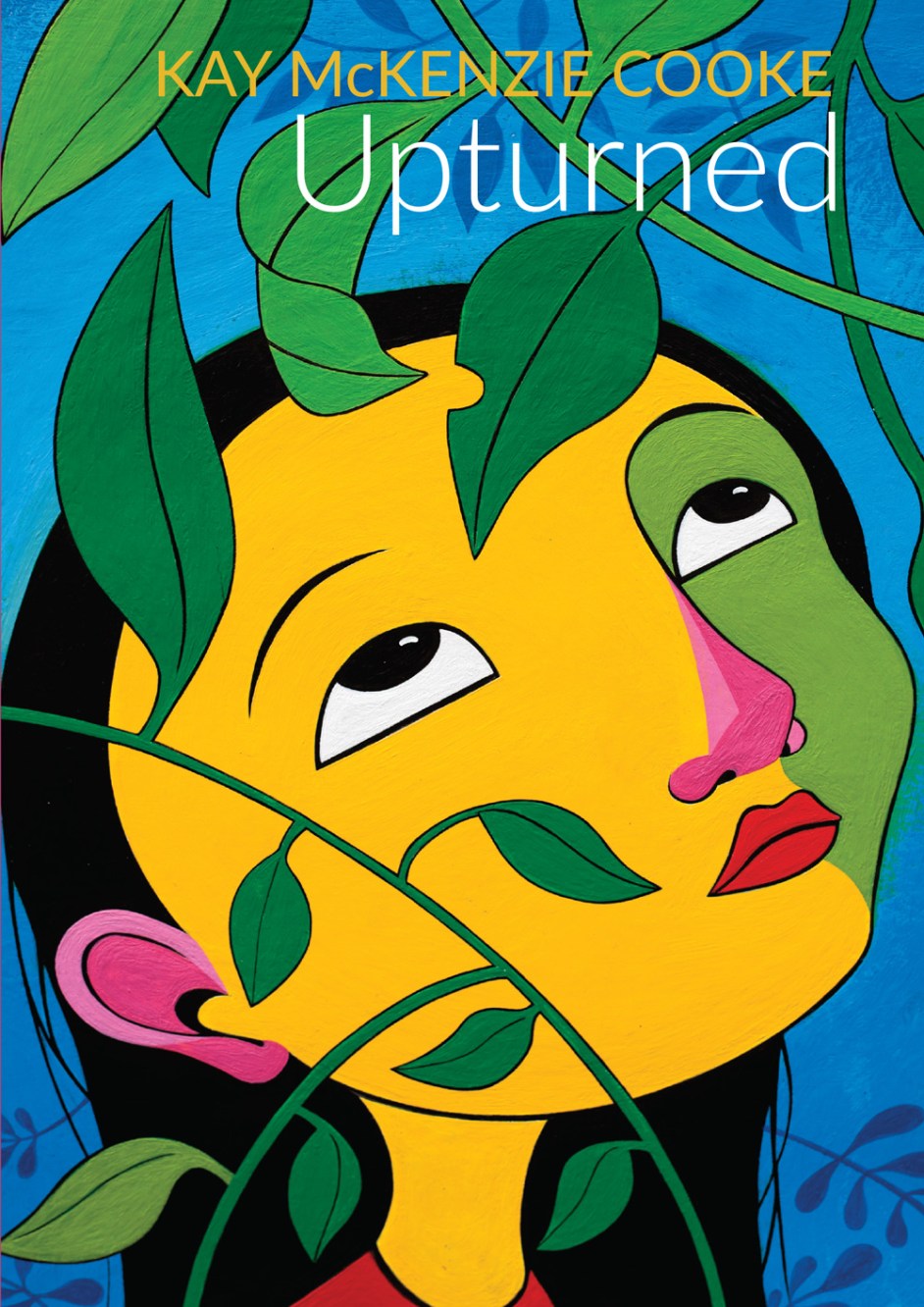
Kay McKenzie Cooke, Ngāti Tahu, Pākehā, is an award winning poet and short story writer. Her debut collection Feeding the Dogs was awarded the 2003 Jessie Mackay Best First Book Award for Poetry at the Montana NZ Book Awards. She lives in Dunedin, and spends part of her year in Berlin. Kay’s new collection with The Cuba Press Upturned is an evocative tribute to family, place, childhood, nature. The poems address attachment and kinship, love and grief. Some poems are southern based while others navigate Berlin. The poetry is a celebration of life and that celebration is of great reading comfort.
Paula What were the first poetry books that mattered to you?
Kay The first poet that comes to mind is Dylan Thomas. I have this idyllic memory of me at thirteen years old sitting under a silver birch tree reading his poetry. It was on a particularly sunny day at Wendon Primary School in Northern Southland. This may well be a false memory! But the delicious revelation, surprise and impact of Thomas’s particular brand of poetry, is not.
Enid Blyton was an early influence (typical 1950’s-60’s child I guess.) I also loved Walter de la Mere and I remember a book of poems by Christina Rossetti featuring in my childhood. And A.A. Milne.
Dare I confess that Rod McKuen was a poet I adored for a (very) short time in the early ‘70’s?
Paula What poetry books are catching your attention now?
Kay Another Confession: Lately I have been so buried in my own poetry I haven’t been able to really take a look at what else is out there. There is such a rich seam of recent poetry to be mined. I would not know where to start. I have a lot (a lot!) of books and poets to catch up on. Both from new poets and from established favourites. And that’s just in Aotearoa.
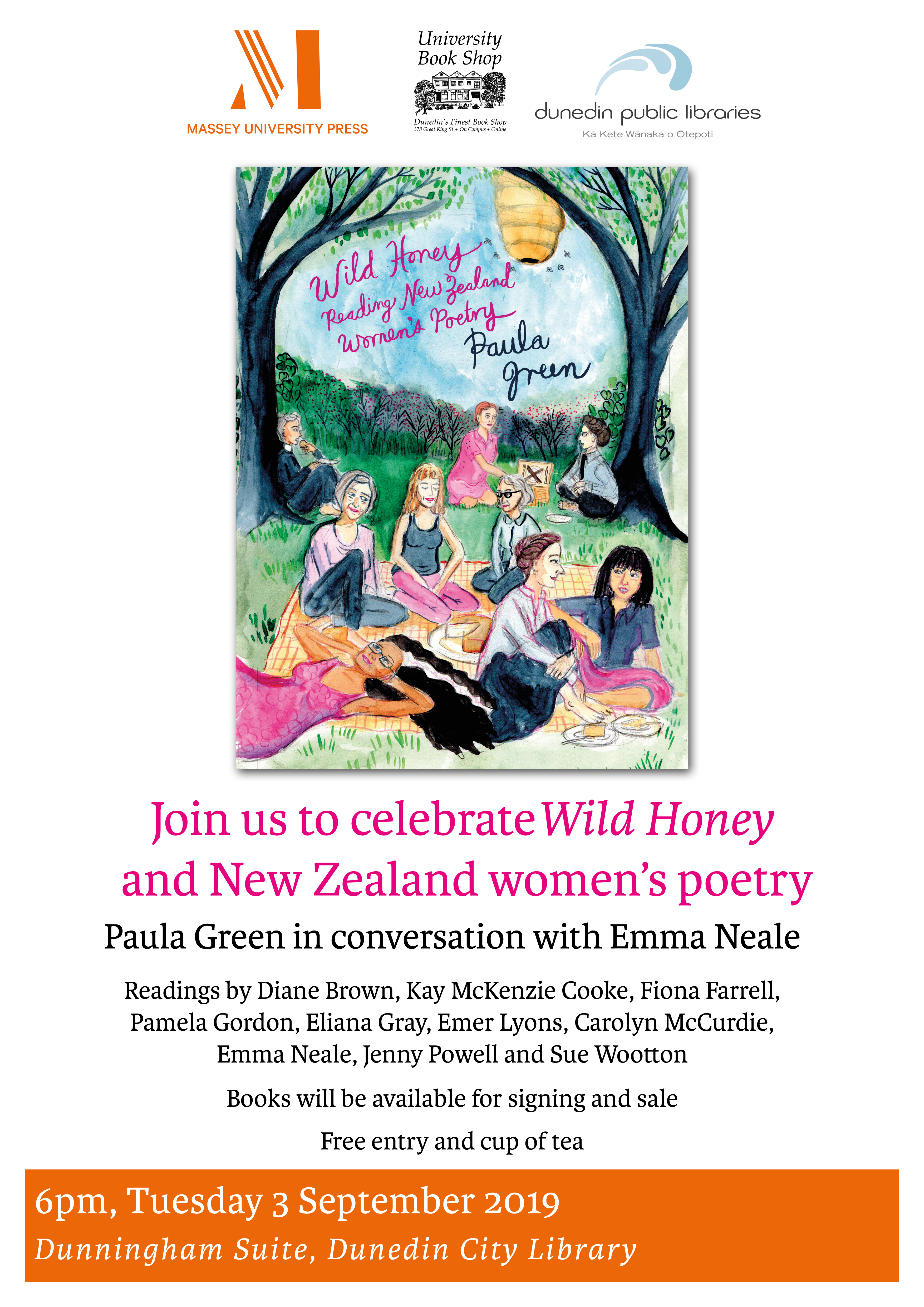
Wild Honey is one I’ve been enjoying as a treasure to dip into. And the latest Landfall (239) as well.
Oh. Does Joni Mitchell’s beautiful book, Morning Glory on the Vine, count? That’s the book I got for my birthday recently and which I’m also dipping into at present.
Paula What else do you like to read?
Kay Autobiographies, biographies, modern novels, murder mysteries, non-fiction books about nature. Historical books. The classics.
Paula Any standout poetry events you have attended either as an audience member or as a participant? Do you enjoy performing your work?
Kay Jenny Powell and I have formed a poetry reading duo called J&K Rolling. We take poetry out into southern rural areas and discover what poetry is to be found in these places.
After five years of us travelling to many varied rural areas, I have a heap of memories of poetry readings performed in halls, art galleries, libraries, show grounds and even a restored, historical bake house. I enjoy performing poetry in such venues and at these low-key events with a small, attentive audience. It’s deeply satisfying.
The Bluff ‘06 organised by nzepc is a standout. Twenty-two poets from all over Aotearoa took part in poetry readings in Motupōhue / Bluff and in Rakiura / Stewart Island.
Reading in Paris at the Chat Noir in 2013 is a poetry reading I will always remember and treasure.
Another more recent reading organised by Jim Gedddes at the beginning of this year with David Eggleton, Cilla McQueen, Richard Reeve, Jenny Powell and myself reading in the Eastern Southland Gallery, is another memorable occasion.
Again – too many to list here. They’re all wonderful events. I feel privileged to have taken part in so many.
One day, back when
everything was only as big
as the span of my forthright steps,
the world shattered into hailstones.
from ‘Hail’
Paula Your new collection Upturned is assured, pitch perfect on the line, multilayered yet runs with sweet economy. What matters to you when you write a poem?
Kay Thank you!
I guess where and how the line ends is important to me. I like each line to chime. Also how a poem begins and ends matters to me. I guess that it does for all poets.
I favour shorter poems. I used to write haiku. Maybe this is where my love of the succinct and economical comes from. Redundancy is something I try to avoid. I like to write tight poems, but not corset-tight.
Paula In the poetry of others?
Kay For me, poetry needs to have music that I can pick up as a tune. A consonance. And I do like poems to, in some way, tell a story.
I like poems that surprise me, with unexpected imagery. Poems that take me somewhere; that go somewhere.
It’s important, personally speaking, that they make sense even if that’s not on the first reading. There needs to be some point at which the real poem emerges from any ‘camouflage.’ This revelation always feels like a special treat.
Some poems I’ve read recently are tending to the lengthy, the clever, startling, oft-times irreverent and angry or edgy and crude. They’re sometimes surreal streams of consciousness with lines that dance, burst, curse, swirl, meander, fly, divert and segue. Sometimes these scattered lines are safely tethered to a subject – sometimes dangerously free-falling. I’m left startled. Is it good? It’s different. To use an old-fashioned term, even rather fetching. Taking off in new directions. Poetry as performance. Poetry using 21st century vernacular. I can’t keep up. Then again, I don’t need to. It’s all good. All is well.
The cotton dress Mum made for me, purple daisies
on black, with puff sleeves, was not the ballgown I longed for
in real satin, electric-blue. And my hair. Too high. Too
stiff. Set with hairspray.
My partner, Maurice, with no idea how to dance,
was not the partner I preferred.
from “Many moons ago, Maurice’
Paula I kept musing on the idea of poet as gardener, memoirist, musician, traveller, daydreamer, archivist as I read. What were you as you wrote this collection?
Kay I think you may have covered it, Paula.
I guess I was me being all of those at different times … plus chronicler. I like the word chronicler with its connotations of recording time.
I am aware that my poetry falls into poems about memory, place, childhood, whanau, tīpuna / ancestors, grief, daily life, ageing …
I think I am most pleased at your idea of ‘musician’. It’s a nice thought to think of my poetry as a kind of music.
I visit her iron-fenced bones
as the sea thumps
below the cliffs of the cemetery,
and I name her: Mary Frances Reilly,
my great-great-grandmother,
and use whatever is left of her
in me
to picture first the girl,
then the woman.
from ‘Name her’
Paula Poetry as keepsake? Family is so important in these poems.
Kay Keepsake is another word I like. It makes me think of a locket. Something treasured and kept safe; kept close.
When one experiences, as I have, the sudden death of a parent at a young age, keeping hold of memories becomes a way of surviving that brutal shock. It’s a way of holding on to a life that has seemingly (or literally) instantly disappeared into some unattainable, unreachable void.
To think someone leaves this world without any trace or memory of their place in it, is an unacceptable thought for me. I just can’t abide the thought of ‘no trace’. Of time itself sweeping away all aspects of a life or valued experiences. And so in my poetry I record. I chronicle. I keep.
I’d sat and read a whole book.
Time-wise we are all losers,
fooled back into memory.
Back then, eating a blackberry’s beaded cushion,
my tongue, my teeth, boring down
to its core,
its tiny wooden heart.
from ‘Blackberry days’
Paula I love the structure of the book. Can you tell me about that?
Kay The poems are divided into four sections. The ones about Berlin were of course easy to place into the one section. However, in order to prevent having too many nature, landscape or place poems together; or bunching-up childhood memories, grief poems, or family poems; it seemed pertinent to switch and mix them around a little. To a certain extent, chronological aspects also had to be taken into account – poems from before and after the Berlin experience for example.
The team at The Cuba Press (especially Mary McCallum) helped me with the structure. The result is pleasing. I like how the different poems speak to each other and how one poem often leads naturally on to the next – sometimes just by the natural extension of an image, key word, idea or impression.
Sing old kettle of slung light
that spins on through
this backyard
that could be the last kitchen
or the first. Old kettle, singing kettle,
let the heat of the days rock you.
from ‘Sing,sing, sing’
Paula Reading your poetry is a sensory experience. Do you have motifs you are particularly fond of?
Kay Yes! I do. And I have to watch that I don’t over-use these favourite motifs.
Mary helped me with that as well. She asked if I realised how many times I use the motifs of air, sun, sky, water … and I also realised that I needed to take out a few too many stones, grasses …
I am perhaps a little too fond of nature’s motifs. Birds are a motif for me as well. They, along with deer and horses, are members of my spirit-animal world.
For days now
the unpegged washing of snow
has lain in the mud of Dunedin’s hills
where a giant hawk of cloud
lifts off, its talons
Mount Cargill, a sag of grey.
from ‘Nor’esterly’
Paula I am reminded of Ruth Dallas’s attachment to the land in her poems, she made herself at home in her beloved south as she looked through an urban window. I have seen it in Sue Wootton’s poetry too. How does the land matter? Do you have go-to places?
Kay As a child brought up in the country way down in the same beloved south, I believe the spirit of that southern rural landscape is in my blood and firmly rooted in my innermost being. As deep as it can go. Even living happily as a city dweller for nearly fifty years has not diminished this relationship I have with this land; this integral part of my being.
Despite its buried streams running underground, Otepoti / Dunedin (as I believe is the case with all cities in Aotearoa) has never lost its relationship with the land. A strong identification with nature is part of its character as a city.
Being tangata whenua has its influence on my relationship with the land too – especially with Murihiku. Nothing needs to be conjured. It’s just there. Even on those days where I don’t leave my house – or even my writing room – my relationship with the land is still a beating heart.
Of course, actually going to places is a helpful and enjoyable top-up of the actual. There is nothing to match looking at a mountain close up, or smelling the seaweed smell of a favourite beach or hearing a mean sou’westerly whining in power lines.
I am eating the language of the ocean
on this last day of summer, Sommer,
eating the language
my granddaughter speaks.
She does not care
what they are, foxes of squirrels, Fuchs or Eichhörnchen –
it is simply her favourite dress
for now anyway, as she eats potato cake
with apple sauce and hardly ever looks at me
drinking her in with my eyes.
from “Foxes or squirrels’
Paula Home is so important but so too is the wider world in your writing. What changes when you write about or from elsewhere?
Kay When I am somewhere unfamiliar, it can manifest as dislocation. This is reflected most in the poems about Berlin which I wrote during and after lone trips there to stay with my son, his wife and their two small children.
While there, I felt something that was akin to homesickness. Keeping a journal helped to chronicle what was happening, both internally and externally. Then once I was back home again, the material in the journal with all its ramblings, jottings and sketches, was what I drew from for the Berlin poems. The many photos I’d taken also triggered poems and helped me to remember cityscapes, trees, pavements, people, sensations and emotions.
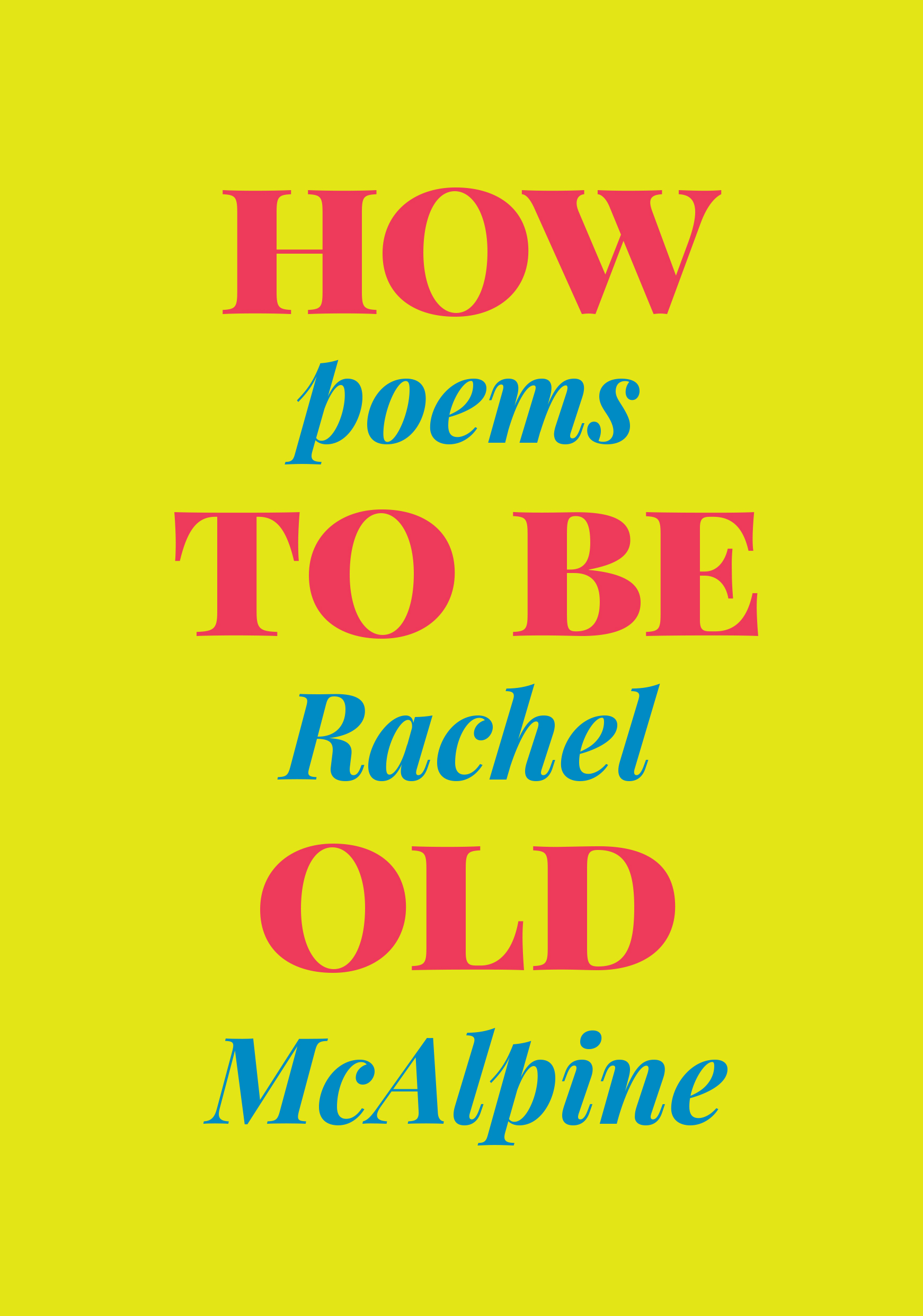
Paula The Cuba Press has published Upturned along with two others written by poets at an older age (Rachel McAlpine’s How to Be Old and John Tāne Christeller’s Fragments from an Infinite Catalogue). What has changed for you as a poet across the decades (if anything?)? How does age change things?
Kay As a young child I wrote poems about fairies. As an adolescent and young adult, about coffee and rain. As a young woman, descriptive pieces about what I could see in front of me – some of which were written as haiku.
Then in my late thirties, I started to study poetry, reading nothing but poetry for ten years.
Writing-wise, this stage was excruciating. I remember often being brought to tears because I couldn’t properly put down on paper what was in my head. Then one day – or so it seems – I hit my stride. I found my voice and I was away.
Age-ing is certainly a weird experience. Some part of me thinks it’s all backwards. The older we grow, the younger we feel. We don’t look the age we feel inside. I can’t explain. Maybe it’s time to write some poems about it.
I remember when I was young, I loved reading personal accounts about what it was like to reach the age of eighty. This gives me hope that there may be a younger audience interested in reading about what it’s like to be old.
I am sometimes tempted to feel out of step with younger writers. Doubt threatens to creep in, until I remind myself that everyone is relevant. One of the features that make the regular Dunedin poetry readings so valuable, is the lively cross section of ages and stages of those that attend and read. All are accepted. All are represented. No-one is made to feel redundant or irrelevant, no matter the age.
Paula Were there poems you found hard to write? In terms of doubt or of subject matter – you do face grief and loss, along with joy?
Kay They are not hard poems to write, the ones about grief and loss. They seem to emerge from a place in me that is never empty. Rather than being hard to write, it’s almost like it’s hard to stop writing about these subjects. Poetry heals. And as long as we have stuff to heal from, poetry is there to help with that. Of course it needs to be achieved without maudlin or sentimental cliches. Isn’t there a saying about when describing a funeral, you don’t describe the tears mourners are weeping, but instead you describe the flowers on the casket? Something like that.
Daughter
My daughter told me about how Ace got run over.
She said that all along she knew it wasn’t a good idea
to let the dog run along beside the car,
but that Kris told her he’d seen his mates do it
and it’d be okay. ‘He should’ve listened to me,’ my daughter said,
‘but he’s too “she’ll be right”. Always with the “she’ll be right”.
Said I’m just being paranoid.’
Then, of course, what she thought would happen
happened: the dog’s leg slipped under the car’s wheel.
She asked me to help her take him to the vet
and carried him to the car like a baby.
‘A twenty-kilo baby at that,’ she said,
‘equivalent to twenty bottles of milk.’
The dog sat in the back seat
with a tartan rug draped over his head
like a Highland shawl, underneath, his face
all screwed up like an old person
trying to remember something.
In the waiting room, my granddaughter and I
decided that from underneath, the turtle in the tank
looked like a grenade with legs,
its cake-rack-patterned
tummy the shade of milky custard,
its head a thumb. The vet’s X-ray showed
that Ace’s injury was just a sprain.
Afterwards we had a cup of coffee at Rhubarb.
‘What’s more,’ my daughter said, referring back,
‘he hasn’t said sorry nearly hard enough.’
On the way home, from the top of Roslyn,
the sea is distant, kidney-shaped,
and my daughter said, ‘Don’t you just hate it
with the sky all white like it is today and no sun?
We may as well all be locked inside
a chilly bin.’ And I think: Daughter, it has to be
one of the most beautiful words.
Kay McKenzie Cooke
Paula Is there a poem that has particularly worked or mattered to you?
Kay The poem about my daughter. She is extra-precious to me because she was adopted out as a baby and we reconnected – or found each other – twenty-three years ago now. (I write more about this in my third book, Born to a Red Headed Woman.)
The poem, called ‘Daughter’, is a slice of life that highlights for me the relationship my daughter and I now have. A relationship I treasure at a very deep level.
Paula Has Covid 19 affected you as either reader or writer? Did you write any poems in lockdown?
Kay I wrote about four poems – mostly about birds. Birds became highlighted for me during that time of lockdown. Possibly because they were symbolic of a freedom to fly or rise above all the fuss, worry and fear.
I thought I’d write screeds. But I was too busy editing Upturned with Mary to write new stuff. Too busy to even take notes from which to write poems from later.
Whatever I write about this strange time may not even be in the form of poetry. We’ll see after I’ve processed it all.
Paula What do you like to do apart from writing?
Kay Watch Netflix and listen to true crime podcasts.
I like to walk and take photos. Spend time with whanau. Go on roadies south.
Watch birds. Pick up stones and shells. I like reading – can’t wait to fully start reading again, to catch up on new poets and read new books from established poets. And add to my murder mystery reading. I’ve spent a whole year just on writing. It’s time to read. It’ll be my summer project.
Paula If you could curate a festival poetry reading, drawing upon any time or place who would you invite?
Kay I would invite: John Keats. Dylan Thomas. Gerald Manly Hopkins. Marianne Moore. Diane Wakoski. John Dolan. Wendy Cope. Fleur Adcock. Cilla McQueen. Ruth Dallas. Talia Marshall. Jeanne Bernhardt. Nick Ascroft. Richard Reeve. David Eggleton. Jenny Powell. Tony Beyer. Matsuo Basho.
Kay McKenzie Cooke reads ‘No Longer Applies’ from Upturned, The Cuba Press, 2020
Kay McKenzie Cooke, Kai Tahu, Kati Mamoe, lives in Dunedin. Her fourth poetry collection Upturned has just been released from The Cuba Press. Her website and blog can be found here.
Rachel McAlpine reads ‘Reading a paper book’ from How to Be Old The Cuba Press 2020
Poet Rachel McAlpine lives in Wellington and is 80. She blogs, podcasts and draws (badly) as well as writing poems. How To Be Old, her latest collection of poems, will be launched by Fiona Kidman at Unity Books on Tuesday 21st July at 12.30 pm.


 NZ Poetry Shelf