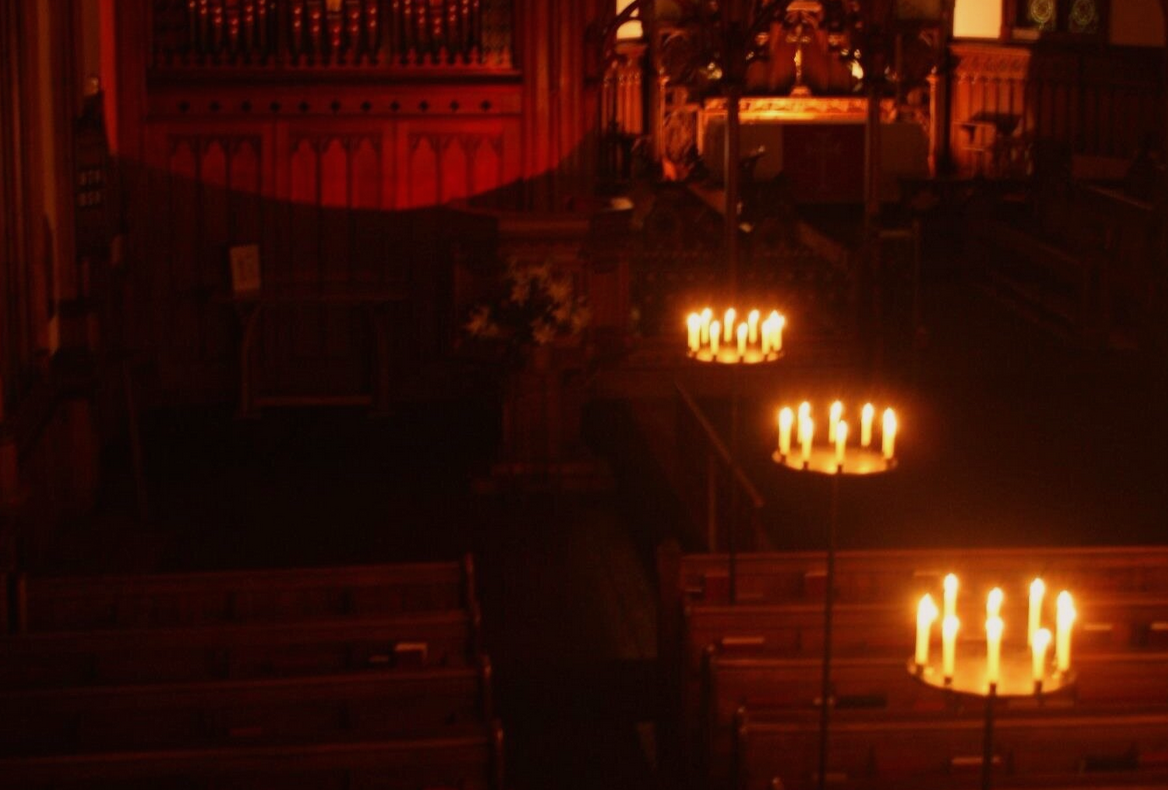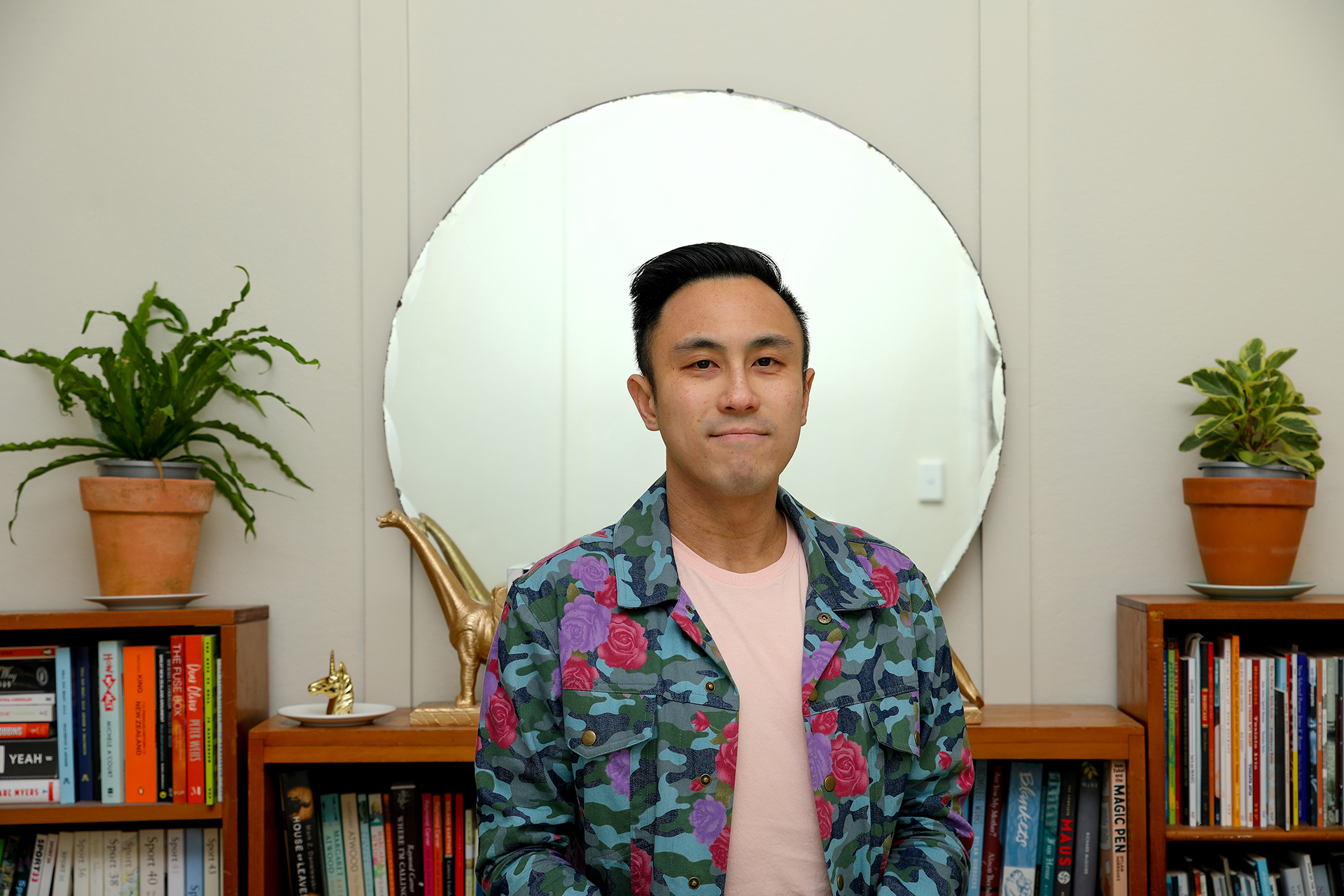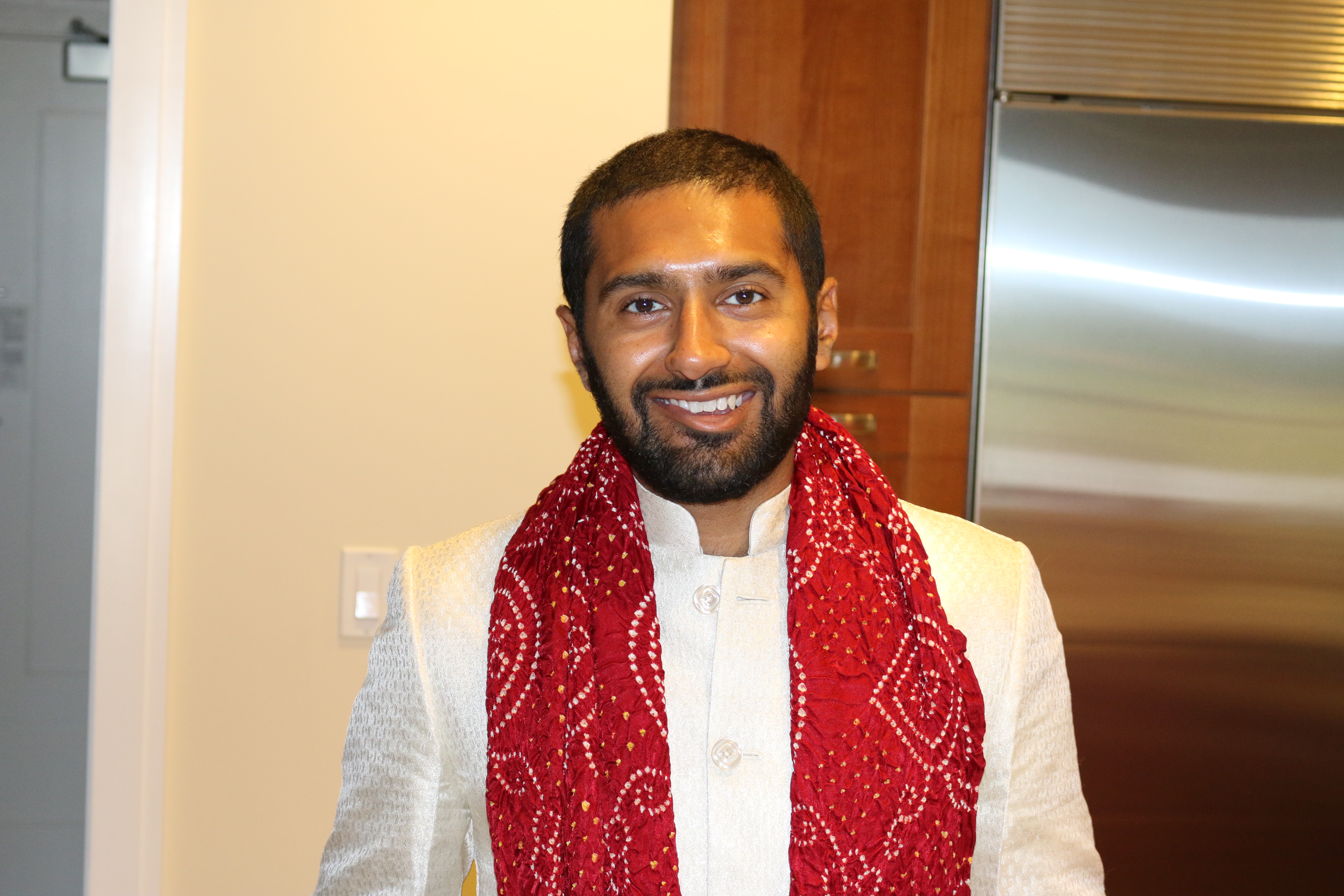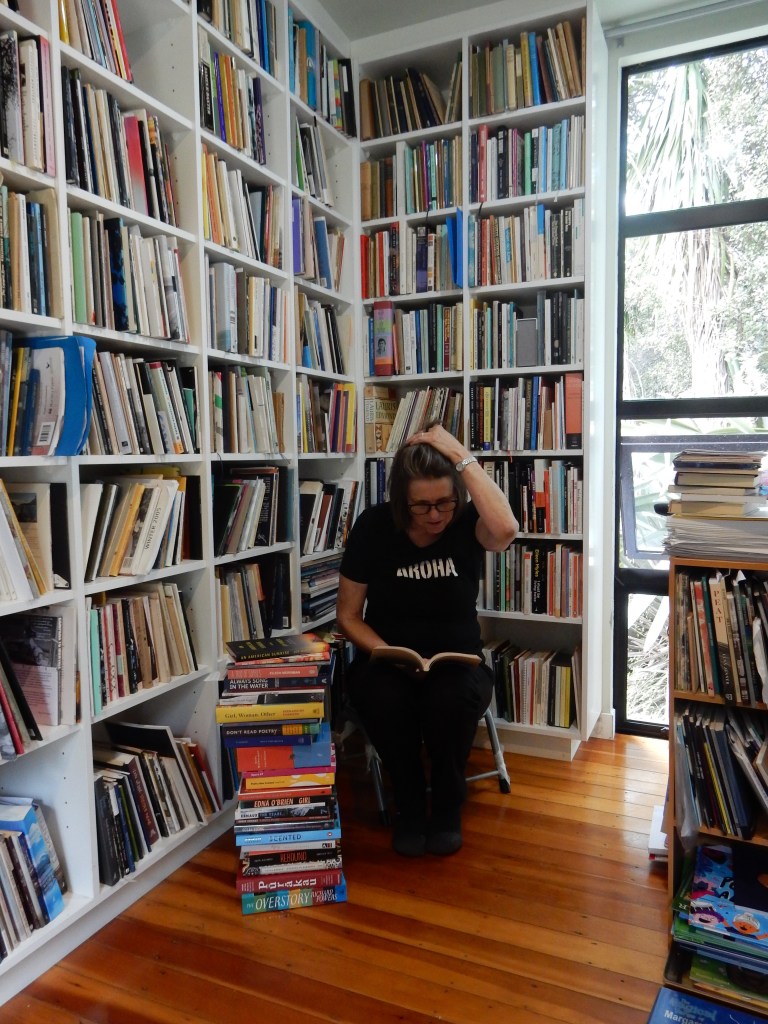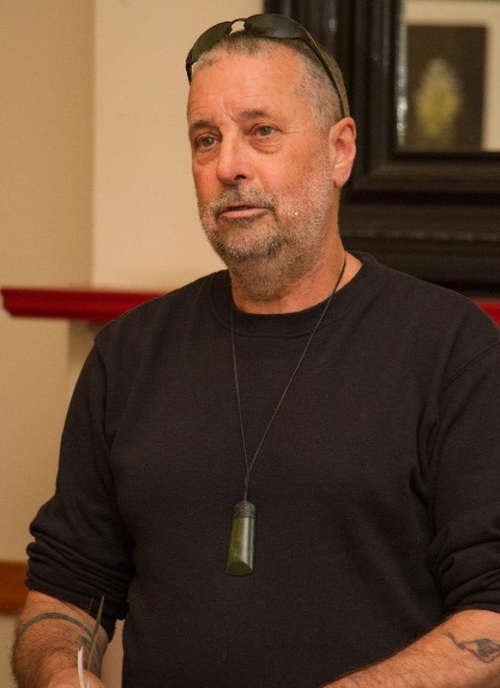
Poetry and music go together like candles and churches, and what’s better than poetry and music? Poetry and music in the cavernous St Peters church on a stormy night. Lōemis Festival’s recent event Epilogue, born out of the mind of Festival Artistic Director Andrew Laking, brought together some of the city’s finest ensemble musicians and a murderer’s row of local poets for an evening of original composition that was at times ecstatic, somber, thought-provoking, soothing and so much more. Local wordsmiths Nick Ascroft, Chris Tse, Rebecca Hawkes, Ruby Solly and Harry Ricketts were all given the opportunity to write and deliver original poems in this reimagined requiem mass and their words the space and scope they deserved.
The event page promised an echo of the original idea, that follows the same rise, fall and atmosphere, and it delivered, interspersing music and the spoken word. The event begun with a composition from the ensemble and they punctuated every poet’s performance, creating room for breach and reflection and time for the poems to wash over the crowd and reset the mood for the next poet. The church was dark and moody and still throughout, while this made for the perfect audience experience it made it impossible to take any notes during the show, as a result I’m just going to gush about all the wonderful performers who took the stage.
Epilogue
Nick Ascroft was the first poet to take to the pulpit. He delivered two new poems that were personal and inventive, hilarious and heartbreaking. While I’ve been a fan of Nick’s wit on the page for years it was great to have the opportunity to see him read in this context, not only did his poems set the tone for the evening but his opener ‘You Will Find Me Much Changed’ has been lounging about in my head ever since. Next up was everyone’s favourite poet crush Chris Tse. Dressed in dapper attire apparently inspired by a fancy can of water, Chris, much like Nick used repetition to build his sermon, like a mantra, an incantation. It reverberated off the stained-glass windows and when Chris finished with his piece, entitled ‘Persistence is futile’, I got so upset I have to wait until 2022 for his third collection.
Rebecca Hawkes was next, accidentally dressed as Kath from Kath and Kim due to a wardrobe malfunction but it didn’t matter. Rebecca is the type of poet tailor-made for an event like this, she can conjure imagery that spans the grotesque to the sublime and she has a performance style that colours those images so vividly you feel fully submerged in her world. Speaking of complex other worlds, Ruby Solly is one of the masters of weaving them together and that was on full display in her performance. Ruby also played taonga pūoro with the ensemble before her reading just to remind the audience how talented she is. The last poet of the evening was Harry Ricketts, whose Selected Poems is out in the world right now. Harry’s ‘The Song Sings the News of the World’ closed out the evening, and while it wasn’t necessarily the most complex or challenging poem of the evening, it was the perfect ending, prompting all those watching to look forward and wonder, leaving the audience with a sense of hope.
Overall it was the perfect evening, poetry and music together as they should be, in a venue built for ritual. Epilogue is the type of event that showcases what poetry can be when it’s not confined, stretching it and moulding it into something unexpected, the type of event Andrew and his VERB co-director Clare Mabey excel at producing. I sincerely hope Epilogue doesn’t live up to its namesake and we get to see it again in one form or another.
Jordan Hamel
Music by Nigel Collins and Andrew Laking, in collaboration with Simon Christie and Maaike Beekman. New texts written and read by Chris Tse, Rebecca Hawkes, Harry Ricketts, Ruby Solly, and Nick Ascroft. With Dan Yeabsley (reeds), Tristan Carter (violin), and Dayle Jellyman (keys).
Jordan Hamel is a Pōneke-based writer, poet and performer. He was the 2018 New Zealand Poetry Slam champion and represented NZ at the World Poetry Slam Champs in the US in 2019. He is the co-editor of Stasis Journal and co-editor of a forthcoming NZ Climate Change Poetry Anthology from Auckland University Press. He is a 2021 Michael King Writer-in-Residence and has words published in The Spinoff, Newsroom, Poetry New Zealand, Sport, Turbine, Landfall, and elsewhere.
Jordan Hamel’s poem ‘You’re not a has-been, you’re a never was!’
Poetry is a way of bridging the faraway and the close at hand. A poem can make the achingly distant comfortingly close. Poetry can be a satisfying form of travel, whether to the other side of the world, to the past or to imagined realms. Reading poems that offer the faraway as some kind of presence, I feel such a range of emotions. Moved, yes. Goose bumps on the skin, yes. Boosted, yes. This is such a fertile theme, I keep picturing a whole book moving in marvellous directions.
I am grateful to all the poets and publishers who continue to support my season of themes.
The Poems
Remembering
if you can you can try to recall
the sun across the roof and you
knee-deep in childhood playing
near the fence with the storm
of daisies still impressionable
in the way of dreams still
believing leaves had voices
and you might then remember
curtains drowned in burnished light
how at night the sky emptied
into a field of stars leaching out
the guilt you’d soon forget unlike
the woman you called Nana who kept
knitting you hats while you kept not
writing back and maybe then you’d know
the injustices you had no part in
the lady who bought your house how
she ravaged your kingdom while
you were away oh these memories
spiralling into memories into
nothing this helter skelter art of
remembering this bending
over backwards running out of light
Anuja Mitra
from Mayhem Literary Journal, Issue 6 (2018)
Drifting North
Acknowledgement to David Eggleton
She said we discussed post
structuralism in a post modern
context. She said in order
to remember such crucial
poetic phrases she had bought
a small exercise book in which
to record them.
It was, she said, a book
of semantic importance.
She said we considered
the deception of disjointed
parody and the fragmentation
of shallow consumer culture.
I can only remember
a girl
in her pale blue cardigan
drifting north
in a zither of light.
Jenny Powell
from Four French Horns, HeadworX, 2004
apricot nails
I want to paint my nails apricot as an homage to call me by your name and the fake italian summer I had last year —
fake because I didn’t cycle beside slow streams or in slow towns
Instead I lay on a 70 euro pinstripe lounger and couldn’t see the water only other tourists
And the apricots I ate came from peach spritzes at sea salt restaurants and clouded supermarket jars
But all the shops are shut and the closest nail colour I have is dark red
I want to be somewhere in northern italy with light green water and deep green conversations
I want to pick fresh apricots from drooping branches and kiss a boy I shouldn’t on cobblestone paths against cobblestone walls
I want to lick a love heart on to his shoulder so that when he gets on a train my hands shake like a thunderstorm
and I can’t cycle home past the fields we held each other in and mum has to pick me up from the station
I want to walk down a staircase with winter at the bottom waiting to sweep me into snow
I want the phone to ring when the sky is white and hear an apricot voice ripe and ready to be plucked from the tree
he’ll say how are you and I’ll slowly leak
Rhegan Tu’akoi
from Stasis 5 May 2020, picked by Aimee-Jane Anderson-O’Connor
Wearing Katherine Mansfield’s Shawl
Seventy years on, shut
in a cardboard box in the basement
of City Hall, you might think
the shawl would have lost
its force to charm, the airy fragrance
of its wearer departed, threads
stripped bare as bones,
yet here it is, another short story:
it felt like love at the Hôtel
d’Adhémar the moment you placed
the silk skein around my shoulders,
the dim red and rusty green fabric
and a fringe gliding like fingertips
over my arm, a draught of bitter
scent – Katherine’s illness,
Virginia’s sarcasm – and
yes, a trace of wild gorse
flowers and New Zealand, not
to mention the drift of her skin
and yours during the photograph,
the stately walk through the town.
Fiona Kidman
from Where Your Left Hand Rests, Godwit, Random House, 2010
Sparks
On the occasion of the Sew Hoy 150th Year Family Reunion, September 2019
Here in this earth you once made a start
home treasure watered with sweat, new seeds
a fire you can light and which gives off sparks
the gleam of gold glowing in darkness
an open door, warm tea, friendships in need
here on this earth you once made a start
sometimes you imagined you left your heart
elsewhere, a woman’s voice and paddies of green
a fire which was lit, remembering its sparks
but even halfway round the world, shoots start
old songs grow distant, sink into bones unseen
here in this earth you can make a new start
with stone and wood you made your mark
built houses of diplomacy and meaning
a new fire was lit, with many sparks
flame to flame, hand to hand, heart to heart
150 years, sixteen harvests of seed
here, in this earth, you once made a start
A fire was once lit. We all are its sparks.
Renee Liang
Heavy Lifting
Once, I climbed a tree
too tall for climbing
and threw my voice out
into the world. I screamed.
I hollered. I snapped
innocent branches. i took the view
as a vivid but painful truth gifted
to me, but did not think to lay down
my own sight in recompense.
All I wanted was someone to say
they could hear me, but the tree said
that in order to be heard I must
first let silence do the heavy lifting
and clear my mind of any
questions and anxieties
such as contemplating whether
I am the favourite son. If I am not,
I am open to being a favourite uncle
or an ex-lover whose hands still cover
the former half’s eyes. I’ll probably never
have children of my own to disappoint
so I’ll settle for being famous instead
with my mouth forced open on TV like
a Venus fly-trap lip-synching for its life.
The first and last of everything
are always connected by
the dotted line of choice.
If there is an order to such things,
then surely I should resist it.
Chris Tse
from he’s so MASC, Auckland University Press, 2018
My city
drawing blank amber cartridges in windows
from which we see children hanging, high fires
of warehouse colours, a reimagining, my city fluttering
far and further away with flags netted
and ziplining west to east, knotted
and raining sunshine,
paving cinder-block-lit-tinder music in alleys
where we visit for the first time, signal murals
to leapfrog smoke, a wandering, my city gathering
close and closer together a wilderness
of voices shifting over each other
and the orchestra,
constructing silver half-heresies in storefronts
to catch seconds of ourselves, herald nighttimes
from singing corners, a remembering, my city resounding
in and out the shout of light on water
and people on water, the work of day
and each other,
my city in the near distance fooling me
into letting my words down, my city visible
a hundred years from tomorrow,
coming out of my ears and
forgiving me,
until i am disappeared someways and no longer
finding me to you
Pippi Jean
Looming
I call it my looming
dread, like the mornings I wake
crying quietly at the grey
in my room, like whispering to my sleeping
mother – do I have to
like the short cuts I can’t take
like the standing outside not breathing
like my hand on the doorknob
counting to twenty and twenty
and twenty.
Tusiata Avia
from Wild Dogs Under My Skirt, Victoria University Press, 2004
mothering daughter
I am coming home to myself
while watching
my mother going away from herself.
Every move you make
an effort
so much slower now, mother
like your body is trying to keep pace
with your mind
everything about you reads as
tired
but sometimes I read as
giving up
FUCK THIS! silently salts my tongue
a tight fist slamming the steering wheel
gas under my foot
tears choking my ears
smoke swallowing my chest.
I am a mother:
Mothering her son,
a motherless daughter mothering her mother.
It’s hard somedays not to be swallowed.
Grace Iwshita-Taylor
from full broken bloom, ala press, 2017
Memoir II
Preparing for death is a wicker basket.
Elderly women know the road.
One grandmother worked in munitions, brown
bonnet, red stripe rampant. the other, a washerwoman:
letters from the Front would surface, tattered.
You must take the journey, ready or not.
The old, old stream of refugees: prams
of books and carts with parrots.
Meanwhile the speeches, speeches: interminable.
When the blood in your ears has time to dry: silence.
The angel will tie a golden ribbon to the basket’s rim.
You will disappear, then reappear, quite weightless.
Jeffrey Paparoa Holman
from Blood Ties: New and Selected Poems 1963- 2016, Canterbury University Press, 2017
fever
moving away from the orchard plots,
laundry lines that sag under the macrocarpa.
moving away from the crystalline skies,
the salt-struck grasses, the train carts
and the underpasses. i astral travel
with a flannel on my head, drink litres
of holy water, chicken broth. i vomit
words into the plastic bucket, brush
the acid from my teeth. i move away,
over tussock country, along the desert
road. i chew the pillowcase. i cling
my body to the bunk. the streets
unfurl. slick with gum and cigarettes.
somebody is yelling my name. i quiver
like a sparrow. hello hello, says the
paramedic. but i am moving away from
the city lights, the steel towers.
and i shed my skin on a motorway
and i float up into the sky.
Elizabeth Morton
from This Is Your Real Name, Otago University Press, 2019
Black Stump Story
After a number of numberless days
we took the wrong turning
and so began a slow descent
past churches and farmhouses
past mortgages and maraes
only our dust followed us
the thin cabbage trees were standing
in the swamp like illustrations
brown cows and black and white and red
the concrete pub the carved virgin
road like a beach and beach like a road
two toothless tokers in a windowless Toyota
nice of you to come no one comes
down here bro – so near and
yet so far – it takes hours
not worth your while –
turned the car and headed back
shaggy dogs with shaggy tales
Murray Edmond
from Fool Moon, Auckland University Press, 2004
The Poets
Tusiata Avia is an internationally acclaimed poet, performer and children’s author. She has published 4 collections of poetry, 3 children’s books and her play ‘Wild Dogs Under My Skirt’ had its off-Broadway debut in NYC, where it took out The Fringe Encore Series 2019 Outstanding Production of the Year. Most recently Tusiata was awarded a 2020 Arts Foundation Laureate and a Member of the New Zealand Order of Merit for services to poetry and the arts. Tusiata’s most recent collection The Savage ColoniserBook won The Ockham NZ Book Award for Best Poetry Book 2021.
Murray Edmond, b. Kirikiriroa 1949, lives in Glen Eden. 14 books of poetry (Shaggy Magpie Songs, 2015, and Back Before You Know, 2019 most recent); book of novellas (Strait Men and Other Tales, 2015); Then It Was Now Again: Selected Critical Writing (2014); editor, Ka Mate Ka Ora; dramaturge for Indian Ink Theatre. Forthcoming: Time to Make a Song and Dance: Cultural Revolt in Auckland in the 1960s, from Atuanui Press in May, 2021.
Jeffrey Paparoa Holman is a Christchurch poet and non-fiction writer. A poetry collection, Blood Ties: selected poems, 1963-2016 was published by Canterbury University Press in 2017. A memoir, Now When It Rains came out from Steele Roberts in 2018. He makes his living as a stay-at-home puppy wrangler for Hari, a Jack Russell-Fox Terrier cross. Hari ensures that little writing takes place, while psychogeography and excavating parks happen daily. Recent work has appeared in Poetry New Zealand Yearbook 2021, an essay on prison reform, and poetry; also, an inclusion in The Cuba Press anthology, More Favourable Waters – Aotearoa Poets respond to Dante’s Purgatory.
Grace Iwashita-Taylor, breathing bloodlines of Samoa, England and Japan. An artist of upu/words led her to the world of performing arts. Dedicated to carving, elevating and holding spaces for storytellers of Te Moana nui a Kiwa. Recipient of the CNZ Emerging Pacific Artist 2014 and the Auckland Mayoral Writers Grant 2016. Highlights include holding the visiting international writer in residence at the University of Hawaii 2018, Co-Founder of the first youth poetry slam in Aoteroa, Rising Voices (2011 – 2016) and the South Auckland Poets Collective and published collections Afakasi Speaks (2013) & Full Broken Bloom (2017) with ala press. Writer of MY OWN DARLING commissioned by Auckland Theatre Company (2015, 2017, 2019) and Curator of UPU (Auckland Arts Festival 2020).
Pippi Jean is eighteen and just moved to Wellington for her first year at Victoria University. Her most recent works can be found in Landfall, Starling, Takahe, Mayhem, and Poetry New Zealand Yearbook among others.
Fiona Kidman has written more than 30 books and won a number of prizes, including the Jann Medlicott Acorn Fiction Prize for This Mortal Boy. Her most recent book is All the way to summer:stories of love and longing. She has published six books of poems.In 2006, she was the Katherine Mansfield Fellow in Menton. The poem ‘Wearing Katherine Mansfield’s shawl ‘is based on an event during that time. Her home is in Wellington, overlooking Cook Strait.
Renee Liang is a second-generation Chinese New Zealander whose parents immigrated in the 1970s from Hong Kong. Renee explores the migrant experience; she wrote, produced and nationally toured eight plays; made operas, musicals and community arts programmes; her poems, essays and short stories are studied from primary to tertiary level. In recent years she has been reclaiming her proud Cantonese heritage in her work. Renee was made MNZM in 2018 for Services to the Arts.
Anuja Mitra lives in Auckland. Her writing has appeared in Takahe, Mayhem, Cordite Poetry Review, Starling, Sweet Mammalian, Poetry Shelf and The Three Lamps, and will appear in the AUP anthology A Clear Dawn: New Asian Voices from Aotearoa New Zealand. She has also written theatre and poetry reviews for Tearaway, Theatre Scenes, Minarets and the New Zealand Poetry Society. She is co-founder of the online arts magazine Oscen.
Elizabeth Morton is a teller of poems and tall tales. She has two collections of poetry – Wolf (Mākaro Press, 2017) and This is your real name (Otago University Press, 2020). She has an MLitt in creative writing from the University of Glasgow, and is completing an MSc in applied neuroscience at King’s College London. She likes to write about broken things, and things with teeth.
Jenny Powell is a Dunedin poet and performer. Her work has been part of various journals and collaborations. She has a deep interest in music and used to be a french horn player.
Chris Tse is the author of two poetry collections published by Auckland University Press – How to be Dead in a Year of Snakes (winner of Best First Book of Poetry at the 2016 Ockham New Zealand Book Awards) and HE’S SO MASC – and is co-editor of the forthcoming Out Here: An Anthology of Takatāpui and LGBTQIA+ Writers From Aotearoa.
Rhegan Tu‘akoi is a Tongan/Pākehā living in Pōneke. She is a Master’s student at Victoria and her words have appeared in Turbine | Kapohau, Mayhem and Sweet Mammalian. She has also been published in the first issue of Tupuranga Journal
Epilogue is a new work that follows the form of a requiem mass, minus the death and liturgy.
Five writers accompanied by an ensemble of musicians explore a series of unrelated events, evoking ideas around transition, inevitability, rest, activity, optimism and infinity.
Music by Nigel Collins (Flight of the Conchords / Congress of Animals) and Andrew Laking, in collaboration with Simon Christie and Maaike Beekman. New texts written and read by Chris Tse, Rebecca Hawkes, Harry Ricketts, Ruby Solly, and Nick Ascroft. With Dan Yeabsley (reeds), Tristan Carter (violin), and Dayle Jellyman (keys).
What to Expect To make Epilogue, we took the structure and sense of a requiem mass, then pulled it apart it and filled it with contemporary language and music. What we’re left with is an echo of the original idea, that follows the same rise, fall and atmosphere, but speaks to more recent events, all of which are different and personal, but connected in a broader sense. Imagine a secular order of service that alternates between music and spoken word and you’re half way there!
Who’s involved? Nigel Collins is a playwright and musician who is best known for his work with Flight of the Conchords (Orchestra of One) and Congress of Animals. He combines with a fantastic ensemble of musicians, including bassist Simon Christie (Aurora IV), Dayle Jellyman and reeds maestro Dan Yeabsley (The Troubles). The texts have been put together by a standout collection of writers, featuring many of Wellington’s best – for more info, click on the artist profiles on this page.
A Clear Dawn: New Asian Voices from Aotearoa New Zealand
eds. Paula Morris and Alison Wong, Auckland University Press, 2021
To celebrate the arrival of A Clear Dawn, I invited nine poets to read one of their poems in the collection as audio or video. This fabulous anthology of poetry and fiction, so astutely and loving assembled by Paula Morris and Alison Wong, is sheer reading joy. I am delighted you get to have a taste of nine of the poets’ voices here. Auckland University Press have created an exquisite book. I love holding it, I love finding my way through the beautifully designed pages. I just love this book.
If you live in Auckland you might like to go to the launch at the Auckland Writer’s Festival:
Saturday May 15th, 5:00pm – 6:00pm Balcony Bar, Level Five, Aotea Centre
Enjoy a complimentary glass of wine with selected readings as this ground-breaking contribution to our literature is launched.
You can listen to Alison Wong discuss the book with Kathryn Ryan here.
Rushi Vyas reads ‘I saw you and I learned this, beloved‘
Vanessa Mei Crofskey reads ‘What’s the pH balance of yin + yang?’
Vanessa Mei Crofskey is an artist and writer based in Te-Whanganui-a-Tara, who features in A Clear Dawn, the first-ever anthology of Asian New Zealand creative writing. She is the current director of Enjoy Contemporary Art Space.
Modi Deng is a postgraduate candidate in piano performance at the Royal Academy of Music on scholarship. Currently based in London, Modi received a MMus (First Class Hons, Marsden research scholarship) and a BA from Auckland University. Her first chapbook-length collection of poetry will be part of AUP New Poets 8. She cares deeply about literature (especially poetry, diaspora), music, psychology, and her family.
Maryana Goco Garcia is a poet, and a journalist who dabbles in photography. All of Maryana’s work, visual or written, attempts to find the miracle in the moment, to encourage pausing, to look hard at what lies before us until we notice something new. You can find her poetry on Instagram where she keeps a visual and word archive as @ripagepoet.
Isabelle Johns likes to write when she has the inspiration, and is (grudgingly) practising doing so without the inspiration part, too. She studies Computer Systems Engineering at the University of Auckland, where she can be found most of the time, either catching up on missed lectures or frantically debugging code before a deadline. Her poems have been published in The Three Lamps, University of Auckland’s literary journal, as well as the upcoming anthology for Asian New Zealand writers, A Clear Dawn.
Jiaqiao (Jay) Liu is a Chinese nonbinary poet currently doing a creative writing MA in Pōneke. They write about family, queerness, longing, myth and tech, among other obsessions. Some of their work can be found in brief, Blackmail Press, takahē and Queer the Pitch.
Neema Singh is a poet from Christchurch of Gujarati Indian descent. Her work appears in Ko Aotearoa Tātou: We Are New Zealand(2020) and A Clear Dawn: New Asian Voices from Aotearoa New Zealand (2021) and she is currently working on her first collection of poetry, a series of poems unfolding the layers of culture, identity and history contained within ordinary moments. Neema is an experienced secondary school English teacher and holds a Master of Creative Writing from The University of Auckland.
Chris Tse is the author of How to be Dead in a Year of Snakes and HE’S SO MASC. He and Emma Barnes are co-editors of Out Here: An Anthology of Takatāpui and LGBTQIA+ Writers From Aotearoa, due to be published in October 2021. He is The Spinoff‘s Poetry Editor.
Rushi Vyas is a writer, educator, and PhD candidate at Te Whare Wānanga o Ōtākou / University of Otago. He is the author of the forthcoming poetry collection When I Reach For Your Pulse (Four Way Books, 2023) which was a two-time finalist for the National Poetry Series in the US, and the co-author of the chapbook Between Us, Not Half a Saint, with Rajiv Mohabir. He holds degrees from the University of Michigan and the University of Colorado-Boulder. He currently serves as Reviews/Interviews Editor for GASHER Journal. Recent poetry is forthcoming or published in The Georgia Review, Indiana Review, Pigeon Pages, Landfall (NZ), Redivider, The Offing, Adroit, Waxwing, and elsewhere.
E Wen Wong is a first-year Law and Science student at the University of Canterbury. She was the winner of the 2020 National Schools Poetry Award.
when asked to explain the lines that lead to now, you describe /
the shape of your body as it hits water / the shape of cold water
shocking muscle / the shape of fleshy chambers forced to loosen
and acquiesce / the shape of your grandparents in their coffins /
the shape of coffins that are too small to contain entire lifetimes /
the soft and hard moments we can’t forget no matter how often we
turn our backs to the light / [you write this poem out of love / but
even love can be a blindfold] / the shape of you and your parents
standing in your grandparents’ driveway / after being kicked out
for talking to your aunty’s white boyfriend / your hand reaching
out to someone you don’t recognise in a dream / their silhouette
branded upon your brain / [you’ve tried to swallow the night and
all its inhabitants / but they weren’t designed for consumption] / the
night standing in for doubt / as you argue with your own memory /
waking up to the smell of 皮蛋瘦肉粥 / the shape of a bowl designed
to hold love / love that is never spoken of because to do so would
silence it / the shape of silence when you tell your parents you’ve
fallen in love with a white boy / the shape of that white boy pressed
against your body / both your hearts / shaped like hungry mouths /
the shape of your mouth biting into the world’s biggest egg / the
shape of years spent running before walking / your knees shredded
and bloody / even after you grew the thick skin they said you would
need in this lifetime / the years pass like a watched pot / but you imagine
steam rising from its wide open body / flashbacks to the shape of air
being forced into a lifeless body / some incisions are made to clean
blood, others to fast-forward a certain end / when your grandparents
spoke of life it was whatever came their way / no one back then had
time to hide behind the sky / to pull strings / to taste control / the shape
of control does not fit with the shape of effort / a grounded bird tries
to climb an invisible ladder to heaven / to correct a path the world
wouldn’t let it look upon / in case it traced a line too close to comfort /
we all fear the shape of comfort when it belongs to someone else /
forgetting that we all look the same buried six feet under / both your
grandparents appear before you on the night you learn how to take off
your blindfold / when you finally recognise the shape of acceptance /
and how it might fit among the ruins of your rejections / it goes like this: /
the fights, the kisses, the direct hits / unfolding yourself into a shape
the world doesn’t know how to contain / what doesn’t fit / what doesn’t
hold true / the shape of your name / the shape of a bowl that never
empties / all of these things fit together if you turn them the right way up /
you run your finger along the lip of the bowl and remember / what it
means to be laced in time and not know how to use your hands to feed
yourself / you count the years / you feel their shape flooding your
throat / making a noise / making a space for what’s to come
Chris Tse
Chris Tse is the author of the poetry collections How to be Dead in a Year of Snakes and HE’S SO MASC. He and Emma Barnes are co-editing an anthology of LGBTQIA+ and Takatāpui writers to be published by Auckland University Press in 2021. He also edits The Spinoff’s Friday Poem.
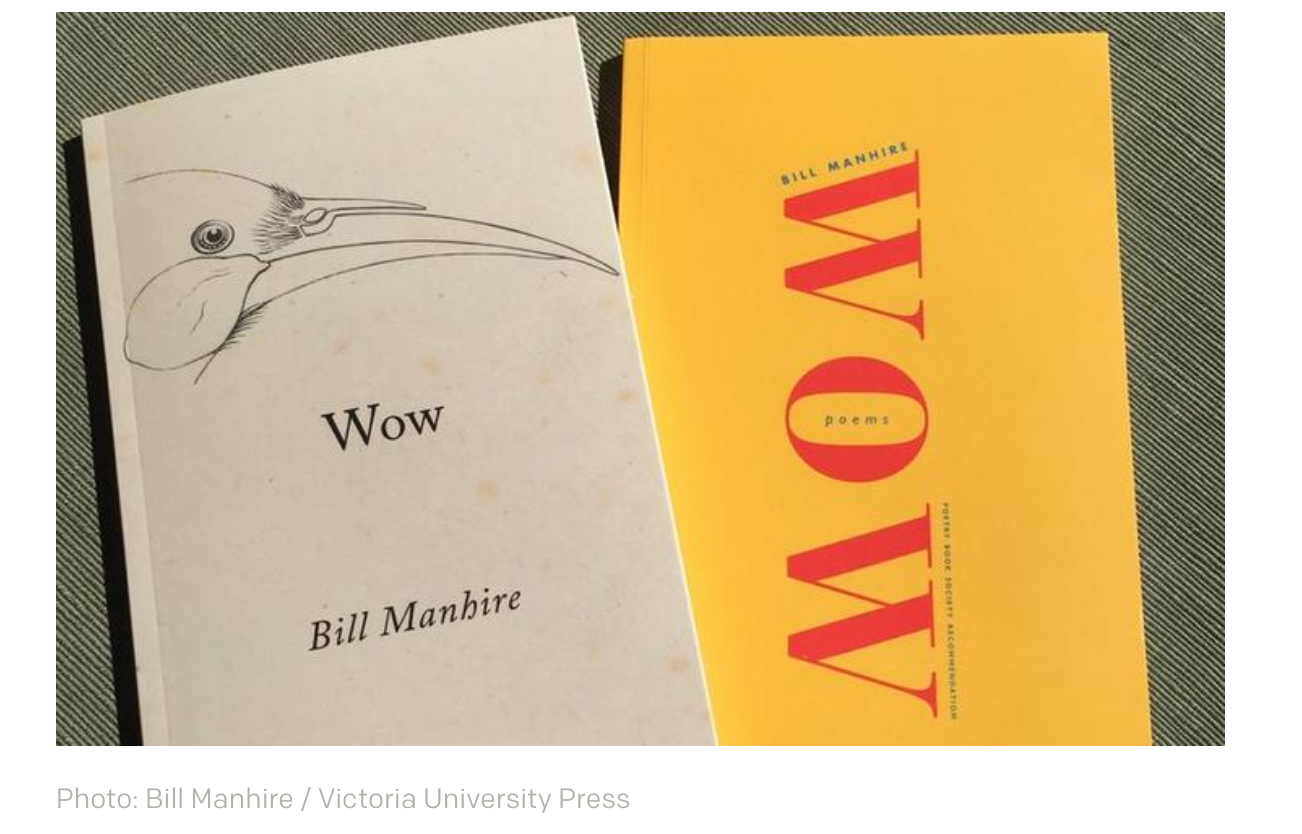
Chris Tse discusses Bill Manhire’s Wow with Kathryn Ryan on Nine to Noon. I loved how Chris said reading the collection reminded him of strolling through the emptied city in lockdown. Yes! Strolling through Bill’s poetry – everything sharpens, the birds are returning, it affects you on so many levels, the invisible is present, fleetingly, lyrically.
Welcome to the Poetry Shelf gathering on National Poetry Day. One of my favourite Poetry Days was in Wellington when I jumped in a taxi and went from one event to the next: Vic Books, the National Library, Unity Books, the Book Hound, Miaow. Listening to others read, reading a snippet myself or mc-ing, it felt like the best thing in the world (well right up there with early morning beach walks, and cooking meals, writing secret things, reading books for hours on end).
These days it feels good to count blessings because there is so much toxic stuff out there. I feel utterly privileged to get sent loads of poetry books published in Aotearoa, and to celebrate some of them on the blog. So many times this year I have picked up a new book and felt goosebumps as I settled into the poem thickets and clearings. You know the feeling – when the music and the mystery and the freshness, the challenges and the sensualness and the connective currents – make you feel so darn good.
I invited a handful of poets to send me an audio or video to celebrate National Poetry Day – it was over to them what they did: read their own poems, read the poems of others, share a favourite book or poet, muse on poetry. Bernadette Hall drove 30 km to hook up with Doc Drumheller and Rangiora Library staff at the band rotunda to create her video. Amy Brown did two versions, one with interruptions and a wee poem from her son Robin. I posted both for you! Student E Wen Wong recorded a poem by Cilla McQueen.
I have been getting these files as Auckland is in level 3 – and everyone else level 2 – and what a treat to listen to them. Poetry can do so much! The past few months it has been of immense comfort, and the way so many of you say yes to my requests.
As some of you know I had a melt down yesterday as WordPress has put us onto a new system that I find hard to manage yet. My daughter helped me a bit, but I had to make a few compromises, and one poet will make a future appearance. Thank you for the boosts on social media.
Happy National Poetry Day everyone. Dip and delve into this glorious and utterly special poetry gathering.
Amy Brown reads two poems of her own: ’16 August 2016′ and ‘Pacing Poem’ from Neon Daze Victoria University Press, 2019. She also reads Airini Beautrais’s ‘Flow’ from Victoria University Press, 2017. Amy sent me two versions, one with interruptions by her son Robin (he does a poem at the end) and one without Robin present. I couldn’t pick as I loved so both, so you get to choose which one to listen to. I think the Robin one is rather special.
Amy Brown reads two poems with the help of Robin
Amy Brown reads the two poems without help
David Eggleton reads ‘The Sound and the Fury’ filmed by Richard C. Wallis in Waikouaiti, North Otago, on Wednesday 19.08.20. Not his tokotoko but a walking stick. Still waiting for the tokotoko ceremony at Matahiwi marae.
Erik Kennedy reads ‘There Is a Man Dancing on the Rudder of an Enormous Cargo Ship’
Bernadette Hall reads two sonnets, one published in Aotearotica and the other in Landfall 239. Her guest Doc Drumheller reads his haiku in Landfall 239. Bernadette had travelled 30 kms to the band rotunda in Rangiora to film this reading with the help of Paula and Daniel from Rangiora Library.
Marty Smith reads ‘Agnus Dei’ from Horse with Hat, Victoria University Press, 2013
Ruby Solly reads two poems, a very early one and a very new one
Chris Tse reads ‘(Green-Nature)’
Louise Wallace reads three poems on a women/mother/daughter theme: by herself, (from Bad Things Victoria University Press, 2017), and by Naomii Seah and Modi Deng (from the latest issue of Starling).
E Wen Wong reads ‘Vegetable Garden Poem iv’ by Cilla McQueen from Axis: Poems and drawings Otago University Press 2001
The Poets
Amy Brown is a New Zealand poet, novelist and teacher, living in Melbourne. In 2012 she completed a PhD in creative writing at the University of Melbourne. She is the author of The Propaganda Poster Girl (VUP, 2008), which was shortlisted at the 2009 New Zealand Book Awards, The Odour of Sanctity (VUP, 2013), a contemporary epic poem, and Neon Daze (VUP, 2019), a verse journal of the first four months of motherhood. She is also the author of Pony Tales, a series of children’s novels.
Doc Drumheller was born in South Carolina and has lived in NZ for more than half his life. He has worked in award-winning groups for theatre and music and has published 10 collections of poetry. His poems have been translated into more than 20 languages. He lives in Oxford, where he edits and publishes the literary journal, Catalyst.
David Eggleton is a Dunedin-based poet and writer. He is the current Aotearoa New Zealand Poet Laureate. His Selected Poems is forthcoming.
Bernadette Hall is Otago born and bred. Following a long career as a high school teacher in Dunedin and Christchurch, she has now lived 17 years in a renovated bach at Amberley Beach in the Hurunui, North Canterbury where she has built up a beautiful garden. Her 12th collection of poetry, Fancy Dancing (VUP), will be launched at the WORD festival in Christchurch in November. ‘It’s as close as I’ll ever get to writing an autobiography,’ she says, laughing. And as for the wilful sonnets that explode in the final pages of this book, she wonders where on earth they came from. ‘It was such fun writing them,’ she says, ‘as if I‘d kicked down the stable doors and taken to the hills.’ In 2015 she collaborated with Robyn Webster on Matakaea, Shag Point, an art /text installation exhibited at the Ashburton ArGallery. In the same year she was awarded the Prime Minister’s Award for outstanding achievement in Poetry. In 2017 she was made a Member of the New Zealand Order of Merit for services to New Zealand literature.
Erik Kennedy is the author of There’s No Place Like the Internet in Springtime (Victoria University Press, 2018), and he is co-editing a book of climate change poetry from Aotearoa New Zealand and the Pacific forthcoming from Auckland University Press in 2021. His poems and criticism have recently been published in places like FENCE, Landfall, Poetry, Poetry Ireland Review, the TLS, and Western Humanities Review. Originally from New Jersey, he lives in Christchurch, New Zealand.
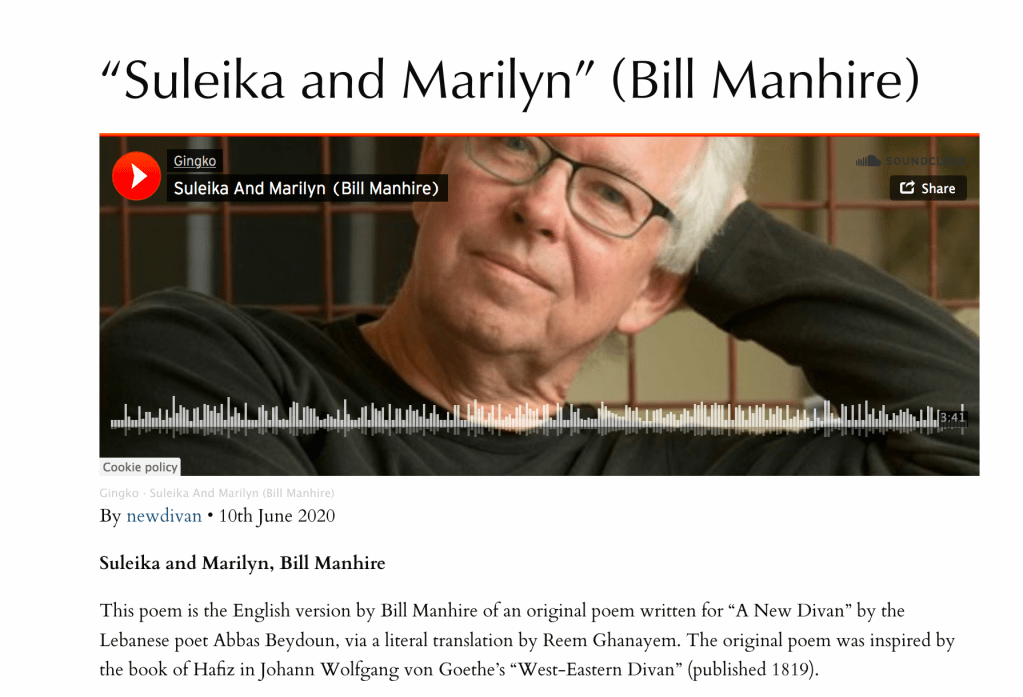
Bill Manhire Aside from publishing his own widely acclaimed poetry, Bill Manhire has edited a number of anthologies and written extensively on New Zealand literature. He was New Zealand’s first Poet Laureate. His most recent collections include Tell Me My Name and Things to Place in a Coffin. Victoria University Press are publishing his new collection Wow November 2020.
Emma Neale is the author of six novels and six collections of poetry. Her most recent novel, Billy Bird (2016) was short-listed for the Acorn Prize at the Ockham NZ Book Awards and long-listed for the Dublin International Literary Award. Emma has received a number of literary fellowships, residencies and awards, the most recent of which is the Lauris Edmond Memorial Award for 2020. Her first collection of short stories, Party Games, is due out late 2020/early 2021. Emma lives and works in Ōtepoti/Dunedin, and she is the current editor of Landfall, New Zealand’s longest-running literary journal.
Marty Smith’s Horse with hat won the 2014 Jesse Mackay award for Best First Book of Poetry. Some of the book looks at the cost to her father of not talking about the war. ‘Agnus Dei’ is a poem that crosses religion over into war, although it looks like farming. She grew up riding beside her father, hence the horse strand in Horse with hat, hence the book she is writing about the obsession of people who risk their lives to ride racehorses. She would risk her life right now to ride a racehorse, if she were allowed.
Ruby Solly is a Kai Tahu / Waitaha writer and musician from Aotearoa, New Zealand. She has had poetry and creative non-fiction published in Landfall, Sport, Poetry NZ, Starling, Mimicry, Minarets, E-Tangata, The Spinoff, and Pantograph Punch amongst others. Victoria University Press will be publishing her debut book of poetry ‘Tōku Pāpā’ in 2021. Ruby is also a scriptwriter and her film ‘Super Special’ which aims to share knowledge around traditional Māori views and practices around menstruation has been featured in film festivals within New Zealand and the US. As a musician, she has played with artists such as Yo-yo Ma as part of his Bach Project, Trinity Roots, Whirimako Black, Rikki Gooch, and Ariana Tikao. Ruby is a taonga puoro (traditional Māori musical instruments) player and therapist with a first-class master’s in music therapy where she conducted kaupapa Māori research into the use of taonga puoro in acute mental health. As a taonga puoro player and therapist, she is privileged to work around Aotearoa with people from all walks of life sharing the taonga of her ancestors. She will be beginning a PhD to further her research this year. Her first album, ‘Pōneke’, which also features poetry, is available from rubysolly.bandcamp.cpm
Chris Tse is the author of How to be Dead in a Year of Snakes and HE’S SO MASC, both published by Auckland University Press. He is a regular book reviewer on Radio New Zealand and contributor to Capital’s Re-Verse column. He is currently co-editing an anthology of queer writers from Aotearoa.
Louise Wallace is the author of three collections of poetry published by Victoria University Press, most recently Bad Things. She is the founder and editor of Starling, and is currently working on a PhD in Creative Writing at the University of Otago on women, [domestic] paralysis and poetic form.
E Wen Wong is in her final year at Burnside High School, where she is Head Girl for 2020. Last year, her poem Boston Building Blockswon first prize in the Year 12 category of the Poetry New Zealand Student Yearbook Competition.
heat of that glittering night and all the other nights
of careless yearning since then tumbling
from limb-crushing dancefloor into the crisp
3AM air with his voice still ringing in my ears:
You’ve got to go to the city.
You’ve got to reach the other side of the glass.
Some of us are neither sunburst nor shade
but a symptom of formative summers caught
somewhere in between like hands pressed against
the edge of the rest of our lives. The glass was
my own making and all my future wonders were
one swift and decisive thought away. I wrote all
my desires in my breath for anyone to read them.
Chris Tse
Chris Tse is the author ofHow to be Dead in a Year of Snakes and HE’S SO MASC. He is co-editing an anthology of LGBTQIA+/Takatāpui New Zealand writers due to be published by Auckland University Press in 2021.
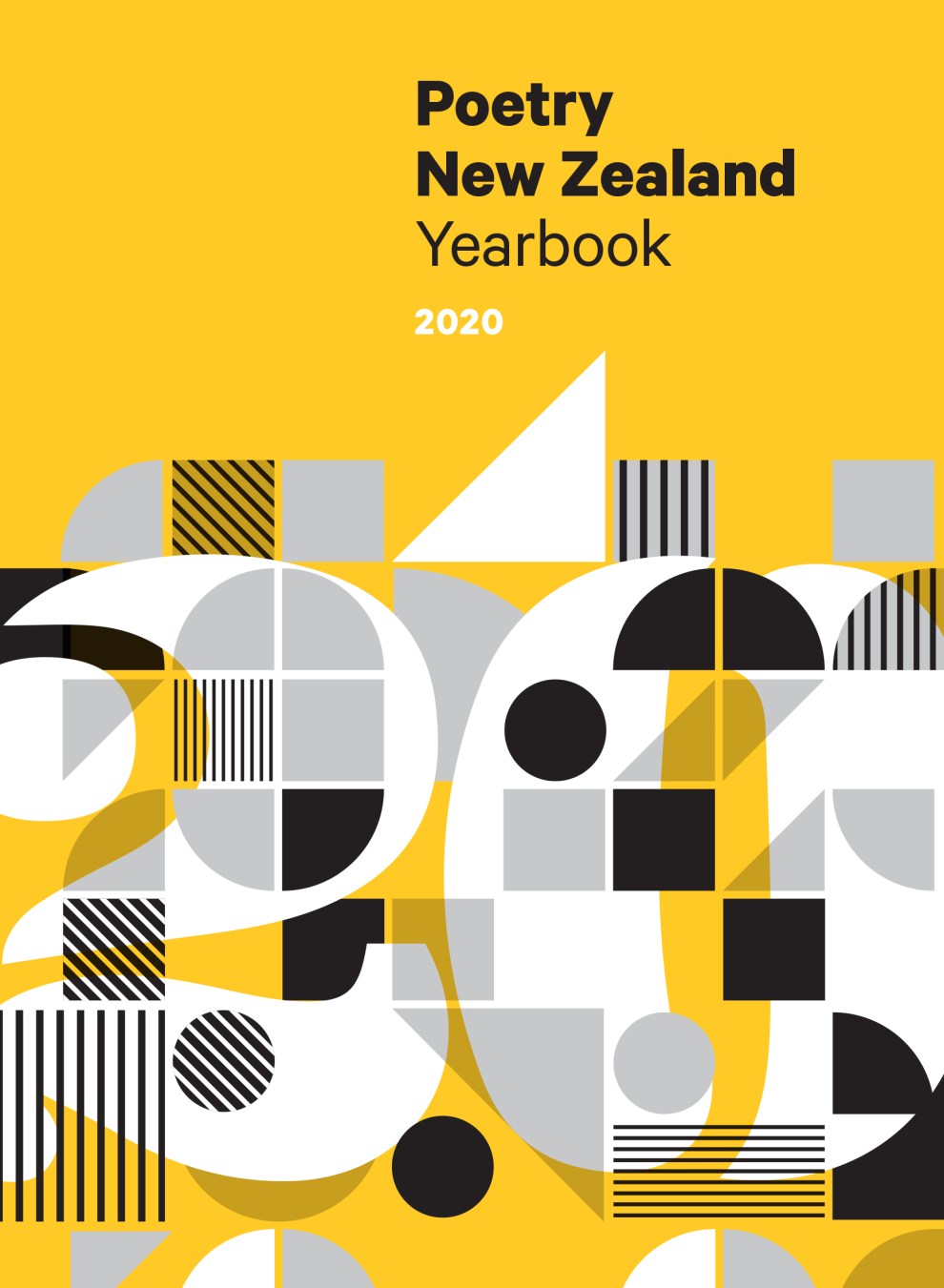
Poetry New Zealand Yearbook 2020 edited by Johanna Emeney (MUP)
Johanna Emeney works at Massey University as a teacher of creative writing and has published several poetry collections.
Many many years ago my first poetry collectionCookhouse (AUP) appeared in the world and it was a big thing for me. I was at the stove with my baby in my arms, when the phone rang, and I dropped something all over the floor. It was Alistair Paterson, then editor of Poetry NZ, wanting to know if I would be the feature poet. The tap was running, the mess was growing, the pot was bubbling, my baby was crying, but somehow I spoke about poetry and agreed to my face on the cover and poems inside. It felt important.
I have only sent poems to journals a couple of times since then as I find it a distraction, but I love reading NZ literary journals. We have so many good ones from the enduring magnificence of Sport and Landfall to the zesty appeal of Mimicry and Min-a-rets.
Poetry NZ has had a number of editors, and is New Zealand’s longest running literary magazine. Poet Louis Johnson founded it in 1951 and edited it until 1964 (as the New Zealand Poetry Yearbook). Various others have taken turns at the helm – most notably Alistair Paterson from 1993 to 2014. In 2014 Jack Ross took it back to its roots and renamed it Poetry New Zealand Yearbook. This year Johanna Emeney stepped in as guest editor while Tracey Slaughter takes over the role from 2021.
Each issue includes essays, reviews, critical commentary, poetry and a featured poet.
For me Poetry New Zealand 2020is a breath of fresh air. It opens its arms wide and every page resonates so beautifully. It showcases the idea that poetry is an open home. The poems behave on the page in a galaxy of ways, sparking and connecting multiple communities. I feel so satisfyingly refreshed having read this, warmed though, restored.
I am at the point in lockdown where I drift about the house from one thing to next in an unsettled state. I alight on this and land on that. So Poetry NZ 2020 is the perfect resting spot. I want to sing its praises to the moon and back, but I am tired, have barely slept and words are like elusive butterflies.
Johanna Emeney’s introduction is genius: ‘It is wonderful to be chosen by poems, and the very opposite of trying to chose poems.’ And later: ‘A poem choose you the minute it takes you by surprise. To be clear this cannot be any old surprise.’ And later: ‘poems that choose you are like mille-feuilles— thoughtfully assembled and subtly layered.’
I love the way Johanna has treated the issue like we often shape our own collections – in little clusters of poems that talk to each other: ‘Into the water’, ‘Encounter’, ‘Other side up’, ‘Remember to understand love’. It is an issue lovingly shaped – I am in love with individual poems but I am also mesmerised by the ensuing conversation, the diverse and distinctive voices.
The essay section is equally strong. You get an essay by Mike Hanne on six NZ doctor poets, Maria Yeonhee Ji’s ‘The hard and the holy: Poetry for times of trauma and crisis’. You also get Sarah Laing’s genius comic strip ‘Jealous of Youth’ written after going to the extraordinary Show Ponies poetry event in Wellington last year. And Roger Steele’s musings on publishing poetry. To finish Helen Rickerby’s thoughts on boundaries between essays and poetry. Restorative, inspiring.
77 pages of reviews cover a wide range of publishers (Cold Hub Press, VUP, Mākaro Press, Otago University Press, Cuba Press, Compound Press, Titus Books, Waikato Press, Hicksville Press and a diverse cohort of reviewers. With our review pages more and more under threat – this review section is to be celebrated.
The opening highlight is the featured poet (a tradition I am pleased to see upheld). Like Johanna I first heard essa may ranapiri read at a Starling event at the Wellington Writers Festival, and they blew my socks off (as did many of the other Starlings). essa is a poet writing on their toes, in their heart, stretching out here, gathering there, scoring the line in shifting tones and keys. So good to have this group of new poems to savour after the pleasures of their debut collection ransack. I particularly enjoyed the conversation between essa and Johanna – I felt like I was sitting in a cafe (wistful thinking slipping though?) sipping a short black and eavesdropping on poetry and writing and life. Tip: ‘That a lot of poems are trying to figure something out. If you already know it, then you don’t need to write the poem.’
I have invited a handful of the poets to read a poem they have in the issue so you can get a taste while in lockdown and then hunt down your own copy of this vital literary journal. Perhaps this time to support our excellent literary journals and take out a few subscriptions. Start here!
a n a u d i o g a t h e r i n g
First up the Poetry New Zealand Poetry Prize and the Poetry New Zealand Student Poetry Competition.
Lynn Davidson (First Prize)
Lynn reads ‘For my parents’
Lynn Davidson is a New Zealand writer living in Edinburgh. Her latest poetry collection Islander is published by Shearsman Books in the UK and Victoria University Press in New Zealand. She had a Hawthornden Fellowship in 2013 and a Bothy Project Residency at Inshriach Bothy in the Cairngorms in 2016. Lynn has a doctorate in creative writing, teaches creative writing, and is a member of 12, an Edinburgh-based feminist poetry collective. Her website
E Wen Wong (First Prize Y12)
E Wen reads ‘Boston Building Blocks’
E Wen Wong is in her final year at Burnside High School, where she is Head Girl for 2020. Last year, her poem ‘Boston Building Blocks’ won first prize in the Year 12 category of the Poetry New Zealand Student Yearbook Competition.
Chris Tse
Chris reads ‘Brightest first’
Chris Tse is the author of How to be Dead in a Year of Snakes and HE’S SO MASC. He is a regular contributor to Capital Magazine’s Re-Verse column and a book reviewer on Radio New Zealand. Chris is currently co-editing an anthology of LGBTQIA+ Aotearoa New Zealand writers.
Fardowsa Mohamed
Fardowsa reads ‘Tuesday’
Fardowsa Mohamed is a poet and medical doctor from Auckland, New Zealand. Her work has appeared in Poetry New Zealand, Sport Magazine, Landfall and others. She is currently working on her first collection of poetry.
Photo credit: Jane Dove Juneau
Elizabeth Smither
Elizabeth reads ‘Cilla, writing’
Elizabeth Smither, an award-winning poet and fiction writer, has published eighteen collections of poetry, six novels and five short-story collections, as well as journals, essays, criticism. She was the Te Mata Poet Laureate (2001–03), was awarded an Hon D Litt from the University of Auckland and made a Member of the New Zealand Order of Merit in 2004, and was awarded the Prime Minister’s Award for Literary Achievement in Poetry in 2008. She was also awarded the 2014 Janet Frame Memorial Award for Literature and the 2016 Sarah Broom Poetry Prize. Her most recent collection of poems, Night Horse (Auckland University Press, 2017), won the Ockham New Zealand Book Award for Poetry in 2018.
Anuja Mitra
Anuja reads ‘Waiting Room’
Anuja Mitra lives in Auckland and is co-founder of the online arts magazine Oscen. Her writing can be found in Starling, Sweet Mammalian, Mayhem, Poetry NZ and other journals, though possibly her finest work remains unfinished in the notes app of her phone.
Semira Davis
Semira reads ‘Punkrock_lord & the maps to i_am_105mm’
Semira Davis is a writer whose poetry also appears in Landfall, Takahe, Ika, Blackmail Press, Ramona, Catalyst and Mayhem. In 2019 they were a recipient of the NZSA Mentorship and runner-up in the Kathleen Grattan Poetry Award.
Photo credit: Miriam Berkley
Johanna Aitchison
Johanna reads ‘The girl with the coke can’
Johanna Aitchison was the 2019 Mark Strand Scholar at the Sewanee Writers’ Conference in Tennessee, and her work has appeared, most recently, in the Poetry New Zealand Yearbook 2020, NZ Poetry Shelf, and Best Small Fictions 2019.
Vaughan Rapatahana
Vaughan Rapatahana reads ‘mō ō tautahi’
Vaughan Rapatahana (Te Ātiawa) commutes between homes in Hong Kong, Philippines and Aotearoa New Zealand. He is widely published across several genre in both his main languages, te reo Māori and English and his work has been translated into Bahasa Malaysia, Italian, French, Mandarin and Cantonese.
His poem tahi kupu anake included in the presentation by Tove Skutnabb-Kangas to the United Nations Forum on Minority Issues in Geneva in November 2019. Interviewed on Radio NZ by Kim Hill in November 2019.
Emma Harris
Emma Harris reads ‘Ward’
Emma Harris lives in Dunedin with her husband and two children. She teaches English and is an assistant principal at Columba College. Her poetry has previously been published in Southern Ocean Review, Blackmail Press, English in Aotearoa and Poetry New Zealand.
Dani Yourukova
Dani reads ‘I don’t know how to talk to you so I wrote it for me’
Dani is a Wellington poet, and one of the Plague Writers (a Masters student) at Victoria’s IIML this year. They’ve been published in Mayhem, Aotearotica, Takahe, Poetry New Zealand Yearbook 2020 and others. They’re currently working on their first collection of poetry.
In 2020 Poetry Shelf will host a monthly, theme-based festival of poems.
First up: trees. I chose trees because I live in a clearing in the midst of protected regenerating bush. It is a place of beauty and calm, no matter the wild West Coast weather. We look out onto the tail end of the Waitātakere Ranges knowing we work together as guardians of this land.
I chose trees because like so many other people the need to care for trees is strong – to see the fire-ravaged scenes in Australia is heartbreaking.
I love coming across trees in poems – I love the way they put down roots and anchor a poem in anecdote, life pulse, secrets, the sensual feast of bush and forests, political layers.
I could plot my life through the books I have read and loved, but I could also plot my life through my attachment to trees.
Let me Put in a Word for Trees
Let me put in a word for breathing.
Let me put in a word for trees.
Let me put in a word for breathing.
Dinah Hawken
from Water, Leaves, Stones (Victoria University Press, 1995)
After a long hard decade, Miranda asks for a poem about feijoas
Small hard green breasts budding on a young tree
that doesn’t want them, can’t think how to dance
if it has to put up with these;
yet over summer the fruits swell and plump:
frog barrel bodies without the jump or croak
limes in thick velvet opera coats
love grenades to throw like flirt bombs
for your crush to catch and softly clutch
before they release their sweet seductions
and when the congregation and the choir
in the Tongan church next door exalt in hymns
while their brass band soars and sforzandos in,
a fresh feijoa crop tumbles to the grass
as if the tree’s just flung down its bugle mutes
in a mid-life, high-kick, survival hallelujah.
Emma Neale
Heavy lifting
Once, I climbed a tree
too tall for climbing
and threw my voice out
into the world. I screamed.
I hollered. I snapped
innocent branches. I took the view
as a vivid but painful truth gifted
to me, but did not think to lay down
my own sight in recompense.
All I wanted was someone to say
they could hear me, but the tree said
that in order to be heard I must
first let silence do the heavy lifting
and clear my mind of any
questions and anxieties
such as contemplating whether
I am the favourite son. If I am not,
I am open to being a favourite uncle
or an ex-lover whose hands still cover
the former half’s eyes. I’ll probably never
have children of my own to disappoint
so I’ll settle for being famous instead
with my mouth forced open on TV like
a Venus fly-trap lip-synching for its life.
The first and the last of everything
are always connected by
the dotted line of choice.
If there is an order to such things,
then surely I should resist it.
Chris Tse
from He’s so MASC (Auckland University Press, 2018)
Reverse Ovid
Woman running across a field
with a baby in her arms . . .
She was once the last pine tree on Mars.
Bill Manhire
My mother as a tree
I like to think my mother may have been a tree
like Fred’s, the oak whose Elizabethan
damask skirts each year spring-clean
the hillside opposite, in front of the house
where Fred was born. Her royal foliage
clothes a peasant’s weathered fingers,
the same unfussed embrace.
Fred never sees her now,
he’s in a rest-home up the coast
and doesn’t get out much
and so, in lieu, she fosters me
from unconditional dawn
to dusk and through the night,
her feet in earth, her head
in air, water in the veins, and what
transpires between us is the breath
of life. In the morning birds
fly out of her hair, in the evening
they are her singing brain
that sings to me. My mother as a tree:
my house, my spouse, my dress
and nakedness, my birth, my death,
before and afterwards. I like
to think my tears may be her
watershed, not just for me.
Chris Price
from Beside Herself (Auckland University Press, 2016)
Objects 4
It’s the close of another year.
Stunned, I walk through the Gardens
feel them draw the numbness out of me.
This is another ‘I do this, I do that’ poem
I learnt in New York from O’Hara.
This is a New York poem set in a garden
styled in colonial civics on an island
that is not Manhattan.
I hurry to the hydrangea garden,
their shaded, moon-coloured faces
so much like my own. As a child I was posed
next to hydrangeas because the ones
next to an unremembered house
were particularly blue—
to match my eyes, presumably.
There are no hydrangeas in New York City.
I rush past the Australia garden but I stop
dead at the old aloes, their heavy leaves
so whale-like, gently swaying flukes
thick and fleshy, closing up the sky.
Some kids have carved their
initials and hearts in the smooth rind,
a hundred years against this forgotten afternoon.
I bend to the ground and sit as if to guard them
in the darkening sun.
The spread of rot constellates out of the kids’ marks
as if to say
look at the consequences,
look at me dying.
Nikki-Lee Birdsey
from Night As Day (Victoria University Press, 2019)
I Buried the Blood and Planted a Tree
Love is the thing that comes
when we suck on a teat and are fed.
Love is the food we can eat.
The food we can’t eat we give
to the ground
to the next day.
We pat the earth
like it is our own abdomen.
If I could have drunk a hot enough tea
to boil it out
I might have.
If I could have stood
on a big red button
and jumped once
to tell it to exit
like the highest note on the piano.
It was a sound I couldn’t feed.
I gave it to tomorrow.
I buried the blood and planted a tree
so she, unable to be fed, could feed.
Maeve Hughes
The sepia sky is not one for forgetting. Even fragmented, looking up at it from beneath a canopy. The flash of light through leaves more twitch than twinkle. Therapists and yoga teachers say It’s important to let yourself to be held by mother earth, to let yourself be. I used to feel relief in the arms of a tree, but now I feel unease. Is it my own chest trembling or the trees? Oxygen spinning from the leaves, boughs holding birds who were once such a chorus they almost drove Cook’s crew back to sea. Invisible roots bearing the weight of me, through the deep dark, where trees talk in voices I am too brief to hear.
Simone Kaho
Trees
Place is bottled lightning in a shop,
or in a chandelier’s glass tear-drop,
or in a glow-worm’s low watt grot,
or in street neon’s glottal stop —
wow-eh? wow-eh? wow-eh?
Place is the moulded face of a hill,
or lichen like beard on a window sill,
or the bare spaces that shadows fill,
or ancestors growing old and ill,
or descendants at the reading of a will,
who frown and examine their fingernails
before plunging off down the paper trails
of diary and letter and overdue bill.
Place is the home of family trees —
family trees to wrap round plots of soil,
tree roots to shrivel into umbilical cords,
tree branches to spill bones and skulls;
but even trees are just a spidery scrawl
against the shelf-life of a mountain wall.
Place is a brood perched on power-poles:
bellbirds with shadows of gargoyles,
korimako who clutch the power of one,
like an egg, to trill their familiar song.
Place is grandsons who sprawl
in the family tree with laughter;
place is the tree windfall,
gathered up in the lap of a daughter.
David Eggleton
from Rhyming Planet (Steele Roberts, 2001)
13
Te Mahuta Ngahere
the father of the forest
a livid monster among saplings.
A swollen aneurism grips his bole.
Below bearded epiphytes
a suppurating canker swarms with wasps.
Derisively lyrical
the tuis in his crazy, dreadlocked crown
pretend to be bulldozers.
Ian Wedde
from ‘Letter to Peter McLeavey – after Basho’, from Three Regrets and a Hymn to Beauty (Auckland University Press, 2005)
Last night I sat outside and looked at the moon. Up there, like it has been since the dawn of time.
Same one the cavemen looked at.
Sickle phase.
I know, scientifically, about the forces that hold it in place.
And suddenly I felt I knew too much.
The grass had been cut, while flowering.
The flowers were still there, they’d either sunk below the blades or reflowered.
I noticed grass flowers look like kowhai post-flowering. When the stamens hang long and white after the flower has fallen away.
The night was still. Cones on the street let me know men would come the next day in matching orange tunics and I should not park there.
The moon was still there.
The stillness and the quiet was misleading.
Everything had a perfect and terrible design that didn’t need me to know it.
I know the trees above the mangroves are called macrocarpas, some bird calls sweetly from the macrocarpa as the sun sets every evening. Orange, purple and pink from the verandah of my flat.
I don’t ever want to know that bird’s name.
Simone Kaho
Song from the fallen tree which served as a twelve year old’s altar to the wild gods
i am a hundred years more girleen since before you were a seed
i fell to mouldering in this darkleaf cathedral where you come
to bury the bones of brief chittering things and burn candles
in roothollows ah you young girleen life all aflickering past short
roots unplanted
i am all your church and ever the altar at which you girleen kneel
i all goldenarched around by sunbeam and sapling green
with my many rings i share with you rootlessness and in winter
you brush away my cloak of snow humming your warmblood
girleen beatsong to soften my ache of frost
while you ask knowing of what time is to the forest and you sing
up your low girleen voice to the horned and feathered kind which
do not walk the rustling hymn of season same as we all
then twice up here you come bringing anothergirl girleen
you open your arms to the sky saying this is your heart and
home yes this the forest that sings you by name and girleen
it is true we the trees know you but you never learned from us
the songs called shyness and slowly and the next time girleen you
bring your brighthaired friend you kiss her in the pricklebelly
shadow of the holly
where i feel you like a seed unhusked shiversway as she
branchsnap slams whipslap runs so when again you dewyoung
girleen come to me you come alone
ungrowing girleen and withering back your shoots as you
bitterbrittle freeze your sapling blood into something thinner
than lancewood leaf
which cracks you through to the heartwood solvent veinsap
dizzily diluting girleen you can barely make your mountainwalk
up to me
until for two snowmelts you do not return but even once your
starved arterial taproot has begun sucking in again greedy sunlight
and sugar to colour your suppling girleen bark back alive
you have disremembered every prayersong taught you by we the
trees and i rot in the forest you called your heart and girleen
you do not visit
Rebecca Hawkes
The Gum-Tree
Sitting on the warm steps with you
our legs and backs supported by timber
looking down to the still trunk of the gum-tree
we are neither inside ourselves
as in the dark wing of a house
nor outside ourselves, like sentries
at the iron gates – we are living
on the entire contour of our skins,
on the threshold, willing to settle
or leap into anywhere.
Here’s to this tree we are standing in.
Here’s to its blue-green shelter,
its soft bark,
the handy horizontal branch
we have our feet on
and the one supporting our shoulders.
Dinah Hawken
from Water, Leaves, Stones (Victoria University Press, 1995)
Nikki-Lee Birdsey was born in Piha. She holds an MFA from the University of Iowa Writers’ Workshop and a BA from New York University. She has been published widely in the US, UK, Canada, and New Zealand, and she is currently a PhD candidate at the International Institute of Modern Letters. Her first book Night as Day was published by VUP in 2019.
David Eggleton’s most recent poetry publication, Edgeland and other poems, was published by Otago University Press in 2018. He is the New Zealand Poet Laureate 2019 – 2021.
Dinah Hawken was born in Hawera in 1943 and now lives in Paekakariki. Her eighth collection of poetry, There is no harbour, was published by Victoria University Press in 2019.
Rebecca Hawkes is an erstwhile painter-poet and accidental corporate-ladder-ascender. Her chapbook Softcore coldsores was launched in AUP New Poets 5 in 2019 and she performs with the poetry troupe Show Ponies. She wrote this tree poem in her previous occupation as a teen and hopes it will survive repotting after all these years.
Maeve Hughes lives in a tall house in Wellington. She has studied Fine Arts and Creative Writing. Her first publication Horsepower won the 2018 Story Inc Prize for poetry and was launched in October last year.
Simone Kaho is a New Zealand / Tongan poet and a graduate of the International Institute of Modern Letters. She published her debut poetry collection, Lucky Punch, in 2016. Simone is noted for her poetry performance and writes for E-Tangata.co.nz.
Bill Manhire’s new book of poems will be published later this year. It might well be called Wow because he is so surprised by it.
Emma Neale is the author of 6 novels and 6 collections of poetry. She is the current editor of Landfall.
Chris Price is the author of three books of poetry and the hybrid ‘biographical dictionary’ Brief Lives. She convenes the poetry and creative nonfiction MA workshop at the International Institute of Modern Letters in Wellington. In May 2019 she and her guitarist partner Robbie Duncan will be among the guests at Featherston Booktown.
Chris Tse is the author of How to be Dead in a Year of Snakes and HE’S SO MASC. He is a regular contributor to Capital Magazine’s Re-Verse column and a book reviewer on Radio New Zealand. Chris is currently co-editing an anthology of LGBTQIA+ Aotearoa New Zealand writers.
Ian Wedde’sSelected Poems were published in 2017 – Te Mahuta Ngahere can be found there and we hope will survive in the bush. Wedde’s historical novel, The Reed Warbler, will be published by Victoria University Press in May, and a collection of essays 2014-2019 is in development.