He is a man carved from witness wood and tonight they will cut him open.
Whispers ate his tongue and people failed to ask after him.
As they tear at his flesh to let in borrowed light his body splinters and edges its way under their nails.
No men with warmth in their fingers or an inkling of privacy, no women with a shred of public sympathy.
They fling his body open. They dismantle him with effortless crime.
Behold the human mess inside cue a surgeon’s wail. Blood-and-bone strokes warped beyond recognition.
What ages he has lived through what ruinous tides have claimed him not unlike the waters that claimed the SS Ventnor.
And having cast off the grain of his years into hallowed seas he traded fear for a nightmare of snakes.
Inside he could be dancing his feet as light as music. Inside he could be snow.
Extraction after extraction there is no consensus on who will keep his soul, who will keep his bones.
When their cruel exercise is over when they have retrieved what they never needed
what remains is a man of a thousand regrets. The insects bury themselves in his swollen dark.
Chris Tse Published in How to be Dead in a Year of Snakes (AUP, 2014).
It’s around this time 20 years ago that I was putting the final touches on my thesis for the MA in Creative Writing at the International Institute of Modern Letters. My thesis was split into three sections, one of which contained the earliest versions of poems that would eventually become my first book, How to be Dead in a Year of Snakes. Some of these poems made it into the final version of the collection untouched, but that first go at telling the story of Joe Kum Yung only scratched the surface of the themes I’d ultimately explore.
‘(Biopsy)’ wasn’t written during that period – it came along much later and was prompted by an unlikely source: the television series Desperate Housewives. In episode two of season seven, Bree Van de Kamp’s contractor and love interest Keith Watson shows her some timber that he wants to use as panelling for her study. “Feel it,” he instructs her. “You know what they call this? Witness wood, ’cause it’s seen so much history.” I’d never heard the term ‘witness wood’ before; later I learned that it specifically refers to salvaged and repurposed wood from structures that were present during significant events. You never know when you’ll see or hear something that’ll give you the start of a new poem. I certainly didn’t expect that watching the melodrama and sexual tension unfold on Wisteria Lane would also give me the start of one of Snakes’ key poems.
Having spent some time revisiting my first book over the past couple of years, to mark its 10th anniversary and to prepare for the audiobook recording, I see the beginnings of themes and concerns that continue to pop up in my later work. ‘(Biopsy)’ is one of my first attempts at untangling the complications of writing about history and the power imbalance that goes with it. In some ways ‘(Biopsy)’ is a small meta moment in the collection that comments on the writing of the book itself and the use of Joe Kum Yung as a source of trauma to drive the narrative forward. Lionel Terry used Joe Kum Yung to make a point about ‘the Yellow Peril’ – as writers, how do we navigate our own biases and motivations when it comes to writing about other people and historical events, even if we’re doing so with the best intentions?
Chris Tse
Chris Tse is a poet and editor based in Te Whanganui-a-Tara | Wellington. He is the author of three poetry collections published by Auckland University Press: How to be Dead in a Year of Snakes, HE’S SO MASC, and Super Model Minority. He and Emma Barnes edited Out Here: An Anthology of Takatāpui and LGBTQIA+ Writers from Aotearoa. In 2022, Chris was named New Zealand’s 13th Poet Laureate and completed his term in August 2025. He was a 2024 fellow of the University of Iowa’s International Writing Program Fall Residency and a 2025 Nederlands Letterenfonds writer in residence.
Today Chris Tse is stepping down from his role as National Poet Laureate, and it felt extremely fitting to acknowledge his vital contribution to poetry in Aotearoa and overseas. He has staged a range of poetry events around the country, drawing in voices, inspiring younger writers, contributing to inspiring poetry conversations in various settings.
Having always been a big fan of Chris’s poetry — from his debut in AUP New Poets 4 (AUP 2011) to Super Model Minority (AUP, 2022) — I decided I would pick one poem from each of his books as a celebration of his tenure. Chris kindly answered a couple of questions from me and contributed a recent poem. To reread my way through his collections was utterly moving: from How to be Dead in a Year of Snakes (2014, AUP), a collection that returns to the tragedy of murdered goldminer, Joe Kum Yung, to his next two, he’s so MASC (AUP, 2018) and Super Model Minority (AUP, 2022). His books navigate sexuality and race, sky and mountain peaks, revolution and imagining, speech and peace. Ah, take the time and spend a long weekend absorbing his extraordinary poetic ink.
Thank you, Chris thank you.
five poems
Dig after Seamus Heaney
Our first back yard hugged the prickled slopes of Kelson.
I watched my father dig and tear his way through bush and clay to find that richer soil.
That spicy scent of gorse, the path he zigzagged.
And beyond him, decades and oceans away, his father stooping to dig gathering ginger and spring onion; dreams of richer days.
•
Between my finger and my thumb the sticks rest.
•
Below the surface lies a history of chopsticks. In the days of new sight we clung to comfort as a sign of success.
Eight treasure soups, the finest teas ivory and bone over wood and plastic.
•
I’ll dig with them.
from Sing Joe, in AUP New Poets 4, Auckland University Press, 2011
•
They peer through me as if I were dead. My hands are tired now, fading to mist.
•••
I’ve held out for luck and fortune like a stony fool,
•••
but sometimes the heart must gracefully accept defeat.
•••
These days it feels like I am digging my own grave.
from How to be Dead in a Year of Snakes, AUP, 2014
Heavy Lifting
Once, I climbed a tree too tall for climbing and threw my voice out into the world. I screamed. I hollered. I snapped innocent branches. I took the view as a vivid but painful truth gifted to me, but did not think to lay down my own sight in recompense. All I wanted was someone to say they could hear me, but he tree said that in order to be heard I must first let silence do the heavy lifting and clear my mind of any questions and anxieties such as contemplating whether I am the favourite son. If I am not, I am open to being a favourite uncle or an ex-lover whose hands still cover the former half’s eyes. I’ll probably never have children of my own to disappoint so I’ll settle for being famous instead with my mouth forced open on TV like a Venus fly-trap lip-synching for its life. The first and last of everything are always connected by the dotted line of choice. If there is an order to such things, then surely I should resist it.
from he’s so MASC, AUP 2018
Wish list—Permadeath
I wish I didn’t feel compelled to write about racism, but there it is patrolling my everyday thoughts like a mall cop drunk with power.
I wish people didn’t ask me how to solve a problem like racism, as if it is a cloud they cannot pin down. I am not an expert spokesman
holding an elusive truth. I wish I could predict when racism would exit stage right to wherever bad things go to die rusty
non-biodegradable deaths, but I can’t predict the death of something with a robust business continuity plan that involves moving from
host body to host body. I am not an exorcist—I am a sympathetic vomiter. Is it predictable for me to write this poem? I suppose so.
What I really want to write about are things with promise, to offer up whiskers on kittens when the outlook is for Nazis on Nazis. I wish
I could sing my way out of this while the man I love applauds from the front row, our adorable Jack Russell terrier Rocket sat by his feet.
I wish I could start a love poem with a line like ‘He thumbs me like the Oxford Dictionary‘ and consider it a job well done. I wish
I didn’t always feel this way—always tired of explaining why I am tired and why writing this poem is more need that want.
I never felt the need to be the gunshot during a knife fight until they told me there was no such thing as ‘let’s finish this once and for all’
from Super Model Minority, AUP, 2022
How to edit a poem
Let the poem approach you first. Don’t point; don’t scare it.
Encircle the poem with broken lines and half-hearted rhymes to reverse any spell that may cause the reader sorrow.
Ask yourself: is the poem merely camouflage for the poet’s desires?
All persons, real or imagined, are questions and aphorisms double-crossing each other in pursuit of a revelation.
Inside this poem there are two poets: one is literal and the other is metaphorical.
Ask yourself: is the poet a secret carried in a whale’s mouth?
Capitalise every word that reminds you of your childhood.
Strike out every verb that will make the reader feel guilty for not living a wholesome and virtuous life.
Inside this poem there are two poets: one tells the truth and theother got away with it.
Ask yourself: when did you last trust a poem?
Interrogate each line as if it were a co-ordinate plucked from a map.
A crooked staircase halfway to the moon. A wolf cries in the dark.
The margins seesaw as you pull yourself into the poem for a better view, to take it all in.
(There is no way out.)
Use the poem as a mirror.
Use the mirror as a sucker punch.
Attack the mirror with a mallet.
Hide the broken shards in the feathers of birds and instruct them to land on rooftops when the night is at its softest.
The townsfolk’s sleep is disturbed by the crackle of crystal rain.
Record their reactions.
Respond, respond, respond.
from Everything I Know About Books: An insider look at publishing in Aotearoa, edited by Odessa Owens and Theresa Crewdson (Whitireia Publishing, 2023)
three questions
What draws you into a poem, whether as writer or reader?
As a reader, I want to get a sense that the poet is writing from a place of curiosity and isn’t afraid to let the reader get a glimpse behind the curtain as they work through their thinking or daydreaming. I don’t necessarily need anything to be resolved – an open end is just as good as any. I try to apply this to my own work as well because a big part of my writing process is to seek understanding about myself or the world. The poem is the result of that exploration.
Have you discovered any poets new to you in the course of your physical or reading travels over past couple of years?
So many! Editing Ōrongohau | Best New Zealand Poems 2023 was a voyage of discovery of new-to-me poets, like John Allison, Isla Huia, Geena Slow and Marjorie Woodfield. This week I’ve been dipping in and out of the 2025 edition of Aotearoa Poetry Yearbook and there are lots of unfamiliar names, so I can’t wait to get to know these poets’ work. I’ve also had the good fortune of working or performing with poets from other countries, either online or in person. Some of the poets whose work I’ve really enjoyed are Hasib Hourani and Panda Wong from Australia, Péter Závada from Hungary, and Amanda Chong from Singapore.
Can you share a couple of highlights from your tenure as Poet Laureate?
For National Poetry Day 2023, I invited students from Te Whanganui a Tara for a day of poetry workshops and activities at the National Library. The poems that the students wrote that day were great and demonstrated how fearless and creative young minds can be. Another highlight was the Poetry International Festival in Rotterdam, where I appeared in an event with Poets Laureates from around the world. It was a really special performance bringing poetry and dance together. I was very proud to be able to represent Aotearoa on stage that night alongside some poetry legends.
National Poet Laureate page Auckland University Press page
The Venetian Blind Poems, Paula Green, The Cuba Press, 2025
When I wrote Wild Honey: Reading New Zealand Women’s Poetry (MUP, 2019), I built a house, dividing the book into rooms, and then moving through open doors and windows to the wider world. The book was neither a formal history nor a theoretical overview of New Zealand’s women’s poetry but a way of collecting, building recouping valuing the poetic voices of women in Aotearoa. As I moved through the rooms in the house the themes accumulated: politics, poetics, love, the domestic, self, relations, illness, death, location, the maternal, home, voice.
The book came out in 2019, not that long ago, and I was interested to read ‘The sickbed’ chapter again. I began the chapter by saying inquisitive audiences often ask, ‘Why write poetry?’. I still claim the answers are myriad: it makes us feel good, we are addicted to wordplay, we can squeeze writing a poem in between domestic chores, parenting, scholarly endeavour, work commitments. We might crave public attention, awards, good reviews. We might simply have to write. Our poetry might reflect a love of music, storytelling, suspense, wit, surprise, attraction to the unsayable or beauty. We might write poems at the kitchen table, in our head as we walk, run, dream or dillydally. We might favour condensation and pocket size writing or expansion and long sequences. We might write from a sick bed.
My collection Slipstream (AUP, 2010) came out of my breast cancer experience. I refer to it in Wild Honey: ‘poetry was an energy boost, a way to enhance my sense of wellbeing’. As I wrote, at least a year after the experience, I did not feel I was writing poems – nothing on the page earned the label ‘poem’ in my view — but I was conscious that the white space, the juxtapositions, the assembled lists and the melody were reaching for the poetic. I did not want to summon the dark, middle of the night slumps, but rather to show illness can change the way you see the day as well as live the day.
The Venetian Blind Poems is a little different in that I wrote it in the moment, in hospital and then back home on the recovery road. But I recognised similar motivations to write.
My new collection has been out in the world for a fortnight now, and it feels so very special. To be in Motutapu Ward and the Day Stay Ward this week, signing copies for nurses, hearing them read fragments aloud, reminded me that poetry is an incredible way of connecting. I am still in a thicket of appointments as I fine tune the road ahead, but this fortnight feels like like my time in hospital, when so many poets sent me a poem in a card. The emails you have sent me these past two weeks, so thoughtful and caring, have shone fresh light on how and why poetry is a gift. On why we write and sometimes publish poetry. I will treasure your emails for a long time (and reply soon)!
More than anything, The Venetian Blind Poems is a way of saying thank you to the doctors and nurses who have given, and are giving so much. I offer an enormous bouquet of thanks to Mary McCallum and Paul Stewart at The Cuba Press, for the beautiful book, and for inviting such terrific responses to post on social media by poets who have read it.
Now its back to normal transmission! I have new ideas for Poetry Shelf bubbling like my sour dough starter, manuscripts to finish, a treasury of books to review, emails to answer, a few more appointments, and most excitingly, I am ready to get my secret seedling idea off the ground: Poetry Shelf Goes Live. Yes! Soon I will be back in the world organising live poetry events around the country.
A cluster of illness poems
The waiting game
begins with someone calling your name before you wait to have your blood taken in a windowless room. Wait for the stultifying thoughts of red and disease to pass. Wait for the phone call, for relief to wash over you. And while you are waiting I recommend you dance like the memory of sweat easing down his throat; roll open like the drum beat of your limbs in sync; tear through your wildest nights, still lit in hopeful neon; cry like the Christmas you lost your last grandparent; and sing like the forgotten violin slowly coming undone in your muscle memory. If you do not allow yourself to sleep in peace with your worries, you will find yourself awake at the bottom of a very deep, very secret lake.
Chris Tse Turbine, 2014
A Final Warning
I walked past the stars the silence of grandfathers
I was going somewhere but where
I went left at first then right then way off course then back to somewhere
near the middle did this mean I was ready to die
well they’ve been testing me for everything I think I’ve got the lot
Bill Manhire from Honk Honk, The Anchorstone Press, 2022
The Night Shift
I wake on the ward, afloat on ketamine, fentanyl, see sky-blue morphine swifts roost nearby in pleated paper thimbles
and some uneasy instinct tugs my gaze to a scuff mark on the lino floor. Coal-dark, it smolders. I stall.
A voice reassures me it’s just a graze left by the wheel of some routine machine: IV, PCA line, heart monitor screen.
Yet as I ease deep-cut core and leaden legs over the distant side of the high bed I can’t shake this need to stare
not quite in fear: not quite.
For last night, creatures came. They arrived en masse, nodded, swayed, pressed into each dimmed cubicle,
their copper eyes bright-candled, lips pouched over strong, proud teeth, their heads bowed in silent inspection;
marmalade lions with oxen feet, crested birds with antlers, candy-pink teats, all crowded, crowded round each bed
as the window in time was fast contracting, and they wanted us to see before our minds sealed tough with the fibers of logic, denial.
Their fur packed tight as green florets on catkins. Their horns, colossal black spikes, gleamed like grand pianos. Such mass and strength in their embedded weaponry,
yet still, they withheld their crush and maim.
The breath and bunt of their herded skulls said we are the unbroken in you, don’t be afraid, and I saw through the seep of dawn
that soon like guardians they will gather each one of us, our failing forms absorbed into their warm, strong-walled veins
until we too watch each figure on the bed as something invisible shifts in the intricate balance of matter and spirit.
So it is awe, not dread, that asks me to leave the ground undisturbed where they gathered, to skirt carefully the sign one left like a scorched hoof print as if they had stood in fire to show they bear time’s pyre for us,
our wild sentries, our wild sentries.
Emma Neale from Liar, Liar, Lick, Spit, Otago University Press, 2024
(A lifetime of sentences)
Soon, I could leave my body without prompts. The artist’s concept of the birth of a star, or I broke my name until the fibres separated and lost their coats. My thirst for windows kept me indoors. My gaze wandered across the suburbs of childhood, faces stammering with shyness, bodies masquerading as furniture. Initial mass and luminosity determine duration, but my sensibility comes to require an object. Here, the word “system” implies a level of certainty that is unwarranted. Some of those memories were not written by me, so they are memos, at home on my desk, but still authoritative. Now, instead of a pupil, there’s a screensaver. It was late. The room was empty. A lifetime of sentences which at first glance seem superfluous, but whose value is later understood. One thing leads to a mother. Soon enough, a flock of children came running and tapped on the glass. When I reached the bottom of the stares, I looked up.
Zarah Butcher-McGunnigle selected by Kiri Pianaha Wong and was published a fine line and also Best NZ Poems 2011
it is a wedding cavalcade in which I take your day of birth and marry it with ten pink tulips to mine look, behind us on the road sadness and unutterable joy leaping over the rocks how we were those people in the crowd unmindful of everything except stepping along together under our parasols what’s wrong with that? see, the road is still there still ahead and behind losing its mind and leaping over the rocks with its train of clowns who are careless careless careless and will never behave any differently believing themselves arm in arm with all they need to sustain life on a distant planet choogaloo, this is all you need tulips and a parasol to keep off the bigger bits of debris falling out of the sky don’t be sad there is every chance we are just now resident in two minds regarding each other tenderly, quizzically, uproariously as a wedding cavalcade
Michele Leggot from Milk & Honey, Auckland University Press, 2005
What’s the time, Mr Wolff-Parkinson-White?
Press palm against skin feel its breathless sprinting
count 230 beats in a minute count six sibling arguments count four gecko squawks
gulp two glasses of water phone the absent dad three times return to the couch
count 194 beats—and whoah with the flutter of a moth it slows down to a jog
steady rhythm of 75
Fire heart Sea heart Earth heart
Calm waters as a child now more fire than earth chased by a white wolf
Want to feed my child ruby corn raspberries red meat cherry tomatoes pomegranate bursts sugar and acid enough to woo a rebel
The heart heals itself between beats, reassures Elizabeth Smither
Mikaela Nyman
Amy Marguerite picked a poem from Shira Erlichman’s Odes to Lithium, a book I now have on order! But sadly I didn’t manage to get permission to post the poem but you can listen to Shira read it here.
Self-Affirming Mantra
I was searching my symptoms online. Disturbed sleep led to fatigue which led to post-viral condition and also to alcohol abuse and liver disease and unthinkable cancers which all led to conclusions about society and how one operates in it, how someone can be rational and maladaptive at the same time, how resilience is just a word in a PowerPoint, how years of work go into the manufacture of one unit of anxiety (a person), and how each unit, although similar to others in many ways, is unique, the product of a freakish and golden permutation of inputs, which led me back to my usual searches for wars and politicians and racing drivers and recipes and animals and islands and colours.
I went out into the day with my symptoms. The sun made the swans look like harps. I appreciated the silhouettes of buildings. I scrumped apples from over a fence. My symptoms were still with me but also not with me. I was loving them. I was setting them free.
Erik Kennedy from Poto | Short (Te Herenga Waka University Press, 2025)
Aotearoa New Zealand Poet Laureate Chris Tse marks the end of his term in this exciting evening with fellow poets Ken Arkind, Cadence Chung, Gregory O’Brien, Chris Price, and Ruby Solly.
Reflections on the future
Join Chris at the National Library to mark the end of his time in the role with his reflections on the future of Aotearoa New Zealand poetry and readings from special guests.
Chris will be joined by poets Ken Arkind, Cadence Chung, Gregory O’Brien, Chris Price, and Ruby Solly.
I left the doors to the past and the future unlocked …
Chris Tse’s three-year term as Aotearoa New Zealand Poet Laureate ends on Phantom Billstickers National Poetry Day, when the next Poet Laureate will be announced.
Chris Tse (he/him) was born and raised in Lower Hutt, New Zealand. He studied film and English literature at Victoria University of Wellington, where he also completed an MA in Creative Writing at the International Institute of Modern Letters. In 2022, he was named the 13th New Zealand Poet Laureate. His poetry, short fiction, and non-fiction have been recorded for radio and widely published in numerous journals, magazines and anthologies. He has published several collections of poetry and his latest book Super Model Minority (2022) was longlisted for the Ockham New Zealand Book Awards 2023.
Ken Arkind is an American poet, author, performer, and educator originating from Steamboat Springs in Colorado. He holds the 2006 title of the American National Poetry Slam Champion and the 2010 title of Nuyorican Poets Cafe Grand Slam Champion. Ken now resides in Auckland and is a recent graduate from the Manukau Institute of Technology’s Creative Arts Programme.
Cadence Chung (she/they) is a poet, student, and musician from Wellington, currently studying at the New Zealand School of Music. Her poems started being published in her junior years of high school, and her debut chapbook anomalia was published by We Are Babies Press in April 2022. Her writing takes inspiration from antique stores, Tumblr text posts, and dead poets.
Gregory O’Brien is a poet, painter, author, curator, and editor. His most recent poetry publication is a collection of poems and paintings, House and contents (2022). Other recent publications include a book-length meditation on the Pacific, Always song in the water (2019) and the Ockham award winning book Don Binney: Flight Path (2023).
Chris Price’s poetry collections include Husk (Jessie Mckay Best First Book of Poetry, 2002), The Blind Singer (2009) and Beside Herself (2016). She has also published Brief Lives (2006), an eccentric ‘biographical dictionary’ that samples the lives of both real and fictional characters. Her latest book is The Lobster’s Tale, a lyric essay in conversation with the photographs of Bruce Foster (2021). Chris is a former editor of Landfall, has been a Katherine Mansfield Menton Fellow (2011) and in 2024 held a Bogliasco Fellowship in Italy. She convenes an MA workshop (Poetry and Creative Nonfiction) at the International Institute of Modern Letters.
Ruby Solly (Kāi Tahu, Waitaha, Kāti Māmoe) is a writer, musician, taonga pūoro practitioner, and music therapist living in Pōneke on the old riwai plantation of her Kāti Māmoe ancestors. She has been published in journals such as Landfall, Sport, and Starling, as well as had poetry published in America and Antarctica as well as Aotearoa. Her first book Tōku Pāpā was published by Te Herenga Waka University Press in 2021.
The arrival of a new Chris Tse poetry collection is always a moment to celebrate.
Paula: In 2022 I am running a few email conversations with poets whose work has affected me over time. I have loved your poetry since your appearance in AUP New Poets 4 (2004). Your new book, Super Model Minority, strengthens my enduring relationship with your writing. The collection is an explosion inside me, but first I want to touch upon the spiky times we live in. What helps you? I am finding books keep repairing me, sending me on extraordinary package holidays, depositing me in the sky to drift and dream, to think. All genres. What are books doing for you at the moment?
Chris: Books have been such a comfort for me these past few years. Emma Barnes and I were still up to our necks in reading for Out Here when we went into lockdown in March 2020, so there was plenty to keep me busy and distracted. Things did get a bit more difficult when we couldn’t access some older and out-of-print books, but we made it work. I’m not a very fast reader so I do tend to take my time with several books on the go at any given time. Books have always made me happy – I was always happiest hunched over a book while my family watched rugby or played mahjong in the background. These days a big part of that happiness is the thrill I get seeing friends getting published and receiving well-earned praise for their amazing work. It’s such an exciting time to be a reader and a writer – to be able to experience the world through the poetry of essa may ranapiri and Rebecca Hawkes, or to have your brain recharged by the essays of Megan Dunn and Lana Lopesi. Aside from a few small projects I have no plans to start writing a new book, so I’m just hungry for stories and ideas right now to see where that might take me next. I want to read as much as I can for pleasure while I can.
Paula:Out Here gripped me on every human level imaginable, yet I never considered how Covid might prevent access to the archives. That was such a joy for me researching for Wild Honey. With Emma, you have gathered something special. Wide ranging and vital. It is how I feel about the younger generation of poets. I fall upon brittle, vulnerable, edgy, risky, exposed heart, potent – and I am grateful to Starling and The Spinoff’s Friday Poems for representing these wide-ranging voices. I am decades older than you, but how is the new generation affecting you?
Chris: For me, it’s such an exciting time to be a poetry reader right now with so many young poets producing ground-breaking and challenging work. Also, they’re voices and perspectives that we’ve been sorely lacking for such a long time – poets like Cadence Chung, Khadro Mohamed, Lily Holloway and Ruby Solly are all redefining what ‘New Zealand poetry’ means in their own ways. If I look back at what it was like to be a poet at their age, the playing field has shifted a lot because of journals like Starling and Stasis, and publishers like We Are Babies Press. I find their energy so infectious and inspiring – it certainly makes me want to keep pushing myself as a writer.
Paula: Exactly how I feel! But I also have poets I have carried across the decades since my debut collection in the 1990s. Bill Manhire, Michele Leggot, Bernadette Hall, Dinah Hawken, JC Sturm, Hone Tuwhare. Poets that helped me become a writer in so many ways. Particularly as I didn’t do any creative writing courses. Were there poets from the past or the present that were writing aides for you? In person or on paper?
Chris: My exposure to New Zealand poetry was sorely lacking as a high school student, so I’m really grateful that the papers and creative writing workshops I did at university introduced me to the canon and more contemporary writers. Jenny Bornholdt, Stephanie de Montalk, Bill Manhire and Alison Wong are poets whose work played a huge role in shaping my fumblings as a young poet. My poetry world was further expanded when I started to stumble across contemporary US poets like D.A. Powell, Frank Bidart, Cole Swensen and Richard Siken, whose first collection Crush I have written and spoken a lot about. It really is one of those life-changing books that set me on my current path. For Super Model Minority specifically, I turned to Chen Chen, Ocean Vuong, Danez Smith, Tusiata Avia, Nina Mingya Powles and Sam Duckor-Jones for comfort and inspiration. Their work feels so vital during these times of change and uncertainty.
Super Model Minority, Chris Tse, Auckland University Press, 2022
Paula: Inspired and comforted seem crucial for both readers and writers. Your new collection is body shattering and heart repairing. And yes, both inspiring and of comfort. The book includes the best endorsements ever (Nina Mingya Powles, Helen Rickerby, Rose Lu). They catch how the reading experience affected me perfectly. Would you couch the writing experience in similar terms?
Chris: Writing this book caught me off-guard, in a number of ways. First, I didn’t think I’d have a manuscript ready so soon after HE’S SO MASC – I was happy to take my time with the next book. Then a few things happened that set off something in me – an urgency to write and respond: the pro-democracy protests in Hong Kong, the aftermath of the Christchurch mosque attacks, and the rise of anti-Asian sentiment as a result of the Covid-19 pandemic. These events all triggered powerful emotions, but the overriding frustration I felt was that things seem to stay the same no matter how much we push for societal change and equality. I was overcome by anger, sadness, and helplessness, so I decided to write myself out of that state and turn it into energy. The poems kept coming and I found myself confronting a lot that I’ve left unspoken for so long – some of it out of guilt, some of it out of fear. Overall, the writing process taught me a lot about myself because of these responses and the realisation that it’s important to hold on to hope throughout the dark times – I’m not as nihilistic as I thought I once was, even if that’s how it may come across in the book!
Paula: I am coming across a number of poets who are re-examining a drive to write poetry in a world that is overwhelming, disheartening. Gregory O’Brien muses on poetry expectations: ‘If the times are dark, oppressive, tunnel-like – as they seem presently – maybe poetry can be a lantern?’ For me it’s Covid and impinging greedy powers. Shattered everyday lives in Hong Kong, Syria, Afghanistan, Ukraine. And it’s like you say – despite waves of resistance, critique, standing up and speaking out – a world free of sexism, racism, poverty, classism, homophobia can feel impossible. And yet … poetry can be essential at an individual level. It seems so, for you and I, as both readers and writers.
I will use my tongue for good. I say I will because this book needs to start with the future even though the future has always scared me with its metallic fingernails poking through the metaphysical portal come-hithering. Aspiration—and the threat of what we have awakened from the salty ashes of a world gone mad— aspiration will bolster my stretch goals. I will use my tongue to taste utopia, and share its delights with my minority brothers and sisters before the unmarked vans arrive to usher me back in time.
from ‘Utopia? BIG MOOD!’
The first poem ‘Utopia? BIG MOOD!’ is an inspired entry to the book. The opening line gives me goose bumps. I want it tattooed on my skin. Heck just reading it make me want to cry, stand up and getting going. It implicates the writing of poetry in the world and the world in the writing of poetry. It gives me hope reading this. You say it all in the poem but do you carry utopia in your heart? Despite your sadness and anger and helplessness?
Chris: That’s such a lovely quote from Greg – it sums up exactly how I feel as a poet and when I’m reading submissions for the Friday Poem. I’ve definitely noticed that recently poets are using poetry to light the way, even if we’re not sure where a particular path is leading us. Better to walk in light than stumble in darkness I suppose. I’m so glad that the first line resonates for you in that way. Here’s the thing – the first lines of all three of my books are a thread that ties them together. (I won’t presume that anyone is reading my work that closely to spot it!) All three books open with a reference to speech or being heard. In Snakes, it’s “No one asked me to speak…”; in HE’S SO MASC I wanted the flipside so the first line is “Shut the fuck up”. I knew I wanted the first line in Super Model Minority to echo the first two books – “I will use my tongue for good” felt like the best way to open this book about confrontation and working towards a brighter future. So, to answer your question, I do carry some form of utopia in my heart because without it I’d be resigning myself to a future that is ruled by sadness and anger. If there’s a conclusion that I come to in the book, it’s that utopia will always be out of reach because we’ll never agree on a singular utopia – the version we carry in each of us is built upon our own desires and subjective perspectives of the world around us.
Paula: Ah it gives me hope to imagine our world no longer governed by despair and anger. I loved your review of Janet Charman’s new collection with Kathryn Ryan on RNZ National ((The Pistils, OUP). I haven’t read the book yet but I got the sense it was personal, intricate, political. The same words apply to your collection. Each poem opens up in the process of reading, and then lingers long after you put the book down. It feels so deeply personal. The way you reassess vital things: the past, the importance of names (your name), speaking more than one language, your parents, relationships, being gay. And in this personal exposure and self-navigation, there are the politics that feed and shape who you are. Inseparable. It feels like a landmark book to me. Is that placing too much on its shoulders?
Chris: It feels like a landmark book for me personally in terms how far I’ve come as a writer over the last decade. I look at my three books side by side and even though there are things I would change in the first two (and I’m sure I may have similar feelings about some of the poems in Super Model Minority in a few years!) I’m really proud of this body of work I’ve created. HE’S SO MASC has those early flourishes of the personal and the political, and I remember being so worried about how it would be received because it was so different in tone and outlook than Snakes. All of my books to date have required a lot of self-reflection and self-critique to get to a place where I’m not only comfortable writing about these topics, but also to be able to share them. Even though the work is personal I hope people can see themselves in it too, or can see why some of the things I write about are a big deal for me and the queer and POC communities.
Paula: Would you see yourself then as a hermit poet, a social poet where you share what you are writing along the way, or something in between?
Chris: I’ve got a small group of trusted writers who I send works in progress to if I’m stuck on something, but this time around I did hold a lot back until it was ready in manuscript form because I wanted to work on trusting my own instincts. However, when it comes to sending work out into the world for publication, I’d say I’m more on the social side, although there were a few poems from Super Model Minority that I chose not to submit anywhere because I felt like they needed to be read in the context of the collection as a whole.
Paula: Is there a poem (or two) that really hits the mark. Whatever that mark might be! That surprised you even.
when asked to explain the lines that lead to now, you describe /
the shape of your body as it hits water / the shape of cold water
shocking muscle / the shape of fleshy chambers forced to loosen
and acquiesce / the shape of your grandparents in their coffins /
the shape of coffins that are too small to contain entire lifetimes /
the soft and hard moments we can’t forget no matter how often we
turn our backs to the light / [you write this poem out of love / but
even love can be a blindfold] / the shape of you and your parents
standing in your grandparents’ driveway / after being kicked out
for talking to your aunty’s white boyfriend / your hand reaching
out to someone you don’t recognise in a dream /
from ‘Identikit’
Chris: I’m really proud of ‘Identikit’ in this collection – finishing that one felt like a fist-in-the-air moment. I think it’s because it covers a lot of historical and emotional terrain that I’ve wanted to write about but had struggled to find a way to balance the pain with moments of joy. Same with ‘Love theme for the end of the world’, which is the slightly more optimistic and hopeful sibling to ‘Identikit’. In fact, the way the “…for the end of the world” poems revealed themselves as I wrote them was surprising to me, because they felt like a valve had ruptured and all this pent up pressure was being spilled out onto the page.
Paula: I wrote down ‘a bath bomb effect’ in my notebook as I was reading. The whole book really. A slow release of effervescence. The kind of poetry that you think and feel. That inspires and comforts! This comes through when you perform or record your poetry. The poems you recorded from the book for Poetry Shelf. Your performances with the Show Ponies. Your readings have got a whole lot of love on the blog. Mesmerising! Does it affect the writing? The future performances in the air?
Chris: Sometimes I’ll have a feeling as I’m writing as to whether or not a poem will be one suited for performances. ‘The Magician’, ‘What’s fun until it gets weird?’ and ‘Poetry to make boys cry’ were written to be performed at particular events so I was conscious about how they flow and build during a performance. Having that embedded into the poem really helps me when it comes to performing it, and hopefully that effect comes across on the page when others are reading it. Reading my work out loud, either at home or to a crowd, has become a much more integral part of my writing and revision process in recent years, even if it isn’t necessarily a poem that I think will make it into high rotation as a ‘live’ poem. This wasn’t really a major consideration when I was writing Snakes because the thought of sharing my work in that way wasn’t really front of mind, although I do love the opportunities that book presents when I’m asked to do a long set and have the chance to read a substantial selection from it.
Paula: I agree that what you write must be a big deal for the queer and POC communities. I am heartened by an increased visibility of Asian writers not just as poets but as editors. But at times I am also disheartened. How do you feel?
Chris: It really is heartening to see so many POC and queer writers getting published and stepping into editing and leadership roles, but there’s still a long way to go to undo decades of erasure and disengagement with the industry, and to not feel like we exist only to be a tick in the diversity box. When it feels like we’re not getting anywhere, I hold on to as many moments of joy as I can and celebrate our achievements. I’ll never forget being on the bus home after the last event at Verb 2019 and being overwhelmed with emotion after spending the weekend attending events featuring so many Asian authors. It felt like such a turning point to have so many writers I could consider contemporaries, and to be graced by the presence of US poet Chen Chen, who has been a major inspiration. The other time I’ve had the same feeling was while rehearsing for a staged reading of Nathan Joe’s play Scenes from a Yellow Peril – the entire cast and crew were Asian. It’s the dual power of being seen and finding your people! When I started writing, the concept of ‘a Chinese New Zealand writer’ felt so murky and out of reach, and I also wasn’t even sure if it was a role I particularly wanted to inhabit. The word ‘whakama’ comes to mind when I think about who I was at that time, and it’s taken me literally decades to push back against that shame and unpack the effect of racism on my life to understand why I need to be loud and proud about who I am.
Paula: Your epigraphs signpost both past and future. This is important. Both in view of poetry and life. Like I have already said, many poets are examining the place and practice of poetry in our overwhelming and uncertain world. Are you writing poems? What do you hope for poetry, as either reader or writer, as editor of The Friday Poem?
Chris: It’s been wonderful seeing more people read and engage with poetry over the last few years both on the page or in person. I think a lot of this is a result of people not relying on old structures and established means of production, and just getting on with getting their work out there through new channels, or putting on innovative events and festivals and mixing poetry with other artforms. It’s proof that we can continue to challenge people’s perceptions of poetry and to find ways to introduce it into people’s everyday lives. But it’s more than just poetry being ‘cool’ again – a lot of work still needs to be done to address diversity, equity and accessibility. From my perspective as a writer, reader and editor, the future looks bright – and isn’t that what we want poetry to do? To show us the power of possibility and give us reasons to be hopeful.
I guess there’s always the pull of more to do—flags to fly and words to scratch into the world’s longest stretch of concrete.
I guess what I’m saying is—I am not done with snakes and wolves; I am not done with feathers or glitter on the roof of my mouth.
This is me begging for a fountain to taker all my wishes. This is me speaking a storm into my every day.
from ‘Wish list—Permadeath’
Chris Tse was born and raised in Lower Hutt. He studied English literature and film at Victoria University of Wellington, where he also completed an MA in Creative Writing at the International Institute of Modern Letters. Tse was one of three poets featured in AUP New Poets 4 (2011), and his work has appeared in publications in New Zealand and overseas. His first collection How to be Dead in a Year of Snakes (2014) won the Jessie Mackay Award for Best First Book of Poetry, and his second book HE’S SO MASC was published to critical acclaim in 2018. He is co-editor of AUP’s Out Here: An Anthology of Takatāpui and LGBTQIA+ Writers from Aotearoa, published in 2021.
Poetry Shelf: Chris Tse reads from Super Model Minority
Super Model Minority, Chris Tse, Auckland University Press, 2022
Chris reads ‘Tomorrow, and tomorrow, and tomorrow’
Chris reads ‘BOY OH BOY OH BOY OH BOY’
Chris Tse is the author of three poetry collections published by Auckland University Press: How to be Dead in a Year of Snakes (winner of Best First Book of Poetry at the 2016 Ockham New Zealand Book Awards), HE’S SO MASC and Super Model Minority. He and Emma Barnes are the co-editors of Out Here: An anthology of Takatāpui and LGBTQIA+ writers from Aotearoa.
Out Here: An anthology of Takatāpui and LGBTQIA+ writers from Aotearoa, eds Chris Tse and Emma Barnes, Auckland University Press, 2021
Gender buttons
An object on a shelf; a self with words inside that never came out. Your finger down my spine; fine singing in my bones. Umbrella avoiding the rain: the celebrating hat you wear. Tell me a little more about myself.
The food you forgot; what you got for biting at my breasts. The coloured loss of uneaten toast on the bench and your tongue of loving pepper. Hunger heavy in my mouth.
This room we bed down in, be wed down in. White roses growing on the ceiling. You want in a variety of colours, but a rose is a rose is a rose a bunch of them placate the air much better than one. We couldn’t grow anywhere else.
The teasing is tender and trying and thoughtful. Melting without mending you undo my gender buttons till all of me is myself.
Hannah Mettner
Out Here is a significant arrival in Aotearoa, both for the sake of Takatāpui and LGBTQIA+ writers and readers, and for the sake of poetry. The sumptuous and wide ranging anthology feeds heart mind skin lungs ears eyes. It is alive with shifting fluencies and frequencies, and I want to sing its praises from the rooftops, from the moon, from street corners.
Chris Tse and Emma Barnes have responded to the erasure of queer identities in a national literature that was traditionally dominated and controlled by white heterosexual men. Chris and Emma opted to use ‘Takatāpui’ and ‘LGBTQIA+’ in the title to signal Aotearoa’s rainbow communities within the broadest possible reach. They have used the word queer in their introduction and underline that that must make room for as many ‘labels and identities’ as necessary. I am using the word queer with similar intentions.
Having spent a number of years on a book that responded to the erasure of women in literature across centuries, I understand what a mammoth task it is to shine a light across invisible voices and to reclaim and celebrate. To refresh the reading page in vital ways. Out Here draws together prose and poetry, from a range of voices, across time, but it never claims to cover everything. We are offered a crucial and comprehensive starting point. After finding 110 writers, Emma and Chris sent out an open call, and the response was overwhelming.
We chose words that delighted us, surprised us, confronted us and engaged us. We chose political pieces and pieces that dreamed futures as yet only yet imagined. We chose coming out stories and stories of home. We followed our noses. What our reading revealed to us is that our queer writers are writing beyond the expectations of what queer writing can be, and doing it in a way that often pushes against the trends of mainstream literature.
Emma Barnes and Chris Tse
I am reading the poetry first. I am reading poetry that reactivates what poems can do whether in terms of style, voice, theme, motifs. Some poems are navigating sexuality, gender issues, sex, love, identity. Other poems explore the body, oceans, discomfort, the end of the world, mothers, fathers, violence, tenderness, place, the dirt under fingernails. Expect humour and expect seriousness, the personal and the imagined. Expect to be moved and to be heartened. Some of the poems are familiar to me, others not, and it is as though I have parked up in a cool cafe for a legendary poetry reading (if only!). The physicality is skin-pricking, the aural choices symphonic, the intimate moments divine.
Take the three poems of Ash Davida Jane for example. I am reminded of the feminist catchphrase the personal is political but I am upending it to become the political is personal. ‘Good people’ resembles an ode to the soy milk carton. The poem considers how to be in the world, to make good choices, and be a good person when the world is drowning in plastics. It blows my head off. Ash’s second poem, ‘water levels’, celebrates the tenderness of being in the bath with someone who is shampooing your hair. The poem slows to such an intimate degree I get goosebumps. A poem that looks like a paragraph, ‘In my memory it is always daytime’, pivots on the waywardness of memory, its omission coupled with its power to transmit. I keep stalling on this glorious suite of poems rereading, revelling in the ability of poetry to deepen my engagement with the world, language, my own obsessions, weakenesses.
I stall too on Carolyn DeCarlo’s poems like I have struck a turning bay in the anthology. Rereading revelling. Reading revelling. And then Jackson Nieuwland’s astonishing ‘I am a version of you from the future’ where they stand in the shifting shoes and choices of a past self and it is tender and it is moving and it is tough. Or Ruby Solly’s ‘Lessons I don’t want to teach my daughter’, which is also tender and moving and tough. The ending in both English and Te Teo Māori restorative.
Imagine me standing on my rooftop singing out the names of the poets in the anthology and how they all offer poems as turning bays because you cannot read once and move on, you simply must read again, and it is measured and slow, and the effects upon you gloriously multiple. Chris and Emma have lovingly collated an anthology that plays its part in the final sentence of their introduction:
The final sentence resonates on so many levels. No longer will we tolerate literature that is limited in its reach. Poetry resists paradigms set in concrete, fenced off manifestos, rules and regulations, identity straitjackets. I welcome every journal and event, website and publishing house, that opens its arms wide to who and how we are as writers and readers. Out Here makes it clear: we are many and we track multiple roads, we are familied and we are connected. We are loved and we are at risk. We are floundering and we are anchored. This is a book to toast with a dance on the beach entitled POETRY JOY. I am dancing with joy to have this book in the world. To celebrate its arrival, I invited nine contributors to record a poem or two. Listenhere.
Thank you Emma, Chris and Auckland University Press; this book is a gift. 💜 🙏
I would like to gift a copy of this book to one reader. Let me know if you’d like to go in my draw.
The editors
Chris Tse (he/him) was born and raised in Lower Hutt. He studied English literature and film at Victoria University of Wellington, where he also completed an MA in creative writing at the International Institute of Modern Letters (IIML). Tse was one of three poets featured in AUP New Poets 4 (2011). His first collection How to be Dead in a Year of Snakes (2014) won the Jessie Mackay Award for Best First Book of Poetry and his second book He’s So MASC was published to critical acclaim in 2018.
Emma Barnes (Ngāti Pākehā, they/them) studied at the University of Canterbury and lives in Aro Valley, Wellington. Their poetry has been widely published for more than a decade in journals including Landfall, Turbine | Kapohau, Cordite and Best New Zealand Poems. They are the author of the poetry collection I Am in Bed with You (2021).
Out Here: An anthology of Takatāpui and LGBTQIA+ writers from Aotearoa, eds Emma Barnes and Chris Tse, Auckland University Press, 2021
We chose words that delighted us, surprised us, confronted us and engaged us. We chose political pieces and pieces that dreamed futures as yet only yet imagined. We chose coming out stories and stories of home. We followed our noses. What our reading revealed to us is that our queer writers are writing beyond the expectations of what queer writing can be, and doing it in a way that often pushes against the trends of mainstream literature.
Emma Barnes and Chris Tse
The arrival of Out Here is significant. Editors Emma Barnes and Chris Tse have gathered voices from the wider reach of our rainbow communities. Queer texts, rainbow texts. Fiction, poetry, comic strips. I am delighted to present a selection of audio readings in celebration.
The readings
Stacey Teague
Stacey Teague reads ‘Angelhood’
Jiaqiao Liu
Jiaqiao Liu reads ‘as my friends consider children’
essa may ranapiri
essa may ranapiri reads an extract from ‘knot-boy ii’
Emer Lyons
Emer Lyons reads ‘poppers’
Oscar Upperton
Oscar Upperton reads ‘New transgender blockbusters’
Hannah Mettner
Hannah Mettner reads ‘Obscured by clouds’
Natasha Dennerstein
Natasha Dennerstein reads ‘O, Positive, 1993’
Gus Goldsack
Gus Goldsack reads ‘It’s a body’
Ruby Porter
Ruby Porter reads ‘A list of dreams’
The poets
Natasha Dennerstein was born in Melbourne, Australia. She has an MFA from San Francisco State University. Natasha has had poetry published in many journals internationally. Her collections Anatomize (2015), Triptych Caliform (2016) and her novella-in-verse About a Girl (2017) were published by Norfolk Press in San Francisco. Her trans chapbook Seahorse (2017) was published by Nomadic Press in Oakland. She lives in Oakland, California, where she is an editor at Nomadic Press and works at St James Infirmary, a clinic for sex-workers in San Francisco. She was a 2018 Fellow of the Lambda Literary Writer’s Retreat.
Gus Goldsack is a poet, cat dad and black-sand-beach enthusiast. He grew up in Te Whanganui-a-Tara / Wellington and Tāmaki Makaurau / Auckland, and lives in Brooklyn, New York. His work has appeared in The Spinoff and Out Here: An Anthology of Takatāpui and LGBTQIA+ Writers From Aotearoa (Auckland University Press, 2021).
Jiaqiao Liu is a poet from Shandong, China, who grew up in Tāmaki-makau-rau. They are finishing up their MA in Creative Writing at Vic, working on a collection about love and distance, relationships to the self and the body, and Chinese mythology and robots.
Emer Lyons is a lesbian writer from West Cork living in New Zealand. She has a creative/critical PhD in lesbian poetry and shame from the University of Otago where she is the postdoctoral fellow in Irish Studies at the Centre for Irish and Scotish Studies. Most recently, her writing can be found at The Pantograph Punch, Newsroom, Queer Love: An Anthology of Irish Fiction, Landfall, and The Stinging Fly.
Hannah Mettner (she/her) is a Wellington writer who still calls Tairāwhiti home. Her first collection of poetry, Fully Clothed and So Forgetful, was published by Victoria University Press in 2017, and won the Jessie Mackay Award for best first book of poetry at the 2018 Ockham New Zealand Book Awards. She is one of the founding editors of the online journal Sweet Mammalian, with Sugar Magnolia Wilson and Morgan Bach.Hannah Mettner
Ruby Porter is a writer, artist and PhD candidate. She tutors creative writing at the University of Auckland, and in high schools. Ruby was the winner of the Wallace Foundation Short Fiction Award in 2017, and the inaugural winner of the Michael Gifkins Prize in 2018, with her debut novel Attraction. Attraction was written during her Masters of Creative Writing at the University of Auckland under supervisor Paula Morris, and published in 2019 by Melbourne-based Text Publishing. It is distributed throughout Australia, New Zealand and North America.
essa may ranapiri (Ngāti Wehi Wehi, Ngāti Raukawa, Na Guinnich, Highgate) is a takatāpui poet living on the lands of Ngāti Wairere. They are super excited about Out Here being in the world even in these weird times. Their first book of poems ransack (VUP) was published 2019. They are currently working on their second book ECHIDNA. They will write until they’re dead.
Stacey Teague (Ngāti Maniapoto/Ngāpuhi) is a queer writer and editor. She is the poetry editor for Awa Wahine, editor for We Are Babies Press, and has her Masters in Creative Writing from the IIML.
Oscar Upperton‘s first poetry collection, New Transgender Blockbusters, was published by Victoria University Press in 2020. His second collection, The Surgeon’s Brain, is scheduled for publication in February 2022. It follows the life of Dr James Barry, nineteenth century surgeon, dueller and reformer whose gender has been the subject of much debate.
Putting this collection together, I tried to group some of my all-time and recent favourite poems in ways where they sat comfortably next to one another – my little poetry playlist/mixtape for Poetry Shelf. Many thanks to Paula for inviting me to put it together, and to all the poets who agreed to be included (and apologies all my favourites that I couldn’t fit in – I was already pushing the limit!).
Alistair Te Ariki Campbell is one of my very favourite writers, especially his love poems. I feel like people often get self-conscious or apologetic about writing love poems – less of this, please! ‘The Fall’ is one of the reasons why it’s so good when a great poet absolutely gets in their feelings – a small, exquisite moment of tenderness, along with useful health & safety advice.
Sophie van Waardenberg is one of the people following in Alistair’s tradition as a great NZ love poet – she’s been slowly building up a collection of wonderful, open-hearted love poems across different journals over the last few years. ‘schön’ is the first of these that I read, a cascade of details and slightly askew metaphors that accumulate into something wonderful.
Cadence Chung’s ‘Hey Girls’ is similar to Sophie’s cascade of moments and images, building into a torrent – it’s one of a series of long, wild poems that have been part of Cadence’s rampage across NZ literary journals over the past two years (see also ‘Girls just wanna have fun’ in The Spinoff, ‘fight scene’ in Food Court, ‘that’s why they call me missus farenheit’ in Landfall, and much more). I’m very excited for her first book, arriving from We Are Babies press next year, giving her just enough time to finish high school in the interim.
I am a very easy touch for any poem that makes me laugh, and Caroline Shepherd is one of the funniest out there – she’s a master at telling jokes as a way to communicate something honest and sincere and sometimes painful. ‘MH370’ was a poem that I remember reading (in Mimicry journal, much loved and missed) and wanting to tell everyone about immediately. (Note: if you want to keep the theme of love poems going rather than pivoting to air disasters, feel free to substitute in Caroline’s equally great ‘Crush Poem!’ here).
I had the same response to ‘Children are the orgasm of the world’, which was the first Hera Lindsay Bird poem I ever read, and wanted to shout from the rooftops about for weeks afterwards (although I think I mostly settled for reading it loudly to my flatmates). I still think about it every time I see a bag with a cheerful affirmation on it.
Hannah Mettner’s ‘Birth Control’ is a recent favourite, one that knocked me down when I first read it in Sweet Mammalian, and then did so again when I heard her read it at Unity Books a few months ago. I love long, exploratory poems like this – something with the time and scope to tell you something new about art history and biblical studies on the way to its conclusion.
Sinead Overbye’s ‘Wormhole’ is another big, wide-ranging poem – I love Sinead’s writing in this form (see also her ‘The River’, ‘Hinemoana’ and more). She always uses her experimentations with the layout of her poem to structure and guide the reader to something deeply felt – she’s another very open-hearted writer. This was originally part of an exquisite corpse experiment for the Digital Writers Festival in Australia where it was paired with music from Ruby Solly (as well as video and coding from two Australian artists, Veronica Charmont and Ruby Quail), and I highly recommend reading it with Ruby’s accompaniment.
Chris Tse and Louise Wallace are both two of my favourite poets and favourite people, so I picked favourites by them that I think read well next to one another. ‘Spanner–A Toast’ and ‘Why we need a reunion’ are both quiet, reflective poems that still hit me hard, years after first reading them. I remember Bill Manhire once described one of Louise’s poems as being like a pebble dropped in the centre of a lake – at first it might seem small, but the ripples keep spreading further and further in your mind after you’ve read it. I think both of these poems do that.
Tayi Tibble’s ‘Karakia 4 a Humble Skux’ is the most recent poem I’ve read that stopped me in my tracks, so it’s the last poem here. It comes towards the end of her new book, Rangikura, and after all of the turbulence in that collection is an incredible moment of calm and transformation – Tayi is always shifting and surprising me as a reader, and she does it again here.
The poems
The Fall
for Meg
I had been painting the blue sky a brighter blue. I had been higher than I thought possible. When I fell, the sun wheeled spokes of light about my head
I make no excuses for my fall – anyone that aims at such heights must take the necessary precautions. He must take care to lean his ladder against a fixed object, preferably a star.
O love, knowing your constancy, how did I fail to lean it against your heart?
Alistair Te Ariki Campbell
from It’s Love, Isn’t It? The Love Poems, Alistair Te Ariki Campbell and Meg Campbell HeadworX, 2008
schön
my girl watered her cacti until they drowned my girl filled my house with flowers until the house coughed and fell down
my girl ties yellow ribbons to my hair with her cold hands and calls me beautiful in swooping german and my girl laughs
when my girl laughs she cuts my life in two and two again where she kisses me there is love fizzing from my cheeks to the car windows
and we walk into the supermarket at midnight when the lilies have gone quiet and hold hands past the eggs and milk and cut-price easter bunnies
when my girl wakes up she looks at me close and still smiles my girl nearest to me in the world plucks her eyebrows and frowns and proves her face
my girl and I, here we are, refusing to decide what to feed each other in the crumbed kitchen with the lights off
my girl and I spill our egg yolks on wednesday’s astrology forget that we are paper boats pushed out to sea by wistful hands
my girl forgets with me the drycleaning ticket my girl forgets with me the breakfast cost
my girl becomes a calendar and I curl up inside her my girl becomes a tongue twister and I curl up inside her
my girl lets the spring in through her hands she puts her hands over my ears and I remember how it feels
it is nice and nice and nice
Sophie van Waardenberg
from Mimicry 4, 2018
Hey girls
Hey girls could we dance in the glister of a winter night could we hum along to the hazy beat of jazz? We could be neon
we could be starlets eyeliner like slits in our skin holding that little 20s powder compact in the shape of a gun (with a matching bullet-shaped lipstick).
God, girls I’d love to glow as green as radium glassware, discarded in the night like a ghost’s banquet, all the dead dames and dandies
sipping toxic wine, listening to the click of the Geiger counter getting louder louder louder, girls, there are graves that still hum with radiation, that you
can’t stand too close to or your cells will go haywire split, swirl, divide oh girls I’d paint my lips fluorescent green just to poison for 24,000 years longer.
Hey ladies if the jazz gets too much then how about we listen to the slow descent into tragedy that Chopin always reminds me of like the blood
crusted onto a stale knife with lapis, emerald, ruby on the hilt. We could waltz far too close at the ball cause a scandal come home with
our petticoats swapped around and smelling like each other, so much so that the swallows would change their paths, mix up their routes confused
with the exchange of souls and lace, and love. My girls, I could be the humble gardener with crooked teeth and dirt down my nails you could be the fair dame
who never accepts marriage proposals and spends all her time planting violets to coat in coarse sugar make the bitter petals sweet. Girls, we could dance
in the dry-throated-heart-thumping mess of waiting backstage before a show, listen to the crowd shout louder than the glaring stars. We could wear huge
plastic earrings, so heavy they can only be worn once a year. Girls, let’s tie the ends of our button-down blouses and make them into crop-tops wear sunglasses on
our heads, but never let them blind us to our brightness. Hey hey hey girls if flowers bloom on my grave then I hope they have disco lights on their stamens
so people never forget the sweat-slicked thumpthumpthump of my past; the statues of the Greeks were once painted and were hideously gaudy, but we forget that things were not always
just bronze, marble, and plaster. We forget the click from the gravestones, growing louder every day. Ticktickticktick tick, the ground is growing heavy from the weight of such
blistering souls it carries. Tickticktickticktick, girls, before it’s too late let us paint ourselves with the brightest pigment and burn our kisses into history books ‒ xoxoxo.
Cadence Chung
from Poetry New Zealand Yearbook, Massey University Press, 2021. The poem was the winner of the 2021 Poetry New Zealand Yearbook Student Competition, Year 12 division.
MH370
A whole ass plane disappeared five years ago and we still Take the bins out and get Thai takeaway
Turn on the news and they’re talking about the print on the royal baby’s bib and I feel like dragging a really large wine glass into somewhere crowded and politely drowning in it to force the point that an ENTIRE plane disappeared OUT OF THE SKY and it isn’t the first thing the Prime News guy opens with like
“Kia ora good evening, I’m Eric Young, an entire fucking plane disappeared 1825 days ago, and this is prime news”
I am no expert in planes or in flight or in anything I am silly and stupid and stuck on this, unattractively, like a mad child
but: an airplane, gone, vanished that flushed, roaring engine 227 passengers, 10 flight attendants, 2 pilots and a snack cart
And the world continues, which I guess is what it does But I want to place a formal compliant to whoever is in charge of this kind of thing that cornflakes shouldn’t go on special when a plane is missing, or at the very least milk should also go on special at the same time
A plane leaves and we look for it and when we don’t find it, we go on. We let the world get away with being this big. Worse- we know it’s this big and we don’t spend all our time afraid. That is the point. Sorry it took so long to say so. Something should not be so large and unforgiving
Caroline Shepherd
from Mimicry 5, 2019
Children are the Orgasm of the World
This morning on the bus there was a woman carrying a bag with inspirational sayings and positive affirmations which I was reading because I’m a fan of inspirational sayings and positive affirmations. I also like clothing that gives you advice. What’s better than the glittered baseball cap of a stranger telling you what to strive for? It’s like living in a world of endless therapists. The inspirational bag of the woman on the bus said a bunch of stuff like ‘live in the moment’ and ‘remember to breathe,’ but it also said ‘children are the orgasm of the world.’ Are children the orgasm of the world like orgasms are the orgasms of sex? Are children the orgasm of anything? Children are the orgasm of the world like hovercraft are the orgasm of the future or silence is the orgasm of the telephone or shit is the orgasm of the lasagne. You could even say sheep are the orgasm of lonely pastures, which are the orgasm of modern farming practices which are the orgasm of the industrial revolution. And then I thought why not? I like comparing stuff to other stuff too. Like sometimes when we’re having sex and you look like a helicopter in a low budget movie, disappearing behind a cloud to explode. Or an athlete winning a prestigious international sporting tournament at the exact same moment he discovers his wife has just been kidnapped. For the most part, orgasms are the orgasms of the world. Like slam dunking a glass basketball. Or executing a perfect dive into a swimming pool full of oh my god. Or travelling into the past to forgive yourself and creating a time paradox so beautiful it forces all of human history to reboot, stranding you naked on some distant and rocky outcrop, looking up at the sunset from a world so new looking up hasn’t even been invented yet.
Hera Lindsay Bird
from Hera Lindsay Bird, Victoria University Press, 2016
Birth control
We begin with the viral video of the anaconda in New England giving birth to her exact genetic copies because she’s never even seen a male snake in all her eight years behind glass.
The headlines are calling it a virgin birth.
I watched the video this morning— now everywhere I turn, a Madonna, a snake. Oh, Rome, how you worship your silk-hipped mothers!
You heap your offerings of smoke and ash, your hard heels of bread. This church is just another Santa Maria with an old woman in a shawl and a takeaway coffee cup shaking outside.
*
At the Vatican yesterday, I wondered if he-who-sees-everything could see the small t-shaped thing inside me. I walked through the metal detectors and bag-check and had the surreal thought that the Pope might sweep down to deny me entry like Jesus in The Last Judgment.
When I first had it inserted, I bled for a month and ruined all the underwear I owned, even though I rinsed them in cold water first the way my mother taught me. Every day I’d think it’d stopped, but it kept coming— Mary’s stigmata, Eve’s—relentless like the blood after birth— uterus closing like a fist with nails cutting into the palm.
In the Vatican there is so much art, so much wealth, but what I notice is the absence of Madonnas. Every wall in Rome is frescoed with Marys except here, the holy centre.
*
At home, my daughter, who has grown so tall so quickly it looks like someone has grabbed her at either end and pulled, starts taking the pill to manage her bleeding.
Six months ago she was innocent as grass. Seems like every initiation into womanhood is an initiation into pain. Into seeing the other women busying around us, bruising hips on the corners of tables, gasping in the bathroom as their stitches tear—
trying to hold back the knowledge of it, doing their best always, always rubbing honey into the wound, almond butter into the cracks in their hands, delivering us into the knowledge of blood.
*
In this church the colours are fairy floss and hayfever and bubble-gum flavoured milk but Byzantine.
The gold is so bright that we glow a bit, even though we joked about burning up as we walked in. If god made gold, it was definitely for this—to dazzle us into a submissive kind of belief.
But, later, all these churches later, what I remember is the fresco of the one woman with her arms held wide trying to call her companions to order, like Bitches, please, and that poor woman on her left with a toddler and a baby on her lap each clamouring for a breast.
Another woman seems to be resting a sandalled foot casually on the decapitated head of a man. Her robe drapes a bit in the blood, but she’s too deep in conversation to notice that. On the far side of the group the woman in blue has her arm raised to receive a raven while she whispers in her friend’s ear.
This is the pastel chaos of womanhood. And behind them all in black, a neat semicircle of men.
*
What’s helpful is to know what the line ‘Blessed be the fruit’ actually means. It’s what the serpent said to Eve just before she bit—what Eve said to Adam juice dripping down her chin.
*
In Rome, outside every church are four or five armed soldiers and a jeep, spilling ash from their cigarettes between the cobblestones, watching. Kitset boys in camouflage and blood-red berets.
I sit on the steps of the fountain and google the church— the first church in Rome dedicated to Mary, it holds the head of the virgin martyr Saint Apollonia. But before that it was a pagan temple dedicated to Carmenta — goddess of childbirth, prophecy and technical innovation. Inventor of the Latin alphabet.
And the old woman, begging outside? One of the soldiers calls her Maria and hands her a bomboloni wrapped in a paper napkin.
*
The light around the broken temple of the virgins is orange and thick. If the flame went out, the women were blamed for being unchaste. Whoever the culprit— she was buried alive with just enough apricots and milk
to make the death a low-angled wasting. What would her heart do, while her face was pulling back into its bones? She would cry, and you would too, for spending your life a servant to fire, and never knowing how it felt to burn.
*
Parthenogenesis is the ancient word for a virgin birth— not magic, but a well-documented biological process in many plants and animals. Typically, what has happened
is that if men can’t explain a thing, they call it witchcraft and destroy it. There is a hymn for everything here and this is the hymn for days made narrow through lack of sleep. This is the hymn for the good-bad gift of knowing.
Hannah Mettner
from Sweet Mammalian 7, 2020
Wormhole
Sinead Overbye
from Scum, July 2020
Spanner—A toast
To be the sun. To be locked in the care of glass. To show, then offer. To know that love is the most dangerous sting yet to still give up an arm. To wake from machines and know your hope will never be yours alone. To take to those machines as an unexpected spanner. To fill a touch with a complete backstory. To leave sugar at my door to keep you close. To crave
but not seek. To know the future and avoid it. To accept that after silk comes rain from dark, honest clouds. To lose a smile at a storied game of chance. To let the morning sweep away the last nine months. To wrong no other even when the line’s gone dead. To family and friendship. To starts, to ends, to towers we go.
Chris Tse
from He’s So MASC, Auckland University Press, 2018
Why we need a reunion
Something about long driveways, wizened trees sprawling overhead, the stew and the yeasty bread. Country comes from the stereo. I like it, I admit – but only in this house.
At the lunch table it’s the same old stories – comforting like the meal. What will you do? My family’s favourite question. I try to think of a new answer, one they might not mind.
Nana broke science. She overpowered our genes – wrestled them to the floor. Let’s forget about who got the coffee table she made from shells. But who did? Let’s forget that.
I could have used a funny uncle growing up. Call me ‘Boss’, he said, and we did, but never saw him much. Other than that, I can’t mention names – everything is touchy still. We won’t be here forever you know, the gorse will eat the hills.
Louise Wallace
from Since June, Victoria University Press, 2009
A Karakia 4 a Humble Skux
I take a bath in my body of water I take a bath in my body of water
I know I am the daughter of rangi papa tangaroa I know I am the daughter of rangi papa tangaroa
& every yung god who fucked it up before me. & every yung god who fucked it up before me.
Every day I breach the surface cleanly Every day I breach the surface cleanly
& step out dripping so hard & step out dripping so hard
ya better call a plumber. ya better call a plumber.
God I’m a flex. God I’m a flex.
I’m God’s best sex. I’m God’s best sex.
I am made in the image of God. I am made in the image of God.
I am made in the image of my mother. I am made in the image of my mother.
I am made in the image of I am made in the image of
my mountain my river my whenua
my mountain my river my whenua
Yeah I’m as fresh as my oldest tipuna. Yeah I’m as fresh as my oldest tipuna.
Even when I’m lowkey I’m loud. Even when I’m lowkey I’m loud.
Lil, but a million years old. Lil, but a million years old.
I’ve been germinating like a seed I’ve been germinating like a seed
been on my vibe like an atom been on my vibe like an atom
& I am wilder than anything & I am wilder than anything
my ancestors could have imagined. my ancestors could have imagined.
So release the parts of me that call for change So release the parts of me that call for change
but the energy is stale. but the energy is stale.
I’m switching it all up I’m switching it all up
fishing stars into the sea fishing stars into the sea
and painting the skyful of whales. and painting the skyful of whales.
Keep it humble, keep it skux. Keep it humble, keep it skux.
Keep it pushing, keep it cute. Keep it pushing, keep it cute.
I be in the marae doing the dishes I be in the marae doing the dishes
cos there’s mahi to do. cos there’s mahi to do.
Creator and Creation. Creator and Creation.
I am made of the same I am made of the same
star matter as legends. star matter as legends.
Āmene. Āmene.
Lesh go. Lesh go.
Tayi Tibble
from Rangikura, Victoria University Press, 2021
Francis Cooke is a Wellington author and co-editor (with Louise Wallace and the editorial committee of Tate Fountain, Claudia Jardine and Sinead Overbye) of Starling journal.
Hera Lindsay Bird was a poet from Wellington. She hasn’t written a poem in a long time, and no longer lives in Wellington.
Alistair Te Ariki Campbell (1925 – 2009) was born in Rarotonga and lived in Aotearoa from the age of eight. During his writing career of sixty years, he published 20 poetry collections along with novels, plays and an autobiography. His many honours and awards included a NZ Book Award for Poetry (1982), an Honorary DLitt from Victoria University of Wellington (1999), the Prime Minister’s Award for Literary Achievement (2005). He was made an Officer of NZ Order of Merit (2005).
Cadence Chung is a poet and student at Wellington High School. She has been writing poetry since she was at primary school, and draws inspiration from classic literature, Tumblr text posts, and roaming antique stores.
Hannah Mettner (she/her) is a Wellington writer who still calls Tairāwhiti home. Her first collection of poetry, Fully Clothed and So Forgetful, was published by Victoria University Press in 2017, and won the Jessie Mackay Award for best first book of poetry at the 2018 Ockham New Zealand Book Awards. She is one of the founding editors of the online journal Sweet Mammalian, with Sugar Magnolia Wilson and Morgan Bach.
Sinead Overbye (Ngāti Porou, Te Aitanga-a-Māhaki, Rongowhakaata) is a poet and fiction writer living in Wellington. In 2018 she completed her MA in creative writing at the IIML. She founded and co-edits Stasis Journal. Her work can be found in The Pantograph Punch, Tupuranga Journal, Turbine | Kapohau, Starling, and other places.
Caroline Shepherd is (still) a Victoria University student whose work has appeared in the Spinoff, Starling, and Stasis, along with some other places that do not start with S. She is based in Wellington and likes mint slices, actually.
Tayi Tibble (Te Whānau ā Apanui/Ngāti Porou) was born in 1995 and lives in Wellington. In 2017 she completed a Masters in Creative Writing from the International Institute of Modern Letters, Victoria University of Wellington, where she was the recipient of the Adam Foundation Prize. Her first book, Poūkahangatus (VUP, 2018), won the Jessie Mackay Best First Book of Poetry Award. Her second collection, Rangikura, was published in 2021.
Chris Tse is the author of two poetry collections published by Auckland University Press – How to be Dead in a Year of Snakes (winner of Best First Book of Poetry at the 2016 Ockham New Zealand Book Awards) and HE’S SO MASC – and is co-editor of the Out Here: An Anthology of Takatāpui and LGBTQIA+ Writers From Aotearoa (AUP, 2021).
Sophie van Waardenberg is a poet from Tāmaki Makaurau and a current MFA candidate at Syracuse University, where she serves as an Editor-in-Chief of Salt Hill Journal. Her first chapbook-length collection, does a potato have a heart?, was published in Auckland University Press’s New Poets 5 (2019).
Louise Wallace is the author of three collections of poetry published by Victoria University Press, most recently Bad Things. She is the founder and editor of Starling and is currently working on a PhD in Creative Writing at the University of Otago. She spent the level 4 lockdown at home with her partner and young son on the Otago Peninsula.
Poetry Shelf Spring Season
Tara Black picks poems Victor Rodger picks poems Peter Ireland picks poems Emma Espiner picks poems Claire Mabey picks poems Sally Blundell picks poems
Poetry and music go together like candles and churches, and what’s better than poetry and music? Poetry and music in the cavernous St Peters church on a stormy night. Lōemis Festival’s recent event Epilogue, born out of the mind of Festival Artistic Director Andrew Laking, brought together some of the city’s finest ensemble musicians and a murderer’s row of local poets for an evening of original composition that was at times ecstatic, somber, thought-provoking, soothing and so much more. Local wordsmiths Nick Ascroft, Chris Tse, Rebecca Hawkes, Ruby Solly and Harry Ricketts were all given the opportunity to write and deliver original poems in this reimagined requiem mass and their words the space and scope they deserved.
The event page promised an echo of the original idea, that follows the same rise, fall and atmosphere, and it delivered, interspersing music and the spoken word. The event begun with a composition from the ensemble and they punctuated every poet’s performance, creating room for breach and reflection and time for the poems to wash over the crowd and reset the mood for the next poet. The church was dark and moody and still throughout, while this made for the perfect audience experience it made it impossible to take any notes during the show, as a result I’m just going to gush about all the wonderful performers who took the stage.
Epilogue
Nick Ascroft was the first poet to take to the pulpit. He delivered two new poems that were personal and inventive, hilarious and heartbreaking. While I’ve been a fan of Nick’s wit on the page for years it was great to have the opportunity to see him read in this context, not only did his poems set the tone for the evening but his opener ‘You Will Find Me Much Changed’ has been lounging about in my head ever since. Next up was everyone’s favourite poet crush Chris Tse. Dressed in dapper attire apparently inspired by a fancy can of water, Chris, much like Nick used repetition to build his sermon, like a mantra, an incantation. It reverberated off the stained-glass windows and when Chris finished with his piece, entitled ‘Persistence is futile’, I got so upset I have to wait until 2022 for his third collection.
Rebecca Hawkes was next, accidentally dressed as Kath from Kath and Kim due to a wardrobe malfunction but it didn’t matter. Rebecca is the type of poet tailor-made for an event like this, she can conjure imagery that spans the grotesque to the sublime and she has a performance style that colours those images so vividly you feel fully submerged in her world. Speaking of complex other worlds, Ruby Solly is one of the masters of weaving them together and that was on full display in her performance. Ruby also played taonga pūoro with the ensemble before her reading just to remind the audience how talented she is. The last poet of the evening was Harry Ricketts, whose Selected Poems is out in the world right now. Harry’s ‘The Song Sings the News of the World’ closed out the evening, and while it wasn’t necessarily the most complex or challenging poem of the evening, it was the perfect ending, prompting all those watching to look forward and wonder, leaving the audience with a sense of hope.
Overall it was the perfect evening, poetry and music together as they should be, in a venue built for ritual. Epilogue is the type of event that showcases what poetry can be when it’s not confined, stretching it and moulding it into something unexpected, the type of event Andrew and his VERB co-director Clare Mabey excel at producing. I sincerely hope Epilogue doesn’t live up to its namesake and we get to see it again in one form or another.
Jordan Hamel
Music by Nigel Collins and Andrew Laking, in collaboration with Simon Christie and Maaike Beekman. New texts written and read by Chris Tse, Rebecca Hawkes, Harry Ricketts, Ruby Solly, and Nick Ascroft. With Dan Yeabsley (reeds), Tristan Carter (violin), and Dayle Jellyman (keys).
Jordan Hamel is a Pōneke-based writer, poet and performer. He was the 2018 New Zealand Poetry Slam champion and represented NZ at the World Poetry Slam Champs in the US in 2019. He is the co-editor of Stasis Journal and co-editor of a forthcoming NZ Climate Change Poetry Anthology from Auckland University Press. He is a 2021 Michael King Writer-in-Residence and has words published in The Spinoff, Newsroom, Poetry New Zealand, Sport, Turbine, Landfall, and elsewhere.
Jordan Hamel’s poem ‘You’re not a has-been, you’re a never was!’

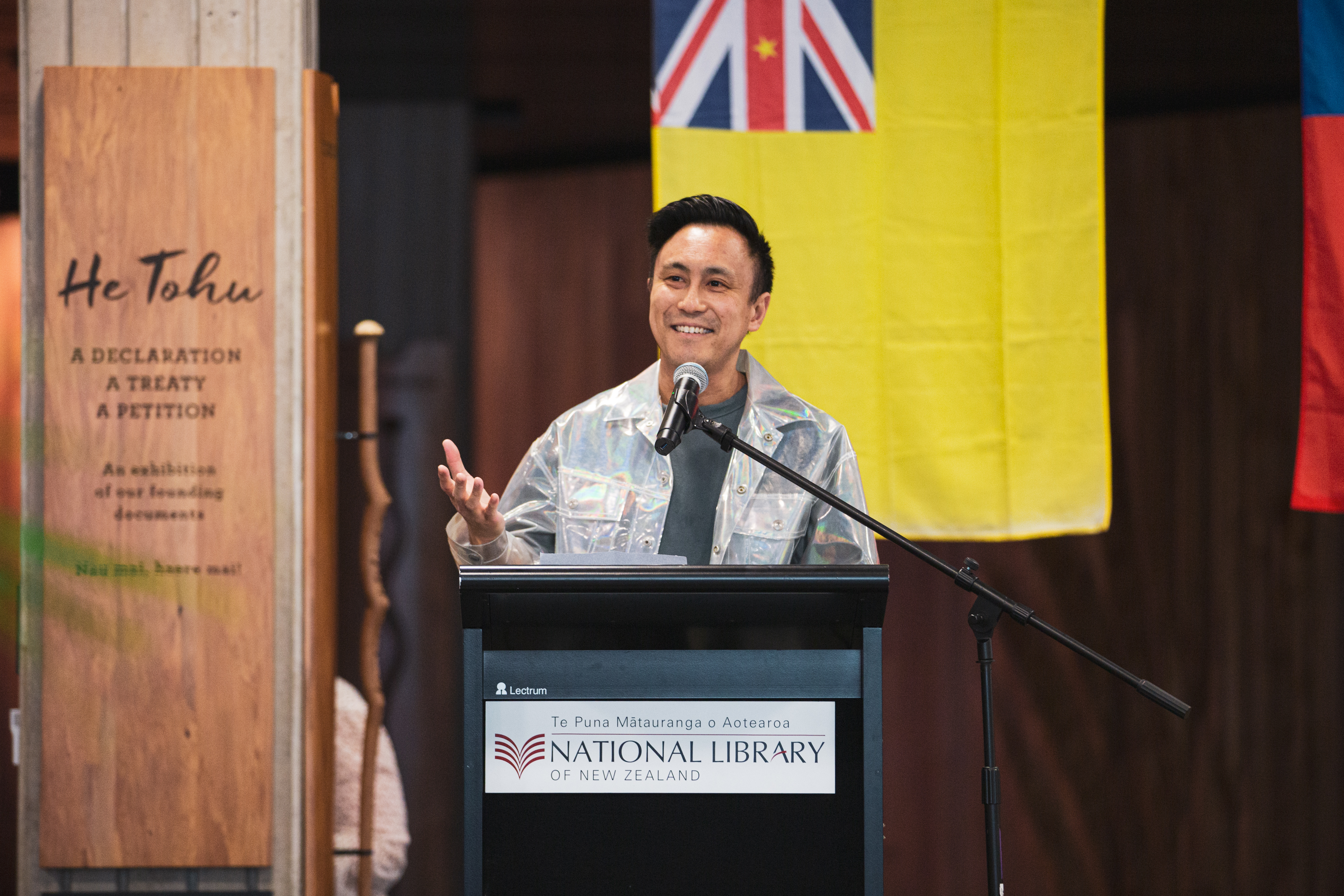
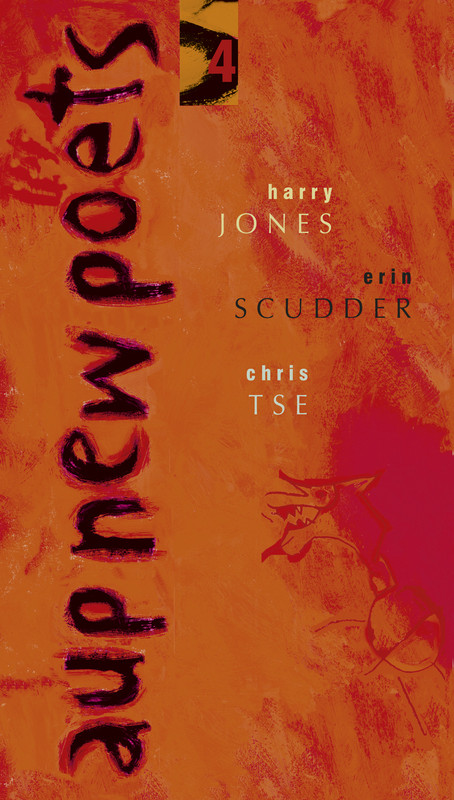
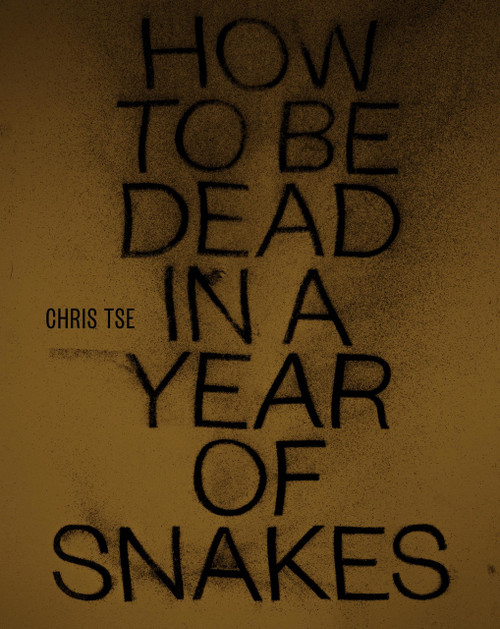
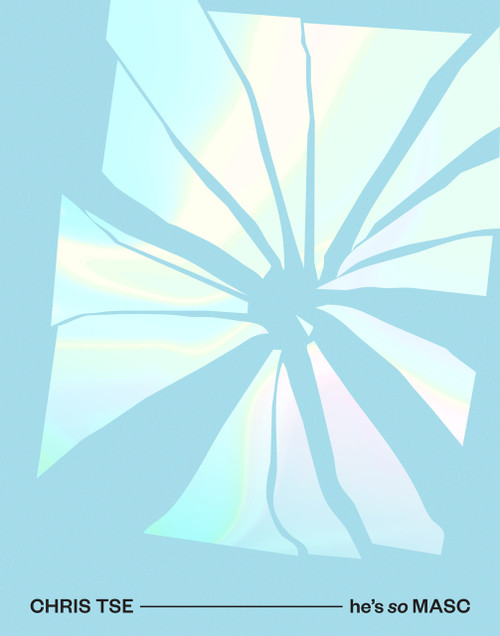
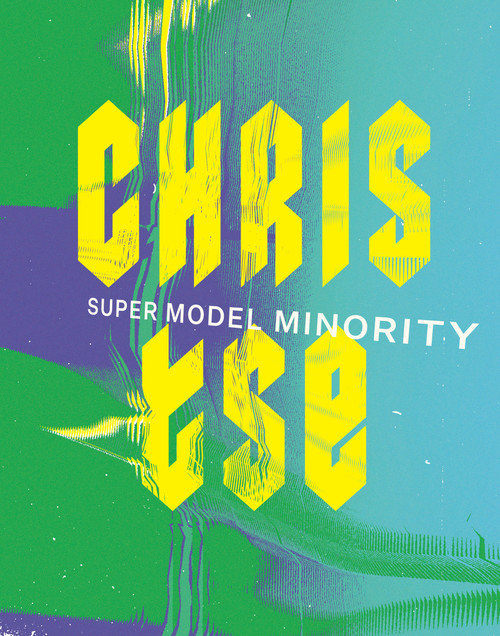

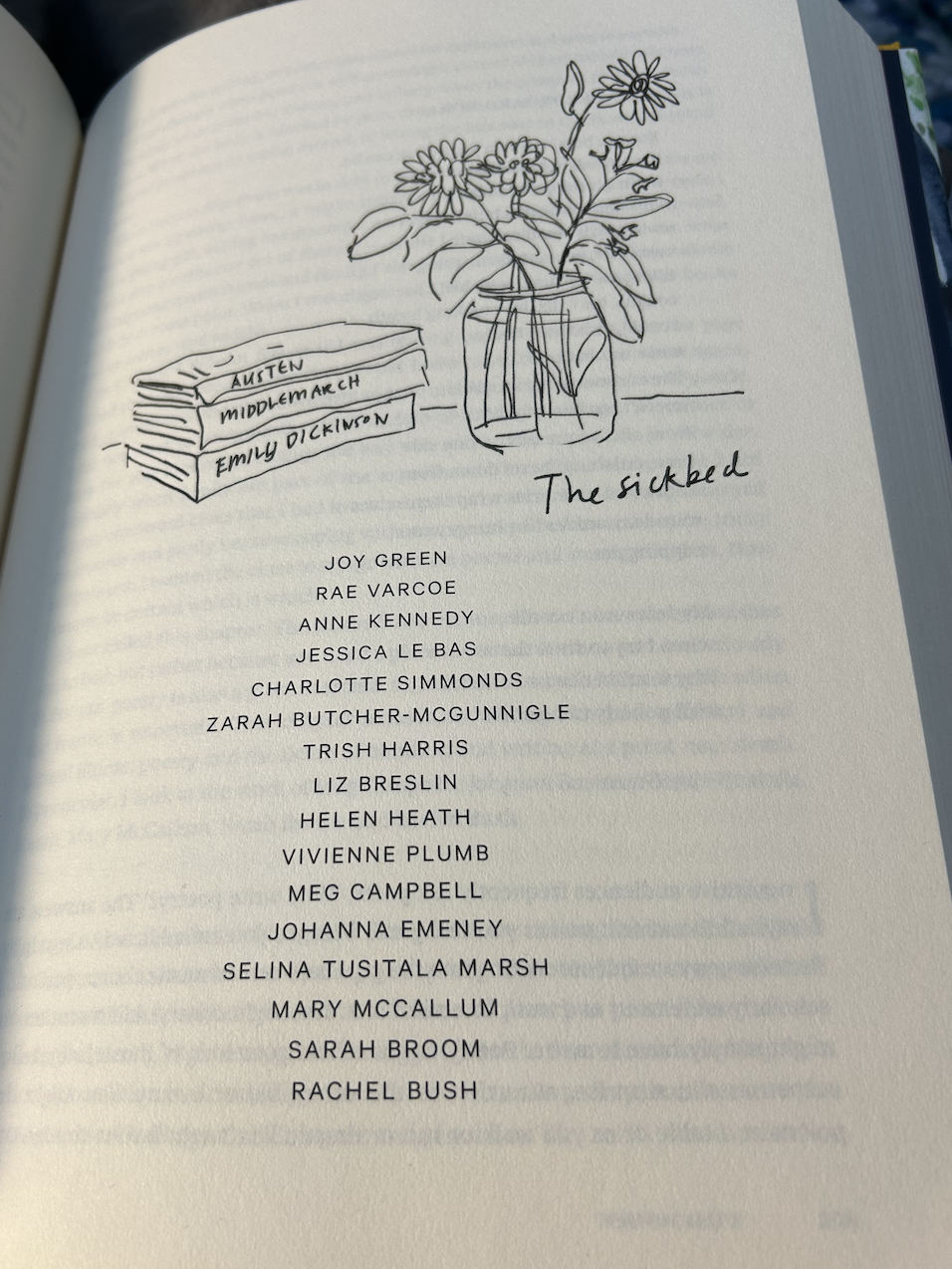
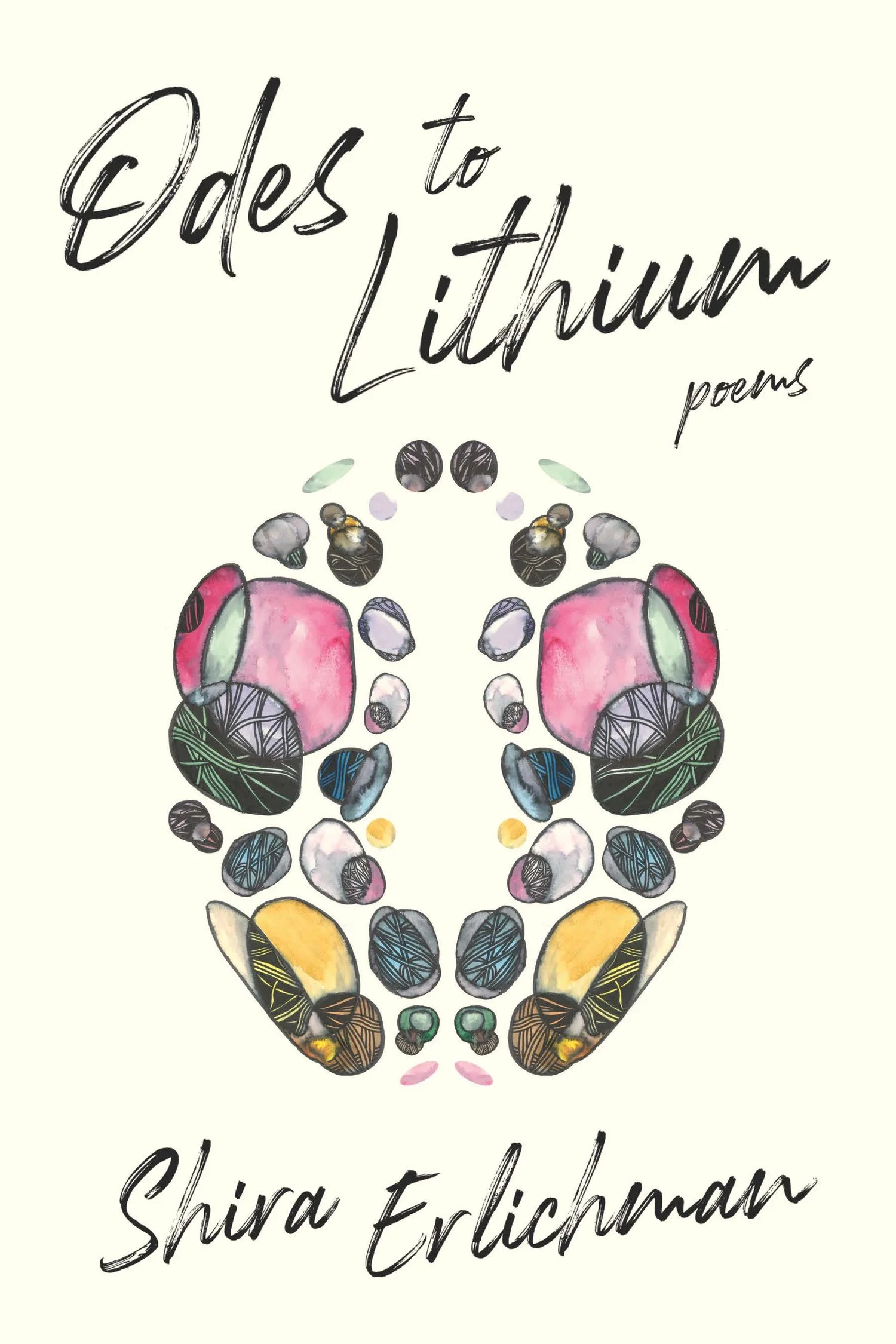
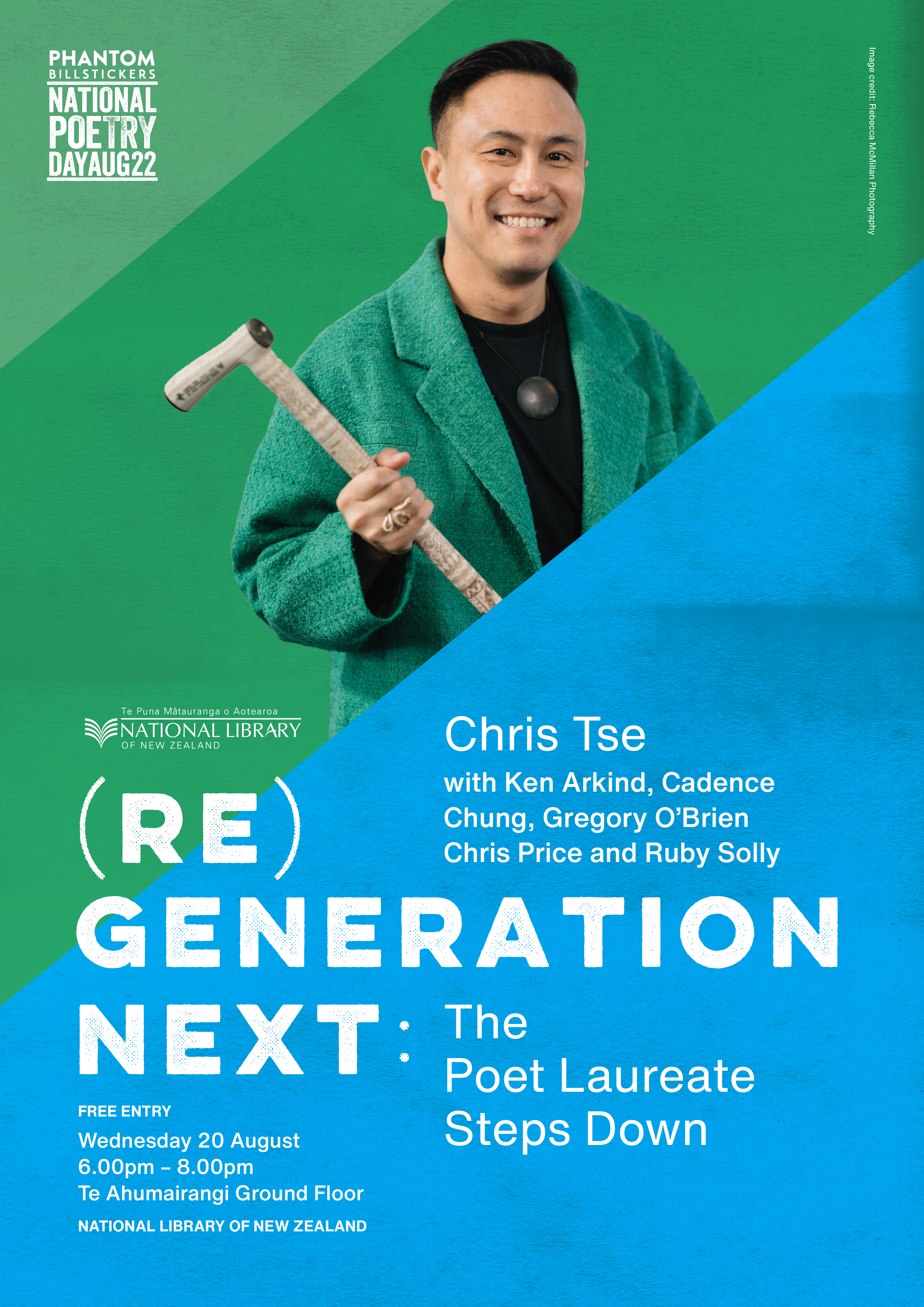
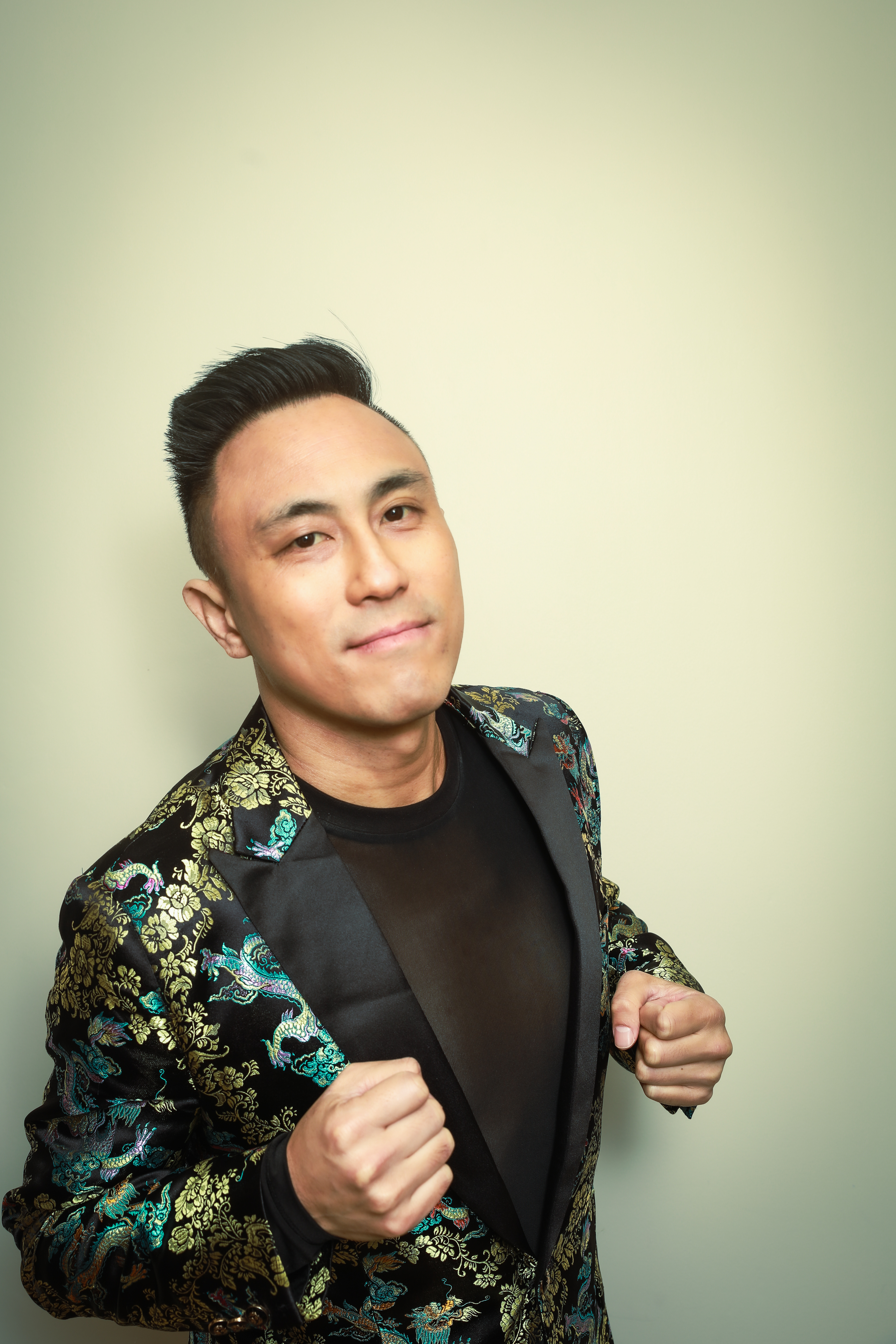
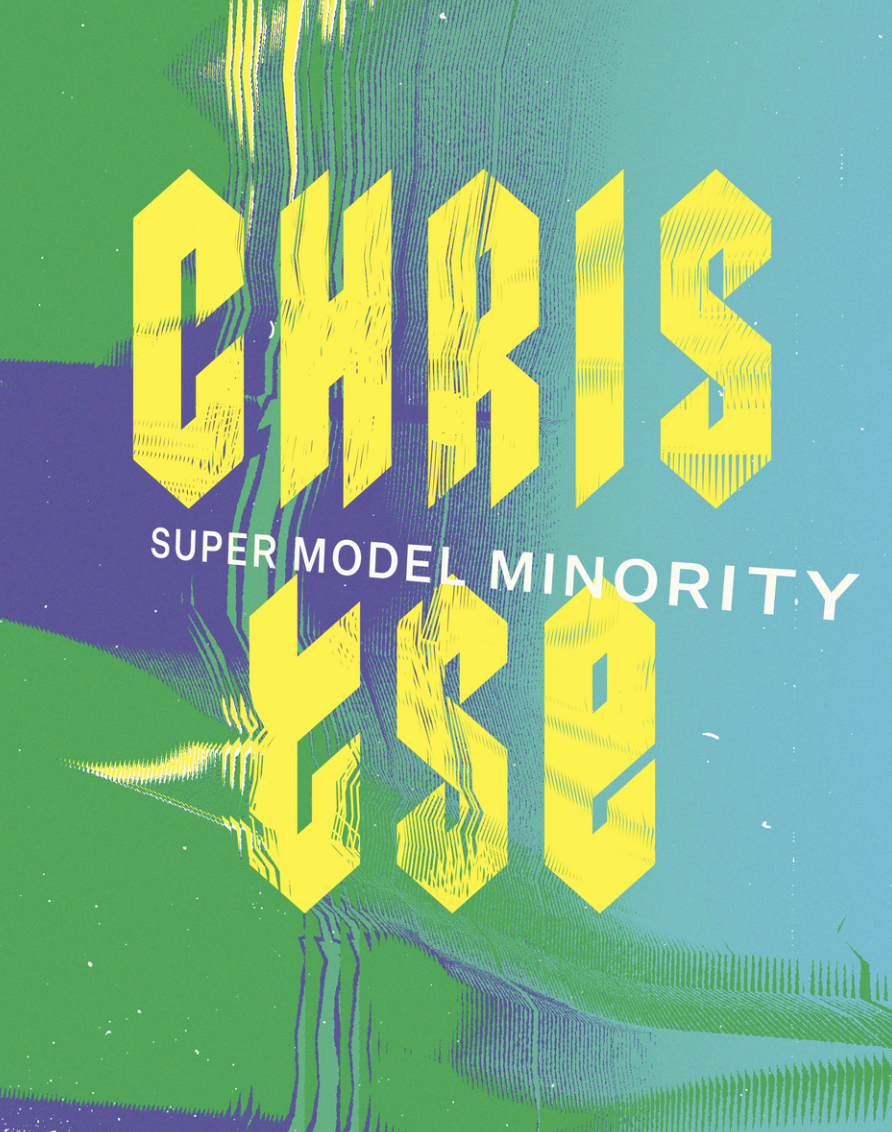
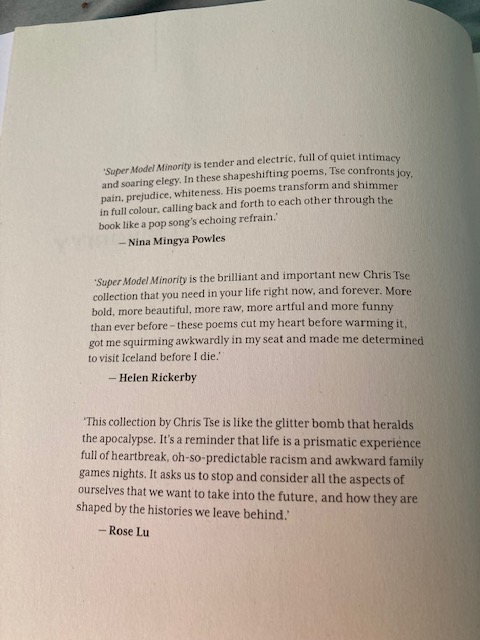
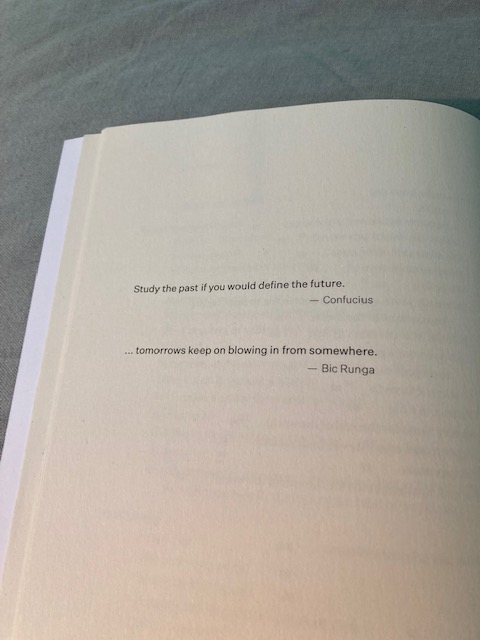
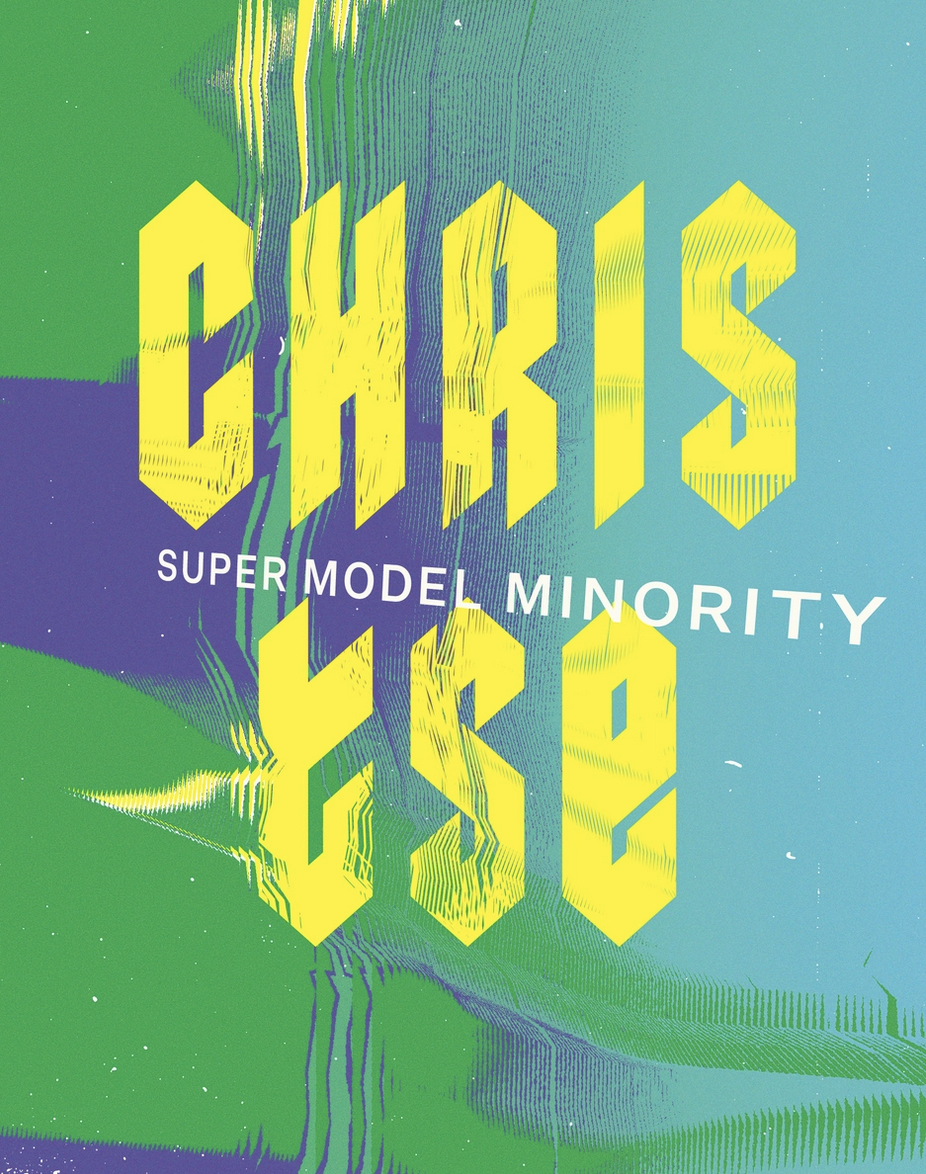

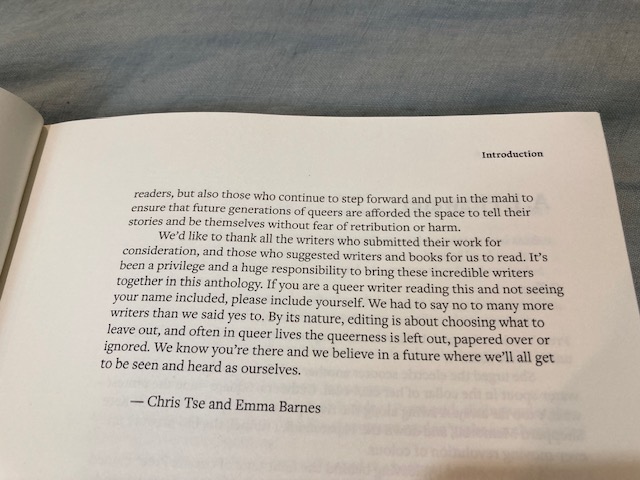
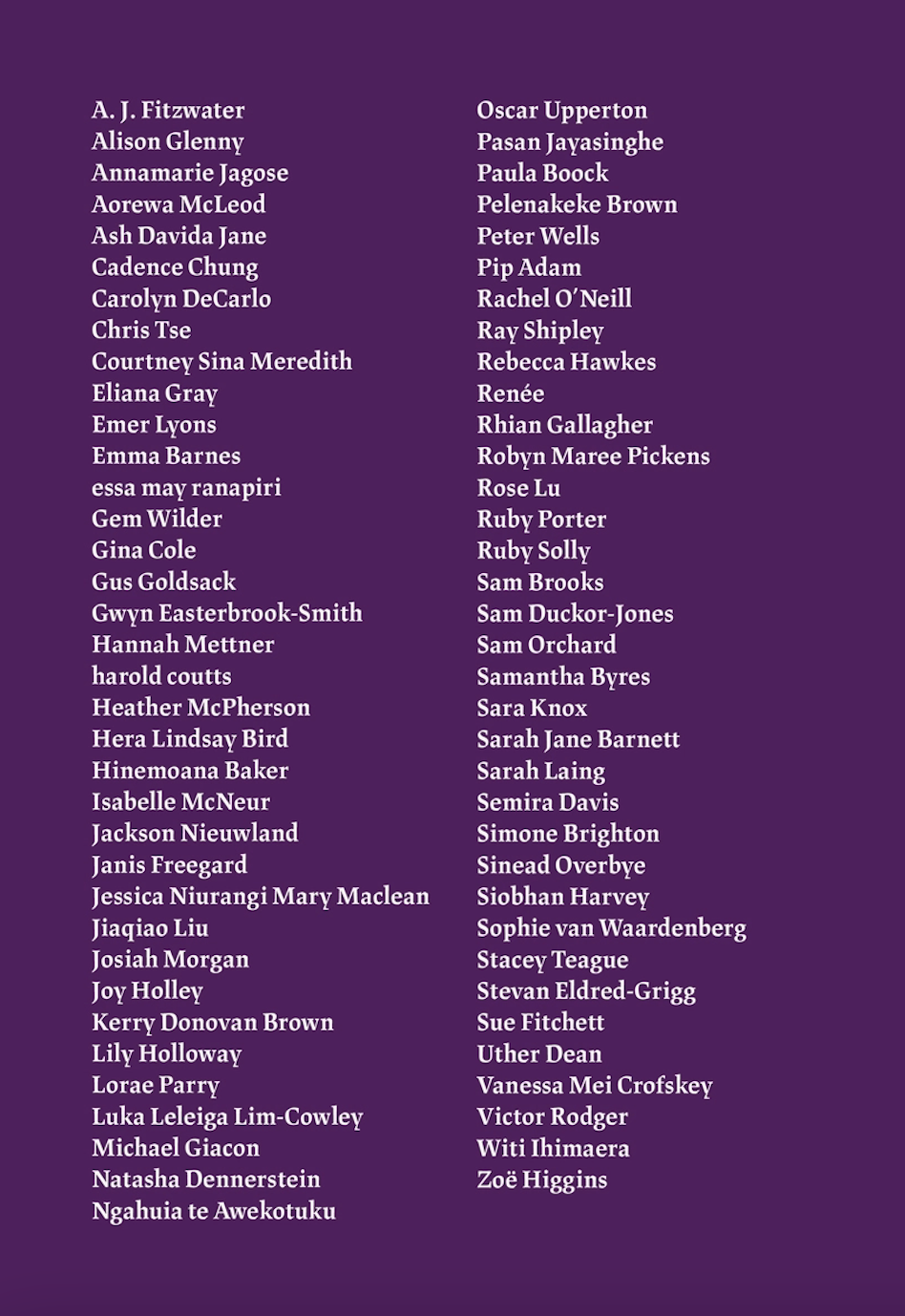
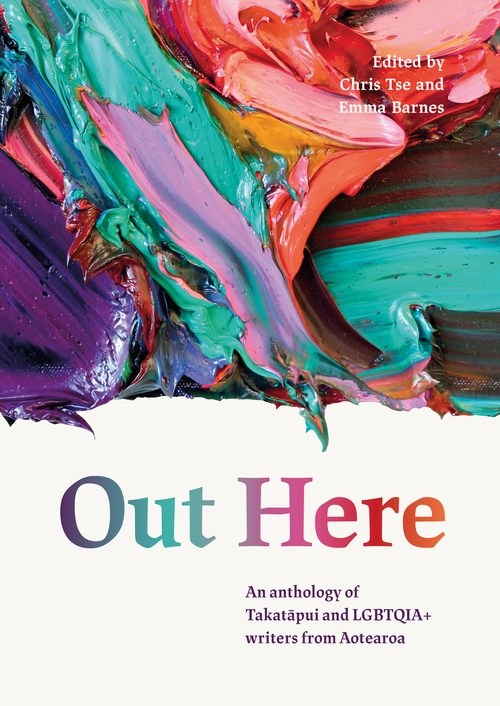
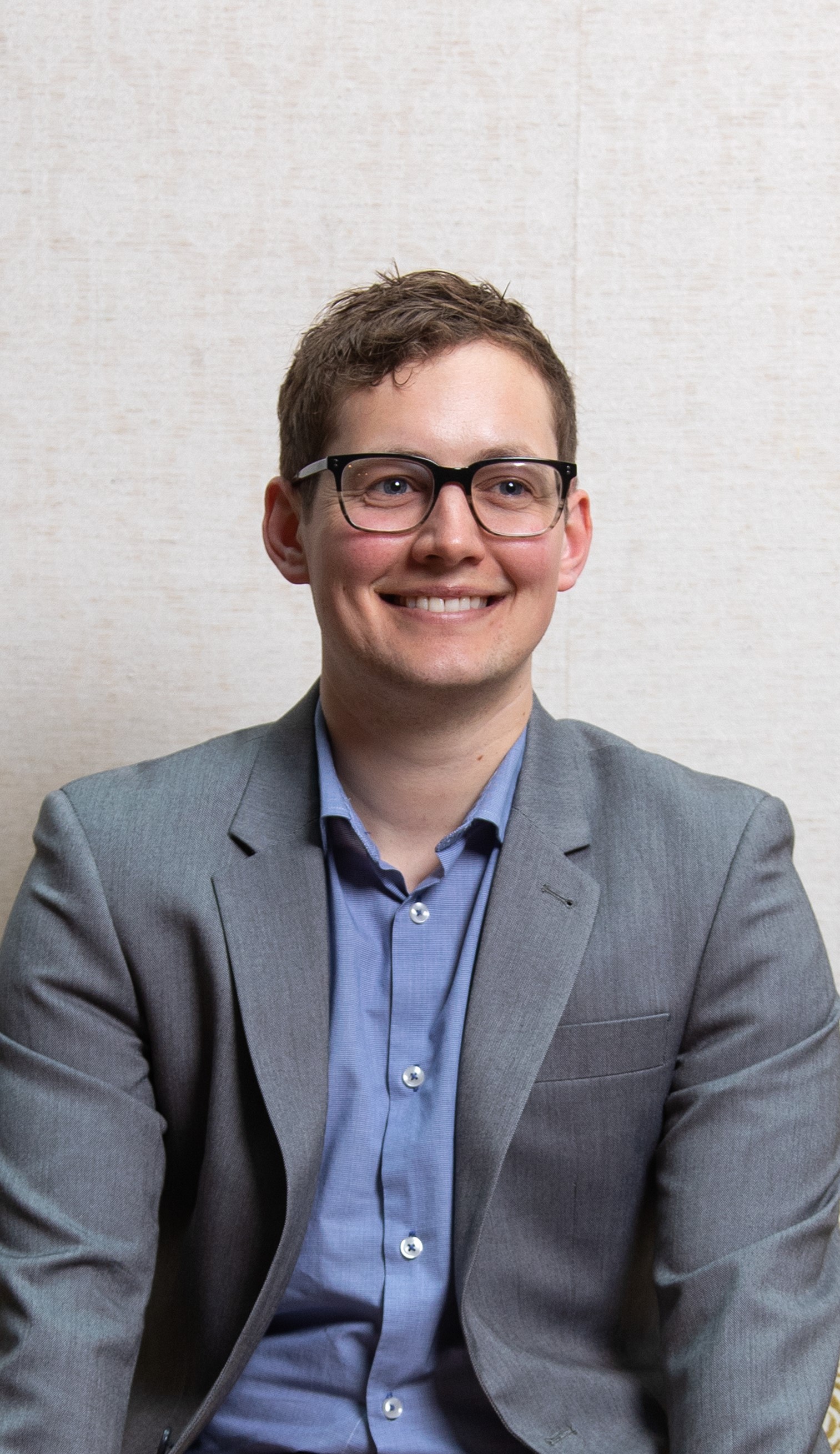
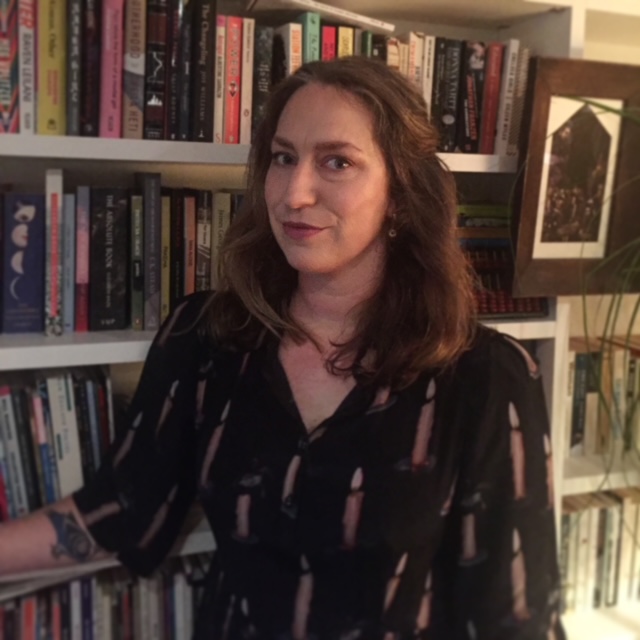
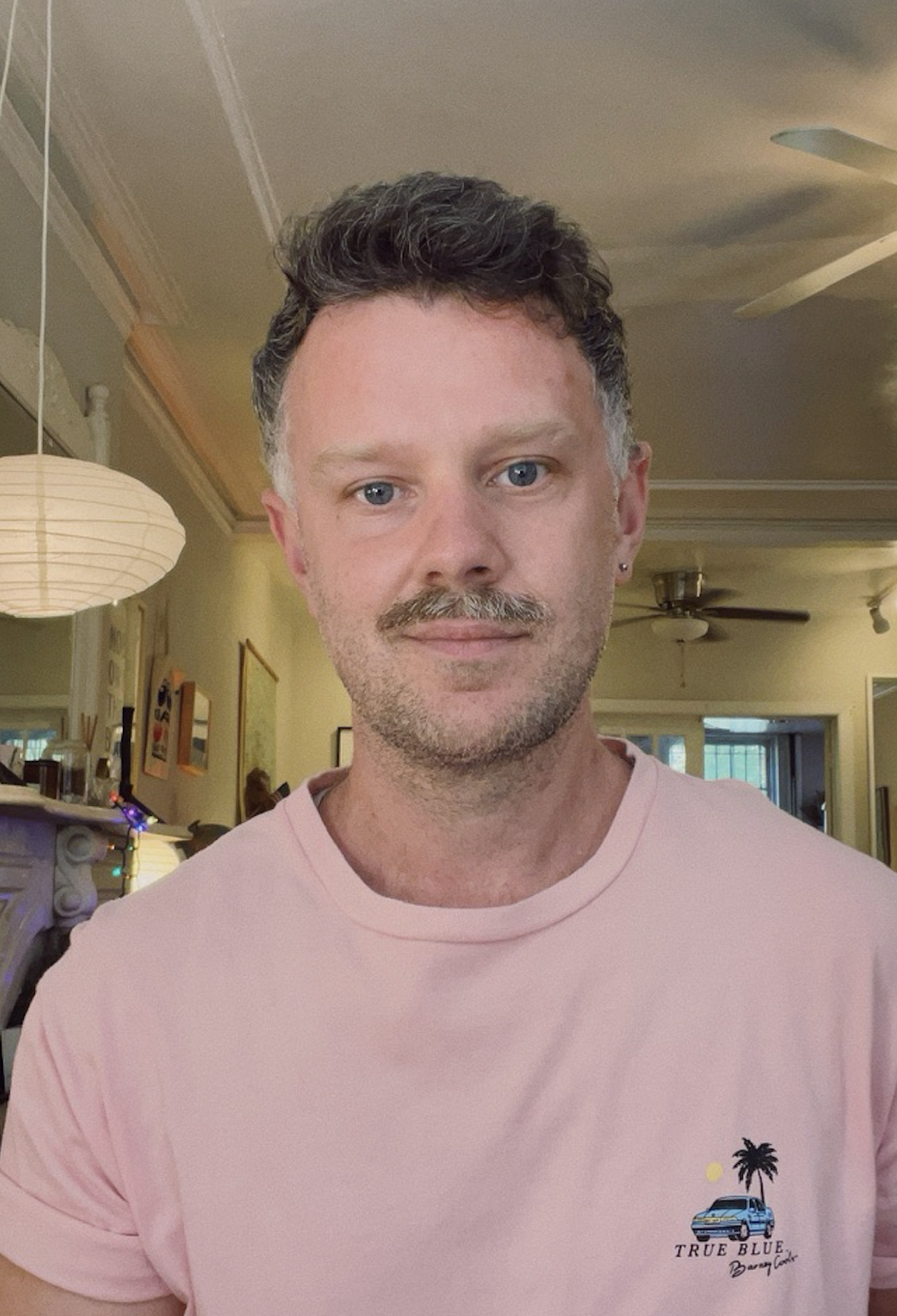
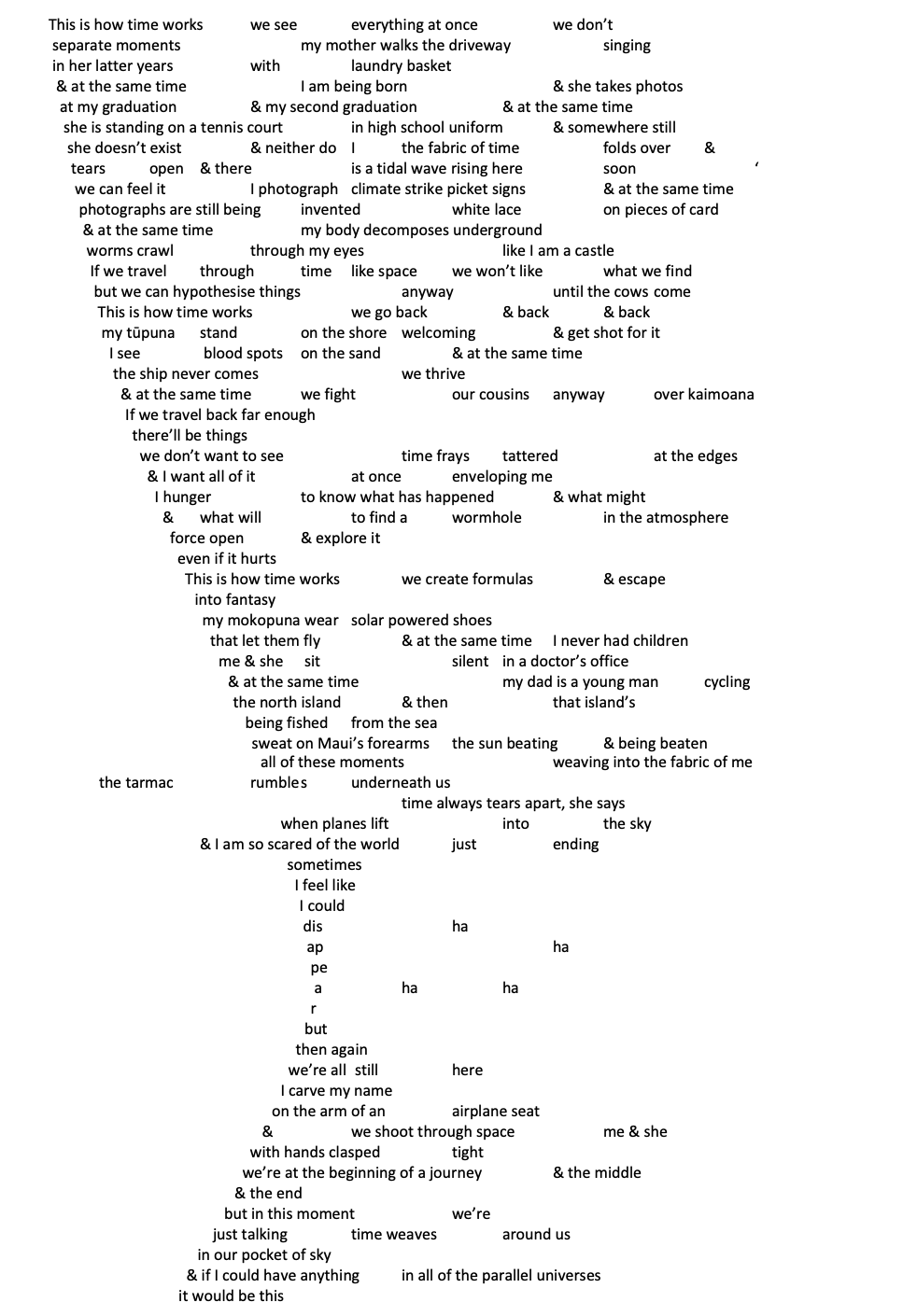


 NZ Poetry Shelf