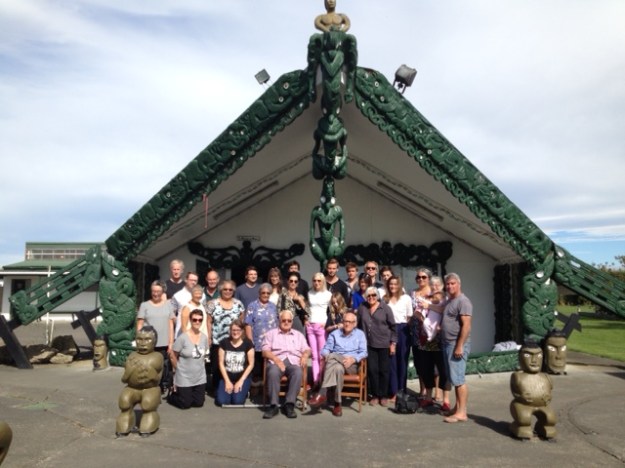
A Little Poetry Shelf Diary: A weekend at Matahiwi Marae to launch our new Poet Laureate, CK Stead


IMG_3281.JPG


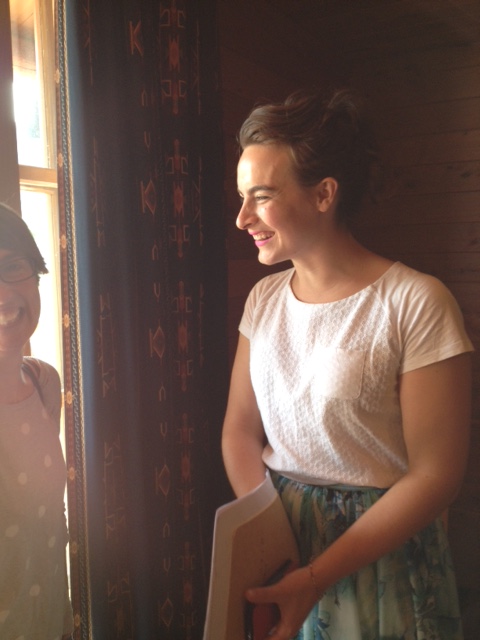
This weekend friends, family and poets gathered to join CK Stead celebrate his Poet Laureateship and the presentation of the tokotoko. It was a marvelous occasion that will stand in my memory for a long time. The weekend featured two key events. The formal and informal proceedings at Matahiwi Marae on the Saturday morning and a Poets’ Night Out in the evening.

With exemplary dedication to New Zealand poetry, Te Mata Estate’s Peter Buck and poet Bill Manhire established the award twenty years ago. In 2007, The National Library took over the administration, although the Buck family still remain involved, and donates a stipend of wine to the Laureates. Unlike most of the visitors, I got called onto the marae on the Friday evening with Chris Szekely and Peter Ireland from the National Library, and a number of their colleagues, including Oliver Stead and his son Isaac. Peter was the driving force behind detail of the weekend, and Ian Wedde’s moving tribute to him at The Circle of Laureates hit the mark. Thoughtful, attentive, committed to making a celebration fit for a Laureate. His back-up team are pretty special too (Joan, Cellia Joe, Lynette, Jason and Oliver).

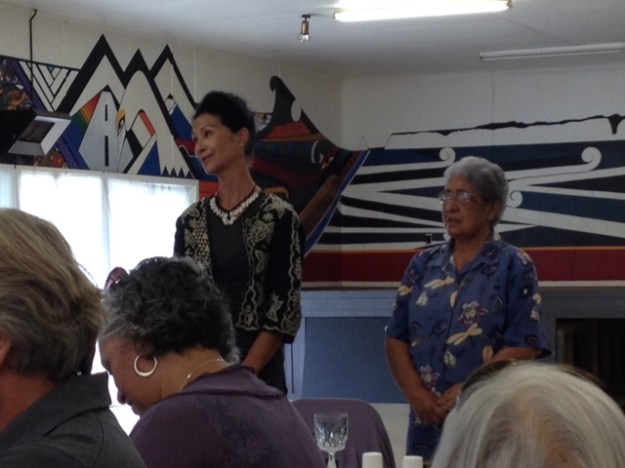
Kaumatua Tom Mulligan and other members of the marae welcomed us with much aroha.

Joan, Cellia, Jason and I practiced some waiata back in the whare nui. CJ on ukulele.We crack up when CJ says all her family knows she can’t sing and she just fakes it. We are all fooled and I wonder what I can’t do but could fake and get away with.

On Friday night we hived off to Havelock North (one poet, five librarians) for dinner at Maine where the food was divine. We fell greedily into the comfort of the best hot chips ever and with that salty comfort digging deep into our bones were ready for whatever the weekend delivered. One plate of salmon with the best Niçoise salad and I was ready for a weekend of poetry and celebration.


Saturday morning

I got up early to walk in the near rain and saw a black cat stock still on a fence post eyeballing my lack of sleep. Not budging an inch until a car came down the gravel road and sent the cat sliding down like a snake into the golden corn. I had no idea what it meant. But it glowed with options.


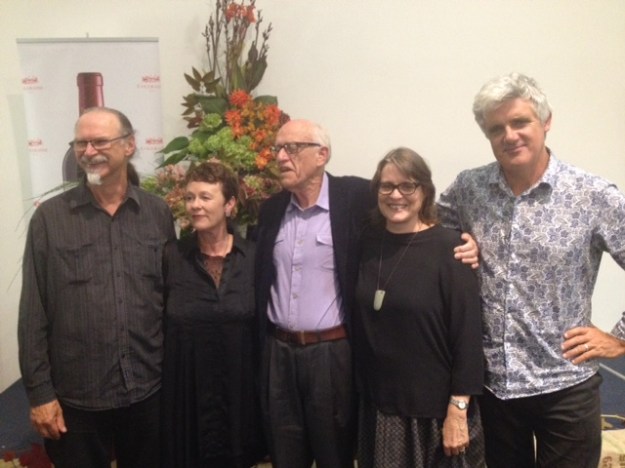
CK Stead was called onto the marae with his whanau (around 20), poets Gregory O’Brien and Chris Price, her partner Robbie Duncan, and other guests. To have such family support felt very special. He is poetry but he is most definitely family. His daughter had travelled from London with her children.

After the formal speeches and the waiata exchanges, the tokotoko was presented to Karl by a kuia. She had such presence. Jacob Scott, who carves the tokotoko for each Poet Laureate said he had wanted to make a tokotoko for a gentleman and a scholar that could be used on a daily basis if needed. He had gained inspiration from Karl’s poem, ‘Scoria.’

Karl responded with a speech that mixed graciousness, humbleness, love. He said he was not only honoured by the role but honoured by the marae: ‘by being here, by your presence, by your aroha.’

Before he read a few poems, Karl talked about place, about the importance of one’s childhood occupation of place, and the way that place becomes one of return. He grew up with three maunga facing him whichever way he turned. He also underlined the primacy of poetry for him since his teenage days and the way he has ‘always come back to poems.’ With much humbleness, he added,’that’s why it is extraordinary at this late stage in my career as a writer to be honoured as Poet Laureate.’

Karl paused in his korero and then said; ‘I am getting advice from the tokotoko. We have to get used to one another.’

At that we all paused.

I am delighted that the Poet-Laureate role honours our elders, our writing taonga. It felt good to be part of the protocol. The talking. The listening. The exchange.


MC-ed by Marty Smith, the informal part of the morning was like a miniature poetry reading. As his invited poets, Chris, Gregory and I read a couple of poems and Chris sang a Bill Manhire song with her partner Robbie. What made this section special were the performances from local secondary students. One student used the analogy of a bird to explore the Poet Laureate’s original function to write poems on dictated subjects. She was keen to let a Laureate fly free! A student played a solo violin piece, one sang a Māori version of ‘Hallelujah,’ while another wrapped up the morning with Van Morrison’s ‘Moondance.’ Wonderful! I pictured us all dancing slow motion with the wind in our hair. Instead the wind whipped the music sheet up and away.

It was a morning of korero, waiata, music and poetry and it felt good to inhale both words and song. Nourishing. We moved to the whare kai where a tremendous lunch of fresh local produce matched the hubbub of conversation. You don’t get to experience many days like this in your lifetime. Such warmth, and connections.


Saturday night

Marty Smith was the MC extraordinaire in a poetry reading of two halves. It’s ages since I have heard Chris and Greg read, but to hear them read in this context was something special with poems handpicked for the Laureate occasion. Greg read a terrific poem now showcased in the selection of Best NZ Poems from 2015, while Chris confirmed that her new book is her best to date (we have an interview in the pipeline!). Three young opera singers from Project Prima Volta wowed us with two arias. The room befitted the occasion: white cloths on tables, astonishing flower/plant arrangements, platters of food, Te Mata wine. Karl started and ended the night and showed very clearly why he is Laureate. He read across his range and his last set gave me goosebumps. The clarity of voice, the poetic strata, the acute detail that makes you want to pick up your pen and write.


Sunday morning

Breakfast and poroporoaki for everyone on the marae. The goodbyes. At breakfast Karl and I talked about the weekend and how we both spent chunks of the night wide awake as though we had to rehearse the next day and analyse the day before. I probably had about two or three hours sleep a night and it seemed like a state of wakefulness that kept me on high alert. What had happened, what was about to happen. I had brought seven books to match most moods (everyone laughed at my big bag of duvet and books) but I only got to read snatches of The Lie Tree. The gap between YA fantasy and the marae was unbridgeable. I got up early and walked my way into wakefulness before Emma Scott, Jacob’s sister, took me out to the river mouth and then coffee at her brother’s house. To see the meeting waters, where river meets ocean, to soak up the gleam of sun on waves and estuary, felt like a poem on the surface of the world. We talked and we looked. Emma is a stone mason. We talked about poetry and we talked about stone. We talked about what holds things together. It matters that we hold up our treasured poets. Give them a place to stand and speak.

There was much korero after breakfast, and song. Chris and Robbie sang a mesmerising Bob Dylan number, almost lullabying me into necessary slumber.

Peter Ireland, running on empty after little sleep, spoke with characteristic thought and thanked everyone personally. It felt like a garland of words to wear out into the world of planes and trains and motorways. Or for me, a place of solitude and bush.

Jacob said it beautifully. He said that the Poet Laureate was significant for the marae. That it spread the hapu’s power and influence. That this is now Karl’s place as well. The undercurrent is that poetry matters. Jacob said it is significant ‘that the Poet Laureate can articulate the thoughts and expressions of who we are. Of what we can do. Of what we have got. And what we could do.’ Like a bird.

We all felt in debt to Tom Mulligan and his drawing together of this poetry clan. With much aroha and generosity of place, stories and a willing ear.

Our heads are full of days we cannot remember, but for many of us, this weekend will not be one of them.

Thank you. Especially Karl, The National Library and Matahiwi Marae.


The performances.


A quick trip into Havelock North to drink the best coffee and eat the best lemon tart in a cafe on the brink of closing for the day. Peter was a very good guide.


The writers, friends and family ate at Pipi Cafe, a cafe renowned for its love of poetry and its excellent pizzas in Havelock North.

Poets’ Night Out


IMG_3258

IMG_3276

The last morning.

A very special Poetry Book Launch: Rachel Bush


And some mornings seagulls fly
three or four over this house to say
something about grief and weather.

–from ‘Watch’, by Rachel Bush


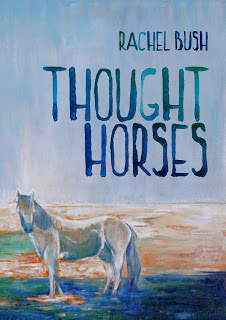
Victoria University Press warmly invites you to a celebration of Rachel Bush and the launch of her new collection Thought Horses.

On Tuesday 19 April, 5.30pm–7.30pm at Vic Books, Kelburn.

This event will include readings of Rachel’s poems by Bill Manhire, Chris Price, Jo Randerson, Louise Wallace, Dinah Hawken, Louise Wrightson and Glenn Colquhoun.

Thought Horses will be available for purchase, $25, p/b.
Refreshments will be served.

Best NZ Poems now live

The 2015 edition of Best New Zealand Poems was launched yesterday, introducing both established writers and new voices to the wider public.
Best New Zealand Poems 2015 can be viewed here.

The anthology has been published annually since 2001 by the International Institute of Modern Letters (IIML) at Victoria University of Wellington.

Poet and academic John Newton had the task of sifting through the thousands of poems published in books and journals last year in search of 25 that delivered what he wanted.

“I was looking for an active jolt of pleasure,” he says. “That moment of finding something that really does it for you, when you can’t wait to get on the phone or on Facebook, or better still in person, hearing it echoed in the pleasure of the person you’re sharing it with.”
Best New Zealand Poems series editor Chris Price, a senior lecturer at the International Institute of Modern Letters (IIML), says one of the contributions is from Selina Tusitala Marsh, who just last month performed for the Queen at Westminster Abbey. “Her poem describes watching The Vampire Diaries after a day spent teaching post-colonial theory,” Ms Price says.
Diverse cultures and forms of communication feature strongly in this year’s selection, demonstrating that our poetry is both rooted in the local and connected to the world. Sarah Jane Barnett’s beautiful and timely poem looks at the life of a refugee from Ethiopia.  Gregory O’Brien’s poem attempts to gain the ear of the King of Tonga, and Alison Wong tries to decipher the language of match-making in Shanghai. Kani Te Manukura remembers Te Kooti’s last stand and thinks about Aotearoa’s race-time continuum. Ashleigh Young encounters a man in Reno with the voice of ‘Death’s personal computer’.

Readers of John Newton’s top 25 poems are also able to hear recordings of several of the poets reading their work.

Ms Price says there is a playful, wry tone to much of this year’s work.
“Hera Lindsay Bird announces that ‘It’s a bad crime to say poetry in poetry’ but she does it anyway. Alexandra Hollis reminds us that Rihanna is as profound as the stars, and Bryan Walpert’s title, ‘This poem is conversational’, might be a comment on the very nature of contemporary New Zealand poetry.”

Best New Zealand Poems is published by the IIML with support from Creative New Zealand, and is hosted by the New Zealand Electronic Text Collection.

Louise Wrightson farewells Rachel Bush


Thought+Horses+cover   rachel+bush


The Strong Mothers

Where are the mothers who held power
and children, preserved peaches
in season, understood about
greens and two classes of protein
who drove cars or did not have a licence
who laughed, raged and were there?
Take Mrs Russell who rode her irate bike,
an upright fly that buzzed
with a small engine on its back wheel
up South Road past the school football field
on her way to the hospital. Consider
the other Mrs Russell, drama judge, teacher of
speech and elocution in a small front room,
part-time reporter on The Hawera Star.
And Mrs Ellingham who had an MA in French,
ah, the university. Or Mrs Smith, one knee stiff
with TB, her tennis parties on Saturdays, adults
on banks and we smoked their cigarettes in the bamboo.
Her legs shone, their skin in diamonds like a lizard’s.
Then Mrs Chapman who sang in the church choir,
formed brooches from fresh white bread,
made you look for a needle till you found it,
heated records and shaped them into vases for presents
who did a spring display in the window of Gamages Hats.

They have left the vowels uncorrected, the stories unproofed.
They have rested their bicycles inside their garages,
looked up the last word, la dernière mot, in Harraps Dictionary,
let needles lie in the narrow dust between verandah boards.
They have tested the last jam on a saucer by a window
comforted the last crying child they will ever see,
and left. How we miss them and their great strength.
Wait for us, we say, wait for me.
And they will.

 
Listen to the poem on Best New Zealand Poems 2002 here


I was sorry to miss the launch of Chris Price and Lynley Edmeades new books at Unity, Wellington, last week. It was the same day as the celebration of poet Rachel Bush’s life at Old St Johns in Nelson. The event was part celebration, part concert. I’ve never been to an occasion like this where spontaneous applause followed the many performances. Rachel would have enjoyed every moment.

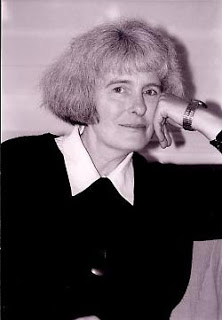
I met Rachel in 1996 when we were on a writing course run by Bill Manhire. I loved her the moment we met. When Bill set the group the task of writing a pantoum—a verse form that by its nature leans toward the serious and contemplative—Rachel’s first line was an accusatory “You offered to make the lasagne” which had us all laughing.


Another member of the group of ’96 was at her farewell too; Ingrid Horrocks, whose mother, Ginny, led the order of service. It’s usual to learn more about a friend’s past on occasions such as this and it was enlightening. Ginny traced her early relationship with Rachel at Canterbury University when they were junior lecturers, their planned trip to visit Tierra del Fuego (which didn’t happen because Rachel met Richard Nunns and fell in love), their shared ‘earth mother’ time bringing up children and their abiding friendship.

Rachel’s recorder group—she favoured the bass recorder—played a few of the same 16th century pieces they had performed for her while she was in the Nelson hospice.

Mary Ayre played ‘Songs without Words’ (Mendlessohn) on the piano and later accompanied Jo Hodgson when she sang ‘Ave Maria’ (Bach/Gounod) and ‘Sleep My Little Prince’ (Mozart).


Late last December I spent a week with Rachel and we went to her singing group run by the talented Pam Sims. Rachel liked German lieder and sang them beautifully in her husky voice. Her voice will always stay with me. It comes through the poems in her three Victoria University Press books: The Hungry Woman (1997), The Unfortunate Singer (2002) and Nice Pretty Things (2011).

Her fourth book, which Rachel saw before she died, thanks to VUP, will be launched at Vic Books in Wellington, 19 April, 5.30pm and at Page and Blackmore in Nelson later in the month.


There were many compliments about Rachel, the person, the writer, the singer, and musician. Peter Speers spoke about how she made ordinary things spring into life and how perceptive and gentle a critic she was. Other speakers mentioned her courage and loyalty to family and friends.

Rachel was a contained, thoughtful, loving friend. Underneath her considered surface I sensed a constant hum as she interpreted what was happening around her. She was wired for observation. This private alert woman was generous with her concern for the well being of her friends and family when they rang or called in to Napoli Way to check her health and lift her spirits. They bought all manner of delicious food and flowers. I remember a huge rich Christmas cake, pale blue eggs, shortbread, sweet peas, date loaves, crispy biscuits, orange roses, frittatas and cheese scones. If food and love could have beaten her cancer Rachel would be with us now. The phone rang often with friends calling from all over New Zealand.


Rachel’s poems featured at the service; her friend Robin Riley read ‘The Strong Mothers’, her lovely grand-daughter Jessica Moser read ‘The Song of Miss Gotto”, one of Rachel’s two daughters, Lucy, read ‘Birthday’. Molly read a poem called ‘Our Mother’ that the sisters had written together. It will appear in a Penguin book called ‘Thanks Mum’ which will be published this Mother’s Day.

Rachel had been cremated before we gathered to farewell her. As Pachelbel’s Canon played, her husband, Richard, carried the box that held her ashes out of the church followed by her family, including her five grandchildren. Rachel has gone and we have lost a wonderful woman and a lively poet. It’s a great comfort that she knew how very much she was loved. And it’s a bonus that we’ll have another opportunity to enjoy Rachel’s whimsy, gentle backslaps and interesting spin on life when her new book, Thought Horses, is released by VUP mid-April.

Louise Wrightson, April 2016


Fergus Barrowman has kindly granted Poetry Shelf permission to post two poems from the new collection (thanks to the latest issue of Sport online).


‘All my feelings would have been of common things’

All my feelings are of common things
of the clock going on, of the next
meal or the last one, of the washing
on the line and if there’s enough heat
to dry it, of how to clean a lawnmower
just enough to make the Salvation Army
man want to take it away, with old grey
grass stuck to the blades, the tyres that hold
dirt, like cleats in walking shoes. Also
a dryer I bought forty years ago,
I stick the manual and the expired
guarantee inside the metal drum.
All those clothes it turned and churned, the lint
that it trapped in its door. I once thought
many things would make my life happier
and now one by one I will let them go.


Stepping out

If you would open your curtains,
if you could just go outside.
But you don’t
you can’t.
If you could step out
of your own house
your own skin,
lay your accumulated habits
and personality on the floor,
say of a hotel foyer,
for someone else to find
after you have gone,
light and lithe, into what
ever’s there, perhaps a spring
morning, pink trees surprised
by blossom. The best spring
is in your own high
free step.

For the rest of the Sport selection go here.


I got to meet Rachel for the first time when she read at the Nelson leg of my Hot Spot Poetry Tour a couple of years ago. Having been attracted to the warmth and detail of her poetry, I was instantly drawn to the warmth and detail of Rachel Bush in person. Her voice. Her smile. Her engagement with the children on the carpet. She was a special person. I wanted to hug her. To read Louise’s moving account of the memorial service is a way to take stock, to sit quietly, to say goodbye. I won’t get to have that coffee on my next visit to Nelson, but I will get to have ‘afternoon tea’ with Rachel’s poems for many years to come. I treasure that one meeting. Thank you Louise for drawing us closer.

Paula Green


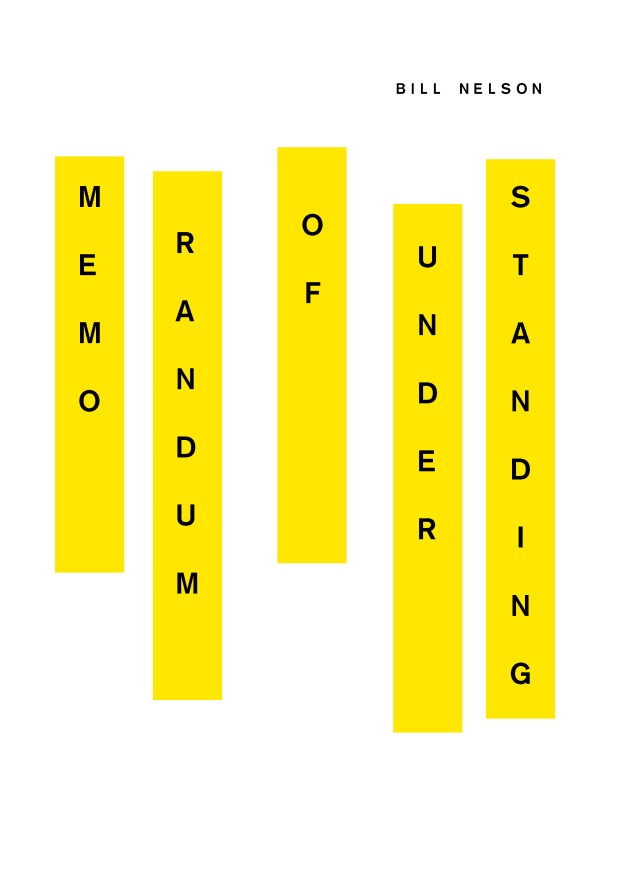
Book Launch: Bill Nelson

Victoria University Press warmly invite you to the launch of
Memorandum of Understanding
by Bill Nelson

on 6pm–7.30pm, Thursday 14 April,
at The Guest Room, Southern Cross Garden Bar
39 Abel Smith St, Te Aro

Memorandum of Understanding will be launched by Kate Camp.
Copies of the book will be for sale courtesy of Vic Books. p/b $25.


Memorandum front cover.jpg

Book launch for Anahera Gildea

We hope you can make it to the launch of Poroporoaki to the Lord My God: Weaving the Via Dolorosa:  Ekphrasis in Response to Walk (Series C) by Colin McCahon by Anahera Gildea,  published by Seraph Press.


Screen Shot 2016-04-04 at 12.46.06 PM.png

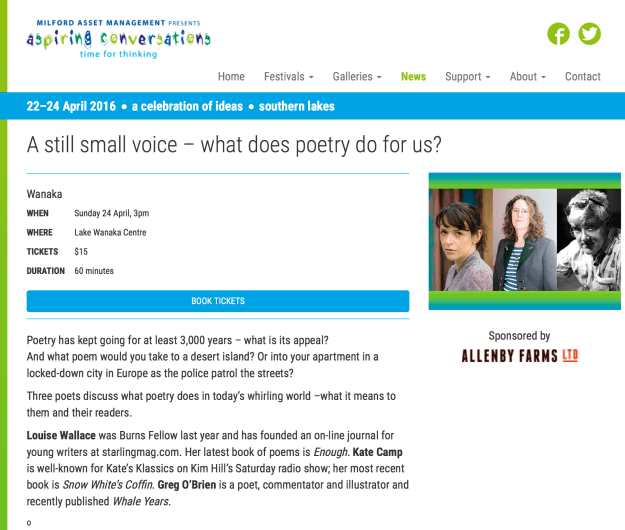
Wanaka Poetry event: ‘A still small voice – what does poetry do for us?

Screen Shot 2016-04-04 at 12.40.22 PM.png


Maria McMillan on Wordsongs


Wordsongs, St Peters Hall, Paekākāriki, 3rd March 2016


I go partly because there’s like a major poetry type gig in Paekākāriki and I’m a Paekākāriki poet and it feels a bit rude not to go. Imagine, I think, if there’s only six people there without me and they decide never to have anything poetry related in our village ever again. Yes, we call it a village and I needn’t have worried. Having scoffed down as much of a delicious fried-rice concoction as I possibly could in 94 seconds  I arrive three minutes late and take the Very Last Seat. It’s an actual excited crowd, in carefully arranged tiers. They’ve turned St Peters Hall around so we face the direction of the sea and one long side of the hall with its cool house-shaped wooden-window shutter things. The huge red velvet curtain hangs over the stage to our left and the doors to the village main street to our right.

I love this hall but truthfully, I’m a bit wary of poetry set to music. It’s the puritanical killjoy in me which says, honey, you need to decide, music or poetry. Just get away with your weird, not very interesting bongo drumming interspersed with a man saying two words usually something like organic tomatoes in  a quiet yet loud, yet well modulated, yet with working-class-solidarity voice and then pausing a full minute while making eye contact with every member of the audience before saying wet. But I know it’s kind of prudish of me and I need to open myself to new experiences so I am willing and here and listening.

Local poet, Dinah Hawken, who starts us off, makes me feel very comfortable. She reads her poetry sans music, the way it should be (sorry) and she starts with a good long poem about environmental catastrophe. The poem earns its length and I enjoy Hawken’s meditative delivery. She reads slowly and thoughtfully and the poem turns from lament to challenge to conversation. I feel like I’m hearing more and more poetry like this, laced with planet grief and helplessness and wonder. I’m glad it’s being written.

The main act is  Bill Manhire with singer Hannah Griffen, pianist Norman Meehan and Hayden Chisholm on saxophone and clarinet. To begin with I think Chisholm is tuning up, his sax is breathy and rough and understated and there’s no clear strong notes but then I realise this is part of it all. He’s throat clearing and then the other clear notes come, but through the set I see this replication of human noises, and also the absorbing of other sounds and instruments. I hear reverb and the plucking of a guitar, slow growling, didgeridoo and the noise of traffic all through his instruments.

In this first song, an interpretation of Baxter’s High Country Weather, the piano and singing come in beside the brass and I’m startled by how much action, how much sound can be produced by just three people. Griffin’s voice is like some really good jazz club singer. I get that vibe through the night. I want to be sitting at a small lamped table having intimate conversations. She sings big, beautiful and clear, high and low.  Next Bill, congenial and with charming anecdotes that thrill the poetry nerd in me, reads Rain by Hone Tuwhare and then the three musicians play it back to us. I get it now. I can listen to the poems read as poems, and listen to the music as music. No bongo drums. No organic tomatoes and soulful stares. It’s a relief. And when I hear Rain sung I’m struck by how lineation changes with the music, the words become split and lumped in different way. We can hear hidden rhymes and rhythms which may be a subtle backbone to verse on the page but in music are drawn out and played with. Cool.

Meehan tells us the set is pretty much the album Small holes in the silence, featuring versions of  Manhire and other poets’ work as songs. We hear interpretations of Alistair Te Ariki Campbell, Manhire, David Mitchell, and my favourite piece, two poems by Eileen Duggan. I can’t actually hear the words as Griffin sings so perfectly in tune with the sax, so my liking this all the same proves how thoroughly mature I’ve become about the whole poetry and music mash up. What I love in this song is the way the sax more than ever takes the role of a voice; for a moment the sax and the singer are a duet and in a kind of heady triumph. After that the two seem to swap places; Griffin no longer singing words but sounds become another instrument and the saxophone becomes a human voice. It’s a meandering interesting work. I also love Manhire’s stories about and poem for Cornish poet Charles Causley. The evening ended with a spoken and then musical interpretation of Manhire’s rhyming list poem ‘1950s.’ The crowd loved it, they threw flowers, they cheered, they stomped. Well, they didn’t but I’m sure if they thought of it they would have. They applauded long and hard. I wander out into the Paekākāriki night. Now the traffic sounds like a saxophone. The crossing signals go off. A train, windows bright, rumbles past us on its way to Waikanae. I wave.

Maria McMillan


On discovering Amy Leigh Wicks

IMG_3149


I got to introduce Amy Leigh Wicks at the Rupaehu Writers Festival, but I had barely sighted her poetry. What a discovery! Like most people in the audience, she blew my socks off. Amy is an American from New York City whose debut collection is Orange Juice and Rooftops. She is currently enrolled in the PhD programme at IIML and will write the critical component of her thesis on the poetry of James K Baxter.

Listening to her read as opposing to reading her for the first time on the page offers quite a different poetry experience. I cheekily asked if could take away the printouts so I could write about the poems. Usually I just depend upon my scrawlings but as chair I tempered my notebook entries. Amy is one of those poets who really knows how to bring a poem to life in the air (she has a background as a slam poet). And in fact won the slam competition at Ruapehu.

This is what linked the the words in the air to the words on the page: space, silence,  pause, what is not said, mysterious bits, strangeness, poetic tilts.

What struck me on the page: these poems feed on questions, curiosity fizzes both above and below the surface. Alongside the the room to breathe, I rediscovered a clarity of voice, sometimes conversational, sometimes lyrical, always fluent. And then the effervescent detail that forms a little uplift in a line.


Here is an Amy Leigh Wicks poetry sampler:


from Honey Moon

The first time we climbed into bed

it seemed like there was no one


else in the world. Then we left New York

and by the time we reached California


we noticed an army of ghosts floating

like balloons above us each night


The word honeymoon is fractured in two  because although you might think this poem is about bed, love, marriage and travelling, those ghosts bust it apart so you shift a little. Often I enjoy strange presences without analysing their status as tropes in a poem. The ghosts float like balloons above the bed. Beautiful. Strange. They don’t need to mean anything. Yet the balloon-ghosts (or ghost-balloons) keep tugging me back to the poem as though I want to make a story for them and give them a part to play beyond the unsettled sleep of a honeymoon couple. This poem, excuse the pun, haunts me. Read the full poem here.


from Learning to Swim

When ____________happened it made me feel …

This is the first rule. It’s like swimming, our new game –

The facts are false, the world inside is real.


Am I still in Vienna, floating from Klimt’s kiss to Schiele?

No.We are at our dining room table, I am learning how not to blame.

When ____________happened it made me feel …


Usually the repetitive lure of a villanelle is like free flowing honey, and the sweetness of repetition infuses fluency. But here the repetition is like a set of judder bars that shakes you out of easy coasting.


from First Night in Aotearoa

I was sitting at a stone table

there was a fire behind me

and a candle before me and

it was raining all around and the papers

on the table were soaking wet

with black ink bleeding through


A few poems are part of a sequence entitled ‘Kiwi Dairy’ and touch upon Amy’s experience of New Zealand (she is from New York). With this poem, again you get the white space, the shiny detail, the strangeness and the multiple questions. It is addictive listening/reading.


Keep an eye out for Amy’s poetry. You will find some poems on Turbine.


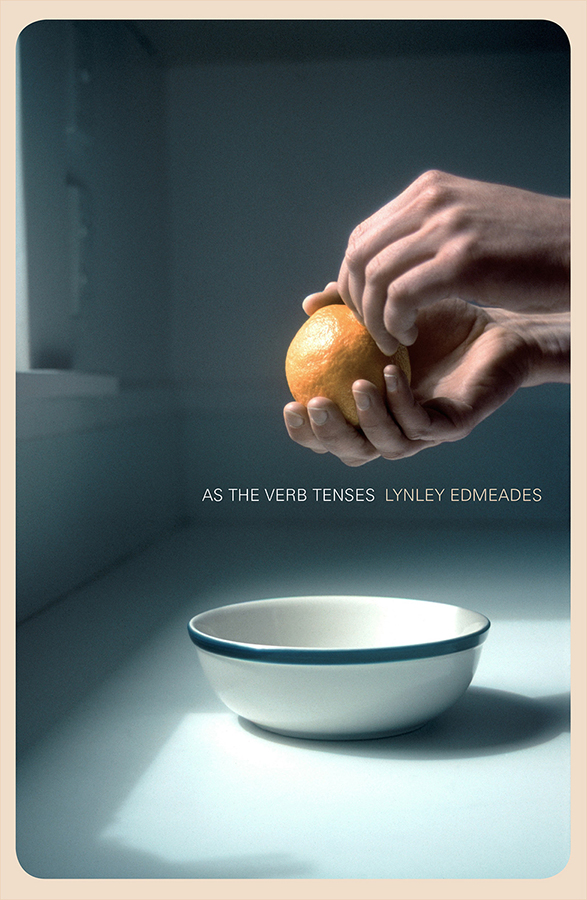
Fabulous poetry covers this year: Here is another

As the Verb Tenses.jpg

‘As the Verb Tenses is the work of a reflective and sensitive poetic talent: one run with gleaming wires of joy. In poems that gather together the vivid details of childhood memory, the surreal juxtapositions of life in the contemporary West, the wry observations of a temporary expatriate, the deeply lodged pain of historical and personal loss, Lynley Edmeades speaks to us in delicately spun lines that press out ironies, dissonances and profound formative experience.’

from Otago University Press. Launched tonight with Chris Price.