Haven’t read this as only back in power but Sweet Mammalian live here

Tenderness
I
A tree in the centre of a corn field
the corn rising in its ranks like braided hair
to meet the lowest branches
a tree that has replaced at least twenty
corn stalks with their divided leaves
twenty golden cobs sweetly surrendered
for this lovely grace: leaf sweep touching
leaf sweep, the whole field given by
this rising trunk, a focus
the pattern drawn from the edge of the field
to the centre where the tree
delivers a blessing.
II
The forest planation blankets hills.
Neat-ankled, swift-running
the dark pines descend
except on one little hilltop a ride
of grass begins and runs
with the trees which seem to bend
tenderly towards it: a bed from which
a child has risen and begun walking
the solicitousness of pine branches over grass.
©Elizabeth Smither from Night Horse
Elizabeth Smither’s most recent poetry collection, Night Horse, was published by Auckland University Press in 2017. She also writes novels and short stories.
Love this series. Heard the fist of these and they are excellent! – Paula
Creative Writing Master of Arts (MA) graduates from Victoria University of Wellington’s International Institute of Modern Letters (IIML) are having their work broadcast on Radio New Zealand (RNZ)’s ‘Nine to Noon’ programme, hosted by Kathryn Ryan.
This is the second year of the reading series, Page Numbers, and this time it has been extended to a fortnight to showcase more of the new writing, described by Kathryn Ryan as “remarkable for the diversity and quality”.
Page Numbers runs from April 9 – 20 and features fiction and memoir by Clare Moleta, Sudha Rao, Linda Collins, Kirsten Griffiths, Lynne Robertson, Sharon Lam, Mia Gaudin, Anthony Lapwood and Maria Samuela—all 2017 IIML Master of Arts graduates.
“We’re delighted to continue this collaboration with RNZ, and that listeners have a chance to connect with this brand new work from a range of voices,” says IIML Senior Lecturer Emily Perkins.
“Listeners will hear tales of intense loss and suppressed love, as well as hot and humorous dating instructions, and hope in unexpected places,” says Ms Perkins. “They’ll find townspeople struggling through climate catastrophe; a clone negotiating personal relationships on a mission to Mars; sex workers dealing with the streets of Wellington; and a family arriving in Dunedin from Pondicherry in 1968, among other pieces. There are stories everywhere, and these new writers have much to tell.”
Page Numbers airs on ‘Nine to Noon’ on RNZ at 10:45am weekdays.
Mon 9th April Safer by Clare Moleta
Tue 10th April Margam: And So (Pt 1) by Sudha Rao
Wed 11th April Margam: And So (Pt 2) by Sudha Rao
Thur 12th April Not Ash by Linda Collins
Fri 13th April Nostalgia by Kirsten Griffiths
Mon 16th April I Love You Darling Loretta by Lynne Robertson
Tues 17th April Potluck by Sharon Lam
Wed 18th April Volcano by Mia Gaudin
Thur 19th April Jack by Anthony Lapwood
Fri 20th April Love Rules for Island Boys by Maria Samuela
Following the initial broadcast, listeners can go online to listen to the series again.
.
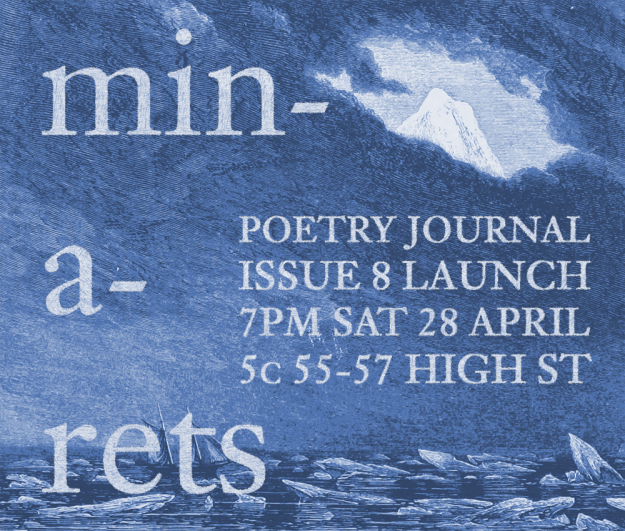
Compound Press presents Minarets Issue 8 Autumn 2018
Edited by Erena Shingade
Illustrations by Harry Moritz
Launch at 7pm, Saturday 28 April at the Compound Press headquarters, 5c 55-57 High Street.
Minarets Issue 8 presents the freshest new writing from a mix of emerging and established New Zealand poets, alongside contributions from two international poets. Humorous, adventurous, and though-provoking, the journal brings a slice of the most intriguing new writing from here and overseas to the table.
Featuring the following New Zealand and international authors: Victor Billot, Freya Daly Sadgrove, Lee Thomson, Zack Anderson (USA), Murray Edmond, Courtney Sina Meredith, Manon Revuelta, Naomi Scully (USA).
What I want from a poetry journal
More and more I witness clusters of poetry communities in New Zealand – families almost – that might be linked by geography, personal connections, associations with specific institutions or publishers. How often do we read reviews of, or poems by, people with whom we don’t share these links? Poetry families aren’t a bad thing, just the opposite, but I wonder whether the conversations that circulate across borders might grow less and less.
I want a poetry journal to offer diversity, whichever way you look, and we have been guilty of all manner of biases. This is slowly changing.
When I pick up a journal I am on alert for the poet that makes me hungry for more, that I want a whole book from.
I am also happy by a surprising little diversion, a poem that holds me for that extra reading. Ah, this is what a poem can do!
Editor Jack Ross has achieved degrees of diversity within the 2018 issue and I also see a poetry family evolving. How many of these poets have appeared in Landfall or Sport, for example? A number of the poets have a history of publication but few with the university presses.
This feels like a good thing. We need organic communities that are embracing different voices and resisting poetry hierarchies.
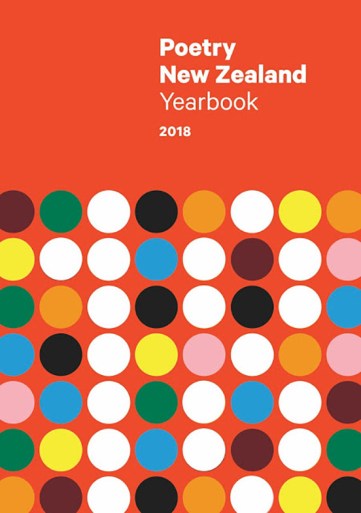
Poetry NZ Yearbook Annual offers a generous serving of poems (poets in alphabetical order so you get random juxtapositions), reviews and a featured poet (this time Alistair Paterson). It has stuck to this formula for decades and it works.
What I enjoyed about the latest issue is the list of poets I began to assemble that I want a book from. Some I have never heard of and some are old favourites.
Some poets I am keen to see a book from:
Our rented flat in Parnell
Those rooms of high ceilings and sash windows
Our second city
after Sydney
Robert Creeley trying to chat you up
at a Russell Haley party
when our marriage
was sweet
from Bob Orr’s ‘A Woman in Red Slacks’
Bob Orr’s heartbreak poem, with flair and economy, reminds me that we need a new book please.
There is ‘Distant Ophir’, a standout poem from David Eggleton that evokes time and place with characteristic detail. Yet the sumptuous rendering is slightly uncanny, ghostly almost, as past and present coincide in the imagined and the seen. Gosh I love this poem.
The hard-edged portrait Johanna Emeney paints in ‘Favoured Exception’ demands a spot in book of its own.
I haven’t read anything by Fardowsa Mohamed but I want more. She is studying medicine at Otago and has written poetry since she was a child. Her poem’ Us’, dedicated to her sisters, catches the dislocation of moving to where trees are strange, : ‘This ground does not taste/ of the iron you once knew.’
Mark Young’s exquisite short poem, ‘Wittgenstein to Heidegger’, is a surprising loop between difficulty and easy. Again I hungered for another poem.
Alastair Clarke, another poet unfamiliar to me, shows the way poetry can catch the brightness of place (and travel) in ‘Wairarapa, Distance’. Landscape is never redundant in poetry – like so many things that flit in and out of poem fashion. I would read a whole book of this.
Another unknown: Harold Coutt’s ‘there isn’t a manual on when you’re writing someone a love poem and they break up with you’ is as much about writing as it is breaking up and I love it. Yes, I want more!
Two poets that caught my attention at The Starling reading at the Wellington Writers Festival are here: Emma Shi and Essa Ranapiri. Their poems are as good on the page as they are in the ear. I have posted a poem from Essa on the blog.
I loved the audacity of Paula Harris filling in the gaps after seeing a photo of Michael Harlow in ‘The poet is bearded and wearing his watch around the wrong way’. Light footed, witty writing with sharp detail. More please!
I am a big fan of Jennifer Compton’s poetry and her ‘a rose, and then another’ is inventive, sound-exuberant play. I can’t wait for the next book.
I am also a fan of the linguistic agility of Lisa Samuels; ‘Let me be clear’ takes sheer delight in electric connections between words.
Finally, and on a sad note, there is Jill Chan’s poem, ‘Poetry’. I wrote about her on this blog to mark her untimely death. It is the perfect way to conclude this review. Poetry is everywhere – it is in all our poetry families.
Most poetry is unwritten,
denied and supposed.
Don’t go to write it.
Go where you’ve never been.
Go.
And it may come.
Behind you,
love rests.
And where is poetry?
What is it you seek?
Jill Chan, from ‘Poetry’
Poetry NZ Yearbook page

TO GET OUT


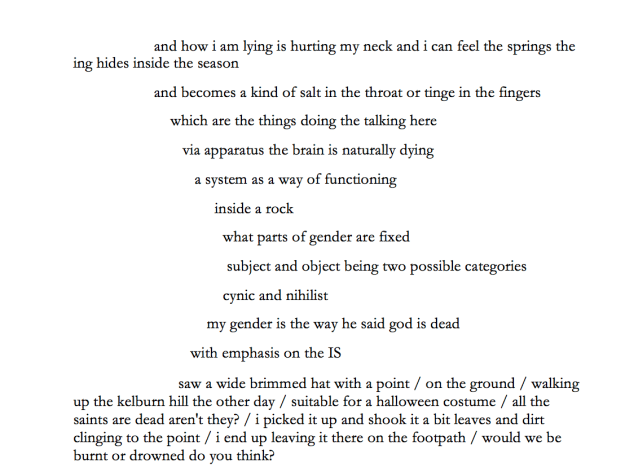

©Essa May Ranapiri
essa may ranapiri | Ngāti Raukawa/Pākehā | takatāpui | they-them-theirs | has words in [Mayhem, Poetry NZ, Brief, Starling, Cadaverine, Them & POETRY Magazine] they will write until they’re dead

Full list here

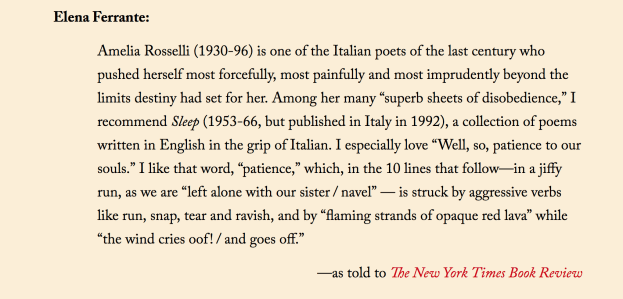
From a variety of sources the list is assembled. I was delighted to be reminded of this Italian poet:


 NZ Poetry Shelf