Poetry Shelf Monday poem: Hannah Mettner’s ‘Breakup poem at Auckland Art Gallery Toi o Tāmaki’

Breakup poem at Auckland Art Gallery Toi o Tāmaki

In the Grey Room at Auckland Art Gallery

I tell a woman I don’t love her. I tell her via text

with Gretchen Albrecht’s huge painting

of a cloud, a country, occupying my field of vision

completely. The wall behind the painting

isn’t grey at all, but a dazzling, electric blue.

The same blue of Frida Kahlo’s

Casa Azul, which my sisters are visiting—

sending me snapchat selfies of their faces filtered

with flower crowns and monobrows.

I want to love her, and I tell her this, but that

just makes it worse for both of us.

She is my ideal woman—she is my ideal woman

and she has red hair cut with a fringe, so why can’t I

make myself tip over into giddy for her?

What a cunt. Always getting in my own way.

Always striving for honesty but saying something

hurtful instead. The only other person

in the gallery is a young woman reading Anne Carson’s

Autobiography of Red and ignoring the art—

that’s the kind of book you see someone reading

and feel like you know them—

that they must feel the same split-open way you did

on reading it. The problem with me

and the ideal woman is that we like all the same books

but never for the same reasons—

like, we’re always not quite in sync. The problem

with me and the ideal woman

is that we both value our mental health too much

to have the Frida and Diego,

Geryon and Herakles kind of love.

The problem with me is that I want that kind of love anyway.

Why am I like this—

is a question I try not to worry at too often

but I’m asking it now—always putting aside something

good for the myth of something better.

This is a high-stakes way to love—being psycho-

analysed via text in a terracotta-red room

with a thousand painted old people looking down at me

from their gold frames.

Because I don’t want to hurt her feelings

and because I keep hoping my feelings might yet arrive

the conversation goes on too long. She’s right,

I’ve done a bad job because I still want her to like me.

What I should’ve said, she says—

This isn’t working. It’s over.

Hannah Mettner

Hannah is a Wellington-based poet from Tūranganui-a-Kiwa. Her first collection, Fully
Clothed and so Forgetful
(VUP 2017), was longlisted for the 2018 Ockham New Zealand Book Awards, and won the Jessie Mackay Award for best first book of poetry. With Sugar Magnolia Wilson and Morgan Bach, she is one of the founding editors of
Sweet Mammalian.

Poetry Shelf on WORD in Ōtautahi Christchurch

Scorpio Books

Having been in lockdown for much of the year, in our sweet haven on the west coast of Tāmaki Makaurau, it feels both strange and wonderful to be flying south to rooms full of people celebrating words. On the plane I wear my mask, listen to music, read Bill Manhire’s Wow, and all the time feel like dancing in the aisle, dancing some kind of gratitude salsa.

Rachael King has shaped a stunning and innovative programme with heart and soul and verve that celebrates books and words in Aotearoa. I pretty much want to go to everything, but that isn’t possible of course, when you are doing your own sessions, and there are several venues. I am very happy there will be key podcasts and some replays on Radio NZ .

The Ko Aotearoa Tātou: We Are New Zealand reading: editor Paula Morris invited the speakers, and other contributors to the book, to stand.

October 30th. One moment I am in our beautiful bush clearing and then, after several hours travel, I am in a festival room listening to writers read from the brand new anthology Ko Aotearoa Tātou: We Are New Zealand (Otago University Press). It is mesmerising, moving, uplifting. It seems both so very real and so very unreal to be there, like I am a sheet of tissue paper that has floated in from up north. Fragile. Unable to speak. See through. Brittle. But hearing these writers, hearing Mohamed Hassan read, hearing essa may ranapiri read, to hear them read from heart, with body sway and body music, along with a number of other authors, is extraordinary.

Later that night, Rachel King launches the festival with ‘Brave Worlds’, the Gala event. John Campbell, with his contagious literary and life enthusiasms, introduces six authors, multiple bravenesses, multiple vulnerabilities. Elizabeth Knox talks abut the courage you draw upon when someone beloved has not much time left, how courage eludes, how loss might go hand-in-hand with regret. I am sitting at the back, fragile tissue paper on the seat, and feel I will start crying. There’s a break in Elizabeth’s voice near the end, and I am thinking it took courage to agree to this public self exposure.

Poet Mohamed Hasan had launched his debut collection National Anthem the night before. Here he talks of his father coming to Aotearoa, of building a family life, of the grief at his aunty’s death, of the immeasurable grief after the March 15 terrorist attacks, of the shocking rise of Islamic abuse since that date. Not the unity. Not the we-are-one. And it is important to hear this. Painful. And I am sitting here in my dampness thinking of the power of poetry. I need to be shown we need to be better. To do better.

Becky Manawatu talks about the courage it takes to stand on this stage alongside the other writers. She talks a bridge from her near failures at secondary school, of the boy who had faith in her desire to write, who believed she would write a novel, the ‘streaming’ test she sat that she thought she would ace, in her passion for learning and knowledge. But she favoured quality over speed so was labelled ‘average’. Becky tells us she was sustained by the mana her sisters fed her, not by the education system that failed her. I am back in my teenage shoes, remembering my English teacher who told me I would never get anywhere in the world writing as I wrote, me believing her, me failing school.

I wanted to stay and hear Behrouz Boochani, Laura Jean McKay and Witi Ihimaera, but I have been awake since 3.30 am, I am full of dampness and grief. I am feeling John’s warmth and empathy as he responds to each speaker, but I am feeling this is a tough tough world. Yes there’s a pandemic, yet there are so many other layers and challenges that demand our courage and our strength. And sometimes it all feels too much. All I can do is put my adult shoes back on and take one step at a time.

I told you I was reading Bill Manhire’s Wow (Victoria University Press), on the plane down, so hearing Bill read a few poems from his new collection and have a conversation with John Campbell is a treat. Bill talks about achieving a particular kind of music, about the way poems drift between sound and sense, sometimes favouring one, sometimes the other. He refers to the idea a poem might be a prolonged hesitation between the two (idea courtesy of another poet whose name eludes me). Ah the joy of hearing Bill read – you hear word music and it takes you in multiple directions. I am still reading his book and slow musing before I write something for the blog so don’t want to say too much more here. But a downright treat to be at this session – and to hear John share Bill’s impact on him in his classes at university: ‘A light went on in my head and heart which has never gone out.’

And that’s it really – sitting in this session it’s a light on in your head and heart.

I feel so comfortable in this session, I keep forgetting I am in the audience and almost join in the conversation, making comments on Bill’s poems, asking questions. Thank heavens I don’t! Would be so embarrassing. Like I said the world feels awry. I feel off kilter.

Later in the day and I am sharing the stage with Morrin Rout and six other poets to celebrate Wild Honey (Massey University Press) and women’s poetry in Aotearoa (Cilla McQueen, Jess Fieberg, Bernadette Hall, Frankie McMillan, Freya Daly Sadgrove and Selina Tusitala Marsh -sadly my dear friend Tusiata Avia couldn’t make it but Selina read a poem of hers). I am still feeling discombobulated, not used to talking to other people in the flesh, but I am having a quick-fire conversation with Morrin and listening to women read whose work I admire. I introduce Cilla and quote from her: ‘Poetry leaves me in a state of never knowing what’s going to happen next.’

I quote from Selina on poetry: ‘I guess it begins with movement, like, something has to move me emotionally, intellectually, spiritually. And then it has to fit right in my mouth, which doesn’t necessarily mean it must rhyme, but that the words must be able to mill about together on the tongue. Ftting in the mouth and on the tongue often means that the words dance with each other, shadowing each other’s rhythms. Juxtapositions are important in order to disrupt expectation and widen the reading audience. For example, what happens when Muay Thai kickboxing, a traditional Tuvalu dance, and grief move together in the same space, on the same page? And then a poem has to move someone else.’

Freya, Selina, Frankie, Bernadette, Cilla and Jess (photo credit: WORD Christchurch)

Morrin asks why I called the book Wild Honey. I don’t say how an Australian academic nearly vomited on me when I told her the title and the book structure at a dinner once. I tell the audience maybe things work on you below the surface, as my partner is the painter Michael Hight, and I have lived with his magnificent beehive (and night) paintings for decades. And how we always have a pot of honey on the kitchen table. But more than that, women’s poetry is like honey, yes sweet, and yes textured and sharp, and yes full of shadow and light, like the transformative activity of the hive. And yes, women have a history of writing poetry in the wild.

I am asked to reflect back on the three women I picked as my foundation stones for the poetry house I built (Jessie Mckay, Blanche Baughan and Eileen Duggan), the first women with books published here. I want to say so much about these women, how I learnt to cross the bridge to their writing over time, how they were fierce and strong, overtly political, fighting for a better world, full of doubt, most especially full of doubt about their ability to write poems when the men knew better. I don’t say how some academics have used the poems of this trio to support theory, especially post-colonial theory, and how both the woman and the poem disappears. And how I want to bring them back to the light.

I love the fact the auditorium lights are up and I can see both familiar and unfamiliar faces in the audience and it feels like a warm and supportive poetry family. I am so grateful to have this chance to talk poetry with Morrin, such a champion of writers and writing in Aotearoa.

Me measuring a poem, or the gleams, or the pause at the end of the line (Photo credit: WORD Christchurch)

Dinner. Eating vegan dosa with humus and crispy chick peas at 27 Steps.

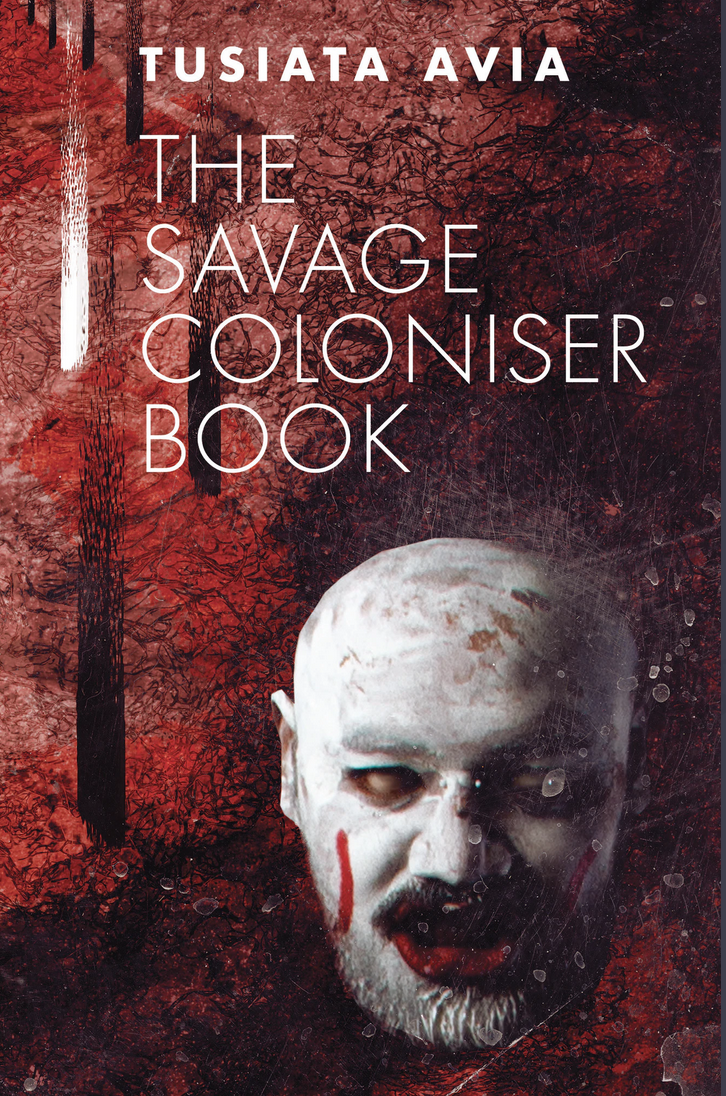
Off to the launch of Tusiata Avia’s The Savage Coloniser Book (Victoria University Press). A small room packed with dear friends and whanau, and conversation. I am sitting on a stool right at the back listening to Tusiata read, and it is beyond words in my head, it is open heart surgery, and it is skin ripping, bone marrow shifting, it is legs unsteady, it is can’t breathe, because this book, these poems, like those of Mohamed, are sitting me bolt upright. I am the white woman. I am the white woman crying at the world. I can’t help it this year. I can’t sleep. I can’t eat.

The arrival of this book is spoken into being with Tusiata’s inner strength and mana. This is need. This is need to speak. This is need to write. This is need to listen. This is need to stop still.

I get a taxi back to the hotel with Elizabeth Knox and I feel the strangeness of this Covid year as we sit in the lobby and and she holds my hand and I tell her something and I am crying. And then I forget to tell her I always call her book The Astonishing Book but I do tell that I wish it had won the book award and that I cried when it wasn’t even shortlisted.

I am lying on my hotel bed drinking camomile tea thinking this is the year of little openings, like the slow lift doors in the hotel, and how something painful unexpectedly and surprisingly spills. Especially at this festival. We writers are spilling our little beans and we are crying. It is strange. And I am listening.

Multiple moons from my hotel room

Breakfast at my favourite cafe in Christchurch, Little Poms. Such a heavenly plate of food (think homemade muesli, saffron-poached pear, sliced kiwi fruit, coconut yoghurt and the best honey drizzle ever) gets you ready for anything, especially making a poetry playground with children.

Carl Shuker in scintillating conversation with Pip Adam

I haven’t read Pip Adam’s Nothing to See yet (Victoria University Press), and maybe I got some spoilers, but this was a gold-mine conversation. Carl is a brilliant chair (best author intro ever!). Pip is hesitant and awkward and effusive and lets slip writing pearls and is utterly inspiring. Listening to Pip I want to get back home and write. She tells us she is interested in loss and grief, and the way we lose ourselves. She is obsessed with artifice and she is obsessed with fakery. She feels like she has been writing one book for ten years. She says she has this brain that thinks it can kill her and she can keep on living. I love the way everything fits and connects, and forges forward and back and side tracks. Wonderful!

And now for The Astonishing Book, The Absolute Book (Victoria University Press): Elizabeth Knox in conversation with Noelle McCarthy. I could only stay for a taster as I had to get ready for my poetry playground, but I am sure this will be available as a podcast or on Radio NZ. Elizabeth’s book is a book of our times: it offers solace, challenges, shifting feelings, essential ideas, underlines our absolute need for books of all shapes and sizes. Above all it will make you happy. This is the Happy Book. If you haven’t read it yet – put it on your must-read list now!

My poetry playground was like a family occasion with everyone joining in and feeling the warm glow of poems. It felt special to do this.

The almost-final session is Dear Katherine. It is a chance for Rachael King to say ‘thank you’ to her terrific team and to introduce the session writers (Menton Fellows: Bill Manhire, Carl Nixon, Fiona Farrell, Vincent O’Sullivan and Paula Morris). Some have written letters to Katherine Mansfield, some have used the Menton time as a springboard to an anecdote or an epiphany. I am completely exhausted, yet utterly riveted with each presentation. It is spell binding. When this comes out on a podcast have a listen.

So many sessions I wish I had been able to get into: sold out (Ray Shipley’s Late Night Poetry Hour darn it, the Curiosity Cabinet, and Witi Ihimaera and Kingsley Spargo), or clashed with my events (sadly Emma Espiner in conversation with Becky Manawatu and David Eggleton’s Poet Laureate picks) or I was too exhausted (Eileen Merriman’s YA session).

That is surely the sign of a magnificent festival, the hunger for more. I kept using the words gleam and glint and light when I introduced the poets in my Wild Honey session. And decided that is what I hunger for – it’s not that I don’t read the dark, the risky, the challenging, but glints of light in the stories and poems we share, in the books we make, feel utterly necessary at the moment.

I couldn’t commit to appearing at WORD until the last moment, feeling at risk travelling, but WORD festival is my highlight of the year. As a writer I was cared for, as a reader I was rewarded on so many levels. Everyone around me was glowing with festival warmth. So many little encounters, conversations, hugs and gleams to bring home. Next year, I want to book my hotel room, a flight and go to as many events as possible.

Home to the sweet embrace of family, sleeping cats, the bird song, the burgeoning garden, the bush smells, the wide open wild beach, so many books to read, and the urge to keep writing secret things. Thanks Ōtautahi. Thanks WORD.

Poetry Shelf Monday poem: Gregory O’Brien’s ‘Streets and mountains’

Streets and mountains

As the cloud reads the orchard, a swimmer reads the curve

of the bay, an ice-skater reads the surface of the half-frozen lake

and, in season, a fisherman reads the pattern of sea-birds. As a

chair reads its position at table, an aeroplane reads the evening

sky and finds a way through. The weather reads the furrowed

brow of the forecaster and is itself, in turn, read. As ever, a bird

reads the absence of birds above a certain field, just as the

streets read the mountains, the mountains the streets, and have

as much to say, as much to say.

Gregory O’Brien

An exhibition of Gregory O’Brien’s paintings–‘The Wading Birds of Drybread’–opened at the Millenium Gallery, Blenheim, on November 1. Recent projects include a new suite of seven collaborative etchings made with John Pule–see below.

Roadsigns for a highway without end, Liku, Niue, 2020, etching and aquatint

Poetry Shelf Video Lounge: Lily Holloway reads some poems

The poems


‘i think i can feel reverberations/of something further downstream’, originally published in Milly Magazine

‘Sentries’


‘stocktaking during venlafaxine discontinuation’, originally published in Scum


‘a girl’s name a headline’, originally published in Midway Journal


‘moirai’, a slightly different version published in The Three Lamps

Lily Holloway is a queer postgraduate English student who likes collecting Teletubbies paraphernalia. She recently won highly commended for the Caselberg International Poetry Prize and was this year’s recipient of the Shimon Weinroth Prize in Poetry, the Kendrick Smithyman Scholarship for Poetry, and second place in the Charles Brasch Young Writers’ Essay Competition. You can find a full list of her published and forthcoming work here.

Poetry Shelf review: Jackson Nieuwland’s I am a human being

I am a human being, Jackson Nieuwland, Compound Press, 2020

Sometimes you pick up a poetry book and you know within a page or two, it is a perfect fit, a slow-speed read to savour with joy. That’s how I felt when I started reading Jackson Nieuwland’s I am a human being. I love the premise embedded in the title, that in turn generates a sequence of poems that form a secret title list poem (I am an egg, I am a tree, I am tree, I am a beaver, I am a bear, I am a dog, I am a bottomless pit, and so on).

The opening poem offers an image that, in its exquisite and heart-moving detail, underlines the range of the book: physical, metaphorical, fable-like, metaphysical, autobiographical. In one poem the speaker suggests they are not quite sure who they are yet, that there is no single word that adequately defines them (‘agender, genderfluid, trans …’). This book, so long in the making, lovingly crafted with the loving support of friends, with both doubt and with grace (think poise, fluency, adroitness), this book, in its lists and its expansions, moves beyond the need for a single self-defining word.

Instead we are offered the image of the egg – and the way we hold a universe of things inside us, and that sometimes we might break.

This is intimate poetry. This is slowing down to observe the quotidian, the daily comings and goings, the things you see and feel when you stop and reflect and imagine, that then tilts to surprise. There is uplift and there is slipstream.

This is contoured poetry because it ignites so many parts of you as you read. You will laugh out loud as you read. You will feel the poignant witty wise delightful magical joy. The shifting melodies. There are keyholes to light and keyholes to dark. The speaker speaks of outsiderness, of what it is to fit, and what it is to not fit.

Sometime you will turn the page to a glorious pun.

Sometimes the vulnerability is a sharp ache above the surface of the line. This from ‘I am version of you from the future’:

Your past self looks at you with sympathy.

They pull you into a tight hug.

You begin to sob

releasing years of tears

that had been held inside

due to the conditioning you received

from a patriarchal society

and the overload of testosterone

pumping through you body.

As you sink into your own embrace,

the two versions of you merge into one,

and you begin again

given a chance to do it all over

but differently this time,

with an open heart

like quadruple bypass surgery.

The risk of death is high

but what other choice do you have?

I am a version of you from the future.

This is just the beginning—

I am a human being is my favourite poetry book of 2020 so far. I like the addition of Steph Maree’s line drawings. I like the way the poetry stretches in its imaginings to draw closer to an interior real that is never fixed. I like the way the poetry is both anchor and liberating kite. I like the acknowledgement that, in order to know who you are, you need to embrace many things. I love this book so very much from first page to last. In the endnotes, the page where the poet gives thanks, I read the best acknowledgement ever:

And thank you for reading

this book. I’ve gone back and

forth with myself for years

about whether these words are

worth anyone’s time. It means

the universe to me that you’ve

read all the way to the end. I

hope you found something that

meant something to you.

Jackson Nieuwland is a genderqueer writer from Te Whanganui-a-Tara. Their poetry has appeared in a number of journals, in print and online.

Compound Press page

Poetry Shelf poets on poetry: Murray Edmond on ‘A translation of one of the sonnets of the importunate’

THE TO AND FROM OF POETRY

Murray Edmond’s poem ‘A translation of one of the sonnets of the importunate’

Poems are written ‘from’ – from the author – and poems are sent ‘to’ –  to the reader. The poem itself, the ding an sich, needs both its writer and its reader to exist; or perhaps it would make more sense to say, ‘to accomplish its existence.’

Any poem can be an occasion to kōrero about poetry. And this is what I’d like to do. Having once written the poem, when you go back to it, you realise you are the reader and you find the poem is staring back at you:

‘Tell me what you make of me now,’ the poem says.

 ‘Okay, poem, I shall try and do this.’

Poems contain within themselves some form of address, which is why one always needs to ask those old questions:

Who (or what) is speaking in the poem?

Who (or what) is being spoken to?

And what is the nature of this speech – does it tell a story? Does it tempt you to agree with a proposition? Does it reveal a surprise? Is it trying to achieve something  – does it petition? Persuade? Plead? Threaten? Demand? Seduce? Okay, so, what is the poem doing?

And that further question: What kind of poem is this?

The poem of mine that I have chosen for this kōrero importunes. That’s the action of poem. It is called ‘A translation of one of the sonnets of the importunate.’ The importunate speak.

Before moving to the next questions, best you have a chance to read the poem for yourself, dear Reader; after all, it is you who shall complete the poem as its reader. For the purposes of this exercise, I, once the author, am now of your kind, a reader too. And, remember, we may always and often disagree:

They brought those fêted seals in bells and hats

and leis by fated sails from ocean bowers

with cargo load of sated foals and gold

crew of fetid souls – white warlock on the bridge

our failed ships drooped before this armada

lagoon spilled shells and pestilence of coral

so that we took forced spoils and chopped them up

in slithers speech degrades – swathed fools

worked days of filched sleeps and broken skin

slipped our secret saviours feasts of scraps –

those zealots who sequestered skeins of poison –

lovers searching under sheets for signs of solace

swift wealth consumes our livers’ breath

sweet succubus send annihilation of the goat

In the last line the poem does reveal to whom it speaks. There is that moment of specific address: ‘sweet succubus.’ A succubus is importuned.

Succubuses (or slightly less hissy, succubae), supernatural entities, better known as demons, are probably folkloric in origin, though they pop up in Jewish religious texts and stories, as well as in the form of ‘Jinns’ in Turkey; and they caused consternation to such Christian thinkers as St Augustine, Thomas Aquinas and James 1st of England – they were anxious if these demons could conceive offspring from humans. In Brazil you might find one in a river looking like a dolphin (boto), but always wearing a hat so you don’t notice the demon is breathing through the top of its head. Though a succubus is female and its male equivalent is called an incubus, there’s a strong feeling that a certain gender fluidity allows a succubus to flip over into an incubus and back again into a succubus, as required. Put simply, these demons come and seduce you and then kill you via sexual desire and ravishment.  They annihilate you. The father of Gilgamesh, hero of the eponymous Sumerican epic, seems to have been an early precursor of an incubus; while in The Zohar Adam’s first wife, Lilith, becomes a succubus. Pope Sylvester (999 – 1003) apologized for having a relationship with a succubus, but there may have been an element of rationalization involved in his story

The voice of my poem importunes a succubus to ‘send annihilation of the goat.’

The action of the poem ghosts the action of a prayer, in that a prayer (while not being a performative speech act) is a form of words that try to make something happen by the act of being spoken.

Well then, what kind of poem is this?  Its title proclaims its origins and its classification.: ‘A translation of one of the sonnets.’ ‘Translation’ means that here exists a previous form of the poem in a different language – what you are reading is a step away from the original. And ‘one of the sonnets’ gives us a particular kind of poem.

The inventor of the sonnet, Giacomo de Lentini, writing in Sicilian in the thirteenth century, was a lawyer, a pleader, in the Sicilian court of Frederick II, an Epicurean atheist whom Dante placed in the sixth layer of hell and Nietzsche called ‘the first European.’ Since then the sonnet has been relentlessly propagated. When Elizabeth Barrett Browning composed her Sonnets from the Portuguese in the mid-1840s, she initially wanted to call them ‘Sonnets translated from the Bosnian.’ Husband Robert used to call her ‘my little Portuguese’ and so the change of name allowed her to embed the private reference (‘Yes, call me by my pet-name’ – Sonnet 33) as well as posing the poems as translations, thus securing the best of both worlds, which sometimes poems aim to do.

Since poets never write alone, it’s worth mentioning that the poet who was on Elizabeth’s mind was Luis de Camões (1524-1580), celebrated ‘national poet’ of Portugal. Camões may have been the first significant European poet to cross the equator into the Southern Hemisphere, spending periods in Goa and in Macau and being wrecked off the coast of Cambodia, experiences which contributed to his epic Lusiads. But he was also a sonneteer. 

The sonnet itself is a topic for sonnets. In English, Keats wrote ‘On the Sonnet’ and Wordsworth wrote ‘Scorn not the sonnet’ (and Shelley wrote a sonnet, ‘To Wordsworth,’ a lament for Wordsworth’s betrayal of his commitment to ‘truth and liberty’). I think my favourite is Edna St Vincent Millay’s ‘I will put Chaos into fourteen lines.’

With my sonnet, I wished to include the presence of chaos within the fourteen-line form. The word succubus comes from the Latin word ‘succuba,’ meaning a ‘paramour,’ which in its turn derives from ‘sub’ meaning under and ‘cubare’ to lie. The succubus will come and lie under you while certain erotic dreams occur. Entirely the fault of the succubus. In an analogical way, the form of the sonnet ‘lies under’ my poem. Desire beneath the chaos.

In his Handbook of Poetic Forms, Ron Padgett writes that the ‘sonnet form involves a certain way of thinking.’ Padgett points out, ‘if you want to write in the sonnet form, it’s good to understand the concept of “therefore”.’

Therefore, the first quatrain of my poem evokes an incursion bringing disaster – ‘by fated sails from ocean bowers’ – the arrival of pestilence, pandemic, plague, prostration, perhaps a colonization, with the fatal combination of ‘crew’ and ‘white warlock on the bridge.’  

The next quatrain informs that, like ‘swathed fools,’ resisters to this ‘armada’ are helpless. Therefore, in the third quatrain, such slow plans as the nurturing of ‘secret saviours’ and the plottings of ‘zealots’ are frustrated by the concitation of the desire for destruction. That desire, ‘annihilation of the goat’ in the poem’s final words, may be for self-destruction or the miracle that will drive the invaders out. ‘Whose annihilation?’ is the question. The sonnet is a coded message from the damned who can only speak in riddles. This is a poem that does not declare itself because it is written from a situation in which it is not safe to do so. The language sounds strange, tantalizing, alien, indeed, translated.

One presumes there are more sonnets to come which might explain. As this garland of sonnets is unwound, will poetry make something happen? ‘Poetry makes nothing happen,’ as Auden mentioned in his poem on the death of Yeats.  And that may just be its achievement. Poetry can make nothing happen. In reality nothing can’t happen. But in poetry it can. That’s what the reader finds, when they invent out of this nothing.

Every poem is a kind of collaboration. When you write a poem you begin by collaborating with the reader’s idea of what a poem is: you may want to subvert this idea or confirm it, but you are complicit from word one. Then the poem has a form that is one you borrow or one that you claim (against what odds it is hard to measure) is your own. The form and the reader are both ‘others’ of your poem. Where does that leave your poem? And you –  are you the ghost of your poem? Is the reader the reader conceived from your poem?

‘A translation of one of the sonnets of the importunate’ appears in Walls to Kick and Hills to Sing From: a comedy with interruptions by Murray Edmond (Auckland UP, 2010) p.19.

Murray Edmond: Born Kirikiriroa 1949, lives in Glen Eden, Auckland. Poet (14 books, Shaggy Magpie Songs, 2015, Back Before You Know, 2019); critic (Then It Was Now Again: Selected Critical Writing, 2014); fiction-writer (Strait Men and Other Tales, 2015); editor, Ka Mate Ka Ora; dramaturge for Indian Ink Theatre. Forthcoming: from Indian Ink, Paradise or the Impermanence of Ice Cream, Q Theatre, October 2020. Ka Mate Ka Ora #18, October 2020. Time to Make a Song and Dance: Cultural Revolt in Auckland in the 1960s, from Atuanui Press in 2021.

You can hear Murray in conversation with Erena Shingade here. He reads this poem at the end.

Auckland University Press page

Poetry Shelf Monday poem: Rachel Lockwood’s ‘Water Ways’

Water Ways

I have bloodied and been bloodied,

I have been rivered and streamed away,

I have been forest, honey, and I have

been dirt drawn beetle, honey, and

I have been mud. I have been

lung smoke, throat clearing,

menthol rasp, honey.

I have been liar and bullshitter,

I have been the round pot of tallow, honey,

and I have scraped. I have been

oceaned and rivered away.

I have been deep ravine, baby,

I have been gully, I have been fog.

I have been mirage darling,

I have been cowboy antithesis.

I have been shadow hungry, honey,

I have been fern, and salmon, and bird.

I have been runt of the litter, honey,

I have been fed fat on cream.

I have been love lettered, been Dear John lettered,

I have been written to ask to leave

and leave and come back again

like some migratory sea bird

to the winter. I have been soft-held,

honey, I have been soft-held by you.

Rachel Lockwood

Rachel Lockwood is Hawke’s Bay born and bred but now living in Wellington and studying a BA at VUW. She was a 2019 National Schools Poetry Award finalist, and has previously been published in Starling.

You can hear Rachel read her poem in Starling 10 here

Rachel muses on essa may ranapiri’s poem ‘she cut her face shaving’

Poetry Shelf Video Lounge: Simon Sweetman reads from his debut poetry collection, The Death of Music Journalism

Simon Sweetman reads poems from his debut poetry collection, The Death of Music Journalism (The Cuba Press, 2020)

Simon Sweetman is a Wellington-based writer of poems, stories, blogs and reviews. He grew up in Hawke’s Bay where sport was the thing. Now it’s music, horror movies, dog walks and family time. The Death of Music Journalism is his second book (after 2012’s On Song) and his first book of poetry. He blogs, everyday, at offthetracks.co.nz and is the host of Sweetman Podcast. Sometimes he appears on RNZ talking about music. And would like to do that more often.

The Cuba Press author page

Poetry Shelf Kitchen review: Ottolenghi FLAVOUR by Yotam Ottolengi and Ixta Belgfrage

Ottolenghi: FLAVOUR by Yotam Ottolenghi and Ixta Belfrage, with Tara Wigley, photography by Jonathan Lovekin, Ebury Press, 2020

Hasselback Beetroot with Lime Leaf Butter

Take eight medium beetroot and brush off the warm earth.

Hold in your hand and breathe in spring.

The garden is full of summer promise, Jacinda speaks of connections.

Breathe out a long winter of lockdowns and catastrophe.

Absorb the song of the tūī, Reb Fountain’s honeyed singing as you

Peel and slice the beetroot thinly, almost to the base, then salt and roast.

Smell the pungent aroma, the wind coming in from the coast.

Melt butter with fresh ginger, garlic, lime leaves, olive oil, and then infuse.

As you wait for the election results to come in, add lime juice.

You are on hold, nothing can be taken for granted, the votes are being counted.

You dream of fresh water and global kindness, our children fed.

You crush and slice, blitz and chop.

You mix kaffir lime leaves, fresh ginger, garlic, green chilli, coriander.

Season your salsa, then season with love and spring promises.

In a blue Temuka bowl, upon a smear of yoghurt (you’ve omitted the cream),

You place the beetroot glistening red.

You spoon over the melted butter strained of aromatics.

You sprinkle the salsa and a squeeze of lime, your early morning beach walks.

Take a moment and wait for your family to put down brushes and pens.

Make room for comfort, for the things that matter most.

You are back at Whangamata watching the sun come up on Level 1.

You are serving the flavour of a London kitchen in a Waitākere haven.

You are tasting the flavour of bridges, the salty with the sour.

Jacinda and her team are back in power talking of new ways of leading.

The kitchen is aglow with food and hope,

And you feel like a load has lifted and floated into the Tasman Sea.

Tomorrow you will cook spicy berbere ratatouille with coconut salsa.

The next day a butternut, orange and sage galette.

One day you might eat at Ottolenghi’s in London,

With Aotearoa flavours in your pockets, the chatterbox tūī in your ear.

Paula Green Election Day, Te Henga

Hasselback beetroot with lime leaf butter on my Temuka blue bowl (bought on a fabulous 2019 Storylines Tour)

Pretty much most rooms in our home have at least two shelves of cookbooks. Cooking and writing poems have gone hand in hand since my debut poetry collection Cookhouse in 1997. Reading other poetry books has taken my writing and relations with the world in different directions. The same goes for cookbooks – I cook both inside and outside my comfort zone, because my love of cookbooks has expanded what and how I cook. It is so very satisfying.

I have book clusters of national cuisines, methods, ingredients (seafood), eating choices (vegan, vegetarian) and, of course, much-loved writers. Yotam Ottolenghi is one such favourite. So his new book Flavour, written and developed along with Ixta Belfrage, is a cause for celebration. His previous two books, Plenty and Plenty More celebrate vegetables, with the second book exploring the way process can take a vegetable in any number of flavoursome directions. Yotam suggests Flavour is like a Plenty 3 as it celebrates the transformation of vegetables into flavour bombs. The book is divided into three sections: process, pairing and produce.

‘While making a delicious recipe can be simple, great cooking is never the result of one element in isolation – it is the interplay of different types of processes, pairings and produces.Yotam Ottolenghi

Yotam’s cookbooks are an essential part of my kitchen, because his recipes are flavour-rich, the processes are easy, the end results both nutritious and delicious. The same applies to the team effort of Flavour. For me the recipes are to be made and savoured (I tag all the ones I am itching to cook), but also to be used as aides to my own culinary inventions. The 20 essential ingredients listed at the end of the introduction are flavour-bomb conductors. Not your usual crew (say tahini, pomegranate molasses, turmeric, balsamic and cider vinegars, horseradish, harissa, cumin, fresh oregano, lemon and dill etc). Maybe things have a inseasons as I have also been favouring chipotle chillies, miso, ground cardamom and tamarind paste lately (on the list), and I am now dead keen to track down black limes, jarred butter beans (!), hibiscus flowers, red bell pepper flakes, rose harissa for my pantry.

Walking on the beach this morning I was musing on the way food has been so important in Covid. In Aotearoa New Zealand we have been baking sour dough, planting seeds, making sweet treats. I learnt to make kombucha (highly recommended), upped my micro greens, learnt to make yoghurt. Food is a way of nourishing us physically, but also offers the utmost comfort in family settings (and with friends when we can do that). Food connects us to the people who generate crops and products for us, to our forbears who have handed down beloved ways of doing things. Yes, I believe tradition is as important as innovation and vice versa. Along with the pairings, processes and products, Yotam and Ixta’s nurturing food values are the pulsating heart of Flavour. I get goosebumps reading through the pages.

Food was a big part of my doctoral thesis where I explored the ink in the novels of C20 Italian women writers. I wanted to know what drove the writing pen – and food most definitely mattered. I am thinking of Yotam’s pairings and products, and the way each ingredient we pick up to slice or saute or steam, is imbued with our mood, our past experiences, the events of the day, our daydreams. An apple takes me so many places when I cut it into slender batons for a coleslaw. Put this word next to that word and you get sparks and hums; put this ingredient with that ingredient and the same thing happens. Poetry and cooking? A match made in heaven.

Flavour is a sumptuous mouth-watering addition to my cookbook collection – at the moment I am lugging it from kitchen table to the lounge to bedtime reading. I have a long list of things to cook – recipes that will be the starting points to new pairings and products. The book fills me with warmth and connections and hope. Bavissimo Yotam and Ixta. I love this collaboration so much. And I have to say my family and I thought the beetroot dish was sensational (as was the election result!). They said it was like being in a restaurant – and it was all a matter of product, pairings and process. A GLORIOUS recommendation from Poetry Shelf Kitchen.

Yotam Ottolenghi is the restaurateur and chef-patron of the four London-based Ottolenghi delis, as well as the NOPI and ROVI restaurants. He is the author of seven best-selling cookery books. Amongst several prizes, Ottolenghi SIMPLE won the National Book Award and was selected as best book of the year by the New York Times. Yotam has been a weekly columnist for the Saturday Guardian for over thirteen years and is a regular contributor to the New York Times. His commitment to the championing of vegetables, as well as ingredients once seen as ‘exotic’, has led to what some call ‘The Ottolenghi effect’. This is shorthand for the creation of a meal which is full of colour, flavour, bounty and sunshine. Yotam lives in London with his family. Website

Ixta Belfrage spent her youth dipping her fingers into mixing bowls in places as far-flung as Italy, Mexico and Brazil and so became an expert without a title. She began her culinary career proper at Ottolenghi’s NOPI restaurant, before moving to the Test Kitchen, where she has worked for Yotam Ottolenghi for four years, contributing to his columns in The Guardian and The New York Times. She lives in London, where she makes regular guest chef appearances in some of the city’s top restaurants. Flavour is her first book.

Penguin Books page

Poetry Shelf review: Nadia Reid’s Canons: Complete Lyrics 2015 – 2020

Nadia Reid Canons: Complete Lyrics 2015 – 2020 (Slow Time Publishing)

You are

The best thing

That I have ever had

I broke my leg on that hill

I remember it so

We were looking for arrows

Looking for something

Closer to the edge of all that I am

You are wanting

Something more

For your life

And for our life

Nadia Reid from ‘Best Thing’ Out of My Province

Each time Nadia Reid releases a new album I have it on repeat for days, and then keep returning. Her songs offer a sweet partnership between melody and lyric, transporting me to both the edges and centre of living, smooth and sharp. With her multi-timbred voice embracing shadows and light, I just can’t stop listening. Her latest album Out of My Province (2020) was my go-to album during Level 4 and 3.

In Wild Honey I claimed Nadia, along with Aldous Harding, Lorde and Chelsea Jade as poets, four women shortlisted for the 2017 APRA Silver Scolls. So many wonderful songwriters in Aotearoa to add to this list: Hollie Fullbrook, Bic Runga, Reb Fountain, Moana Maniopoto, Anika Moa, Don McGlashan for a start. Put an album on and you get the song. The word and musical choices are inseparable, the one feeding the other. But you can also focus on the lyrics, because the word is a musical choice as much as it carries stories, feelings, ideas, connections and truths, along with similes, metaphors, omission, repetition and rhyme.

Reading Canons I am celebrating Nadia’s lyrics as poetry. I can replay them in her voice or mine, stripped back bare so the word is a musical note. The syllables and the white space establish rhythm and, in that heavenly combination, build mood and presence.

Rather than placing the lyrics in chronological order of the albums – Listen to Formation, Look for the Signs (2015), Preservation (2017), Out of My Province (2020) – the collection moves though shifting moods and experience. There is loneliness, emptiness and sharpness. There is heart, love and relations. Above all there are seasons. There is LIFE!

Reading the lyrics, with their exquisite effects, Nadia’s words make music, while also scoring and underscoring personal experience, intimate stories. I am wondering if this is a case of writing into a way of knowing. Of setting down anchors, and of liberating self. Each song draws upon multiple preservations, formations and signs. A moment in time, an experience, a recognition. Poetry can be a matter of writing out of one’s place and of testing a way of being. This is what haunts in Canons.

Individual lines stick:

          ‘Closer to the edge of all that I am’

          ‘I threw out my winter coat

          I cut the sleeves off all I’d known’

          ‘I am making friends with who I used to be’

          ‘All my undoing

          Will become a lonely life’

        ‘We see things in a different light

          I’m looking outward into the night’

Read the lyrics and you hear the economy, the roominess, the unspoken, the unsung that resonates on the albums. Glorious!

There is also an introduction by the very articulate music critic and author Nick Bollinger (check out his music reviews on The Sampler and Music 101 at RNZ National or his memoir Goneville).

I love Canons – it’s fabulous in its own right, but it also leads me back to the breathtaking albums. This is a time, in the midst of pandemic and global upheavals, when music can deliver the utmost comfort, get your skin prickling, your heart and limbs moving, your mind stilled or on the move, and you feel all the better for having listened.

You can order the book from Nadia’s website, and she will sign it for you and add a dedication upon request.

Afterthought: I would welcome a series of lyric books showcasing the fabulous songwriters of Aotearoa.

‘These lyrics can be read alongside the songs, or not; they can be taken any which way. I feel privileged to document the lyrics of my first three albums and to be able to share the hard and the dark and also the joy and elation of my life so far.

I hope that all song, poetry and music can be the guiding light in your life as it is in mine.’

Nadia Reid ‘Author’s Note’