
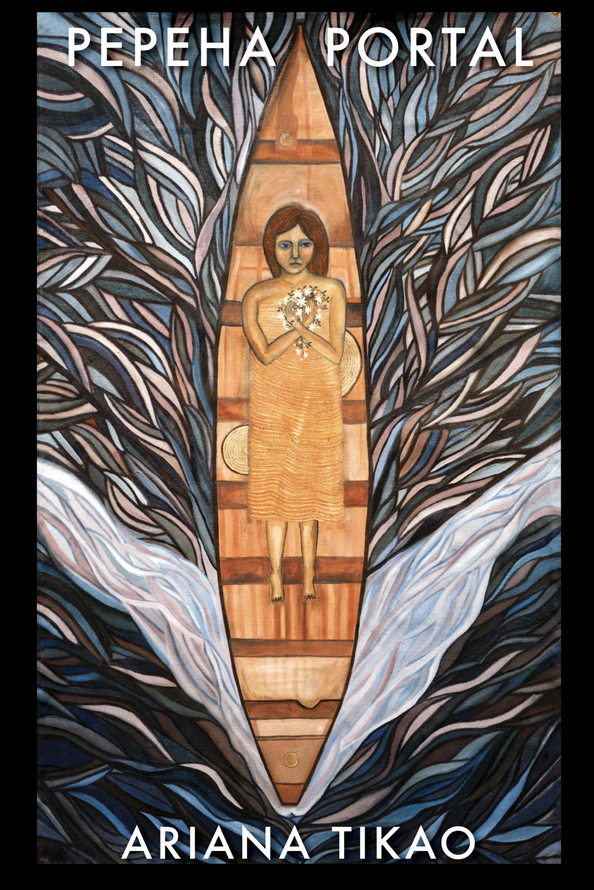
Pepeha Portal, Ariana Tikao
cover image: Kate Stevens West (Kāi Tahu), Kurawaka/Tender Ties Kohikohi, 2021
University of Otago Press, 2026
To read Pepeha Portal is uplifting. The poetry offers an experience that nourishes the air I breathe, the physical ground I stand upon, the metaphorical paths I navigate, the way I move between past present future, the way poems can hold me in prolonged and vital embrace.
The collection is divided into two parts, ‘Pepeha’ and ‘Portal’. Two warm welcome palms held out to me as reader, let’s say to you as reader. Two versions of homecoming and homebeing perhaps, with vital movement between and beyond and close to. The first section, ‘Pepeha’, introduces self in Māori through connections to tīpuna place and stories, where the presence of people and ancestors acutely matter. The second, the ‘Portal’, the doorway, offers an array of life-rich movement in the Christchurch of Ariana’s childhood and the Ōtautahi of her adulthood.
Think place. Think belonging. Think aroha. Think wisdom. Think physical land. Think the ache of the land ravaged for-earth-ruinology, not for-earth-ecology: “rock spews into Whakaraupō / in the name of progress”.
I love how te reo Māori and English weave together across the collection, heightening the rhythm of two languages singing alongside each other, the way individual words are blooming with distinction, semantic nuances, cultural links. To have this precious language presence is vital when we are calling for te reo Māori to be both heard and visible in the streets, in schools, in parliament, in books published, the songs recorded, the stories shared. Let these lines from ‘To’u Reo’ settle upon your skin:
Then I remember Hana O’Regan:
He ātaahua te reo i roto i a koe
Āe, the reo inside me is perfect
It’s in my blood
like lava
like a fire
like my pōua said Mana
is a fire
never extinguished
I keep jotting down words to carry through the collection as I read, like echo mantras: belonging, connecting, here, from. There in the moving eulogies to mother and father. There in the poem, ‘Ko Au Tonu’ with its echo-chamber line, “I am here”. And there in the terrific poem ‘From’. It’s like song. It’s like a self chant. I just want to hear the poem singing in the air. Here’s a taste of it (you can hear Ariana read the poem below):
I’m from Redgrave Street, Hoon Bay. Pōtiki of seven ‘half-caste’
kids raised in a house built by the state, with purple polyanthus
and sweet peas blooming along the driveway
I’m from picking the hardened chewing gum off the footpaths,
spitting out grit like pips, coaxing back flavour with persuasive
saliva and metal-filled teeth
Musicality is important as I read, and I was super keen to hear Ariana perform some poems. Ariana, a musician and New Zealand Arts Laureate, is attuned to the cadence of words and her poetry reflects this, with her aural agility, a gift.
In the poem, ‘Intonation’, a poem dedicated to the late Moana Jackson, I find deep-seated heart, and again we are in a crucial stream of belonging and connections. The poem sings the praises of Moana and underlines we are not writing and reading in empty impoverished hopeless vacuums. We are writing and singing, joining and remembering, connecting and that matters. Here’s a stanza:
The time has come
if we each tell
one of his stories
we will light up this place
so bright we gotta wear shades
Ariana is crafting and sharing poetry with roots in the personal but it is also poetry speaking to for out and for the world. I stall on ‘Kua Whetūrakitia’, a poem shaped like an urn or a vase or beacon. A beacon of light that we hold up for Gaza.
I stall on ‘Settling’, a striking poem that holds the title word, a prickly spiky word, out to us, shaking the word a little like a snow globe, letting sediment settle upon us, the sediment that forms in the shaken jar. Turn the word again and settle is negotiating, negotiations. And another turn and it’s the Israeli settling settlers on the West Bank, as the Palestinians mourn their bombed whanau. This word. This settling, this unfolding and refolding gash in hearts settling.
I’m electrified by ‘Transforming’ and its call for action. Protest. Speaking out. It feels important this, that Ariana’s poetry, so personal and grounding, shines insistent light on global and local wounds and speaks out. In this ground-tremor poem, Ariana turns to the mokopuna:
Papa’s heat is also rising. We will summon those wiling to fight
for Papatūānuku, those who won’t keep extracting from her –
unlike us, who believed the the claim of the capitalists. These new
fighters will speak our reo and dance with the fluid movement
of bull kelp surging around the rocks. Wehi and wana will
explode from them like white water from a blowhole. It is these
mokopuna that we need. They won’t stay seated in rows. They
won’t wear bows in their hair. Nau mai e tama. Nau mai e hine!
Much of collection was written during Ariana’s 2023 Ursula Bethell Residency at the University of Canterbury. In her endnote, she mentions her office corkboard: “I progressively added printed pages from the Ngāi Tahu digital atlas Kā Huru Manu, to use it as a visual reminder of our placenames and the stories behind them. As a way to track progress, I’d added coloured pins to the map. In the end, there were over thirty pins.”
And now, the extraordinary reach and intimacy of Pepeha Portal settles and unsettles and resettles me. I am musing on writing poetry as a form of travel, inner private intimate travel, physical travel, travel that sparks epiphany, travel that refreshes the light in which I view and hear and absorb the world.
This gift of a book is in the world. Thank you.
a reading

‘Te Waihora’
‘Transforming’
‘From’
‘Intonation’
Ariana Tikao is a Kāi Tahu writer, musician and New Zealand Arts Laureate. Her work spans poetry, music and interdisciplinary performance, and has been published widely in Aotearoa. Her book Mokorua: My Story of Moko Kauae was published in 2022 (AUP). Pepeha Portal is her debut poetry collection.
Otago University Press page
 NZ Poetry Shelf
Pingback: Poetry Shelf weekend reading and an invitation | NZ Poetry Shelf