
Good news! Congratulations to the author of one of my favourite fiction reads of the year: The Quiet Spectacular.

Good news! Congratulations to the author of one of my favourite fiction reads of the year: The Quiet Spectacular.
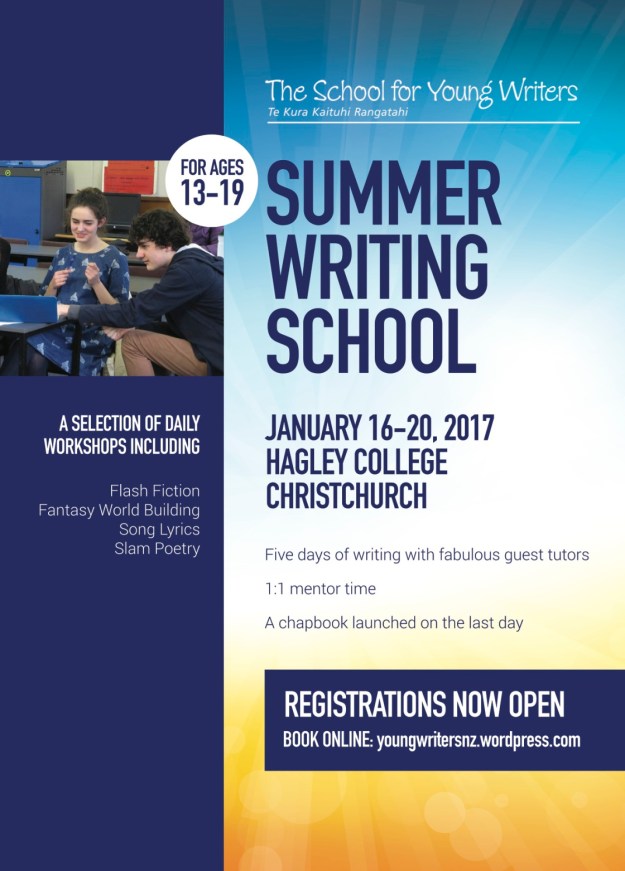
Be in quick to get your top picks of workshops. Some are almost full!
As they become full they will be deleted from the booking form, and you will be assigned the alternative. So don’t miss out on your top picks ( although we think all of the workshops will be fabulous!)
If you miss out on a workshop that you really really wanted to do then let us know and we will do our best to make another opportunity for this to happen for you in 2017.
Visit here for info
 Hera Lindsay Bird
Having Our Imagist Cake and Eating It, Too
“You owe reality nothing and the truth about your feelings everything.”
~Richard Hugo, Triggering Town
For me, the central question/task of poetry is how to make something that feels alive on the page. How do we get to the heart of what we are trying to say, without being overly didactic or too shy? How do we to approach what we are unable to approach, when we are stuck and overwhelmed, staring at a blank page? Good poetry should guide itself, not be dragged kicking and screaming towards a predestined conclusion. Good poetry allows the poem permission to steer itself. But how, practically, can we achieve this? And how can we take linguistic and formal risks while staying emotionally honest. In other words, how can we have our imagist cake and eat it too?
This workshop is a practical guide to generating new ideas & experimenting with text, but it’s also about how we integrate emotional honesty into our writing practice, and how we can adapt formal exercises, (which are so often sterile and cerebral) to bring us closer to the heart of what we are trying to say.
Hera Lindsay Bird is a poet from Wellington. Her debut collection Hera Lindsay Bird was published by Victoria University Press in 2016, and has gone on to be reprinted several times since. She has published work in the Toast, The Hairpin, The Listener and The Spinoff, and her book has been featured in The Guardian, Vice, and The Sunday Star Times. She believes in emotional honesty, excessive similes, and the occasional dick joke.


New Zealand poets Steven Toussaint and Gregory Kan have been awarded the prestigious 2017 Grimshaw Sargeson Fellowship. This is the first time two poets have been the recipients of the fellowship.
The poets will have the opportunity to focus on their craft full-time, with each having a six-month tenure at the Sargeson Centre in Auckland, and sharing an annual stipend of $20,000.
Originally from the United States, Steven Toussaint is looking forward to seeing where the fellowship takes him, as his writing is often troubled by our increasingly digital environment.
“The digital age has opened up wonderful opportunities for new kinds of communication. However, it has also scattered our attention in many different directions. At times I feel concerned that my attention is strained by all the media and digital attractions that exist around me,” he says.
Steven will use the fellowship to work on a new book of poetry, which will consist of individual poems with unifying themes about religious imagination.
Steven’s published works include a chapbook, Fiddlehead, which was published in New Zealand in 2014, with his first full length book, The Bellfounder, published the following year in the United States.
Gregory Kan says the fellowship provides a wonderful platform to help writers gain traction in an unrestrained world of literature.
“The digital age has meant that we have more writing than ever before – it’s a form that was previously only accessible to a privileged group, but is now more pervasive than ever which is fantastic,” he says.
Gregory will be using the fellowship to work on another book of poems. He will be consolidating pieces of already completed work as well as writing new pieces which interrogate the writing of biography and autobiography in this era of overwhelming and spectacular information.
Gregory published his first book this year, This Paper Boat with Auckland University Press, which is on the Okham NZ Book Awards long list for poetry. His work has been published in numerous literary journals, as well as contemporary art exhibitions and catalogues.
Frank Sargeson Trust Chair Elizabeth Aitken-Rose says she is delighted with the calibre of this year’s fellows and is excited to see them take their work to the next level.
“The current technological revolution is shining a light on some wonderful talent we may never have known about before – and this was quite evident in the quality of applicants we received this year,” she says.
“Being a writer in the digital age gives writers unprecedented opportunity, yet this can make it more challenging for writers to cut through and have their voice heard. This is particularly the case for poets, we are very excited to have two poets win the Fellowship this year.
“The fellowship will assist Steven and Gregory in gaining traction in this highly competitive environment, giving them a platform from which they can continue to build their careers and time to dedicate to their projects.”
The fellowship will run from 1 April 2017 to 30 November 2017. Steven will have the first stint at the residence with Gregory finishing out the tenure.
In 2016 the fellowship was awarded to Diana Wichtel and Breton Dukes. Other previous winners include Alan Duff, Michael King and Janet Frame.
The fellowship has been recognising and supporting some of our greatest talents for more than 30 years, says Grimshaw & Co Partner Paul Grimshaw.
“It offers vital support to New Zealand writers to focus, uninterrupted, on their work,” Grimshaw says. “They are contributing to New Zealand’s literary landscape and we are very proud to support them.”
Further information on the Fellowship is available here. Any queries can be directed to Elizabeth Bennie at elizabeth.bennie@grimshaw.co.nz or on +64 9 375 2393.
Coming down for this so might see you at the opening.

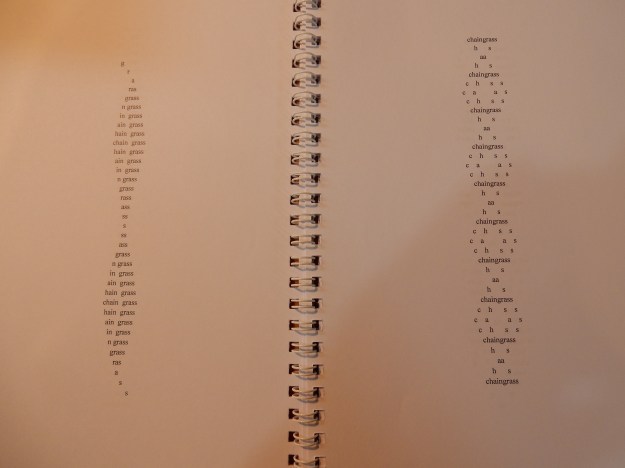
Catherine Vidler has used Bill Manhire’s poem ‘Falseweed’ as the starting point for a series of poems. I am hesitant to name this endeavour concrete poetry. I am not sure why. Perhaps because although the poems plant a visual imprint on the page, a tangible icon to lock eyes upon, the effect is more like a kinetic web, an ethereal tissue that evokes memory, anecdote, fleeting sensations. I have seen these poems referred to as visual poetry.
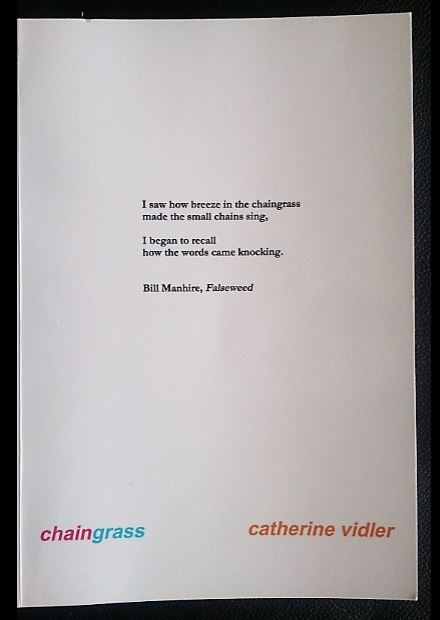
The cover of the paperback (SoD)
Bill’s lines haunt – a kind of causeway to daydreams. Catherine has set up camp on the causeway and in an almost stream-of-conscious way lets Bill’s words float and tumble and take shape. Sometimes I see the visual imprint but I can no longer read the words with my myopia. That doesn’t matter to me. I know the words are there. Sometimes they are lost in smudged grey blocks of once-were-words. I get the nostalgic kick of cross stitch – me at school in the sixties making thread patterns on linen like generations of women before me. I was never very good and found my mind wandering to patterns in the sky.
Then again it is like trying to catch a dandelion kiss and blow it to your grandmother. The tissue poems are like a map of a mind wandering from the poetic line. At times a molecular snapshot, at times the pattern of a choreographer, at times the movement of the wind. Accepting the book on these terms, my terms really, no page is static.
I am reminded of the utter of joy of abstract art. In Paris I sat in front of Gerhard Richter’s mound of yellow pollen for an hour, sitting and looking at the yellow. It began to move and hum – just as yellow on a canvas can move and hum – and lift you beyond colour, can sink and submerge you in colour. It’s not like I entered a Zen-like space – I instead entered a fullness, a richness of experience that braided physical images with deep feeling.
If you are going to read this book the verb ‘to read’ acquires new dimensions.
Catherine’s chaingrass poems also appear in a smaller chapbook. There is a sense (sensation) of leafing through the long grass because it is the long-grass poems that have made it here. Shuffle too and fro, your eye catches glints of wordchains and you are caught in the long grass. The white space renders the word stamp elegant, skeletal like a leaf-haul in autumn; altogether beautiful and mesmerising. Yet there is change, transformation, a magnetic pull of letters to displace and connect the word fragments. The grass is memory. By this point the visual dance, almost molecular, shifts to a new key, and yes, it becomes music.
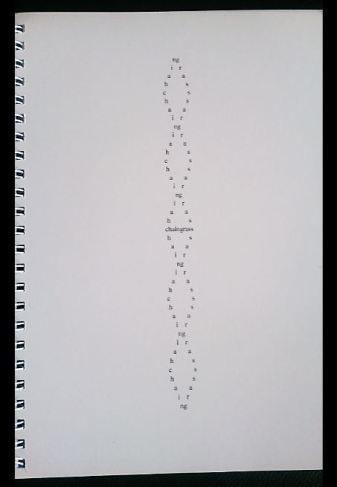
The cover of the chapbook (zimZalla)
For the big, Stale Objects dePress book:
chaingrass, SOd press 2016
The book can be purchased online through Lulu here.
For the zimZalla book:
Chaingrass, zimZalla obect 039, 2016, zimzalla.co.uk
The book can be purchased online at zimZalla’s object page
Catherine Vidler‘s collection Furious Triangle was published by Puncher & Wattmann in 2011. She is the editor of trans-Tasman literary magazine Snorkel.

from chaingrass the chapbook


Please join us for a multilingual poetry reading to celebrate the launch of the first the first two chapbooks in the Seraph Press Translation Series:
Shipwrecks/Shelters: Six Contemporary Greek Poets, edited and translated by Vana Manasiadis
and
Observations: Poems by Claudio Pasi, translated by Tim Smith with Marco Sonzogni
6.00pm Wednesday 14 December
ST PAUL St Gallery
40 St Paul Street, Auckland
All welcome
For more information about the books, or to buy them online visit.
and for more about the Seraph Press Translation Series, visit.


 NZ Poetry Shelf