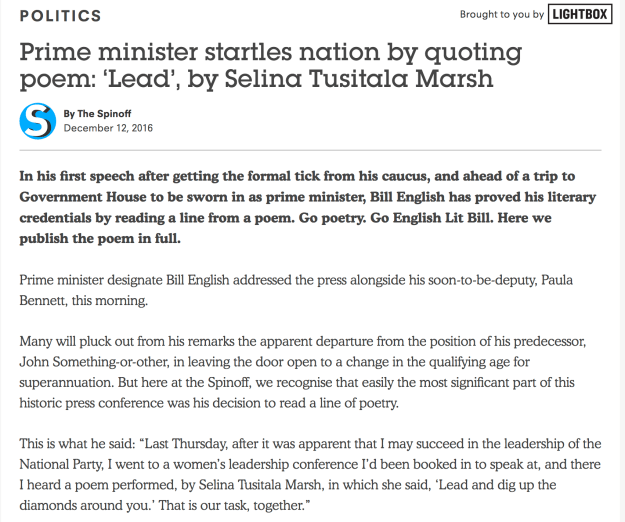
Read and hear Selina’s poem at The Spin Off

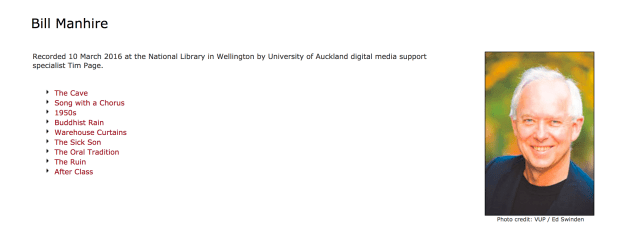
Poets Jenny Bornholdt, Janet Charman, Owen Connors, Andrew Johnston, Bill Manhire and Chris Price contribute dazzling audio recordings of recent work and comment on their Six Pack selections. They join a gallery of recorded performances by poets working in Aotearoa New Zealand and the Pacific region. Click, listen and browse Six Pack Sound’s growing sampler of remarkable poetic voices.
See here.
The poems of Emily Dickinson began as marks made in ink or pencil on paper, usually the standard stationery that came into her family’s household. Most were composed in Dickinson’s large, airy bedroom, with two big windows facing south and two facing west, at a small table that her niece described as “18-inches square, with a drawer deep enough to take in her ink bottle, paper and pen.” It looked out over the family’s property on Main Street, in Amherst, Massachusetts, toward the Evergreens, her brother’s grand Italianate mansion, nestled among the pines a few hundred yards away. Dickinson had a Franklin stove fitted to a bricked-up fireplace to keep her warm, which meant that she could write by candlelight, with the door closed, for as long as she wanted. In much of the rest of the house, the winter temperature would have been around fifty degrees. Though she usually composed at night, Dickinson sometimes jotted down lines during the day, while gardening or doing chores, wearing a simple white dress with pockets for her pencils and scraps of paper. A younger cousin recalled her reciting the “most emphatic things in the pantry” while skimming the milk.
For Dan Chiasson’s complete article in The New Yorker see here.
Max Porter, a novelist “bursting with originality” who was inspired by memories of childhood loss and the work of Ted Hughes, has been named young writer of the year.
Porter won the £5,000 Sunday Times/Peters Fraser and Dunlop accolade on Thursday night for first book Grief Is the Thing With Feathers, which was published to rave reviews in 2015. In 2015, he was shortlisted for the Guardian first book award and this year won the Dylan Thomas award.
He received award at an event at the London Library. The prize is given for the best piece of fiction, nonfiction or poetry by a British or Irish writer aged 35 or under. Porter, who has just turned 35, joins an illustrious list of past winners including Zadie Smith, Naomi Alderman, Robert Macfarlane and Simon Armitage.
For the c0mplete Guardian article see here
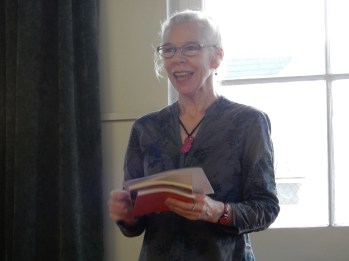
This is a terrific interview (interviewed by Evangeline Riddiford Graham and Elizabeth Baikie) from Anne Kennedy as her Residency at Victoria University draws to a close.
Full interview here.
In this place, at this time, what are you reading?
I’ve just finished Helene Wong’s memoir, Being Chinese, which is a beautiful and moving book. I felt ashamed and inspired at once reading about the racism that was dealt to the Chinese community here, and how despite that they just got on with it. I’ve been reading what I bring home from Wellington book launches: Nick Ascroft’s Back With the Human Condition, hilarious and serious poetry, a good combination; Sarah Laing’s Mansfield and Me which I binge-read one weekend and then found myself with a Laing-like running commentary in my head. Lee Posna’s riveting Arboretum. I’m reading a novel by Susanna Moore, Sleeping Beauties, which interests me because it’s set in Hawai`i.
Some favourite quotes:
‘Writing is in defiance of the material world even though it’s often a representation of it.’
Victoria University of Wellington’s International Institute of Modern Letters’ (IIML) annual online literary journal returns this year with a new name—Turbine | Kapohau—and a new website.
This combines the original name Turbine with a new Māori name Kapohau.
Kapohau is the Māori term for the action of a wind turbine, comprised of ‘kapo’, to catch/capture, and ‘hau’, which typically means wind in the turbine context. However, ‘hau’ is also used in other contexts to mean the vitality or vital essence of a person, place or object. This ambiguity makes for a beautiful fit for the journal.
Showcasing new writing from an international selection of emerging and established writers, plus the latest graduates from the IIML, Turbine | Kapohau 16 is spinning with work that investigates re-invention and change. Edited during a turbulent month of the United States elections and earthquakes, the Turbine | Kapohau 16 contributions jolt and soothe in equal measure.
The 2016 Adam Foundation Prize winner Annaleese Jochems contributes a chapter from her award-winning novel, And Lower. Anna Jackson returns from the 2016 Katherine Mansfield Menton Fellowship to contribute three poems and a sound recording. Other poets in this issue include Airini Beautrais, winner of the 2016 Landfall Essay Competition, and Nick Ascroft and Bill Nelson, who have both published new books with Victoria University Press this year. There is fiction from Christine Utz and poetry from Justin Cox, both teachers at The University of Iowa and convenors of this summer’s IIML Iowa Workshops, hosted at Victoria. This year’s edition also sees a diverse selection of fiction, creative non-fiction and poetry from past, present, and future IIML Master of Arts and PhD students.
In the Turbine | Kapohau interview, 2016 Victoria University/Creative New Zealand Writer in Residence and award winning poet, novelist and scriptwriter Anne Kennedy shares her thoughts on returning to Wellington, working across form, and watching the birds from her window. When asked about the writing life in Aotearoa Kennedy says: “Writing a New Zealand novel is about as sensible as buying a Lotto ticket, but I do it because I don’t know what else to do for kicks.”
After a brief hiatus, the ‘Reading Room’ returns in this issue. Selected entries from the reading journals of students from the IIML’s Master of Arts in Creative Writing shed light on the inner workings of a developing writer’s mind as each of them looks to the future.
Turbine | Kapohau 16 was co-edited by Elizabeth Baikie and Evangeline Riddiford Graham.
Turbine | Kapohau 16 can be viewed online.

The Man in the High Castle by Philip K. Dick
Mansfield and Me: A Graphic Memoir by Sarah Laing
Can You Tolerate This by Ashleigh Young
This is excellent! For the complete list of contributions at Booknotes Unbound see here.
Good to see Emma Neale’s Billy Bird, Gregory Kan’s This Paper Boat and Sarah Laing’s Mansfield & Me make numerous appearances. Good reads indeed!
I felt the best books of 2016 list in The Herald did not involve a scan back over the year to select gold nuggets but a cluster of books that had not yet been reviewed. Disappointing.
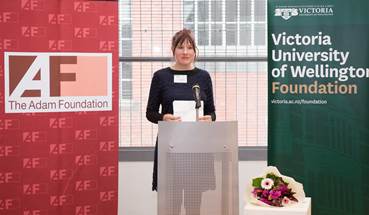
In a strong year for new writing at Victoria University of Wellington’s International Institute of Modern Letters (IIML), a risk-taking, wildly funny, ‘powerful and troubling’ novel has been awarded the 2016 Adam Foundation Prize in Creative Writing.
Annaleese Jochems, 22, wrote the winning book, And Lower, as part of her 2016 Master of Arts (MA) at the IIML.
“I’m ecstatic and still a little unbelieving at having won. My classmates are a group of deep-feeling, hard-thinking writers and we’re a team now. It’s been a privilege to be involved in their projects and to receive their considered feedback on my novel. Emily Perkins and Pip Adam are both extremely patient, knowledgeable and questioning teacher-supervisors who pushed me to the edge of my brain’s capacity. I’ll never be the same again!” Annaleese says.
Annaleese had been studying writing at the Manakau Institute of Technology in Auckland and moved to Wellington to take up a place on the IIML MA programme.
Supported by Wellingtonians Denis and Verna Adam through the Victoria University Foundation, the $3,000 Adam Prize is awarded annually to an outstanding student in the MA in Creative Writing programme at the IIML.
And Lower tells the dream-like story of two young women who steal money and flee Auckland to live on a boat in the Bay of Islands. It centres on Cynthia, described by one examiner as “a superb character, a creature of pure physical and emotional need,” and her series of misadventures, driven by an erotic fixation and a world-view gleaned from a close study of reality TV. Cynthia wants nothing but love, but when a rival gets in her way the black comedy heats up, and the plot takes a thrilling, violent turn.
Emily Perkins, a senior lecturer at the IIML and co-convenor of this year’s Master’s programme, says it’s been a delight to read the novel as it has developed over the course of the MA.
“Annaleese is an inventive, bold and ambitious writer. She is one of a terrific group of new writers coming through the MA programme, and her exhilarating novel is full of ideas and absurdities that speak to our times. And Lower takes the reader on an unsettling, sometimes hilarious, always surprising ride, rendered with sensory acuity and charm.”
Acclaimed author Tracey Slaughter, an examiner for Annaleese’s thesis, praises: ‘a narrative of delightful originality’ and ‘dazzlingly astute observations’, delivering a ‘slick transition from irony to menace… with lucid, pared-back imagery’.
“Throughout, it is Jochems’ piercing sense of tone which shines. The voice of the piece is always taut, savvy, biting… beautiful.”
An extract from the novel features in the newly launched 2016 edition of literary journal Turbine | Kapohau, available online.
Previous Adam Foundation Prize recipients include authors Eleanor Catton, Catherine Chidgey, Ashleigh Young and Hera Lindsay Bird.
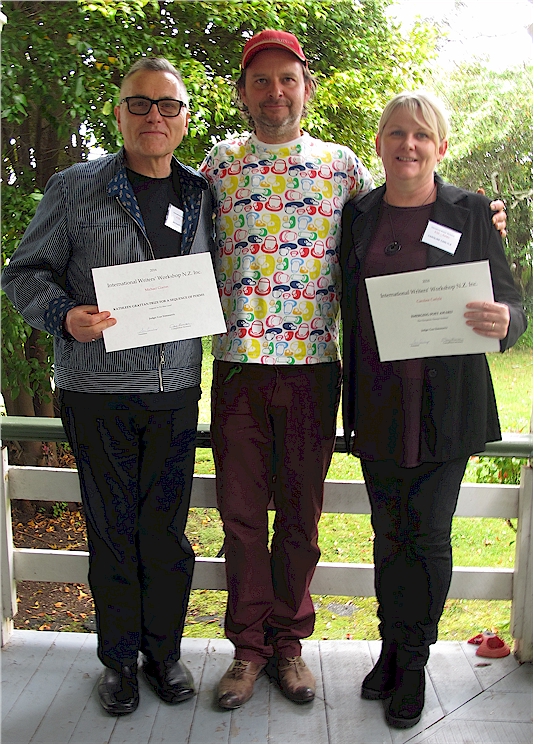
The winner of the 2016 Kathleen Grattan Prize for a Sequence of Poems, run by International Writers’ Workshop NZ Inc (IWW), has been announced with the $1000 prize awarded to Michael Giacon of Auckland for his sequence, Argento in no man land.
Giacon was born and raised in Ponsonby. He is from a large Pakeha-Italian-Samoan family, and has worked at tertiary level in English language teaching for quite some time. In 2016 he graduated with an AUT Masters in Creative Writing, producing a volume of poetry, Beyond Retrieve, which was all about a life of writing. Argento in no man land began as part of his Masters. A series of IWW poetry workshops helped him select and shape his winning sequence of 13 poems telling of spring-to-spring romance, love, lust, break-up, some sadness, hope, for Argento Q in the gay milieu.
This year’s judge, Gus Simonovic, said of the winning sequence: “This seduces on the first read with its feel of ‘ease’. You know when you read one of those poems that have just ‘landed’ as they are; the ones that look and sound as if they come directly from that eternal creative source; and where the poet is just the medium between the source and the reader. The structure of the poem is ‘predictable’, but the content itself is everything but. Its natural flow and the richness of the emotional landscape makes it readable and re-readable with endless incarnations of poetic surprise(s).”
The Emerging Poet Award, presented to an IWW member of at least three years standing who has not had poetry published previously, is Caroline Carlyle for her sequence The Chongololo Therapy Sessions. A chongololo is a giant African millipede and the seven poem sequence relates to her childhood growing up in Zimbabwe.
About the Prize
The Kathleen Grattan Prize for a Sequence of Poems has been made possible by a bequest from the Jocelyn Grattan Charitable Trust. It was a specific request of the late Jocelyn Grattan that her mother be recognised through an annual competition in recognition of her love for poetry and that the competition be for a sequence or cycle of poems with no limit on the length of the poems. It is one of two poetry competitions funded by the Trust, the other being the prestigious Kathleen Grattan Award run by the publishers of Landfall magazine.
This is the 8th year the prize has been contested. Previous winners are:
2009: Alice Hooton for America.
2010: Janet Charman for Mother won’t come to us, and Rosetta Allan for Capricious Memory.
2011: Jillian Sullivan for how to live it
2012: James Norcliffe for What do you call your male parent?
2013: Belinda Diepenheim for Bittercress and Flax.
2014: Julie Ryan for On Visiting Old Ladies.
2015: Maris O’Rourke for Motherings
 NZ Poetry Shelf