Category Archives: Uncategorized

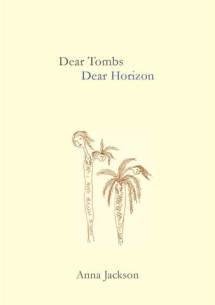
Anna Jackson’s Dear Tombs Dear Horizon


dear-tombs-dear-horizon-front-cover-web.jpg


Dear Tombs, Dear Horizon, Anna Jackson, Seraph Press, 2017


Anna wrote this hand-stitched chapbook in Menton, France when she held the Katherine Mansfield Menton Fellowship in 2016. The long poem savours time to write in the slow stretch of the present participle: walking, dreaming, seeing, reading, writing and more walking. Such leisurely engagement with books read, the world sighted and thoughts that appear like surprising musical notes renders the poem lento, adagio, largo.

For the reader to be caught in such a contemplative beat is immensely satisfying. The physical world simmers on the line while the abstract world, both dreamed and mused, shines below and above.


Sun on the coast, sun on my back, but

the mountains dark with cloud,

misty down to the ground, and higher

up, stormy. The shadow of my hand

on the page as I write, writing

inside my own shadow.


The poem steps off from graffiti witnessed on rocks: ‘You are my most lovely horizon’. Each experience, thought, recalled page or vista steps off into the mysterious elsewhere of thinking, and from the elsewhere of thinking into the paradoxical here yet elsewhere of writing. The  horizon is the translucent line where Mediterranean sky meets Mediterranean sea, a sensual hook of beauty that stalls the walker, but it is also the indefinable lure that poses a need to write, to think, to experience. It is Katherine Mansfield, the other authors, the conversations that stick, the not-home-ness that becomes a home-ness.

I am thinking of the way the doorstep at Villa Isola Bella leads to the corner of a Vermeer painting and the poem produces a mise en abyme of looking. Stillness matters: the long pleasurable look into the corner of a painting becomes the long pleasurable look into the corner of a poem where detail stockpiles and sparks daydream.


At the Villa Isola Bella, my favourite place

is the doorstep, on the corner where a spider

grooms itself on the mottled buttery

yellow stone, beside the eggshell blue

door frame, and the terracotta tiles.

It is like finding myself in a corner

of a Vermeer interior, a detail

closer up than a Vermeer painting

has ever gone, so that with all the stillness

on the canvas, there is this corner

so close up, the spider moves.


Therein lies the beauty of this sequence: in stillness you find movement and in movement you find stillness.

I adore this poem because it takes me to an unfamiliar physical place, yet allows me to ride the coat tails of a roving, inquisitive mind. Such curiosity fires the writing process. I am reminded of the way Bill Manhire produced his astonishing collection, Lifted, after his Menton Fellowship with its gift of time. Anna has a new collection in the pipeline but, in the meantime, this is a must-read treasure, also in debt to the gift of time. I don’t want to unpick the curves, arcs and echoes in the poem, the illuminations and the epiphanies, because I want you to read it for yourself. I just love it.


A ticket simply to go, or to go and to return?

Oh, to return, to return, to return,

to return, to return. I walk once again

méthode flâneusoise around

the coast and the graffiti

reads, “Ma plus belle horizon, c’est toi.”

I wonder how to turn the dream about the

tombs into a poem. I think of

starting the poem “Dear Tombs,” and

wonder whether perhaps I should

try writing the poem

in terza rima. Really I just want

to pile into it everything I have got.


Seraph Press page
 

A 2017 poem toast to you – from Mere Taito’s splendid debut


Feed

the sea
gate-crashes your lunch
through an opening
in the bus shelter wall

it salts your chips
makes you squeeze
the tomato sauce out of your words
onto the battered fish

the butcher’s paper
grabs the name of your crush
and coats it with the hot oil
before the wind blows it
through the door of the Metrolink bus
E.R.I.C

(sigh…)
deliriously happy
you mouth feed the seagulls


©Mere Taito, The Light and dark in Our Stuff (2017)


Mere introduces herself at the start of her debut poetry book – a book that I like very much indeed.

‘The island of Rotuma is my ancestral-mapiga (grandmother) home. It looks like a whale on Google Earth. Fiji is my I-grew-up here-home and New Zealand, my right-now home. I moved to New Zealand in 2007 because my father ‘talked up’ this country – he said it was a great country to live in. Except for winter, I have no reason to believe otherwise.’

The book is a book of two halves; five dark poems and five light poems. I have read it twice, sitting on the beach at the end of my run, finding the shift from dark to  light sparking even sharper in a dramatic setting. Mere offers music, challenges, an attentive eye and heart, and it feels like a little guidebook to living. On this particular occasion, in this particular way. Wonderful.

So with this poem, and permission from Mere, a warm seasonal, poetry toast to you all!

xx

My stack of poetry books to read

DSCN9240.JPG


Dear poetry fans

Thank you so much for your support this year: your contributions, emails, invitations, challenges and poetry conversations!

I still have a sizable tower of New Zealand poetry books I have been sent this year and I am keen to read them over the next few months. Poetry seems to have got a bit more attention in 2017 or am I imagining it? I started Poetry Shelf because it felt like so many local arrivals vanished into the ether and I’d stumble upon them by chance. Reviews were few and far between. However, it feels like we are part of myriad poetry communities that are doing myriad things in diverse ways, with distinctive voices, and these connections matter.

Yesterday I finished a major draft of my book on NZ women’s poetry – and I just don’t have the time to write an end of year set of crackers and tinsel. This year I am not posting the annual monster roundup by local poetry fans of favourite reads from any time and any place. Next year the blog will spark back into renewed action, but I will post little pieces to highlight my summer poetry delights as I can.

Thank you for sending books. I might not write about them all, but I will read them all and definitely showcase some.

I am about to a post a poem from a little book that caught my attention as my Happy Summer time toast to you all.

Meanwhile I am taking a week out to reboot with novels, movies, the garden and early morning runs and swims on the beach – not to mention long periods gazing at the sky.

Warm regards

Paula


Seraph Press interviews Nina Powles

Luminescent is one of my favourite poetry reads in 2017. Check out this new interview with Helen Rickerby.


Screen Shot 2017-12-13 at 9.04.29 AM.png


A new poem from Joan Fleming: ‘Was the night before’


Was the night before


[because fast and faster aren’t necessarily

[this lucky and the lights burning her feet like

[angry because people are saying “happy hols” and the jingling

[was the first sign the roast was too long in the

[wondering if burnt feet stay burnt like

[decorations and shoved them onto the coffee table like here

[dry streets don’t you remember how we always

[someone is always closing them again, “it’s the flies”

[her favourite, marshmallows liquefying into the mashed

[a skin on it because we left it too long or

[not the smell that sets the alarms off, it’s the smoke’s

[makes my soul slack out she said, those tunes you want to claw your

[“over here” said the Santa, because where were all the little

[crackling, that’s my favourite part even though my mouth can’t

[if I’m going to do it, I’m not going to do it wearing

[be always telling you shut the

[not the family I thought I

[happens when I lit the pine

[bauble just comes right apart in your hand


©Joan Fleming 2017


Joan was one of the highlights for me at the recent Poetry & the Essay conference at Victoria University. Her paper raised important questions on borrowing, acknowledging, taking risks, building conversations, processing different ways of doing and being, especially of being white woman alongside aborigine women. Having had a taste of the poems, I can’t wait for a book to emerge. And I just loved listening to her reading.

This poem, however, is a little – as Joan said – slightly prickly toast to Christmas.

Submissions open for next Sweet Mammalian

15b020_ee7e44c71b3c4841aabfb6028a4deb81.jpg

SUBMISSIONS

Send us your writing, be it a roar, purr, or pip-squeak.

Sweet Mammalian aims for diversity and inclusiveness—we want all different kinds of poetry, from all different kinds of writers. In order to make this possible we need your submissions, so send us your thrilling writing!

Submit up to 5 poems of any length. Please send your work in a single word doc attachment to , and include a short bio note and the titles of your poems in the body of the email.

We are now accepting submissions for Issue Five. The submission deadline is 31 December 2017.

Issue Five will be published in the early months of 2018.


See here


The Kathleen Grattan Prize for a Sequence of Poems 2017 – Winner Announced


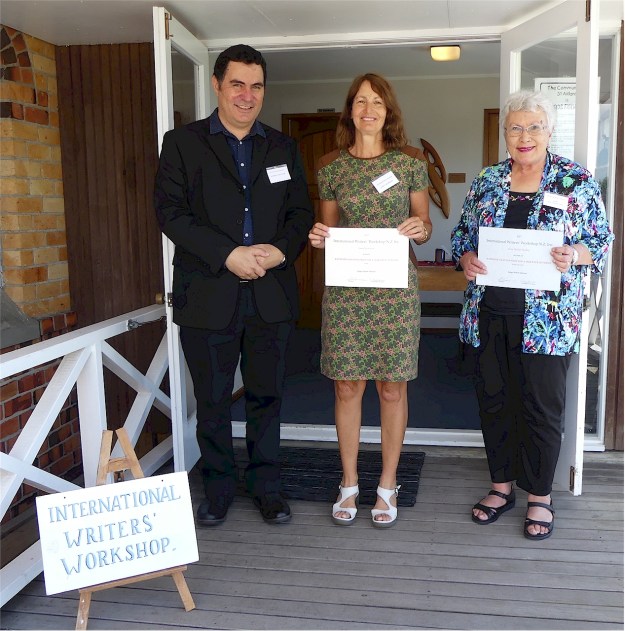
IWW Kathleen Grattan Prize Winners 2018.jpg


International Writers’ Workshop (IWW) is delighted to announce that Janet Newman is the 2017 winner of The Kathleen Grattan Prize for a Sequence of Poems for her sequence, Tender. The $1000 prize was judged by respected Auckland poet Robert Sullivan.

Tender is a seven poem sequence about Janet’s father, Doug Newman (1919-2008). The poems show him as a farmer, a former WWII soldier, and in old age, revealing both his tough exterior and a covert tenderness. By tracing his life from her childhood to his death at 89 years, the sequence explores the ways in which war invades the lives of veterans and their children.

Ms Newman, a member of IWW since 2012 and a runner-up in The Kathleen Grattan Prize for a Sequence of Poems in 2014, was born in Levin and raised on a dairy farm at Koputaroa in Horowhenua. She completed a Certificate in Editorial and Publishing at Wellington Polytechnic and worked as a journalist in Lower Hutt, Christchurch and Perth in Western Australia before returning to Koputaroa where she now lives and runs the family farm. She has a Masters of Creative Writing from Massey University and is presently a PhD student at Massey. Her critical and creative thesis looks at New Zealand’s long history of environmentally oriented poetry, and includes a collection of original ecopoems.

Runner-up is Anne Hollier Ruddy of Orewa who began writing poetry in 2006 and has been a member of IWW since 2011. Her poems have appeared in various Australian and New Zealand anthologies, as well as Shotglass Journal, Cordite Poetry Review and Blackmail Press. Her sequence of poems, Ambushed by Gauguin, begins and ends with a reflection of the Mother and Child theme in art with other poems in the sequence exploring it personally in biographical terms.

Mr Sullivan said writing poetry is a journey of discovery and is timeless, whatever the style. He said when writing poetry to think, “Is there an accent on what really matters and not just the right word in the right place?” Of the winning and runner-up sequences he said the poets have submitted their inner hearts. The sequences were new and original, exuded honesty and ‘show, not tell’ while disclosing some aspects of the narrator’s character as well.

About the Prize

The Kathleen Grattan Prize for a Sequence of Poems has been made possible by a bequest from the Jocelyn Grattan Charitable Trust. It was a specific request of the late Jocelyn Grattan that her mother be recognised through an annual competition in recognition of her love for poetry and that the competition be for a sequence or cycle of poems with no limit on the length of the poems. It is one of two poetry competitions funded by the Trust, the other being the prestigious Kathleen Grattan Award run by the publishers of Landfall magazine.

Previous Winners

This is the 9th year the prize has been contested. Previous winners are:

2016: Michael Giacon for Argento in no man land

2015: Maris O’Rourke for Motherings

2014: Julie Ryan for On Visiting Old Ladies.

2013: Belinda Diepenheim for Bittercress and Flax.

2012: James Norcliffe for What do you call your male parent?

2011: Jillian Sullivan for how to live it

2010: Janet Charman for Mother won’t come to us, and Rosetta Allan for Capricious Memory.

2009: Alice Hooton for America.

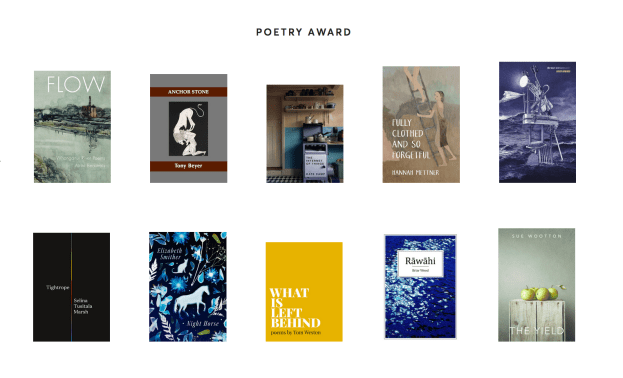
Congratulations to the Ockham Book Award Poetry Longlisters

Screen Shot 2017-11-28 at 6.17.55 AM.png

Congratulations poets – this is a strong showing.


Here is my conversation with NZ Poet Laureate, Selina Tusitala Marsh.

My conversation with Airini Beautrais.

My conversation with Hannah Mettner.

My conversation with Elizabeth Smither.

My conversation with Sue Wootton.

Two poems and my response to Kate Camp’s collection

Two poems and my response to Briar Wood’s collection.


I haven’t yet read the other  collections – but I loved these enough to have showcased them on the blog. I would sing the praises of them anywhere.


The Poetry Award will be judged by poet, novelist and creative non-fiction writer Alison Wong; poet and deputy chief executive, Māori, at Manukau Institute of Technology Robert Sullivan; and Otago poet, publisher, editor and librettist Michael Harlow.

My commiserations to those who missed the list. This year has produced an extraordinary array of poetry books from main and boutique presses. And yes, very good books are missing (it’s like trying to squeeze your books in your holiday bag and the bag just won’t shut) so I am going to flag just a few.

The glorious books of Bill Manhire (there are two!), Michele Leggott and Nina Powles.  I would add Louise Wallace, Maria McMillan, James Brown, Caron Smeaton, Reuben Todd. .


Congratulations to those on the longlist.  A toast to you, to your publishers and booksellers and to those who spread its joy far and wide.


Rest of award results and details of poetry books here