


Reuben Todd, The Poet Creep, self published, 2017
I could eat you
with my bare feet.
Reuben Todd graduated from the Hagley Writers Institute and acknowledges the tutelage of Kerrin P. Sharpe and mentorship of Bernadette hall at the front of his new poetry collection, The Poet Creep. He works in multiple fields: writer, comic, director, actor and produces Christchurch’s live weekend sketch show, Skitch.
The poetry collection crept up on me slowly, and then picked up speed, like a wild wind gusting through my poetry-focused mind. Six distinctive sequences grasp the white space of the page and, using that as a key element, play with language to a point of alluring freshness. Words hug the line, dart above and below, congregate in prose-like flashes, are crossed out, repeat, splinter, break apart. The effect might induce poetry vertigo but instead I am pulled along a current of reading that replays an unstable world, a flickering heart, an excavating mind.
At times it feels like I have entered the realm of dystopian poetry where surreal channels bust the borders between the real, the longed for and the imagined.
‘IS?TANBUL’ is a surprising page turner – fidgety restless poetry – that responds to an unstable, immaterial world. Words repeat, letters float and drift or overlap (impossible to replicate on my staid blog). In this sample note the ‘h’ and ‘f’ of ‘ashfelt are jammed tight as though intensifying the tension between heart and ruin:
earthworks
earthworks
earthworks
ashfelt
earthworks
trees
Sometimes a single line floats like a guest lyric:
Snow is falling like fat wet kisses
Blank pages reinforce the primacy of white space, the fresh start, the need to pause, the silent beat, the tacit sidestep, the unsayable, if not the unthinkable.
A sequence of B/W images, ‘UNCOUPLED V GNETTE’, with ‘i’ missing, like a motif of self erasure, like a hiccup or pause, a bridge to the white space, pulls me to concrete details. Close-up images of architectural features form the book’s core. Interpreting this choice – the intricate, hard and designed surfaces of built things – I feel the physical core absorbs the knotted movements, the virtual scenarios, the upended semantics, the tilted ground we stand on.
The final sequences, if not all the sequences, present autobiography that refracts and reflects stutters and sings. Then again, every word might be a downright lie. This is not important. The need to break and link, overlap and disintegrate, produces poetry that fires both heart and mind. Language is always on the move, and it is an exhilarating experience following it. I loved this collection.
Buda
calls
across
the
water
,
but
Pest
cannot
hear
.
Pest
calls
across
the
water
,
but
Buda
cannot
hear
.
from ‘Where we part.’
Reuben Todd web page
Tales of the Waihorotiu,Carin Smeaton, Titus Books, 2017
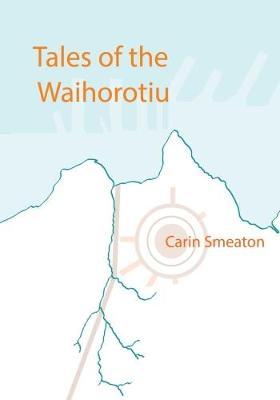
Carin Smeaton’s debut collection, Tales of the Waihorotiu, is all about voice. It is acutely textured: surprising, open, sharp, slang-rich, vernacular driven. It pulls you so close you can sense the speaker’s breath on the line. It grips you from the first page until the last.
The short lines, the shortened words, intensify the conversational flow – like there is an inward outward breath audible, like there is pause for thought, what to reveal and what to keep quiet. Conversational fluency in poems ought not be taken lightly, we are so easily seduced by an apparent ease, but this is exquisitely crafted. Talk is transposed into music and that music becomes poetry, layered, magnetic.
What I love in this collection is the way voice is a gateway to abundant life on the page, startling at times, moving at others. Place matters, people matter and experience is the pulse that steers the line. You might move from a meteor shower to kids spinning on a whirligig to eating eel to Fargo to bad relations to Woody Allen to Mary Poppins to a broken tooth to St Kevin’s Arcade to the Rugby World Cup to a crap world to a better world to headache and heartache.
The title refers to the Waihorotiu stream that used to run down Queen Street but after life as a canal, then sewer, now flows underground. The poetry’s roots soak deep into Auckland, especially into lives that flow counter to the bright lights and the privileged. Voice now gives presence to the voiceless.
This a heart-crunching, mouth-watering, kaleidoscopic read and I love it. Here is a poem to whet your poetry taste buds:
Media Release
17 November 2017
Michael King Writers’ Centre 2018 Residency Recipients Announced
Next year New Zealand’s largest writer-residency organisation will host its largest-ever number of residencies, offering opportunities to 15 emerging and established writers – historians, memoirists, essay writers, fiction writers, poets and dramatists.
Established writers include Courtney Sina Meredith (Early Summer), Fiona Samuel (Winter) Jacquie McRae (Māori residency), Tracy Farr (Spring) and Mark Broatch (Late Spring).
The six-month University of Auckland Residency at the MKWC has been awarded to acclaimed playwright Victor Roger who will work on a novel and a collection of short fiction. ‘Having written an essay last year for the Academy of New Zealand Literature about the state of Pasifika fiction,’ Victor says, ‘it’s very clear that New Zealand is lacking Pasifika novelists. One of the huge drivers for me to finish this work is the desire to add another voice to the canon.’
The newly established Pasifika residency will be held jointly by historian Trevor Bentley and poet Serie Barford who will each spend two weeks at the centre in Devonport.
The first recipient of a Pasifika residency for emerging writers is ‘radical accountant’ Pala Malisa, son of former Vanua’aku Pati cabinet minister Sela Molisa and civil servant and the writer Grace Molisa.
The first recipients of Māori residencies for emerging writers are fiction writers Helen Waaka and Kelly Joseph, and essayist Nadine Millar.
Other emerging writers awarded residencies are Alan Drew, Lawrence Patchett, and Rosetta Allan.
By winter Fiona Samuel will take up a four week residency to work on a novella – an imaginary memoir based on a significant event in the life of her grandmother and her great aunt.
Jacquie McRae will take up the Māori Writer’s Residency to work on a new work of fiction based on facts about the colourful history of the temperance movement in New Zealand and the resulting illicit trade of home brewed whiskey.
Tracy Farr been awarded the four-week Spring Residency to work on her latest project; her third novel – the story of three sisters, identical triplets born in an amusement park in the first decade of the twentieth century. The novel explores the sisters’ ability to describe the world and make it into sense, and to live lives filled with wonder. It is a novel that is deeply interested in voice and in identity – how they form, how they develop and change.
In the late spring, Mark Broatch will spend two weeks working on completing the final draft of a contemporary novel that has at its centre an exploration of modern relationships and male friendship.
The Early Summer Residency has been awarded to Courtney Sina Meredith. Courtney will hold a four-week residency. Her project is a work of creative non-fiction. Courtney says ‘this will be a book of creative non-fiction that plaits together stories of young creatives in Aotearoa with an emphasis on Pasifika, Maori and Queer voices. This book is inspired by the ‘real life’ stories I have been privileged enough to hear, receive and observe – as a writer, educator, arts administrator, and more recently as a feature writer and contributing editor’.
All of the residencies are available thanks to support from Creative New Zealand.
The Michael King Writers’ Centre thanks all applicants and wishes all our residency recipients the best of luck with their work.
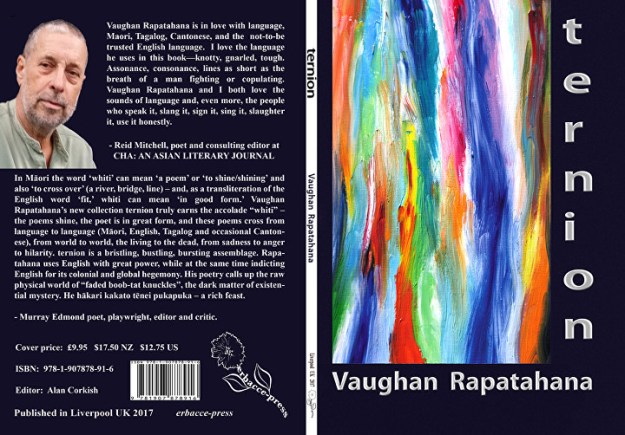
Ternion Vaughan Rapatahana (Liverpool: erbacce-press, 2017)
Vaughan Rapatahana travels and lives in three distinctive places: Aotearoa, the Philipines and Hong Kong. His poetry reflects an impulse to travel because the linguistic movement, whether aural or visual, is paramount. Words dart, dash, stretch, stutter, link, break down, break apart. There is vertical uplift and downward slants. Such linguistic playfulness is not simply a matter of exercising the dimensions and possibilities of language; each poem travels with a movement of heart and mind.
There is the hiccup of letters and words in ‘my father’s death’, a poem that faces the hard-to-say in fits and starts. Physical detail anchors the experience:
only
the young oldest son
there to witness
his shrivelled size,
the estranged demise
-astray the slim single bed
The diverse subject matter embraces the movement of a global traveller, with several languages sharpening the line, hooking place and experience, opinion and identity. He rails against the weakness of English (‘railing against’). He rages against blinkered if not blind identity views: ‘why/ are we/ mis interpreted/ all the time?’ (‘I carry a rage’).
The detail is pungent and thick on the line – especially when place is at the poem’s core:
hong kong, you old bastard;
your flabbergasted lips
basting the back alleys
in jisms of sputum,
disabling sophomore solons
garbled in yellow
under colourless sun.
from ‘hong kong town, 2015’
What I love about Vaughan’s poetry are the multiple jigs: the way death brushes against life, humour touches against sharp-as-axe political edges, confession corrupts reticence. Poetry is a way of cooking up a brew that resists boundaries, rules, decorum, models. I especially like the scene at the fence where poetry is the topic pf conversation:
‘Smells good,
you cookin’ up another one
of those bloody poems of your’s mate?;
offered my gap-toothed neighbour,
through the interrupted picket fence.
‘reckon,’ I said, stirring up
a bit of everything on the page,
so to speak.
from ‘boil up’
The neighbour hopes the poem hasn’t got any of ‘those clever-dick tricks’ when he wants ‘plenty of/ good old carrot & onion words’. I love this poem. On the one hand, Vaughan is responding to the age-old incomprehension at what a poet does, but it also gets right down to the guts of how he brews a poem. There are clever, tricky acrobatics on and off the line that signal intellectual engagements with the world, but there is also a Hone-Tuwhare-like cheek and an absorption of an everyday physical world. We might get ‘cacophonous condiments’ along with ‘a little watercress on the side’ and a good stir of Te Reo.
Murray Edmond claims the collection as ‘a rich feast’ on the back cover and I agree. The poems spark in myriad directions that touch mind and heart, and I can think of few local examples that are so linguistically and creatively fluid.
Postscript: Vaughan’s must-read poem for Tusiata Avia and Fale Aitu / Spirit House resonated so deeply I felt like crying. A poem like this underlines the way we write within poetry communities, not in estranging isolation, but in arm-to-arm states of poetry and human connection. I love that. I love this generous embrace.
manuia Tusiata, manuia
this is the best body of poetry
I’ve hugged for years.
from ‘fa’afetai Tusiata’
‘It appears the cold weather has finally arrived in Madrid after an extended summer… Anna Borrie and I read ‘You’ by C.K. Stead in the final episode of ‘Poem on the Terrace – New Zealand Poets’, where we introduce kiwi poets to a Spanish-speaking audience.’
Charles Olsen
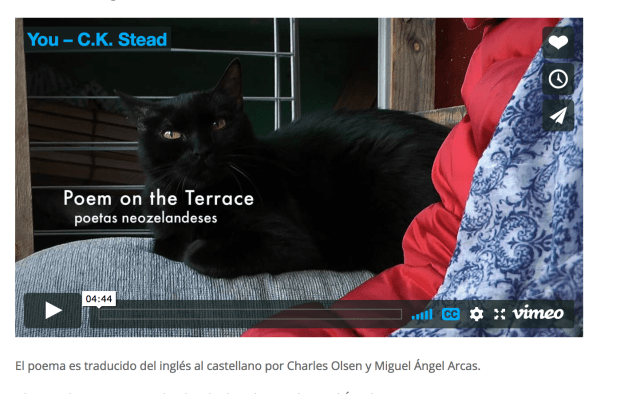
Listen here
Landfall Essay Competition winners share prize for radically different topics
Two New Zealand essayists writing on very different topics – life as an army recruit and the power of scent – are joint winners of the 2017 Landfall Essay Competition.
Laurence Fearnley, of Dunedin, and Alie Benge, of Wellington, will share the $3000 cash prize and both will receive a year’s subscription to Landfall.
The judge of the annual award was outgoing Landfall editor David Eggleton.
Of the 64 entries received, the two finalists’ essays proved especially difficult to separate, though their topics and their strategies are very different, he says.
“Alie Benge’s essay, ‘Shitfight’, which is about raw army recruits in Australia being prepared for a theatre of war in the Middle East, has a physicality and dynamic urgency to it that stopped me in my tracks,” says Eggleton.
Whereas he says Laurence Fearnley in her essay ‘Perfume Counter’ makes scents – at once treasurable, resonant, mysterious – synaesthetic emblems of how we perceive the world.
“Her assured and measured writing brings her surroundings alive with sharp, descriptive clarity.”
Their winning entries will be published in Landfall 234, available later this month. Landfall is published by Otago University Press.
There are five shortlisted essays: ‘Gone Swimming’ by Ingrid Horrocks, ‘Reaching Out for Hear’ by Lynley Edmeades, ‘A Box of Bones’ by Sue Wootton, ‘I Wet My Pants’ by Kate Camp and ‘Trackside’ by Mark Houlahan.
For more information about the Landfall Essay Prize and past winners, go to http://www.otago.ac.nz/press/authors/awards/otago065482.html
The winners
Alie Benge is a writer and copy-editor living in Wellington. She has previously been published in Headland and has work coming out in Takehē and Geometry. She is working on a novel inspired by her childhood in Ethiopia.
Laurence Fearnley lives in Dunedin. In 2016 she was the recipient of the Janet Frame Memorial Award and the NZSA Auckland Museum Grant and she is currently researching and writing a book of essays and stories based on landscape and scent. For the past year she has also been co-editing an anthology of New Zealand mountaineering writing with Paul Hersey. This work has been generously funded by the Friends of the Hocken Collections and will include non-fiction, archival material, fiction and poetry and will be published by Otago University Press in 2018.
Laurence has published ten novels and two books of non-fiction, as well as short stories and essays. She was awarded the Artists to Antarctica fellowship and in 2007 the Robert Burns fellowship at the University of Otago.
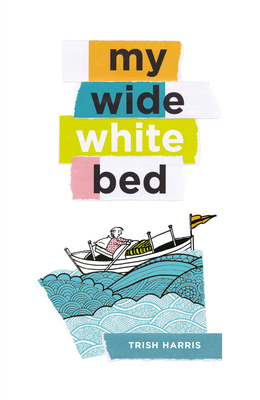
The Wide White Bed Trish Harris Landing Press 2017
Trish Harris spent eight weeks in the Orthopaedic Ward at Hutt Hospital as people – visitors and patients – came and went about her. Someone brought her a journal and that became both her private room and the subsequent resource for My Wide White Bed.
The poetry is airy, with acute observations, luminous things, and an awareness of community experience rather than a single perspective. It is immensely readable; I gobbled it in a flash, loving the sweetly crafted lines, the wit and the reflection.
The sequence comprises untitled poems that begin with the idea of a ship:
The hospital sails
like a tall ship
down the crease of the valley.
I am stabilised
mid-mast
laid out on a wide white bed
head facing east.
The book struck such a cord with me because it took me right back into the thick of hospital stays where intimacy thresholds dissolve, discomfort displaces comfort and walls and windows are unsteady.
This is not a bitter grim read but an essential read in the light of the current state of hospital care. The politics are subtle and various:
They arrive
as elderly women with
broken bones
strained muscles.
Back home
they are the strong ones
caring for senile husbands
sick sisters
dying mothers.
They come to this place
of illness
for a rest.
Trish pulls us into the lives of others as much as she exposes her own story, and that is what elevates the reading experience. Names are changed but the dialogue, the situations and the revelations sound out as vital human truths. This is poetry of connection, of empathetic relations in tough circumstances. Single lines glow:
Merle is doing crosswords.
That’s why she buys the newspaper.
At home her husband grows daisies and dementia.
The book should be in the drawers beside every hospital bed, and in the gift shop, because the book, like the boat with the wind in its sails, is an astonishing uplift. Plus I recommend placing a journal and pen in bedside drawers, so patients can open up their own privates rooms to write or doodle windows and doors and secret sails.
Then again pick up this book for a wet Sunday and savour the rewards. I love it.
All night long I ease
the white blanket over shoulder
across belly and over hip
dreaming of transformation.
In the morning the nurse says
You look like a cocoon.
I smile. The covers bulge
with antennae buds and
the scratching of wings.
©Trish Harris The Wide White Bed
Trish Harris has a BA of Applied Arts (Creative Writing) from Whitireia New Zealand. She has worked with words – editing, writing, creating and tutoring – for over thirty years. In 2016, Escalator Press publisher her memoir, The Walking Stick Tree. Her poetry has appeared in various journals.
Episode 51: Pip Adam talks to Nina Powles about her new work LUMINESCENT
Listen here.
‘In this episode I spoke with one of my favourite Wellington poets Nina Powles. I first spent time with Nina around Helen Rickerby’s table where a group of us were hand-binding copies of her first collection Girls of the Drift.
Nina is an outstanding poet, non-fiction writer and zinemaker. She is half Malaysian-Chinese, half Pākehā. Nina has an MA in creative writing from Victoria University of Wellington and won the 2015 Biggs Family Prize for Poetry for the first draft of Luminescent. She is the author of the chapbook Girls of the Drift (Seraph Press, 2014) and several poetry zines.
Nina’s new work Luminescent is an extraordinary work.’
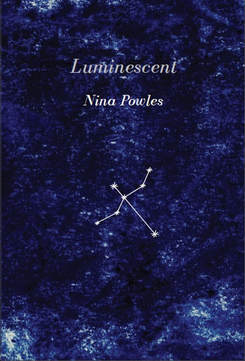
Paula: I love this collection so much. Here is my review.
 NZ Poetry Shelf