
The Writer in Residence is an annual appointment to foster New Zealand writing, with support from Creative New Zealand.

The Victoria University of Wellington / Creative New Zealand Writer in Residence appointment is jointly funded by Victoria University of Wellington and Creative New Zealand. It has been created to foster New Zealand writing by providing the appointee with the opportunity to write full-time within an academic environment for the period of tenure.
Applications are invited from writers in all areas of literary activity, including drama, fiction and poetry, New Zealand art, biography, history, music, society and culture, etc. Applicants should be authors of proven merit normally resident in New Zealand or New Zealanders currently resident overseas. There is no restriction on the occupation of applicants, but they should not be employees of Creative New Zealand or Victoria University, or have been employed by Victoria University in the twelve months prior to the closing date.
Applications for the 2019 appointment are now open, with an application deadline of 30 September 2018. A full role description and application is available on the Current Vacancies page of Victoria’s website (position reference 2254. Enquiries can also be directed to modernletters@vuw.ac.nz.
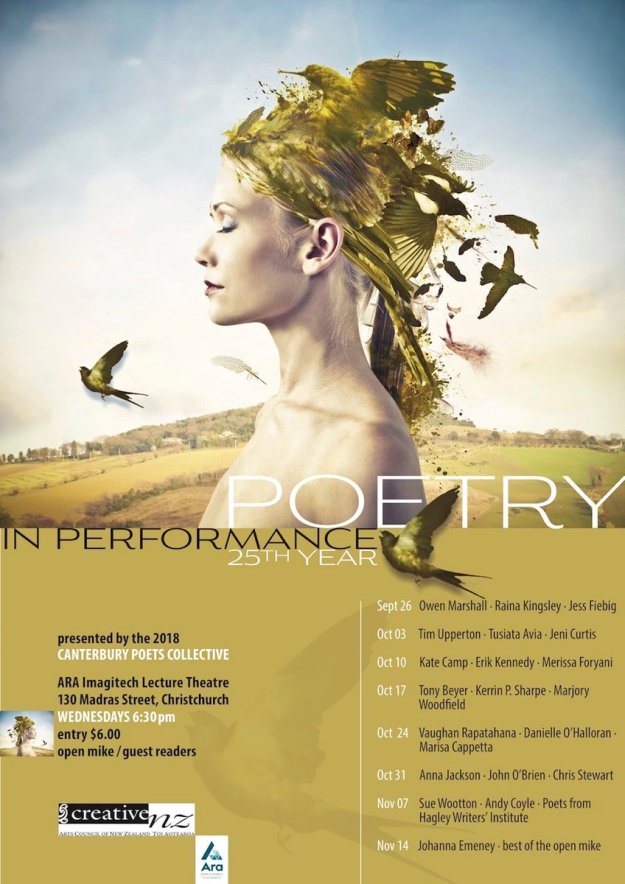
The International Institute of Modern Letters (IIML) is delighted to announce the addition of this special event to the 2018 Writers on Mondays series.
Kate Camp: Menton, memoir and me:
When poet Kate Camp took up the Katherine Mansfield Menton Fellowship in 2017, it was to write memoir, not poetry.
Memoir writing raises interesting questions – of fact and fiction, ethics and ego, what one remembers, and what one chooses to reveal. In this lecture, Kate Camp examines a more difficult and profound question – who cares? Who could possibly give a damn about the details of someone else’s life?
Drawing on her own work and that of other New Zealand writers, Camp’s lecture is an entertaining, insightful, and at times deeply personal exploration of the ‘point’ of writing memoir.
Originally delivered September as the Frank Sargeson Memorial Lecture, initiated by Waikato University with the support of the Friends of Hamilton Library.
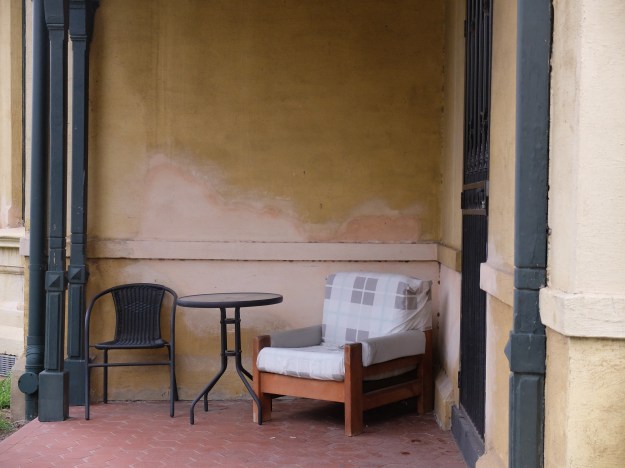
‘Prologue‘ appeared in Three Lamps, an online journal from the University of Auckland, edited by Paula Morris.
Wen-Juenn Lee edits poetry for the Australian literary journal, Voiceworks. She works and lives in Melbourne, and writes of home and belonging.
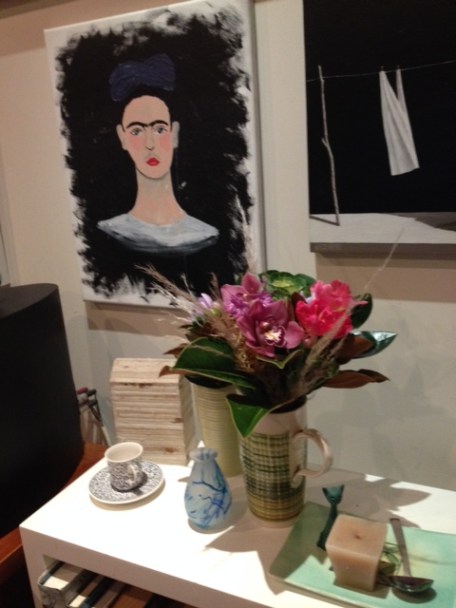
Frida Kahlo by my daughter, Estelle Hight
125 years ago today many but not all New Zealand women got the vote.
I have waited until today to let this sink in and react
I am sitting here at my kitchen table with the grey clouds and a bite
in the air thinking of our early women poets who held hands with
the English suffragettes and risked their words to shape a better
future for all women by writing and speaking out and imagining
an equal life for women without violence and without poverty
and without being spoken over or patronised or ignored
on the grounds women were not men’s equal. I am thinking
this and the way I have a support crew of women who have held
my hand over the past year through difficulty and celebration
and I am wondering how we are risking words to shape
a better future for all women by writing and speaking out
and imagining lives without violence or poverty or denigration
or erasure or inequity and I am thinking of Selina Tusitala Marsh
and Tusiata Avia who have held my hand in this tough year
and who stand tall and proud for all women but especially
Pasifika women and speak out about abuse be it physical
or emotional and who then stand even taller and show
how words can sing and who get young Pasifika
women singing and I can feel the chain of hands stretching
back through a line of women writing to Blanche Baughan
and Jessie Mackay and I can feel the hand of Airini Beautrais
who is brave in her writing and Dinah Hawken who showed
me the tug of war between men and women and the way they
let the rope go and the way Fiona Farrell gave voice to her
broken city and we could hear the small stories of living
and here I am taking stock and giving thanks to the women
who came before me and giving thanks for my vote
and my freedom to choose education and motherhood
but thinking then of my notfreedom within medical systems
that know best and education systems that let children down
and clamp the Arts and the way even now our voices might
be trampled upon when we don’t sing in harmony. I am thinking
we bake bread and we buy bread and we get married and we don’t get married
and we live with women and we live with men and we hang out washing
and soothe the troubled child and we change gender and we go to work
and fold the clothes and get bruised and make the money stretch and make dreams
and try to keep warm and run away and chop the wood and get degrees
and we hold hands and we keep holding hands because there is strength in difference.
This year has almost wiped me out or so it feels but to sit here at the kitchen table and
reflect back on those brave early women who never gave up and who embraced shrill
and loud and forceful puts me back with the wind blowing through the manuka
back to that moment when I wrote a poem for Neve and her parents
and the world felt full of hope because kindness is just as important as strength.
Written in one breath by Paula Green, 19th September 2018, Bethells Valley, Waitakere

A new Foundation established by the Auckland Writers Festival aims to strengthen Aotearoa’s literary landscape.
The Mātātuhi Foundation, launched this evening, will provide opportunities for New Zealand writers to develop and promote their works and for readers to increase their engagement with the work of local writers and will fund activities that contribute to literacy in this country.
Auckland Writers Festival Chair, Pip Muir says the launch of the Mātātuhi Foundation is the next step in the realisation of a long-held dream.
“When the Festival began almost 20 years’ ago, meetings were held around a kitchen table. Since then, the appetite to engage with writers from New Zealand and around the world has grown exponentially and with it the opportunity to deepen our commitment to our literary landscape.
“It is absolutely fantastic that the Festival has reached a point where it can further contribute to the national reading and writing community. We are thrilled to be able support the nation’s literature with the launch of this ground-breaking initiative.”
The Foundation will operate independently of the Auckland Writers Festival Trust and initially aims to make up to ten one-off grants of $2000 – $5000 per year whilst building an endowment platform to support its long-term endeavours.
Inaugural Committee members are professional director and senior finance executive Anne Blackburn (Chair), writer and academic Paula Morris, Festival Trust Board Chair and lawyer Pip Muir, Auckland Writers Festival Director Anne O’Brien and country head of Chartered Accountants Australia and New Zealand and Book Council board member Peter Vial.
Ms Blackburn says she relishes the opportunity to work with an organisation that supports New Zealand literature. “I very much look forward to receiving applications from groups that seek to engage more readers and also from our writers, whose words and ideas enrich our lives.”
Applicants are invited to submit expressions of interest twice a year, with deadlines of 31 October and 31 May.
For further information please contact Penny Hartill, hPR, 021 721 424, penny@hartillpr.co.nz
Leaving Bass Rock gannet colony
After skypointing to show
it’s ready
after one last dive, shorting the sea
(the crack, the pressured current fizzing)
after one last moment of great aloneness: a fleck
in oceans
after the last fish in its gut –
the fin and skin and bone of it – tears apart
it takes a final flight, blowing
Bass Rock into the feathery pieces we call
aura or
atoms we called
father or
Adam
©Lynn Davidson
This poem was was published in New Writing Scotland 35. Bass Rock is a rock/island in the Firth of Forth. It’s a huge gannet colony and has a long and interesting history of human habitation too.
Lynn Davidson writes poetry, fiction and essays. Her latest poetry collection Islander will be published by Shearsman Books and Victoria University Press in 2019. Lynn currently lives in Edinburgh.
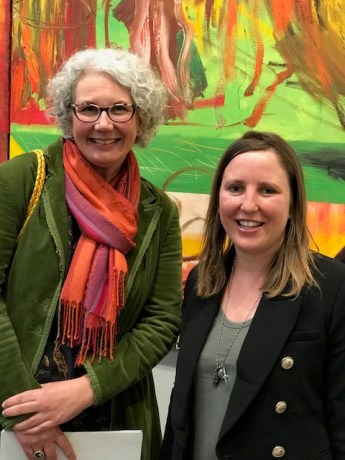
Judge Elizabeth Morton and winner Gillian Roach
Gillian Roach is this year’s winner of the NEW VOICES – Emerging Poets Competition.
Post-graduate student of the Masters in Creative Writing, AUT. Roach is an Auckland poet and fiction writer who recently completed the Masters In Creative Writing course at AUT. She studied English Literature and Language at Victoria University and has a diploma in journalism.
Her poem ‘A boy says he has no say’ was described by this year’s judge Elizabeth Morton as, “a delicate poem, with an enviable lightness of touch. The movement from one stanza to the next is gentle‚ and the suburban scenes, with hedges and lemon tree‚ are delightfully familiar. But this is also a poem with grit and a sadness ostensible if you rub away at the props. The deeper unfoldings are not explicit‚ but it is clear there is a turn of darkness here – ‘disappointment’‚ the neighbours ‘gathered in mourning’ and the ‘dead duck head down in murky summer’‚ the ‘small sadness … neither fruit nor bud’. This poem is a gut-punch, and kept igniting questions. Each time I read it I felt closer to its truth.
Runner-up: PATRICIA HANIFIN (ex student of AUT, lives in Auckland)
Has had work published in Turbine, Flash Frontier, Headland and others. In 2014, she was runner up in National Flash Fiction Day (NZ) competition. She’s recently completed a novel, Ghost Travellers.
Morton described her poem On being silent too long as, visceral and urgent, thick with the fluids and salts that flesh entails. It is a poem of the untouched and unspoken, of the once ineffable backlog of words that come flooding out with a sort of violent energy. There are old tropes re-fangled and sutured together to create something vital and fabulist – there are wolves at the door, salt in the wounds, a crown of thorns. This poem commands attention and wears its fierceness like a medallion.
Elizabeth Morton said she was “gobsmacked by the attention and craft of the sixty poems in the menagerie. There were critters of all types – long, squat, form-driven and free-range. There were beasts of poems, poems that slunk and yowled, poems that tipitoed, and many poems that pounced in the last couple of lines, leaving me whiplashed, winded, awestruck. I found lines that could be printed on t-shirts. I found time-travel – both back and forward – nostalgic reminiscence, to climate change and apocalypse. There were poems that spoke to their creators – poems that had seen terrible things, poems that asserted a finger in the face of dissension and adversity, poems that coexisted with pain. There were poems I wanted to talk to over a cup of tea. There were poems I wanted to hug. There were so many poems that were vulnerable, took risks, ached at my heart – and yet many of these were left without placings, without chairs to sit. There are so many good poems standing awkwardly by the door because I just couldn’t keep adding commendations.”
Highly Commended
Lincoln Jaques – Undertaking a Master of Creative Writing Student, AUT
Sarah Scott – from Wellington is studying for her Masters in Art History at the University of Auckland
Commended
Savannah Mouat – Studying Pschycology at Massey University’s Albany Campus.
Daniel Nissen-Ellison – Studying Art and English at the University of Auckland.
Lydia Chai – is studying law at the University of Auckland
 NZ Poetry Shelf