Category Archives: NZ poetry

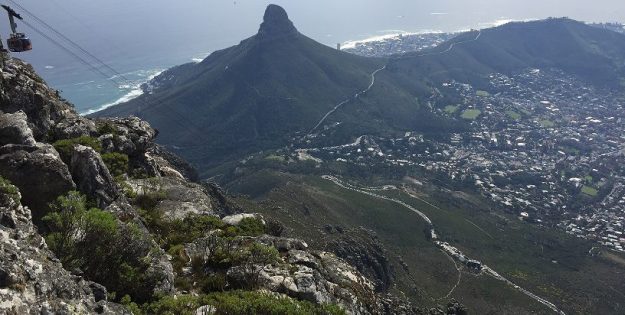
On ANZL – Letter from Cape Town: Selina Tusitala Marsh on coconuts and colonialism

IMG_4295-816x412.jpg
Selina Tusitala Marsh has written an account of her recent visit to Capetown that includes poems and journal prose. It has just been posted on the Academy of New Zealand Literature site.
 

The full here.

A brief extract:

Nearly There

There’s a poem that needs finishing. It began in London and will end in Cape Town. It started on the night of March 14 after a conversation with Prince Philip, the Duke of Edinburgh, at Malborough House. I had been commissioned to write and perform a poem for Queen Elizabeth II, Head of the Commonwealth, for Commonwealth Observance Day on behalf of its 53 member states. After the Westminster gig we were invited back to one of the palaces, where I met the Duke of Edinburgh and had the following exchange:

‘Good evening, Your Highness.’

‘Yes. And what do you do?’

‘I’m a poet.’

‘Yeeess. But what do you dooo?’

‘Oh, I teach postcolonial literature at the University of Auckland in New Zealand.’

Cocking his head and holding my gaze, the Duke replied, ‘Post?

Slight smirk on his face, he then moved on down the line to other greeters.

After sharing this story with some poets, it was suggested that I record the conversation and turn it into an audio poem, capturing as many people with as many different accents saying the word ‘post’. I said I could do one better, that in July I was going to the Association of Commonwealth Language and Literature Studies conference in South Africa. There, I’d have Commonwealth representatives galore to give me their own accented enunciations of ‘post’: ‘POST!’ ‘post –‘, ‘post?’, ‘PoSt’, ‘Post!’, ‘P**T’, and perhaps even ‘!//post’ (if there were any Khoisan speakers around).

So, I’m off to Cape Town to finish a poem, write some poetry, and give my conference paper on an experiment where I apply avante garde poetry techniques (a mixture of Found Poetry, Erasure Poetry and Open Field Composition) by blacking out Albert Wendt’s classic 1977 novel Pouliuli (which happens to mean ‘black’, ‘void’ and refers to a metaphysical darkness). I’m also running a poetry workshop with Glen Arendse, a Boesman Mouthbow musician (the hunting bow is also a traditional instrument of the San Boesman – yes, think The Gods Must Be Crazy, then think again).

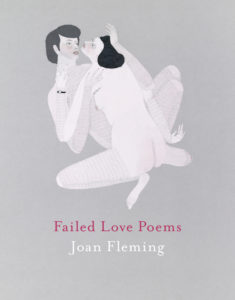
Landfall Review Online showcases great writing (reviewer and the poets): Elizabeth Morton on Joan Fleming Dinah Hawken Claire Orchard

failed_love_poems_fleming-235x300


Full review here

On Joan Fleming: Failure makes lemonade; slams one door only to shake others open – sometimes. Failure has a knack of forcing its protagonist down substitute alleyways, leaving one to navigate unorthodox routes in pitch black. Joan Fleming’s latest collection, Failed Love Poems, is about Love, but more so, it is about a lengthy, howling procession of Loves gone kaput. There is love clinging on by tooth-strings, love in absentia, love as apology, love treading on eggshells, love cemented in verse, and love that ebbs in spite of itself.

Book Launch: Jenny Bornholdt’s new poems and Ashleigh Young’s essays


Victoria University Press warmly invites you to the launch of

Selected Poems
by Jenny Bornholdt

&

Can You Tolerate This? Personal Essays
by Ashleigh Young

6.00pm–7.30pm, Thursday 11 August
at Unity Books
57 Willis St, Wellington.
All welcome.

Buy both books on the night for only $60 (normally $70).
This offer applies at the Unity Books launch only.

For more information click on the titles below:
Selected Poems by Jenny Bornholdt
$40, hardback
Can You Tolerate This? Personal Essays by Ashleigh Young
$30, paperback

Out and About with ‘Iris Dreaming’


Published on YouTube Jul 25, 2016

Robin Hyde – who was born Iris Wilkinson – was one of the greatest poets in New Zealand. But her eventful life, which took her to war-torn China and to London on the brink of World War Two, was rocked by trauma and crisis.

Listening to Frank O’Hara


Listening to Frank O’Hara


Josephine is a tourist and wants to do things spontaneously like go into Jackson McNally and buy Laura Solomon or Short Talks or listen to Frank O’Hara read why he’s not a painter on YouTube, but all she finds is a heartbreaking rendition of ‘Having a coke with you,’ read cigarette in hand, in that melodic voice, American accent dipping and pausing until he asks indirectly, what good is art when all he sees is paint just paint, and his lover all movement, ah such movement and the face, hot beyond portraiture. You need the right person beside the right tree in the right light in the right city and this is love. She hears that and reads of his death.


© Paula Green New York Pocket Book Seraph Press 2016


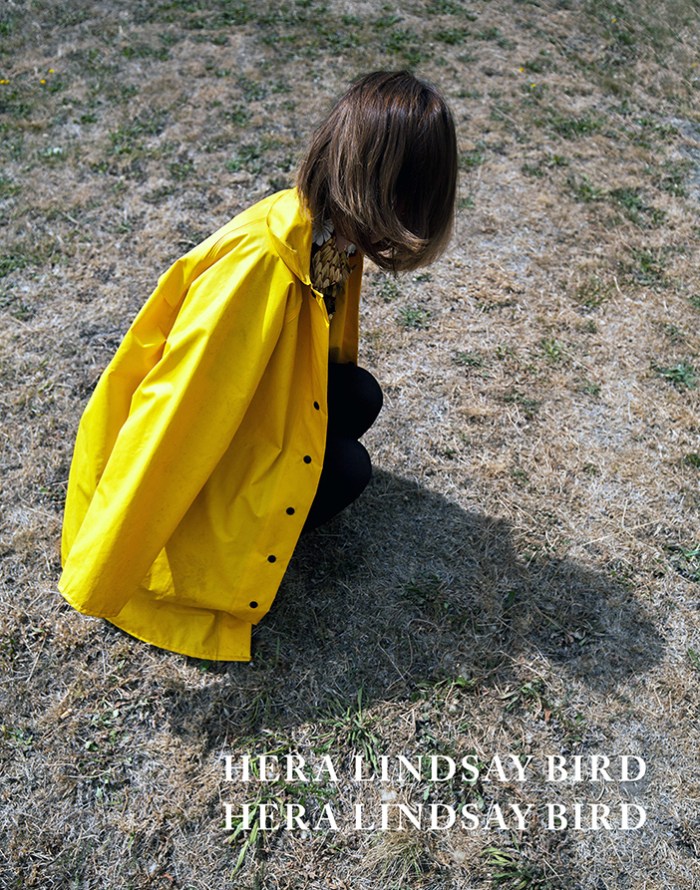
Is Hera Lindsay Bird a flash in the pan?

ca5ff196-de28-4704-a12b-2d6a1292d767.jpg


‘All I care about is looking at things and naming them’

‘I love life’

Hera Lindsay Bird Hera Lindsay Bird, Victoria University Press, 2016


For the past week or so, after visits to our key research libraries,  I have been writing about Jessie Mackay, a founding mother of New Zealand poetry. What I am writing is under wraps but my relationship with both the woman and her poetry is not clear cut. She moves me, she astonishes me, she irritates me, but I am always filled with admiration. One question bubbling away is: how different is it for women writing over a hundred years later?  Sure, contemporary poems are like a foreign country, we have changed so much. But what of our behaviour as poets? Our reception? What feeds us? What renders us vulnerable and what makes us strong?

I want to draw a pencil line from Jessie Mackay to Hera Lindsay Bird and see what I can peg on it. But I want to save these thoughts for my book.

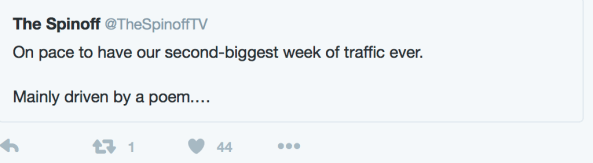
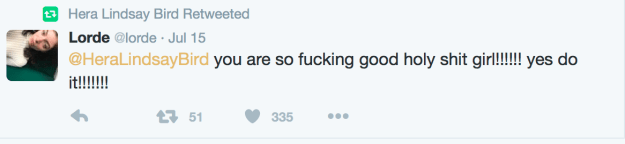
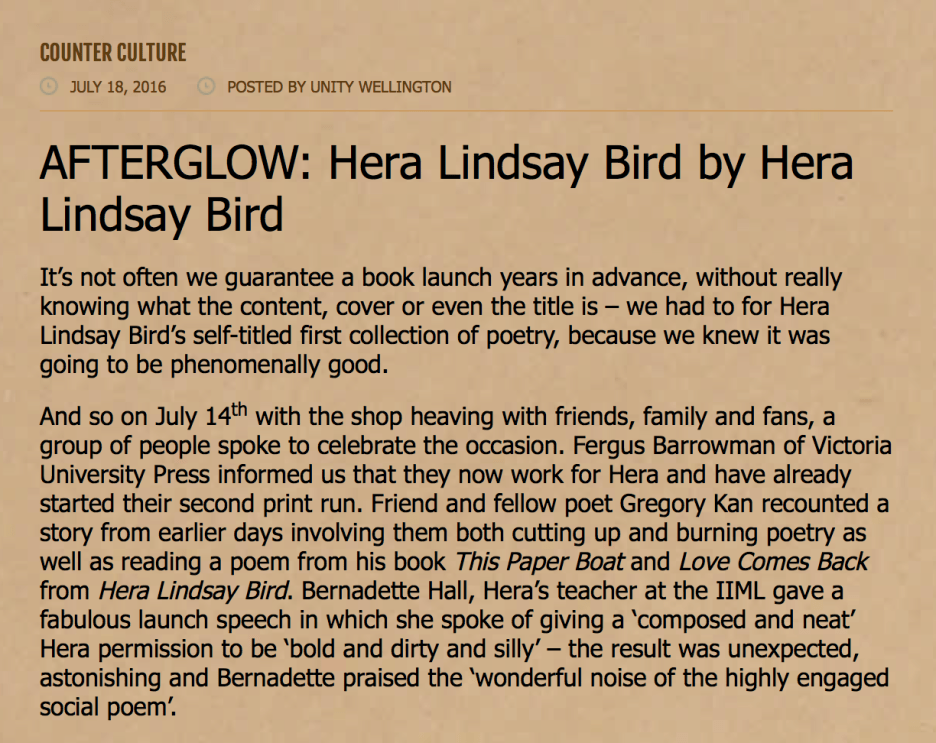
Hera Lindsay Bird has attracted the biggest hoo-ha with a poetry book I can recall. It felt like I was witnessing the birth of a cult object. Images of the book cover on the side of a bus or a building (photoshopped?!?!) created a little Twitter buzz. Lorde tweeted. Anika Moa tweeted. Tim Upperton reviewed it on launch day on National Radio. Interviews flamed the fan base on The Spin Off, The Wireless and Pantograph Punch. The interviews promoted a debut poet that is hip and hot and essential reading. Poems posted have attracted long comment trails that apparently included downright vitriol (I haven’t read these and I think just applied to one poem). The Spin Off cites this as one of a number of factors in the shutting down of all comments on their site. The launch was jam packed, the book sold out, and took the number one spot on the bestseller list. Hera is a poet with attitude. Well, all poets have attitude, but there is a degree of provocation in what she says and writes. Maybe it’s a mix of bite and daring and vulnerability. Just like it is with JM, Hera’s poetry moves, astonishes and irritates me, but most importantly, it gets me thinking/feeling/reacting and prompts admiration.


A few thoughts on Hera Lindsay Bird by Hera Lindsay Bird


This book is like rebooting self. Each poem reloads Hera. Click click whirr.

At first you might think the book is like the mohawk of a rebellious punk who doesn’t mind hate or kicking stones at glass windows or saying fuck at the drop of a hat.

The word love is in at least two thirds of the poems. It catches you at times with the most surprising, perfect image:

‘when we first fell in love

the heart like a trick candle

on an ancient, moss-dark birthday cake’


‘it’s love that plummets you

back down the elevator shaft’


You could think of this book as a handbook to love because Hera doesn’t just write love poems, she riffs on notions of love:

‘It’s like falling in love for the first time for the last time’

or: ‘What is there to say about love that hasn’t already been’


Some lines are meant to shock you out of reading lethargy:

‘I feel a lot of hate for people’

or: ‘My friend says it’s bad poetry to write a book’

or: ‘Some people are meant to hate forever’


or:

‘It’s a bad crime to say poetry in poetry

It’s a bad, adorable crime

Like robbing a bank with a mini-hairdryer’


Hera reads other poets and uses them as springboards to write from: Mary Ruefle, Bernadette Mayer, Mary Oliver, Chelsey Minnis, Emily Dickinson.

Sometimes the book feels like a confessional board. Poetry as confession. It hurts. There is pain. There is always love.

This poetry is personal. Poems (like little characters) interrupt the personal or the chantlike list or the nettle opinion the honey opinion as though they want a say and need to reflect back on their own making, if not maker.

Love hate sex girlfriends life death: it is not what you write but how you write it that makes a difference, that is the flash in the pan, not to mention the pan itself.

Hera writes in a conversational tone, sometimes loud, sometimes quiet, as though we are in a cafe together and some things get drowned out but the words are electric and we all listen spellbound.


She uses excellent similes. On poetry:

‘This is like an encore to an empty auditorium

It’s a swarm of hornets rising out of the piano’


‘Neither our love nor our failures will save us

all our memories

like tin cans on a wedding car

throwing up sparks’


‘I can only look at you

Like you are a slow-burning planet

And I am pouring water through a telescope.’


Hera likes to talk about bad poems; like the wry punk attitude that says look at my bad style. I am not convinced that there is much in the way of bad poetry here unless you are talking about a vein of impoliteness. It kind of feels like a set of Russian dolls – inside the bad poetry good poetry and inside that the bad and then good and so on and so forth. There is always craft and the ears have been working without fail.

One favourite poem in the book is ‘Mirror Traps’ but I am saving that for the Jessie Mackay pencil line.

Hera’s sumptuous book comes out of a very long tradition of poets busting apart poetic decorum, ideals and displays of self. It’s a while since we have witnessed such provocation on our local poetry scene. What I like about this scintillating writing is that each poem manifests such a love of and agility with words — no matter how bad it tries to be. It is addictive reading. Yes there is a flash that half blinds you and spits searing fat along your forearms, but you get to taste the sizzling halloumi with peppery rocket and citrus dressing.


‘I love to feel this bad because it reminds me of being human

I love this life too

Every day something new happens and I think

so this the way things are now’


PS I adore the cover!

Hera Lindsay Bird has an MA in poetry from Victoria University where she won the 2011 Adam Prize for best folio. She was the 2009 winner of the Story! Inc. Prize for Poetry and the Maurice Gee Prize in Children’s Writing. She lives in Wellington with her girlfriend and collection of Agatha Christie video games.


Poem: ‘Everything Is Wrong


Screen Shot 2016-07-23 at 1.40.53 PM.png


Screen Shot 2016-07-23 at 1.40.12 PM.png


Screen Shot 2016-07-23 at 1.42.56 PM.png


Screen Shot 2016-07-23 at 1.41.59 PM.png

Screen Shot 2016-07-25 at 3.42.24 PM.png

mxb160714-HLB06D0134-1024x683.jpg

1779473_722846587735015_2139168024_n1.jpg


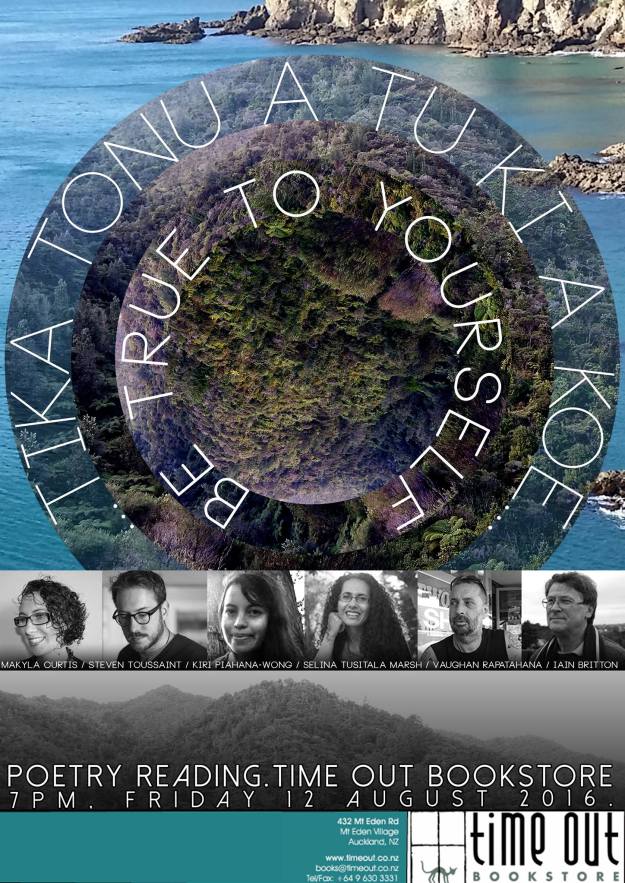
Be True to Yourself: Timeout Bookstore Poetry Reading

13701223_509189825943412_8019241691609010191_o.jpg


Time Out Bookstore, Poetry Reading

Friday 12 August at 7pm.

The line-up includes:
Makyla Curtis
Steven Toussaint
Kiri Piahana-Wong
Selina Tusitala Marsh
Vaughan Rapatahana
Iain Britton

This is a BYO event. Come relax, have a drink and listen to some fantastic poetry!

Hope to see you there!

Morning Shivers, Fierce Light, Unmissable: Bill Manhire’s poem, Suzie Hanna’s short film


Part of Fierce Light

Poem:  Bill Manhire

Animator:  Suzie Hanna

Voice:   Stella Duffy

Sound Design:  Phil Archer


Fierce Light brought together leading poets from countries that participated in the First World War, including Yrsa Daley-Ward, Jackie Kay, Bill Manhire, Paul Muldoon and Daljit Nagra, to create new works that endeavour to understand the incomprehensible; exploring contemporary events while also contemplating the First World War. These works were presented alongside a series of specially commissioned short films, each made in response to the new poems and themes raised within them.

Co-commissioned by 14-18 NOW, Norfolk & Norwich Festival and Writers Centre Norwich

Poem also appeared on BBC Radio 3


This is so moving; so perfect in its simplicity and rhyme, its flickering images, as though the past can never settle, always slightly out of grasp, the resonant voice drawing us in, the physical detail also flickering with heartbreak and static. It is one story and it is manifold. This is what poetry can do when it meets up with an animator. Memorable. PG

Happy Birthday Sam Hunt

Radio NZ has produced a small video of Sam Hunt reading a few poems  from his new collection, Salt River Songs. It is a perfect snap shot of Sam at home in the Kaipara, and of the lyrical joy of his poetry. Altogether mesmerising.

h a p p y   b i r t h d a y  S a m Hunt, you are our poetry icon extraordinaire, and poetry in New Zealand would not be the same without you. We grew up with Sam-Hunt poems sizzling and simmering in our blood.

T h a  n k   y o u !