Category Archives: NZ poetry

Poetry Shelf guest spot: Rhian Gallagher selects Cilla McQueen’s ‘Low Tide, Aramoana’


Low Tide, Aramoana


Sky with blurred pebbles

a ruffle on water


sky with long stripes

straight lines of ripples


sky-mirror full of

sand and long pools


I step into the sky

the clouds shiver and disappear


thin waterskin over underfoot cockles here and there old timber

and iron orange and purple barnacled crab shells snails green

karengo small holes


I look up from walking at

a shy grey heron on

the point of flight.


oystercatchers whistle stilts and big gulls eye my quiet

stepping over shells and seaweed towards the biggest farthest

cockles out by the channel beacon at dead low tide


It’s still going out.

I tell by the moving

of fine weeds in

underwater breeze.


takes a time to gather these rust and barnacle coloured  whole

sweet mouthfuls


Low.

and

there’s a sudden


wait


for the moment

of precise

solstice: the whole sea

hills and sky

wait


and everything

stops.


high gulls hang seaweed is arrested the water’s skin

tightens we all stand still. even the wind evaporates

leaving a scent of salt.


I snap out start back get moving before the new tide back

over cockle beds through clouds underfoot laying creamy

furrows over furrowed sand over flats arched above and below

with blue and yellow and green reflection and counter reflection


look  back to

ripples

begun again.


Cilla McQueen


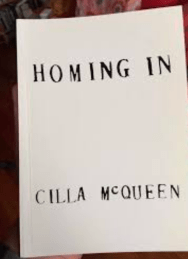
from Homing In  (McIndoe, 1982), also published in poeta: selected and new poems (Otago University Press, 2018)


From Rhian Gallagher

Sometime in the early 1980s I heard Cilla read ‘Low Tide, Aramoana’ on TV. I was utterly spellbound.

Cilla does not so much read her poems as enact them. They seem written to a music score, a sound choreography. Her work is also very visual and ‘Low Tide, Aramoana’ is a big canvas.

Whatever expectations the title sets up are given a tilt at the outset. For it is not the tide that is encountered but the sky. It is a simple notion, the sky being reflected in the water, but I experience it in the poem as if it were a brand new thing and

‘I (too) step into the sky’

In more than one way ‘I step into the sky’. The tides are a condundrum, taking place on earth yet the movement is being conducted by the moon and sun. The spaciousness of the poem on the page has me feeling this mystery all over again — my mind is up there with the moon and the sun.

The meditative opening lines are followed by a hurried, heaped-up rhythm, detailing forms and life-forms encountered on the sand flats:

‘thin waterskin over underfoot cockles here & there old timber/& iron orange & purple barnacled crab shells snails green karengo small holes’

This alternating rhythmn shapes the poem. It is a movement from a contemplative interior to the external world and back again, flowing in and out, almost as a tide itself.

On one level this is a foraging poem: going ‘out to the channel beacon at dead low tide’ for ‘the biggest farthest/cockles’. Foraging is also a metaphor for the making of the poem: the gathering is going on right from the first footstep onto the sandflats and the poem is, indeed, made of ‘whole/sweet mouthfuls’.

Some decades past before I heard Cilla read this poem again, at the Dunedin Writers Festival. It was almost eerie. The poem has a tipping point. It takes us there, way out to the edge – a brink of change, when something amazing (or horrendous) is about to happen. That moment when ‘we all stand still’.

I may risk overloading the achieved simplicity of the poem. The environment it brings to life, the multiple invocations it sets going in me, is why it has stayed close. Cilla’s pared-down language and accessibility belies an underlying multi-layered sophistication. ‘Low Tide, Aramoana’ has never given up all its secrets.


Rhian Gallagher


Rhian Gallagher‘s debut poetry collection Salt Water Creek (Enitharmon Press, 2003) was shortlisted for the Forward Prize for First Collection while her second collection Shift, ( 2011/ 2012) won the 2012 New Zealand Post Book Award for Poetry. Gallagher’s most recent work Freda: Freda Du Faur, Southern Alps, 1909-1913 was produced in collaboration with printer Sarah M. Smith and printmaker Lynn Taylor (Otakou Press 2016). Rhian was awarded the Robert Burns Fellowship in 2018.

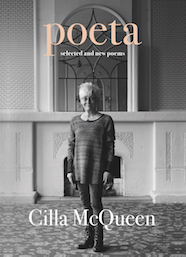
Cilla McQueen is a poet, teacher and artist; her multiple honours and awards include a Fulbright Visiting Writer’s Fellowship 1985,three New Zealand Book Awards 1983, 1989, 1991; an Hon.LittD Otago 2008, and the Prime Minister’s Award for Literary Achievement in Poetry 2010. She was the National Library New Zealand Poet Laureate 2009 -11.  Recent works include The Radio Room (Otago University Press 2010), In A Slant Light (Otago University Press, 2016), and poeta: selected and new poems (Otago University Press, 2018).
 

otago693326-1.jpg   Screen Shot 2019-04-23 at 3.33.19 PM.png


Poetry Shelf review: Lynn Davidson’s Islander

Islander__83638.1547675687.jpg


Lynn Davidson Islander Victoria University Press 2019


Time goes slower in the sea

and faster in the mountains.

Physics has taken over

where poetry left off.


from ‘Pearls’


Lynn Davidson’s terrific new poetry collection, Islander, travels between Scotland and New Zealand, between the place she grew up (Kapiti, Wellington) and the place she now lives (Edinburgh). Divided into five parts the poems move amidst light, fire and earth. Like Dinah Hawken, Lynn pays close attention to the world about her, the physical world, the inhabited world, a world buffeted by weather, seasons, time. Her poems are layered and fluent and measured.

The opening poem, ‘My stair’, sees the speaker (the poet?) looking out, in an eerie night light, from her second-floor window onto the bus depot. She evokes a scene through pitch perfect detail and a surprising simile (‘buses lightly lumber / into the yellow depot / like bubbles back / into solution’). But the surprise for me, the point of ruffle and ripple, is the mention of the father:


My father’s heart is failing, he fills up


with fluid (like an empty bus fills up with light?)

I look for flights.


One of the pleasures of this collection is the eclectic movement. There is movement born from departure, from the sway between presence and absence, birds in flight, the ripple of water, the movement of a musing and contemplative mind. A number of poems struck me. ‘A hillside of houses leave’ is mysterious, magical and rich in movement. Like many of the poems, there is a link to birds that might be symbolic but that is always physical.


Steeped in old weather the wooden houses

remember their bird-selves and unfold

barely-jointed wings.


The poem holds the conundrum of life – its impermanence, its fragility and the little anchors, the necessary bones.


People curl inside

the bones that keep them

that will not keep them long.


The presence of birds is fitting in a collection that navigates islands – the birds might signal the ocean’s presence, the multiple flights, the multiple nests, the bird on the poet’s sight line, the bird carried by heart, the bird house and the bird lungs.

I began to see the collection as a poetry chain; where this poem rubs against that poem and that poem rubs against this. Here the light of this day touches the light of that day which touches the light of the day before all the way back to ancient times. Dinah has a poem dedicated to her and I am reminded of Dinah’s ability to evoke the spare and the luminous within a cluster of lines that then open out with absorbing richness. Lynn is similarly dexterous. This from Lynn’s ‘Bonfire’:


The mainland is rendered down

silvers and is gone.


My heart is green and raw – a pea not a heart –

front to the fire back to the wind.


The groan of stone on stone unsettles

me as I unsettle them.


Islands is also inhabited with daily lives, with anecdote and incident, thus rendering landscape humane as well as wild and beautiful. At times it made me laugh out loud as in ‘Lineage’:


I was nine months pregnant, and waiting, when the man in the

Taranaki airport shop snapped this isn’t a library you know,


and when I turned my great belly full of fingernails and teeth-in-bud

towards him he asked (hotly) if I was actually going to buy anything.


The baby made exclamation marks with its soft bones,

glared with its wide open eyes – two Os. No I said I won’t buy


my news from you.


Lynn traces family, the children who leave, the children who make home solid, the unnamed boy who names home hame, the children half a hemisphere away. This from ‘Leaving Wellington’:


Hours go by and elements still gather.

Each day my waking children, just by naming

assembled all the solid things of world:

the bath, stove, chair, the bed, the window,

the shoe, the dinosaur, the door, the wall.

Then in a kind of via negativa

they composed two empty rooms by leaving home.


I said it was an anchor but it’s not.

It’s a shadow roughly like a kiss.


This is a book to slow down with – just as you slow down when you walk the perimeter of an island – gazing into a shifting sky vista and towards the unreachable but alluring horizon line  –letting your own thoughts cascade and catch. It is a book where the view of a poem never settles but keeps revealing new lights, new joys, new surprises. I love this considered pace, this sharp revelation, this anchored heart. I love this book.


Victoria University Press author page


Lynn Davidson is the author of four collections of poetry, most recently How to Live by the Sea (2009, VUP) and a novel, Ghost Net, along with essays and short stories. She grew up in Kāpiti, Wellington and currently lives in Edinburgh.


Poetry Shelf Monday poem: Simone Kaho’s ‘Tour’


Tour

The crows will be her friends.
They are waiting on powerlines in the rain.
It’s exciting to be in another country with different birds even if they’re black and mawkish, and it’s only England, so kind of coming home.
‘Do they think dark thoughts?’
He comes back from training and through unspoken agreement she holds him at bay, at first.
Later, he says – ‘You held me off just the right amount’.
It’s the only kind thing he says all day.
She watches British bunnies run across the green British lawn in the British mist, into a British hedge.
That evening New Zealand loses.
Someone has scrawled a rude note for him on a napkin, he sees her looking and says
‘You’re laughing’.
She’s not.
She wishes she could.
I don’t wonder how he is doing she thinks ‘Now’.
It doesn’t even creak.
Her heart pulp; memories.
The overwhelming smell of little old ladies’ heads at mass at the Vatican.
Crouching down between acres of knees.
Him lifting her onto his shoulders, in fresh air above the churchgoers, with her battered face and oversized sunglasses.
Pope John Paul passing so close in his glass cartoon car, she could have reached out and left a fingerprint.
Her queen wave.
The ornate courtesy of him helping little old ladies over the barricades.
His beaming, bashful, face, which had gotten battered too.
Him walking straight into the Vatican while a two-mile line formed behind.
Both kneeling before the Michelangelo, not noticing marble Mary was the same age as Jesus.
Noticing nothing but the stillness of her chest
until he shifts beside her
and she wants to take it all back,
the gravel in her face,
the gravel in his.
The bottles she threw at the hostel, his blazed green eyes on the bottom bunk as the cops knocked.
The contrite blowjob in the church graveyard behind the homestay.
I can’t help being helpless, your contempt is not helping me.
She rolls her eyes as he slaps her.
That vein in his forehead is pulsing again and in a way, it has something to say and no one knows any better and
she wishes he hadn’t thrown stones at her window
and she hadn’t opened it
and he hadn’t climbed in
and she wishes she had knees instead of jelly and
she wishes she could put her heart out of her body and
let it live wild in the bush


Simone Kaho


Simone Kaho is a New Zealand poet of Tongan descent. She was born in Auckland and received an MA in creative writing from the International Institute of Modern Letters at Victoria University of Wellington.


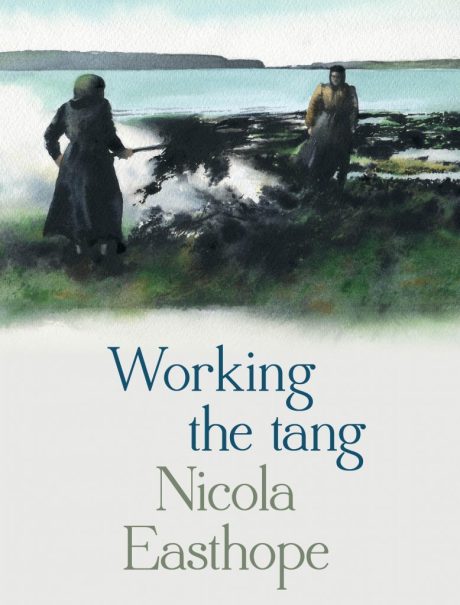
Poetry Shelf audio spot: Nicola Easthope reads ‘Kitesurfing’


Working-the-tang-front-cover-updated-778x1024.jpg


Nicola Easthope reads ‘Kitesurfing’ from Working the Tang The Cuba Press, 2018


Nicola Easthope is a teacher and poet from the Kāpiti Coast. Her first book of poems, leaving my arms free to fly around you, was published by Steele Roberts Aotearoa in 2011. ‘Working the tang, Birsay’ is inspired by her Orcadian roots and the etymologies and experiences of the Norse word for seaweed (among other things). She was a guest poet at the Queensland Poetry Festival in 2012, and at the Tasmanian Poetry Festival in October 2018.

The Cuba Press page


Poetry Shelf Classic Poem: Kiri Piahana-Wong picks Hone Tuwhare’s ‘Toroa: Albatross’


Toroa: Albatross


Day and night endlessly you have flown effortless of wing

over chest-expanding oceans far from land.

Do you switch on an automatic pilot, close your eyes

in sleep, Toroa?


On your way to your home-ground at Otakou Heads

you tried to rest briefly on the Wai-o-te-mata

but were shot at by ignorant people.

Crippled, you found a resting-place at Whanga-nui-a-Tara;

found space at last to recompose yourself. And now


without skin and flesh to hold you together

the division of your aerodynamic parts lies whitening

licked clean by sun and air and water. Children will

discover narrow corridors of airiness between, the suddenness

of bulk. Naked, laugh in the gush and ripple—the play

of light on water.


You are not alone, Toroa. A taniwha once tried to break out

of the harbour for the open sea. He failed.

He is lonely. From the top of the mountain nearby he calls

to you: Haeremai, haeremai, welcome home, traveller.

Your head tilts, your eyes open to the world.


Hone Tuwhare


Originally published in Mihi: Collected Poems (Penguin, 1987) and subsequently published in Small Holes in the Silence: Collected Poems (Godwit, 2011). Published with kind permission of the Estate of Hone Tuwhare.


Note from Kiri:

Hone Tuwhare has written so many beloved and iconic poems, but for me, this poem ­– ‘Toroa: Albatross’ – has always particularly resonated. It’s a poem about a bird that is so much more than a poem about a bird. The poem speaks of death, loneliness and homecoming. It crosses effortlessly from the physical world into the metaphysical. When I read this poem, I hear the voices of my departed tūpuna calling from the other side. I hear the ineffable beat of wings.


Kiri Piahana-Wong, Ngāti Ranginui, is a poet and editor, and is the publisher at Anahera Press. Kiri is currently working on the fourth edition of Māori literary journal Ora Nui, due out this September.

Hone Tuwhare (1922- 2008) was a father, poet, political activist and boilermaker. He published at least thirteen collections of poetry, won two New Zealand Book Awards, held two honorary doctorates and, in 1999, was Te Mata Poet Laureate. In 2003 he was named an Arts Foundation of New Zealand Icon Artist.


9781869795788.jpg


Poetry Shelf noticeboard: Gregory O’Brien’s launch speech for Richard von Sturmer’s Postcard Stories

9781877441622.jpg


POSTCARD STORIES…a launching speech, VicBooks, Wellington, 12 April 2019


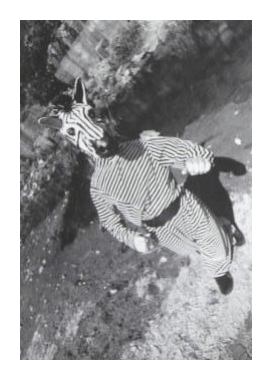
It’s over thirty years ago since Richard von Sturmer appeared on the cover of Robert Cross’s and my book about New Zealand writers Moments of Invention. Back in 1987 I remember Richard suggesting that Robert photograph him in his ‘most natural habitat’. So we went to Smales Quarry, near Lake Pupuke—a flooded, desolate, you could almost say post-apocalyptic zone—a lunar landscape with the occasional sprig of kowhai. After spending quality time in a trench-coat and mask (as the ‘Neanderthal businessman’ character, Mr Chipden), Richard donned striped overalls and a papier mache zebra-head.

Screen Shot 2019-04-17 at 7.43.56 AM.png

Was the zebra outfit a uniform or a disguise—an act of self-expression of concealment? Either way, the photo on the book’s cover raised the question, for me, of how it might be that writers, more generally, fit into this world. Richard was, and still is, proposing we should all look, listen and think beyond the obvious. Maybe the lesson of Smales Quarry is that we should look for answers in the direction of archaeology or possibly the analysis of dreams, rather than in the realms of sociology, cultural history or literary theory. The cover photo of Richard, zebra-headed and humanimal (in the adjectival sense), begged the question whether the life of the writer is ultimately an absurdity, a theatrical production or maybe even an inexplicable folly. More than anything else, the image reminds me of one characteristic of all good writers: they are up to something. They ask that we follow them somewhere new and surprising. ‘I think we should go into the jungle,’ as Barbara Anderson would have put it. Their jungle.

The cover photo was taken shortly after the appearance of Richard’s We Xerox Your Zebras appeared—a book which has long been something of a cult classic and which, infamously, upon publication prompted threats of legal action from Rank Xerox Corporation, on account of copyright infringement. Still in his twenties, Richard’s creative trajectory as a genre-bending, world-expanding writer was set, as was his now longstanding allegiance with, and commitment to, the unexpected, the odd and the illuminating. He struck me then, as he strikes me now, as an improving influence not only on the world of letters but on the world itself.

Over the three decades since then, there have been collections of poems from Richard and –to much-deserved acclaim upon its publication three years ago–a memoir about his father and grandfather, This Explains Everything. Yet, as the new book reiterates, nothing is ever really explained. Explanation is too often simply a misreading, simplification or a reduction of the matter at hand. Reality is full of live circuitry and ongoingness and expansiveness. We reach conclusions at our peril.

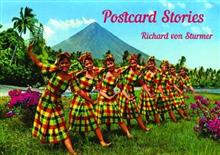
Richard’s books are working documents of a life-in-progress, a sensibility in the making and constant remaking. Reality is put, much of the time, through a Zen Buddhist filter, yet his writing can be as rowdy and colourful as the line-dancing Filipino women on the cover of Postcard Stories. Such a paradoxical, contrary state remains at the heart of his creative project. Also worth noting is a curious propensity for the transmutation or transubstantiation of the mundane or the misguided into a state of meaningful joyfulness.

What sort of narratives are on offer in Postcard Stories? Are these stories about postcards or inspired by postcards—or are these the stories the postcards themselves might have told, if they could speak. Through the first half of the book, Richard performs a visual/verbal two-step, offering short sequences of text—a hybrid of short story and  haiku—to enhance, elaborate upon, subvert and embrace the images which they accompany.


Quickly enough, the book gets one thinking about the nature of postcards. It becomes a protracted meditation on that endangered if not dying species. In the era of the jpeg and digital file, postcard stands are becoming fewer and further between. Postcard Stories offers the gentlest of interrogations, a backward glance at these printed images, their industry and their format. It asks questions, but without, of course, requiring any kind of answer.

Most of the time, postcards relate to a specific location yet, as this book manifests, they often reflect a certain lostness, aimlessness, waywardness. You would not want to use them to get your bearings in the physical world. I remember, years ago when Jen and I were spending six months in the South of France courtesy of the Katherine Mansfield fellowship, Richard sent us—in Menton—an antique Greetings from Menton postcard which he had procured from a South Auckland second hand shop.  As Richard’s new book attests, postcards, like the rest of us, lead paradoxical, complex and unreliable lives. In his bright and user-friendly introduction, he goes so far as to describe postcards as ‘cells in a giant, universal brain’ then adds, instructively: ’I like to dream with postcards’.

Traversing such inner and outer realities, the texts in Postcard Stories feature a surprising number of flowers. Ditto monuments, towers, clocks and water features. In deep amidst the imagistic ebb and flow, we are asked to consider how flowers flower differently in words than they do in pictures. We are back in the quarry. We are back at the beginning of the world, and the beginning of the word. We are once again keeping company with a zebra-headed youth in his wasteland-quarry. Yet we are also in the world of a film-maker, one half of the Humanimals who is now one half of a group called the Floral Clocks (greetings to the other half, Gabriel White, here with us tonight)… We are in the world of a man- or person-of-letters, an exemplary citizen of Aotearoa, a Buddhist, activist, free radical and traveller in the universe of postcards; a surveyor also of the lives contained in these most wistful of images and of the lives that continue to swirl around them long after they have been posted, received and put to one side.


Gregory O’Brien


.


Poetry Shelf noticeboard: David Howard awarded UNESCO Ulyanovsk residency

Writers from Slovenia and New Zealand to be the first participants of the Ulyanovsk UNESCO City of Literature Residency Programme

D4OrruYVUAEUk6M.png

In September, David Howard from Dunedin (New Zealand) will visit Ulyanovsk. The author is going to develop a poetic sequence set in Ulyanovsk, as well as to collaborate with a local composer on a musical setting for his texts. Howard is the author of six books, a participant of several international residencies, was awarded several literary awards, was a participant of exhibitions and performances, an editor of several books, including the book, devoted to Russian authors. His works were translated into European languages; the book «The Ones Who Keep Quiet» (Otago University Press, 2017) featured in the New Zealand Listener’s Books of the Year. David received the New Zealand Society of Authors Mid-Career Writers’ Award (2009), the University of South Pacific Poetry Prize (2011), and the University of Otago Robert Burns Fellowship (2013).

Full details here

Poetry Shelf in conversation with Elizabeth Welsh


DSC_0937.jpg


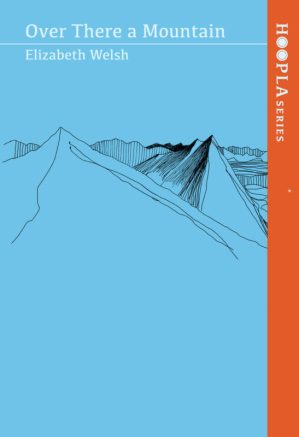
Elizabeth Welsh, Over There a Mountain, HoopLa Series, Mākaro Press, 2018


Elizabeth Welsh’s debut poetry collection, Over There a Mountain, is an exquisite read: surprising, absorbing, complex. She is an academic editor working for international university presses, she founded the online journal The Typewriter, and co-edited Flash Frontier. Her poetry has appeared in local and overseas journals and in 2012 she won the Auckland University Divine Muses Emerging Poets Award. She lives in Auckland with her family.

The collection brought Anne Kennedy’s marvelous Time of the Giants to mind as Elizabeth has also produced a long narrative poem made of glistening pieces and fluent lines. There is a sense of magic at work, a myth-like underlay, seams of real experience, and a satisfying blend of true and invented settings. This is the story of a daughter whose parents are mountains  – who puzzles and struggles and faces what it is to be a mountain daughter, to be with a mountain mother and a mountain father. This is fable but this is also satisfyingly human as the mountain daughter navigates how she is formed ‘by’ and ‘outside’ relationships.

Over There a Mountain was one of my favourite poetry reads of 2018.


Over-there-a-mountain-cover


It’s hard to know how to be    with a mother who is

a mountain. It’s hard to feel how to be   with a father

who is a mountain. It’s hard to understand how to be.

It’s hard to explain that luminous bond, that bewilderingly

stretched distance.


Paula: Narrative and character mattered so much as I read Over There a Mountain. What poetic effects were you drawn to as you wrote?


They were slow-moving, glistening tail-lights

in the guttering of a kasrt dawn.


Elizabeth: Yes, both narrative and character are central to Over There a Mountain, given its form as a narrative poem. It was actually near to completion when the poem evolved and settled into a book-length narrative (albeit split into three distinct parts – the mountain-daughter’s childhood, adulthood and last years), tracing the arc of the mountain-daughter’s life and eventual transformation. As it is involved in, or at least plays with, contemporary myth-making, the oral quality and auditory effects were particularly important to me. When I was unable to find a specific sound or rhythm, I took liberties with words, much to the confusion of my publisher at times. I remember ‘alpinic’ and ‘huffly’ both resulting in interesting discussions.


Paula: I love the liberties with words, the sonic playfulness, because that added to the mysteriousness, the strangeness. You hear mystery. Poetry is all the better for made up words.

I was totally captivated by the protagonist daughter – the underlying daughterness – and her electric movements. What discoveries, joys and struggles unfolded as you wrote your way into the daughter?


Her mountain-father found it easy, catching sight of her

in a bottle-green jersey scaling a vertiginous cliff, shoulder

blades painted with a dipped sphere of wet Cheshire moon;


she became all manner of oceans.


Elizabeth: Thank you – I’m really pleased you felt that way about the mountain-daughter. It was an interesting exercise, as I fell pregnant and gave birth to my daughter around roughly the same time (tracing my notes back, it appears the mountain-daughter began to emerge about a year before I fell pregnant when I was living far from home in south London). Whether it was timing or synchronicity or chance, I became increasingly fascinated by familial bonds and ways to refigure, disrupt, defamiliarise them. The domestic is traditionally wrought as such a safe, sanitised space, but is so expansive in its reach; it maintains such a hold on us, even as we age. And the mountain-daughter is both us and not-us, she struggles in ways we don’t and struggles in ways we do; at times, it was quite liberating to construct her character. The particular challenge for me was tracing her ‘daughterness’ – I love that word(!) – throughout her later years as a chronicle of growth, with grafts and accretions, trying to do justice to the shape her inheritance would take. I’m sure we never lose our sense of being the child of our parent(s), whatever form that relationship takes.


They told her the mountain stories as love stories, taking

her each dusk to pick bear’s garlic together. Not touching,

they bobbed like pendulums as she murmured: we just keep

hardening and hardening and hardening until all we are

is unfolded, thrown wide.


Paula: I love the way I build a setting for the narrative in my head that draws upon my own mountain experiences. Did you have real places that loomed large in your imagination?


Sleeping afterwards in the southern heat of a midday sun,

she dreamed of Tākaha Hill, Pancake Rocks, both faint

and singing outlines.


Fa!


Elizabeth: The collection is deeply rooted in the New Zealand landscape, so there are quite a number of real places that surface throughout the poem. But while parts of the poem are specifically geographically located – including Mount Saint Bathans, Punakaiki, Mount Peel, Tākaka Hill, Mount Aspiring, Dolomite Point, Miranda and Picton – a significant portion of the narrative is deliberately hazy as to its precise location. The Southern Alps, around the Mackenzie country, particularly Lake Tekapo and Mount John, as well as Arthur’s Pass, heavily influenced ‘the mountain-daughter’s childhood’. And the edge where the Waitākere Ranges meets the Tasman Sea provided inspiration for the final section – that wild, untamed, rugged topography ‘what is this line of sea she came to? […] Bucking the empty trug to the picketed boundary of sopping, wolfing dunes’.

Also, venturing globally, a very fortunate and well-timed encounter with the ancient Montserrat (and the Benedictine Abbey there, complete with Holy Grotto), a multi-peaked mountain range that is part of the Catalan Pre-Coastal Range in Spain, spurred on the narrative and general ‘mountain thoughts’.


Paula: Ah maybe that is one part of the strong connections I feel with the book – like a channel for subconscious attachment- because I see the tail end of the ranges and smell the Tasman Sea from our place and I drive around the Mackenzie country and Central Otago with my partner artist.

Do you have a cluster of poetry books with which you have strong goosebump connections? Whatever they might be?

Elizabeth: Oh yes, I know what you mean – that feeling of simultaneous exhilaration and unease/disquietude. Poetry collections that I have felt an extremely strong kinship with over the years and which, without doubt, have hugely informed my creative practice include Maggie Nelson’s Bluets – these fragments/propositions change me, confront me every time I read them with their candour, urgency and meditative illumination – Anne Kennedy’s Sing-Song, Mary Oliver’s Swan, Alice Oswald’s Dart – the primal, polyvocal, experimental quality of this poem still haunts me – as well as Woods etc., Fleur Adcock’s Tigers, William Carlos Williams’ Paterson, Anna Livesey’s Ordinary Time – this collection is a true gift; it lived within arm’s reach when my daughter was very young – Max Porter’s Grief is the Thing with Feathers, Mary Stanley’s Starveling Year, H.D.’s Helen in Egypt and for its shimmering poetic sensibility, Jessie Greengrass’ Sight.


Paula: I love this list! I haven’t read Jessie Greengrass. I have been musing on activities that augment poetry writing. For me: running, walking, gardening, cooking and of course reading. Listening to music. What activities enhance writing for you or keep it in balance?

Elizabeth: So much of my life is filled with motherhood at the moment, which enriches and enhances my writing and thinking and being in every way (although actually getting words to paper can be somewhat challenging). In particular, baking bread with my daughter each week is such a therapeutic act for us both and always leaves me poetically inspired. Tending to our garden and wild span of bush also slows me down and reminds me to be patient, to be present.


Two mountains encase a flushed fire,

two mountains eat hot soda damper with their daughter.


Elizabeth reads from Over There a Mountain

Mākaro Press page

Extract at Turbine / Kapohau


Poetry Shelf Monday Poem: Jack Ross’s ‘What do you want?’


What do you want?


said the librarian

in Friendly Feilding

to come in from the cold

was my reply


we’re closing an hour early

for a function

the function I’d driven down for

I walked away


he’s crying

but he doesn’t know

why he’s crying

said my sister


to the primer one teacher

who wanted to know why

I guess I do too

I guess I do


I was small and afraid

of a brand-new place

so many people

but what remains


is kindness

my sister

trying to help

unavailingly


Jack Ross


Jack Ross’s novel The Annotated Tree Worship was highly commended in the 2018 NZ Heritage Book Awards. He has written five poetry collections and six other volumes of fiction. He works at Massey University, and is the managing editor of Poetry New Zealand. His blogs here.


Poetry Shelf noticeboard: Gail Ingram launches new collection

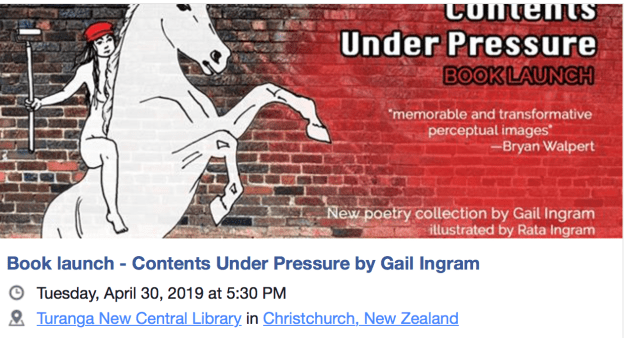
Contents Under Pressure a new poetry collection by Gail Ingram illustrated by Rata Ingram published by Pūkeko Publications 5.30-7.00pm Spark Room, Ground Floor at Tūranga New Central Library, Christchurch.


Screen Shot 2019-04-13 at 3.17.20 PM.png