Tag Archives: Gail Ingram

Poetry Shelf Breathing Room: White horses by Gail Zing

White horses
at the Christchurch Symphony Orchestra 

The percussion rolls in / and
out / in and
out the swell / a perfect swell / an ocean growl
so deep / and she is fine
on the edge of her folding seat 
next to her friend / and the girl in the story next
to her friend / the pilot who invited her
on this gig / the symphony thickening / with opening
courage / and PTSD in the hooves
of the ocean drums / and the flying girl / and the
ocean rising to the sky flute / when the girl /
returned from world war one / turns / between notes 
to pick up her handbag / it seems / but
lifts the handle on the exit / door to the airstream 
over Cook Strait / the rush of cellos
she leaps out / into the horn of the sky

the air is not the ocean / it is a piccolo 
she is rushing / through blue air and tinkling
but the air is the air is the air
until it is

a long flatline so hard / a body can fall through

how long it lasts / how small a suspension
my friend’s arm against mine / 
in the clang / the pilot must drop /
to look for his friend / in the ocean /
and there are only / white horses

the complexity of a galloping drum / he circles again 
and again / and everything is lost
the heads of crowds / the marvellous conductor
until there’s only a stampede / the
swell / of all those beating hearts 
on the edge of their folding seats.

Gail Zing

This one is FOR the CSO for telling this NZ story in music, about a nurse (Viva Farmar) who survived WWI and came home to jump out of her friend’s aeroplane over the Cook Strait a while later. The friend, the pilot, described that all he could see was the white horses or wave-tips in the sea, she was completely gone. I was so moved by the music that captured this tragic story I wrote this poem – art inspiring art, connections on connections across time.

Gail Zing is a Te Waipounamu author of three collections of poetry, including Some Bird, selected for Best Poetry Books 2024 by The NZ Listener. Winner of both Caselberg and NZPS International Poetry Competitions and placed in many others including the 2025 Fish Poetry Prize and Hungry Hill Political Poetry prize, her work appears in Poetry Aotearoa, Cordite Poetry Review, Poems for the Planet, Stone Circle ReviewCatalyst, Landfall, The Spinoff and others. She is a freelance editor, including previously for a fine lineFlash Frontier and takahē, and she teaches at Write On School for Young Writers and Hagley Writers Institute. In 2025 received a residency at Robert Lord House in DunedinSee more here

Poetry Shelf review: Gail Ingram’s Contents Under Pressure

cv_contents_under_pressure

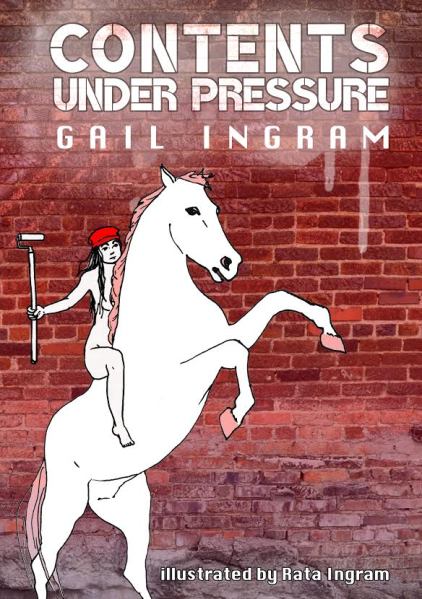
Gail Ingram, Contents Under Pressure, Pūkeko Publications, 2019


Gail Ingram has published poetry and flash fiction both in New Zealand and internationally. She lives in Christchurch where she is part of a writing/ critiquing group of poets. Contents Under Pressure is her debut poetry collection and includes illustrations by her daughter, Rata Ingram.

Contents Under Pressure is in debt to a city; the poems navigate post-earthquake Christchurch. When I first held the book and flicked through the pages, I was reminded of flicking through a book to watch the drawings on the bottom corners move. Flick the pages of this book and it is poetry in disrupted movement: you get spiky angles, walls of text, bold against light, steps against missing bits, changing fonts.

The title is perfect: everything is under pressure – the fractured city and the contents of the book. This is the story of a city filtered through that of a mother / graffiti artist and her son, and both have different ways of coping with a city in pieces.

The opening poem ‘Definition: mother / graffiti / artist’ introduces just that: a mother who goes tagging in the city that continues to break. At times the pages of the book stand in for the tagged walls:


she sprays

airport walls in zen

tangles so strangers

trace poke-leaves

in sesquipedalian mazes


from ‘From below, the graffiti artist is’


I love this book because it shakes up what poetry can do while simultaneously bringing us in close, so searingly close, to human trauma.

An early poem returns us to solid ground: the mother and her sons are looking at a photo of the family tobogganing at Round Hill. It is a white hot shard in the collection that makes the rest of the poetry even more poignant:


Mum took the photo. I’ve got this picture of Dad resting his

arm across her shoulders —

Yeah, like a security blanket.

Yeah.

But now when I look at it, I don’t see us. I don’t know who

that family is, but …

I know the mountains —

The mountains are capable of moving.


from ‘She overhears the boys talking about the photo in the hall’


The portrait of the woman feels like a woman behaving out of character in order to relocate herself (her new character) in the new and shattered terrain. She leaves her familiar/unfamiliar daylight routines. She becomes someone other in the pitch dark night. At times the writing is in shards and spiky while at times it is lyrical:


She hasn’t gone out into the ink

of the night street yet. Here,

she exists, safe as a thief

in the stoma of their sheets

before she will slink through the open window,

creep along the dark passages of local streets,

and tap her own tune

on the city’s leaping drum.


from ‘The graffiti artist waits for the world to sleep’


The graffiti artist shows us the power of art to make both public and personal both ideas and feelings. And we can engage with this. We can be moved and we can be challenged. In ‘The graffiti artist as a teenager’, her art teacher had showed the class the ‘Cubist strokes of “Guernica””. She is learning what art can do:


At fourteen she learned the power of dots. That a

cluster could create a river pebble’s shadow, a

crease in a smile or the trail of cupped hooves on

farm soil. Forty pencils pattering in the class, and

the hexagon-window left free, high in the streaked

pupil, made the picture come alive as if it was her

paper skin under the shrapnel of sharp lead. (…)


There are many threads to track through the book. Equally captivating is the thread of the son thrown off kilter, with drugs, anxiety, physic textbooks. In ‘Expedition to the New World’ the mother and son are traipsing through the vegetable aisles where the poem’s punning supermarket title confirms everything is made strange and off-centre:


(…)  She can’t find what they need. He

brushes past tins of spaghetti. Root-like tendrils on the

labels seem to take an interest in his passing, as though to

grasp for arm or ankle. He half-stumbles into the bags of

stalky cereal and utters a guttural sound, an earthquake

rumble that shudders up through his body to settle there.


On the back of the book Sue Wootton, Bernadette Hall and Bryan Walpert underline what a gift this book is. I agree. The poetry represents the way the shattering of familiar terrain shakes up everything: family, body, heart, faith, everyday routines, solid attachments. It shakes you as you read. It is intimate and it is wide reaching. It also shows the way art, language and a deep love of family carry you as you discover ways to resettle. A gift of a book.


Pūkeko Publications page


Poetry Shelf noticeboard: Gail Ingram launches new collection

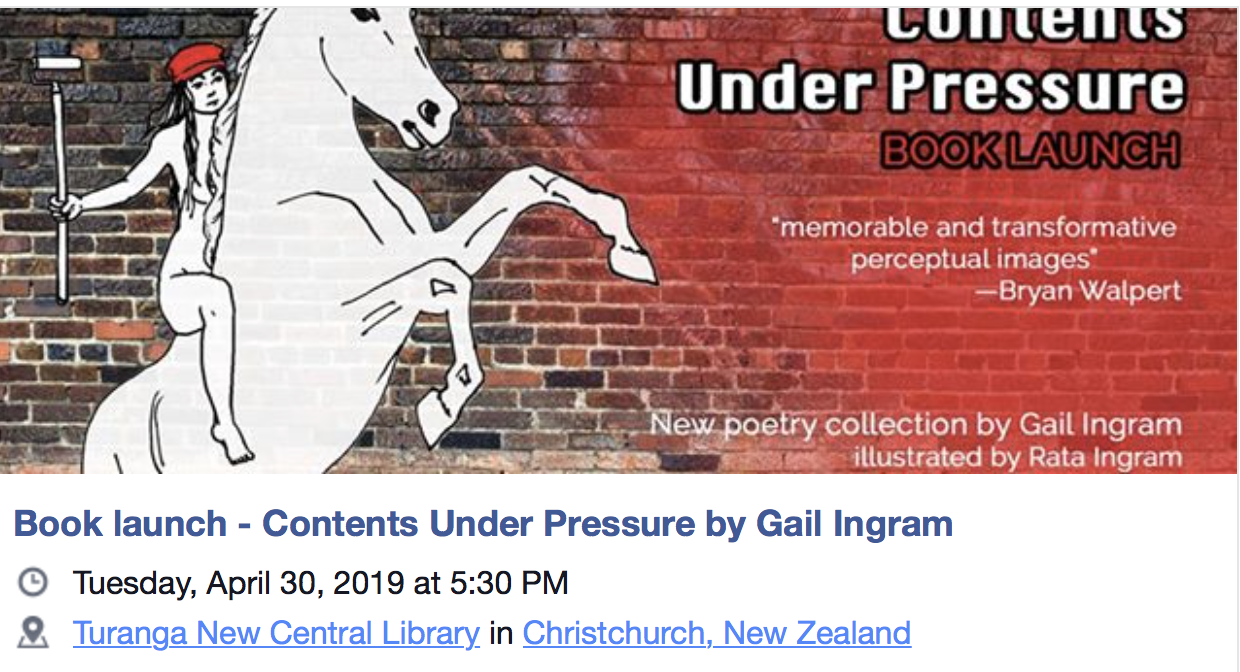
Contents Under Pressure a new poetry collection by Gail Ingram illustrated by Rata Ingram published by Pūkeko Publications 5.30-7.00pm Spark Room, Ground Floor at Tūranga New Central Library, Christchurch.


Screen Shot 2019-04-13 at 3.17.20 PM.png