Category Archives: NZ poetry

WRITERS ON MONDAYS In the company of a master: Vincent O’Sullivan

WRITERS ON MONDAYS

In the company of a master: Vincent O’Sullivan

We kick off our 2015 programme in grand style with one of New Zealand’s finest. Poet Laureate Vincent O’Sullivan’s impressive writing career includes poetry, biography, novels, plays and short stories. His recent publication Being Here is the first to survey the entire span of O’Sullivan’s poetry, from 1973’s Bearings to new poems first published in this volume. Join us as O’Sullivan and longtime publisher and friend Fergus Barrowman take a journey back through an illustrious writing career, discussing favourite themes and preoccupations, recent work, and the public role of poetry.

Writers on Mondays is presented with the Museum of New Zealand Te Papa Tongarewa with support from National Poetry Day and Circa Theatre.


DATE:  Monday 13 July

TIME:   12.15-1.15pm

VENUE: Te Papa Marae, Level 4, Te Papa
(Please note that no food may  be taken onto the Marae).

Welcome back the NZ Book Awards with a gift for fiction

New Zealand Book Awards Return with Major Fiction Prize

After a 12-month hiatus, the country’s premier book awards will return in 2016 with a new structure, a new judging process and a significant, annual fiction prize of $50,000.

The New Zealand Book Awards winners will be announced at an event during the country’s largest literary gathering – the Auckland Writers Festival – in May 2016.

The New Zealand Book Awards Trust chair, Nicola Legat, says she is delighted to announce the changes, and in particular the major fiction award, which is provided by the Acorn Foundation, through the generosity of one of its donors.

“It creates a tremendous and lasting literary legacy. The sum of $50,000 will be awarded to the top fiction work annually, in perpetuity. This will make a difference not only to the receiving writer, but also to the literary fabric of New Zealand. It is a huge gift for us all.”

The Acorn Foundation is a Western Bay of Plenty-based community foundation that encourages people to leave bequests in their wills, or gifts during their lifetimes.

Acorn Foundation’s Operation’s Manager, Margot McCool, says it is humbling to witness such generosity.

“Since 2003 we have been encouraging generosity, so that people who really care about their community can fulfil their wish of enabling organisations and causes they believe in. We are so pleased that this award will make such a difference to New Zealand novelists’ careers,” says Mrs McCool.

In addition to an annual fiction winner, there will be a poetry, a general non-fiction and an illustrated non-fiction winner and, should there be sufficient entries, a Māori language award. The three Best First Book Awards will also continue.

Ms Legat added that including the awards in the Auckland Writers Festival programme ensures they reach more people.

“The New Zealand Book Awards will be the first public event in the festival’s line-up. With the festival growing exponentially year-on-year (55 percent in 2014 and a further 17 percent in 2015), we are taking New Zealand writers to a huge reading audience.”

Auckland Writers Festival director Anne O’Brien says embracing the New Zealand Book Awards was a natural fit.

“The festival is committed to sharing a love of books and reading and to championing and supporting New Zealand writers through exposure to thousands of festival-goers each year.  The New Zealand Book Awards are a celebration of writing excellence and we’re delighted to offer them a home in the festival’s programme,” says Ms O’Brien.

The four main categories will be judged by specialist judges, three per category, plus a Maori language adviser for the Maori language awards.  The judges will select a long list of around eight books in each category. It will be announced in November 2015.

The shortlist of four books in each of the categories will be announced in early March 2016.

“The changes to the judging process are a direct result of the consultation process carried out by the Book Awards Trust in 2014. Having fewer books for each judge to read, and having more specialist depth in each genre, will allow a more detailed examination of the works,” says Ms Legat.

The call for entries in the awards is scheduled for August 1 this year.

For interview opportunities and further information please contact: Penny Hartill, director, hPR 09 445 7525, 021 721 424, penny@hartillpr.co.nz

Full article go here

A shameless plug for poetry

My book The Letter Box Cat and other poems is a finalist — most unusual to have poetry there. So this seems like a golden opportunity to make a national show of children’s hands for poetry. Do get children to vote! (the other books are excellent too, I have to say!). So few children’s poetry books get published here. Bottom of rung in my view.

Only children can vote.

2015 New Zealand Book Awards for Children and Young Adults

Children’s Choice 

Would you like to choose the winners in the 2015 New Zealand Children and Young Adults Book Awards?


Be part of the Children’s Choice voting and have your chance to vote for the New Zealand books you think are the best.

Children and teenagers across the country have been busy reading and reviewing their favourites amongst all the New Zealand books entered in the 2015 NZ Book Awards for Children and Young Adults. Their votes created a list of 20 books they think are the best.

So get voting: we want to know what New Zealand kids think. Choose your favourite in the Top 5 in each category that’s relevant to your age group. (We have adult judges separately deciding on the overall winners, but we also want to know what kids think are the best books.)

Everyone kid who votes (you’ll need to be 18 years old or under) will be in the draw to win some books for yourself and for your school. On the second page we will ask you questions to help us contact you via your school if you win. If you are unsure about anything ask mum or dad or your teacher to help you.

Voting closes at 12 noon on Friday, 31 July.

So vote now and tell your friends to vote too. Just click here to vote!

Voting button

Morgan Bach’s launch at Wellington’s award-winning Unity Books -Would love to be there for this! Can’t wait to read it

684a89cf-1c7b-4ee7-a686-f3e03271a543

Victoria University Press warmly invites to the launch of

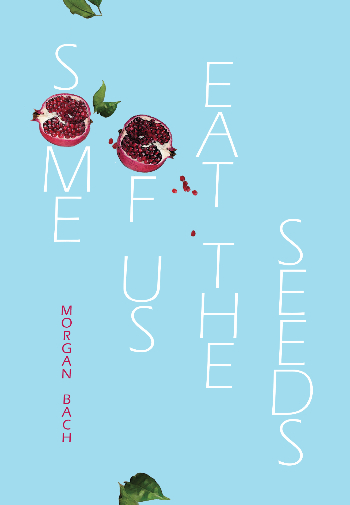
Some of Us Eat the Seeds
by Morgan Bach

6pm–7.30pm on Thursday 16 July
at Unity Books, 57 Willis St, Wellington.

About Some of Us Eat the Seeds:
Morgan Bach weaves a line between waking life and the unstable dreamworld beneath, disorienting and reorienting us from moment to moment. In poems of childhood, family, travel and relationships, she responds to the ache and sometimes horror of life in a voice that is restless and witty, bold and sharp-edged.

‘It’s ordinary and extraordinary. It’s the kind of arrival that delights me.’ – Bernadette Hall

Kerrin P Sharpe’s There’s a Medical Name for This — It is an astonishing book that lurked in the undergrowth of my thoughts for months

medical_4_7_1__67194.1407673215.220.220   Snapshot_20121120_8


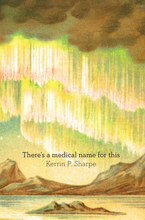
Kerrin P Sharpe There’s No Medical Name for This Victoria University Press, 2014


Last year I posted a poem from Kerrin P Sharpe’s new poetry collection, There’s a Medical Name for This. Finally, after all this time, I have picked up the book to reread and review. It is an astonishing book that lurked in the undergrowth of my thoughts for months with its sachets of strangeness, enigma, acute realness. Just casting your eye down the poem titles is poetry pleasure. Some collections house a poem or two that stand out, where the poet has transcended that which is good to become that which astonishes. In this book, I found countless examples that did that for me. Not in a flaming extravagant way but in ways that are at more of an alluring whisper. These poems are imbued with little droplets of incident, image, tension.

Near the start of the book, a miniature earthquake poem, whose perfect line breaks punctuate the modicum of detail, the deft phrasing (‘the basilica is a waltz of stone’) and the way the final stanza sings you back to the title (‘when gerry thinks of angels he hears their wings’).

Sometimes, oftentimes, the poems step into strangeness surrealness the point of becoming fable. There are no endnotes to provide author-led guy ropes into a poem so it is over to you where you step. ‘[T]here were stars behind him,’ a portrait of an elephant, shifts from an elephant in a photograph with Hemingway to ‘that year the elephant/ became a living lighthouse/ he wore a lamp/ and built a curved staircase.’ Magical. Or, in an even more captivating example (‘in the cart’), a mother, a pie cart, two hats and pastry come together in what might be a bedtime story, an heirloom anecdote, a housewifery lesson.

Rather than talk about what the poems are doing, I keep discovering snippets to share with you. The way the beginnings of the poems catch you by surprise: ‘every poem has a mother/ to feed his house/ the small bones of snow.’ Where to after such a glorious start? An equally glorious ending (I am withholding the middle!): ‘not even his mother// sews such small birds.’

Things aren’t stable in this collection. This becomes that and that becomes this as tropes shift and settle and then shift again. And so ‘a pine that is/ really the breeze/ a fish that is/ really a stone.’ Similes startle and invigorate the lines: ‘her thoughts in the thermal pools/ like fern wrapped sushi.’

These poems draw upon illness, fathers, mothers, sons, daughters, brothers, sisters, twins, snow, much snow, ponies, many ponies, birds and feathers. Whatever the subject matter, there is movement, and out of that movement vibrant, life.

Characters (pilgrims, farmers, surgeons, whistlers, gondoliers) stroll though the poems and it seems to me they wear whiffs of the poet, autobiographical traces, and yet they are more than that. Anyone can occupy these shoes that are like little shoe-stories that get handed down and then tried on for size. They are also, and so often, like fairy tales that take you out of the tedium of daily grind and familiarity and transport you to the magic and mystery of otherness and magical possibility. The poems might have a local genesis but they reach out beyond to the faraway, to Russia, rice plantations, Antarctica. Here or there, everything is in debt to place and that attachment to ‘where’ is one that makes the poems matter (‘the small farmer remains place faithful/ to the dell’). Characters become a way of circulating stories, those traces of anecdote, a forward tang to elsewhere (a turbine// turns my father’). The procession of pilgrims throughout is the poetic glue that tenders physical bearings to an uplift of wonderment. We get to be the pilgrims of the poems. We get to feel the gap, the connections, the arrival at arm’s length.

Some poems surprise in their shifting forms. ‘[S]on’ juxtaposes two definitions — the first stanza prosaic and dictionary-like, the second stanza exemplifying personal portrait as definition. The ‘half the story’ (I adore this poem!) is indeed half a story; it builds a list that builds narrative out of what you might call stream-of-conscious jump cuts.

You need a treasure box to store the adorable phrases and lines: ‘She carries him through the loom/ of fields’ ‘in the long legged darkness’ ‘the beachcomber/ keeps a button box/ a cross section/ of folded years’ ‘my father’s kitchen/ was older than eggs.’

This is a collection of exquisite variety, yet these poems are a snug fit as though for all their differences, they are meant to be together. As I read, my favourite poem was replaced by the one I was currently reading, and then again, and then again. To read these poems is to be a pilgrim – tasting the sweet and sour bite of the land, feeling the lure of travel and elsewhere, entering the space between here and there that is utterly mysterious, facing a terrific moment of epiphany.


VUP page


NZ Flash Fiction: A National Week of it, every which way you look!

In today’s Sunday Star TImes

Flash writers on writing flash and what it means to them:

Michelle Elvy

(NFFD founder and organiser)

My tips: Don’t beat around the bush. What you omit is as important as what you say; there’s beauty between words – in the space you create, at the edges of the story. Don’t go for gimmick. Edit: when you think you’re done, cut it in half. Quality over quantity.

Owen Marshall

(NFFD 2015 judge)

It’s about control of language, perception of human nature, originality, emotional power. A lot has to be done by insinuation and subtext, every word has to do its job. It really has to have something to say.

Gill Ward

(creative writing teacher; 2015 shortlisted writer)

It’s like when people tell a story. They don’t use a lot of words but they still tell it in a way that you understand. In a lot of modern fiction, they like to try and stay mysterious, but when you’ve only got a certain amount of words you can’t afford that luxury.

Hayden Pyke

(2015 shortlisted writer)

There’s something quite cool about finishing something; the satisfaction of actually having something completed. I just try to write about the things that are happening with the people in my life. It’s important to me that those little things that happen in people’s lives that are maybe looked over and seem quite mundane, that those things get written about as well.

Frankie McMillan

(previous NFFD comp winner and judge, 2015 twice shortlisted writer)

Flash leaves room for the reader to respond, you can publish on your own Facebook page, people get used to being efficient with language. As a tutor, it’s good for teaching students about using imagery to suggest, rather than spelling it all out. Most of all you want something that lingers in the mind; so you put it down and it’s still with you half an hour later.


For the rest of today’s Sunday Star Times article with comments on Flash Fiction by other writers see here.

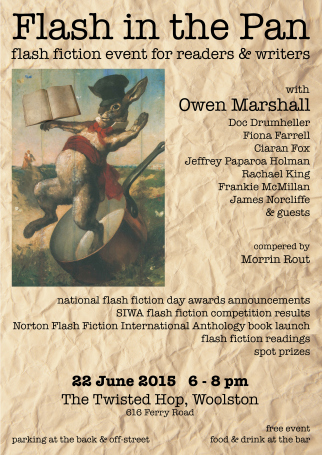
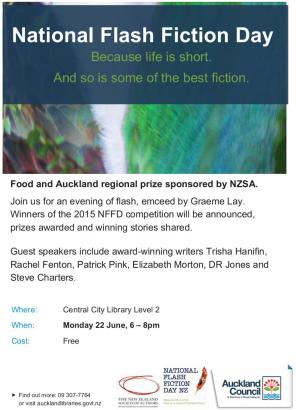
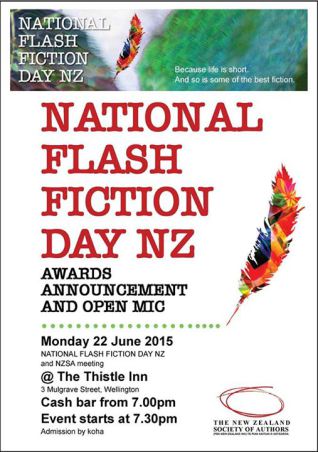
For full list of Flash Events go here:

chch-poster-final-flash-2015-crdownloadakl-poster wellington-poster


Other Flash Around Aotearoa

Northland June 3 * Dunedin June 8 * Auckland inside.out June 10 * Masterton June 23 * Details below for each event

~

 NORTHLAND June 3

Northland Flash Fiction Competition and event

Flash Fiction Competition 2015

Whangarei Libraries is sponsoring a Northland flash fiction competition for the fourth year in a row. Competition has already closed but the winners will be declared at a special awards ceremony on Wednesday 3 June 2015, 5.30 pm in May Bain Room, Whangarei Central Library.

Short-listed stories will be read and winners will be announced. All are welcome.

~

DUNEDIN June 8

The NZ Society of Authors Otago Southland Branch is holding a Flash Fiction themed Writers Salon on Monday June 8 at The Thistle Cafe & Bar in The Octagon.

The theme for the Writers Salon in June – 6pm Monday June 8 – will be Flash Fiction

We will feature eight writers reading work of 500 words. All selected contributions will include the word flash in one of these forms:

Flash
Flashed
Flasher
Flashest
Flashing
Flashy
Flashier
Flashiest
~

AUCKLAND INSIDE.OUT June 10

insideout June 10Inside.out open mic for writers goes flash in june — inviting writers of flash fiction to come share your stories. Hosted at the One2One Cafe, 121 Ponsonby Rd, Ponsonby.

inside.out runs open mic spots for writers of any experience or genre. Stories and poetry are illuminated when read aloud or performed. Meet other writers as well. Excellent musicians and competitions with prizes at each event. The cafe is licensed with hot snacks and great coffee.

Entry by koha, which goes to the musicians that night.

Come from 6pm; open mic starts at 7pm.Let’s hear what you’ve been working on…

Find inside.out on Facebook /

contact MC Anita Arlov: anitaarlov@hotmail.co.nz   tel. 021 100 40 77 

 ~

MASTERTON June 23

SHORTisSWEETposter (1)

Short Is Sweet — Flash event at the Masterton District Library on 23 June. All are welcome!

~

REGIONAL AWARDS

This year, regional awards for the best flash fiction stories entered in the national competition are being offered by the NZ Society of Authors branches in the following regions:

Auckland * Canterbury * Central District *

Hamilton * Northland * Otago * Wellington 

Regional Awards will be announced on June 22. NFFD is excited and grateful to have the support of the NZ Society of Authors branches.

NZSA LOGO

~

If you would like to organise something in your area, get in touch!

Contact

nationalflash [at] gmail [dot] com

~

And if you happen to be in the UK the following week, after our June 22 events have closed, check out the UK NFFD. June 27, 2015. Details here.

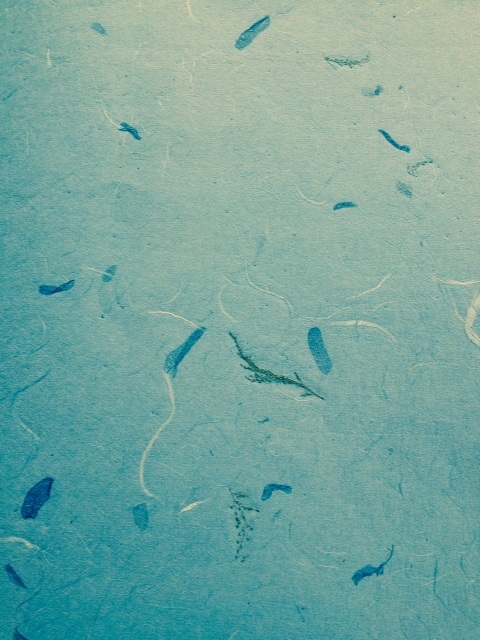
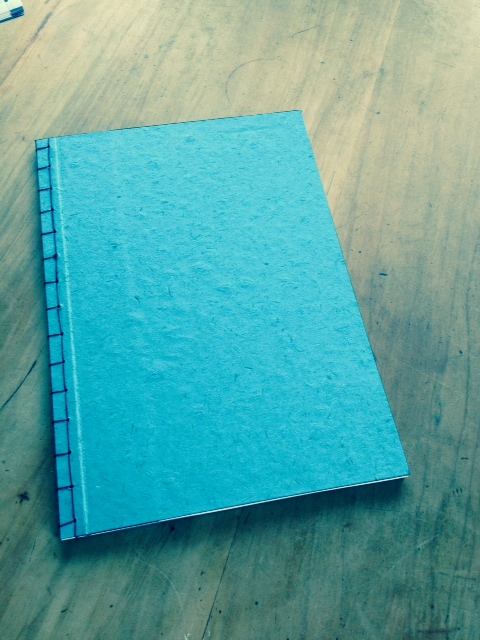
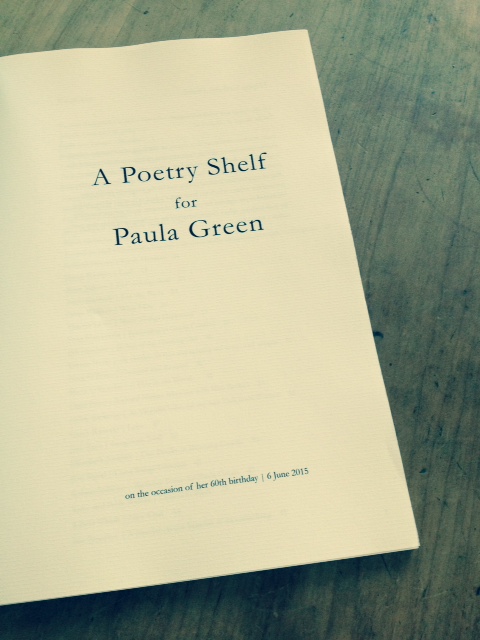
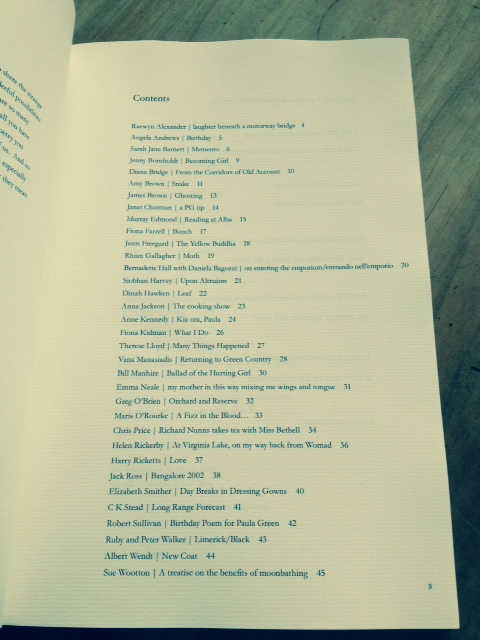
a birthday shelf made into a beautiful blue book

Anna Jackson (and Helen Rickerby) presented me with this yesterday. Utterly gorgeous.

divine shade of blue, exquisitely hand stitched, heavenly end papers, internal design ever so sweet


photo 3 photo 1

photo

photo 2 photo


Bob Orr writes a poem after hearing Edwin Thumboo at AWF 2015 – marvellous!

Festival


(for Edwin Thumboo)


I sizzle to your poems –


last seen in Singapore

I duck into a hole in the wall café


only a short walk up Queen Street

where in styrofoam containers


hot and spicy prawns

have made it here


all the way from

the coconut palm coast of southern India.


Is this where poems come knocking?

As the kitchen door swings open


I glimpse an

old man


subterranean and

beat


amid his world of woks and hard working pans.


© Bob Orr  2015