Category Archives: NZ poetry

Cleaning my study, five wine boxes to unpack and a parcel that gives me goosebumps

photo

Today I am clearing my study ready to start writing a book on New Zealand women’s poetry. I am working my way through deadlines (almost done). I have finished my astonishing visit as Writer in Residence at Fairburn School in South Auckland. Still so many books to review and share here. Interviews to do. Friday poems to kick start again.

Thanks to Chris Else, I have borrowed his collections of Landfall, Sport and Takahe before they moves on to a good home. Five wine boxes full — what discoveries will I make within their pages? It is so very exciting and so very helpful when I am not attached to a university. I am full of gratitude.

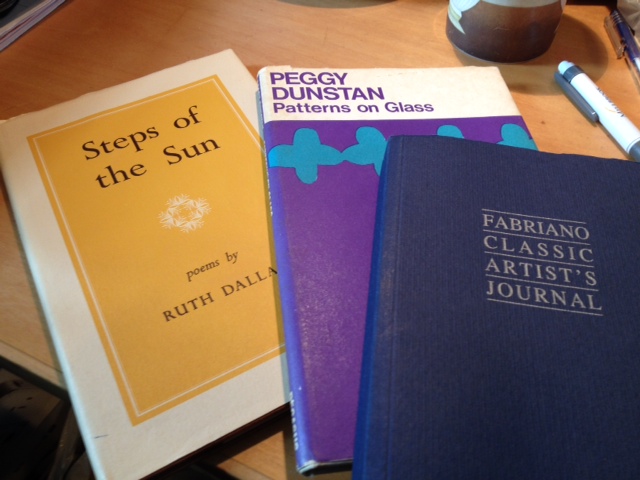
Then today the most lovely surprise package from Laurence Fearnley who had discovered a collection of poetry books in a second-hand bookshop in Dunedin. I have neither of these books, beautiful much-loved editions that I will treasure. I got goosebumps as I held them. Again I am full of gratitude.

It makes me feel I am part of a very supportive writing community.

I face this project that I am about to start on Monday (full strength) with a mix of nerves, terror, pleasure, doubt, excitement — the way once you start reading and writing anything can happen as you traverse the unexpected, the unfamiliar, the wayward and the illuminating.

I can’t wait.


Massey University Poetry News

Massey poets on a winning streak


Two Massey University poets from the School of English and Media Studies are on a winning streak, with one shortlisted for a top international prize and another taking out a national poetry award.


Dr Jo Emeney                                          Janet Newman


A poem by Master of Creative Writing student Janet Newman has won the Open category of the New Zealand Poet Society’s 2015 International Poetry Competition.

Ms Newman says her poem, Biking to the Manawatū River, evokes the natural beauty as well as artificially transformed features of the environment. Judge Harvey Molloy said her poem shows “great focus and restraint.”

“Through description we see what might glibly be called our ‘environmental impacts’, but there’s also a personal, subjective mind present in ‘leaves like curled hair’ and roots ‘wrenched up like memory’. Nothing here is overstated or forced and yet an atmosphere of understated disquiet pervades – there’s violence at every turn,” he said in his report.

Ms Newman is nearing completion of her degree, which she has worked on for the past two years. She has been writing poetry for a number of years, and is working on a collection of new poems, as well as researching the eco-poems of New Zealand poet Dinah Hawken, for her thesis.

Another Master of Creative Writing student, Gail Ingram, earned a Commended award for her poem Once Were Elvers.

The New Zealand Poetry Society was founded in 1973 by Wellington writer Irene Adcock, and will host a poetry conference in Wellington from November 13 – 15.

Auckland-based poet and creative writing teacher Dr Johanna Emeney has made the shortlist of 50 for the Montreal International Poetry Prize from some 2,000 poems entered from around the world.

The winner will be announced in early December. She and Associate Professor Bryan Walpert, who teaches creative writing at the Manawatū campus, were both selected for the long list of 70 announced last month.

This year’s is the third prestigious biennial award, worth C$20,000 (NZ $21,500).

Dr Emeney’s poem, There will be no more horses here, will be published as part of the organisation’s anthology, and is already available to read and as an audio recording on its website.

She recently gained her PhD in Creative Writing on medical language and themes in poetry, and hopes to publish a collection of poems, titled Family History. The poems are about her mother, and were written as part of her doctoral thesis.

This year’s Montreal Prize judge is Irish poet, Eavan Boland, one of Dr Emeney’s favourites. “Having taught the poetry of Eavan Boland to many classes of sixth form students in the UK, I get to experience the fantastic feeling of knowing that she’s holding my poem in her hands and reading it. That’s crazy!”

The Montreal Prize publishes the top 50 poems of each competition in its Global Poetry Anthology Series with Vehicule Press. Its website says the competition is; “committed to encouraging the creation of original works of poetry, to building cross-national readership and to exploring the world’s Englishes”.

Listen to Dr Emeney read her poem on the Montreal International Poetry Prize website here.

MEGA-READING AT OGH LOUNGE 23 SEPTEMBER 5.30-7 PM

ALL WELCOME!

LOUNGE #46 Wednesday 23 September
Old Government House Lounge, UoA City Campus, Princes St and Waterloo Quadrant, 5.30-7 pm

Featuring work in progress by the Masters of Creative Writing class of 2015:

Caroline Barron
Ruth Bayley
Sarah Costelloe
Stephanie Davidson
Jacqui Hammond
Harley Hern
Ann Neville
Rachel O’Connor
Juliet Robieson
Tom Romeo
Phill Simpson
Dianne Starrenberg

Free entry. Food and drinks for sale in the Buttery. Information Michele Leggott  m.leggott@auckland.ac.nz  or 09 373 7599 ext. 87342. Poster: http://www.nzepc.auckland.ac.nz/events/lounge46_poster.pdf

The LOUNGE readings are a continuing project of the New Zealand Electronic Poetry Centre (nzepc), Auckland University Press and Auckland University English, Drama and Writing Studies,  in association with the Staff Common Room Club at Old Government House.

LOUNGE READINGS #45-47: 12 August, 23 September, 21 October  2015

***

Poetry Shelf interviews Joan Fleming – ‘My only rule is to write from the gut, not from the head’

22594_10153379194378623_813944774194288648_n

Photo Credit: Ben Speare

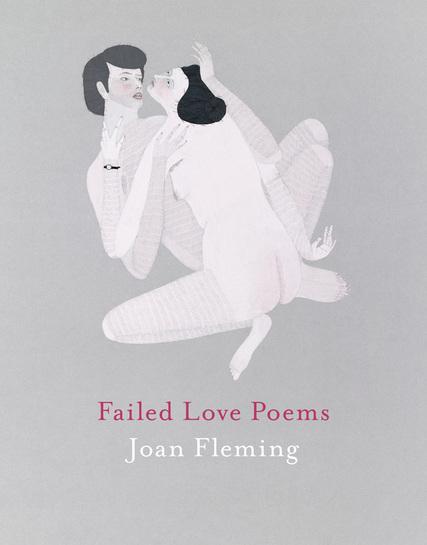
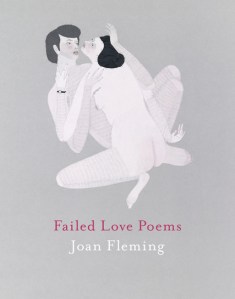
Victoria University Press has just published Joan Fleming’s second poetry collection: Failed Love Poems, a book in which I found so much to admire. Joan graduated with an MA in Creative Writing at IIML, where she was awarded the Biggs Prize in 2007. She is currently working on a Doctorate in ethnopoetics at Monash University in Melbourne. Her debut poetry collection, The Same as Yes was published by Victoria University Press in 2011. Along with Anna Jaquiery, Joan recently edited Verge 2015, a literary journal from Monash University. It is a terrific issue – I reviewed and highly recommended it here.
 

7485719  7485719

To celebrate the arrival of her new collection, Joan agreed to be interviewed.


Did your childhood shape you as a poet? What did you like to read? Did you write as a child? What else did you like to do?

I read constantly as a kid and kept journals. Shel Silverstein, fantasy YA novels with animal characters, kid romances, and a collection of ‘morality’ storybooks with titles like Courage: the Helen Keller story are what I remember reading and re-reading. I had an imaginary friend named Becky, and I think I was a bit fey, always off with the pixies or tucked into a corner, praying under my umbrella. But I was a performer, too. I would do anything goofy, just to be looked at. I was an easy child, but a strange one. I wonder if you can see that in my poems now.


When you started writing poems, were there any poets in particular that you were drawn to (poems/poets as surrogate mentors)?

The poems that carved early grooves in my mind were often lived or shared, somehow. I would memorise poems and recite them to my own head as I walked through Wellington. Paul Muldoon’s “Wind and Tree” is now inextricably Kelburn; Hopkins’ “The Windhover” is Lambton Quay. I discovered Anne Carson and wanted to inscribe everything she’d written on the inside of my body. I carried her “Town” poems with me, like “Town of Uneven Love”: “If he had loved me he would have seen me. / At an upstairs window brow beating against the glass.” See how you can walk yourself deeper and deeper into that poem?! I have an intense memory of drunkenly reading sections of Howl aloud to a living room of people, not all of them friends, and then going out into the alleyway behind the house to cry. Music had a similar effect. The poetry of Radiohead and Bonnie Prince Billy can still bring me to my knees. For me, it was about rhythm, emotion, suggestion. And poetry having palpable effect, an effect you couldn’t escape, even if you wanted to.


I love the way your poems refresh the page. There is an elasticity of grammar, a tilt of perspective, dazzling connections and disconnections, an originality that furnishes a distinctive voice. What are some key things for you when you write a poem?

My only rule is to write from the gut, not from the head. I know when I’m writing from the head. What happens is this flat, crass, nasal voice squats in my frontal lobe and won’t shut up, saying, “this is what a poem should do.” When I’m writing from the gut, there are no directives. Only sensation, surprise, connection, music, and feeling. It takes a lot of time and a lot of reading to get the gut working, but it’s the only way.


I adore the inventive syntax at work in your poems; a syntax that replays ambiguity and honeyed fluency all in one breath. Are there any other poets that have fed your syntactical inventiveness?

Anne Carson and Gertrude Stein are heroes of odd syntax for me. Jerome Rothenberg’s pseudo-translations of ritual poetries have also been influencing my practices of fragment and invention.


Deletion and erasure is a potent device (so apt for revelations and concealments when it comes to matters of the heart). Whereas Mary Ruefle whites out part of a poem in order to create something new, you have used bold black as an erasure tool. It steps away from a thing of aesthetic beauty as we witness on Mary’s page to something far harder hitting. Like a gut kick. Can you talk a little bit about notions of erasure in this collection?

Do they hit hard? That’s good. A couple of the blacked-out poems are angry ones. Erasure turned out to be a way of protecting certain subjects and lending torque to poems that gave too much away. The act of erasure also feels thematic – we perform conscious or unconscious erasures on our memories of love. We select moments and lenses; we tell ourselves a story, that casts the beloved in golden or bitter light. Blackout was a way of enacting that selectivity of the mind – the mind’s failure to tell itself the whole truth about love.


‘Things’ are palpable. They send you on a goose-bump trail such as with paper or sugar or biscuits. At the start of ‘First loss’: ‘When we met, all the songs were about loss,/ all the television shows contained it,/ it was in everything, like sugar.’ And then a little later: ‘your eyes gone hurt and biscuity with broken/ light and hunger.’ What do you want things to do in your poems?

Sometimes I want things to be persons. To have personhood, agency, worldview. Or be receptacles for emotional energies that can’t possibly be named.


At the heart of the book – love. Like a word repeated to the point it is drained of meaning and vitality, love can be elusive. Reading the poems love felt like a human glue. To know love is to have lost love, could that be true? To lose love, is to know love. To have lost love is to invent love, could that be so? What discoveries did you make as you wrote? Or is this only to be discovered as you live?

There is one monstrously important relationship whose aftermath I put to rest in these poems. There are still poems in the book I can’t re-read without getting choked up. I know confessional poetry is unfashionable, but candid, passionate, stirring writing is what I am always looking for. Those are the poems I value. That particular relationship was a ‘failure’ according to the standard narrative. We were together for years, but we didn’t marry, we didn’t have children, it didn’t end when one of us died. But it’s impossible to call it a failed relationship. It was a success. It didn’t last, but in the end (the last sequence in the book is named as much, “The End,”), it made us both larger and more capable of giving and receiving love.


I loved the proseness of the poetry/ the poetry of the prose. Would you write a novella or a novel?

I tried to write a novel a couple of years ago, but it was a dreadful, a plot-less, cringingly autobiographical mess. I’ve entertained the idea of writing a pulp novel about non-monogamy, Confessions of a Call Girl–style (surely it would be a bestseller!?), or a historical novel about my grandparents’ time as missionaries in Central Australia. Though I worry about becoming one of those writers who dilutes her craft by spreading it too thinly. Fiction is an art form I have huge admiration for, but I’m a total novice at it until further notice!


You recently spent time in the Outback. How did that vastness and colour infiltrate your writing?

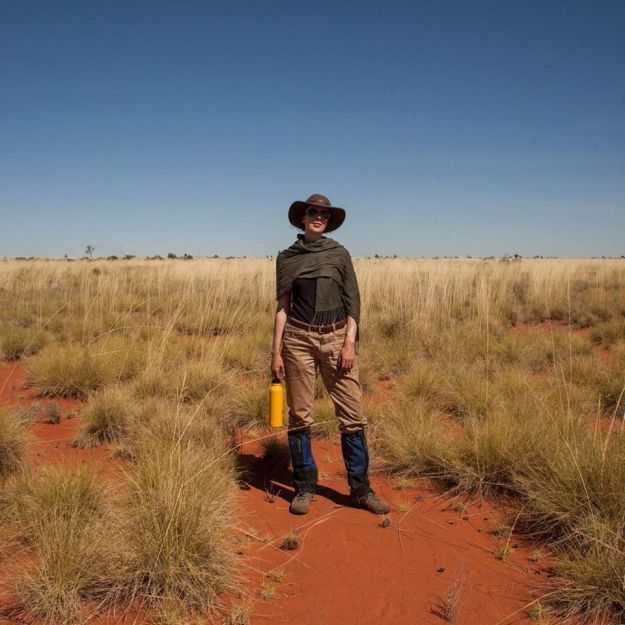
Yes! Absolutely it has. That time helped strengthen my intuition. Weeks on end in the desert will do strange things to your body-perceptions. The land starts to talk to you, and you can’t help but listen, because it is working on your moods and your dreams.

I’m writing about that time in the Outback now. About my relationships with Yapa (Aboriginal) friends and worldview. I suppose the full effect of that desert-infiltration will show itself in time.


What New Zealand poets are you drawn to now?

Some of the New Zealand poets I’m most excited about haven’t even published full collections yet: Hera Lindsay Bird, Loveday Why, Nina Powles, Lee Posna, Bill Nelson, Emma Barnes, and Sugar Magnolia Wilson. I also want to read everything written by Ashleigh Young, Sarah Jane Barnett, Rachel O’Neill, and Zarah Butcher-McGunnigle. It’s the next generation I’m most drawn to, though poets Jenny Bornholdt and Dinah Hawken still loom large.


Joan Fleming’s webpage

Victoria University Press page

A Feast of Poetry at Going West – kick starts tonight and a photo from the archives

DSCF0102 (Large)

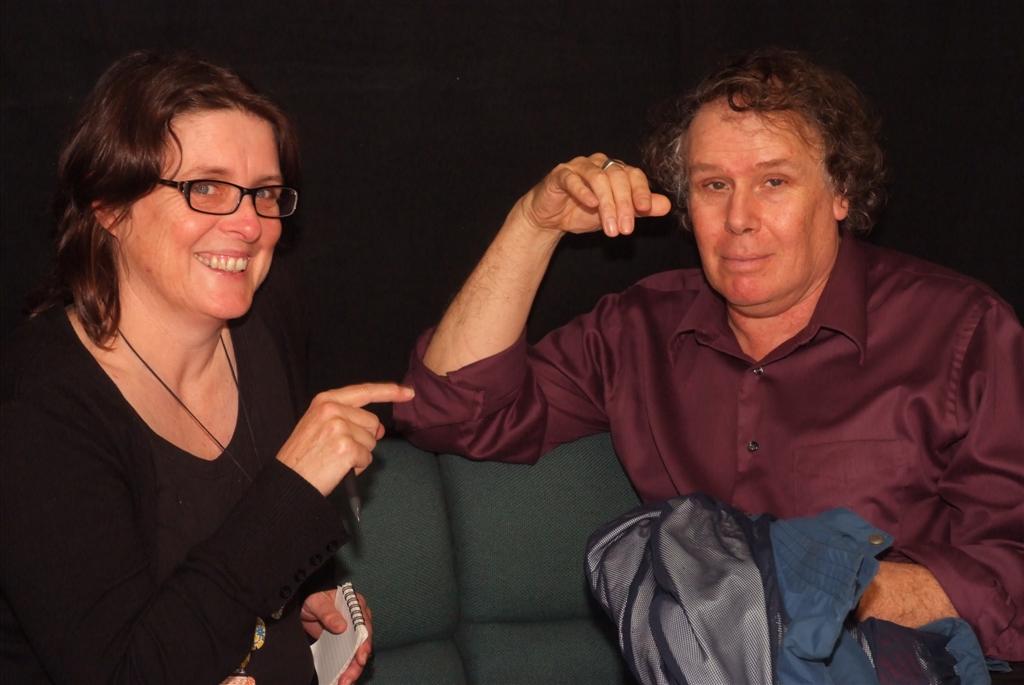
Paula Green & Harry Ricketts at the Going West Books & Writers Festival 2009.
Photo: Gil Hanly, Going West Trust Archives.

(fascinating photo! my little notebook, finger pointing, yep he’s the poet up tonight!)

I love this family festival. I love the sliding doors opening in the breaks and everyone tucking into food and conversation like one big poetry family. I love the eclectic programme and the way you can sit back in the same chair and get taken on a thousand voyages. Three cheers to the hard-working Going West team. I am honoured to be part of the festival, on your 20th celebration.


This year you hear:

Friday (tonight)

7.20 In Remembrance: Glenn Colquhoun

7.30 Curnow Reader: Harry Ricketts

8.20 Myths and Legends of the Ancient Pakeha: Glenn Colquhoun


Saturday night

8.30pm Poetry Slam (Harry, Glenn and I are judges)


Sunday morning

9.30 am  The Poetry of Place: Kerry Hines and Leilani Tamu in conversation with me


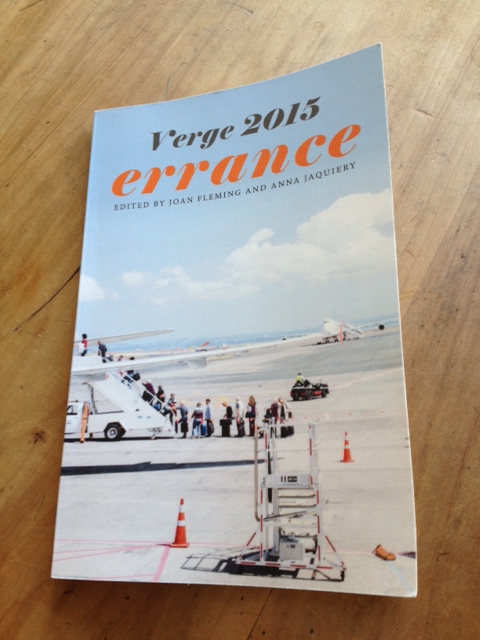
Verge 15 — If all the issues have this vitality, and take you to a verge in such distinctive ways, it is worth a subscription

photo


poetry is the mouthpiece of the unspeakable

Verge is a literary journal published by Monash University Publishing. The Press aims to bring ‘to the world publications which advance the best traditions of humane and enlightened thought.’

This issue is edited by two women with New Zealand links. Joan Fleming is a poet currently writing a doctorate on ethnopoetics at Monash University. Her second poetry collection, Failed Love Poems, has just been released by Victoria University Press. Anna Jaquiery is a Wellington based novelist. Pam Macmillan (UK) have published two of her crime novels. She is also completing a doctorate at Monash University in Creative Writing.

This issue contains poems and short fiction, and includes a number of writers with New Zealand connections (including Emma Barnes, Amy Brown, Lynn Davidson, Rosa McGregor, Lee Posna, Erin Scudder, Steven Toussaint, Sugar Magnolia Wilson).


Joan has written a terrific introduction that sent me down trails of sparking thought in view of my new project on NZ women’s poetry. She introduces the life-blood theme of the issue: errance (‘1. the act of travelling from one place to another without any clear destination 2. a wandering of the mind’).

Such a poetic prompt stands in for the way many writers work. Yes, there is a starting point but you then let go into uncertainty, discovery, uncertainty, electricity. Joan writes: ‘What we know and can’t know is a personal obsession of mine. I try and practice a mode of attuned, sensitive ignorance in my own poetry, as well as in my research.’ The word ‘can’t’ — a tiny hook as though taboo or impenetrable or withheld.

‘Errance’ also stood for the way I engaged with the issue as reader. In a sense (aural, visual), the work is afterness (Post Language) in that it steps out of Language Poetry. A thin, almost invisible guy rope. You enter into murkiness, the unfamiliar, difficulty, miniature theatrical stages, staged heart, aural agility, sumptuous image building, dissolution, elusive meaning, skerricks of story, smidgeons of character, semantic hinges. Aural chords. Visual melodies. Sharps and flats for ear and eye. What binds this collection of writing is an utterly infectious joy of language. A love of the word on the page — of the way this word electrifies that word. Or mutes. Or sidetracks.

I loved the metonymic kick between this word and that word, this presence and that absence, this gesture and that arrival.

Always poetic currency fermenting in the gaps.


Here are some of the poems I loved:

Cody-Rose Clevidence (I can’t reproduce the title correctly as the first word is crossed out) but the poem is from ‘Flung Throne.’ The looping, loping syntax brings you back to the word, then steers you to a pulsing visual tapestry. Hairs raising on the back of my arm as I read this.

Lee Posna ‘Job’s Clouds’ The poem takes ‘cloud’ as its poetic core and then surprises you at every twist and turn. The last line catches you, utterly.

Steven Toussaint from ‘Aevum Measures’ Reading this for me is a Zen-like experience where I get drawn into the moment of a line ( a word, a phrase) and everything stalls. The language — resplendent for the eye, divine notes for the ear. Poetry then becomes transcendental. Uplifting. Leads you elsewhere. Beyond this, for me, the surprising metonymic glints are a vital feature.

Cy Mathews ‘Old Song’ This is like a road poem, a skinny road poem (part fable)  spining down the page where nothing much happens, like that view that is always the same, never shifting, until you spend time and learn to look and there you are nestled in its alluring grip and difference.

Shari Kocher ‘Errancy: A Primer, after Emily Dickinson’ Poems split in two halves with an empty backbone that makes reading variable. You move through honeyed melody and crackling connections. Over that split between left and right. Up down. I acquired a compendium of phrases I want to keep with me for awhile.


Reading this issue it felt as though there is something in the air we are breathing. A poetry mist/spray that gets into our lungs. Motifs echo. Poetry here invites a different way of reading, yet never lets go of eye and ear. And still, in the very best examples, you meet that drumming heart. In the white space, the cracks, the cloudy patches, in the inbetween.

If all the issues have this vitality, and take you to a verge in such distinctive ways, it is worth a subscription. Bravo!


A call for earthquake poems

Call For Submissions

Proposed anthology of poems prompted by the Canterbury Earthquakes

There has already been a range of wide range responses to the earthquakes  – from moving to darkly comic, from passionate to offbeat and quirky.

All of this suggests – despite its rather bleak subject matter – a nuanced and richly varied collection of poems might be gathered together for possible publication in book form.

Local poets and editors Joanna Preston and James Norcliffe are currently gathering such material and would be interested in receiving work that might be appropriate.

The anthology is still very much at the projected stage and there is no certainty it will proceed. It is also proposed that any proceeds beyond publication costs be donated to appropriate earthquake recovery projects so that no individual payment will be offered.

We would be interested in considering either published or unpublished material.

Submissions, which should be sent to either

James Norcliffe normel@clear.net.nz  or  x-msg://2/normel@clear.net.nz

Joanna Preston  preston.joanna@gmail.com  or x-msg://2/preston.joanna@gmail.com

Deadline:  October 30.

check out ‘catch and release: Poems from Manawatu’ edited by Helen Lehndorf

catch and release:  Poems from Manawatu’ is the first e-publication from City Libraries and Community Services.  As part of the experimental poetry programme KUPU – PoetryBeyondWords, the book is one of a series of initiatives designed to engage the community in poetry writing.  Around two hundred and fifty submissions of poetry and proverbs were received and we’re thrilled with the response.

One of the aims of KUPU is to provide an avenue for poets of all levels to develop their engagement activities with local audiences, and act as a stepping stone in artistic development.  The point of the ebook was to create a piece of work that the contributing poets could use to profile their poetry.  “It is challenging starting out” says Genny Vella, City Cultural Coordinator.  “Being able to include publications in personal profiles and biographies adds a little more weight to the body of work poets are able to call on to demonstrate their talent”.

Ten poems were selected from forty submissions.  The result is a lovely anthology of works by known and previously unpublished poets about Manawatu – the creative expression of heart and place.

read them here

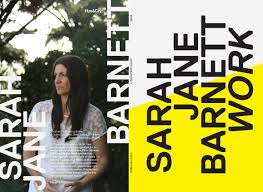
Sarah Jane Barnett is launching Work at Vic Books soon

images-1


You are warmly invited to join Hue & Cry Press and Sarah Jane Barnett in launching WORK at Vic Books, Victoria University. All welcome.

In these six long poems Sarah Jane Barnett explores how people fight for a normal life. Set in Ethiopia, Paris, Norway, and New Zealand these astonishing poems take you into the lives of others—a grieving man leaves Ethiopia at the end of the civil war; a polyamorous couple have a child; a woman hunts a black bear on a New Zealand sheep station. Original and spellbinding, these poems walk the line between poetry and fiction.

WORK will be launched at Vic Books, Wellington. Sarah will read from ‘Ghosts,’ a speculative poem set in Norway’s northernmost town, Svalbard. The poem includes dialogue between the characters Diane and Fowler, who will be read by Wellington writers Therese Lloyd and Matt Bialostocki. Get ready for a performance!


where: Vic Books, 1 Kelburn Parade, Wellington

when: Thursday 22nd October, 5.30pm start with the reading 6-6.15pm.

Hue & Cry Press
Vic Books

If you can’t make the launch, WORK can be pre-ordered from Hue & Cry Press store:

2015 NEW VOICES – Emerging Poets Competition – the results

Congratulations!

Ria Masae 1

2015 NEW VOICES – Emerging Poets Competition

The Divine Muses Poetry Reading and Penguin Random House New Zealand are pleased to announce the winner, runner up and highly commended entries in the 2015 NEW VOICES – Emerging Poets Competition.

The winner of the 2015 NEW VOICES – Emerging Poets Competition is Manukau Institute of Technology student Ria Masae for her poem, ‘Native Rivalry’. Writing of the winning entry, our judge commented, “I chose this poem as the winner because it is a beautiful poem, with layers I can ruminate on, and though I read this poem over and over, I never tired of it, in fact I always found a little something more to enjoy each time. It is a sharp observation, yet written with affection, and is very easy to love.”

Our huge congratulations to Ria who holds a BA from the University of Auckland, and is currently studying towards a BCA at MIT.  Her work has been accepted for publication by Blackmail Press, Potroast, Ika,and Otoliths. She is a member of SAPC (South Auckland Poets Collective).

Runner up this year was Auckland University of Technology Masters in Creative Writing graduate, Georgina Monro for her poem, ‘Student Nurse’. This, says Allan, “is a compassionate poem, which utilises figurative language to express modes of communication in unusual forms.”

Monro is a graduate of the Masters in Creative Writing program at Auckland University of Technology. She has been a finalist in the Going West Poetry Slam and the Auckland Writers and Readers Festival Slam.

Additionally there were two Highly-Commended entries are, ‘Murmur’ by Auckland University Philosophy graduate, Sahanika Ratnayake and ‘Colour me true’ by Michelle Chote who is in her 2nd year of study in Italian and French.

Ria Masae and Georgina Monro join our winners and runners up, many of whom have gone onto have work widely published in journals here and overseas, including Elizabeth Welsh, Elizabeth Morton and Rosetta Allan.

There were over 70 entries to this year’s competition. Of those works submitted, Allan said, “The breadth of subject matter was vast, and the forms of poetry went from Rhyming iambic pentameter, right through to freeverse.”


newvoices300dpi    Logo-RGB_PRH-NewZealand