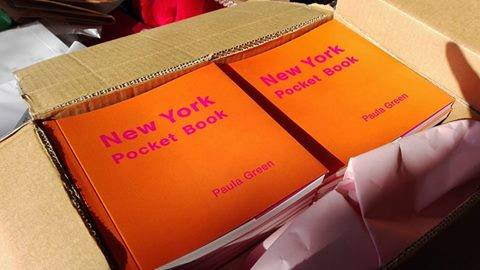
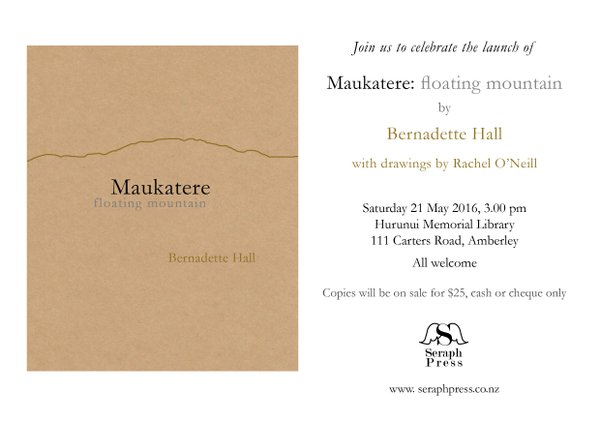
Hard to settle, haven’t got my copies yet, but look what Seraph Press has.
Two launches in one week.

Hard to settle, haven’t got my copies yet, but look what Seraph Press has.
Two launches in one week.
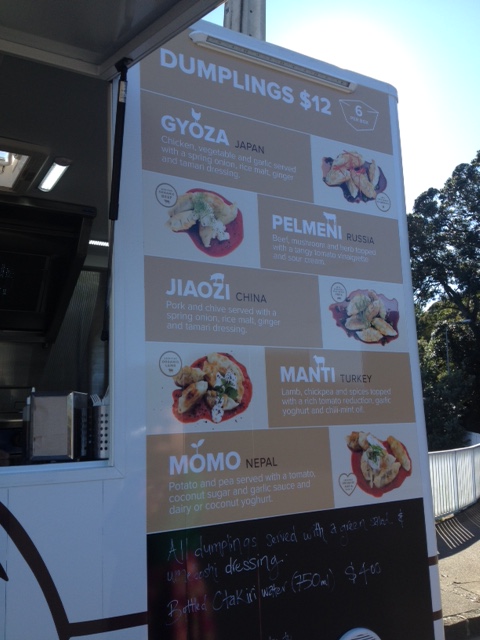
Very Good Dumplings
no rain nor hail nor thunder how surprising
surprising my first very good dumplings
warm and perfect, fresh dumpling bites
of Japan light such lovely rumba on the tongue
or Nepal’s soothing balm and how embarrassing
I do a warm and perfect jig in the mongrel dog wind
by the sea at Cox’s Bay sweet herb salad to the side
the cobalt blue sky a clean sheet of a day
Paula Green
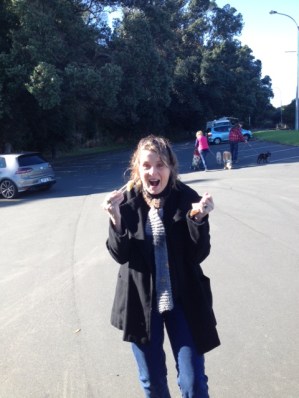
Oh my gosh! The Very Good Dumpling Truck will be at Cox’s Bay Wednesday to Saturday from 11 am until 3pm. I will drive in especially for these!

From editor Jack Ross:
From today (Sunday, May 1st: Mayday) onwards, Poetry NZ is open for submissions for the next yearbook. This will be appearing in Late February / early March next year, from our new publisher Massey University Press, and thereafter at the beginning of each year.
Submissions close on 31st July.
For further advice on how to submit, please look at this page on our website. Please note: no more than five poems at a time, of any length, on any theme, in any style. This editor has also written a few advisory comments of his own in this post, below.
As well as poetry, we’re also interested in essays and other prose comments on poetics and allied subjects. Remember, too, that all poems sent in for this issue are eligible to be considered for the Poetry NZ Poetry Prize, as mentioned in another post below.
See here for journal site
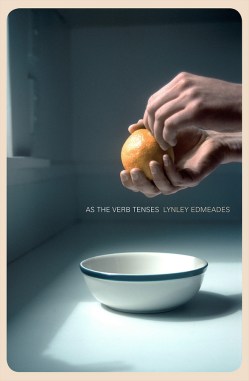
Mary McCallum from Mākaro Press and Heidi North-Bailey have given me permission to post this marvelous mother poem from Heidi’s debut poetry collection. The poem is so beautifully lyrical, exquisitely layered, the gaps large and resonant, the line of women vital; the hidden stories pull you back for another look, and then another. This is one of my favourite poems of the year to date.


©Heidi North-Bailey 2015

Listening In
The mere presence of her was the necessary part.
Over-hearers, their little coves of ears
were, of course, listening in.
Together, we could hear history
painting a diagram of itself, and things began
to form layers. My mother’s hand
upon the pillow, the pillow soft upon the bed.
©Lynley Edmeades from As the Verb Tenses Otago University Press 2016
This mother poem is a perfect advertisement for a collection that shows how real life can give poetry a vital tang; that poems excised from who you, where you and where you are from sometimes lack the power to kick start your heart from daily routine. The gaps are resplendent. The detail: lyrical, tender, uplifting, deliciously layered.
Everything slows down to a leisurely pace.
Elsewhere in the book: ‘You’re wondering what to do with this, this slowness.’
Absorb and connect. Absorb and connect. This is a terrific debut (oh! and a stand-out cover).
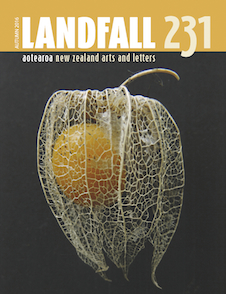
We are well served by literary journals at the moment. Each delivers slightly different treats, biases, focuses but all offer high quality writing that resist any singular NZ model.
The latest Landfall (as you can see) has a stunning cover with its Peter Peryer photograph.
Inside: poetry (37 poets!), fiction, non-fiction, art and book reviews (including an excellent review of Anna Smaill’s The Chimes, one of my top fiction reads of the past year).
The poets range from the very familiar, whether young or old, to those new to me. And that is as it should be. David Eggleton is keeping the magazine fresh whilst giving vital space to our literary elders and maintaining a strong and welcome Pacific flavour.
A tasting plate of lines that got me (I seem to have been struck by mothers, fathers, surprising images, little twists):
from Brian Turner’s ‘Weekends’:
think of what a place could be
when it’s not what we possess
that counts most
but what we are possessed by
from CK Stead’s ‘One: Like a bird’ (for Kay):
You were beautiful, and I
sang, as I could in those days
all the way home—like a bird.
from Leilani Tamu’s ‘Researching Ali’i’:
I searched for you in boxes
the archivist muttered poison
from Rata Gordon’s ‘A Baby’:
I want to make a baby out of one peach and one prickle.
I want to use the kitchen sponge, sticky rice and a rubber band.
I want to use the coffee grinder.
from Siobhan Harvey’s ‘Spaceboy and the White Hole’:
he pictures matter barely visible, the light
of white holes as they transmit their secret
messages, sharp elegies, about letting go.
from Ruth Arnison’s ‘The Visit’:
Even from the road her house gave us the creeps.
Pale, communion wafer thin, and disapproving,
its severe windows three-quarter blinded.
from Heather McQuillan’s ‘In which I defend my father’s right to solitude’:
our father has a fine tooth way
of finding vulnerabilities
on the outward flanks
the wolf is always at his door
from Doc Drumheller’s ‘My Father’s Fingers’:
Days after my father died I felt a sense
of urgency to take care of his hot-house.
from Koenraad Kuiper’s ‘from Benedictine Sonnets’:
Mother always knitted particularly socks.
Knitting socks is a fine skill under the lamplight.
from Elizabeth Smither’s ‘Three “Willow” Pattern Bowls’:
My father thought I meant the plate
and wrapped one from the china cabinet
I carried it close to my heart
all the way back for a second reprimand.
from Bob Orr’s ‘Seven Haiku’:
I don’t care about
frogs
basho’s dead
from Will Leadbetter’s ‘Three Variations on “The Red Wheelbarrow” by William Carlos Williams’:
Nothing depends upon
the green wheelbarrow
Great winter reading!
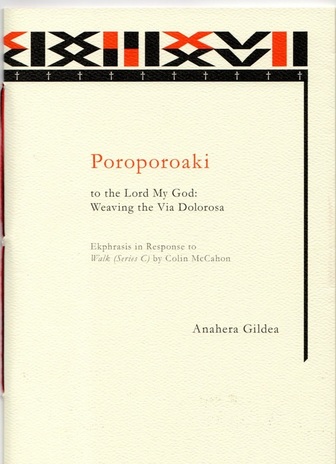
Anahera Gildea, Seraph Press, 2016
Designed and produced by Helen Rickerby of Seraph Press, this is the most exquisite chapbook imaginable. Add the gorgeous paper stock to the extra heavenly endpapers, the hand stitching and an internal design that is elegant and minimalist and you have a rare poetry treat. It is a work of beauty and all poets will be dreaming of their very own chap book. I for one!
XIV
Sometimes it is enough
to sit and look out.
Other times you have to walk
across bone, stone and shell.
Anahera Gildea’s poem is written in response to ‘Walk (Series C)‘ by Colin McCahon and is as much for James K Baxter as it is a response to the painting. It is an example of poetry as gift/taonga. Each line carefully stitched like the stitching in the kahu-kuri she makes for Baxter. This poet knows you don’t need many lines on the page to entice a reader to linger. You are walking alongside McCahon’s painting, you are walking along the wild and dark threat and wonder at Muriwai Beach, you are walking the Stations of the Cross and you are walking the poem. It is, for me, a very moving sequence.


(excuse my photos but I have managed an eerie poetry light on everyone!)
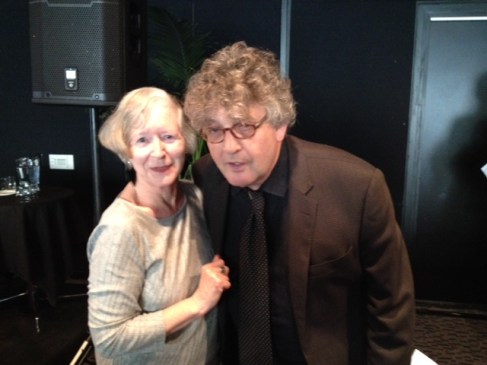
Going to the Sarah Broom Award is always a sad-glad occasion for me as I get to remember a wonderful poet and to celebrate the vitality of New Zealand poetry.
This year was no exception. The award is a gift from Sarah’s husband, Michael Gleissner. His dedicated drive to support NZ poetry offers an award for a poet at any stage of their career. For the past two occasions, an overseas judge has selected the shortlist and winner. This year, acclaimed Irish poet, Paul Muldoon, was judge. He had no idea who wrote the poems and insisted on reading all the entries (over 250) because he wanted to find the entries that ‘judge you, that read you and impress themselves upon you.’


Paul’s short list: Airini Beautrais, Elizabeth Smither and Amanda Hunt
Paul began with a moving tribute to Sarah, Sarah’s family and her poetry. He read her poem (among others) ‘Holding the Line’ and said: ‘We’re all trying to hold the line of poetry which seems a little perilous, but that’s what we’re all trying to do.’
Each poet read a handful of poems.
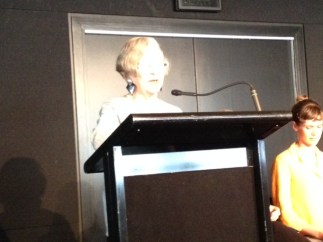
The winner, Elizabeth Smither read the poem about her mother that she read at the Laureate Circle event in Wellington. Kate Camp and I were in a frenzy to read it again. Elizabeth so kindly gave Kate her copy and signed it and emailed me one. It is the kind of a poem that has built a room of its own in my head. The sort of poem that rises and pierces your heart with the acute depiction of a moment. Elizabeth is outside in her car in the street seeing her mother move through her house without realising her daughter is watching. Elizabeth followed it with a poem, ‘The name in the fridge’ that made me laugh out loud. She and friend had put the name of someone they wished ill of in the freezer but nothing bad happened (see poem below). As Paul said, Elizabeth has the skill to blend humour with seriousness. Yes, her poems can handle that and so much more. The stillness, insight and deep connection to humanity makes Elizabeth a poet writing at her very best.
Elizabeth is a former NZ Poet Laureate, has published numerous poetry collections that have garnered awards and high praise, along with short stories and novels. She lives in New Plymouth.
The name in the fridge
Someone we both disliked: you wrote
his name on a slip of paper
folded it, and inserted it in the freezer
under a tray of ice cubes, next to
a frozen chicken, frozen vegetables
a casserole sectioned into cartons.
You’d read about it. Nothing too serious
would happen. Perhaps he’d lose his job
or his dog would need taking to the vet.
The dog would recover, the bill be huge.
His wife might flirt with someone at a party
and be noticed: notice was a big part of it.
When nothing happened after six months:
his dog had puppies, he got promoted
we took out the paper, ice-encrusted
and brushed it against our jerseys. Soft
powder fell into the sink. You said
you’d take it with you when you went to England
as if it would be more potent there.
A huge fridge near an Aga
stuffed with grouse and pheasants and wild boar.
©Elizabeth Smither
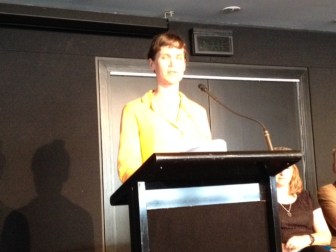
Airini Beautrais read from a sequence of poems that forge links with the Whanganui River. As a poet she bends the line and then makes it glow with luminous detail so that as you listen to the contours of voice you are both skimming the slopes of every day living and doing little side jumps to out-of-the-everyday. It all comes down to voice. To human beings finding their way in different circumstances. As I listened I felt like I want to read the river, to read the whole sequence, and follow people as much as river currents.
Airini has published three collections of poetry and is a graduate of IIML. Her most recent collection, Dear Neil Roberts, was longlisted for the Ockham NZ Book Awards in the Poetry Category. Like Amanda she studied ecological science at university. Her debut collection was named Best First Book of Poetry at the Montana NZ Book Awards 2007. She lives in Whanganui.
Airini acknowledged the significance of Sarah’s poetry: ‘As a mother and writer I find Sarah’s poetry particularly moving, and also inspirational. I am inspired by her bravery and strength. She has left us an important legacy.’
Observatory
Kids, who wants to look up through the telescope?
This is the largest unmodified refractor telescope in use
in New Zealand. Birthday girl, you first. I hope
you’ll see a planet up there, with rings. That might come loose
if you fiddle with it, be careful. It looks like smoke?
That would be a cloud. Is that really a planet? Yes.
Nah, I stuck a picture up on the end. That was a joke.
Could an asteroid destroy humanity? Well, I guess
there’s a chance. No object we know of threatens us any time soon.
Is there life like ours, out there? Keep looking up, wave a little.
Parents, bring your kids back one Friday night, maybe the moon
will be visible. Who hasn’t had a turn yet? Look there, and it’ll
be right in the middle. Ha, that’s what everyone says. You know how
they called this planet Saturn? They really should have named it Oh wow.
©Airini Beautrais
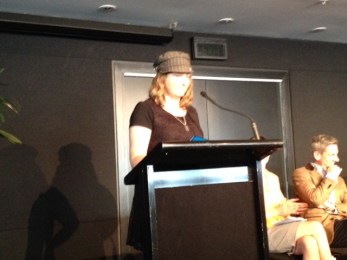
Amanda Hunt read a bunch of native bird poems that were glorious renditions of birds but offered so much more in terms of life and living. Like Elizabeth she had the ability to make us laugh and pause. There was the joy of hearing a poet for the first time that you know absolutely nothing about and have no idea what effect her poems will have on you. I loved the static between visual detail and people doing things.
Amanda is a poet and ecologist based in Rotorua and, while she has been writing poems for awhile, is beginning to seek increased publishing opportunities. She studied medicine and environmental science at the University of Auckland. She has worked in environmental and resource management throughout New Zealand and Australia, but returned to her home town a few years ago.
Amanda said that she ‘felt the award helps to keep Sarah’s amazing work very much alive and it was a real honour to be reading at this event in her name.’
Overture
He says
the grey warbler sounds
like the beginning of a Bizet aria
a small pale bird
ruffling its feathers
inside a red dress
one wing outstretched
as its sings the same song
over and over
all our birds have
funny names and
our voices are strange so
he has to ask us to repeat
what we say
over and over
the cold is on the border
of being worth dressing for
he came without gloves
it’s still winter and the
wind blitzes us from the south
but in the morning he’s not sure
if it’s snow he sees on the hills or
the sun in his eyes
we drive on the wrong side of the road
there are no newspapers in his language
and he still wakes late with jet lag
and yet
every morning
in the kowhai tree behind his house
the first notes of a song
he already knows.
©Amanda Hunt
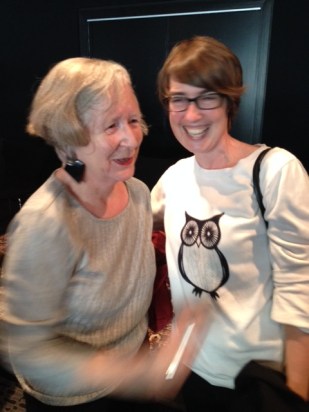
(Elizabeth with her AUP editor, Anna Hodge)
When Elizabeth was announced as winner she was a little shocked (I do think the finalists could be told back stage so they don’t have to sit on stage for an hour, with the the sizable store of nerves that build when you are about to read in public). She searched in her bag for a piece of paper while Paul supplied her with another poem to read.
I thought her thank-you speech was very moving. She said, ‘It feels like having your first poem accepted again. The chase is always on the for the next poem that might be better though it is always moving out of reach.’
Elizabeth was reminded of her short story where a young girl, notebook in arm, struggled to be a writer in Paris. Elizabeth had included this quote from Mavis Gallant in her story: ‘She was sustained by the French refusal to accept poverty as a sign of failure in an artist.’
Elizabeth said that poets would be familiar with this and ‘That is why the Sarah Broom Award is so marvelous. Sarah and Michael have exactly understood the position, the amount is perfect, the conditions are wonderful.’
Like Airini and Amanda, she paid moving tribute to Sarah’s poems: ‘I heard that a whole new cluster of planets has just been discovered. That’s how I think of Sarah’s poems: flying through space, serene and beautiful, wrought from tragedy and beauty.’
Elizabeth also thanked the audience! She made us feel that as readers we matter: ‘And I want to thank the audience for being present. Poetry could not survive without you. The girl in the French cafe was counting on that: if she could write something, someone would read it and she then would be a writer.’
Thanks to AWF for hosting this event.
Thanks for a terrific occasion Michael. Three very special writers. One very special award.

With the latest issue, Ika is planting its feet firmly on the NZ writing landscape, as a journal to take notice of. Each issue tweaks the design a little. This one looks good. Poems luxuriate on the page. The art is honoured. The internal design is appealing to the eye.
Anne Kennedy, with her astute eye and ear, has assembled writing that matches the fresh appeal of the design. Like Sport, the journal acknowledges its links to its Creative Writing programme and allows established writers to rub shoulders with students. I applaud the celebration of Pacific writing. You will find art, poetry, fiction, an interview and nonfiction. A feast indeed.
Lovely launch at Auckland Central Library on Saturday with a fitting speech by Sue Orr, a handful of readings and wow-factor song.
A taste of poetry:
Annaleese Jochems: She is a graduate of MIT and is now doing a Masters in writing at Victoria. Her poem is your entry into the book and it leaves you wanting more. Just what a new voice offers: surprising lines, audacity, elasticity.
I must go home for dinner,/ but I don’t want to go home/ where I play my unrequited/ love like a banjo
Poet and publisher Kiri Piahana-Wong has a suite of poems that I think are her best yet. How do you reproduce feeling in a poem in 2016? Kiri shows how: ‘A month later my chest/ still felt like a stone/ was inside it so I stayed/ there and I kept waiting’
Bill Manhire also has a suite of poems. The first poem, ‘We Work to be Winners’ got under my skin because I loved the surprising juxtapositions of one line alongside the next. It got me thinking about the origins of the poem. Sometimes if you know that, it changes the way you read the lines. In this case I began inventing origins as I waited in a festival queue. It felt like the poem had a fascinating backstory which could become a poem in its own right. It might be a found poem (but from where? that is what intrigues). It could be written from the point of view of someone who writes a sentence in a diary each Thursday. Or the offbeat biography of a hippy from the 1970s. Get the journal and decide for yourself. First line: ‘I left the ashram running for my life.’
Craig Santos Perez: ‘Micronesians in Denial’ brings mouth-watering detail alongside history alongside political spikes. I also loved ‘Aunty of rainwater and Smoke’ – the title says it all. This is poetry song and poetry joy.
David Eggleton (winner of Poetry Category at NZ Book Awards last week) is hitting his poetry straps so to speak. You get two poems that are a linguistic explosion in the ear with musical chords sneaking in and rhythms pulling you along at breakneck speed. It is not just aural gold though because there is the visual weave that ignites all senses.
Awks: you winged Auk-thing, awkward, huddling;
you wraparound, myriad, amphibious,
stretchy try-hard, Polywoodish
juggernaut’ (from ‘Edgeland’)
I am flicking in and out of the journal waiting for a session at the festival and stumble upon these lines by Hera Lindsay Bird (she has a book out with VUP later this year!): ‘O Anna/ let us jettison the manky quilts/ of our foremothers’ Yep – it is a terrific poem.
Courtney Sina Meredith’s ‘of all the bricks we laid in our sleep’ stuck with me, haunted me as I drove home on Sunday with festival fatigue. this poem was like a haunting refrain. ‘and hear your soft waiata/ through the floorboards’
This stanza from Doug Poole‘s ‘The light I had hoped’ also got to me:
As a child I would lie awake listening to my grandmother slapping
clothes on her bedside chair, speaking aloud her thoughts of the day,
clicking rosary beads and whispering her prayers
This afternoon I fell upon ‘Chasing Spirits’ by Kim M. Melhuish. A voice keeps asking ‘how’s this’ and the answers tumble like little poetry postcards perfectly formed:
two words
fishing for love
pink orchids
finger paint
the night ahead.
And then it was this delicious morsel from Vivienne Plumb from ‘Peach Tree’:
The cactus unfurls its one brilliant
blinding flower. Excuse me,
there is no poetic peach tree here.
AND I still have to read poems by these poets: Airini Beautrias, Bryan Walpert, Charlotte Steel, Elizabeth Morton, Gregory O’Brien, Makyla Curtis, Manisha Anjali, Ria Masae, Richard Von Sturmer, Sophie van Waardenberg.
I applaud everyone involved. This is a journal worth subscribing to.
Enquiries: ikajournal@gmail.com
submit at
 NZ Poetry Shelf