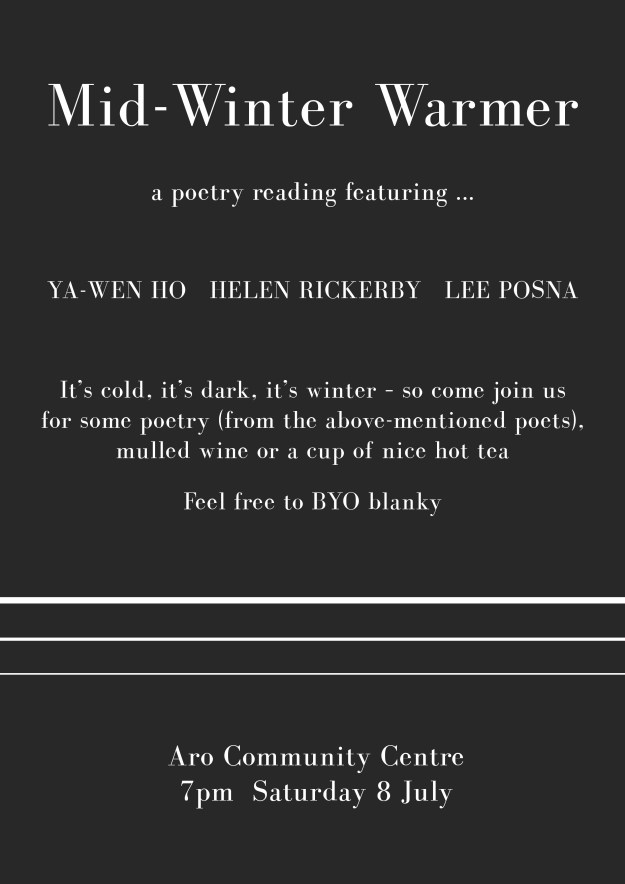
Wellington mid-winter poetry warmer with Helen, Ya-Wen and Lee
Leave a reply

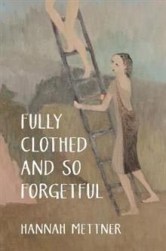
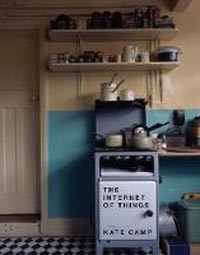
Fully Clothed and So Forgetful by Hannah Mettner (Victoria University Press, 2017), 91 pp., $25; The Internet of Things by Kate Camp (Victoria University Press, 2017), 61 pp., $25
One quality I love about first volumes of poetry is that they often contain an element of the poet’s origin story. Hannah Mettner’s Fully Clothed and So Forgetful certainly does: there are poems referencing childhood, relationships with siblings and wider family, elements of cultural confusion after an across-the-world move, parenthood – all described with deftness, wit and originality. How about that title? It’s a delight … inviting, and very human.
full review here
As Rick Stein would say, we need more of this! Such a very good idea.
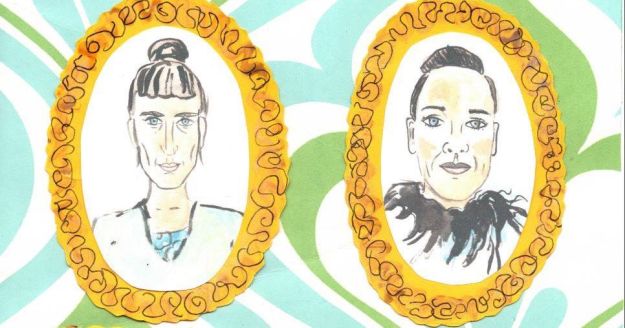
From Maria and Airini:
‘(Our portraits are by the wondrous Sarah Laing) Airini and Maria are going on tour in July! Like rock stars only way cooler. Napier 15th, Thames 16th, Auckland tbc, Wellington 28th, Palmerston North 29th and Paraparaumu Beach on the 30th. We’re promoting our new books: Maria‘s and Airini‘s.’
See here for details
Paula’s seven thoughts on Maria’s new book here.
After lunch my mother walks into the dining room
and my father and I both
blow our noses.
In the past when I thought about people my parents
were somehow
not among them. But some wound stayed
wide in all of us, and now I see in their faces
strange rivers and waterfalls, tilted over with broom.
You are watching the brown-paper covers of books grow
out around your father, as he dreams there
against the wall, thinking perhaps
how rocks are not quite lands.
Gregory Kan, from untitled sequence in This Paper Boat (Auckland University Press, 2016)
Kevin Ireland picked Gregory’s poem and had this to say: “Gregory Kan’s sequences in This Paper Boat are full of self-discoveries and surprises. The words really do swirl around and head off in different directions — just like the paper boats that inspired them.”
Group Two (go here for poems)
Tusiata Avia
‘I cannot write a poem about Gaza’
Fale Aitu/ Spirit House
(VUP, 2016)
picked:
Teresia Teaiwa
‘Fear of Flying (in broken Gilbertese)’
Poetry Foundation site
Kevin Ireland
‘Flying across Australia’
Looking out to sea
(Steele Roberts, 2015)
picked:
Gregory Kan
[Any of the sequences]
This Paper Boat (AUP, 2016)
Diana Bridge
‘Big Bang’
In the supplementary garden
(cold hub press, 2016)
picked:
John Dennison
‘Sleepers’
Otherwise
(AUP, 2015)
Andrew Johnston
‘Deuteronomy’
Fits and Starts (VUP, 2016)
picked:
Bill Nelson
‘The whys and Zs’
Memorandum of Understanding (VUP, 2016)
Michael Harlow
‘The late news’
Nothing For It But To Sing (OUP, 2016)
picked:
Paul Schimmel
‘With Words’
Reading the Water (Steele Roberts, 2016)
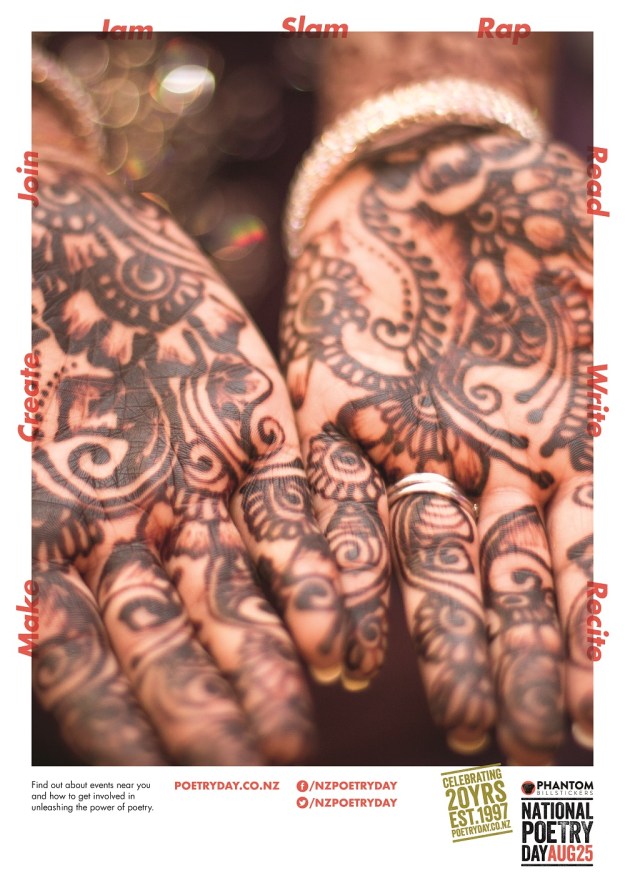
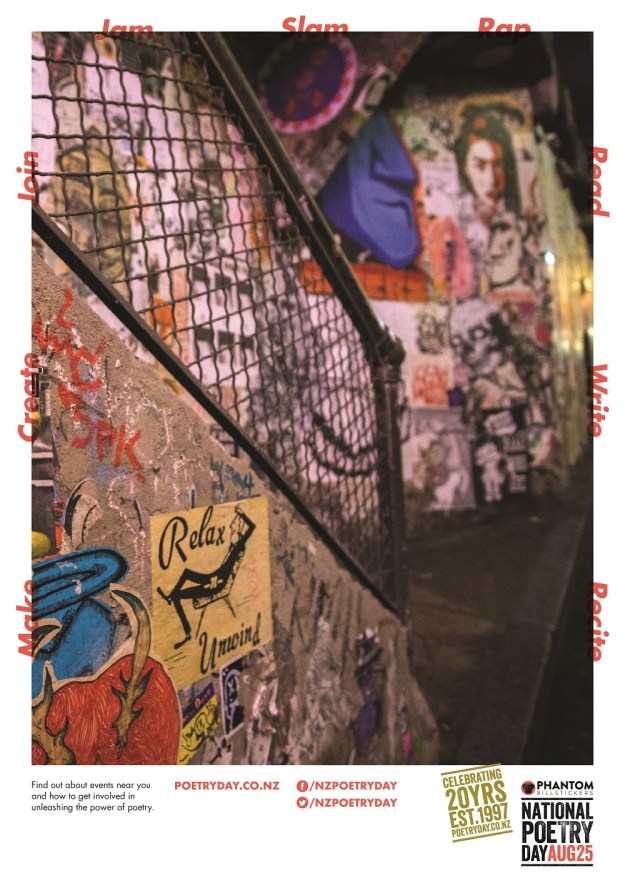
Phantom Billstickers National Poetry Day celebrate 20 years with diverse
poetry collection
To mark the 20th anniversary of Phantom Billstickers National Poetry Day (NPD), 20 leading Kiwi poets were asked to select one of their own poems, something they felt spoke to New Zealanders now. They also chose a poem by an emerging poet, writers they feel make essential reading for us in 2017.
The result is the 20/20 Collection – 40 poems by New Zealand poets who represent the diversity and vibrancy of talent in our contemporary national literature. The list includes Poet Laureates, Ockham New Zealand Book Awards winners, and strong new voices from recent collections and anthologies.
NPD has been running continuously since 1997 and is always celebrated on the last Friday in August. Poetry enthusiasts from all over New Zealand organise a feast of events – from poetry slams to flash and pop-up events – in venues that include schools, libraries, bars, galleries, surf clubs, and parks. This year’s NPD will be held on Friday 25 August.
Launched on May 24, the 20/20 Collection will be published in groups of ten poems between now and NPD. Featured poets are: Jenny Bornholdt and her pick, Ish Doney; Paula Green and Simone Kaho; Vincent O’Sullivan and Lynley Edmeade; Apirana Taylor and Kiri Piahana Wong; Alison Wong and Chris Tse; Tusiata Avia and Teresia Teaiwa; Kevin Ireland and Gregory Kan; Diana Bridge and John Dennison; Andrew Johnston and Bill Nelson; Michael Harlow and Paul Schimmel; C.K. Stead and Johanna Emeney; David Eggleton and Leilani Tamu; Elizabeth Smither and Rob Hack; Richard Reeve and Michael Steven; Robert Sullivan and Ngahuia Te Awekotuku; Bill Manhire and Louise Wallace; Selina Tusitala Marsh and Reihana Robinson; Cilla McQueen and David Holmes; James Norcliffe and Marisa Capetta; and Brian Turner and Jillian Sullivan.
Paula Morris, NPD spokesperson for the New Zealand Book Awards Trust, said that she was “excited to see the range of voices selected here, and the ethnic and geographic diversity in the poets chosen by our twenty established writers. This list speaks to a ‘new’ New Zealand literature, and reflects how much our culture is changing and growing.”
Many of the poets featured in the 20/20 Collection will take part in events on 25 August, Phantom Billstickers National Poetry Day 2017. Event organisers are encouraged to register their poetry event online as soon as possible: http://www.nzbookawards.nz/national-poetry-day/how-to-register-your-event/.
Now into their second year of naming rights sponsorship of National Poetry Day, Phantom Billstickers will support NPD and 20/20 on the ground, online and in print, with funky billstickers that celebrate our nation’s poets. Business Development Manager Kelly Wilson says, “If given a platform, poetry speaks to people. We are very proud at Phantom to support National Poetry Day and provide platforms all around the country for the poetic voice of New Zealand.”
Phantom Billstickers National Poetry Day is proudly administered by the New Zealand Book Awards Trust.
Notes to Editors
National Poetry Day was established in 1997 with a mandate to celebrate discovery, diversity, community and pushing boundaries. It is a one-day national poetry-event extravaganza held on the last Friday of August each year. This is the second year of National Poetry Day operating under the sponsorship of Phantom Billstickers.
Phantom Billstickers is a street poster company which has consistently helped New Zealanders express themselves since 1982. Recognising and supporting home-grown talent has always sat comfortably alongside its commercial campaign work. Phantom actively promotes New Zealand music, art, poetry and culture around the country and across the world, putting poetry on posters and a literary mix of work into cafes via its quarterly magazine Café Reader.
The New Zealand Book Awards Trust was established as a charitable trust in 2014 to govern and manage the country’s two major literary awards – The Ockham New Zealand Book Awards and the New Zealand Book Awards for Children & Young Adults – as well as National Poetry Day, and to ensure their longevity and credibility.
The 20/20 Collection features work by living New Zealand poets with one exception: Tusiata Avia’s selection of a poem by Teresia Teaiwa. Sadly, Teresia died of cancer in March, aged just 48. She was a much loved and influential
figure in Pacific studies, and the committee hopes that her inclusion in 20/20 encourages more people to seek out her important creative and critical work.
Paula Morris (Ngati Wai, Ngati Whatua) is an award-winning novelist, short story writer and essayist. A frequent book reviewer, interviewer and festival chair, Paula holds degrees from universities in New Zealand, the U.K. and the US, including a D.Phil from the University of York and an MFA from the Iowa Writers’ Workshop. She is convenor of the Master in Creative Writing programme at the University of Auckland in New Zealand.
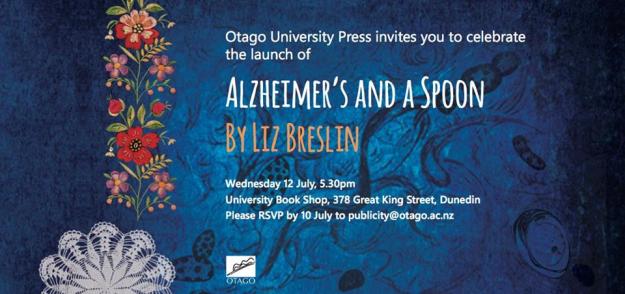
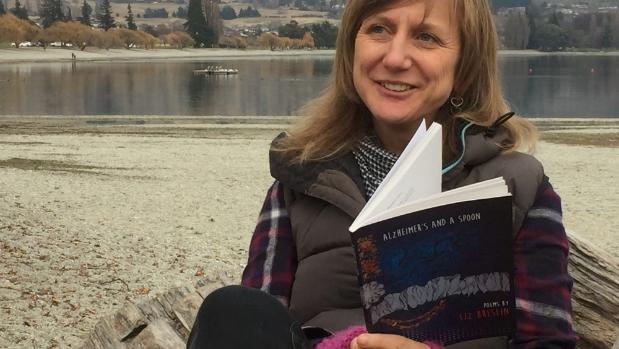
Wanaka poet, Liz Breslin, reads her poem ‘Dichotomy,’ from her first published collection of poems, Alzheimer’s and a Spoon, published by Otago University Press, and to be launched in Wanaka on July 13th.
From Liz:
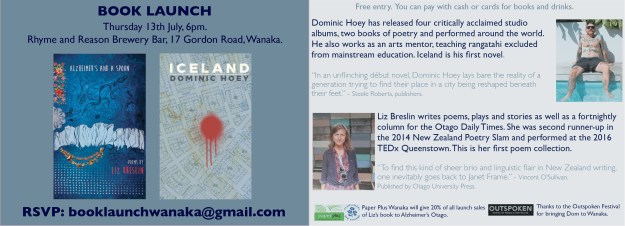
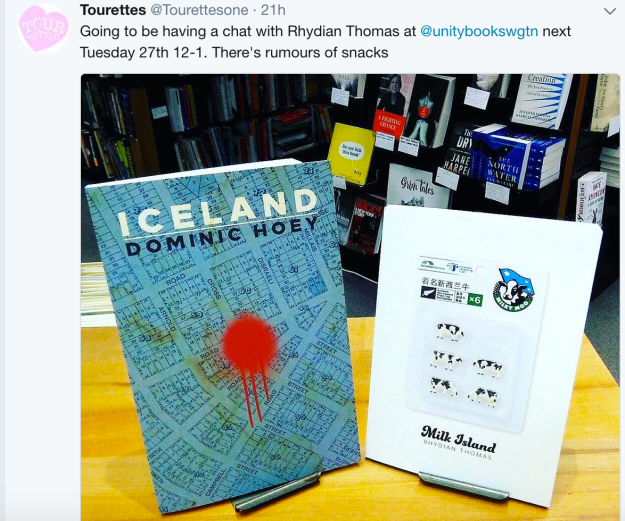
What’s better than a book launch? A double book launch. A double book launch with beer. A double book launch in Wanaka with beer brewed in Wanaka. Words by Liz Breslin and Dominic ‘Tourettes’ Hoey. Books – a novel and some poems. Beer.
Come and listen to Dom and Liz launch their new books. Dom’s novel has been called ‘an unflinching début’ and Liz’s poems have got ‘sheer brio and linguistic flair.’ Since Liz has got the rhymes covered, is Dom bringing reason? Maybe. Probably. Possibly.
He describes his novel, Iceland, as “a tragic love story set in the neighbourhood. It’s about what happens when people are forced to live in a memory of their home. There’s also lots of funny stuff too.”
You’d think funny stuff would be short on the ground in a book about Alzheimer’s, but there’s also humour in Liz’s book. Her back cover blurb says –
“Alzheimer’s and a Spoon takes its readers on a tangled trip. Public stories – a conversation at the Castle of the Insane, online quizzes to determine if you’re mostly meercat or Hufflepuff. #stainlessteelkudos. Personal tales, of Liz’s babcia, a devout Catholic and a soldier in the Warsaw Uprising, who spent her last years with Alzheimer’s disease. There is much to remember that she so badly wanted to forget.”
Dom’s coming to the launch thanks to the Outspoken Festival – and he’s definitely an outspoken entertainer himself. Luc Bohyn, Outspoken’s originator, is excited to bring Dom down as it creates the synergies he enjoyed about Outspoken. Different voices in the same space always make for an interesting evening.
Liz and Dom’s books are as diverse and entertaining as their creative careers are to date. Dom has two poem collections and four studio albums to his name – this is his first novel. He also performs spoken word, is working on a one-man play and spends his time teaching rangatahi excluded from mainstream education.
Liz is known to some people locally for her fortnightly column in the Otago Daily Times, or for her plays, and though she’s had individual poems published, this is her first collection.
“I’m totally completely massively delighted to be published by Otago University Press,’ says Liz. “They’ve been brilliant to work with, and I love having the professional standards and support.”
Liz and Dom are both “pretty good performers” and looking forward to entertaining people when sharing their words at Rhyme and Reason.
And what a great place for a celebration! Apart from the name being an obvious fit, Rhyme and Reason have got their own beers on tap, a selection of other local brews, a tonne of enthusiasm and their own font. And what word nerd doesn’t want to have a ook launch in a brewery that has its own font?
Launch details:
Thursday July 13th, Rhyme and Reason brewery bar, 17 Gordon Road, 6pm.
No entry charge. You can pay cash or EFTPOS for books and drinks.
Paper Plus will be selling books and donating 20% of all launch sales of Liz’s book to Alzheimer’s Otago.
rsvp: booklaunchwanaka@gmail.com
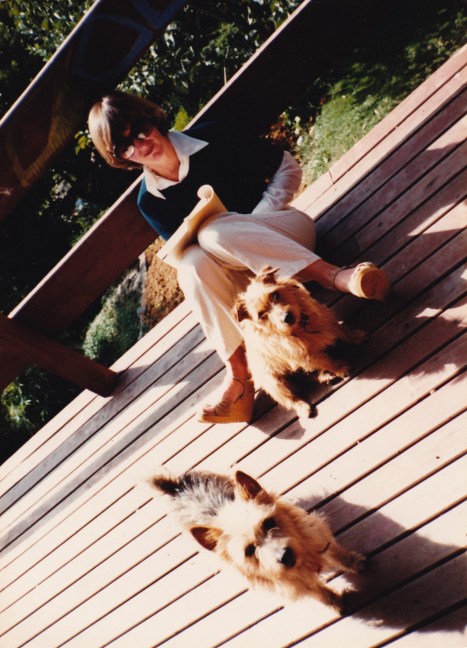
Elizabeth Smither with Rusty and Sneaky
‘The Labradors have made nests already
simply by lying in the long grass
sucking the green into their bodies’
from ‘Lying in the long grass between two black Labradors’ in Night Horse
I recently read through the alluring stretch of Elizabeth Smither’s poetry; from Here Come the Clouds published in 1975, to the new collection, Night Horse, just released by Auckland University Press. I was drawn into melodious lines, pocket anecdotes, bright images and enviable movement. Harry Ricketts talked about the transformative quality of Elizabeth’s poems in an interview with Kathryn Ryan, and I agree. As you follow reading paths from the opening line, there is always some form of transformation. The poetry, from debut until now, is meditative, andante, beautiful.
Elizabeth Smither has written 18 collections of poetry, five novels, five short story collections, journals, essays and reviews. She was New Zealand’s Poet Laureate (2001-3), was awarded the Prime Minister’s Award for Literary Achievement in Poetry in 2008, the same year she received an Hon D. Litt from Auckland University. She has appeared widely at festivals and her work has been published in Australia, USA and UK.
To celebrate Night Horse (Auckland University Press, 2017), Elizabeth agreed to answer a few questions.
‘You can run as fast as Atalanta
who bowled three apples at her suitors
Double Red Delicious’
from ‘An apple tree for Ruby’ in Night Horse
What sparked your imagination as a child? Was reading a main attraction or did you also write? Did particular books endure?
Reading and writing. I liked to say long sentences to myself as I walked. The first thing I can remember writing about was my pet New Zealand White rabbit. All the usual books of the period: Anne of Green Gables, Little Women, A Girl of the Limberlost which I found faintly terrifying. I can see these are the precursors of George Eliot and Jane Austen. As a teenager I had a crush on French writers: Colette, Gide, Mauriac, Sartre, de Beauvoir, Simenon. My father was a great novel reader and he impressed on me the sacrifices made by writers like Charles Dickens. I was scared of Quilp in The Old Curiosity Shop and never got past the page on which he appeared.
‘The cats are out by the letterboxes
at the ends of long driveways
waiting to see how the night will shape itself.’
from ‘Cat night’ in Night Horse
Your debut poetry collection, Here Come the Clouds, appeared in 1975, your eighteenth volume, Night Horse, was published in June this year. I see the same poetic attentiveness and ability to assemble detail that both stalls and surprises the reader. Do you see any changes in the way your write poems, or what you bring to poems, over the past decades?
Elizabeth Caffin wrote of an assured voice but I am unaware of it. I think it is more a question of a philosophy: Keats being lost in the leaves of a tree; being most ourselves when we are unconscious of what the self is; not feeling we are the centre of the universe but one of its parts. It is also a balancing act: the outside world meeting the interior; the sad existing alongside the pleasing, our mixed motives and our inability to ever know more than a fraction. In compensation we have the lovely leap of the imagination. I think poetry in many ways is a dare.
Have any poets or books affected or boosted your poetic directions?
Wallace Stevens was a huge discovery. I used to spend a year reading a major poet. Stevens, Roethke, Berryman, Plath, Sexton, Bishop, Lowell, Synder, The Beats, Black Mountain. Now I am less of a swot and read wherever I please. And when I am tired and jaded I re-read Hercule Poirot.
‘More moon tonight. 14 per cent bigger
and closer to the earth. The whole sky
seems to leap to greet a visitor.’
from ‘Perigee moon’ in Night Horse
In 1975, very few women poets were getting published in New Zealand. Did you feel you were writing within a community of poets? Men or women? Was it difficult to get your first book out?
Part community, part social movement: Greer, Friedan, Steinem, Kedgley, Mead. The United Women’s Convention. We were all swallowing American poets at that time, looking for a freer way forward. My first book I owe to Sam Hunt who was visiting and found a folder of poems he gave to Alister Taylor. After Alister came McIndoe and then AUP.
‘Fast the pulse of the music, every beat
clear as a little stream running over stones’
from ‘At the ballet’ in Night Horse
Your new collection is a delight to read and offers so many poetic treats. I was thinking as I read that your poems are like little jackets that can be worn inside out and outside in. In stillness there is movement and in movement there is stillness; in musicality there is plainness and in plainness there is musicality. In the strange there is the ordinary and in the ordinary there is the strange. What do you like your poems to do?
I want them to do everything. Everything at once. I want them to feel and think (and feel the thinking in them as you read). I want them to be quick, in the old sense of the word: the opposite of dead. I want them to not know something and try to find it out – I would never write a poem with prior knowledge – I think ignorance can be bliss or at least start the motor. And as I write more I find out more and more about musicality. Isn’t one of the loveliest moments in music when harmony breaks through discord as though it is earned and you know that discord, instead of being a thicket or a dark wood, is part of it?
‘Down their sleeves (his jacket, her blouse)
run currents the early evening stars detect
and whose meaning is held in great museums’
from ‘Holding hands’ in Night Horse
I love that idea! What attracts you in the poetry of others?
Boldness, form (the pressure of it), language as clear as it can be, given the difficulty or otherwise of the content, not being self-centred, engaging the reader. Visceral was the quality Allen Curnow looked for when I had the temerity to leave a poem in his letterbox. ‘I poked it with a stick and it was alive.’ James Brown does it in ‘Flying Fuck’ (‘The Spinoff, June 9, 2017); Stephen Romer in some lines about cleaning a barn (‘Carcanet Eletter: Set Thy Love in Order)
‘Perhaps in our cool northern air
you rose some echelons
being lighter, the barn empty’
while Carol Ann Duffy excoriates Theresa May with lines that reach back to the roots of poetry:
‘The furious young
ran towards her through fields of wheat.’
‘Morals that are so pure they blaze
the sunlight back into the air’
from ‘A landscape of shining of leaves’ in Night Horse
Janet Frame worked hard to get the rhythm right in her poems and she wasn’t always satisfied (ah, the rogue self-doubt! I adore her musical effects). I find you are able to slow down the pace of your poems so that I linger as reader upon an image, a word, an anecdote, a side-thought to see what surfaces. Does this reflect your process as a writer?
I think, since I write in longhand, it may echo the pauses during composition.
Do you, like Janet and countless other poets, have poetry anxieties?
Just the big anxiety, the generalised one. To be better, to get closer, to go deeper, knowing that a rigorous equation awaits. I particularly felt this in ballet: any advance, even within the safety of a spotlight, opened a further and equivalent unknown. My other anxiety is that, having embarked on a poem at speed and decided on a stanza form, the stanzas won’t add up when I have finished.
‘Eggs in foil were hidden everywhere
until the taste of sweetness palled.
She sits in an armchair with her bear’
from ‘Ruby and fruit’ in Night Horse
Your poetry does not slip into a self-confession or grant a window on your most private life, yet it acts as an autobiographical record of your relations with the world, people, animals and objects. How do you see the relationship between autobiography and your poems?
Some of the recent autobiographical poems remind me a little of Elgar’s ‘Enigma Variations’. Ruminating portraits of friends or events illustrating a friend. The ‘Enigma Variations’ are tender but well-defined, different in tone. Autobiography, to me, has many hazards. We all excuse ourselves and even the most honest and analytic among us favour some perspectives over others. I feel confident that something of ourselves always gets in and reveals more than we can imagine. ‘Am I in this poem?’ has never worried me. I know I am.
Are there taboo areas?
No, never. It’s just a case of what you can handle.
‘It was all those unseen moments we do not see
the best of a friend, the best of a mother
competent and gracious in her solitude’
from ‘My mother’s house’ in Night Horse
‘Later you’ll scrub individual stains
from the white field: the rim of someone’s glass
down which a red droplet ran, a smear
of eggy quiche, a buttered crumb.’
from ‘The tablecloth’ in Night Horse
I especially love the ongoing friendship and granddaughter poems, but I particularly love the first poem, ‘My mother’s house.’ Kate Camp and I heard you read this at the National Library’s Circle of Laureates and were so moved and uplifted that we asked for copies! Unseen, you are observing your mother move through the house from the street (you gave us this introduction) and see her in shifting lights. The moment is extraordinary; are we are at our truest self when we are not observed? There is the characteristic Smither movement through the poem, slow and attentive, to the point of tilt or surprise. The final lines reverberate and alter the pitch of looking: ‘but she who made it/who would soon walk into the last room/of her life and go to sleep in it.’ Do you have a poem or two in the collection that particularly resonate with you?
I’m fond of ‘The tablecloth’ after I observed my friend, Clay, scrubbing at a corner of a white damask tablecloth in the laundry after a dinner party. It reminded me of the old-fashioned way of washing linen in a river. It’s both a doll-sized tablecloth and something almost as large as the tablecloth for a royal banquet around which staff walk, measuring the placement of cutlery and the distance between each chair. ‘Ukulele for a dying child’ tumbles all over itself in an incoherent manner because the subject is so serious and no poet can do it justice. The grandmother poems will probably be ongoing because it is such an intense experience: something between a hovering angel and a lioness. Going back to your remark about ‘My mother’s house’ I agree with the truth that is available in our unobserved moments. Perhaps there is a balance between our social and our private moments which might comprise something Keats called ‘soul-making’.
‘Next morning she was called again
to undo the work of her marvellous wrists.
“Miss Bowerman, can you let out the water?”‘
from ‘Miss Bowerman and the hot water bottles’ in Night Horse
There is no formula for an ending but I often get an intake of breath, a tiny heart skip when I read your poems. What do you like endings to do?
The endings I like best have some extravagance in them, like the ending of ‘Cat Night’ where the road which still retains the day’s warmth turns into carriages and cocottes on the Champs-Elysées.
‘Let the street lights mark
the great promenade down which love will come
like black carriages on the Champs-Elysées.’
There’s a big difference between the size of a cat and a carriage but the emotion is the same.
Which New Zealand poets have you read in the past year or so that have struck or stuck?
Diana Bridge, Claire Orchard, John Dennison, yourself in New York, Michael Harlow, Geoff Cochrane and all the laureates.
Or from elsewhere?
Lots of Australians. I’ve just read Rosemary Dobson’s Collected Poems.
Do you read widely in other genres?
Yes, I particularly like hybrid forms – travelogues that turn into miniature poetry collections, diaries, memoirs that admit to no rules as if they understand the psychology of the reader who is liable to become bored, and also the limits of being an author. My main love remains the novel, followed closely by the short story and the detective story.
I was once asked to pick a single New Zealand poem I love to talk about on Summer Noelle. What poem would you pick?
Since Allen Curnow: Simply by Sailing in a New Direction, a biography by Terry Sturm, edited by Linda Cassells and Allen Curnow: Collected Poems, edited by Elizabeth Caffin and Terry Sturm are being published by AUP later this year, and since our pohutukawa are threatened by myrtle rust, I would pick ‘Spectacular Blossom’.
‘ – Can anyone choose
And call it beauty? – The victims
Are always beautiful.’
Auckland University Press Night Horse page and author page
Booksellers review by Emma Shi
Radio NZ National review by Harry Ricketts with Kathryn Ryan

Writers on Mondays 2017, hosted by Victoria University of Wellington’s International Institute of Modern Letters (IIML), brings together a line-up of new and established talent to showcase what’s happening in the world of New Zealand writing and beyond.
image006.png
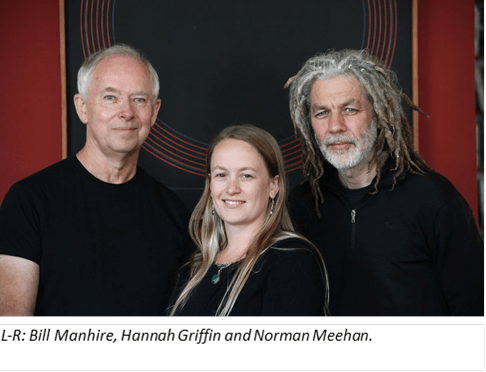
To launch the 2017 programme the IIML is presenting the first free Wellington performance of Tell Me My Name, Bill Manhire’s sequence of thirteen riddle poems set to music by composer Norman Meehan and performed by vocalist Hannah Griffin and Victoria New Zealand School of Music violinist and lecturer Martin Riseley. The concert takes place at 5.30pm, Tuesday 11 July at Meow, 9 Edward Street.
The popular lunchtime series at Te Papa Tongarewa begins on 17 July and the first three weeks feature award-winning authors from America, Australia and New Zealand.
It kicks off with Catherine Chidgey, winner of the $50,000 Acorn Fiction Prize at the 2017 Ockham New Zealand Book Awards, in conversation about her prize-winning book The Wish Child and her writing career to date.
On 24 July, 2016 Stella Prize winner Charlotte Wood, one of Australia’s “most original and provocative writers” (The Australian) appears with New Zealand novelist and convenor of the IIML Master of Arts fiction stream Emily Perkins.
On 31 July, American poet and essayist Marianne Boruch joins the IIML’s poetry and creative nonfiction convenor Chris Price to explore how her work approaches the big topics of love, death and human knowledge. Marianne Boruch’s restless curiosity ranges across science, music, medicine and art, asking questions such as “why does the self grow smaller as the poem grows enormous?”.
Director of the IIML Professor Damien Wilkins says the combination of new voices and established writers in Writers on Mondays is wonderful.
“This free series is a great way for readers and writers to get together for entertaining, informative, uplifting, even perplexing sessions of talk and performance.”
On 7 August poet and novelist Anna Smaill introduces a quartet of poets with exciting new books. Featuring work from the cutting edge of NZ poetry with Louise Wallace (Bad Things), Hannah Mettner (Fully Clothed and So Forgetful), Maria McMillan (The Ski Flier) and Airini Beautrais (Flow).
In Hopeful Animals, 14 August, Damien Wilkins, Tracey Farr and Pip Adam discuss and read from their recent novels, and consider how fiction continues to provide a vital lens on contemporary life.
Writers on Mondays will acknowledge National Poetry Day with the annual Best New Zealand Poems reading on 21 August. Best New Zealand Poems 2016 editor and Arts Foundation Laureate Jenny Bornholdt introduces this lively session featuring 13 poets at the top of their game.
On 28 August The Fuse Box gathers some of our best writers to shine a light on the creative process. Playwright Gary Henderson, novelists Rajorshi Chakraborti and Elizabeth Knox, and poet James Brown join editors Chris Price and Emily Perkins to take a look at the wiring of creative writers and celebrate the launch of this collection of essays on creativity from Victoria University Press.
Acclaimed playwright Victor Rodger, the Victoria University/Creative New Zealand Writer in Residence for 2017, has assembled a panel of writers to explore how the work of others can inspire and challenge. Mitch Tawhi Thomas, Moana Ete, Jamie McCaskill and Faith Wilson discuss the dynamics of creative communities on 4 September.
The final month of events showcases work from the current cohort of writers in the Masters in Creative Writing Programme at the IIML. It begins with fiction, poetry and creative nonfiction writers in The Next Page, 11 and 18 September, then moves to Circa Theatre for Short Sharp Script, 25 September and 2 October, where actors perform dynamic new work by participants in the Master of Arts scriptwriting workshop.
The Writers on Mondays series runs from 17 July to 2 October, 12.15–1.15pm, Te Marae, Level 4, Te Papa Tongarewa, with the exception of the opening concert at Meow and the two Short Sharp Script events at Circa Theatre. Admission is free and all are welcome.
The full 2017 Writers on Mondays programme is can be viewed and downloaded from the IIML’s website.
Writers on Mondays is presented by Victoria University’s International Institute of Modern Letters with the Museum of New Zealand Te Papa Tongarewa, and additional support from Circa Theatre and National Poetry Day.
For more information contact Pip Adam on pip.adam@vuw.ac.nz or modernletters@vuw.ac.nz.
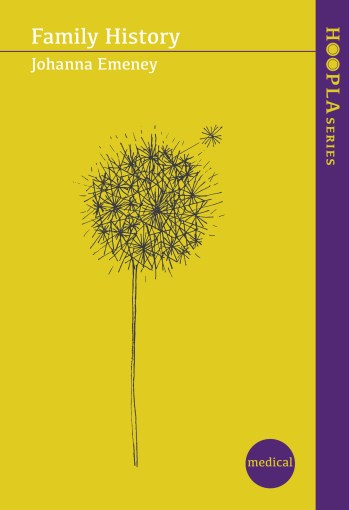
Johanna Emeney, Family History, Mākaro Press, 2017
My darling, this afternoon, I found three white parachutes
from a dandelion on my shoulder, seeds stuck in,
wings waiting – little angels of your imprint, your leaving.
from ‘Dandelion’
What you bring to a book affects the way you read it – as though already established trenches or crevices are more receptive, more alert to shared experiences. Johanna’s new poetry collection is a family history but the mother is placed centre stage; we are brought close to her breast cancer and shocked by her premature and unexpected death. The collection begins with gaps in the family photograph album and ends with blurry photos; it is as though these poems are held up to the gap, where light and dark dazzles and where edges blur. Early on a poem stalls me, as I too watch the ducklings ‘that cats dare not disturb.’ The snapshot tingles because I have never thought of ducklings this way, and it is as though I am seeing the world as something that must not be corrupted or thrown off course. The pathos lies in the way the poet is thrown off kilter; her family not ‘off limits.’
Even if one were to straggle,
to drop off the end
like a misplaced preposition,
lost for a moment in the long grass,
no cat would mess with it
because today belongs
to the ducklings
and all the other
spring things
that on some mornings
and some afternoons
are just plain off limits.
from ‘Ducklings’
You never know how you will react when faced with life-threatening illness, or when someone close to you is; you never know which details will stand out to elbow and nudge and stick. Johanna’s book traverses the sweet and the sour, the coordinates of illness, the pain, the anger and the way things can be luminous, sharp, elusive, blunted. ‘Undertaking’ is a sestina, the perfect form to catch the undulations of grief that repeat and slap an attack of feeling – a little like the book does as a whole.
Things are palpable: gateways to grief, memories, a relationship presence, a relationship absence. ‘Ham bag’ was a humorous code for handbag between mother and daughter; when the poet (I am boldly granting the first-person pronoun autobiographical status) catches sight of a calico bag, she misses her mother again:
Ready to go? Got your hambag, darling?
And I say:
Yes, Mum, all the better to put my ham in,
and we’re beside ourselves again.
from ‘Ham bag’
I am sitting in a cafe at AWF17, a table of writers next to me, conversations adrift because I am adrift on the currents of this book. The writing stitches me and I feel the needle prick and sew, prick and sew, as I read. There is a fluency of writing, a lightness of line as the shadows swell and the hurt pulses. It is not the first time writing poetry stands as a keepsake, for the sake of mother, family, friends and self. For the sake of a reader who keeps reading the same lines over.
The final poem, ‘Glass bowl with pink swirls,’ is so simple yet so sharp, I think I am going to cry, despite the writers I know laughing and conversing at the next table. This is what writing can do. It can pull you down to the very tiny gestures that mark a day, that mark a life so that everything shifts a little. You can feel those internal trenches and crevices tremble. The glass bowl holds the mother’s hand, a last image, a last desire, as she feels the warm soap suds. The glass bowl, a keepsake; and the poem.
To perceive you seeing nothing and everything
to watch the loop of your hand in its benediction
or to sit at your feet with my hot cheek tilted
to meet the roll and stroke of soft fingers,
was to be most steady and most moved
by your tender infinitive. That keepsake.
from ‘Glass bowl with pink swirls’
This book is a breathtaking startling soothing toppling skin-shaking eye-pricking heart-skipping glorious read.
Johanna Emeney lives in Auckland where she tutors at Massey University and co-facilitates the Michael King Young Writers Programme. She has been placed third and been commended in the Hippocrates Prize for Poetry and Medicine and shortlisted for the International Montreal Poetry Prize. Her debut collection was entitled, Apple & Tree (2011).
Mākaro Press page
The collection is part of the 2017 HoopLa Series that also includes Jeffrey Paparoa Holman’s Dylan Junkie and Elizabeth Morton’s Wolf.
 NZ Poetry Shelf