


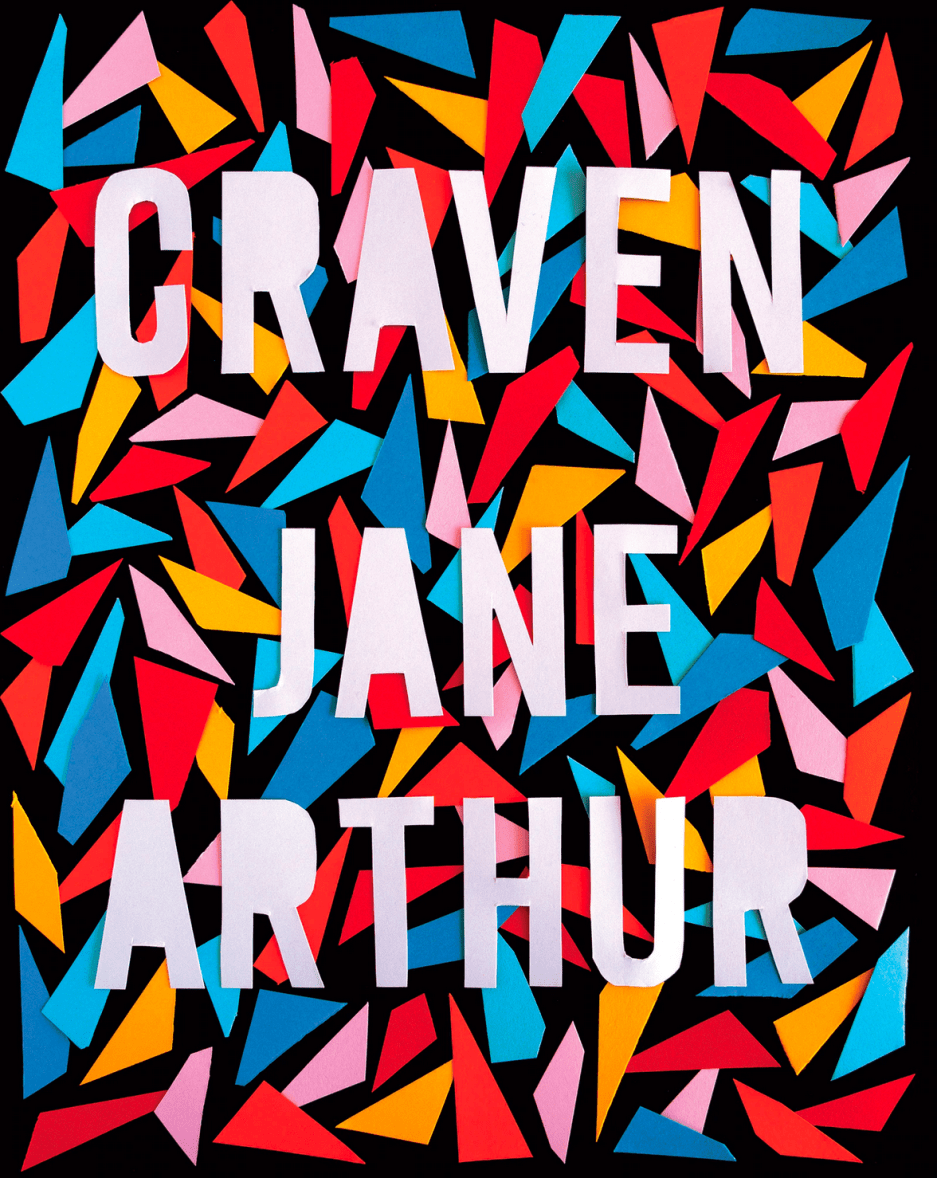
Craven, Jane Arthur, Victoria University Press, 2019
I have a broth at a simmer on the stove.
Salty water like I’ve scooped up some ocean
and am cooking it in my home. Here,
gulp it back like a whale sieving plankton.
Anything can be a weapon if you
swallow hard enough:
nail scissors, a butter knife, dental floss,
a kindergarten guillotine, hot soup,
waves, whales.
from ‘Circles of Lassitude’
Jane Arthur’s debut collection Craven inhabits moments until they shine – brilliantly, surprisingly, refractingly, bitingly. Present-tense poetry is somewhat addictive. With her free floating pronouns (I, you, we) poetry becomes a way of being, of inhabiting the moment, as you either reader or poet, from shifting points of view.
It is not surprising it has been longlisted for the Ockham New Zealand Book Awards.
The collection title references lack of courage, but it is as though Jane’s debut collection steps across a line into poetic forms of grit. This is a book of unabashed feeling; of showing the underseam, the awkward stitching, the rips and tears. Of daring to expose. The poems are always travelling and I delight in every surprising step. You move from taxidermy to piano lessons to heart checks and heart beats, but there is always a core of exposed self. And that moves me. You shift from a thing such as a plastic rose to Brad Pitt to parental quarrels. One poem speaks from the point of view of a ship’s figurehead, another from that of Constance. There is anxiety – there are dilemmas and epiphanies. The poetic movement is honeyed, fluid, divinely crafted – no matter where the subject travels, no matter the anxious veins, the tough knots.
An early poem, ‘Idiots’, is like an ode to life, to ways of being. I keep crossing between the title and the poem, the spare arrival of words punctuated by ample white space, elongated silent beats that fill with the links between brokenness, strength and pressing on.
Idiots
I’ve known people who decided
to carry their brokenness like strength
idiots
I’m a tree
I mean I’m tall, I sway
I don’t say, treat me gently
No¾I say, cool cool cool cool
I say, that really sucks but I guess I’ll survive it
or, that wind’s really strong
but so are my roots, so are my thighs
my branches my lungs my leaves my capacity to wait things out
I can get up in the morning
I do things
I heard Jane read for the first time at the Sarah Broom Poetry Prize session at the Auckland Writers Festival in 2018. Her reading blew my socks off, just as her poems had delighted American judge, Eileen Myles, and it was with great pleasure I announced her as the winner. Eileen described Jane’s poetry: ‘poetry’s a connection to everything which I felt in all these [shortlisted] poets but in this final winning one the most. There’s an unperturbed confident “real” here.’ In her report, Eileen wrote:
The poet shocked me. I was thrust into their work right away and it evoked the very situation of the poem and the cold suddenness of the clinical encounter, the matter of fact weirdness of being female though so many in the world are us. And still we are a ‘peculiarity’ here and this poet manages to instantly say that in poetry. They more than caught me. I like exactly how they do this – shifting from body to macro, celestial, clinical, and maybe even speaking a little out of an official history. She seems to me a poet of scale and embodiment. Her moves are clean and well-choreographed & delivers each poem’s end & abruptly and deeply I think. There’s a from the hip authority that inhabits each and all of these poems.
I am revisiting these words in view of Craven’s multiple poetry thrills. So often we talk about the way a poem steps off from the ordinary and blasts your heart and senses, if not your mind, with such a gust of freshness everything becomes out of the ordinary. This is what happens with Craven. A sense of verve and outspokenness is both intoxicating and necessary:
I’m entertaining the idea of never being silent again,
of walking into a room and shouting, You Fuckers Better Toe the Line
like a prophylactic.
from ‘Sit Down’
A sense of brittleness, vulnerability and self-testing is equally present:
I’ve been preoccupied with what others think again.
I’ve been trying not to let people down.
Nights are not long enough.
Lately there’s been more sun than I would’ve expected.
I keep the weather report open in its own tab and check it often.
From ‘Situation’
The movement between edge and smooth sailing, between light and dark, puzzle and resolution, and all shades within any dichotomy you might spot – enhances the reading experience. This is a book to treasure – its complexities and its economies, its confession and its reserve. It never fails to surprise. I am so excited she will be reading at my Poetry Shelf Live session at Wellington’s Writers Festival in March (see below). Triple yeah!
Jane Arthur was the recipient of the Sarah Broom Poetry Prize (2018). She has worked in the book industry as a bookseller and a book editor for over fifteen years. She has a master of Arts in Creative Writing from IIML at Victoria University of wellington. She was co-founder of the The Sapling, an online site for children’s literature. She lives in Wellington.
Jane will be appearing in my Poetry Shelf Live session at NZ Festival of the Arts,
Michael Fowler Centre, Sunday 8 March 2020 12:30pm – 1:30pm
Victoria University Press page
Poetry Shelf Monday poem: ‘Situation’ by Jane Arthur
Poetry Shelf audio spot: Jane Arthur reads ‘Snowglobe’
Poetry Shelf: Conversation with Sarah Broom Prize finalist, Jane Arthur
daughters depart
they are in the waves
beating for shore
as the little fish of their absence
swims in the fissures of my long grown bones
currents take hold
until
from sentiment
i fall to sediment
where the fumerole heat
escapes
in deep
dark
down
hair
a fontanelle
tells the stalker of memory
the necessity of tenderness
Janet Charman
Janet Charman’s monograph ‘SMOKING! The Homoerotic Subtext of Man Alone’ is available as a free download at Genrebooks. Her essay ‘Mary Mary Quite Contrary’ on Allen Curnow’s suppression of the poetics of Mary Stanley, appears in the current issue on-line of Pae Akoranga Wāhine, the journal of the Women’s Studies Association of NZ.
Ben Fagan is a performance poet and director of Motif Poetry.
He has a video just released in collaboration with the NZ Youth Choir. It’s the seventh video in his series Pākehā 2020, which is wrapping up this month.
‘To stiffen the sinews, to summon the blood’: Ka Mate Ka Ora: A New Zealand Journal of Poetry and Poetics
Ka Mate Ka Ora: A New Zealand Journal of Poetry and Poetics will be 15 years old in 2020. The latest issue contains a memoir of the last years of Baxter’s life, an essay about Mary Stanley’s poetry, an essay about David Merritt’s poetry and production systems, an essay about David Kaarena-Holmes’ poetry, and a reflection on the fictive lives of poets. But no poems. And no reviews of recent books of poetry. That’s what it’s like at Ka Mate Ka Ora. We don’t publish poems and we don’t run short reviews (though longer review-articles are definitely part of our kaupapa).
Ka Mate Ka Ora was designed to fill a gap – the lack of in-depth discourse about poetry and poetics within Aotearoa’s literary community. I guess you can say we are a specialist magazine, a niche product for an informed market. But this ‘informed market’ has many links to international poetries and poetics, which is where the electronic format is crucial. And this means KMKO is more than ‘just’ an academic journal. (I know that ‘just’ is not ‘just’!). If you haven’t seen the magazine before and want a look, or if you want to go back and revisit this or that issue, click here.
Throughout Ka Mate Ka Ora’s existence, we have sustained a policy of looking outward to what is going on elsewhere via reports from local roving reporters: Pam Brown on Australian poetry (issue #1), Anne Kennedy on Hawai’i poetry (#3), Anna Smaill on poetry in London (#5), Murray Edmond in China (#5), Lisa Samuels in Spain (#12) and Erena Shingade from Mumbai (#16).
The magazine is open access on-line. Its inception dates back to a time when the internet was more innocent and idealistic. We are still holding out for this ideal.
But times pass and worms turn and poets die. Over its 15 years obituaries have also become a regular feature: we have said haere ra to Dennis List, Mahmoud Darwish, Jacquie Sturm, Leigh Davis, Martyn Sanderson, Trevor Reeves. Rowley Habib (Rore Hapipi), Russell Haley, Heather McPherson, Gordon Challis and John Dickson. This list is interesting because each of these names occupied a crucial niche situation in New Zealand poetry at various times; yet none would quite qualify for that brief eternity of media attention that is shone in this age of reincarnated celebrity on certain kinds of literary names at their passing. I like to think that Ka Mate Ka Ora’s attention to such figures as those listed above will provide a valuable doorway through from the future to the past.
The majority of issues of Ka Mate Ka Ora have been composed from the careful editorial selection, aided by outside readers, of unsolicited contributions. But there have been at least four ‘special’ issues. Hone Tuwhare’s death warranted an issue-sized response, and Robert Sullivan took over the editorship for this (#6). Then there have been issues about ‘Words and Pictures’ (#7), James K.Baxter (#8) and Translation (#11).
Special issues tend to bring in a swathe of special contributors, whereas an issue that consists of four or five substantial essays errs in favour of depth rather than spread. More than 100 different writers have contributed to KMKO over the past 15 years. Contributors range from those who are poets themselves to academics, to Masters and Doctoral students who are often both poets and scholars, plus photographers, illustrators, archivists, printers, designers, songwriters et al.
The contents of KMKO have become cumulative, as the editorial in the latest issue highlights in relation to the catalogue of contributions about James Baxter:
John Newton, ‘”By Writing and Example”: The Baxter Effect,’ No.1, Dec. 2005.
Paul Millar, ‘Return to Exile: James K. Baxter’s Indian Poems’ plus the unpublished Indian poems, No. 3. March 2007.
Dougal McNeill, ‘Baxter’s Burns,’ No. 8, Sept. 2009.
Jeffrey Paparoa Holman, ‘”Reason not the Need”: John Newton and James K. Baxter’s Double Rainbow,’ No. 8, Sept. 2009.
Francis McWhannell, ‘Hunt’s Baxter,’ No. 8, Sept. 2009.
Reproduction of Baxter’s ms. Of ‘Jerusalem in Winter,’ No. 8. Sept. 2009.
John Petit’s photographs of Baxter at Hiruharama, Dec. 1970, No. 8, 2009.
Stephen Innes,’ The Baxter Papers at the University of Auckland Library,’ No. 8, 2009.
Paul Millar and Miranda Wilson, ‘”The Fire-bird Singing Loud”: James K. Baxter’s Relationship with Composer Dorothy Freed,’ No 15, July, 2017.
Keir Volkerling, ‘James K. Baxter – an Evolving Memoir,’ No.17, Oct 2019.
Threading one’s way through these disparate works of criticism and literary historiography, it is possible to trace the developing case study of Baxter criticism as it has taken shape in the 21st century up to (and with Keir Volkerling’s piece, even beyond) the recent controversy of Baxter’s ‘me/too moment’ with the publication of the Letters in 2019.
Ka Mate Ka Ora is named after the first line of what can be labeled Aotearoa’s most well-known and, at times, most controversial poem. The crass, commercial and appropriative imitations of the haka form that now get mounted world-wide with depressing regularity, do not touch upon Te Rauparaha’s words. The words of haka have always been of the most charged and sensitive kind. Robert Sullivan, in his editorial in issue #1 quotes Timoti Karetu with regard to this kind of kind of short, intense haka, he ngeri, to the effect that such a form is designed ‘to stiffen the sinews, to summon up the blood’: life or death?
I have been the editor of Ka Mate Ka Ora from the first issue until now. I have been greatly assisted in this role by Hilary Chung, Michele Leggott and Lisa Samuels. We are planning a new issue for 2020, #18, so if you wish to send a contribution, first spend a little time looking through some issues, then read about us by clicking on the red ‘about’ at the bottom right of the magazine’s home page, and email to Murray Edmond at m.edmond@auckland.ac.nz. All contributions are sent out for at least one reader’s report.
Murray Edmond
Murray Edmond’s recent books include Back Before You Know (2019) and Shaggy Magpie Songs (2015), two poetry volumes; Then It Was Now Again: Selected Critical Writing (2014); and Strait Men and Other Tales, (2015), fictions. He is the editor of Ka Mate Ka Ora: A New Zealand Journal of Poetry and Poetics (http://www.nzepc.auckland.ac.nz/kmko/ ); and works as a dramaturge (Jacob Rajan and Justin Lewis’s Mrs Krishnan’s Party (2017) and Welcome to the Murder House (2018) and Naomi Bartley’s Te Waka Huia, 2017/ 2018). Also directed Len Lye: the Opera (2012).
Back Before You Know (Compound Press, 2019) has been longlisted for the Ockham NZ Book Awards.
HAPŪ WĀNANGA
for Tawera & Sharron
From Parihaka you can see it maybe hope is a kind of haunting
the shape of women learning maybe it is a dazzling thing
how to startle the red earth the whenua like the threads of a kaitaka
that will be buried but not left behind that have been woven
how to labour in the present with something I can only describe
tense with the weight of a future as breath
and the sound of tupuna knocking the wind has an ache in it
the marae fills with the first language it sounds like a river
I recognise but do not understand whose blue end is coming
but the kuia teaches me how to harvest moonlight where the world begins
pulling the threads from harakeke is this enough to remedy the past
draped over her lap like a question the world doesn’t stop to answer
I roll the silver between my fingers rain rolls off the mountain
the strands fray into more questions but they say you don’t need an atlas
made up of tinier pieces of doubt the size of the universe
she takes them and rests them on her calf to make sense of this
handrolls the fear into a muka of light approaching moment
Maria Yeonhee Ji
This piece by Maria has everything I seek to admire in a poem. First of all, its structure is entirely emblematic and relevant. It does something different without being gimmicky and gratuitous. For me, the white space is possibility. It is an invitation to hope. It is a suggestion that I may read the poem two ways. Most importantly, it is a birth canal of sorts for “the approaching moment” upon which the poem ends—but does not end.
“Hapū Wānanga” has an easy unity of theme and imagery. Indeed, one of its themes, the solidarity of women—sensed especially in this place of ancestors—is highlighted by the motif of weaving. There is a blended spirituality and corporeality to this poem which hinges on Maria’s ability to make magic from the concrete to “harvest moonlight” like the kuia who shows the speaker part of this new world.
This poem is also special because it signifies Maria’s last year publishing work in Signals, the journal of the Young Writers Programme. Ros Ali, my colleague at the YWP, taught Maria at St Cuthbert’s College, and Ros and I have both enjoyed Maria’s company at many workshops and master classes over the years. This is a beautiful valedictory poem as Maria goes off into the world of medicine (and the world of more writing, of course). Ros and I wish her every success.
Johanna Emeney
Johanna Emeney is a senior tutor in Creative Writing at Massey University, where she has worked since 2011. She also leads community writing projects with migrant young people and older adults with her friend, Ros Ali. They have worked together on the Michael King Young Writers Programme since 2009. Jo has published two collections of poetry (Apple & Tree, Cape Catley, 2011, and Family History, Mākaro Press, 2017), as well as an academic book called The Rise of Autobiographical Medical Poetry and the Medical Humanities (ibidem Press 2018). Her latest publication is a chapter on poetry for the Routledge Companion to Literature and Disability (2020).
Maria Yeonhee Ji is a writer and junior doctor based in Tāmaki Makaurau. She holds an MBChB and a BMedSci (Hons) from the University of Auckland, and dreams of adding a Masters in Creative Writing to this list someday. Her writing has appeared in several publications, including The Pantograph Punch, takahē, Signals, and Starling.
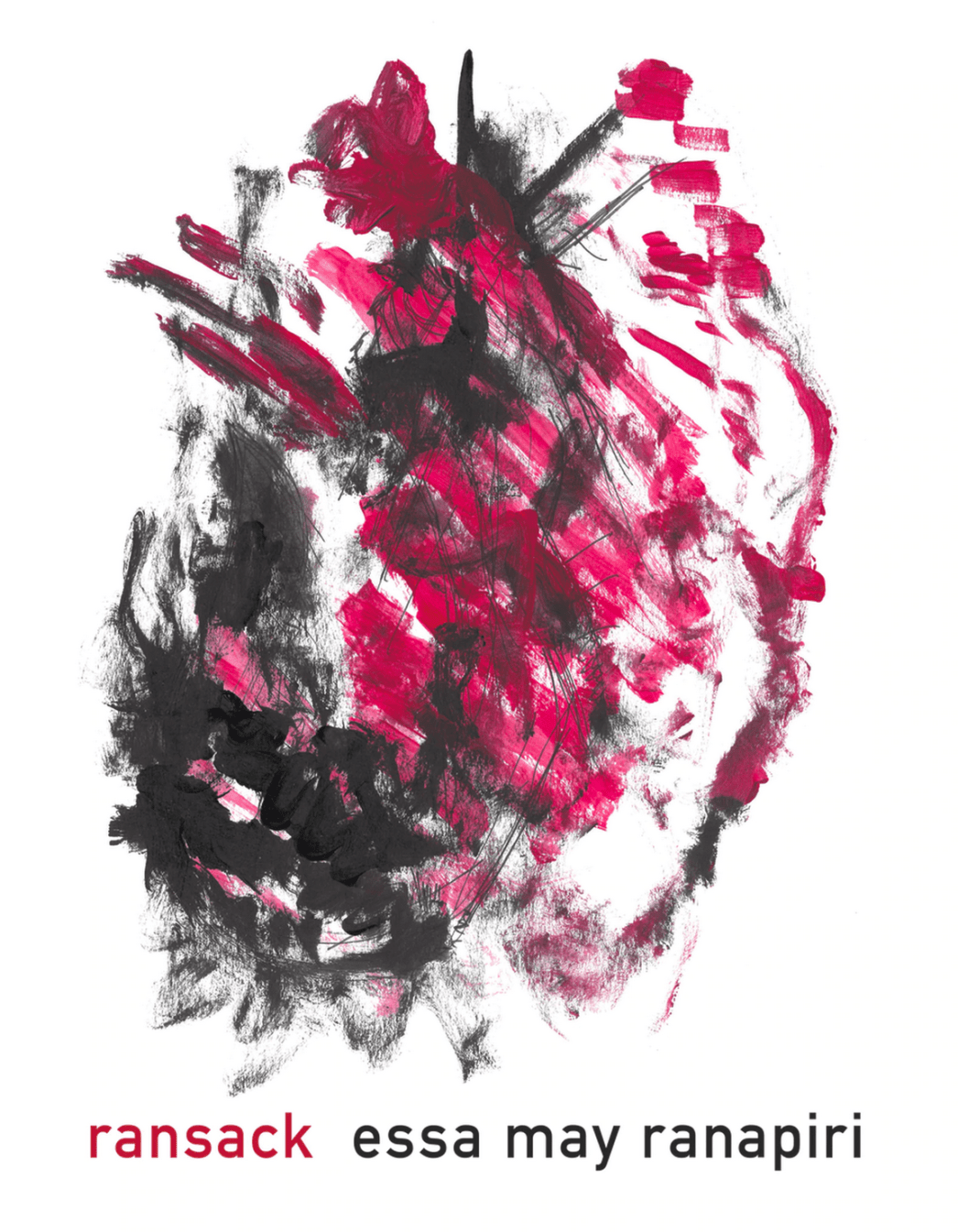
ransack, essa may ranapiri, Victoria University, 2019
‘he is like a bumblebee stinger on my tongue when I say it’
from ‘Dear Orlando’
essa may ranapiri begins their debut poetry collection ransack with a quote from Virginia Woolf’s gender-switching Orlando: ‘Ransack the language as he might, words failed him. He wanted another landscape, and another tongue.’
When I was doing my doctoral thesis (Italian) I carried a Virginia Woolf quote from A Room of One’s Own with me and I still do: ‘Mary is tampering with the expected sequence. First she broke the sentence; now she has broken the sequence. Very well, she has every right to do both these things if she does them not for the sake of breaking, but for the sake of creating.’
Sometimes we need to break language, to smash how we do things in order to begin again, in order to find form and fluidity for our voices. Sometime language fails us. Sometimes we have to smash muteness and test our way into a new musicality, a new sequence of connections. We may be fierce and we may be vulnerable.
I dipped in and out of ransack last year, and loved every snatched moment, but a few weekends ago I sat down in the cool shade and read the book slowly, cover to cover, and felt myself upturn, overturn, inturn and sideturn as the poetry pulsed through my being (I am thinking of that as a verb). This is what a book can do.
essa’s book is a glorious sequence of creating – of ransacking what has been, in order to refresh what will be. Letters written to Orlando make an appearance – like a epistle spine for the collection or a poetry pivot for both reader and writer.
The opening poem ‘my tongue as rope’ lays down a thicket image – the kind of image that hooks you, especially when you think of writing, speaking and even self as braid. The braided rope is the anchor, the preserver, the tough knot, ‘the single knot’, the finder.
essa writes: to pull in sound / draw in lists / the endeavour hits the land’. Can the poems be a form of rope? ‘my tongue-rope wraps itself until it is a single knot.’
A single poem breaks apart in my mouth and heart. The break in the flow creates a new current.
fetal
a mothe
r returnin
g to the grown ground like a gow
n of weeds got a stretching motion
n to stil
l body corps
e the wood in the wax in the flowe
r chains a bab
y stil
l bor
n rattling i
n the mutton skie
s chubby in the loa
m to no mor
e
Reading ransack allows me to absorb the nonbinary experience afresh. Unsettling the line on the page unsettles the line of thought, the entrenched dichotomies of either / or / male / female / she / he / soft / hard / weak / strong
A long poem ‘Con-ception’ is dedicated to essa’s mother and is a reading explosion of arrival, pregnancy, forming embryo, forming mother. I have never read a piece that breaks into and out of the maternal that has affected me so much. I am going to give you a quote that is also right-hand margin justified, but not all the book is (the forms are dancing on their toes in an exuberant display of variousness:
in the world and into the world of tubes
ride the machine
incubate in plastic
and drench in yellow light
the air is whole new in-the-world
and out of the old world
recognise voices
am i
an i?
put in
alove?
When she finally has a shower afterwards she is crying.
Reading the ransack sequences and I am feeling poetry. essa tells Orlando ‘You never had to discover yourself in a book. You never questioned your gendered nature – you moved from one perfect set of genitalia to another according to Aristophanes and the great round people of concave and convex, of female and male.’
essa places body and experience at its white hot core – a gift in its sharpness, its broken cutting lines and its sweet fluencies as the writer navigates how to be, how to be body, how to be bodymindheart in the world. Part of the writing of experience, with that backstory sting of ‘he’, is claiming name, celebrating a pronoun:
u said you liked the ‘th’ sound in they and them the softening of it
and how it fitted around my rage
made it/for it
to be okay to touch
i talk you through other constructions
ones that subverted phonetics
me as a slice of not that
when expecting this
the xe sound like zay
from ‘a phone call about the nature of pronouns gendered and otherwise’
ransack is a skin-prickling, heart-blasting, mind-opening glorious feast of a book that in the spirit of Virginia breaks up language in order to create something breathtakingly new.
essa may ranapiri, Ngāti Raukawa, is a poet from Kirikiriroa, Aotearoa. They graduated with an MA in Creative Writing from Victoria University of Wellington (2018) and their work has appeared in many local journals. They are the featured poet in Poetry Yearbook 2020 (Massey University Press). ransack has been longlisted for the Ockham NZ Book Awards 2020.
essa may ranapiri website
Victoria University Press page
The Pantograph Punch Jackson Nieuwland reviews ransack
RNZ interview
Poetry Shelf: essa reads ‘Glass Breaking’
essa on being at IIML with Tayi Tibble
‘Kotahi ano te kōhao o te ngira
E kuhuna ai te miro ma te miro whero me te miro pango ‘
– Pōtatau Te Wherowhero
]There is but one eye of the needle,
Through which the white, red and black threads must pass.]
ko Aotearoa te ingoa o tēnei whenua ātaahua.
land of the long white cloud for many
nestling in a sea of verdant green,
surrounded by a brilliant blue ocean
& where the All Blacks often reign.
yet of course New Zealand
is also the name of these islands
some say that maybe –
with our increasingly multi-cultural crew
Pākehā, Māori, Asian, Pasifika –
it is time for a new name,
stressing our interconnections?
after all, we are rowing together
in this waka nowadays
heading in the right direction –
learning how we can all work closely
to include, as well as to respect, all our
sometimes confusing cultural credos
and to kōrero together in spite of them
in a continuous talanoa.
ni hao
talofa lava
tēnā koe
malo e lelei
different, yes and yet, respecting this diversity,
this contrasting, this sometime conflicting mix,
where Te Tiriti o Waitangi is the foundation document,
where journalism has flourished for well over 150 years
with upfront news & freedom of views
in the two key tongues, te reo Māori rāua ko te reo Ingarihi,
& Hindi is now the fourth most spoken language – namaste!
together we can connect and thrive.
āe ko Aotearoa te ingoa
throughout both North and South
we are birds singing several different waiata
tui, takahē, kōkako, kiwi
striving to make one mighty nest;
our own place for all –
one of a kind, the very rare huia,
a heaven on earth.
pristine air; clean water; prime food,
scenic vistas second to none,
what else could anyone want?
āe, ko Aotearoa te ingoa
let’s be thankful about who we are
& what we have –
the sense of fair play
the spirit of helping those in need,
sharing & supporting
including one and all.
thank you my friends
kia ora taku hoa
fa’afetai outou o a’u uo
xie xie wo peng-youmen
salamat po mga kaibigan
shukraan lakum ‘asdiqayiy
there is so much to celebrate
in this lengthy land,
tō mātou whenua tino waimarie
& we should all be proud.
Vaughan Rapatahana
from ngā whakamatuatanga / interludes (cyberwit, 2019)
A poet, novelist, teacher, critic, translator and editor, Vaughan Rapatahana, Te Ātiawa, commutes between homes in Hong Kong, Philippines and Aotearoa New Zealand. He is widely published across several genres, in multiple countries, in both his main languages, te reo Māori and English, and his work has been translated into Bahasa Melayu (Malay), Italian, French, Mandarin.
In 2019, he published five books, participated in World Poetry Recital Night, Kuala Lumpur and Poetry International at London’s South Bank Centre and in the launch of Poems from the Edge of Extinction and in Incendiary Art: the power of disruptive poetry. His poem tahi kupu anake included in the presentation by Tove Skutnabb-Kangas to the United Nations Forum on Minority Issues in Geneva in November 2019. His PhD thesis from the University of Auckland is on Colin Wilson and subsequently published a collected works about Wilson, More than the Existentialist Outsider (Paupers Press, Nottingham, UK, 2019.)
His latest poetry collection ngā whakamatuatanga/interludes was published by Cyberwit, Allahabad, 2019) and Aotearoa New Zealand. Atonement (University of Santo Tomas Press, Manila) was nominated for a National Book Award in Philippines (2016). He writes a series of commentaries pertaining to Aotearoa New Zealand poetry for Jacket 2 (University of Pennsylvania, USA): a 2015–2016 series and again during 2018-2019.
His poetry teaching resources have been published in Hong Kong SAR, Brunei Darussalam, Australia, and New Zealand, including the first bilingual (Māori and English) such resource in 2011, Teaching Poetry. In 2019, book three of the series Poetry in Multicultural Oceania has been published by Essential Resources, Christchurch, New Zealand – with a new resource Exploring Multicultural Poetry for younger students due at the end of 2019.
Rapatahana will be participating in The Foundation and Cultural Organization International Academy Orient-Occident. Curtea de Argeş, Romania in July 2020.
Rapatahana is one of the few World authors who consistently writes in and is published in te reo Māori – in all of his books and also poetry publications in Aotearoa NZ (for example, Mayhem, Poetry New Zealand, takahē), USA (Antipodes), Canada (The Capilano Review), Australia (Meniscus), U.K. and so on. It is his mission to continue to do so and to push for a far wider recognition of the need to write and to be published in this tongue.
His New Zealand Book Council Writers File

our place, January 2020
In 2020 Poetry Shelf will host a monthly, theme-based festival of poems.
First up: trees. I chose trees because I live in a clearing in the midst of protected regenerating bush. It is a place of beauty and calm, no matter the wild West Coast weather. We look out onto the tail end of the Waitātakere Ranges knowing we work together as guardians of this land.
I chose trees because like so many other people the need to care for trees is strong – to see the fire-ravaged scenes in Australia is heartbreaking.
I love coming across trees in poems – I love the way they put down roots and anchor a poem in anecdote, life pulse, secrets, the sensual feast of bush and forests, political layers.
I could plot my life through the books I have read and loved, but I could also plot my life through my attachment to trees.
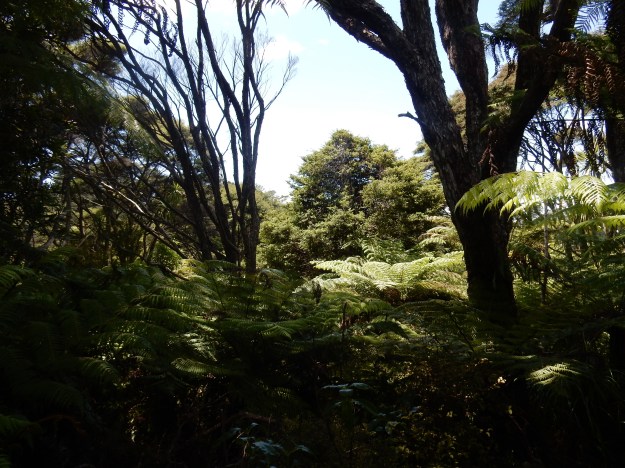
Let me Put in a Word for Trees
Let me put in a word for breathing.
Let me put in a word for trees.
Let me put in a word for breathing.
Dinah Hawken
from Water, Leaves, Stones (Victoria University Press, 1995)
After a long hard decade, Miranda asks for a poem about feijoas
Small hard green breasts budding on a young tree
that doesn’t want them, can’t think how to dance
if it has to put up with these;
yet over summer the fruits swell and plump:
frog barrel bodies without the jump or croak
limes in thick velvet opera coats
love grenades to throw like flirt bombs
for your crush to catch and softly clutch
before they release their sweet seductions
and when the congregation and the choir
in the Tongan church next door exalt in hymns
while their brass band soars and sforzandos in,
a fresh feijoa crop tumbles to the grass
as if the tree’s just flung down its bugle mutes
in a mid-life, high-kick, survival hallelujah.
Emma Neale
Heavy lifting
Once, I climbed a tree
too tall for climbing
and threw my voice out
into the world. I screamed.
I hollered. I snapped
innocent branches. I took the view
as a vivid but painful truth gifted
to me, but did not think to lay down
my own sight in recompense.
All I wanted was someone to say
they could hear me, but the tree said
that in order to be heard I must
first let silence do the heavy lifting
and clear my mind of any
questions and anxieties
such as contemplating whether
I am the favourite son. If I am not,
I am open to being a favourite uncle
or an ex-lover whose hands still cover
the former half’s eyes. I’ll probably never
have children of my own to disappoint
so I’ll settle for being famous instead
with my mouth forced open on TV like
a Venus fly-trap lip-synching for its life.
The first and the last of everything
are always connected by
the dotted line of choice.
If there is an order to such things,
then surely I should resist it.
Chris Tse
from He’s so MASC (Auckland University Press, 2018)
Reverse Ovid
Woman running across a field
with a baby in her arms . . .
She was once the last pine tree on Mars.
Bill Manhire
My mother as a tree
I like to think my mother may have been a tree
like Fred’s, the oak whose Elizabethan
damask skirts each year spring-clean
the hillside opposite, in front of the house
where Fred was born. Her royal foliage
clothes a peasant’s weathered fingers,
the same unfussed embrace.
Fred never sees her now,
he’s in a rest-home up the coast
and doesn’t get out much
and so, in lieu, she fosters me
from unconditional dawn
to dusk and through the night,
her feet in earth, her head
in air, water in the veins, and what
transpires between us is the breath
of life. In the morning birds
fly out of her hair, in the evening
they are her singing brain
that sings to me. My mother as a tree:
my house, my spouse, my dress
and nakedness, my birth, my death,
before and afterwards. I like
to think my tears may be her
watershed, not just for me.
Chris Price
from Beside Herself (Auckland University Press, 2016)
Objects 4
It’s the close of another year.
Stunned, I walk through the Gardens
feel them draw the numbness out of me.
This is another ‘I do this, I do that’ poem
I learnt in New York from O’Hara.
This is a New York poem set in a garden
styled in colonial civics on an island
that is not Manhattan.
I hurry to the hydrangea garden,
their shaded, moon-coloured faces
so much like my own. As a child I was posed
next to hydrangeas because the ones
next to an unremembered house
were particularly blue—
to match my eyes, presumably.
There are no hydrangeas in New York City.
I rush past the Australia garden but I stop
dead at the old aloes, their heavy leaves
so whale-like, gently swaying flukes
thick and fleshy, closing up the sky.
Some kids have carved their
initials and hearts in the smooth rind,
a hundred years against this forgotten afternoon.
I bend to the ground and sit as if to guard them
in the darkening sun.
The spread of rot constellates out of the kids’ marks
as if to say
look at the consequences,
look at me dying.
Nikki-Lee Birdsey
from Night As Day (Victoria University Press, 2019)
I Buried the Blood and Planted a Tree
Love is the thing that comes
when we suck on a teat and are fed.
Love is the food we can eat.
The food we can’t eat we give
to the ground
to the next day.
We pat the earth
like it is our own abdomen.
If I could have drunk a hot enough tea
to boil it out
I might have.
If I could have stood
on a big red button
and jumped once
to tell it to exit
like the highest note on the piano.
It was a sound I couldn’t feed.
I gave it to tomorrow.
I buried the blood and planted a tree
so she, unable to be fed, could feed.
Maeve Hughes
The sepia sky is not one for forgetting. Even fragmented, looking up at it from beneath a canopy. The flash of light through leaves more twitch than twinkle. Therapists and yoga teachers say It’s important to let yourself to be held by mother earth, to let yourself be. I used to feel relief in the arms of a tree, but now I feel unease. Is it my own chest trembling or the trees? Oxygen spinning from the leaves, boughs holding birds who were once such a chorus they almost drove Cook’s crew back to sea. Invisible roots bearing the weight of me, through the deep dark, where trees talk in voices I am too brief to hear.
Simone Kaho
Trees
Place is bottled lightning in a shop,
or in a chandelier’s glass tear-drop,
or in a glow-worm’s low watt grot,
or in street neon’s glottal stop —
wow-eh? wow-eh? wow-eh?
Place is the moulded face of a hill,
or lichen like beard on a window sill,
or the bare spaces that shadows fill,
or ancestors growing old and ill,
or descendants at the reading of a will,
who frown and examine their fingernails
before plunging off down the paper trails
of diary and letter and overdue bill.
Place is the home of family trees —
family trees to wrap round plots of soil,
tree roots to shrivel into umbilical cords,
tree branches to spill bones and skulls;
but even trees are just a spidery scrawl
against the shelf-life of a mountain wall.
Place is a brood perched on power-poles:
bellbirds with shadows of gargoyles,
korimako who clutch the power of one,
like an egg, to trill their familiar song.
Place is grandsons who sprawl
in the family tree with laughter;
place is the tree windfall,
gathered up in the lap of a daughter.
David Eggleton
from Rhyming Planet (Steele Roberts, 2001)
13
Te Mahuta Ngahere
the father of the forest
a livid monster among saplings.
A swollen aneurism grips his bole.
Below bearded epiphytes
a suppurating canker swarms with wasps.
Derisively lyrical
the tuis in his crazy, dreadlocked crown
pretend to be bulldozers.
Ian Wedde
from ‘Letter to Peter McLeavey – after Basho’, from Three Regrets and a Hymn to Beauty (Auckland University Press, 2005)
Last night I sat outside and looked at the moon. Up there, like it has been since the dawn of time.
Same one the cavemen looked at.
Sickle phase.
I know, scientifically, about the forces that hold it in place.
And suddenly I felt I knew too much.
The grass had been cut, while flowering.
The flowers were still there, they’d either sunk below the blades or reflowered.
I noticed grass flowers look like kowhai post-flowering. When the stamens hang long and white after the flower has fallen away.
The night was still. Cones on the street let me know men would come the next day in matching orange tunics and I should not park there.
The moon was still there.
The stillness and the quiet was misleading.
Everything had a perfect and terrible design that didn’t need me to know it.
I know the trees above the mangroves are called macrocarpas, some bird calls sweetly from the macrocarpa as the sun sets every evening. Orange, purple and pink from the verandah of my flat.
I don’t ever want to know that bird’s name.
Simone Kaho
Song from the fallen tree which served as a twelve year old’s altar to the wild gods
i am a hundred years more girleen since before you were a seed
i fell to mouldering in this darkleaf cathedral where you come
to bury the bones of brief chittering things and burn candles
in roothollows ah you young girleen life all aflickering past short
roots unplanted
i am all your church and ever the altar at which you girleen kneel
i all goldenarched around by sunbeam and sapling green
with my many rings i share with you rootlessness and in winter
you brush away my cloak of snow humming your warmblood
girleen beatsong to soften my ache of frost
while you ask knowing of what time is to the forest and you sing
up your low girleen voice to the horned and feathered kind which
do not walk the rustling hymn of season same as we all
then twice up here you come bringing anothergirl girleen
you open your arms to the sky saying this is your heart and
home yes this the forest that sings you by name and girleen
it is true we the trees know you but you never learned from us
the songs called shyness and slowly and the next time girleen you
bring your brighthaired friend you kiss her in the pricklebelly
shadow of the holly
where i feel you like a seed unhusked shiversway as she
branchsnap slams whipslap runs so when again you dewyoung
girleen come to me you come alone
ungrowing girleen and withering back your shoots as you
bitterbrittle freeze your sapling blood into something thinner
than lancewood leaf
which cracks you through to the heartwood solvent veinsap
dizzily diluting girleen you can barely make your mountainwalk
up to me
until for two snowmelts you do not return but even once your
starved arterial taproot has begun sucking in again greedy sunlight
and sugar to colour your suppling girleen bark back alive
you have disremembered every prayersong taught you by we the
trees and i rot in the forest you called your heart and girleen
you do not visit
Rebecca Hawkes
The Gum-Tree
Sitting on the warm steps with you
our legs and backs supported by timber
looking down to the still trunk of the gum-tree
we are neither inside ourselves
as in the dark wing of a house
nor outside ourselves, like sentries
at the iron gates – we are living
on the entire contour of our skins,
on the threshold, willing to settle
or leap into anywhere.
Here’s to this tree we are standing in.
Here’s to its blue-green shelter,
its soft bark,
the handy horizontal branch
we have our feet on
and the one supporting our shoulders.
Dinah Hawken
from Water, Leaves, Stones (Victoria University Press, 1995)
Nikki-Lee Birdsey was born in Piha. She holds an MFA from the University of Iowa Writers’ Workshop and a BA from New York University. She has been published widely in the US, UK, Canada, and New Zealand, and she is currently a PhD candidate at the International Institute of Modern Letters. Her first book Night as Day was published by VUP in 2019.
David Eggleton’s most recent poetry publication, Edgeland and other poems, was published by Otago University Press in 2018. He is the New Zealand Poet Laureate 2019 – 2021.
Dinah Hawken was born in Hawera in 1943 and now lives in Paekakariki. Her eighth collection of poetry, There is no harbour, was published by Victoria University Press in 2019.
Rebecca Hawkes is an erstwhile painter-poet and accidental corporate-ladder-ascender. Her chapbook Softcore coldsores was launched in AUP New Poets 5 in 2019 and she performs with the poetry troupe Show Ponies. She wrote this tree poem in her previous occupation as a teen and hopes it will survive repotting after all these years.
Maeve Hughes lives in a tall house in Wellington. She has studied Fine Arts and Creative Writing. Her first publication Horsepower won the 2018 Story Inc Prize for poetry and was launched in October last year.
Simone Kaho is a New Zealand / Tongan poet and a graduate of the International Institute of Modern Letters. She published her debut poetry collection, Lucky Punch, in 2016. Simone is noted for her poetry performance and writes for E-Tangata.co.nz.
Bill Manhire’s new book of poems will be published later this year. It might well be called Wow because he is so surprised by it.
Emma Neale is the author of 6 novels and 6 collections of poetry. She is the current editor of Landfall.
Chris Price is the author of three books of poetry and the hybrid ‘biographical dictionary’ Brief Lives. She convenes the poetry and creative nonfiction MA workshop at the International Institute of Modern Letters in Wellington. In May 2019 she and her guitarist partner Robbie Duncan will be among the guests at Featherston Booktown.
Chris Tse is the author of How to be Dead in a Year of Snakes and HE’S SO MASC. He is a regular contributor to Capital Magazine’s Re-Verse column and a book reviewer on Radio New Zealand. Chris is currently co-editing an anthology of LGBTQIA+ Aotearoa New Zealand writers.
Ian Wedde’s Selected Poems were published in 2017 – Te Mahuta Ngahere can be found there and we hope will survive in the bush. Wedde’s historical novel, The Reed Warbler, will be published by Victoria University Press in May, and a collection of essays 2014-2019 is in development.
 NZ Poetry Shelf